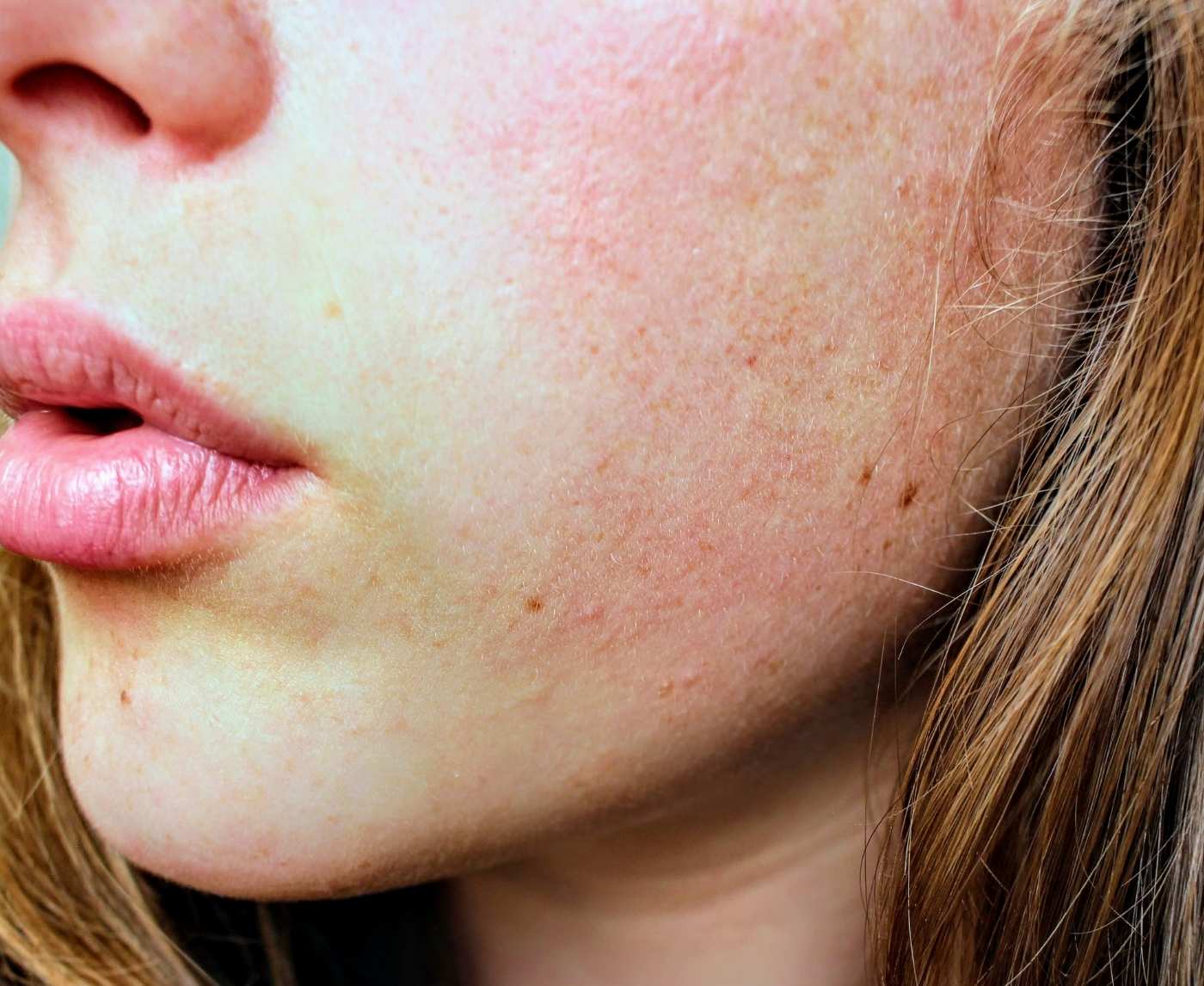

Published: July 2025 | Last updated: April 2026 | Editorial review and quality control: Martina N.
Most bumps near the genitals are not herpes. They are not even an STI. They are ingrown hairs from a recent shave, contact reactions to a new laundry detergent, friction marks from new underwear, or a clogged hair follicle that will resolve in a few days on its own. The trouble is that herpes, syphilis, and HPV can also start the same way, and on day three of staring at a small red mark in the bathroom mirror, that overlap is hard to live with.
This guide walks through how each of the five most common causes actually shows up (not the textbook version), what visual clues hold up versus which ones lie, and when a quick at-home test is worth the small effort to settle the question. The aim is calm, not alarm, and clarity over generic reassurance.
How do I tell if a bump is an STI or just an ingrown hair?
You usually can't tell from looking alone. Even clinicians get it wrong on visual inspection, per CDC and NHS guidance. Useful clues that point toward an STI rather than an everyday skin issue: pain or tingling that arrives before the bump itself, a cluster of small blisters on a red base, a single painless ulcer that lingers more than a week, or recurrence in the exact same spot. Useful clues for non-STI causes: a visible hair under the skin, response to warm compresses within 48 hours, or improvement with an over-the-counter antihistamine. When the visual story is mixed (and it usually is), the only honest answer is a test, either a clinic-collected swab if you have an active sore right now, or an at-home blood antibody test once the relevant window period has passed.
Key Takeaways
- Per CDC, most people with genital HSV-2 do not know they carry it. The first outbreak often gets dismissed as razor burn or an ingrown hair.
- Blood antibody tests for herpes need a 4 to 12 week window after exposure to be reliable. If you have an active sore right now, a clinic-collected PCR swab is more sensitive.
How a bump near the genitals can mean five different things
The frustrating truth about diagnosing skin in this part of the body is that the most worrying conditions and the most boring ones look almost identical at the start. A herpes lesion on day one is often a single red papule with no fluid yet, easy to mistake for a clogged pore. A primary syphilis chancre is a single round ulcer that does not hurt, easy to write off as a shaving nick. An ingrown hair, especially on freshly waxed skin, can show as a tender red bump that throbs in exactly the way you would expect a viral lesion to throb.
What separates them, when anything separates them, is the trajectory over five to seven days plus context. A bump that appeared within 48 hours of shaving in a recently shaved area is most likely an ingrown. A bump that followed a new sexual partner by 2 to 12 days, with tingling that came before the visible mark, fits herpes. A single painless sore that appeared roughly 3 weeks after a sexual encounter fits primary syphilis, which is one reason it gets missed so often.
The five most common possibilities are summarized in the table below. Visual inspection alone is unreliable for most STIs, per CDC and dermatology guidance.
| Condition | Typical appearance | Pain or itch | Timing clue | What pushes toward testing |
|---|---|---|---|---|
| Ingrown hair | Single red papule, often with visible coiled hair beneath the skin | Mild tenderness | Within 1 to 2 days of shaving or waxing | Persists more than a week, or recurs in the same spot |
| Folliculitis | Cluster of small papules each centered on a hair follicle, some with a yellow pustule cap | Mild itch and tenderness | After heat, sweat, friction, or shaving | Spreads beyond hair-bearing skin, fever, or no improvement after a week |
| Allergic contact reaction | Diffuse pink-red patch with poorly defined edges, sometimes scaling | Itch is the dominant symptom | After new soap, lube, detergent, or condom material | Improvement with antihistamine confirms allergy. No improvement raises other possibilities |
| Herpes (HSV-1 or HSV-2) | Cluster of small fluid-filled blisters on a red base. Can also start as a single red bump or paper-thin abrasion | Tingling or burning often precedes the bump, then pain | 2 to 12 days after exposure. Recurs in the same area | Cluster of vesicles, recurrence pattern, or tingling prodrome |
| Primary syphilis chancre | Single round ulcer with a raised firm border, painless | Painless. That is the diagnostic clue | Roughly 3 weeks after exposure on average, though the range is wide | Painless ulcer that does not respond to topical creams |
How herpes actually presents in early infection
The textbook description of a primary herpes outbreak (a cluster of fluid-filled blisters on a red base, painful, accompanied by flu-like symptoms) does happen, but it is one of several presentations and rarely the first one for many people. Per CDC and NHS guidance, primary outbreaks can also start as small red papules with no fluid, paper-thin abrasions that look like a friction injury, or simply tingling and burning over a patch of skin where a visible lesion never quite forms.
The bump itself is rarely what makes herpes identifiable. A few patterns matter more, and they tend to show up together. Tingling or burning often arrives one to two days before any visible mark. The lesion reactivates in the same exact spot because the virus lives in a single nerve ganglion. The visible course follows a recognizable arc from small papule to fluid-filled vesicle to shallow ulcer to crust, healing within seven to ten days for a primary outbreak and faster for recurrences. Any single one of those is suggestive on its own, and seeing all of them together is the closest thing herpes has to a recognizable signature.
Asymptomatic shedding is also more common than the textbooks suggest. Per CDC, viral shedding can occur on days when a person feels completely fine, with no visible lesions, and transmission to a partner is still possible. Most people with herpes cannot identify which partner transmitted it to them, even when they want to. Herpes can also appear outside the textbook areas. Skin-to-skin contact during oral sex can produce HSV-1 lesions on the genitals; receptive friction during outercourse can produce lesions on the inner thighs or buttocks; herpetic whitlow (a herpes lesion of the finger or cuticle, usually from direct contact with another active sore) is well-documented. Location often suggests but rarely confirms diagnosis.
The figures below compare an ingrown hair, folliculitis, an early herpes vesicle cluster, and an allergic contact reaction in clinical reference imagery.
Why syphilis sores get mistaken for shaving nicks
Primary syphilis presents as a chancre: a single, round, firm-bordered ulcer that appears at the site of bacterial entry, typically a few weeks after exposure. Per the CDC About Syphilis guidance, sores are usually firm, round, and painless. The chancre often looks like a shallow cut or a small painless crater with a clean appearance. Because it does not hurt and because it heals on its own within a few weeks even without treatment, many people see it, decide it must be a shaving cut or a friction sore, and forget about it.
The bacterium does not stop spreading when the chancre heals. Untreated syphilis progresses to a secondary stage weeks to months later, which can include a body-wide rash (classically on the palms and soles), patchy hair loss, and flu-like symptoms. Untreated further, it can cause damage to the heart and nervous system years later. The good news: per CDC, syphilis is curable with the right antibiotics from a healthcare provider, and earlier-stage treatment is more straightforward.
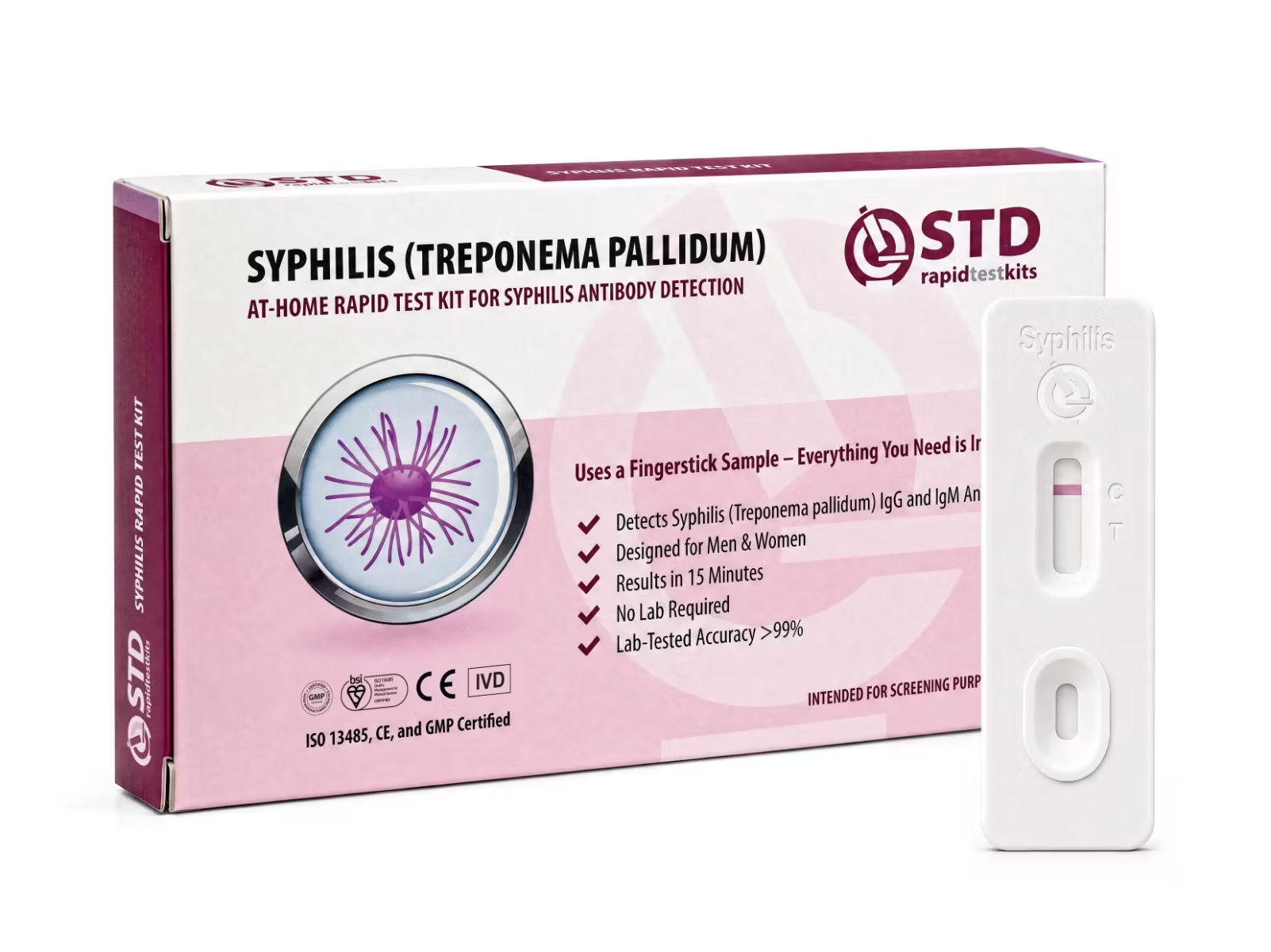
If you have a single painless sore that has lasted more than a few days, especially after a sexual encounter in the last three months, syphilis is worth ruling out. A blood antibody test typically becomes reliable about 3 to 6 weeks after exposure. The at-home rapid syphilis test uses a fingerstick blood draw and reads in about 15 minutes; it is useful as a screening step. A positive screen should be confirmed with a clinic-run RPR (rapid plasma reagin, the standard non-treponemal blood titer) or treponemal antibody test before treatment.
Ingrown hairs, folliculitis, and contact dermatitis: the everyday lookalikes
Most genital bumps are non-STI causes, and three account for the majority. An ingrown hair forms when a shaved or waxed hair curls back and grows into the skin instead of out, producing a small red papule with the hair often visible just below the surface. Ingrown hairs respond to gentle exfoliation, warm compresses, and time, usually resolving in three to seven days without treatment.
Folliculitis is inflammation (and often mild bacterial infection) of one or more hair follicles. It tends to look like a cluster of small papules, each centered on a follicle, with some developing a yellow pustular cap. Per the American Academy of Dermatology folliculitis guidance, common triggers include shaving, plucking, waxing, and tight clothing that rubs against the skin. The page recommends warm compresses applied for 15 to 20 minutes three to four times a day to help the skin clear faster, alongside stopping the triggering activity. A persistent or spreading case can be treated with a topical or oral antibiotic.
Contact dermatitis is an allergic or irritant reaction in the skin where it touched something it does not tolerate. Common triggers in this area include scented laundry detergent, fragrance in body wash, latex condoms, lubricants with glycerin or propylene glycol, and the dye in dark fabrics. The visual presentation is a diffuse pink-red patch, often poorly defined at the edges, sometimes with mild scaling. Itch is usually the dominant symptom. The patch fades within a few days once the trigger is removed, and an over-the-counter topical hydrocortisone or oral antihistamine often speeds the process.
None of these are an emergency. Testing still matters when symptoms persist beyond a week, or when the visual story does not fit any of the three cleanly.
Most genital bumps and rashes are not emergencies. A reasonable timeline is to try the obvious causes first: stop shaving the area, change soap, switch detergent, give it 5 to 7 days. Test, see a clinician, or both if any of the following apply: pain or burning during urination, fever or swollen lymph nodes, a single painless ulcer lasting more than a week, recurrence in the exact same spot, or progression from a small bump to a fluid-filled blister within a few days. Visit urgent care the same day for severe pain, signs of cellulitis (spreading redness with warmth and fever), or a bump that is bleeding heavily.
When testing makes sense, and which test to use
Testing for an STI feels straightforward in theory and confusing in practice because every infection has a different window period: the time between exposure and when a test can reliably detect it. Test too early and you can be infected and still test negative, which is the most common reason people end up with a string of negatives followed by a delayed positive.
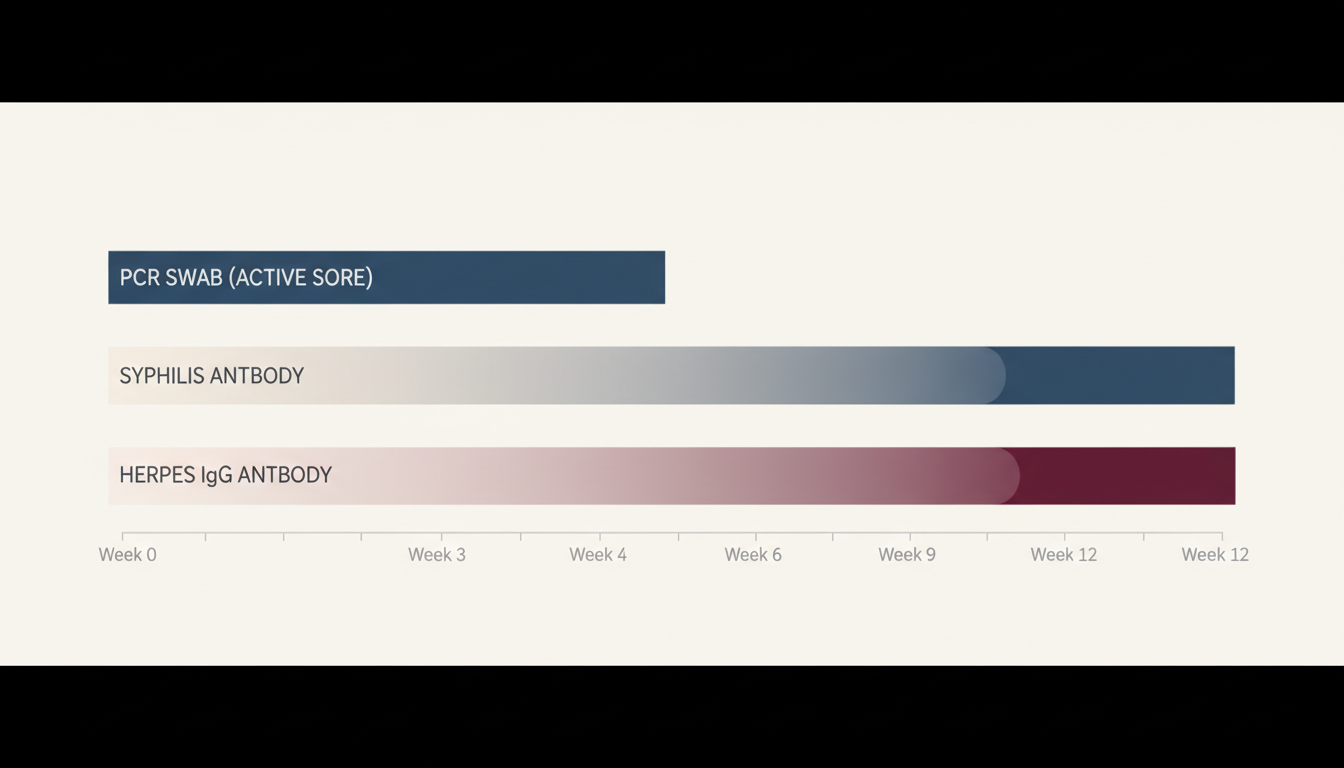
The right test for a skin-symptom query depends on whether a sore is currently visible. With an active lesion, direct sampling is more useful: a clinician collects fluid from the sore for PCR, which detects viral DNA in the lesion itself and works whether the sore is two days old or seven. Without a visible lesion, blood antibody testing becomes the practical option once the antibody window has passed. A blood test will not pick up an infection acquired three days ago because the immune system has not yet built a measurable antibody response, but several weeks later it gives a reliable read.
| Infection | When a rash or sore typically appears | When testing is reliable | Test type |
|---|---|---|---|
| Herpes (HSV-1 or HSV-2) | 2 to 12 days after exposure | PCR swab: immediately, while a sore is open. Blood antibody (IgG): 4 to 12 weeks after exposure | Clinic PCR swab if active sore. At-home or clinic blood antibody test if no current sore |
| Syphilis | Roughly 3 weeks after exposure on average, though the range is wide | Blood antibody test: 3 to 6 weeks after exposure for screening reliability | At-home or clinic blood test, with RPR confirmation if positive |
| HPV | Weeks to months after exposure (warts may take 1 to 8 months to appear) | Visual diagnosis for warts; cervical cytology and HPV DNA in clinic for women | Clinic exam. Our at-home rapid HPV swab is validated for vaginal self-collection only and does not replace cervical screening; male readers needing a test should see a clinic |
| Chlamydia and gonorrhea | Often produce no skin rash, but can produce discharge or pelvic discomfort 1 to 3 weeks after exposure | 1 to 2 weeks after exposure (NAAT in clinic; at-home rapid swab kits also available) | At-home or clinic swab |
If your first test was negative but the symptoms have not gone
This is the second most common scenario after "I do not know what this is." A negative test result, especially in the first few weeks after exposure, does not always mean the infection is not there. Most delayed positives trace back to the same causes: the test was run inside the antibody window (less than 4 to 12 weeks after exposure for herpes, less than 3 to 6 weeks for syphilis); the wrong test was used (a chlamydia swab cannot detect a herpes lesion); or the visible bump was caused by something other than the infection that was tested for.
The right next step depends on the visual story. If the bump has changed since the test (new fluid, new vesicles, ulceration, recurrence in the same spot), get a swab while a lesion is open. PCR swabs detect viral DNA directly without needing an immune response, so timing relative to exposure does not matter as long as a sore is present. If the bump has resolved but the worry has not, retesting in 8 to 12 weeks gives the immune system enough time to make the antibodies a blood test detects. If the bump never fit any STI presentation in the first place, an in-person dermatology visit is often more useful than another STI test, because the answer might be a non-sexual condition entirely (psoriasis, lichen planus (a chronic inflammatory skin condition that can mimic genital STI lesions), or contact dermatitis from an irritant you have not identified yet).
Mild symptoms may go unnoticed or be mistaken for other skin conditions like a pimple or ingrown hair.
How at-home rapid tests work for skin-symptom worries
At-home rapid STI tests are lateral-flow immunoassays, the same screening technology behind a home pregnancy test or a rapid COVID antigen test. A small sample (a fingerstick drop of blood for the blood-based panels, a self-collected swab for the swab-based panels) is added to the test cassette, the device runs for 10 to 15 minutes, and a colored line indicates a positive or negative result. They are designed for screening at home, with the same intent as a routine clinic screen: high sensitivity for the question "do I likely have this," with confirmation testing recommended for any positive.
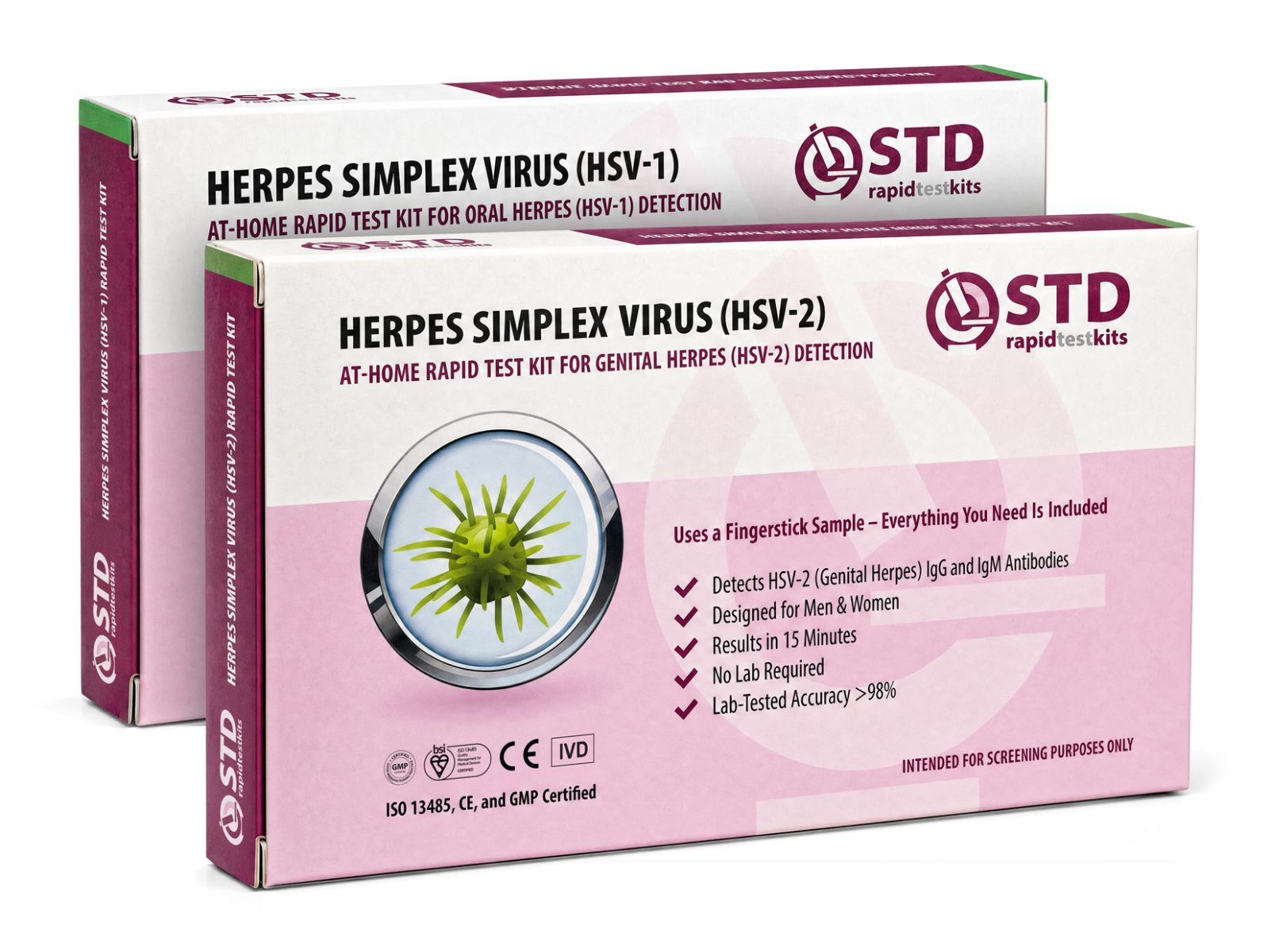
For skin-symptom queries specifically, the most useful at-home tests are the herpes blood antibody test (HSV-1, HSV-2, or a combined panel) and the syphilis blood test. Both are fingerstick blood tests, both pick up the immune response the body makes after infection, and both are most reliable several weeks after exposure rather than the first few days. The herpes window is 4 to 12 weeks for IgG antibodies. The syphilis window is 3 to 6 weeks for screening reliability.
At-home rapid tests do have limits. They are screening tools, and they do not replace a clinic visit when an active lesion needs to be swabbed for PCR (the lab gold standard for diagnosing an active herpes outbreak), or when a bump is changing rapidly, painful, or accompanied by systemic symptoms. They fit the more common scenario well: an exposure happened, the visible signs are unclear or absent, and you want to settle the question privately without booking a clinic appointment.
This article is published by stdrapidtestkits.com, which sells at-home STI testing kits. We recommend products based on fit-for-purpose for the reader's concern, not commercial benefit.
Talking to a partner about a bump
This part is often harder than the test itself. The fear is that mentioning a bump will read as accusation, when in practice a partner who is told calmly almost always responds calmly. The most useful framing puts the focus on the situation rather than on the partner. "I noticed something on my skin and I want to get it checked. I think we should both test, just to be sure" is a sentence that does not require either person to be the source. It opens a door instead of pointing a finger.
The math also helps when fear runs ahead of the conversation. Many STIs can be carried for months or years without symptoms. Per CDC data, most people with genital HSV-2 do not know they carry it. Where the infection came from is often impossible to determine, and chasing that question rarely changes what happens next. Getting a result, treating what is treatable, and managing what is manageable does change next steps.
If a positive result has already come back and the conversation needs to include disclosure, in-person delivery is optional and so is doing it cold. Anonymous partner-notification services are available through most U.S. state and local health departments and through CDC's partner-services networks. Written notes work too.
Lead with shared information rather than blame. Keep it short. Offer to test together when that fits. Anonymous partner-notification tools are available through most U.S. state and local health departments if a face-to-face conversation is not possible.
If your result comes back positive
Most positive results feel far more catastrophic in the first hour than they actually are. The STIs that present as visible skin symptoms tend to be either curable or manageable, often both.
Syphilis is curable with the right antibiotics from a healthcare provider, per CDC guidance. The chancre heals on its own; the antibiotic prescribed by a clinician clears the underlying bacterial infection so it does not progress to later stages. After treatment, follow-up blood titers are monitored over the following months to confirm response.
Herpes is a lifelong infection of the nerve ganglia, and treatment focuses on management. Antiviral medications (acyclovir, valacyclovir, famciclovir) reduce the frequency, duration, and severity of outbreaks and lower the risk of transmission to a partner. Many people with herpes go years between outbreaks once the immune response has settled. Suppressive daily antiviral therapy is an option for people with frequent outbreaks or who want to lower transmission risk to a partner. CDC and the NHS both describe herpes as a manageable lifelong infection rather than a permanent disability, and the public-health framing has shifted in that direction over the last decade.
HPV is more nuanced. Most HPV infections clear on their own within two years. The high-risk strains responsible for most cervical cancers are tracked through cervical screening (Pap and HPV co-testing in women); low-risk strains that cause genital warts are treated with topical agents, cryotherapy, or in-clinic procedures. The HPV vaccine is recommended at ages 11 to 12, with catch-up vaccination through age 26 for those who didn't start or finish the series. Per CDC's HPV vaccines page, some adults age 27 through 45 may decide to get vaccinated after speaking with their doctor about their risk for new HPV infections and the possible benefits.
Syphilis: curable with the right antibiotics prescribed by a clinician, with follow-up blood titers monitored after treatment. Herpes: manageable with daily or episodic antiviral therapy; many people go long stretches between outbreaks. HPV: most infections clear on their own within two years; visible warts are treated locally; cervical screening tracks high-risk strains in women.
FAQs
- Can herpes really look like a single ingrown hair?
- Yes, especially in the first few days of an outbreak. Per CDC guidance, primary herpes lesions can present as small red papules without fluid before progressing to vesicles, and they can appear singly or in clusters. The clue that pushes toward herpes rather than an ingrown hair is the prodrome (tingling or burning a day or two before any visible mark), the trajectory (papule to vesicle to ulcer to crust over 7 to 10 days), and recurrence in the exact same spot. An ingrown hair usually has a visible coiled hair beneath the skin and resolves in three to seven days without that progression.
- How long after exposure should I wait before testing?
- It depends on the test and the infection. For an active sore right now, a clinic-collected PCR swab works immediately and is the most sensitive test available. For blood antibody testing without a current sore, herpes IgG antibodies typically become detectable 4 weeks after exposure and reach maximum reliability by 12 weeks; syphilis blood tests are reliable 3 to 6 weeks after exposure. Testing inside those windows can produce a false negative.
- My swab was taken from a healing crust and came back negative. Could the result be wrong?
- A negative swab on a crusted lesion does not rule out herpes, and that is worth knowing before you put the worry down. Once a sore starts crusting, the active virus shed in lesion fluid drops sharply, and the swab can miss a real infection that an earlier-stage swab would have caught. The most useful follow-up is asking a clinician about a repeat swab on any new lesion that appears, ideally within the first 48 hours of fluid forming.
- Can I have herpes with no visible symptoms at all?
- Yes, and this is common. Per CDC and WHO data, most people with genital HSV-2 are unaware they carry it. Asymptomatic shedding (the virus being present and transmissible without any visible lesion) accounts for a substantial fraction of new transmissions. A blood antibody test is the practical way to settle the question when there is no current sore.
- Do herpes bumps always hurt?
- No. Pain is common with primary outbreaks but not universal, and recurrent outbreaks are often milder. Some people only notice a tingle or itch without sharp pain. The absence of pain does not rule out herpes; it just shifts the visual diagnosis further into uncertain territory and pushes the value of testing higher.
- What's the difference between an ingrown hair and a herpes bump in the first 24 hours?
- Often nothing visually distinguishable. The clues that emerge over 48 to 72 hours are what separate them. An ingrown hair tends to plateau or improve once you stop irritating the area, and you can usually see the trapped hair under the skin. A herpes lesion tends to progress, with a fluid-filled vesicle developing where the bump was, and the surrounding area often feels tingly or burning beforehand. If 48 hours of warm compresses and stopping shaving has not changed anything, that is a useful signal.
- Is the at-home rapid test as accurate as a lab test?
- Different tools, different roles. At-home rapid tests are lateral-flow immunoassays designed for screening; clinic NAAT and PCR tests are molecular tests with higher analytical sensitivity. A positive at-home rapid test should be confirmed with a clinic-run lab test before treatment decisions. For most screening questions ("do I likely have this?"), rapid lateral-flow tests perform well; for definitive diagnosis ("is this what's happening right now?"), clinic NAAT or PCR remains the more sensitive option.
- What test should I use if I'm not sure what's causing the bump?
- A multi-infection panel covers more ground than running each single test separately and is reasonable when the visual story is ambiguous. Combo panels that test for herpes, syphilis, and several common bacterial STIs at once are a practical first step when you do not have a clear suspect infection. If a panel is positive for any individual infection, follow up with the relevant clinic confirmation test.

- U.S. Centers for Disease Control and Prevention. About Genital Herpes: symptoms including the verbatim note that mild symptoms may be mistaken for a pimple or ingrown hair, asymptomatic transmission, and the proportion of carriers who are unaware of their status.
- World Health Organization. Herpes simplex virus fact sheet: prevalence, transmission, and clinical features of HSV-1 and HSV-2.
- U.S. Centers for Disease Control and Prevention. About Syphilis: chancre presentation as usually firm, round, and painless; stages of progression; and the verbatim statement that syphilis is curable with the right antibiotics from a healthcare provider.
- U.K. National Health Service. Genital herpes overview: variability of primary outbreak presentation, prodromal sensations, recurrent outbreaks, and antiviral suppressive therapy considerations.
- American Academy of Dermatology. Folliculitis: typical presentation, common triggers including shaving, plucking, waxing, and friction from tight clothing, plus warm-compress self-care for 15 to 20 minutes three to four times a day, and antibiotic options when persistent.
- U.S. Centers for Disease Control and Prevention. About HPV: typical clinical course of HPV infection, transmission routes, and basic vaccination overview.
- U.S. Centers for Disease Control and Prevention. HPV Vaccines: routine recommendation at ages 11 to 12 with catch-up through age 26, and the option for adults age 27 through 45 to consider vaccination after consulting a healthcare provider.
