Published: November 2025 | Last updated: May 2026 | Editorial review and quality control: Martina N.
Do you need to retest after finishing STI antibiotics?
Yes. The CDC recommends retesting about three months after treatment for chlamydia, gonorrhea, or trichomoniasis, regardless of symptoms, because reinfection is common. A separate test-of-cure (used in pregnancy or pharyngeal gonorrhea) requires waiting at least four weeks. Testing earlier risks a false positive from residual bacterial DNA.
You finished the antibiotics and the symptoms faded, or maybe the discharge shifted in a way you cannot quite pin down. The pills are gone, the appointment is behind you, and it feels like the story should be over. For chlamydia, gonorrhea, and trichomoniasis, it is not. The U.S. Centers for Disease Control and Prevention recommends that nearly everyone who tested positive returns for a follow-up test about three months later, because reinfection in the months after treatment is genuinely common (CDC chlamydia treatment guidelines). Timing matters here. Test too soon and a fragment of dead bacteria can trigger a positive that is not real. Test too late and a fresh reinfection has had weeks to spread or cause complications like pelvic inflammatory disease.
This guide covers the calendar, the discharge that did not settle, the negative test that does not match how you feel, the non-STI causes that antibiotics can unmask, and how partner coordination changes the outcome. It is written for the person finishing a course of doxycycline and wondering why nothing feels finished, for the woman whose retest came back negative even though something is clearly off, and for anyone second-guessing what they see.
Key Takeaways
- The CDC recommends a routine retest about three months after treatment for chlamydia, gonorrhea, or trichomoniasis to catch reinfection, regardless of symptoms or whether your partner was treated.
- Test-of-cure (a separate retest at least four weeks after finishing therapy) is reserved for specific situations like pregnancy, pharyngeal gonorrhea, or persistent symptoms; it is not the default.
Who Needs to Retest After Treatment
Retesting after a treated STI is a routine clinical recommendation built into how STI care works, because reinfection is common and often silent. The CDC's chlamydia treatment guidelines specify that men and women treated for chlamydia should be retested approximately three months after treatment, regardless of whether they believe their sex partners were treated (CDC, 2021). The same three-month timing applies to gonorrhea, where antibiotic-resistance concerns add weight to follow-up screening (CDC gonorrhea overview). For trichomoniasis, retesting within three months is recommended for sexually active women, since reinfection rates after treatment can run as high as one in five (CDC STI Treatment Guidelines). The World Health Organization echoes this priority globally, noting that treating sexual partners is an important component of STI case management to prevent reinfection (WHO STI fact sheet).
Syphilis sits in a different category because tracking the cure relies on watching antibody levels fall over time. Providers schedule serologic follow-up to confirm the treatment response, with the CDC's STI Treatment Guidelines specifying clinical and laboratory checks at scheduled intervals over the following year (CDC STI Treatment Guidelines, 2021). HIV does not work like a bacterial infection; if a positive screening test prompted treatment, monitoring is lifelong, and any post-exposure testing follows separate window-period rules.
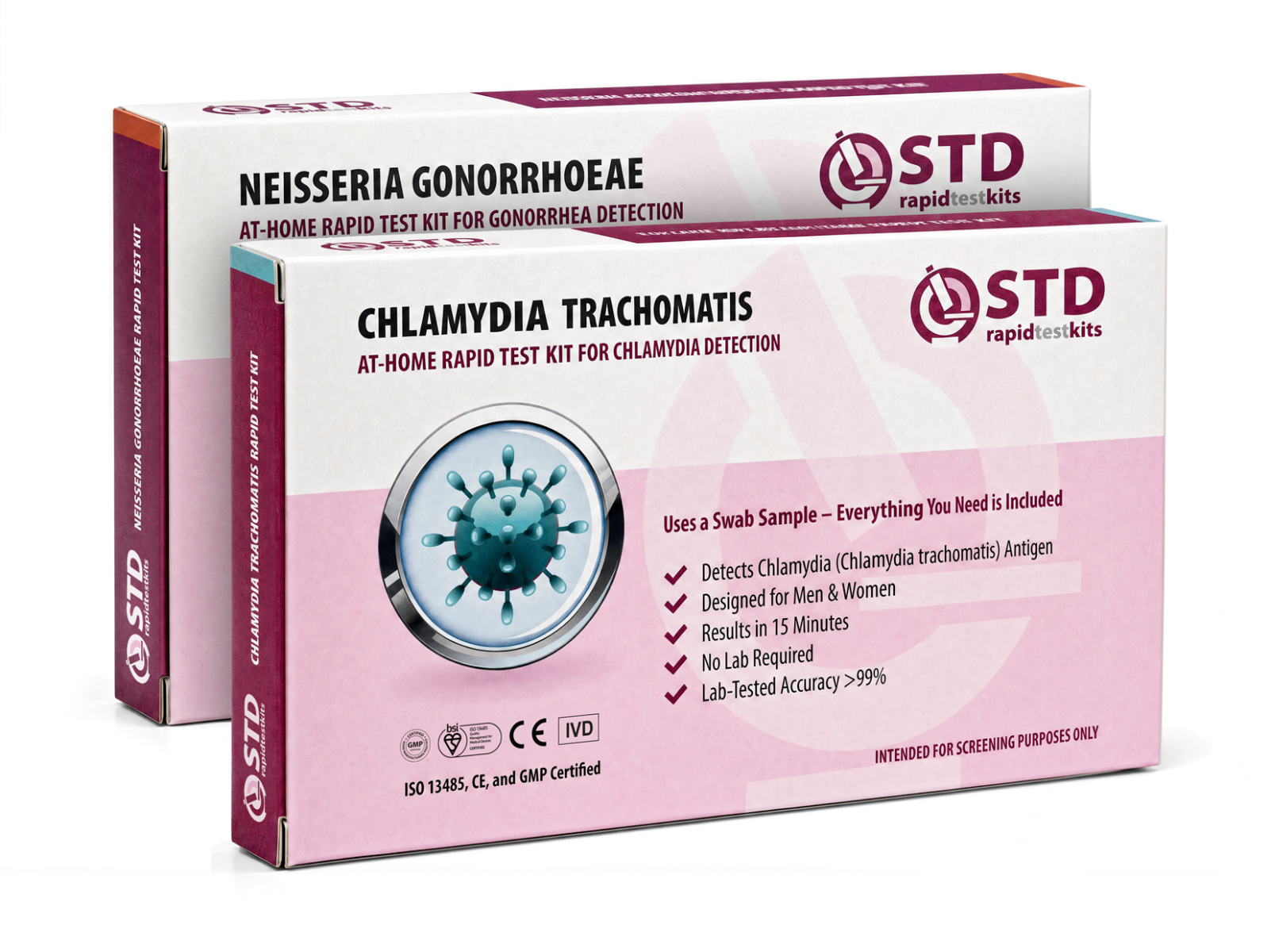
If you were treated for chlamydia, gonorrhea, or trichomoniasis, a retest is part of the standard plan the CDC recommends for everyone in that situation. An at-home chlamydia and gonorrhea test covers the two most commonly retested infections without requiring a clinic visit.
Reinfection with trichomoniasis after treatment can run as high as one in five within three months (<a href="https://www.cdc.gov/std/treatment-guidelines/default.htm" target="_blank" rel="noopener noreferrer">CDC STI Treatment Guidelines</a>), often because partners were not treated or because the infection produced no symptoms either time. The CDC recommends retesting sexually active women within three months of treatment. Our trichomoniasis rapid test kit is validated for vaginal self-swab only; men who need a trichomoniasis test should see a clinic.
Retest Timing by Infection
Different organisms clear at different speeds, and the tests themselves behave differently after treatment. The table below summarizes current CDC-aligned recommendations for the most common scenarios. Specifics in your case may shift based on test type, anatomic site, and whether symptoms persist.
| Infection | Routine retest after treatment? | Recommended retest window | Why |
|---|---|---|---|
| Chlamydia | Yes | About 3 months | Reinfection is common; standard CDC recommendation |
| Gonorrhea | Yes | About 3 months | High reinfection risk; antimicrobial resistance concerns |
| Trichomoniasis | Yes (women) | Within 3 months | High reinfection rates and frequently asymptomatic |
| Syphilis | Yes (serologic follow-up) | Scheduled clinical visits over 12 months | Track antibody titers to confirm response |
| Genital herpes | No (unless new symptoms) | Only if a new outbreak appears | Not curable; antiviral therapy manages flares |
| HIV | Ongoing monitoring | Per treatment plan | Confirmatory and viral-load testing are clinical, not at-home |
Why Testing Too Soon Can Mislead You
One of the most common retesting mistakes is rechecking too quickly. The urge is understandable: you want a clean result before a new partner, before traveling, or just to put the worry to rest. Nucleic acid amplification tests (NAATs), the lab-grade tests used for chlamydia and gonorrhea, can detect fragments of bacterial DNA or RNA from organisms already killed by treatment. The CDC explicitly notes that NAATs are not recommended within four weeks of completing therapy as a test-of-cure for this reason (CDC STI Treatment Guidelines, 2021).
The mirror-image problem also exists. If you test very soon after a fresh exposure, the bacterial load may not yet be high enough to trigger a positive on any test. Window periods vary by infection and test type: chlamydia and gonorrhea typically need about 7 days from exposure before they become detectable, trichomoniasis needs 7 to 10 days, syphilis 3 to 6 weeks, and HIV (fourth-generation antigen/antibody test) about 18 to 45 days (CDC STI Treatment Guidelines). Testing inside that window can return a negative result even when an infection is present.
One of the most discouraging scenarios is a negative test result alongside discharge that has not gone away. The test technically did its job; the bacterial load simply was not high enough yet, or the cause is no longer the original infection. If the original test was done a few days after exposure or a few days into symptoms, retesting outside the window is the only way to get a definitive answer.
Four weeks is the floor for any meaningful test-of-cure when one is indicated. Three months is the right window for routine reinfection screening. If you are testing because of a new exposure rather than treatment follow-up, the window depends on the specific infection.
A NAAT taken within four weeks of finishing antibiotics for chlamydia or gonorrhea can return a positive result based on dead bacterial DNA, not a live infection. If a clinician is checking treatment success in a high-risk situation (pregnancy, pharyngeal gonorrhea, persistent symptoms), the recommended test-of-cure window is at least four weeks after completion of therapy.
Test of Cure vs Three-Month Retest: Two Different Goals
Two retesting scenarios get blurred together, and confusing them is one of the most common mistakes. Test-of-cure asks one narrow question: did this specific infection clear after treatment? It uses a minimum four-week window after therapy and is conditional. Routine three-month retesting asks a different question: is there a new infection that took hold since treatment ended? It applies to nearly everyone. Same testing technology, different problems.
Test-of-cure is selective. The CDC reserves it for situations where treatment failure has consequences worth catching quickly: pregnant patients with chlamydia, pharyngeal gonorrhea (where standard regimens are less reliable), persistent symptoms after a full course of therapy, or concern about poor adherence. Outside those situations, a routine test-of-cure for genital chlamydia or gonorrhea after a complete antibiotic course is not standard practice.
Three-month retesting is for almost everyone who tested positive. It is built around a real epidemiologic finding: studies of treated patients consistently show high reinfection rates within the following months, often because a partner was never treated or a new partner introduced the same infection. The CDC's next-steps guidance for positive chlamydia or gonorrhea results states clearly that patients should be retested in three months (CDC: next steps after a positive test). Catching reinfection at three months prevents it from spreading further and from causing complications like pelvic inflammatory disease (CDC chlamydia treatment guidelines). This site sells the at-home rapid tests described throughout this article; product recommendations are based on what fits the reader's situation, not commercial benefit.
Repeat infection with C. trachomatis is common among women treated for chlamydial infection during the preceding several months. Therefore, all women treated for chlamydia should be retested approximately 3 months after treatment, regardless of whether they believe their sex partners were treated.
What If Discharge or Symptoms Persist?
Discharge after STI treatment is not always a sign that something went wrong. After a successful course of antibiotics, the lining of the urethra, vagina, or cervix is still inflamed. It sheds debris and immune-system fluid for several days while the tissue rebuilds. A small amount of discharge in the first 7 to 10 days, and even a slightly off-color tint before it settles, is part of normal recovery. Most post-treatment discharge resolves within that window.
Beyond 10 days, the picture changes. Discharge that thickens, picks up an odor, or shifts color (yellow, green, brown, or gray), discharge that cleared and then returned, and burning, itching, or pelvic pain all warrant another look. If you had sex without a barrier since finishing treatment, especially with a partner who was not treated alongside you, that tips the scale toward retesting rather than waiting. The checklist below captures the clearest signals that a retest is the right next step.
Signs That Warrant a Retest
One or more of these patterns after finishing antibiotics is a reason to retest, not to wait it out.
- Discharge shifts to yellow, green, brown, or gray Common
- New odor develops, especially fishy or strongly foul Common
- Burning during urination, itching, or pelvic pain accompanies the discharge Common
- Discharge that cleared after treatment returns days or weeks later Common
- Symptoms appeared or worsened after unprotected sex with an untreated or new partner Common
Sorting Out the Cause: STI, Yeast, or Something Else
Several different problems can produce discharge after STI treatment, and they do not all point to the same fix. The most common explanation for returning symptoms is reinfection from an untreated partner or a new exposure, not treatment failure. CDC clinical guidance flags high repeat-infection rates within months of treatment as the specific justification for the three-month retest rule, with younger sexually active adults at the higher end of that risk window (CDC chlamydia treatment guidelines). The table below sorts through the most common causes and whether each one needs retesting.
Antibiotics that treat chlamydia or gonorrhea also flatten part of the normal vaginal and gut microbiome. The bacterial populations that keep yeast in check, and the ones that maintain vaginal pH acidic enough to suppress bacterial vaginosis, take a hit alongside the pathogen. For people with vaginas, the result is a real risk of yeast overgrowth (thrush) in the week or two after treatment ends; the NHS lists antibiotic use as a recognized trigger for thrush (NHS on thrush). Bacterial vaginosis, which the NHS describes as resulting from a change in the normal balance of vaginal bacteria (NHS on BV), can also develop in this post-antibiotic window when the flora is already disrupted. Both conditions mimic the discharge pattern of an STI in the weeks after treatment.
Men can see post-antibiotic discharge or irritation from non-STI sources too, particularly chemical irritation from soaps, lubricants, or condoms, and from minor urethral inflammation or balanitis. A second STI not detected on the original panel, such as Mycoplasma genitalium, sometimes accounts for symptoms that persist after confirmed-negative chlamydia and gonorrhea results. M. genitalium causes urethritis and cervicitis with symptoms nearly identical to chlamydia, and standard doxycycline may not fully clear it; if chlamydia and gonorrhea retests come back negative but symptoms persist, ask a clinician about M. genitalium testing. The visible discharge pattern usually points toward the cause: thick, white, cottage-cheese-textured discharge with itching usually means a yeast infection; thin, gray-white discharge with a fishy odor, especially right after sex, usually points to bacterial vaginosis; watery, yellow, or greenish discharge, especially with burning or pelvic pain, is still consistent with a bacterial STI and warrants retesting.
| Possible cause | What it usually means | Does it need a retest? |
|---|---|---|
| Post-treatment shedding | The body is clearing dead bacteria and immune cells from a now-cleared infection. | No, unless it worsens or persists past 10 days. |
| Reinfection from an untreated partner or new exposure | The original infection was cured, but bacteria came back. | Yes; retest 2 to 6 weeks after the new exposure. |
| Antibiotic-resistant infection | Most relevant for gonorrhea in regions with rising resistance. | Yes; the clinician may switch antibiotics and do a test-of-cure. |
| False negative on the first test | Test was done inside the window period or the sample was poor. | Yes, especially if symptoms persist past 10 to 14 days. |
| A non-STI cause unmasked by antibiotics | Yeast overgrowth or bacterial vaginosis often follows broad-spectrum antibiotic courses. | Maybe; an STI retest plus a vaginal-flora workup is the safer combination. |
New or Lingering Skin Symptoms After Treatment
Some STIs produce symptoms outside the genital area, and those can show up before or after treatment. Secondary syphilis classically causes a rash on the palms, soles, or trunk weeks after the initial infection, sometimes appearing during or after antibiotic treatment for an early-stage diagnosis. Herpes outbreaks can recur on or around the genitals, mouth, or buttocks long after an initial diagnosis. New or unusual skin findings after STI treatment are worth photographing and bringing to a clinician, because they often shape what kind of follow-up testing is needed.
When Is It Safe to Have Sex Again?
The CDC's straightforward answer for chlamydia and gonorrhea is to abstain from sexual activity for seven days after starting a single-dose treatment, or until completing a seven-day course, and to wait until any symptoms have resolved. The same window applies to your partner: they need to be treated and to wait the same seven days before sex resumes (CDC STI Treatment Guidelines).
Where this gets complicated is when only one of you was treated. Resuming sex with an untreated partner restarts the exposure clock immediately. The infection can pass back to you, and a follow-up test weeks later may simply detect the new round. If your partner has not been treated yet, the seven-day rule does not apply. Either wait until both of you have completed therapy, or use condoms consistently until that happens. The distinction matters because many repeat positives at the three-month retest trace directly back to the timing gap between one partner finishing treatment and the other starting.
Both you and your partner must complete the full antibiotic course and wait seven days (or until symptoms resolve, whichever is longer) before resuming sex. If only one partner was treated, the countdown has not started. Use condoms or wait until both courses are finished.
Why Partner Treatment Changes Everything
The single biggest reason people retest positive after treatment is reinfection from an untreated partner, not antibiotic failure. Reinfection can happen within days if your partner was not treated and sex resumed before their treatment was complete. What reinfection looks like depends on the person and the infection: some see exactly the same symptoms they had the first time, others get a different pattern with new pelvic cramping or burning urination, and some have no symptoms at all. That last variant is the most consequential, because an asymptomatic reinfection still spreads, still causes damage over time, and still shows up on a test taken at the right interval.
The damage from untreated reinfection is not theoretical. Repeat chlamydia or gonorrhea raises the risk of pelvic inflammatory disease, which can scar the fallopian tubes and affect fertility (MedlinePlus: chlamydia). In rarer cases, the consequences include chronic pelvic pain or ectopic pregnancy. The CDC's next-steps guidance after a positive chlamydia or gonorrhea result specifically warns that untreated infections in women can cause permanent reproductive damage (CDC: next steps after a positive test). Catching reinfection early through routine retesting is the primary way to prevent that downstream damage.
Partner treatment is built into modern STI care for exactly this reason. Many U.S. states allow expedited partner therapy (EPT), where the diagnosed patient can take antibiotics or a prescription home for their partner without that partner needing a separate clinical visit. EPT is approved for chlamydia and gonorrhea in most jurisdictions and is supported by the CDC where state law permits it (CDC STI Treatment Guidelines).
If a retest comes back positive, the conversation with a current or recent partner is often the hardest step. Shame around STIs is the single biggest reason people delay these conversations until it is too late to keep them simple. A short, factual message gives a partner the information they need to protect their own body, and most people respond with relief at being told rather than with blame. A factual opener like "My recent retest came back positive, and the timing means you may have been exposed" gives the partner what they need without drama. If speaking in person feels impossible, anonymous notification through a state health department's partner-notification program delivers the message without a phone call.
Expedited partner therapy (EPT) is legal in most U.S. states for chlamydia and gonorrhea. If your provider has not mentioned it, ask directly: "Can I take a prescription home for my partner so they don't need a separate visit?" The CDC supports EPT where state law permits it, and many local health departments will dispense or write the script.
How to Retest at the Right Time
Retesting is not an admission of failure; it is what good follow-up looks like. The CDC and most national health services treat post-treatment retesting as part of normal care for the most common bacterial STIs (CDC STI Treatment Guidelines). The mistake people make is not retesting itself, but retesting at the wrong time, with the wrong sample type, or confusing test-of-cure with the routine reinfection screen.
The most predictable errors: testing within a week of finishing antibiotics (driven by anxiety, but wasted if bacterial DNA has not cleared), treating the absence of symptoms as proof of cure (many STIs are silent), relying on a single early negative after a new exposure (infections inside the window period are invisible to any test), and skipping partner notification entirely. Use the scenarios below as a starting point for timing. Each assumes the goal is a definitive answer, not just symptom relief. For a focused recheck of chlamydia and gonorrhea, at-home STI test kits give a private, rapid answer. Any positive result from a rapid test should be confirmed with a clinic NAAT so the right antibiotic is prescribed.
| Your situation | When to retest | Best method |
|---|---|---|
| Discharge came back after a finished course of treatment | 2 to 3 weeks after the last dose of antibiotic | Rapid at-home swab kit, or clinic NAAT panel |
| You had sex with a new partner since the last test | 2 to 4 weeks after that exposure | Home rapid test for screening; clinic NAAT if positive |
| First test was negative but symptoms persist | 10 to 14 days after that first test | A different sample type (swab plus blood, if appropriate) |
| A partner tested positive | Same day if possible, then again at 2 weeks | Lab NAAT through a clinic, or a confirmatory rapid panel |
What to Do with Your Retest Results
A negative retest alongside symptoms that have not resolved signals that the cause is no longer (or never was) the original infection. The right follow-up is a clinic visit for a broader workup: a vaginal-flora swab if you have a vagina, a urinalysis to rule out a urinary tract infection, and a conversation about less commonly tested infections like Mycoplasma genitalium. CDC treatment guidance directs clinicians to evaluate alternative causes when symptoms persist after a documented negative STI panel (CDC STI Treatment Guidelines).
A positive retest usually means one of two things: reinfection from an untreated source, or a strain that did not respond fully to the first antibiotic. The clinician will typically re-treat with the same regimen (most chlamydia and gonorrhea responds the second time when the partner is also treated) or move to a second-line antibiotic if there is reason to suspect resistance. The CDC's guidance after a positive result also walks through partner notification and the abstinence interval that follows the second course (CDC: next steps after a positive test). What changes the long-term outcome is whether you and your partner both finish the second course. Either path leads to the same endpoint: a clear answer, a complete treatment, and a final retest at the three-month mark to confirm there is no lingering reinfection.
| Retest outcome | What it usually points to | Best next step |
|---|---|---|
| Negative retest, symptoms still present | Cause is no longer (or never was) the original infection; consider yeast, BV, UTI, or Mycoplasma genitalium | Clinic visit for a broader workup: flora swab, urinalysis, and evaluation for alternative pathogens |
| Positive retest | Reinfection from an untreated source, or partial response to the first antibiotic course | Re-treat (often the same regimen), confirm the partner is treated, consider a second-line antibiotic if resistance is suspected |
Following Through on the Three-Month Retest
Following through on the three-month retest is the step that gets quietly skipped most often. People feel better, life moves on, and the appointment never happens. CDC treatment guidance explains why that instinct is the wrong one: a high prevalence of repeat chlamydia infection has been observed among women and men in the months after treatment, and the majority of those repeat infections come from untreated partners or new exposures rather than treatment failure (CDC chlamydia treatment guidelines).
The value of the three-month retest extends beyond your own health. Chlamydia and gonorrhea circulate through sexual networks in cycles of treatment and reinfection. Each undetected reinfection perpetuates that cycle and adds exposure risk for future partners. One test, taken on schedule, interrupts the chain.
Whether you retest at a clinic, a public-health site, or with a discreet at-home kit, the value comes from doing it on the right calendar. For a focused check after treatment, a swab-based rapid test at the three-month mark gives a clean answer. For broader coverage, particularly when a new partner of unknown status has been part of the picture since the original diagnosis, a multi-infection panel is the more conservative starting point.
What Should You Do Next?
Are you within the first 10 days after finishing antibiotics, with only mild or fading discharge and no worsening symptoms?
Yes: This is likely normal post-treatment recovery. Note the date you finished antibiotics and set a calendar reminder for three months out for your routine retest. Talk to recent partners now so they can be treated before that date.
Has discharge persisted past 10 days, changed color or odor, or returned after clearing?
Yes: Retest now rather than waiting for the three-month mark. A rapid at-home swab or clinic NAAT can distinguish reinfection from a non-STI cause like yeast or BV. If the retest is negative but symptoms continue, see a clinician for a broader workup.
No: Follow the standard plan: retest at three months, choose your method in advance (clinic, public-health site, or at-home rapid kit), and make sure any recent partners have been treated before you retest.
Use this as a starting point. A healthcare provider can tailor advice to your specific situation.
Frequently Asked Questions
- Do I really need to retest if I feel completely fine?
- Yes. Reinfection after chlamydia, gonorrhea, or trichomoniasis treatment is common and usually silent. CDC guidance calls for a routine retest at three months regardless of how you feel, because symptom-free reinfection is the rule, not the exception.
- How long should I wait after antibiotics before testing again?
- Three months for the routine reinfection screen. If your clinician specifically requested a test-of-cure (less common, used in pregnancy or pharyngeal gonorrhea), wait at least four weeks; earlier testing risks a false positive from residual bacterial DNA that the body has not yet cleared.
- How long should discharge last after STD treatment?
- Some clear or slightly tinted discharge is normal in the first 7 to 10 days while the urethral or vaginal lining heals. If it persists past 10 days, or sooner if the color or odor changes, the right move is a retest rather than more waiting.
- I tested positive again after treatment. Did the antibiotics fail?
- Usually not. Most repeat positives after standard chlamydia or gonorrhea treatment turn out to be reinfections from an untreated partner or a new exposure rather than antibiotic failure. True treatment failure does happen, particularly with antibiotic-resistant gonorrhea, but reinfection is the more common explanation. A clinician can help sort out which one applies.
- Could my discharge be a yeast infection or bacterial vaginosis instead?
- Often yes, especially within two weeks of finishing antibiotics. Thick, white, cottage-cheese-textured discharge with itching usually points to a yeast infection. Thin, gray-white discharge with a fishy odor (often most noticeable right after sex) usually points to bacterial vaginosis. Both are treatable but require different medication than an STI, so distinguishing them matters.
- If my partner was treated, can I still be reinfected by them?
- Yes, if the timing did not line up. Both partners need to finish their full course of antibiotics and avoid sex during that window. If sex resumed before either course was complete, the bacteria can transfer back. The CDC recommends seven days of abstinence after starting single-dose treatment for chlamydia and gonorrhea.
- Why did my test come back negative when I still have symptoms?
- The most likely reason is that the test was done inside the window period for that infection. Most bacterial STIs need at least 7 days from exposure before they can be detected, and trichomoniasis needs 7 to 10 days. Retesting at the right interval usually clears this up. If a second test is also negative but symptoms persist, the cause is likely something other than the original STI; a clinic visit for a broader workup is the next step.
- Are at-home rapid tests reliable for retesting?
- Yes, when used after the correct window. Lateral-flow rapid tests perform best when bacterial fragments from the prior infection have cleared and any new infection has had time to develop. That means waiting at least four weeks after treatment, ideally three months for a true reinfection check. A positive result from any rapid test should be confirmed with a clinic NAAT or blood test.
How we sourced this article: Our editorial team summarized current public-health and peer-reviewed clinical guidance, principally the U.S. Centers for Disease Control and Prevention's STI Treatment Guidelines, alongside related CDC topic pages, the UK National Health Service's STI and thrush references, and the World Health Organization's STI fact sheet. We do not provide clinical diagnosis. For symptoms, persistent positive results, or treatment-failure concerns, see a licensed provider.
- U.S. Centers for Disease Control and Prevention. Sexually Transmitted Infections Treatment Guidelines, 2021. Authoritative source for the routine three-month retesting recommendation, the test-of-cure scenarios, the seven-day post-treatment abstinence rule, expedited partner therapy support, trichomoniasis reinfection rates, and HIV testing-window guidance referenced throughout this article.
- U.S. Centers for Disease Control and Prevention. Chlamydial Infections (STI Treatment Guidelines, 2021). Source for the three-month retesting recommendation in chlamydia, the four-week NAAT test-of-cure floor, and the framing that most posttreatment infections reflect reinfection rather than treatment failure.
- U.S. Centers for Disease Control and Prevention. About Gonorrhea. Source for the three-month retesting recommendation in gonorrhea and the antimicrobial-resistance context that adds urgency to follow-up screening.
- U.S. Centers for Disease Control and Prevention. Next Steps After Testing Positive for Gonorrhea or Chlamydia. Patient-facing guidance for the three-month retest rule, partner notification, and the warning that untreated infections in women can cause pelvic inflammatory disease and permanent reproductive damage.
- UK National Health Service. Thrush in men and women: causes and triggers, including antibiotic use. Source for the post-antibiotic yeast overgrowth framing.
- UK National Health Service. Bacterial vaginosis: overview, symptoms, and the role of vaginal bacterial balance. Background reference for BV symptoms and vaginal-flora framing discussed alongside the post-treatment section.
- World Health Organization. Sexually transmitted infections (STIs) fact sheet. Global source for the framing that more than one million curable STIs are acquired daily and that partner treatment is an important component of STI case management to prevent reinfection.
- U.S. National Library of Medicine, MedlinePlus. Chlamydia Infections. Source for the retesting-at-three-months recommendation and the warning that untreated chlamydia can cause permanent damage to the reproductive system, including pelvic inflammatory disease and infertility.
