
Published: August 2025 | Last updated: May 2026 | Editorial review and quality control: Martina N.
You took the test. The result said negative. A week later something feels off: an itch, a sore, a strange burn during urination. The thought arrives uninvited. Did the test miss it? Did I tell my partner I was clean when I wasn't? You are not the first person to land in that loop, and the answer is more useful than the panic suggests.
A negative result and real symptoms can both be true at the same time, usually for one of three reasons: a window period that hadn't closed yet when you tested, a panel that didn't cover the right infection or the right body site, or a non-STI cause that looks the same from the outside. None of those mean you lied. They mean testing is a snapshot rather than a guarantee, and the rest of this article walks through what to do about it.
Key Takeaways
- A negative result reflects what was detectable on the day you tested. Several STIs need weeks before they appear on a blood or antibody test, so testing too soon is the most common reason symptoms surface later.
- Burning, itching, discharge, and rashes after sex have non-STI causes too, including yeast, bacterial vaginosis, UTIs, friction injuries, and contact reactions. Retesting plus a clinic workup sorts one cause from another.
Symptoms After a "Clean" Test Are Not Just in Your Head
The first sign that something is off is rarely dramatic: an itch that worsens at night, a new kind of discharge, a raw throat after oral sex, or a sore that persists without being painful enough to drive you to urgent care. Sometimes there is no physical symptom at all, only an internal alarm that won't switch off, especially if you already told a recent partner you were tested. The guilt of that conversation can hit harder than the burning sensation that started it.
Be specific about what your body is reporting. Common post-testing symptoms people describe include genital or anal itching that worsens at night, clear, white, or yellowish discharge with a new odor, internal burning or sharp pain during urination, throat discomfort after oral sex, swollen lymph nodes near the groin or neck, and unexplained rashes or sores that may or may not be painful. Each of those can signal multiple things, and only some of them are STIs. The fix is to take the signal seriously rather than override it with a previous result. Testing is a snapshot of one day, on one sample type, for one list of infections.
- Genital or anal itching that worsens at night
- Clear, white, or yellowish discharge with a new odor
- Internal burning or sharp pain during urination
- Throat discomfort after oral sex
- Swollen lymph nodes near the groin or neck
- Unexplained rashes or sores, painful or not
Why Negative Doesn't Mean Nothing: The Window Period Reality
The window period is the gap between when an infection enters the body and when a test can reliably detect it. During that gap, you can be infected, be infectious, and still test negative. Different infections have different windows because tests look for different things: the pathogen itself, fragments of its genetic material, or antibodies your immune system makes in response. Per CDC and NHS guidance, the rough windows look like this:
- Chlamydia and gonorrhea: usually detectable within 1 to 2 weeks on swab or urine NAAT testing.
- HIV: a laboratory antigen-antibody assay (4th-generation) detects most infections by 18 to 45 days, per CDC HIV testing guidance. Older antibody-only rapid tests can take up to 90 days.
- Syphilis: blood tests are typically reliable from 3 to 6 weeks after exposure, sometimes up to 12 weeks for low-titer cases.
- Herpes (HSV-1 and HSV-2): antibody blood tests usually need 6 to 12 weeks to become reliable, with some people taking longer to seroconvert.
- Hepatitis B and C: windows run several weeks; hepatitis C antibody tests sometimes need up to 11 weeks.
If you tested four days after a hookup, those windows had not closed for almost any infection. A negative result from inside the window covers what was detectable at that moment, which is less than the full picture. Many rapid tests also detect antibodies rather than the pathogen, which extends the window further. And not every panel is comprehensive. Unless you specifically asked about herpes, trichomoniasis, or oral and rectal sites, you probably weren't tested for them, regardless of what the lab requisition called a "full panel."
This pattern is fairly common. People test soon after a new partner, get a clean result, feel relief, then develop symptoms a week or two later.
Can I have an STI even though my test came back negative?
Yes, for two main reasons. The window period for HIV antibody tests can run up to 3 months; for chlamydia and gonorrhea it is usually 1 to 2 weeks; for syphilis blood tests it is 3 to 6 weeks. Standard panels also often skip throat and rectal sites unless you specifically ask. If symptoms started after a negative result, retest at the appropriate window with body-site coverage that matches your sexual practices.
When You Said "I'm Clean" and Believed It
There is a particular kind of dread that hits when symptoms appear after you've told someone you were tested. The mind starts replaying the conversation. Did I say "clean" or "recently tested"? Did I imply more certainty than I had? Did I betray someone I cared about? The shame moves quickly, and it lands hardest on people who grew up hearing that an STI is a moral verdict rather than a medical event.
Here is the calmer reading. Most people use the word "clean" to mean "I tested recently and the result was negative," which is a reasonable shorthand. A single negative test cannot prove the absence of every infection at every body site through every window. Telling a partner what you knew when you knew it is honest reporting of available information. It only becomes a problem if you stay silent once new information arrives.
Sensitivity is the share of true infections a test catches. Lateral-flow rapid tests sit lower than laboratory NAAT (nucleic acid amplification testing), which is why the CDC describes lab-based NAAT as the screening gold standard for chlamydia and gonorrhea. Rapid antigen and antibody assays can miss early infections more often than NAAT does, and antibody tests for HSV are well known for missing recent or asymptomatic infection, per CDC genital herpes guidance. None of that means rapid tests are useless. They are a fast, private screen that catches a lot of infections quickly. They work alongside clinic confirmation when something positive shows up.
So if you said you were clean and believed it, you were trusting the test in front of you with the information you had. That is what most people do. The next move, if symptoms appear, is to retest with the right method at the right time and to tell your partner what you find. The goal there is courtesy. You are giving both of you the same accurate information to act on.
Most people who have chlamydia have no symptoms. Even when chlamydia causes no symptoms, it can damage a woman's reproductive system and lead to pelvic inflammatory disease.
Testing Is Care, Not Certainty: What to Do Next
If symptoms started after a negative result, plan a second round of testing instead of assuming the first one was wrong about everything. The right plan depends on which symptoms you have and how long ago the last possible exposure was.
Ask the clinic or the kit you use to cover, at minimum:
- Chlamydia and gonorrhea, on the body sites that match your sexual practices: urine or self-swab for genital exposure, throat swab for oral sex, rectal swab for anal sex.
- Syphilis, blood test (RPR or treponemal antibody).
- HIV, ideally a 4th-generation antigen-antibody assay, with a follow-up test at six weeks for confirmation if the exposure was recent.
- Herpes: swab any active sore directly (most accurate); use a blood antibody test only when no lesion is available, and only after the window has closed.
- Trichomoniasis, often left off standard panels but a frequent cause of symptoms in any anatomy.
Match the test to the exposure. If oral sex was on the table, a urine test will not detect throat gonorrhea or chlamydia. If anal sex was involved, a rectal swab is what catches it. People assume their clinic ran "everything," but standard panels often skip pharyngeal and rectal sites unless the patient asks for them by name. The same applies to herpes serology, which is rarely included in default screening unless requested.
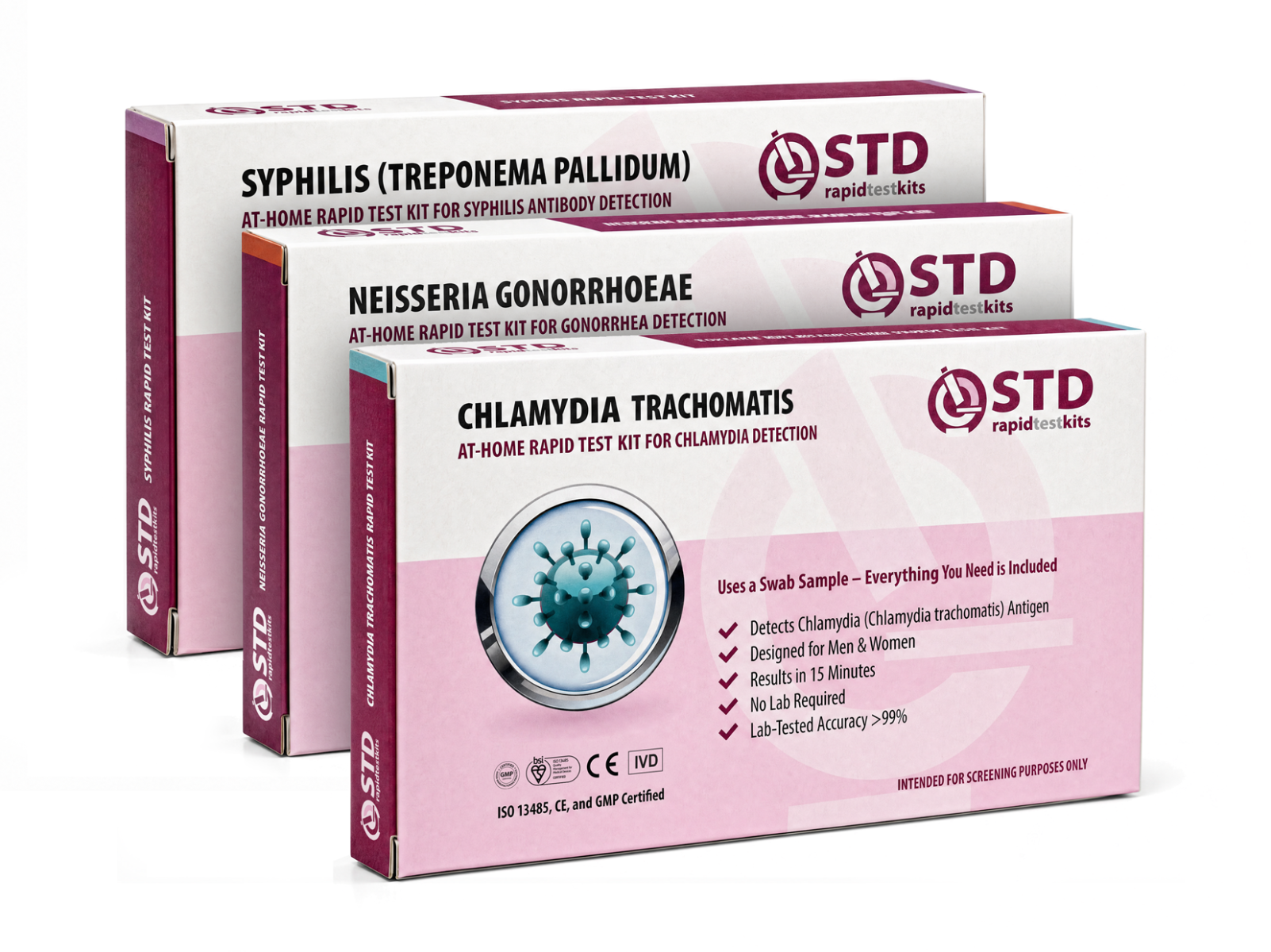
If the wait for a clinic appointment is what's keeping you up at night, an at-home rapid test for the most likely culprits can buy you accurate information sooner. Use it as a screen and confirm anything positive with a clinic test. The combo kit below covers the three most common bacterial STIs in one package, which is a reasonable starting point if your symptoms point in that direction.
stdrapidtestkits.com sells the rapid at-home tests referenced in this article.
But What If It Isn't an STI? Common Causes That Look Identical
Before assuming the worst, run through the list of non-STI causes that produce overlapping symptoms. They are common, treatable, and frequently coincide with sexual activity, which is why they get blamed on STIs in the moment.
- Yeast infections show up in any anatomy, often after antibiotics, after sex with a new partner, or after anything that disrupts the local microbiome. Symptoms include itching, white discharge, redness, and burning.
- Bacterial vaginosis (BV) is not an STI but is associated with new sexual partners and pH changes in vaginal anatomy. Discharge is typically thin and grayish with a fishy odor.
- Allergic and irritant reactions to latex, spermicide, lube ingredients, scented soaps, or laundry detergent can produce swelling, itching, and rashes within hours of contact.
- Friction injuries from prolonged or rough sex (toys included) can cause small tears, redness, and tenderness that mimic herpes or HPV lesions.
- Urinary tract infections are not sexually transmitted but often follow sex. The burning during urination is the bladder, not the urethra picking up an STI.
- Contact dermatitis from a new product, a recent shave, or even a sweat reaction can cause persistent itching and small bumps that look like an STI rash to a worried eye.
You can have more than one of these at the same time. A person with a UTI can also have trichomoniasis. Someone with bacterial vaginosis can have just cleared chlamydia. Guessing rarely helps, and Googling at 3 a.m. tends to lock in whichever scary outcome you searched first.
Retesting, not guessing, is what gets you an answer. If the second result is also negative but symptoms persist, ask a clinician for a workup that goes beyond the standard STI panel: a urinalysis, a vaginal pH and wet-mount, a fungal culture, or a swab for non-STI bacterial pathogens. None of these are exotic. Most clinics offer them in a single visit if you ask.
The shame around symptoms often stops people from booking that appointment. If you are itchy, in pain, or anxious enough to be reading this article at 2 a.m., you deserve answers, even if the eventual answer is "irritation that will clear in a week."
Asymptomatic Carriage: STIs Without Symptoms Still Transmit
Flip the scenario. What if the infection was already there before the test but never produced symptoms? That happens often. Per the CDC, most people with chlamydia have no symptoms at all. The World Health Organization notes the same global pattern across the major bacterial STIs. A substantial share of gonorrhea infections, especially throat and rectal ones, are also silent. Many people who carry HSV-1 or HSV-2 never have a recognizable outbreak. Early-stage syphilis can pass unnoticed entirely, with the primary chancre healing on its own before someone realizes what it was.
Asymptomatic carriage matters for two reasons. First, infections you don't know you have can still be transmitted, which is why population-level screening exists in the first place. Second, when symptoms do eventually surface (sometimes weeks or months after exposure) the result can look like it came out of nowhere. A test taken at the right window catches many of these silent cases. A test taken too early or on the wrong sample type misses them, and the infection keeps incubating.
This is the practical case for routine screening rather than reactive testing. The CDC recommends annual chlamydia and gonorrhea screening for sexually active women under 25, and at least annually for sexually active men who have sex with men, with more frequent testing if there are multiple or new partners. HIV testing at least once for everyone aged 13 to 64, with more frequent testing for people in higher-risk categories, is also recommended.
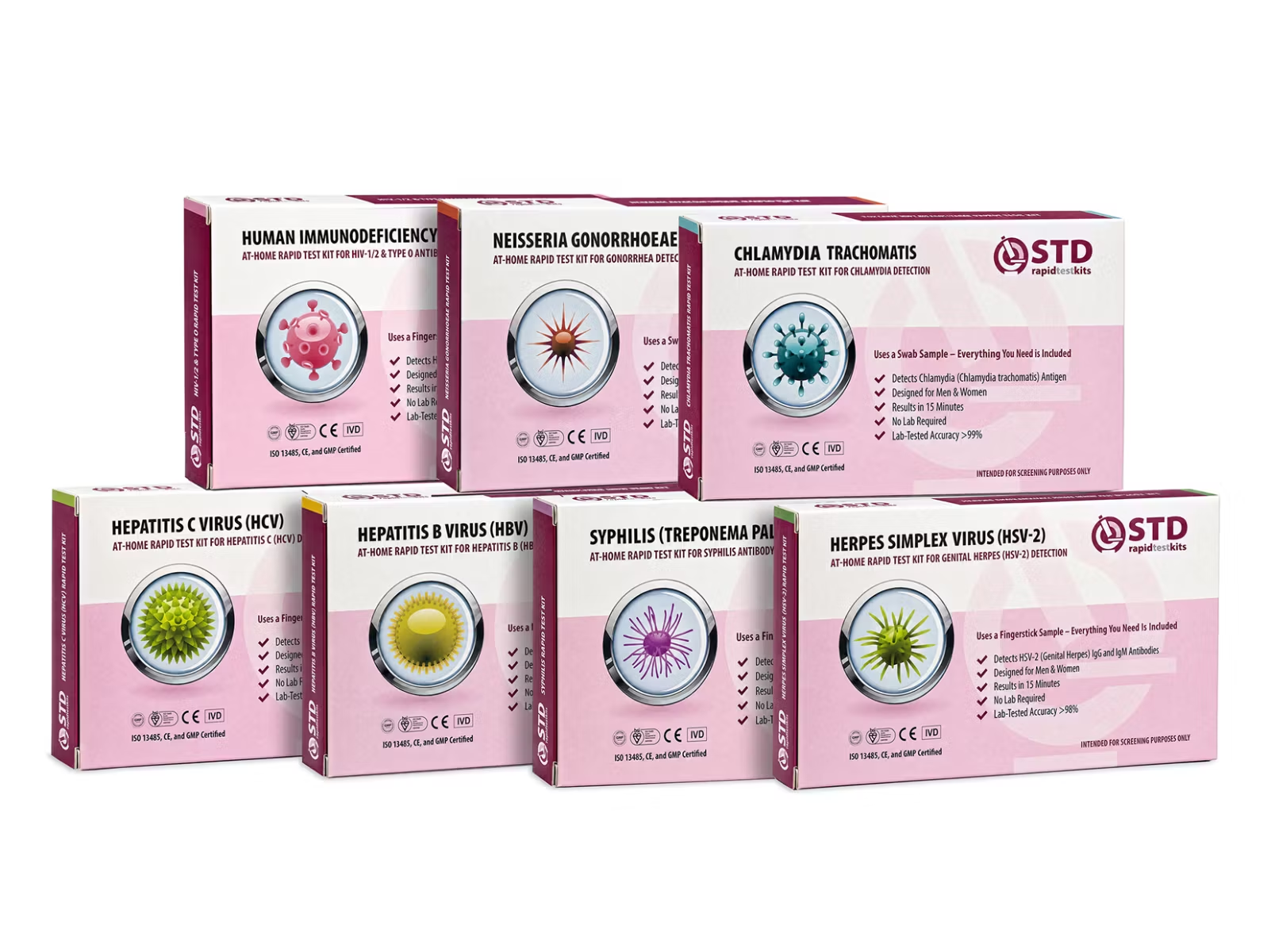
A single negative result is a moment in time. Periodic testing is what actually maps the picture, especially when partners or risk levels change. The 7-in-1 kit below is one way to cover the most common infections in a single sweep, which is useful as a periodic check rather than a one-time reaction to a scare.
How to Tell a Partner Without the Shame Spiral
If you've already told a partner you were tested and now have symptoms, the conversation does not have to be a confession. Frame it as updated information. Something simple works: "I tested recently and the result was negative, but I've started having symptoms and I'm going to retest. I wanted to tell you so we can both make decisions with the same information."
That sentence does several things at once. It does not assign blame. It does not over-promise about results that haven't come back yet. It treats your partner as someone capable of handling the truth. Most people respond to that kind of message far better than to the alternatives, which usually involve panic, accusations, or silence until the second result is in.
If the relationship is new, the conversation can stay small. If it is ongoing, you might also propose getting tested together at the same window, which removes the awkward "who passed it" arithmetic that derails a lot of these conversations.

When to Retest, and What to Ask For
Timing the retest matters more than rushing it. The biology has to catch up before a test can detect anything new, and a second too-early test will produce another false negative.
For chlamydia and gonorrhea, retest at least 1 to 2 weeks after the most recent exposure if symptoms are present, with body-site coverage that matches the exposure (throat, rectal, genital). For HIV, the most reliable single retest window is six weeks after exposure with a 4th-generation antigen-antibody test, with a confirmatory test at three months for absolute certainty. For syphilis, blood testing is reliable from about three weeks onward, with most cases detectable by six weeks. For herpes, swab any active lesion immediately for the most accurate result; antibody testing is a longer-window backup at 6 to 12 weeks post-exposure.
If you've developed sores, ulcers, or flu-like symptoms (fever, swollen lymph nodes, a rash on the palms or soles), ask specifically about herpes and syphilis. Both can produce systemic symptoms early, and both are curable or manageable when caught. If symptoms persist after a second round of testing comes back negative, ask for a non-STI workup: urinalysis, vaginal swab and wet-mount, allergy review, contact-irritant history. You are allowed to advocate for yourself without apologizing for taking up the appointment.
| Infection | Recommended retest window | Test method |
|---|---|---|
| Chlamydia and gonorrhea | 1 to 2 weeks after exposure | NAAT swab or urine, on the body sites that match exposure |
| HIV | 6 weeks (3 months for full confirmation) | 4th-generation antigen-antibody assay |
| Syphilis | 3 to 6 weeks after exposure | Blood test (RPR or treponemal antibody) |
| Herpes (HSV-1, HSV-2) | Swab active sore immediately; antibody at 6 to 12 weeks | Lesion swab if available; blood antibody as backup |
Why This Conversation Matters Beyond One Negative Test
The aftermath of post-test symptoms is rarely just physical. It changes how people talk about testing, how confidently they answer the next "are you tested?" text, and how willing they are to ask a partner the same question. There is a wider lesson worth keeping.
A negative test is real information, not a permanent identity. "Clean" is a result on a specific day for a specific list of infections at specific body sites. Treating it like a credential is the part that goes wrong. Treating it like a snapshot, useful but bounded, is what makes ongoing sexual health workable.
The honest version of "I'm tested" includes the date, the panel, and the body sites. The honest version of "I'm fine" includes "so far." That sounds clinical at first reading, and it reads as accuracy in practice. People who hear it usually appreciate the precision more than the polished phrasing they expected, because it gives them something to work with rather than a status to trust on faith.
A negative test is real information, not a permanent identity. It is a snapshot of one day, on one panel, at one set of body sites. Use it as one data point alongside ongoing screening rather than a status that travels with you between partners.
FAQs
- What is the most common reason a negative STI test turns out to be wrong?
- Testing inside the window period. The window is the gap between exposure and when a test can reliably detect the infection, and it varies by pathogen and by test type. A four-day-post-hookup HIV antibody test, for example, will likely come back negative even on a true infection because antibodies have not had time to form. The second most common reason is body-site mismatch: a urine sample cannot detect throat or rectal gonorrhea, so an oral or anal exposure may show negative on a urine-only panel.
- Why do my symptoms feel real if my test said clean?
- Because they probably are. A test catches what was detectable on a specific day, on a specific sample type, for a specific list of infections. Burning, itching, discharge, or pain after sex are real symptoms that deserve attention regardless of what your last result said. The next step is figuring out the cause, which often means retesting at the right window or asking about non-STI possibilities like yeast, bacterial vaginosis, or a UTI.
- What should I say to a partner I told I was negative?
- Keep it factual and short. Something like, "I tested recently and the result was negative, but I've started having symptoms and I'm going to retest to be sure." That sentence does not promise anything you can't back up, doesn't assign blame, and gives both of you the same information to work with. Most people respond well to that approach because it treats them like an adult instead of a verdict.
- Do all STIs come with obvious symptoms?
- No. The CDC describes chlamydia as largely asymptomatic, with most people never developing recognizable symptoms. Throat and rectal gonorrhea are commonly silent. Many people with HSV-1 or HSV-2 never have a typical outbreak. Early-stage syphilis can resolve without anyone noticing the chancre. This is exactly why routine screening exists, even when you feel fine.
- Could itching, burning, or discharge be something other than an STI?
- Often, yes. Yeast infections, bacterial vaginosis, urinary tract infections, allergic reactions to lube or latex, friction injuries, and contact dermatitis all produce overlapping symptoms. After ruling out STIs with retesting, ask a clinician about a non-STI workup, including urinalysis, vaginal pH and wet-mount, fungal culture, or allergy review depending on what you're experiencing.
- How soon should I retest after a negative result with new symptoms?
- The right window depends on which infection you are worried about and which test type was used. As a rough guide: chlamydia and gonorrhea, 1 to 2 weeks; HIV on a 4th-generation test, 6 weeks with a 3-month confirmation; syphilis, 3 to 6 weeks; herpes antibody, 6 to 12 weeks (or swab any active sore immediately). Body-site matching matters as much as timing, so make sure the swab covers the site of exposure.
- How accurate are at-home STI tests?
- Reputable home rapid tests use the same lateral-flow chemistry as point-of-care tests at clinics. Sensitivity and specificity are typically in the high 90s for the relevant infection when used after the window period has closed and the sample is collected correctly. They function as a private, fast screen. Anything that comes back positive is worth confirming with a lab-based test, and anything negative with persistent symptoms is worth retesting or following up at a clinic.
- U.S. Centers for Disease Control and Prevention. Sexually Transmitted Infections Treatment Guidelines and screening recommendations for chlamydia, gonorrhea, syphilis, and HIV.
- U.S. Centers for Disease Control and Prevention. HIV testing guidance, window periods, and 4th-generation antigen-antibody assay information.
- U.S. Centers for Disease Control and Prevention. Chlamydia fact sheet covering asymptomatic prevalence, screening recommendations, and detection windows.
- U.S. Centers for Disease Control and Prevention. Genital herpes (HSV-1 and HSV-2) detection, swab versus serology guidance, and antibody-test limitations.
- World Health Organization. Sexually transmitted infections fact sheet covering global epidemiology, screening, and asymptomatic-carriage patterns.
- UK National Health Service. Sexually transmitted infections, testing, and clinical guidance for symptoms after exposure.
