Published: October 2025 | Editorial review and quality control: Martina N.
Buying a syphilis rapid test usually doesn't happen because you're feeling calm. It happens at 1 a.m. after Googling a bump, or the day after a hookup that suddenly feels riskier than it did. The kit shows up in plain packaging, and now you're staring at a foil pouch on your bathroom counter, second-guessing every step before you've taken any.
This guide walks you through the actual process: what's in the box, how to collect a fingerstick blood sample, how to read one line versus two, and what a faint test line really means. It also covers what to do after the result lands, whether that's negative, positive, or invalid. The aim is fewer surprises, less spiral, and a clear next move.
Key Takeaways
- A syphilis rapid test is a fingerstick blood antibody screen. One line means negative, two lines mean positive (even faintly), and a missing control line means the test is invalid.
- Read your result inside the 10 to 15 minute window the instructions specify. Marks that appear after 20 minutes don't count, and antibodies may not show up if you tested in the first 2 weeks after exposure; most people seroconvert by 3 to 6 weeks, so a 6-week retest is the safer target.
Why testing at home feels harder than it should
Syphilis carries a particular kind of dread because of the lore around it. Clinical literature has long nicknamed Treponema pallidum, the bacterium that causes syphilis, "the great imitator," since the early sore can resemble an ingrown hair, a paper cut, or a heat rash, and the later rash can look a lot like eczema or a viral exanthem. That ambiguity feeds the panic loop most readers walk into testing with: you're not just checking for one thing, you're trying to decide whether your body has been lying to you.
At-home testing answers a narrower question than a clinic visit, and that's exactly what makes it useful right now. It tells you whether your blood currently carries antibodies against T. pallidum. It does not stage the infection, distinguish a current case from an old treated one, or rule out very recent exposure. A rapid test is a screen that gives you something concrete to act on within 15 minutes, while a clinic confirms what's underneath.
Reframe the box on your counter as an information tool. The result will either reassure you, or it will give you a reason to call a clinician with specifics in hand.
Antibodies detected in treponemal tests typically persist for life despite treatment unless treatment occurs early in the course of infection.
What you'll find inside the kit
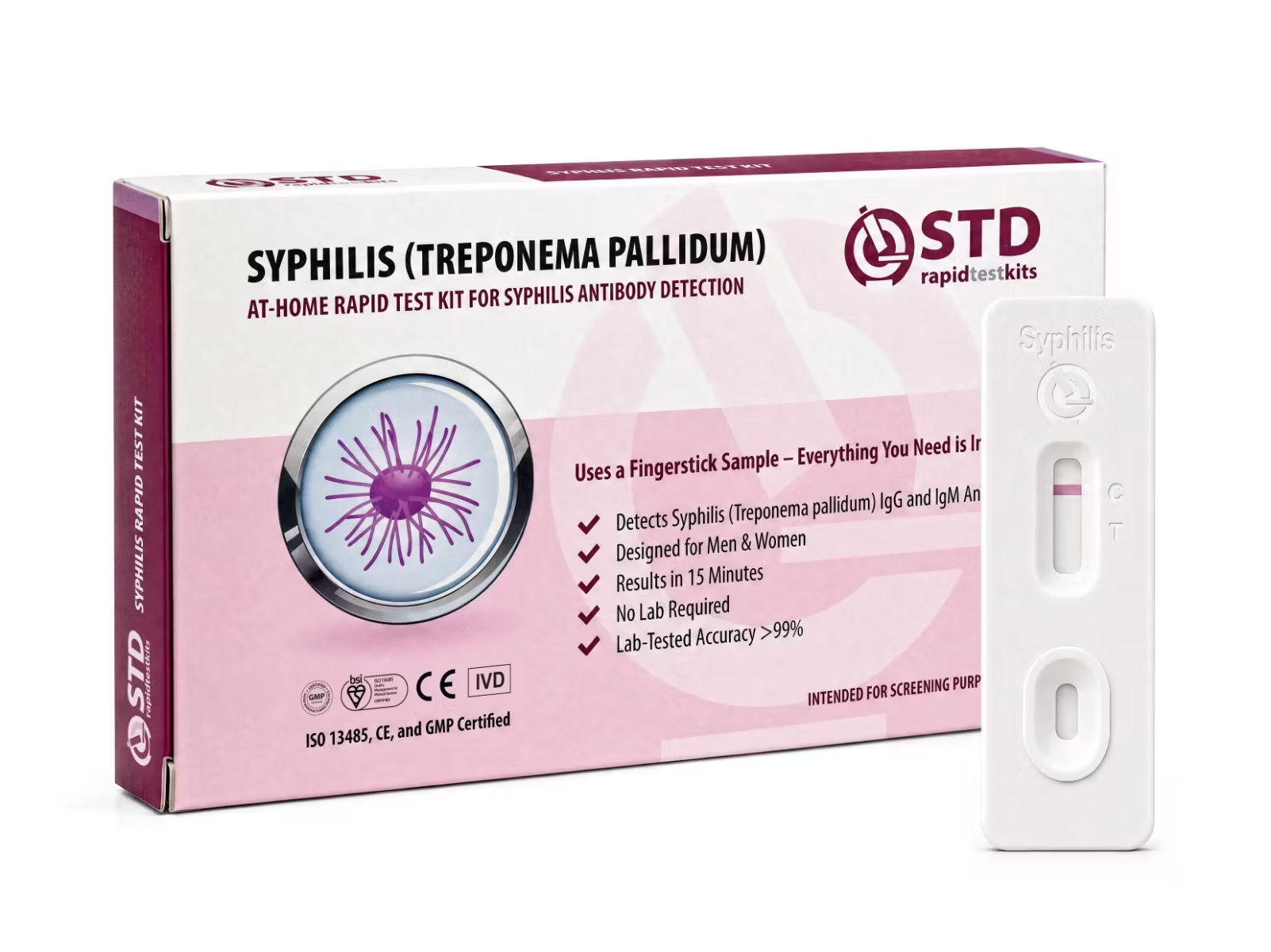
Most at-home syphilis rapid tests use a fingerstick blood sample and a lateral-flow cassette, the same general format as a pregnancy test or a COVID-19 antigen test. The chemistry is different (your blood is reacting with treponemal antigens fixed to the strip), but the workflow looks familiar. Before you open anything, lay everything out on a clean flat surface and check the foil pouch's expiration date.
A typical box includes the items below. Storage matters more than people expect: keep the kit at room temperature, away from glove compartments, radiators, and refrigerators. Heat shifts the chemistry; cold can damage the buffer. If the kit has been left in a hot car or stored next to a heater, treat the result with caution and run a fresh kit if you can.
| Item | Purpose |
|---|---|
| Test cassette (sealed) | The lateral-flow strip where your result develops after blood and buffer are added |
| Alcohol swab | Cleans the fingertip before pricking; must dry fully before blood collection |
| Sterile lancet | Single-use spring-loaded device that pricks the side of your fingertip |
| Capillary pipette | Draws a measured drop of blood and transfers it to the cassette's sample well |
| Buffer solution | Reagent that moves your sample through the strip and binds the antibody-detection chemistry |
| Instructions | Manufacturer-specific timing, drop counts, and result interpretation guide |
Setting up your space (and your nervous system)
Lay everything out on a clean, flat surface. A bathroom counter or a desk both work. Wash and dry your hands thoroughly with soap and warm water; warm hands bleed more easily, which means less squeezing later. Read the paper instructions twice before opening the foil pouch. The instructions in your specific kit override anything you read online, including this guide, because buffer drop counts and well placement vary slightly between manufacturers.
If you're squeamish about the lancet, set a phone timer for the result window the moment you add buffer, then walk away. Reading too early misses a slow-developing positive; reading after 20 minutes lets evaporation create marks that aren't real results. The instruction sheet gives a specific window, usually 10 to 15 minutes, and that window is the one to trust.
Before you start, decide what you'll do with each possible outcome. A negative is a relief, but it doesn't override symptoms. A positive result is a flag. Book a confirmatory blood test at a clinic and bring the rapid-test cassette or a photo of the result with you. An invalid result means you run a fresh kit. We sell the syphilis rapid test described in this guide; full kit details are below.
Read the result between 10 and 15 minutes after the buffer drops. Earlier and you may miss a slow-developing positive; later and evaporation can paint pseudo-lines onto the strip. Marks that appear after 20 minutes do not count.
Step by step: running the test
The hardest part of an at-home test is not the science. It's the moment your hand hovers over the lancet. The whole sequence below takes maybe two minutes of active work plus the read window.
Wash your hands with soap and warm water and dry them completely. Open the alcohol swab and clean a fingertip on your non-dominant hand, usually the ring or middle finger. Let the alcohol fully evaporate before pricking; residual alcohol can interfere with how blood beads on the skin and how it travels through the strip.
Press the sterile lancet firmly against the side of your fingertip. The side of the finger hurts less than the pad and bleeds more easily. Most lancets auto-activate when you press, with a quick rubber-band-snap sensation. Apply gentle pressure from the base of the finger toward the tip until a drop forms. Don't milk it aggressively, that introduces tissue fluid that dilutes your sample and can cause a faulty read.
Use the pipette to draw the drop and transfer it to the cassette's sample well, usually marked "S". Add the number of buffer drops your kit specifies, typically 2 to 3, into the buffer well. Set your timer immediately. Don't tilt the cassette, blow on it, or move it to a different surface during the read window.
If a few drops of blood feel like the worst part of the day, you're not unusual. The most avoidable cause of an invalid result is collecting too little blood or adding the wrong number of buffer drops. Slow down on the volumes and the strip chemistry runs the way it's supposed to.
Reading the lines: one, two, or none
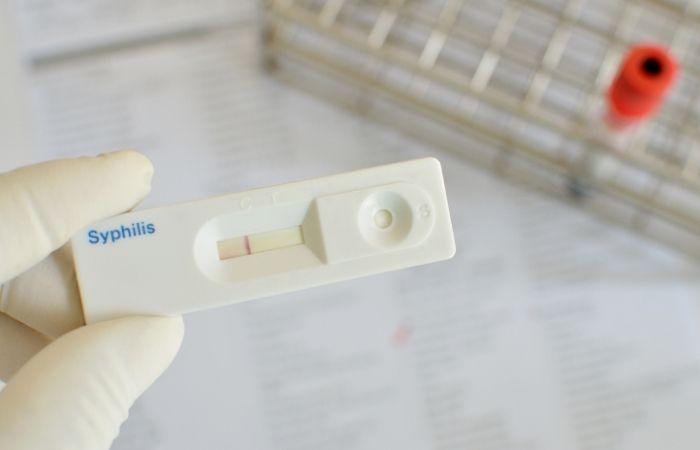
Every syphilis rapid cassette has two zones: a control line (C) and a test line (T). The control line confirms that the buffer flowed through the strip and that the chemistry worked. The test line shows whether your blood contains antibodies against T. pallidum.
If the control line never appears, the test is invalid regardless of what happens at T. Throw out the cassette and run a new kit, paying attention to the buffer drop count and the volume of blood you transferred. The most common cause of a missing control line is too little sample volume or too few buffer drops.
About that faint line. A test line counts even when it's barely visible, as long as the control line is present and clearly developed. Antibody concentration affects line darkness; line darkness does not tell you anything about how recent or how severe the infection is. A whisper-thin pink line means antibodies are present, and you should treat the result as a preliminary positive, then book a confirmatory non-treponemal test (RPR or VDRL, which measure active infection levels rather than just antibody presence) at a clinic.
| What you see | What it means |
|---|---|
| Control line only (C) | Negative: no detectable syphilis antibodies in this sample |
| Control line and test line (C + T) | Preliminary positive: antibodies detected, even if T is faint |
| Test line only (T) | Invalid: control failed, the result cannot be trusted |
| No lines at all | Invalid: the test did not run; check sample volume, buffer drops, and kit expiry |
When the result might mislead you
No screening test is perfect, and at-home rapid tests have specific failure modes worth naming. False negatives happen most often when antibodies haven't had time to form yet. Most people develop detectable antibodies within 3 to 6 weeks of exposure, with some taking up to 12 weeks. If you tested in the first two weeks after a known exposure, a single negative is provisional rather than final; retest at the 6-week mark to be sure.
False positives are less common but real. Treponemal antibody tests can react with antibodies from other spirochetal infections (Lyme disease, leptospirosis, yaws), and some autoimmune conditions, especially lupus, can cause cross-reactivity. A positive rapid result always needs a confirmatory non-treponemal test (RPR or VDRL) at a clinic, both to confirm the screen and to determine whether the infection is currently active.
The third pattern is the invalid result, where the control line never appears or appears very weakly. The reasons are operator-controlled most of the time: too little blood, missed buffer drops, an expired kit, or a cassette stored somewhere too hot or too humid. Run a fresh kit, follow the volume guidance carefully, and if two kits in a row come back invalid, contact the seller before assuming the test is at fault.
| What went wrong | Why it happens | What to do |
|---|---|---|
| Tested too soon after exposure | Antibodies haven't formed yet (typical window 3 to 6 weeks) | Wait until at least 6 weeks post-exposure and retest |
| Control line missing | Too little sample, missed buffer drops, expired kit, or damaged cassette | Discard, run a fresh kit with closer attention to volumes |
| Faint mark appears after 20 minutes | Evaporation creates pseudo-lines outside the read window | Trust only results read inside the 10 to 15 minute window |
| Buffer drops skipped or wrong count | Strip chemistry never fully runs | Run a new kit and follow the manufacturer's drop count exactly |
Disposal, privacy, and the next ten minutes
The post-test minutes are quietly the strangest part. Adrenaline drops, the result is what it is, and there's a real "now what" feeling whether you're holding a single line or two. Logistics first, feelings second.
Wrap the used lancet in tissue or click it back into its safety casing before binning it. The cassette, pipette, and alcohol swab can go into a sealed plastic bag if you want extra discretion, then into normal household waste. Most jurisdictions don't require biohazard handling for single-person home use of a fingerstick lancet, but local rules vary; if you're unsure, check your municipal waste guidance.
For privacy, the kit doesn't transmit your result anywhere. The result is yours unless you decide to share it.
- No app pairing or cloud upload. The cassette is the only place your result exists.
- No clinic notification. Your medical record only learns about the test if you tell your provider.
- No insurer signal. The kit is a consumer purchase, not a billed lab event.
- Order history exists with the retailer the same way any e-commerce purchase does.
What your result actually means
A negative test, taken at least 3 weeks (and ideally 6 weeks) after the exposure you're worried about, is meaningful. It says your blood currently doesn't carry antibodies to T. pallidum. If you tested earlier than 3 weeks, or if you have ongoing symptoms (a painless sore, a rash on your palms or soles, lymph-node swelling), the negative is provisional rather than final. Repeat at 6 weeks, or book a clinic visit for a lab-based test if symptoms persist.
A positive test is a flag, not a diagnosis. The next step is a confirmatory blood draw at a clinic or telehealth lab partner, which combines a treponemal test (similar chemistry to the rapid) with a non-treponemal test (RPR or VDRL) that quantifies how active the infection currently is. The good news worth holding onto: syphilis at every stage except late tertiary disease is curable with antibiotics from a healthcare provider, with a short course often clearing early infection (CDC syphilis overview).
Telling recent partners is part of the next step, both for their health and to break the chain of transmission. Treatment for partners caught early is the same short antibiotic course; it short-circuits the spread that surveillance data keeps tracking upward.
Local public-health departments and several telehealth platforms can notify recent partners on your behalf, anonymously if you prefer. You don't have to send the message yourself, and you don't have to be named. Partners caught early get the same short antibiotic course you would.
When you should test again
One test is rarely the end of the story. There are three situations where retesting is worth scheduling, even after a confident result.
The first is timing. Syphilis has an average antibody-formation window of 3 to 6 weeks, with most cases producing detectable antibodies inside 6 weeks but some pushing closer to 12. If you tested at 5 days post-exposure, a negative result reflects "no antibodies yet" more than "no infection". Retest at 6 weeks, and if exposure was high-risk, also at 3 months.
The second is treatment follow-up. After antibiotic treatment, treponemal antibodies often remain detectable for years, sometimes for life. This is why post-treatment monitoring uses non-treponemal tests like RPR, which measure activity rather than just memory. A rapid treponemal test taken months after a successful treatment course can still show two lines and is not, by itself, a sign of treatment failure.
The third is new exposure. Each new partner without barrier protection resets the clock. Routine retesting on the schedule the CDC suggests for sexually active adults (annually, or every 3 to 6 months for higher-risk patterns) keeps your status current rather than retrospective.
| Situation | When to retest | Why |
|---|---|---|
| Tested within 2 weeks of exposure | At 6 weeks; high-risk exposures also at 3 months | Antibody formation runs 3 to 12 weeks; the early window can miss a real infection |
| After completing antibiotic treatment | Per your clinic's RPR follow-up schedule | Treponemal antibodies persist; non-treponemal RPR titers track whether the infection is active |
| New partner or new unprotected exposure | After each exposure, on the same 6-week timeline | Each exposure restarts the antibody-development clock; prior tests don't cover the new event |
You're not the only one going through this
U.S. syphilis rates have been climbing for over a decade. Numbers don't soothe panic, but they do reframe one thing: whatever you're feeling right now, you are sharing it with millions of other people who walked into the same checkout flow and the same plain-packaged foil pouch.
Testing is what moves a vague fear into a fact, and a fact into a plan. The plan ends one of two ways: a clean negative that lets you move on, or an early-caught infection that an antibiotic course resolves.
U.S. case counts have climbed above 200,000 annually in recent CDC reporting (<a href="https://www.cdc.gov/sti-statistics/">CDC STI Surveillance</a>). The WHO estimated around 8 million adults aged 15 to 49 were infected with syphilis worldwide in 2022 (<a href="https://www.who.int/news-room/fact-sheets/detail/sexually-transmitted-infections-(stis)">WHO STIs fact sheet</a>).
Frequently asked questions
- How accurate is an at-home syphilis rapid test?
- Lateral-flow rapid syphilis tests typically report sensitivity in the low- to mid-90s and specificity above 98% when used correctly and at the right time. Accuracy drops sharply if you test in the first 2 weeks after exposure, before antibodies have formed. Lab-based testing remains more sensitive than any rapid kit, especially for very early or treated infections, so a positive rapid result always needs lab confirmation.
- What does a faint line on a syphilis test mean?
- If the control line is clearly developed and there is any visible line at the test position, even a faint pink or grey one, treat it as a preliminary positive. Antibody concentration affects line darkness, but a faint line and a dark line carry the same meaning at the screening stage: book a confirmatory blood test through a clinic or telehealth provider.
- How soon after exposure should I test?
- Test at 6 weeks for the most reliable read. If the exposure was high-risk, retest at 3 months. The first 2 weeks are too early because antibody formation runs roughly 3 to 12 weeks depending on the individual; a negative inside that early window is provisional, not final, so plan a follow-up rather than relying on the early result.
- My test had no lines at all. What happened?
- No lines, including no control line, means the test was invalid. The most common causes are too little blood, fewer buffer drops than the instructions specify, an expired kit, or a cassette stored in a hot or humid environment. Run a fresh kit, paying close attention to volumes and drop counts. If two kits in a row are invalid, contact the seller before assuming the test is at fault.
- Can I use a syphilis rapid test if I'm pregnant?
- Yes, and you should test during early pregnancy regardless of risk factors. Untreated syphilis in pregnancy can cause stillbirth and serious birth defects, but treatment with penicillin during pregnancy almost completely prevents transmission to the baby. A positive rapid result during pregnancy needs urgent follow-up with your prenatal provider, not a wait-and-see approach.
- I had syphilis years ago and was treated. Will the test still be positive?
- Years after successful treatment, a rapid treponemal test can still show two lines, and that result on its own does not mean the treatment failed. Book a non-treponemal blood draw (RPR or VDRL) at a clinic; that test measures whether the infection is currently active rather than reading lifetime antibody memory. Bring your treatment date when you book.
- Should I tell my partner if I test positive?
- Yes. Syphilis transmits through oral, vaginal, and anal sex, including during the symptomless latent stage, so anyone you've had recent unprotected contact with should know. Most local public-health programs offer anonymous partner-notification services, and several telehealth platforms can send notifications on your behalf. Treatment for partners caught early is the same single antibiotic course.
- Will anyone find out I took an at-home test?
- The kit doesn't transmit your result anywhere. There's no app, no cloud upload, no message to your insurer or doctor. Order history exists with the retailer the same way any online purchase does, but no one in your medical record knows you ran a kit unless you tell them. The result lives only on the cassette in front of you and in whoever you decide to share it with.
- U.S. Centers for Disease Control and Prevention. Syphilis topic pages: stages, symptoms, transmission, and treatment guidance.
- U.S. Centers for Disease Control and Prevention. MMWR Recommendations and Reports: Laboratory Recommendations for Syphilis Testing, United States, 2024. Source for confirmatory-testing protocol, treponemal antibody persistence, and rapid-test framing.
- U.S. Centers for Disease Control and Prevention. Sexually Transmitted Infections Surveillance, with annual case counts and trend data.
- World Health Organization. Sexually transmitted infections (STIs) fact sheet, with global incidence estimates including the 2022 syphilis figure for adults aged 15 to 49.
- National Health Service (UK). Syphilis topic page, including symptom progression, testing pathway, and treatment summary.
- Mayo Clinic. Syphilis topic pages: symptoms, causes, and stage descriptions.
