
Published: August 2025 | Last updated: May 2026 | Editorial review and quality control: Martina N.
There you are, phone in hand, staring at a name in your contacts list. Maybe you just got a positive test result. Maybe a previous partner called to tell you they did. Either way, you are stuck in the space between knowing something and saying something. This guide is for that space. It walks through the timing, the wording, the legal context, and the testing logistics so the conversation lands as care rather than catastrophe.
Key Takeaways
- Disclose as soon as you have clear information, ideally after a confirmed test result, and sooner if exposure was high risk.
- The CDC notes that many STIs, including chlamydia and gonorrhea, are commonly asymptomatic, so people often transmit infections without knowing.
This Is About Responsibility, Not Guilt
Exposure does not make you reckless. It does not make you dirty. It does not make you a villain in someone else’s story. Most sexually transmitted infections are passed by people who do not realize they are carrying anything. The CDC’s STI guidance notes that many infections, including chlamydia and gonorrhea, are frequently asymptomatic, meaning partners can transmit them without any visible sign.
Picture the moment. You and someone you care about, or someone you barely know, had a night that felt easy. Maybe you used protection. Maybe you did not. Days later, a test comes back positive. Or a previous partner reaches out with news of their own. You land in the gray space between panic and follow-through.
The goal here is care, and the work of disclosure is not a self-punishment ritual. It protects both of you from ongoing risk, and it short-circuits the reinfection cycles public health departments routinely flag when partners are not told.
Most STI transmission happens without the person realizing they are carrying anything, and that is simply how asymptomatic infections operate. The productive question at this point is what you both do with the information.
When Should You Tell Them?
Timing matters, because clarity reduces chaos. There is a real difference between firing off a 2 a.m. text in a panic spiral and reaching out once you have something concrete to share. Waiting too long carries its own cost, especially for partners who could be unknowingly transmitting onward.
The right answer depends on what you currently know, what symptoms are present, and what kind of exposure happened. The table below maps the most common situations to a sensible disclosure window.
| Scenario | Risk Level | Recommended Timing to Disclose | Why |
|---|---|---|---|
| You tested positive for a confirmed STI | High | Immediately after receiving results | Prevents further exposure and supports early testing and treatment for partners |
| Partner told you they tested positive | Moderate to High | As soon as you confirm your own exposure window | Shared exposure timeline matters for testing accuracy |
| You have symptoms but no test yet | Variable | Test first unless symptoms are severe | Gathers clarity before raising alarm |
| Condom broke or unprotected sex occurred | Variable | Discuss a testing plan within days | Early openness reduces anxiety and builds trust |
What Do You Actually Say?
This is the part people freeze on, and the words themselves are usually what trip people up.
Imagine sitting at the kitchen table, phone face down, rehearsing. You do not want to sound accusatory. You do not want to sound ashamed. You do not want it to feel like you are making it their fault. A simple four-beat structure works: state the fact, name the timeline, redirect to shared health, then offer a next step.
It can sound like this:
“Hey, I wanted to let you know I recently tested positive for chlamydia. I’m not sure when I got it, but since we were together recently, I wanted you to have the information so you can get tested too.”
Notice what is missing: no blame, no apology spiral, no over-explaining, just information and care.
If you do not have confirmed results yet but suspect exposure, you might say:
“I found out a previous partner tested positive, and since we were together around that time, I’m getting tested. I wanted to give you a heads up so you can decide what feels right for you.”
That keeps the tone calm. Shared responsibility, no finger-pointing.
- State the fact (your result or the known exposure).
- Name the timeline (roughly when you were together).
- Redirect to shared health (you wanted them to have the information).
- Offer a next step (where or how they can get tested).
If They React With Anger
Sometimes people respond with fear, and fear can sound like anger. You might hear, “You gave this to me.” Or worse, “How could you?”
Pause. Unless someone knowingly hid a diagnosis, most transmission happens without awareness. The World Health Organization flags stigma as a barrier to sexual and reproductive health outcomes for people with STIs.
Picture the scene. You are sitting in your car after sending the message. Three dots appear, then disappear, then appear again. The reply lands sharp and fast. Your pulse jumps.
Rather than defending yourself, ground the conversation in facts and next steps. That shifts the energy from accusation to shared solution. If the conversation turns abusive, you are allowed to disengage. Disclosure does not require you to absorb mistreatment.
“I understand this is upsetting. I didn’t know I had it. I’m telling you because I care about your health.”
The line works because it does three things at once: it acknowledges their feelings, it states what you knew at the time, and it redirects to the reason you are speaking up.
Do You Have a Legal Obligation to Tell Them?
This depends on the infection and your state. Several U.S. states have specific disclosure laws for HIV, with the legal landscape varying considerably by jurisdiction. Most other STIs fall under ethical responsibility rather than criminal statutes, unless someone knowingly exposed a partner.
The fear of being sued or charged is common, but in most real-world scenarios involving unintentional exposure, legal consequences are rare. What matters legally is knowledge and intent. Public-health frameworks focus on harm reduction, not punishment of honest mistakes.
Transparency still protects you socially and medically. Silence rarely improves outcomes.
Criminal statutes for non-disclosure exist in some U.S. states specifically for HIV. For most other STIs, disclosure is an ethical responsibility rather than a legal one, unless there is evidence of knowing, intentional exposure. If you are worried about your specific state’s rules, a state health department helpline can confirm.
Testing Windows: What Is Reliable, and When
Fear fades faster when there is a plan. If you tested positive, treatment for bacterial infections like chlamydia and gonorrhea typically begins right away per the CDC’s STI Treatment Guidelines. Viral infections like herpes and HIV require longer-term management but are manageable with current medication.
If you have not tested yet, do it as a way to gain clarity, not as a panic move. The table below summarizes typical window periods based on CDC and manufacturer-label guidance.
| Infection | Earliest Reliable Test | Peak Accuracy | Retest After Treatment |
|---|---|---|---|
| Chlamydia | 7 to 14 days (NAAT) | 14+ days | About 3 months |
| Gonorrhea | 7 to 14 days (NAAT) | 14+ days | About 3 months |
| Syphilis | 3 to 6 weeks | 6 to 12 weeks | 6 to 12 months depending on stage |
| HIV | 10 to 33 days (NAAT) | 45+ days (Ag/Ab test) | Per clinical guidance |
| Herpes (HSV antibody) | 6 to 12 weeks | 12+ weeks | Not typically retested unless symptomatic |

The Reinfection Trap Nobody Warns You About
Something practical gets lost in emotional conversations. When both partners are not treated at the same time for bacterial infections like chlamydia or gonorrhea, reinfection is common. You treat yours. They do not treat theirs. You reconnect weeks later. Suddenly you are positive again and convinced someone cheated. The real explanation is usually biology, not betrayal.
This is why disclosure is strategic as well as ethical. The table below shows what happens with and without partner notification.
| Step | What Happens Without Disclosure | What Happens With Disclosure |
|---|---|---|
| Initial Infection | One partner treated, the other unaware | Both partners informed |
| Post-Treatment Intimacy | Untreated partner reinfects the treated partner | Both treated simultaneously |
| Follow-Up Testing | Confusion and mistrust | Clear timeline and shared prevention plan |
Text or Face-to-Face: Match the Method to the Relationship
There is a quiet debate people do not talk about out loud. Is sending a text cowardly, or is it considerate?
Imagine this. You met on a dating app, saw each other twice, and the connection was warm but casual. That situation probably does not require a sit-down coffee conversation. A direct, respectful message works fine. Written communication often reduces emotional escalation and gives both people room to process privately.
Now picture a different scene. You have been seeing someone for six months. You share playlists. You have met their friends. That conversation deserves eye contact. Tone matters more when attachment runs deeper.
Match the method to the relationship. What should not change is clarity.
Text example for a newer partner:
“Hey, I wanted to let you know I tested positive for gonorrhea this week. I’m getting treated, and since we were together recently, I wanted you to have the information so you can test too.”
In-person example for a longer relationship:
“I got my results back and tested positive for chlamydia. I didn’t know I had it. I care about us, so I want to make sure we both get treated and move forward safely.”
Direct, calm, no dramatic confessions, no self-condemnation speeches.

Anonymous Notification: When Direct Contact Feels Unsafe
There are situations where direct communication feels unsafe or impossible. Maybe the encounter was brief. Maybe it was emotionally volatile. Maybe you fear retaliation.
Public health departments in many U.S. regions, and the NHS sexual-health services in the U.K., offer anonymous partner notification, particularly for HIV and syphilis. These services inform partners that they may have been exposed without revealing your identity.
Choosing anonymity is not cowardice. Sometimes it is the safest route. The priority is making sure someone knows they need testing.
- U.S. state and county health departments run partner-services programs, especially for HIV and syphilis.
- U.K. NHS sexual health (GUM) clinics offer provider-led contact tracing on request.
- Online services let you send a notification message that names the infection but not you.
When the Exposure Was Casual
Hookups carry their own emotional math. There may be no emotional safety net, no built-in trust. Just a message thread and a memory.
In these cases, brevity works best:
“Hey, I recently tested positive for syphilis. I’m being treated. Since we were together recently, I wanted you to know so you can get tested.”
You do not need to relive the night. You do not need to overexplain. You are sharing health information.
Managing Your Anxiety Before You Speak
Your nervous system is loud right now. That is normal. Shame and uncertainty activate the same fight-or-flight circuits as physical danger. But this is a health conversation, not actual danger.
Before reaching out, do three quiet things. Confirm your testing status. Write down the key sentence you want to lead with. Remind yourself that most STIs are treatable, manageable, and common. The WHO estimates more than one million new curable STI cases occur worldwide every day, so you are not an outlier.
Preparation quiets the panic that sharpens tone, and tone shapes how the other person receives the news.
- Confirm your testing status, so you are speaking from facts rather than fear.
- Write down the one key sentence you want to lead with, so the message stays clear under pressure.
- Remind yourself that most STIs are treatable, manageable, and common.
What If You Are Not Sure It Was You?
This is where things get emotionally messy. Maybe you tested positive, but you have had more than one partner in the past few months. Maybe they have too. Suddenly the conversation turns into a silent math equation no one wants to solve.
Here is the part most people avoid. Unless someone has had no other partners and you are within a narrow exposure window, it is often impossible to identify exactly who transmitted what. Mayo Clinic guidance and public-health research consistently note that long latency and asymptomatic carriage make a single source rarely provable.
If someone says, “You gave this to me,” ground the conversation in that uncertainty rather than in defense.
“I don’t know when I contracted it, and I don’t know where it came from. What matters is we both have the information now.”
That framing protects your dignity without escalating blame, and it keeps the conversation on the action both of you can take next.
After You Tell Them: What Comes Next
The conversation ends. Your phone goes quiet. You exhale and wait.
They might respond quickly. They might need space. They might surprise you with kindness. Many people do. Once the shock settles, most adults understand that STIs are common, manageable, and frequently silent.
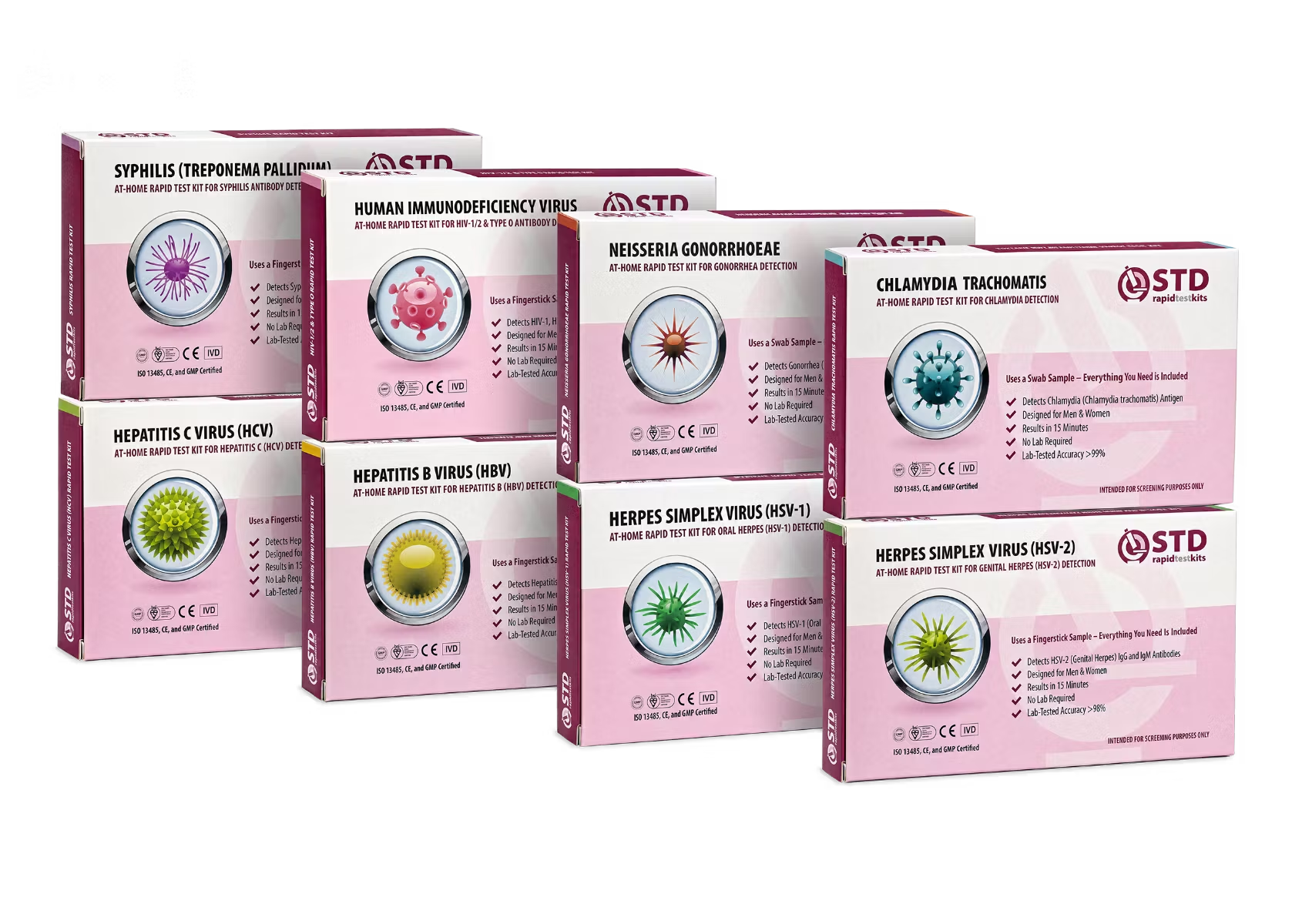
Focus on your follow-through. Complete treatment. Avoid sex until cleared. Retest at recommended intervals. If you need clarity on timing or discreet options, review what is available before the conversation so you are not researching in the middle of it.
Because many sexually transmitted infections produce no symptoms, testing is the only reliable way for someone to know their status.
The Conversation You Are Avoiding Might Save You Both
There is a quiet irony in all of this. The thing you are most afraid of saying is often the thing that prevents bigger consequences later. Untreated syphilis can progress silently. Undiagnosed gonorrhea can cause complications. Even viral infections like herpes are easier to manage when someone knows what they are dealing with.
Picture this. Months from now, they start having symptoms. They trace back partners. Your name comes up. But you never said anything. The narrative shifts from “We handled this responsibly” to “Why didn’t you say something?” That shift is avoidable.
You cannot control someone else’s reaction. You can control your integrity. You can choose transparency over avoidance, facts over fear. Once the conversation is done, you get to exhale. Care is the point here, and care is never something to apologize for.
FAQs
- Do I really have to tell them, even if it was just a hookup?
- If you are asking the question, you already know the answer is yes, even if it was one night, and even if you never planned to see them again. A simple, respectful heads-up is enough. The point is not reliving the night; it is protecting someone’s health.
- What if I am not 100% sure I am the one who exposed them?
- Welcome to the gray zone. Most STI transmissions live there. Unless the timeline is crystal clear and exclusive, it is often impossible to pinpoint who gave what to whom. Shift the frame: ‘I tested positive, and since we were together, I wanted you to know.’ No detective work required.
- Should I apologize?
- You can express care without collapsing into shame. ‘I’m sorry this is stressful, I care about your health’ centers responsibility rather than guilt. Choose that framing.
- Is texting really okay, or is that cowardly?
- Context matters. For a two-date situation or a dating-app connection, a direct text is appropriate. For a long-term partner, face-to-face often feels more respectful. The real question is whether your message is clear, not which medium you used.
- What if I am still waiting on my results?
- If a previous partner already told you they tested positive, it is reasonable to let recent partners know you are getting tested. If you are spiraling on vague symptoms with no confirmed exposure, test first.
- Can we just wait and see if symptoms show up?
- No, that is gambling rather than prevention. Many infections, including chlamydia, gonorrhea, and early HIV, can be completely asymptomatic. Testing is the only reliable way to know.
- Could this ruin my relationship?
- Silence is more likely to damage trust than honesty. Plenty of couples navigate an STI diagnosis and come out stronger because transparency builds trust. It is uncomfortable, but uncomfortable and destructive are not the same thing.
How We Sourced This Article: This guide synthesizes current public-health guidance from the CDC, WHO, NHS, and Mayo Clinic alongside published research on partner notification effectiveness and reinfection rates. It is editorial summary content for general readers, not personal clinical advice. For symptoms or specific clinical questions, please see a licensed provider.
- U.S. Centers for Disease Control and Prevention. STI prevention overview and partner-services guidance, including notes on asymptomatic transmission of chlamydia and gonorrhea.
- U.S. Centers for Disease Control and Prevention. STI Treatment Guidelines covering recommended therapy and retesting intervals for chlamydia, gonorrhea, syphilis, herpes, and HIV.
- World Health Organization. Sexually transmitted infections fact sheet, including the global statistic that more than 1 million curable STIs are acquired every day and notes on stigma as a barrier to sexual and reproductive health outcomes.
- U.K. National Health Service. Sexually transmitted infections (STIs) overview, including partner notification services run through sexual health clinics.
- Mayo Clinic. Sexually transmitted diseases symptoms and causes reference, including notes on the asymptomatic carriage and long latency of common STIs.
