
Published: August 2025 | Last updated: May 2026 | Editorial review and quality control: Martina N.
Finding out you tested positive for gonorrhea is jarring. Telling the person you slept with can feel harder than the diagnosis itself. The good news: most partners react better than people expect, and the conversation gets simpler when you have a script, a sense of timing, and accurate information to share.
This guide walks through what to say, when to say it, and how to handle whatever comes back at you. It is written for people who feel anxious or ashamed, who don't know exactly who exposed whom, and who want to do the right thing without spiraling into a confessional. Gonorrhea is one of the most commonly reported bacterial STIs in the United States, with more than 543,000 cases reported in 2024 (CDC STI surveillance). You are not the first person to have this conversation, and you won't be the last.
Key Takeaways
- Tell recent partners within one to two days of your positive result so they can begin testing and treatment before complications develop.
- Both of you need treatment in the same window. If one starts antibiotics and the other doesn't, the infection passes back and forth indefinitely.
Why This Conversation Feels Impossible
The weight of a positive STI result is rarely about the infection itself. Gonorrhea is treatable, usually with a single antibiotic appointment for uncomplicated cases (per the 2021 CDC STI treatment guidelines for gonococcal infection in adults). The harder part is what testing positive seems to say about you, your choices, or your relationship.
That weight is built from stigma, not biology. Bacterial STIs are common, often symptomless, and easily passed before anyone has reason to test. Reframing the disclosure as a routine health update, rather than a confession, takes some of the pressure off. You aren't admitting wrongdoing; you are giving someone the information they need to protect their own health.
Delaying makes everything worse. Untreated gonorrhea can lead to pelvic inflammatory disease, infertility, and a higher risk of transmitting or acquiring HIV (WHO). The longer your partner stays in the dark, the more time those complications have to develop, and the more likely the two of you are to reinfect each other.
This article is published by stdrapidtestkits.com, which sells at-home STI testing kits. We recommend products based on what fits the reader's situation, not commercial pressure. If your partner needs a test we don't sell (a pharyngeal swab, for example), we will say so plainly.
When to Have the Conversation
The general rule: tell partners within one to two days of your positive result. That window gives them time to get tested and start treatment before they pass the infection on, and before they develop complications themselves.
If you have already started antibiotics, you still need to tell them. Treating only one half of a sexual pair leads to what clinicians call ping-pong transmission, where the untreated partner reinfects the treated one the moment sex resumes. The CDC's expedited partner therapy guidance exists for exactly this reason: in many states, your provider can prescribe treatment for your partner without seeing them in person, to break the cycle.
Timing also depends on the relationship. The table below maps four common situations to a suggested window and approach.
| Situation | When to tell | Suggested approach |
|---|---|---|
| Just tested positive, starting treatment | Within one to two days of your result | Clear, compassionate message that includes a testing recommendation |
| Waiting on confirmatory results but exposure is likely | As soon as you suspect risk | Frame as a potential exposure and suggest mutual testing |
| Past partner, weeks or months ago | As soon as you can reach them | Short factual message; anonymous notification if direct contact isn't safe |
| Ongoing partner or relationship | Before the next time you have sex | In-person or phone conversation, with room for their questions |
What is the calmest way to tell a partner I have gonorrhea?
Within one to two days of your positive result, send a short, factual message: that you tested positive, that you have started or are arranging treatment, and that they should get tested even if they feel fine. Keep blame out of it. A text often works as well as an in-person conversation. The priority is that they hear it from you, in time to act.
How to Actually Say It
Not every situation calls for the same approach. A long-term partner deserves more than a text. A former hookup may be impossible to reach any other way. Three formats cover almost every scenario.
By text, for casual or hard-to-reach partners:
Hi. I wanted to let you know I tested positive for gonorrhea. I have started treatment. You should get tested too, even if you don't have symptoms. Happy to share testing options if that would help.
By phone or in person, for ongoing partners:
I got tested recently and the result came back positive for gonorrhea. I am on treatment now. I am not trying to assign blame. I just want both of us to get treated so we can move past this together.
Anonymously, when direct contact feels unsafe or impossible:
Someone you were recently sexually involved with has tested positive for gonorrhea and wants you to know. Please consider getting tested.
For the anonymous route, services such as TellYourPartner.org and many local health departments will send a notification on your behalf without revealing your identity. Use these tools without guilt. They exist to make disclosure possible in situations where direct contact would put someone at risk or simply isn't realistic.
Text works for casual or hard-to-reach contacts. Phone or in person is better for ongoing partners. Anonymous services exist for any situation where direct contact feels unsafe or simply isn't possible.
When the Response Isn't What You Hoped
Some partners respond with grace. Others react with denial, anger, or silence. None of those reactions are predictable, and none of them are your job to manage. Your job is to deliver accurate information in time for the other person to act on it.
If a partner accuses you of cheating or claims you have ruined their life, that response is shaped by stigma rather than by science. Gonorrhea can sit silently in the genitals, throat, or rectum for weeks (CDC), which means tracing exactly who passed it to whom is often impossible. Calmly stating the facts, then stepping back from the argument, usually defuses the worst of it.
If you are worried about retaliation, an abusive partner, or a former contact who might harass you, an anonymous notification through your local health department is the safer path. Public-health partner-notification programs in most states will reach out confidentially on your behalf, with no information about you shared.
| Partner reaction | What it might mean | Suggested response |
|---|---|---|
| “Are you saying I gave it to you?” | Defensive or confused | “I'm not blaming you. I just want both of us to get tested.” |
| Silence or ghosting | Overwhelmed or avoiding | Respect the space. You've done your part. Consider anonymous re-notification if their health is genuinely at risk. |
| “You should have told me sooner.” | Scared or angry | “I told you as soon as I knew. I get that this is hard. I'm trying to do the right thing.” |
| “Thank you for telling me.” | They value your honesty | Offer to share treatment information or testing options if they want them. |
Why Both of You Need Treatment in the Same Window
Gonorrhea treatment is short. Per the 2021 CDC STI treatment guidelines, the current recommended regimen for uncomplicated infection is a single 500 mg intramuscular dose of ceftriaxone (1 g for people weighing 150 kg or more). Treatment plans should always come from a clinician who can review your specific situation, including any antibiotic allergies or co-infections.
The piece that surprises people: you and your partner need to clear the infection at the same time. If one of you finishes antibiotics and resumes sex with the other before they have been treated, the bacteria comes right back. The same CDC guidance recommends abstaining from any sexual contact for seven days after treatment, and only resuming once all partners have also been treated.
Retesting also matters. Even after a clean course of treatment, the CDC recommends a follow-up test about three months later to confirm you haven't been reinfected. The table below summarizes the most common treatment-and-retesting situations.
| Situation | Next step | Retesting window |
|---|---|---|
| You have started antibiotics | Tell partners; avoid sex for at least seven days after treatment is complete | Re-evaluate if symptoms persist after treatment |
| Your partner started treatment after you | Use protection or abstain until both of you have completed treatment | Retest about three months later to confirm no reinfection |
| You had unprotected sex after your diagnosis | Notify the person promptly | Recommend full STI screening, not just a gonorrhea test |
What If You're on the Receiving End?
If a partner comes to you with the news, take a breath before responding. The first thing they need is acknowledgement, not interrogation. They did a hard, responsible thing by telling you, and your reaction shapes whether they'll do it again with the next person.
Get tested promptly even if you feel fine. Gonorrhea is often asymptomatic, particularly in the throat or rectum (CDC), so a normal-feeling body is not proof that you weren't exposed. Most clinicians can run a nucleic acid amplification test (NAAT) from a urine sample or a self-collected swab; results typically come back within a few days.
Avoid the urge to assign blame in the moment. Whether you stay together, take a break, or end things is a real question for later. For the next 24 hours, the priority is testing and, if needed, treatment.

Tools and Services That Help
If you'd rather not improvise, several free or low-cost resources exist for both disclosure and testing.
Anonymous partner-notification platforms. TellYourPartner.org and similar services run by local health departments will send a short, factual heads-up on your behalf. Useful for past partners, hookups, or any situation where direct contact would be unsafe or unwelcome.
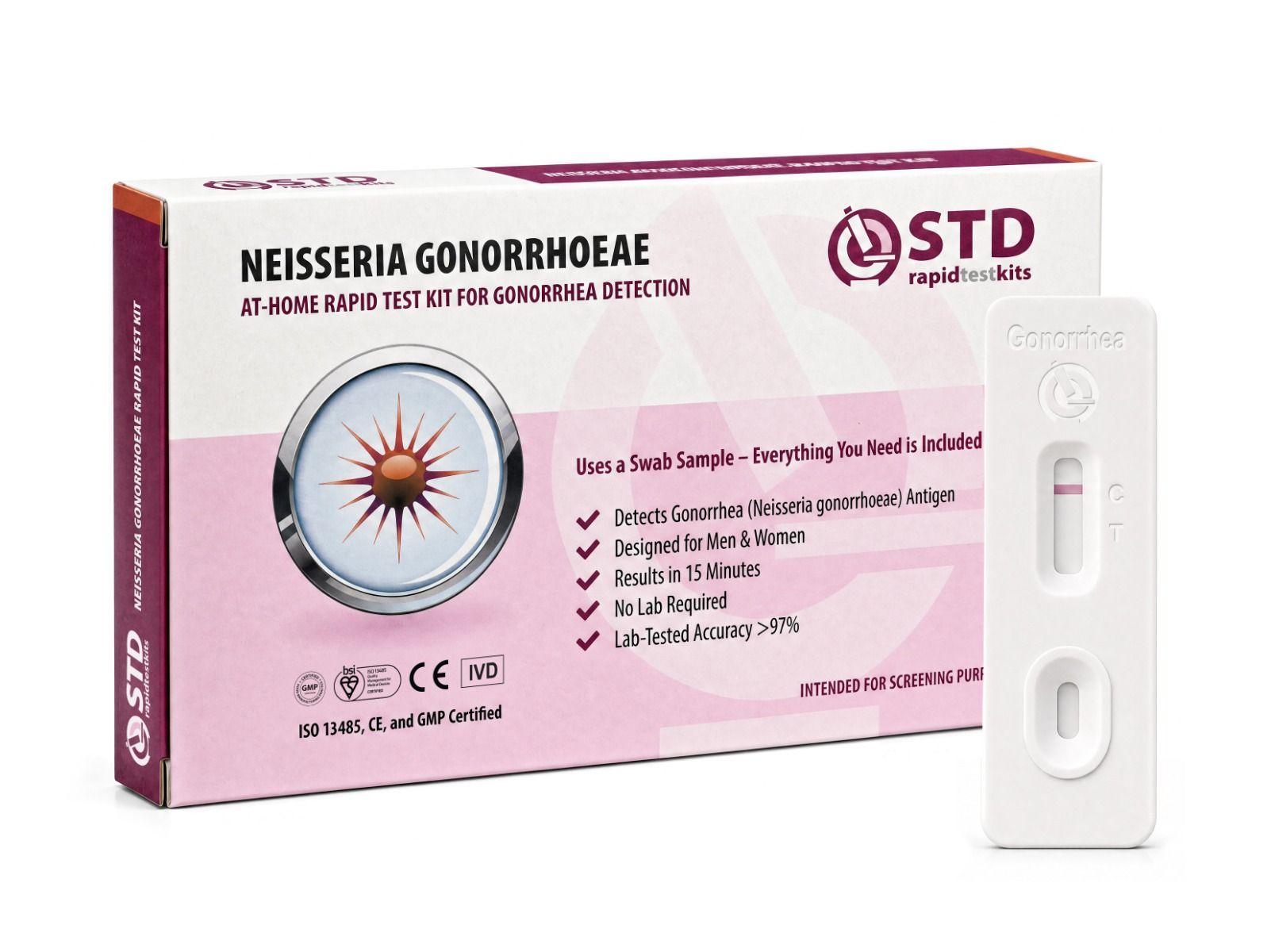
At-home rapid testing. For a partner who wants a quick screen without scheduling a clinic visit, rapid lateral-flow swab kits give a result at home in about fifteen minutes. These home kits screen accurately when used after the appropriate window period, and a positive home result is worth confirming with a clinician so that treatment can be arranged.
Mental-health support. Shame after a positive test is common and survivable. The SAMHSA National Helpline offers free, confidential, 24/7 referrals for mental-health and substance-use support, and many people find a therapist who works in sexual health helpful if the diagnosis is sitting heavier than it should.
Moving Forward, and Dating Again
A positive gonorrhea test does not mean your sex life is over. It means you got tested, you treated the infection, and you communicated with the people who needed to know. That sequence is more responsible than most people manage.
If you're newly single or starting to date after a positive test, two habits make the next chapter easier. The first is regular testing, even when you feel fine and especially after a new partner. The CDC recommends that sexually active women under 25 get screened annually for gonorrhea and chlamydia, with more frequent screening for higher-risk situations (CDC). Men who have sex with men should be screened at least annually at the relevant anatomical sites of exposure, with more frequent screening if risk behaviors persist (USPSTF, citing CDC).
The second habit is normalizing the testing conversation early in any new sexual relationship. Saying when you last tested, what you tested for, and asking the same of a new partner shifts the dynamic from awkward to routine. Some people prefer to do it before any clothes come off; others wait until the conversation feels natural. Either timing is fine. What matters is that the conversation happens.
If you and a new partner both want a baseline before sex, a multi-infection home kit can give a fast screening picture for the most common STIs in a single sitting, with no clinic appointment required.
Gonorrhea is a common sexually transmitted disease. If left untreated, gonorrhea can cause serious and permanent health problems in both women and men.
FAQs
- Do I have to tell every partner I've had recently?
- Most public-health guidance recommends notifying partners from at least the past 60 days, since gonorrhea can be silent for weeks. If your symptoms or last negative test go further back, extend the window to cover that period. A short, factual notification is more useful than a long apology, and it protects more people than just the person you're talking to.
- Can I tell them anonymously?
- Yes. Services such as TellYourPartner.org and local health-department partner-notification programs will send a heads-up on your behalf without naming you. This is widely used when there is a safety concern, when a past relationship would make direct contact awkward, or when you've lost touch with the person.
- What if I don't know who passed it to me?
- That is the norm rather than the exception. Gonorrhea is often asymptomatic, particularly in the throat and rectum, so it can be carried for weeks before anyone has reason to test. Focus on what you can control: telling recent partners and getting yourself treated. Trying to reconstruct the exact transmission chain rarely produces a useful answer.
- How long after treatment can I have sex again?
- The 2021 CDC STI treatment guidelines say wait seven days after treatment and only resume sex once all partners have also been treated. Resuming earlier risks immediate reinfection, even if your own treatment worked.
- Will my partner need a different test if they were exposed in the throat or rectum?
- Yes. Genital, pharyngeal, and rectal gonorrhea require different sampling methods. Throat and rectal testing is best done at a clinic or sexual-health service, since home swab kits sold in the US are validated for genital sampling rather than for those anatomical sites. For a throat or rectal screen, point your partner toward a local clinic.
- What if my partner refuses to get tested?
- You have given them the information they need; the decision is theirs. If you live in a state that allows expedited partner therapy, your clinician may be able to prescribe treatment for them through you, which sometimes lowers the barrier. Otherwise, the priority is to protect your own future health by completing your treatment and using protection going forward.
- Should I get tested again later, even if my treatment worked?
- Yes. The CDC recommends a follow-up test about three months after treatment to confirm you haven't been reinfected. Reinfection is common and most often happens via an untreated partner returning to the same sexual rotation.
- How accurate are home rapid tests for gonorrhea?
- Rapid lateral-flow swab kits used after the appropriate window period give a screening result with good agreement to laboratory NAAT testing in many comparison studies. Sensitivity is highest when the swab is collected correctly and after the infection has had time to be detectable. For sensitivity and specificity figures specific to our kit, see the product page or the instructions included in the box. A positive home result is worth confirming with a clinician so that treatment can be started.
How we sourced this article: We combined current guidance from the U.S. Centers for Disease Control and Prevention, the World Health Organization, the U.S. Preventive Services Task Force, and the UK National Health Service, alongside SAMHSA's mental-health support resources, to make this guide practical, compassionate, and clinically grounded. The reviewer is a medical doctor who checked the piece for alignment with current public-health guidance.
- U.S. Centers for Disease Control and Prevention. Gonorrhea: information on transmission, symptoms, screening intervals, and follow-up testing recommendations.
- U.S. Centers for Disease Control and Prevention. STI Treatment Guidelines (2021): gonococcal infection in adults, including ceftriaxone regimen and seven-day post-treatment abstinence.
- U.S. Centers for Disease Control and Prevention. Expedited Partner Therapy: how clinicians can prescribe treatment for sexual partners to prevent reinfection.
- U.S. Centers for Disease Control and Prevention. Annual STI surveillance data, including 2024 gonorrhea case counts in the United States.
- World Health Organization. Sexually transmitted infections fact sheet: complications of untreated gonorrhea, including pelvic inflammatory disease and infertility.
- U.S. Preventive Services Task Force. Chlamydia and Gonorrhea Screening: recommendation statement and accompanying CDC screening-interval guidance for MSM.
- UK National Health Service. Gonorrhea: symptoms, testing, and treatment information aimed at the general public.
- Substance Abuse and Mental Health Services Administration. National Helpline: free, confidential, 24/7 mental-health and substance-use support and referrals.
