

Published: August 2025 | Last updated: April 2026 | Editorial review and quality control: Martina N.
A sore throat after a sexual encounter is one of those Google searches that spirals fast. Most of the time the answer is reassuringly mundane: dry winter air, allergies, post-nasal drip, or a virus running through your social circle. But pharyngeal gonorrhea, the clinical name for a gonorrhea infection of the throat, is real and more common than most people realize, particularly after unprotected oral sex with a new partner.
The complication: the throat infection is usually silent. Most people who carry it feel completely fine, and that's exactly why it continues to circulate. The rest of this article walks through how transmission actually works, what the (rare) symptoms look like, when to test, what at-home rapid kits do and don't cover, and what treatment looks like if a test comes back positive.
Can oral sex cause gonorrhea in the throat?
Yes. Pharyngeal gonorrhea spreads when bacteria from a partner's genital infection reach throat tissue during oral sex, and most cases cause no symptoms at all. The CDC recommends a throat swab analyzed by NAAT for diagnosis, with the most reliable testing window 7 to 14 days after exposure. Treatment is a single intramuscular antibiotic injection (500 mg ceftriaxone). At-home rapid lateral-flow swab kits use a genital sample and don't test the throat directly, so for pharyngeal screening you'll need a clinic; the home kit can still rule out the genital exposure from the same encounter.
Key Takeaways
- Pharyngeal gonorrhea is usually silent. The CDC describes most throat infections as asymptomatic, so testing is the only reliable way to know.
- At-home rapid swab kits use a self-collected genital sample, not a throat swab. They cover the genital exposure from the same encounter; a clinic NAAT throat swab handles the pharyngeal site.
How oral sex moves gonorrhea to the throat
Neisseria gonorrhoeae, the bacterium that causes gonorrhea, infects mucous membranes: the urethra, cervix, rectum, eyes, and pharynx. When a person performs oral sex on a partner with a genital gonorrhea infection, those bacteria come into direct contact with throat tissue and can colonize it. Penetration, ejaculation, and visible symptoms on the partner are not required. Mucous-membrane contact with infected secretions is enough.
The reverse direction (someone with throat gonorrhea infecting a partner's genitals during oral sex) is also possible, though research suggests it's a less efficient route than genital-to-throat transmission. Either way, oral sex is not a low-risk shortcut around STIs. The CDC's About Gonorrhea page explicitly lists the throat as a recognized site of infection, and the agency's screening recommendations call for routine throat testing in higher-risk populations.
Worth noting: the throat is not an immune shield. It's mucous-membrane tissue, biologically similar to the genitals in how bacteria establish and persist there.
- Performing oral sex on an infected partner (fellatio or cunnilingus). Bacteria from the partner's urethra or cervix transfer to the back of the throat. This is the dominant route.
- Oral-anal contact (rimming) with an infected partner. Less common, but documented in surveillance data.
What pharyngeal gonorrhea feels like
Most cases of throat gonorrhea cause no symptoms at all. The CDC's STI treatment guidelines describe pharyngeal infection as "usually asymptomatic," which is the central reason it goes undiagnosed and continues to spread. When symptoms do appear, they tend to be subtle and easy to mistake for a viral cold or seasonal allergies.
Symptoms that can show up include:
- A persistent or recurring mild sore throat
- Redness or mild swelling in the back of the throat
- Slightly tender lymph nodes in the neck
- Mild discomfort when swallowing
- Occasionally, white patches or pus on the tonsils
What pharyngeal gonorrhea typically does not cause: a high fever, full-body aches, severe pain when swallowing, or the abrupt, dramatic onset that strep throat is known for. The infection sits relatively quietly in pharyngeal tissue and rarely triggers a strong systemic response.
Symptoms, when they appear, typically surface around five to ten days after exposure and often fade in and out over weeks rather than escalating.
| Feature | Throat Gonorrhea | Strep Throat | Common Viral Sore Throat |
|---|---|---|---|
| Onset | Gradual or unnoticed | Sudden and painful | Gradual |
| Severity of pain | Mild or absent | Severe | Mild to moderate |
| Fever | Uncommon | Common (often >38°C) | Sometimes (low-grade) |
| Swollen lymph nodes | Sometimes mild | Common, tender | Common |
| White patches or pus | Occasionally | Often | Rare |
| Sexual exposure link | Yes (oral sex) | No | No |
| Resolves on its own | Unlikely without treatment | Some viral mimics resolve; bacterial strep needs antibiotics | Usually within 7–10 days |
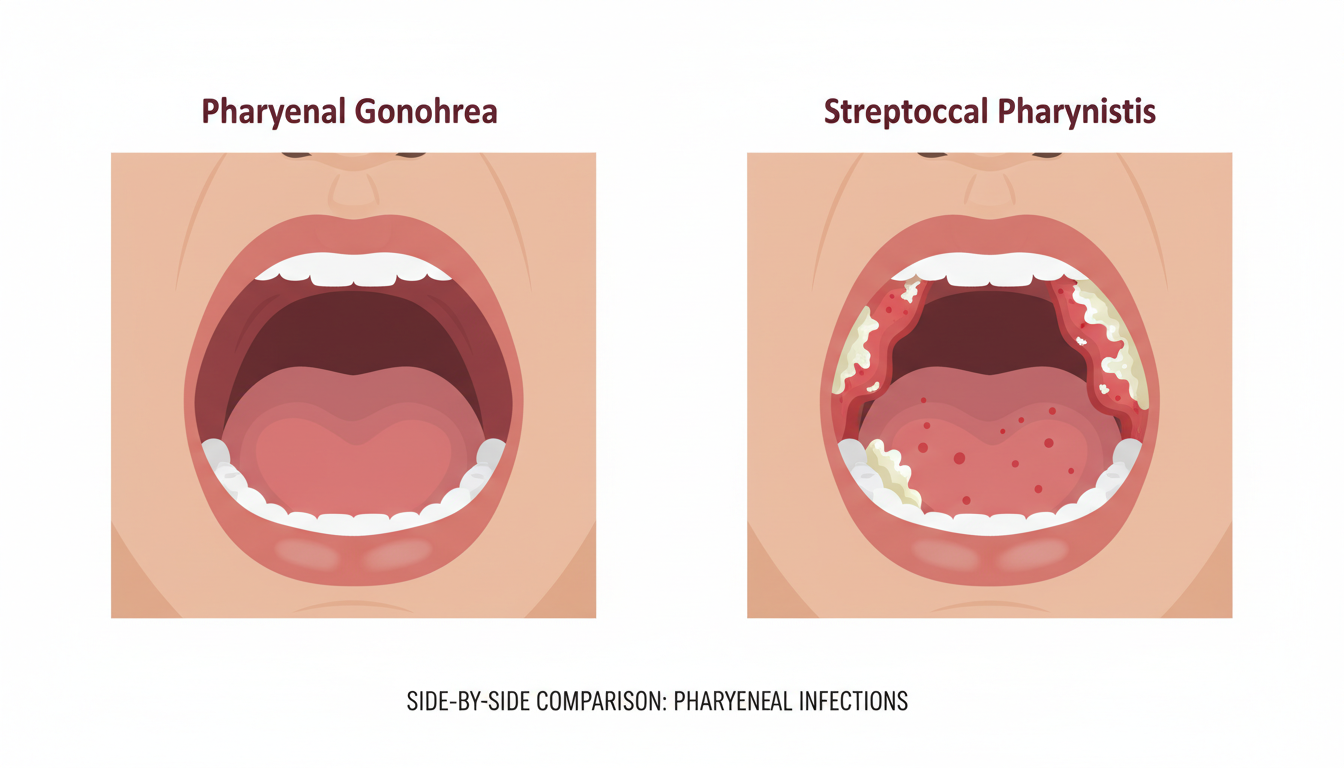
Throat gonorrhea vs strep throat: how to tell the difference
Bathroom-mirror diagnosis with a phone flashlight is everyone's first step, and it's also unreliable. Both strep and pharyngeal gonorrhea can show redness with occasional white patches; the camera roll won't tell you which one you have. Context matters more than visual inspection, and exposure history is where to start. Strep throat is bacterial too (Streptococcus pyogenes), but it spreads through respiratory droplets, not sex. If your throat soreness started during cold-and-flu season after a sick coworker coughed across your keyboard, strep is statistically more likely. If it started a week or two after unprotected oral sex with a new partner, pharyngeal gonorrhea climbs the differential.
Strep also tends to come with sudden, severe pain when swallowing, fever above 38°C, and tender front-of-neck lymph nodes. Pharyngeal gonorrhea tends to come with quiet discomfort or nothing at all. The CDC's STI treatment guidelines note that pharyngeal gonococcal infection presents very differently from common viral or streptococcal pharyngitis, and recommend testing whenever exposure is plausible regardless of how mild the throat symptoms feel.
When the symptoms are ambiguous and exposure is plausible, both conditions can be tested at a clinic on the same visit. A rapid strep antigen test takes minutes; a gonorrhea throat NAAT is sent to a lab and takes a few days. Treatment differs (penicillin or amoxicillin for strep, intramuscular ceftriaxone for gonorrhea), so accurate diagnosis matters before antibiotics are chosen.
When (and how) to test after oral exposure
Timing matters as much as choosing the right test. Testing too early after exposure can produce a false negative because Neisseria gonorrhoeae needs time to multiply in pharyngeal tissue to detectable levels. The window where most pharyngeal NAATs become reliably positive is generally 7 to 14 days after exposure. Testing in the first few days isn't "wrong," but a negative result that early should be repeated within the optimal window.
Diagnostic options:
- Clinic throat swab analyzed by NAAT. This is the laboratory gold standard. The CDC's STI treatment guidelines specifically recommend NAAT testing of pharyngeal swabs for any patient with relevant exposure history.
- Self-collected throat swab via a clinic-affiliated mail-in NAAT service, available through some sexual health clinics and telehealth programs.
- Urine-only kits will not detect a throat infection. Urine samples test urethral cells; bacteria living in pharyngeal tissue won't show up.
If you also had genital contact during the same encounter (kissing, oral, plus penetrative sex or shared toys), test both sites. People can have a positive throat result alongside a negative genital result, or vice versa; the anatomical sites are independent and need to be sampled separately.
Days 1–3: Too early. NAAT may miss low bacterial loads. Wait or plan to retest.
Days 4–6: Possible detection but elevated false-negative risk. A negative here warrants follow-up.
Days 7–14: Optimal window. A negative NAAT in this window with no new exposure is reassuring.
Day 15+: NAAT remains accurate as long as the infection hasn't been treated.
What at-home rapid test kits cover (and what they don't)
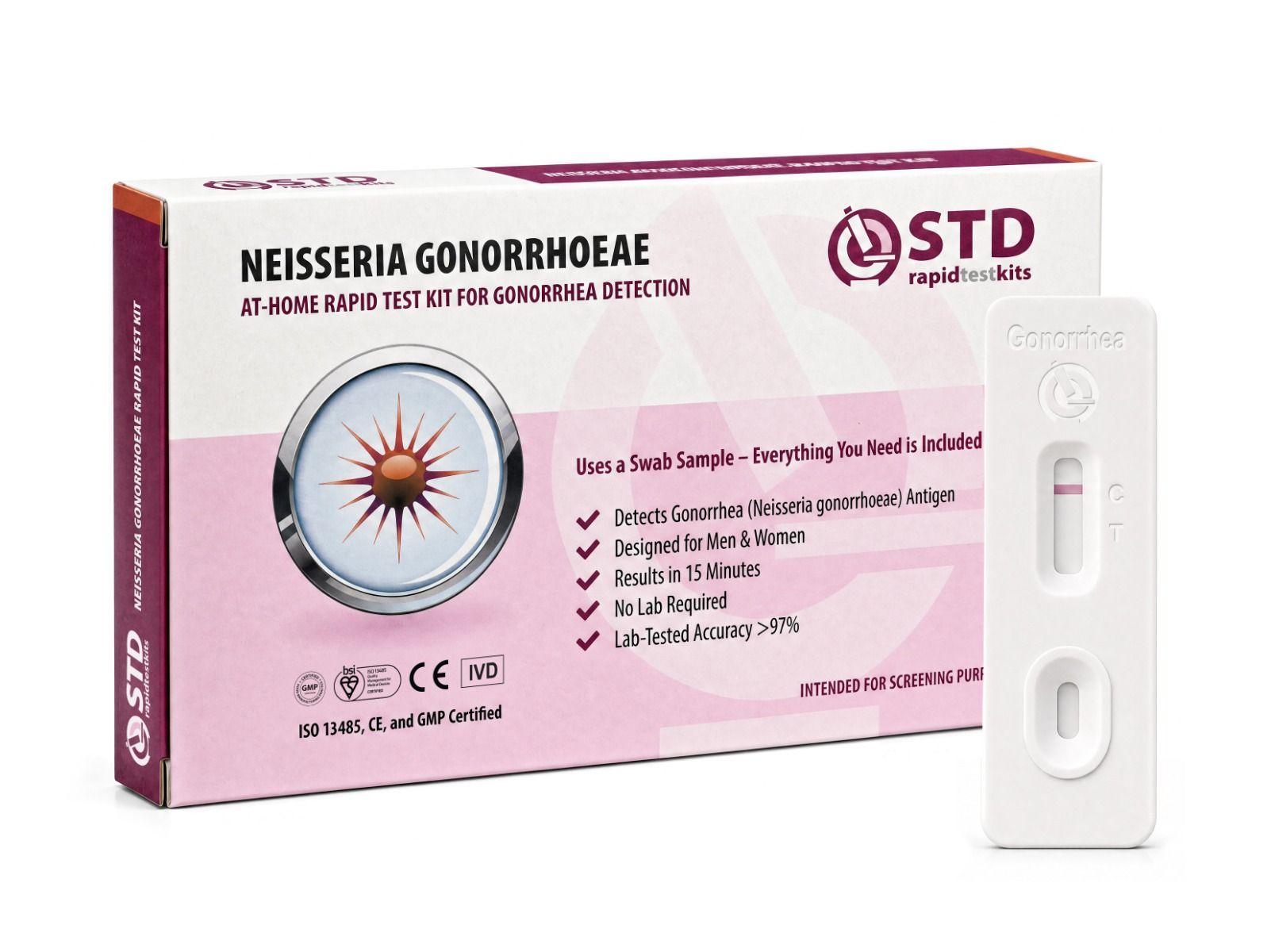
The at-home rapid tests sold here at stdrapidtestkits.com are lateral-flow immunoassays that use a self-collected genital (vaginal or penile) swab, not a throat swab. They detect chlamydia and gonorrhea bacteria at the genital site, where most infections from heterosexual penetrative sex actually occur. They will not tell you whether you have a throat infection. For the pharyngeal site specifically, you'll need a clinic NAAT throat swab; we don't sell that.
That gap matters, but it isn't a reason to skip home testing entirely after an oral exposure event. Most encounters that involve oral sex also involve genital contact on the same evening, whether through kissing, fingering, penetrative sex, or shared toys and lubricants. Bacteria from any of those routes can colonize multiple sites. Screening the genital exposure with a fast, private home kit gives you clarity on the route a home kit is designed for, and a clinic visit fills in the throat piece.
The complementary picture:
- For the throat: clinic NAAT throat swab is the right tool. We don't sell that; this article isn't going to pretend otherwise.
- For the genital exposure from the same encounter: our rapid lateral-flow kit covers chlamydia and gonorrhea with a 15-minute result.
- For broader bloodborne screening after a higher-anxiety exposure event: a multi-STI combo kit covers HIV, syphilis, and hepatitis B and C from a fingerstick blood sample.
One technical clarification worth keeping in mind: lateral-flow chemistry is meaningfully different from laboratory NAAT. Lab NAAT amplifies bacterial DNA and reaches higher analytical sensitivity, particularly in low-bacterial-load asymptomatic infections. Home rapid screens are quicker and private, and they're useful for symptomatic or higher-bacterial-load infections; positives are worth confirming at a clinic, and any negative result with a recent or higher-risk exposure is also worth a confirmatory clinic test.
Treatment, complications, and the antibiotic resistance problem
The CDC's 2021 STI treatment guidelines recommend a single 500 mg intramuscular dose of ceftriaxone for uncomplicated pharyngeal gonorrhea in adults (1 gram for people weighing 150 kg or more). Most patients respond quickly, and any mild symptoms typically resolve within several days. Test-of-cure follow-up at 7 to 14 days post-treatment is recommended specifically for pharyngeal infections, because the throat is harder to clear than genital sites.
Untreated, throat gonorrhea is unlikely to clear on its own. Some infections may seem to fade as inflammation subsides, but the bacteria can persist in pharyngeal tissue for weeks to months and continue to be transmissible during that time. Possible complications include:
- Transmission to partners through subsequent oral sex.
- Spread to the bloodstream in rare cases (disseminated gonococcal infection, or DGI), causing skin lesions, joint inflammation, and fever.
- Increased susceptibility to HIV transmission if exposed during the active infection, due to inflamed mucosal tissue.
The pharyngeal site is also a particular concern for antibiotic resistance. The throat is one of the body environments where Neisseria gonorrhoeae can exchange genetic material with related Neisseria species. Resistant strains have already been identified globally, and the World Health Organization has flagged gonorrhea as a high-priority resistance threat. Incompletely treated pharyngeal infections create selection pressure for resistance, which is why proper diagnosis and full completion of prescribed antibiotics matter.
For pharyngeal gonorrhea specifically, the CDC recommends returning for a follow-up NAAT 7 to 14 days after treatment to confirm the bacteria have been eradicated. This is more rigorous than the follow-up advice for genital infections and reflects the harder-to-clear nature of throat infections plus the resistance concern.
Pharyngeal gonococcal infections are usually asymptomatic but can cause sore throat. Eradication of pharyngeal infection is more difficult than eradication of urogenital and rectal infections.
Reinfection and partner notification
Treatment works, but reinfection is common, particularly when sexual partners aren't treated at the same time. A familiar pattern: one partner completes a course of antibiotics, feels fine, and resumes sex with an untreated partner the following week. Within days, they've been re-exposed and the infection returns.
Standard clinical guidance is to:
- Notify all sexual partners from the past 60 days (or the most recent partner if longer ago) so they can be tested and treated.
- Avoid sexual contact for 7 days after both partners have completed treatment.
- Retest at three months after treatment, regardless of whether symptoms return. Reinfection rates are high enough that this catch-up screen is part of CDC guidance.
Partner notification can be uncomfortable. Many sexual health clinics offer anonymous notification services that send a partner a message about possible exposure without revealing the source.
- Past 60 days: notify all sexual partners (or the most recent partner if longer ago) so they can be tested and treated.
- 7 days post-treatment: avoid sexual contact until both partners have completed antibiotics and the 7-day window has passed.
- 3 months post-treatment: retest, regardless of whether symptoms return. Reinfection from untreated partners is the most common reason positives reappear.
Prevention without giving up oral sex
Preventing pharyngeal gonorrhea doesn't require eliminating oral sex from your life. It does require honest conversations, consistent barrier use during higher-risk encounters, and routine screening when sexual networks change.
Practical measures with evidence behind them:
- Condoms during fellatio and dental dams during cunnilingus or rimming substantially reduce transmission risk. They're not perfect but they meaningfully shift the odds. The NHS guidance on gonorrhoea explicitly recommends barrier methods during oral sex with new or non-monogamous partners.
- Routine screening every 3 to 12 months for sexually active people with multiple partners, with the interval shorter for people in higher-prevalence networks (per CDC screening recommendations). Screen at all relevant anatomical sites (throat, genitals, rectum) when exposure history warrants it.
- Honest, non-judgmental conversations with partners about recent testing, current symptoms, and risk factors. The goal is information sharing, not interrogation.
- Avoiding sexual contact while symptomatic or undergoing treatment.
Emerging research is also looking at doxycycline post-exposure prophylaxis (doxy-PEP), which has shown promise for reducing chlamydia and syphilis incidence in some populations and is being studied for gonorrhea, with mixed results so far. Talk to a clinician if this is something you want to consider; it's a prescription-only intervention with side effects worth discussing.
- Barrier methods during oral sex. Condoms during fellatio and dental dams during cunnilingus or rimming meaningfully reduce transmission risk per NHS and CDC guidance.
- Routine screening every 3 to 12 months for sexually active people with new or multiple partners, with throat swabs added at the clinic visit when oral exposure is part of the picture.
When throat symptoms warrant immediate care
Most pharyngeal gonorrhea cases are mild or asymptomatic and don't require an emergency visit. But certain throat symptoms point to acute conditions that need same-day evaluation regardless of sexual history.
Seek urgent medical care for: high fever (above 39°C / 102°F) with severe throat pain; difficulty breathing or noisy breathing; drooling or inability to swallow saliva; one-sided severe neck swelling with restricted neck movement; or visible pus at the back of the throat with a muffled "hot potato" voice.
These point toward conditions like peritonsillar abscess, severe streptococcal infection, or epiglottitis, which need urgent in-person treatment, not at-home screening. Severe throat pain is statistically more likely to be one of these than gonorrhea, but it always warrants assessment.
Common myths about throat gonorrhea, briefly addressed
Five claims that come up often, against what authoritative sources report:
- "Oral sex doesn't transmit STIs." False. Oral-genital contact transmits gonorrhea, chlamydia, syphilis, herpes (HSV-1 and HSV-2), HPV, and HIV (with much lower per-act efficiency for HIV than genital exposure).
- "If I had it, I'd know." Usually false. Pharyngeal gonorrhea is asymptomatic in the majority of cases per CDC data. Symptoms cannot rule infection in or out.
- "Mouthwash will prevent it." Largely unsupported. A few small studies have suggested antibacterial mouthwash might briefly reduce pharyngeal bacterial load, but no major clinical guideline endorses mouthwash as a substitute for testing or treatment.
- "Only people with many partners get it." False. A single oral encounter with an infected partner is sufficient. Risk depends on exposure, not partner count.
- "It will go away on its own." Unlikely. The infection can fluctuate but typically does not resolve without antibiotics, and untreated infections continue to transmit during that period.
If you're inside the testing window right now
If you've had unprotected oral sex within the last week or two and you're worried about throat gonorrhea, the practical sequence is straightforward. Wait until at least day 7 (ideally days 7 to 14) for the most reliable result. Get a clinic NAAT throat swab if you can; supplement with a home rapid kit for the genital exposure from the same encounter. If you test positive, treatment is a single antibiotic injection and a brief follow-up visit. If you test negative inside the window with no further exposure, the result is reliable.
- Wait until day 7 to 14 after exposure for the most reliable NAAT result.
- Clinic NAAT throat swab covers the pharyngeal site; a home rapid kit covers the genital exposure from the same encounter.
- If positive: a single 500 mg ceftriaxone intramuscular injection, plus a follow-up NAAT at 7 to 14 days post-treatment to confirm the infection has cleared.
Frequently asked questions
- Can I get throat gonorrhea from a single oral sex encounter?
- Yes. Transmission doesn't require repeated exposure or any specific act beyond mucous-membrane contact with infected secretions. A single encounter with an infected partner can be enough; many encounters are not. The only way to know which side of that probability you're on is to test within the appropriate window.
- My throat is sore the morning after oral sex. Is this an STI?
- Probably not, though possibly. A sore throat 12 to 24 hours after oral sex is more likely to be physical irritation (deep contact, dryness, prolonged stimulation) than an STI. Pharyngeal gonorrhea takes days to weeks to develop detectable infection, if it develops noticeable symptoms at all. Wait until the 7 to 14 day window and test if you're concerned about exposure.
- Will a home test kit detect throat gonorrhea?
- No. These kits sample genital tissue, not pharyngeal mucosa, so a throat infection won't show up. For pharyngeal screening, a clinic NAAT throat swab is the only reliable option. The home kit is still useful for the genital exposure from the same encounter, which most readers had alongside the oral contact.
- Can I have throat gonorrhea and a negative genital test?
- Yes. Anatomical sites are tested independently. A throat infection can be present alongside negative genital results, and vice versa, depending on which mucous membranes were exposed. If you had oral and genital contact during the same encounter, both sites should be tested.
- How is throat gonorrhea treated?
- One clinic visit, one injection: 500 mg of ceftriaxone given intramuscularly (1 gram for people 150 kg or more). Because the throat is slower to clear than genital sites, a follow-up NAAT at 7 to 14 days post-treatment is specifically recommended for pharyngeal infections to confirm the bacteria are gone.
- Can deep kissing transmit gonorrhea?
- Possibly, though it remains an active research question. Some studies have detected viable Neisseria gonorrhoeae in saliva of infected individuals, suggesting kissing may play a role in transmission. The risk appears lower than oral-genital transmission but is not zero.
- Should I notify my partner if I test positive?
- Yes. CDC guidance is to notify sexual partners from the past 60 days (or the most recent partner if longer ago) so they can be tested and treated. Most clinics offer support with this conversation, including anonymous notification services that send a message about possible exposure without revealing the source.
- Does mouthwash kill gonorrhea bacteria in the throat?
- The evidence is weak. A few small studies have suggested short-term reductions in pharyngeal bacterial load with antibacterial mouthwash, but no major clinical guideline endorses mouthwash as a substitute for testing or antibiotic treatment. Use it for breath if you like; don't rely on it for STI prevention.
- U.S. Centers for Disease Control and Prevention. About Gonorrhea, with overview of transmission routes (including the throat as a recognized site of infection), epidemiology, and screening guidance.
- U.S. Centers for Disease Control and Prevention. Sexually Transmitted Infections Treatment Guidelines (2021), Gonococcal Infections section, including the 500 mg ceftriaxone regimen and the pharyngeal test-of-cure recommendation.
- World Health Organization. Sexually transmitted infections fact sheet, including discussion of gonorrhea as an antibiotic-resistance priority pathogen.
- UK National Health Service. Gonorrhoea overview covering symptoms, transmission, prevention, and barrier-method recommendations during oral sex.
- U.S. Centers for Disease Control and Prevention. STI screening recommendations for sexually active adults, including extragenital site testing for higher-risk populations.
