HIV Rash on Dark Skin: What It Looks Like and Why It Gets Missed
Helps you decide when a rash is worth testing for HIV




- On melanated skin, a rash from acute HIV often appears dusky violet, deep brown, or charcoal gray rather than the bright red shown in most textbook photos. It tends to be flat or only slightly raised, smooth rather than scaly, and is typically not itchy.
- Acute HIV rash usually shows up 2 to 4 weeks after a possible exposure. If your timing fits and a clinician has not run an HIV test specifically, push for one. Retest after the window period if your first result is negative but the concern remains.
Published: September 2025 | Last updated: May 2026 | Editorial review and quality control: Martina N.
If you searched for “HIV rash on dark skin” because the photos in every other result looked nothing like what you are actually seeing on your body, this piece is written for you. The short answer up front: you cannot reliably tell what a rash is by looking at it, and testing is the only way to know. Most rashes that show up around a sexual-health concern turn out to be something else, heat, friction, a new soap, an eczema flare, a common viral illness. The smaller possibility, an acute HIV rash, is real and worth ruling out, and on melanated skin it can look very different from the pink-and-red textbook photos that dominate every image grid.
This piece pulls together what dermatologists and infectious-disease specialists actually look for when they evaluate a rash on darker skin, the conditions that mimic acute HIV, the realistic timeline in which an HIV rash can appear, and what to do if a provider dismisses your concern. The point is not to diagnose anyone in front of a screen. The point is to give you enough to advocate for the test you need.
One note on framing. Multiple peer-reviewed studies have documented that dermatology training has historically over-represented lighter skin tones in textbook images, and the measurable result is delayed or missed diagnosis for patients with darker skin. We summarize that research below and link directly to the source organizations. The takeaway is not that every odd patch on your skin is HIV. The takeaway is that the gap in clinical pattern-recognition is real, your concern is reasonable, and you do not need anyone's permission to get a test.
Key takeaways
- On melanated skin, a rash from acute HIV often appears dusky violet, deep brown, or charcoal gray rather than the bright red shown in most textbook photos. It tends to be flat or only slightly raised, smooth rather than scaly, and is typically not itchy.
- Acute HIV rash usually shows up 2 to 4 weeks after a possible exposure. If your timing fits and a clinician has not run an HIV test specifically, push for one. Retest after the window period if your first result is negative but the concern remains.
What an HIV rash looks like on darker skin
The first problem is the language. Most clinical descriptions of an acute HIV rash were written for a default reader assumed to be lighter-skinned. You will see words like “red,” “pink,” “inflamed,” and “maculopapular” in source after source. On lighter skin, the rash can in fact look like that. On darker skin, the same rash often presents with very different surface coloring, and clinicians who have not seen many examples on melanated skin can scan past it.
The patterns to know:
- Color. Dusky red, violet, purplish-brown, deep brown, or charcoal gray. The exact tone depends on baseline skin tone and lighting. Sometimes the only visible cue is that an area looks slightly darker, shinier, or “shadowed” compared with the surrounding skin.
- Texture. Flat patches (macules) or very slightly raised (papular), usually smooth. Not scaly, not weeping, not crusted. The clinical word “maculopapular” just means a mix of flat and slightly bumpy.
- Sensation. Typically not itchy. Sometimes mildly tender if you press on it. Many people only notice it in the mirror, not because the skin feels different.
- Distribution. Symmetrical, usually across the trunk first (chest, upper back, shoulders), and often spreading to the face, arms, and sometimes the palms or soles.
- Timing. 2 to 4 weeks after the exposure, lasting around 1 to 3 weeks, then fading on its own.
The rash rarely arrives in isolation. Acute HIV (also called acute retroviral syndrome, or ARS, or the seroconversion illness) is the body's first major immune response to the virus, and it usually feels like a moderate flu. Alongside the rash, common symptoms include a low-grade fever, sore throat, swollen lymph nodes in the neck, persistent fatigue, muscle aches, headache, night sweats, and mouth ulcers. Not everyone gets every symptom. Some people get only the rash. Some people get no acute symptoms at all and are diagnosed years later. The point of the rash, when it does appear, is that it is one of the few visible cues an immune system gives that something serious is happening.
Why this gets missed in the exam room
This is the part that is well-documented and still under-discussed. Dermatology training in the United States and the United Kingdom has historically pulled most of its teaching photos from lighter-skinned patients. Multiple peer-reviewed analyses of U.S. medical school textbooks have found that darker skin tones are substantially under-represented in the visual material residents learn from, and the American Academy of Dermatology has formally acknowledged the gap as part of its skin-of-color education initiatives. Surveys conducted by the AAD have consistently found that residents report lower confidence diagnosing rashes on Fitzpatrick skin types IV through VI, which include most Black, brown, and South Asian skin.
The downstream effect, documented in studies of acute HIV recognition specifically, is that clinicians more often correlate “red, pink, hot to the touch” with infection and “darker patch, no itch” with dryness or pigmentation change. A patient with the second pattern can be told it is eczema, contact dermatitis, or a reaction to laundry detergent, and never tested for the actual condition that triggered the rash. By the time other symptoms develop, weeks have passed, and the diagnostic window for early antiretroviral intervention has narrowed.
This is not a moral indictment of any individual provider. It is a structural training gap. But knowing the gap exists changes what you can ask for in the exam room. If you describe a recent possible exposure plus a new rash that fits the pattern above, you are entitled to a specific request: an HIV test, including one that covers the acute-infection window. A provider who declines without a clear clinical reason is one you can go around, either by asking for a second opinion or by ordering a private test yourself.
Reviews of U.S. medical school dermatology textbooks have repeatedly found that images of skin conditions on darker skin tones are a small minority of the teaching material. The American Academy of Dermatology has acknowledged this and points its members to skin-of-color resources as a partial fix. In dermatology resident surveys, fewer than half consistently report confidence diagnosing rashes on Fitzpatrick skin types IV through VI. None of this means a provider will get it wrong; it means asking for the specific test you came for is reasonable, not pushy.
HIV rash vs. eczema, heat rash, and other look-alikes
Most rashes are not HIV. That is the honest, calming truth, and it is what the data shows. The conditions below all present in ways that can resemble an acute HIV rash on darker skin, and they show up far more often. Telling them apart on sight is hard. Telling them apart with a careful symptom history is easier.
A few quick distinctions worth holding in mind. Eczema is usually chronic: if you have it now, you have likely had a version of it before. It clusters in flexural areas (inside of the elbows, behind the knees, behind the ears), it itches, and it often flakes. Heat rash hits hot, sweaty, blocked sweat ducts, often in skin folds, and tends to feel prickly. Drug eruptions usually start 1 to 3 weeks after starting a new medication, including over-the-counter ones. Contact dermatitis lines up with where a new product touched your skin. Acute HIV rash does none of those tidy things: it shows up out of context, it is not itchy, and it tracks with a possible exposure timeline.
| Feature | Acute HIV rash | Eczema | Heat rash | Drug reaction |
|---|---|---|---|---|
| Onset | 2 to 4 weeks post-exposure | Chronic or recurrent | Sudden, with heat or sweat | 1 to 3 weeks after new medication |
| Itch | Usually no | Yes, often intense | Yes, prickly | Often yes |
| Color on darker skin | Dusky violet to deep brown | Gray, hyperpigmented patches | Tiny flesh-toned bumps | Variable, often diffuse |
| Location | Trunk, face, arms | Elbows, knees, behind ears, hands | Skin folds, neck, back | Trunk first, then spreads |
| Texture | Flat or slightly raised, smooth | Scaly, dry, sometimes weeping | Tiny raised bumps | Often raised, sometimes hives |
The timing question: when an HIV rash can appear
Acute HIV rash, when it occurs, appears in the same window as the seroconversion illness: about 2 to 4 weeks after the exposure that transmitted the virus, occasionally as early as 1 week or as late as 6 weeks. It is part of the body mounting its first immune response, and it typically clears on its own within 1 to 3 weeks even if untreated. The temptation, especially when the rash fades, is to assume the body handled whatever it was. It did not. The virus persists, the antibody response continues to build, and the next visible signal may not come for years.
If you are looking at a rash that started more than 6 weeks after the exposure you are worried about, the rash itself is less likely to be acute HIV. That does not rule HIV out: chronic HIV can also cause skin problems later, but they tend to be different conditions (seborrheic dermatitis, eosinophilic folliculitis, certain drug reactions, opportunistic infections) and they are not the classic acute-HIV pattern. If you are still inside the 2-to-6-week window, a single negative test today may be too early to be conclusive. Laboratory antigen-antibody and HIV RNA tests can pick up infection earlier than rapid antibody tests, and the CDC recommends testing again after the relevant window period for the test you took if your first result is negative but the exposure concern remains.
Most people have flu-like symptoms within 2 to 4 weeks after infection. Symptoms may last for a few days or several weeks.
When and how to test
For most people reading this, the next move is straightforward: get an HIV test. The choice is between in-clinic testing (still the most accurate, and free at most state health departments and many community clinics) and at-home rapid testing (faster, private, and a reasonable first screen). Both have a place. The right one depends on how recent the exposure is and how soon you want an answer.
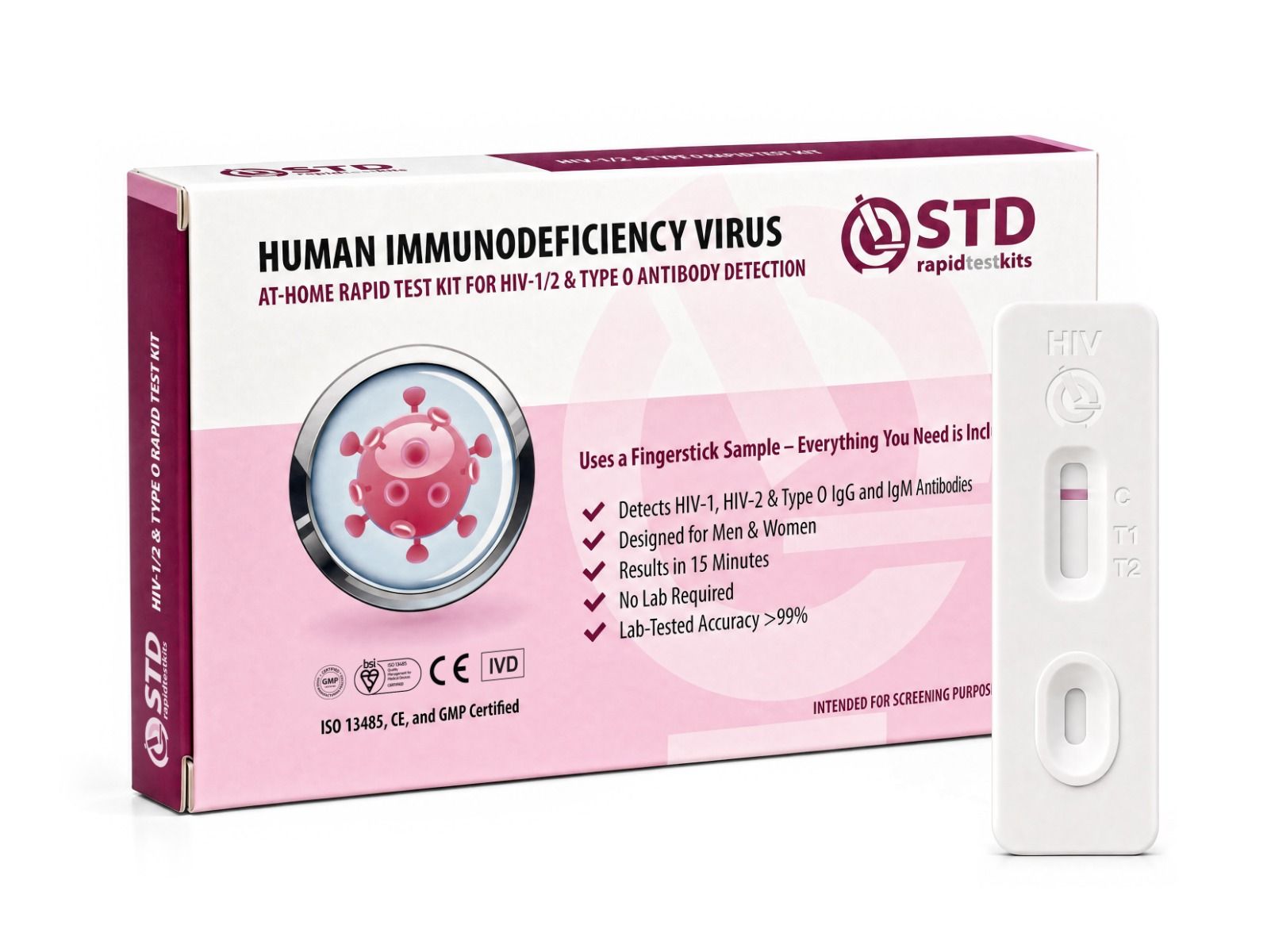
At-home rapid HIV tests, including the kit we sell, are lateral-flow antibody tests that look for HIV-1 and HIV-2 antibodies in a fingerstick blood sample. They give a result in around 15 minutes. The technology is meaningfully different from laboratory HIV testing, which uses fourth-generation antigen-antibody assays or HIV RNA tests and can detect infection earlier in the window. The two are complementary, not equivalent. A rapid antibody test is a useful screen. A positive result on it is highly significant and should be confirmed at a lab. A negative result on a rapid antibody test inside the window period can be a false negative. Per CDC guidance, rapid antibody tests typically detect HIV 23 to 90 days after exposure; testing again at the end of that window catches infections the early test missed.
One thing worth saying clearly, because it changes how the whole testing decision feels. A positive HIV result is not the diagnosis it once was. People diagnosed with HIV today and started promptly on antiretroviral therapy typically reach an undetectable viral load within months, live a normal life expectancy, and cannot sexually transmit the virus to partners while undetectable. Treatment is widely available, often free or low-cost through state programs, and increasingly delivered via telehealth. The urgency of testing is about reaching that treatment early, not about a terminal prognosis.
Practically: if your possible exposure was more than 23 days ago and you want a quick, private answer, a rapid antibody test is reasonable, with the responsible bookend of a follow-up lab test toward the end of the window period. If your possible exposure was within the last 72 hours and you have not yet started post-exposure prophylaxis (PEP), the right first move is not a test, it is a same-day clinic visit to start PEP. PEP works only inside the 72-hour window. Do not wait on a test before pursuing it.
If a clinician dismisses your rash
Reader reports of being brushed off in the exam room are not a vibes complaint, they are a documented pattern. If a provider tells you a rash “does not look like HIV rash” without first asking about your exposure history and ordering a test, you are inside the failure mode this whole article is about. The most useful thing to do in that moment is name what you are asking for, in writing if possible:
- State the specific exposure date and the rash onset date.
- Ask for an HIV test by name, including an antigen-antibody (fourth-generation) lab test, not just a rapid antibody screen.
- If they decline, ask them to document the refusal and the reason in your chart. This is a normal patient-rights request. Many providers reconsider once the request is being formally recorded.
- If the decline stands, you can get tested without their involvement: walk-in community health clinics, county public-health departments, Planned Parenthood, and at-home test kits all bypass the gatekeeper.
The framing matters. You are not “demanding” a test. You are asking the system to do what its own clinical guidelines say it should do in your situation. The CDC's testing recommendations are explicit: anyone with a possible HIV exposure who develops symptoms consistent with acute HIV infection should be tested, and where available, with a test that covers the acute-infection window.

FAQs
- How quickly after a possible exposure can an HIV rash appear?
- The rash, when it occurs, typically shows up 2 to 4 weeks after the exposure, sometimes as early as 1 week or as late as 6. It is part of the acute-infection seroconversion illness, not a late or chronic sign. If the rash fades on its own within 1 to 3 weeks, that does not mean the infection cleared.
- Does an HIV rash itch?
- Usually no. That is one of the features that distinguishes it from eczema, allergic reactions, and heat rash, all of which typically itch. An acute HIV rash tends to be smooth, painless, and not itchy, which is one reason it gets dismissed in the exam room.
- What does an HIV rash look like on darker skin specifically?
- On melanated skin the key cue is a color shift rather than redness: look for an area that appears slightly darker, shadowed, or violet-tinted compared with the surrounding skin. The texture tends to be smooth and flat, more like a discoloration than a traditional raised rash. If the patch appeared roughly 2 to 4 weeks after a possible exposure and is not itchy, treat it as a signal worth testing, not as something to wait out.
- I was told my rash is “just eczema.” Could the diagnosis be wrong?
- If the rash appeared 2 to 4 weeks after a possible exposure, is not itchy, is not in eczema's usual flexural distribution (inside of elbows, behind the knees), and is not responding to steroid cream the way eczema would, it is reasonable to push for HIV testing. You can request the test by name. You do not need the original provider's agreement.
- Can a rapid at-home HIV test detect the infection during the acute phase?
- Sometimes. Rapid antibody tests typically detect HIV 23 to 90 days after exposure, per CDC testing guidance. A negative result inside that window does not rule HIV out. Retest at the end of the window period for the test you took, and if you want the earliest possible detection, ask a clinic for a lab antigen-antibody or HIV RNA test.
- What is the difference between a rapid at-home antibody test and a lab test?
- At-home rapid tests are lateral-flow antibody tests that use a fingerstick blood sample and give a result in around 15 minutes. Laboratory tests typically use fourth-generation antigen-antibody assays or HIV RNA tests, which can detect infection earlier in the window period and have higher analytical sensitivity. A positive rapid test should always be confirmed with a lab test.
- Should I start PEP if my exposure was recent?
- If you are inside the 72-hour window after a possible HIV exposure, talk to a clinic or emergency department about post-exposure prophylaxis (PEP) before you do anything else. PEP is a 28-day course of antiretroviral medication that can prevent infection from establishing. It only works inside the 72-hour window, and the earlier inside that window it starts, the better.
- If the rash goes away on its own, can I stop worrying?
- No. The acute HIV rash, like the rest of the seroconversion illness, typically clears on its own within 1 to 3 weeks. The virus persists after the visible symptoms fade. If the timing and pattern fit, the disappearance of the rash is not evidence the body cleared the infection. Test anyway.
You came here for an answer. Here is the answer.
The skin alone cannot tell you whether what you are seeing is acute HIV or something else. The combination of a recent possible exposure, a rash that fits the morphology described above (flat or slightly raised, smooth, dusky violet to deep brown, not itchy, on the trunk and arms), and other flu-like symptoms inside the 2-to-4-week window is enough to take seriously. The answer is a test. If you can do that today, do it today. If today is not possible, do it this week. If you are inside the 72-hour PEP window, skip the test step for now and go to a clinic.
Whatever the result, you will know more than you do right now. Act on it.
- Rash plus a possible exposure in the last 2 to 6 weeks? Get an HIV antibody test now. If it is negative, retest toward the end of the antibody window (up to 90 days).
- Possible exposure in the last 72 hours? Go to a clinic, urgent care, or emergency department for post-exposure prophylaxis (PEP) before you test. PEP only works inside the 72-hour window.
- Concerned but exposure was years ago? A standard antibody test is conclusive at this point. Test once and you will know.
- U.S. Centers for Disease Control and Prevention. About HIV: overview of acute HIV infection, seroconversion symptoms (including rash), and transmission. Used for acute-symptom description and the recommendation to test anyone with possible exposure and consistent symptoms.
- U.S. Centers for Disease Control and Prevention. HIV Testing: guidance on test types (rapid antibody, fourth-generation antigen-antibody, HIV RNA), the 23-to-90-day rapid antibody window, and retesting recommendations.
- U.S. National Library of Medicine, MedlinePlus. HIV/AIDS: plain-language overview of acute HIV infection, symptom timing, and testing options. Used as a secondary corroboration of acute-symptom timing.
- U.S. National Institutes of Health, HIVinfo. HIV Testing fact sheet: discussion of nucleic acid test (NAT) detection windows and the general concept of test-specific window periods.
- UK National Health Service. HIV and AIDS, Symptoms: acute (seroconversion) symptom list including rash, fever, sore throat, and swollen glands.
- American Academy of Dermatology. Public dermatology A-to-Z resource and AAD position statements on diversity in dermatology training and skin-of-color education. Used for the dermatology-training-gap framing and for clinical descriptions of eczema, contact dermatitis, and heat rash differentials.