
Published: October 2025 | Last updated: May 2026 | Editorial review and quality control: Martina N.
Hepatitis C tests do not return reliable answers immediately after exposure. The virus replicates quietly in the bloodstream for weeks before either antibodies or detectable viral RNA appear, so the calendar matters as much as the test you pick. This guide walks through what each test actually measures, when it becomes accurate, and what to do if your timing did not line up with the test's window.
You may have come across this article after a partner disclosed a diagnosis, after sharing personal-care items with someone whose status you are not sure about, or after a tattoo session where the needle hygiene felt unclear. Hepatitis C transmits through blood-to-blood contact, per the U.S. Centers for Disease Control and Prevention, so any situation where blood from one person could reach another's bloodstream is worth thinking about. Knowing when to test, and which test to take, is the difference between a result that actually means something and false reassurance that delays treatment.
Key Takeaways
- HCV antibody tests are most reliable 8 to 11 weeks after exposure; in some people the window can extend up to 6 months.
- HCV RNA testing can detect infection within a few weeks of exposure but is mainly available through clinics, not at-home rapid kits.
How Hepatitis C Tests Work, and What They Measure
There are two ways to look for hepatitis C in the body, and they answer different questions. Confusing them is the most common reason people walk away thinking they are clear when they are not.
The first is the HCV antibody test, often listed on lab orders as anti-HCV. It does not look for the virus itself. It looks for the proteins your immune system produces in response to a hepatitis C infection. Antibody tests are inexpensive, widely available, and form the standard first step in screening, including for the at-home rapid cassettes sold on this site. The catch: antibodies take time to form. Per CDC hepatitis C testing guidance, most people develop detectable antibodies 8 to 11 weeks after exposure, and a small minority do not reach detectable levels until up to 6 months.
The second is the HCV RNA test, also called nucleic acid testing or NAT. This one detects the genetic material of the hepatitis C virus directly in your bloodstream. (HCV is an RNA virus, not DNA. The distinction matters because some popular explainers get this wrong.) Because RNA testing finds the virus itself rather than your immune response to it, it works much earlier, typically within the first few weeks after exposure, with the exact window depending on the assay.
Here is how the two compare side by side:
| Test Type | What It Detects | Best Use | Window Period |
|---|---|---|---|
| HCV Antibody Test (anti-HCV) | The body's immune response to HCV | Standard first-line screening at home or in clinic | 8 to 11 weeks (up to 6 months in rare cases) |
| HCV RNA Test (NAT or PCR) | Hepatitis C viral RNA in the bloodstream | Confirming a positive antibody test, or testing soon after exposure | Within the first few weeks (varies by assay) |
| Reflex Confirmation | Positive antibody followed automatically by RNA testing on the same sample | Distinguishing past cleared infection from active infection | Same as above; depends on initial test |
Window Period vs Incubation Period: A Quick Vocabulary Check
Two terms get mixed up constantly. They are related, but they describe different things, and only one of them governs your test result.
The incubation period is the time between exposure and the first symptoms (if any). For acute hepatitis C, that ranges from two weeks to six months, per the WHO. The catch is that the majority of acute infections produce no symptoms at all. Per the CDC's hepatitis C overview, many people with hepatitis C do not look or feel sick during the early weeks. Symptoms are not a reliable trigger to test.
The window period is the time between exposure and when a test can reliably detect the infection. For HCV antibody tests, that window is the 8 to 11 weeks mentioned above, with rare extension to 6 months. For HCV RNA tests, the window is much shorter, typically the first few weeks after exposure. The window period is the number that should drive your testing schedule, not how you feel.
You can be inside the window period and feel completely well. You can also feel ill from a viral illness that has nothing to do with HCV. Neither tells you anything definitive. The test result, taken at the right time, does.
How long after exposure should I wait to test for hepatitis C?
For an antibody test (the standard at-home and clinic option), wait at least 8 to 11 weeks after exposure for a reliable result, and retest at 6 months if you remain concerned. HCV RNA testing can detect the virus within the first few weeks but is generally available only through a clinic or lab. If you tested negative before week 8, retest at 12 weeks before considering yourself clear, per CDC guidance.
When Hepatitis C Becomes Detectable: A Week-by-Week Timeline
The single most useful thing you can do after a possible exposure is plan your test for the right week. Testing too early produces a negative result that means nothing. Testing at the right time produces a result you can actually act on.
The table below combines the antibody and RNA windows into a practical schedule. It assumes you do not have liver-involving symptoms (jaundice, dark urine, persistent right-upper-quadrant pain). If you do, do not wait; see a clinician now and ask for both an HCV RNA test and a liver function panel.
| Time Since Exposure | What May Be Happening Biologically | Best Testing Approach |
|---|---|---|
| 0 to 7 days | Virus may be replicating but is undetectable on standard tests | Wait. An antibody test now will be negative regardless of true status |
| 1 to 3 weeks | Viral RNA can begin to reach detectable levels in the blood | Clinic-based HCV RNA testing may be reliable for high-risk exposure (shared needles, occupational blood exposure, infant born to HCV-positive mother) |
| 3 to 7 weeks | Antibodies may be forming but often below detection thresholds | Antibody tests still unreliable. Repeat at 8 to 12 weeks |
| 8 to 11 weeks | Most people now show detectable antibodies | Standard antibody test (at home or in clinic). Retest at 12 weeks if negative and exposure was high risk |
| 12 to 24 weeks | Almost all immunocompetent people show detectable antibodies | Antibody test is highly reliable. A negative at 12 weeks effectively rules out infection in healthy adults |
Why a Negative Result Can Still Be Wrong
A clean result feels final. With hepatitis C, especially in the first weeks after exposure, a negative test can be technically accurate (you really do not have antibodies yet) while you are still infected. There are three reasons this happens, and they are worth understanding before you decide what to do next.
First, the test was simply too early. Antibody tests, including the rapid lateral-flow cassettes sold for at-home use, depend on your immune system having produced enough HCV antibodies to register on the strip. If you test in the first 2 to 3 weeks after exposure, the virus may already be replicating, but the antibodies are not yet there to detect. The result is mathematically negative and biologically meaningless.
Second, the test sample or process was compromised. At-home kits work well when you follow the directions, but they have failure modes: opening the cassette early and letting it dry out, reading the result before the full development time has elapsed, reading after the result has expired, or using a kit past its shelf-life date. Any of these can produce an invalid result that the strip still tries to display.
Third, biological variation. A small fraction of people produce antibodies more slowly than the general population. People who are immunocompromised (those with HIV co-infection, people on immunosuppressive medication after a transplant, or those undergoing chemotherapy) may take longer than 6 months to show detectable HCV antibodies. For people with weakened immune systems, clinical guidelines recommend HCV RNA testing rather than antibody testing to reduce the risk of false negatives.
An antibody test taken before week 8 can miss an early infection. Standard CDC guidance is to repeat at 12 weeks if your first test was negative but taken earlier than the recommended window. For high-risk exposures (shared needles, occupational blood contact, infant born to HCV-positive mother), ask a clinician about HCV RNA testing, which detects the virus directly within the first few weeks.
Retesting After New Exposure or After Treatment
Hepatitis C does not always follow a clean line from exposure to result. Some people clear the virus on their own. Others go through treatment, complete it, and then face a new possible exposure. Retesting is the bridge between any of these scenarios and a current answer, and the timing depends on which one you are in.
After a possible new exposure
If you have had a known or suspected exposure and want a clear answer, the standard approach is straightforward: test at 8 to 12 weeks with an antibody test. If that is negative and your exposure was high risk, retest at 6 months. If your exposure was very recent (within days) and high risk, talk to a clinician about HCV RNA testing rather than waiting the full antibody window.
After completing antiviral treatment
Modern direct-acting antiviral (DAA) regimens cure hepatitis C in over 95 percent of cases, per WHO. A cure is confirmed by a sustained virologic response (SVR), which is a negative HCV RNA test 12 weeks after the end of treatment. Antibody testing is not useful here, because antibodies usually persist for years after a cure and will keep returning positive even when the virus is gone. Once you have an SVR, the antibody test cannot tell you whether you have a new infection. Going forward, RNA testing is the only way to evaluate a fresh exposure.
For ongoing risk factors
If you continue to have ongoing risk (injection drug use, sexual partners with hepatitis C, occupational blood exposure), the CDC recommends regular periodic testing. The interval depends on the level of risk, but annual testing is a typical baseline, and shorter intervals (every 6 months) for higher-risk situations.
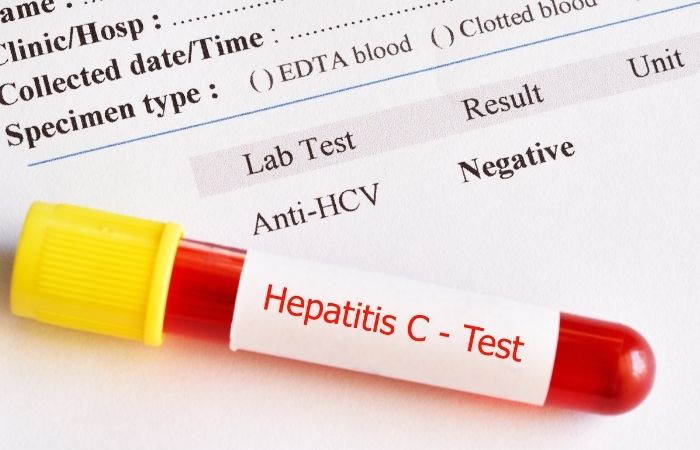
Per CDC hepatitis C testing guidance, most people develop detectable HCV antibodies 8 to 11 weeks after exposure, with up to 6 months for a small minority. A negative antibody test before that window cannot reliably rule out infection. If your first test was earlier, plan to retest at 12 weeks.
Testing at Home: What the Process Looks Like
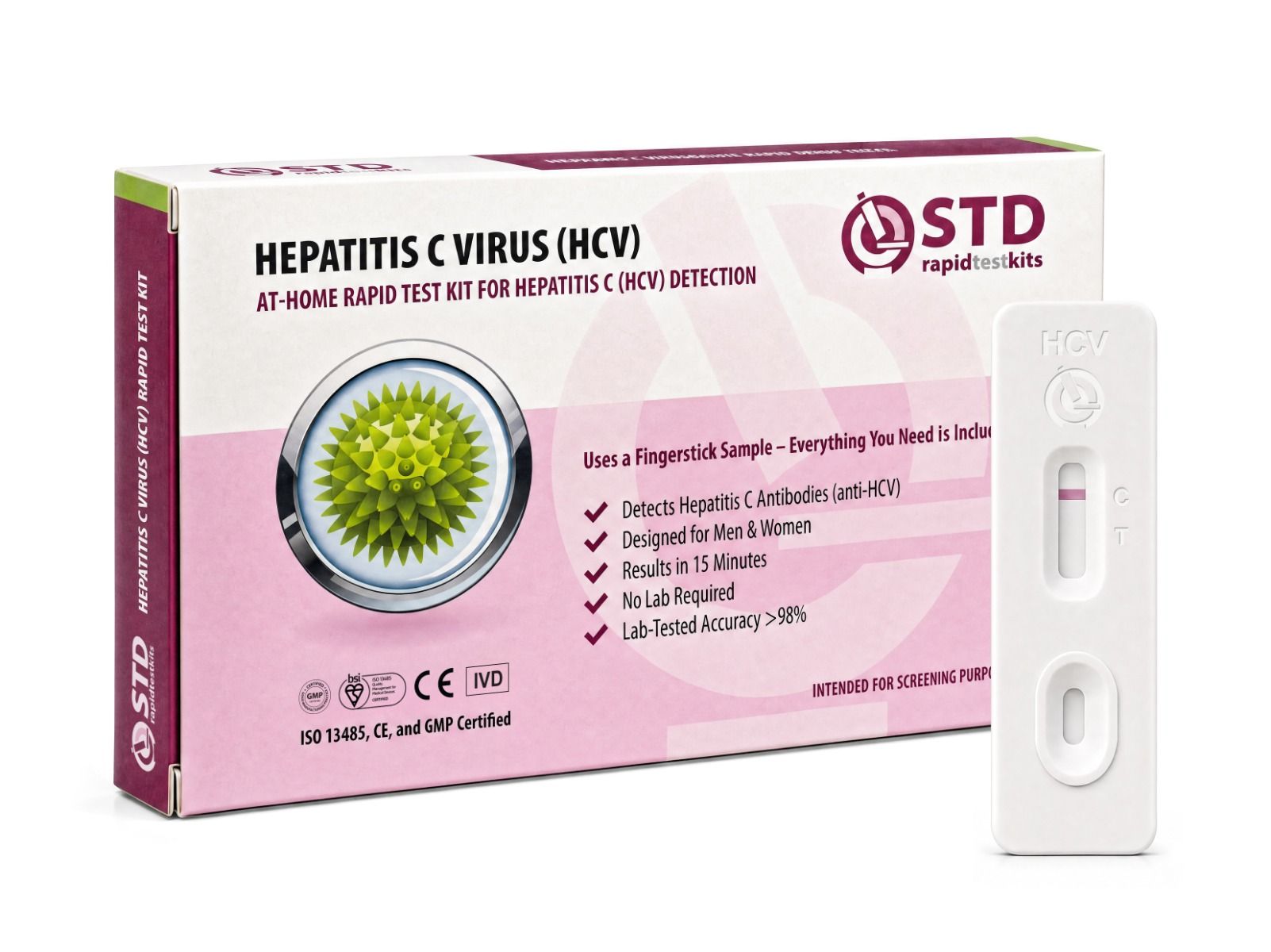
At-home hepatitis C tests sold on this site are rapid lateral-flow antibody cassettes. They use a small fingerstick blood sample, develop in about 15 minutes, and produce a visible line if HCV antibodies are present. They do not test for HCV RNA. That difference matters: a home antibody test gives a useful answer 8 to 11 weeks after exposure, but it cannot answer questions about an exposure within the past 2 weeks.
The practical workflow is short. Open the kit, prick a clean fingertip with the lancet, transfer one or two drops of blood to the cassette, add the buffer solution, and wait the full development time printed on the instructions before reading. A control line confirms the test ran correctly. A second line in the test region indicates antibodies are present.
If a home antibody test is positive, the result needs confirmation with a clinic-based HCV RNA test. Per WHO data, around 30 percent of people clear HCV spontaneously without treatment (with a range of roughly 15 to 45 percent), but they continue to test antibody-positive for life. RNA testing is what distinguishes a past resolved infection from a current active one, and it is what determines whether you need treatment.
Kits ship in plain packaging. The on-label test technology is lateral-flow immunoassay, the same chemistry used in pharmacy-bought rapid tests for many other antibody screens. It is not laboratory-grade NAT or PCR; lab testing remains the gold standard for analytical sensitivity, and a positive home result should be followed up with a lab confirmation.
When to See a Clinician Instead of Testing at Home
At-home testing covers the majority of routine screening situations well. It does not cover every situation. The following circumstances are reasons to skip the home kit and go to a clinic, urgent care, or emergency department first.
Suspected very recent exposure within the antibody window. If you had a high-risk blood exposure within the last 7 days (a needlestick injury, sharing injection equipment, exposure through compromised skin), an at-home antibody test will not give a meaningful answer. Clinics can order HCV RNA testing that detects the virus within the first few weeks. Some occupational health protocols also call for serial testing at 6 weeks and 6 months for healthcare workers with documented exposures.
Symptoms of acute hepatitis. Yellowing of the skin or eyes, dark urine, pale stool, nausea or vomiting that lasts more than 24 hours, persistent right upper abdominal pain, or unexplained severe fatigue are reasons to see a clinician without waiting for any test result. Acute hepatitis from any cause can be serious enough to require hospital monitoring.
Pregnancy or planning pregnancy. Hepatitis C can transmit from a pregnant person to a baby. Universal HCV screening during pregnancy is now recommended, per CDC hepatitis C guidance, and the testing pathway includes RNA confirmation, which is not something a home kit can do.
Existing liver disease, HIV co-infection, or immunocompromise. Antibody-only testing is less reliable in these groups. RNA testing through a clinic is the better starting point.
A positive home test result. A positive antibody result needs RNA confirmation before any treatment decisions. The clinic visit is also the entry point to treatment if the RNA test is positive, and modern direct-acting antiviral pills cure most cases within 8 to 12 weeks of treatment.
(1) High-risk blood exposure within the last 7 days: ask for HCV RNA testing rather than waiting for antibodies. (2) Symptoms of acute hepatitis (jaundice, dark urine, severe fatigue): see a clinician immediately, do not wait for any test. (3) A positive home antibody result: confirmation with a clinic-based HCV RNA test is required before treatment.
The Bottom Line on Hepatitis C Testing Timing
The single rule that matters most: an antibody test taken in the first 8 weeks after exposure is not a useful test, regardless of what it says. If you tested early and got a negative result, that result is not the end of the story; it is a placeholder until you can retest at the right time. The standard CDC recommendation is to retest at 12 weeks if your earlier antibody test was negative.
Hepatitis C is curable. Modern treatment is short, well-tolerated, and effective for the vast majority of people who take it. The only thing that delays a cure is a missed diagnosis, and the most common reason for a missed diagnosis is testing inside the window period and trusting the result. Plan your test around the calendar, not your anxiety, and a negative result will actually mean negative.
Two calendar rules to remember
- Wait until 8 to 11 weeks after exposure for the at-home antibody test to give a reliable answer.
- If your first test was taken earlier and was negative, retest at 12 weeks before considering yourself clear.
Frequently Asked Questions
- How soon after exposure can I test for hepatitis C?
- If you can access an HCV RNA test through a clinic, it is reliable from the first few weeks after exposure. Antibody tests, including at-home rapid kits, become reliable from 8 to 11 weeks. Retest at 12 weeks if your first antibody test was earlier and negative.
- What is the hepatitis C window period?
- For the standard at-home antibody test, plan on 8 to 11 weeks after exposure for a reliable result. For clinic-based HCV RNA testing, it is much shorter, often within the first few weeks. A negative antibody result before 8 weeks should be repeated at 12 weeks before you treat it as final.
- Does a negative test at 12 weeks mean I am clear?
- For immunocompetent adults with a single known exposure, a negative antibody test at 12 weeks effectively rules out infection. For people with weakened immune systems (HIV co-infection, transplant immunosuppression, chemotherapy), clinical guidelines recommend RNA testing rather than relying on antibody tests at 12 weeks.
- I feel fine. Do I still need to test?
- Yes, if you had a possible exposure. Most people with acute hepatitis C have no symptoms in the early weeks, per CDC, and many first learn they are infected only when chronic liver damage shows up years later. Symptoms are not a reliable indicator of HCV status.
- How many tests do I need after a possible exposure?
- Most people need one test, taken 8 to 12 weeks after exposure. If your first test is negative and your exposure was high risk, retest at 6 months. If your first test is positive on antibody, you need a follow-up HCV RNA test at a clinic to confirm whether the infection is current.
- Can hepatitis C clear on its own without treatment?
- Yes, in roughly 15 to 45 percent of people (with about 30 percent as the central estimate), the immune system clears HCV during the acute phase, per WHO. The remaining majority develop chronic infection, which causes silent liver damage over years and now responds to direct-acting antiviral treatment with cure rates above 95 percent.
- I am pregnant. Should I be tested for HCV?
- Yes. Universal HCV screening during pregnancy is now recommended per CDC. Hepatitis C can transmit from a pregnant person to an infant, and pregnancy testing pathways use clinic-based blood draws with RNA reflex confirmation, not at-home kits.
- My home antibody test was positive. What is next?
- A positive antibody test means you have been exposed to HCV at some point. About 15 to 45 percent of people clear the virus on their own and remain antibody-positive for life without active infection. The next step is an HCV RNA test through a clinic to determine whether the infection is current. If RNA is also positive, treatment with direct-acting antivirals cures the majority of cases.
- U.S. Centers for Disease Control and Prevention. Hepatitis C basics, transmission routes, and acute infection symptoms.
- U.S. Centers for Disease Control and Prevention. Hepatitis C testing root reference for screening and retesting recommendations.
- World Health Organization. Hepatitis C fact sheet, including incubation range, spontaneous clearance proportion, and treatment cure rates.
- U.K. National Health Service. Hepatitis C overview, symptoms, and testing pathway.
- U.S. Centers for Disease Control and Prevention. Hepatitis C root resource hub, including current screening recommendations across populations and pregnancy.
