
Published: December 2025 | Last updated: May 2026 | Editorial review and quality control: Martina N.
You followed the instructions, set a timer, and watched the line come up. But nothing else did. No burning when you pee, no discharge, no swelling, no soreness, nothing your body is sending up as a warning. A positive gonorrhea rapid test paired with a body that feels completely fine is one of the more disorienting health results you can get at home, and it sends a lot of people straight into panic.
Here is the calmer version of what your test might be telling you. A large share of gonorrhea infections cause no noticeable symptoms in the early weeks, so a real positive without symptoms is biologically plausible. At the same time, at-home rapid tests are screening tools, not diagnostic gold standards. They produce a small share of false positives, especially when the kit was stored badly, read late, or used too soon after exposure. The right next move is the same in either case: confirm before you start treatment, and use the days between tests to learn what your result really means.
Key Takeaways
- Most women with gonorrhea have no symptoms or symptoms so mild they're mistaken for something else, so a real positive without symptoms is plausible (CDC).
- A single rapid-test positive is one data point, not a diagnosis. Confirm with a lab nucleic acid test before starting antibiotics.
Why a Positive Gonorrhea Test Without Symptoms Is Common
Gonorrhea has a reputation for being loud: dripping discharge, a sharp burn during urination, swollen tissue. That reputation comes from cases where the bacterium colonizes tissue sensitive enough to react quickly. In many infections, especially in women and at non-genital sites, that reaction never shows up.
According to the U.S. Centers for Disease Control and Prevention, most women with gonorrhea have no symptoms, or symptoms so mild they are mistaken for a bladder infection or vaginal complaint (CDC, About Gonorrhea). Men more often notice classic urethral symptoms, but a meaningful share of male infections stay silent too. Rectal and pharyngeal gonorrhea rarely cause noticeable signs in either sex, which is part of why the NHS recommends screening for anyone with new partners regardless of how they feel (NHS, Gonorrhoea).
A real, untreated infection can sit in the body without raising a single warning flag. The same biology that makes routine screening valuable also makes it hard to tell, from how you feel alone, whether a positive rapid test reflects an actual infection or a test artifact. A laboratory nucleic acid test, which looks for the bacterium's DNA rather than antibody-binding proteins, is what answers that question.
Most women with gonorrhea have no symptoms or symptoms so mild they are mistaken for a bladder infection or vaginal complaint (U.S. CDC, About Gonorrhea). Pharyngeal and rectal infections rarely produce noticeable signs in any gender, so feeling fine is not the same as being uninfected.
How Gonorrhea Rapid Tests Actually Work
At-home gonorrhea rapid tests are lateral-flow immunoassays. You collect a swab sample, mix it with a buffer, and apply a few drops to a strip coated with antibodies that grab onto specific bacterial antigens. If enough of the target antigen is present in your sample, a colored line forms in the test region. The technology is in the same family as a rapid pregnancy test or rapid strep test, optimized for speed and privacy at home.
Lateral-flow tests are not designed to match the analytical sensitivity of a laboratory. Labs run nucleic acid amplification tests (NAATs), which copy and detect the bacterium's DNA from your sample. NAAT is the standard the CDC recommends as the most accurate test for gonorrhea, particularly in people with no symptoms (CDC STI Treatment Guidelines).
Home lateral-flow and lab NAAT are complementary, not equivalent. The rapid test gets you a fast, private answer about whether to look closer. The lab test gives the confirmatory accuracy you want before any medical decision.
| Test Type | Sample | Turnaround | Best Use | Confirmatory? |
|---|---|---|---|---|
| Rapid lateral-flow (at home) | Self-collected swab | 10 to 20 minutes | Private screening between partners, fast triage | No, a positive should be confirmed |
| Lab NAAT (PCR or TMA) | Swab or urine, processed in lab | 1 to 3 days | Diagnosis, confirmation of a rapid positive, asymptomatic screening | Yes, considered the standard |
Why a Rapid Gonorrhea Positive Might Be a False Alarm
Rapid tests don't measure infection directly. They measure whether antibody-coated strips detect bacterial proteins in your sample. Sometimes those proteins look enough like target antigens to trigger a positive line even when the live bacterium is absent or barely present. The WHO identifies molecular testing (NAAT/PCR) as the gold standard for gonorrhoea diagnosis (WHO, Gonorrhoea Fact Sheet), and a rapid-test result on its own is meant for screening rather than diagnosis.
Here are the five most common reasons a rapid gonorrhea test gets it wrong:
| Possible Cause | Why It Matters |
|---|---|
| Tested too soon after exposure | Bacterial load may be too low to detect reliably, or transient proteins may register a misleading signal |
| Cross-reactivity with other genital bacteria | Bacterial vaginosis flora, normal urogenital bacteria, and other organisms can sometimes trigger a positive antibody line |
| Result read outside the manufacturer's window | Lines that appear after the stated 10 to 20 minutes are usually evaporation artifacts, not real positives |
| Improper storage or expired kit | Heat, humidity, and time degrade the antibody chemistry and produce unreliable results |
| Sample contamination | Touching the swab tip, using an unclean surface, or cross-contaminating between tests can skew the strip |
What to Do When the Gonorrhea Result Doesn't Match Your Body
First step: don't rush into panic, and don't rush into antibiotics. A single rapid test result is one piece of the puzzle. If you've tested positive for gonorrhea but have no symptoms, the next move is straightforward, get a confirmatory test, ideally a NAAT through a clinic, urgent care, or sexual health service.
Why wait? Because treatment based on a single unverified result, especially when you feel fine, leads to unnecessary antibiotic exposure. The CDC's treatment guidance updates regularly to reflect tracking of antibiotic-resistant gonorrhea strains, and stewardship of remaining first-line treatments matters at both the personal and public-health level (CDC STI Treatment Guidelines). Every unnecessary course of ceftriaxone increases selection pressure on the bacterium.
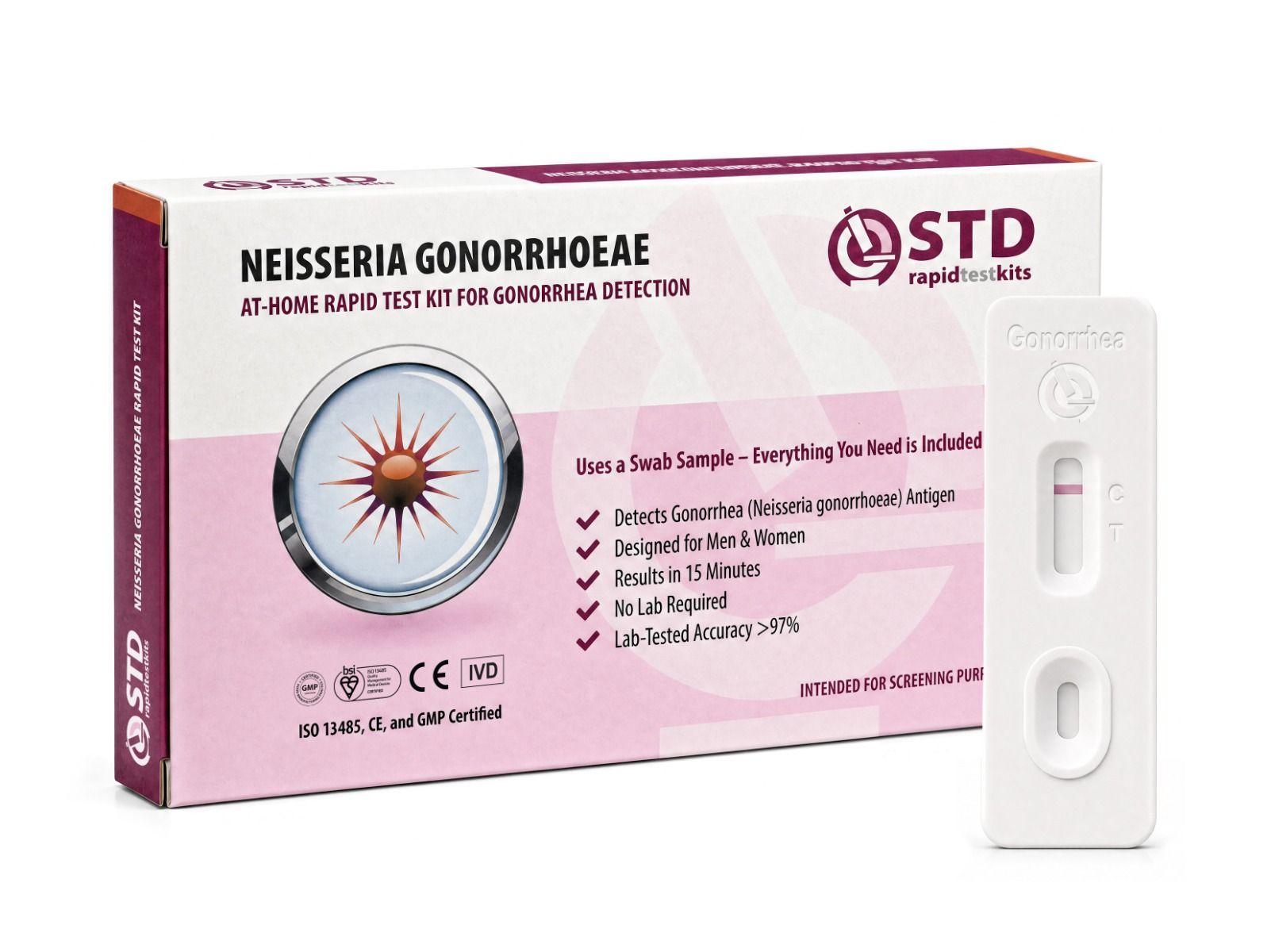
A reasonable plan when you have a positive rapid test and no symptoms: schedule a confirmatory NAAT, hold off on antibiotics until results are back, pause sexual contact during the wait, and use the time to figure out which exposure window your test was actually measuring. If symptoms develop while you wait, that changes the calculation, call a provider sooner rather than later. One note before the product link below: our site sells the rapid screening kit, which is a lateral-flow test and not a diagnostic replacement for a clinic NAAT.
How Long to Wait Before a Confirmatory Gonorrhea Test
Test timing matters as much as test type. If you tested very soon after a potential exposure, the result might reflect transient bacterial fragments or a low bacterial load rather than an established infection. Even lab NAATs can be unreliable in the first few days after exposure.
A general timeline for thinking about when to retest or confirm:
- Within 7 days of exposure: results from any test may be unreliable. Plan a retest at 14 days unless symptoms develop sooner.
- 14 days or more after exposure: most accurate window for both rapid screening and lab NAAT. This is when a confirmatory test gives you the clearest answer.
- After completed treatment: wait at least 3 weeks before retesting. Earlier tests can still detect dead bacterial fragments and produce a misleading positive.
- Routine asymptomatic screening: align with the testing schedule your provider recommends, often every 3 to 6 months for people with new or multiple partners.
How to Read Faint Lines and Late Results
Few things on a rapid test cause more anxiety than a faint second line. The rule is simpler than the spiral. Any line, no matter how faint, should be treated as a potential positive only if it appears within the test's valid reading window, usually 10 to 20 minutes after running the sample.
Past that window, the strip is no longer giving you a reading. Lines can appear from evaporation, dust, ambient humidity, or reagent drying, none of which mean infection. People often describe leaving a test on the counter while taking a phone call, returning twenty minutes later, and seeing a faint second line that turned out to be an evaporation artifact. The phone alarm is not just a convenience; it's part of the test.
If you missed the window, the test is invalid. Throw it away, repeat with a fresh kit at the correct timing, or go directly to a lab NAAT. Don't make decisions about treatment or partners based on a late-read strip.
If a faint line appears within the manufacturer's 10 to 20 minute window, treat it as a potential positive and confirm with a lab NAAT. If a line appears after that window, the test is invalid, discard it and run a fresh kit or go straight to lab testing.
Why You Shouldn't Walk Away From a Gonorrhea Positive
The flip side of false positives is real positives that the body never advertises. Gonorrhea is a bacterium, not a virus, and it does not quietly resolve on its own. Left untreated, even symptomless infections can cause real harm.
In men, untreated gonorrhea can lead to epididymitis, chronic pelvic pain, and rarely, infertility. In women, the bacterium can ascend into the upper reproductive tract and cause pelvic inflammatory disease, scarring of the fallopian tubes, ectopic pregnancy risk, and tubal infertility. The CDC's About Gonorrhea resource describes pelvic inflammatory disease as one of the more common preventable causes of female infertility (CDC, About Gonorrhea).
In all genders, untreated gonorrhea also raises HIV risk in both directions. Inflammation of the genital, rectal, or pharyngeal mucosa lowers the cellular threshold for HIV acquisition during subsequent exposure, and in people already living with HIV, that same mucosal inflammation increases viral shedding and raises onward transmission risk. Treating the bacterial infection promptly closes that elevated-risk window in both directions, which is why public-health screening programmes treat a gonorrhea diagnosis as a near-term action item.
- In men: epididymitis, chronic pelvic pain, and rarely infertility.
- In women: pelvic inflammatory disease, fallopian tube scarring, ectopic pregnancy risk, and tubal infertility.
- All genders: rectal and pharyngeal complications, ongoing onward transmission, and bidirectional elevated HIV acquisition or transmission risk while the infection is active.
Talking to a Partner Before You Have Gonorrhea Confirmation
This is where shame tries to creep in. Don't let it. A rapid test result you're following up on is information, and sharing it with a current sexual partner is an act of care, not a confession of wrongdoing. You can frame it plainly: "I got a rapid test result that I'm now confirming with a lab. Wanted to keep you in the loop in case you want to test too."
If the confirmatory test comes back positive, the early conversation made follow-up easier. If it comes back negative, you didn't lie, you were responsible with imperfect information. Most partners appreciate honesty framed in care more than they appreciate finding out later that you knew and waited.
If you're still waiting on the lab result, hold space for the discomfort. Anxiety in the meantime doesn't mean you did something wrong; it usually means you're treating your own health and your partner's health seriously.
Try this: "I got a result I'm following up on with a lab. Wanted to keep you in the loop so you can decide whether to test too." Short. Factual. No commitment to a diagnosis you don't have yet.
When Treating Gonorrhea Right Away Makes Sense
Most clinicians recommend confirming before treating an asymptomatic rapid-test positive. There are a few situations where that calculus changes and a provider may treat presumptively, before the confirmatory result is back. Even in those cases, the decision belongs to a licensed clinician or telehealth provider, not a self-prescribed pharmacy run. Bring the test result, the timeline of exposure, and your symptom history to that conversation. If you're not sure whether your result was a true positive, retesting with a different method, especially at the 14-day-plus mark, lets you move forward with real clarity.
The usual exceptions where a clinician may recommend presumptive treatment:
- You can't access a clinic or lab for a confirmatory NAAT within a reasonable time frame.
- You had clear gonorrhea-like symptoms recently that have since resolved.
- A current sexual partner has tested positive for gonorrhea and you're a likely contact.
- You're pregnant, where the cost of waiting is higher than the cost of presumptive treatment.
How to Reduce False Positives Next Time
If this experience left you frustrated, the practical fix is to tighten how you use the test the next time around. Most false-positive stories trace back to a handful of preventable errors. One more practical note: avoid testing during a high-anxiety window like the morning of a big event, the middle of a flight, or right before a difficult conversation. Stress makes it easier to skip a step, read late, or misinterpret a line, and the test itself is not going anywhere. Pick a quieter slot and you'll trust the result more.
The five practices that actually move the needle:
| Practice | Why It Matters |
|---|---|
| Read the instructions all the way through before opening anything | Each manufacturer's timing and procedure differs slightly. Reading midway through is a setup for misreads. |
| Use a phone timer set to the manufacturer's exact window | Reading a strip late is the most common cause of evaporation-line false positives. |
| Store kits in a cool, dry place away from cars, bathrooms, and direct sun | Heat and humidity degrade reagents and antibody chemistry, undermining accuracy. |
| Don't touch the swab tip or surrounding swab shaft | Skin oils, surface residue, and cross-contamination can produce invalid readings. |
| Confirm any positive with a lab NAAT | A NAAT through a clinic, urgent care, or sexual health service removes the guesswork. |
FAQs
- Can a positive gonorrhea rapid test be wrong if I have no symptoms?
- Yes, both directions are possible. Many real gonorrhea infections are asymptomatic, so a true positive without symptoms is plausible. Rapid tests also produce a small share of false positives, especially when the kit was stored badly, read after the timing window, or used very soon after exposure. The way to tell which one you're looking at is a confirmatory lab nucleic acid test, not how you feel.
- How accurate are at-home gonorrhea rapid tests compared to lab tests?
- At-home lateral-flow rapid tests are designed for speed and privacy. They have meaningfully lower analytical sensitivity than laboratory nucleic acid amplification tests (NAATs), which the CDC identifies as the most accurate test for gonorrhea. Treat the rapid test as a screening tool and use a lab NAAT to confirm any positive before treatment.
- What does a faint line on a gonorrhea rapid test mean?
- If a faint line appears within the manufacturer's valid reading window, usually 10 to 20 minutes, treat it as a potential positive and confirm with a lab test. If the line shows up after that window, it's almost certainly an evaporation artifact and the test is invalid. Throw it away and repeat with a fresh kit or go straight to a lab.
- Can bacterial vaginosis or a yeast infection cause a false positive gonorrhea result?
- Sometimes. Inflammation, altered vaginal flora during a bacterial vaginosis or yeast flare, and other genital bacteria can occasionally trigger cross-reactive signals on antibody-based rapid tests. It's another reason a confirmatory NAAT matters when you have no symptoms and a positive screening result.
- How soon after exposure can a rapid test detect gonorrhea?
- The most reliable testing window starts around 14 days after exposure. Tests run earlier than that can pick up transient signals or miss real infections because bacterial load hasn't built up yet. If you test in the first week and the result is unexpected, retest at the two-week mark with the same method or a lab NAAT.
- Should I start antibiotics right away if my rapid test is positive but I feel fine?
- Most experts recommend confirming with a lab NAAT first. Treating based on a single unverified result drives unnecessary antibiotic use and feeds the antibiotic-resistant gonorrhea problem the CDC is actively tracking. Exceptions include known partner positives, recent symptom history, and inability to access a confirmatory test, all of which should be discussed with a clinician.
- Can I have gonorrhea and transmit it without any symptoms?
- Yes. A substantial share of people with gonorrhea, especially women, carry it without burning, discharge, or any other warning sign. Silent infections still transmit during oral, vaginal, and anal contact, which is why routine screening is recommended for people with new or multiple partners even when they feel fine.
- Does a genital swab test detect a throat or rectal gonorrhea infection?
- No. Each swab samples one body site. A vaginal or penile swab tests only that site. If you've had oral or anal exposure, those sites need their own samples, usually through a clinic that offers pharyngeal or rectal swab NAATs. A negative genital test does not rule out gonorrhea elsewhere.
The Bottom Line on a Silent Gonorrhea Positive
A positive rapid gonorrhea test in a body that feels fine is not a verdict. It's a prompt to look closer. Most women with gonorrhea and a meaningful share of men have no symptoms in the early weeks (CDC, About Gonorrhea), so a real positive without symptoms is biologically reasonable. Rapid tests also produce a small share of false positives, especially when used outside their ideal conditions. Both possibilities point to the same next step: a confirmatory lab nucleic acid test before any antibiotic decision, and a paused timeline rather than a panicked one.
You're allowed to question a test result. You're allowed to wait for confirmation before assuming the worst. And you're allowed to keep a partner informed honestly without committing to a diagnosis you don't have yet.
- Book a confirmatory NAAT through a clinic, urgent care, or sexual health service.
- Hold off on antibiotics until the lab result is back, unless a clinician advises otherwise.
- Pause sexual contact during the waiting window so you aren't acting on a question mark.
- Loop in any current partner using the short framing above, so they can decide whether to test.
- U.S. Centers for Disease Control and Prevention, About Gonorrhea. Used here for asymptomatic-rate context, transmission routes, screening recommendations, and pelvic inflammatory disease / infertility consequences of untreated infection.
- U.S. Centers for Disease Control and Prevention, STI Treatment Guidelines. Used here for the recommendation that NAAT is the most accurate test for gonorrhea (including in asymptomatic people) and for current antibiotic-resistance and treatment-stewardship guidance.
- World Health Organization, Gonorrhoea Fact Sheet. Used here for the identification of molecular testing (NAAT/PCR) as the gold-standard diagnostic for gonorrhoea.
- United Kingdom National Health Service, Gonorrhoea. Used here for symptom presentation, screening recommendations regardless of how the person feels, and the confirmatory-testing pathway.
- Cleveland Clinic, Gonorrhea Overview. Used here for general biology of the infection and the asymptomatic presentation discussion.
