
Published: December 2025 | Last updated: May 2026 | Editorial review and quality control: Martina N.
Feeling wiped out after sex is normal in plenty of cases. The body releases prolactin and oxytocin, blood pressure drops, and a parasympathetic rebound kicks in. That can leave you sleepy and slow for an hour, sometimes longer. The version harder to explain is the one that does not fit that pattern: energy that stays gone the next day, chills or low-grade fever showing up a few weeks after a new partner, or a drain that arrives even after sex that was not particularly physical.
This guide is for readers who have noticed a pattern and want a clear answer about what to do next. It walks through what counts as ordinary recovery, where infections like HIV, hepatitis, and syphilis can present early as fatigue, how the timing of testing is calibrated for each, and where an at-home rapid kit fits versus when a clinic is the better call.
Key takeaways
- Fatigue alone is rarely an STD, but when it lasts past 24 hours and travels with night sweats, sore throat, low-grade fever, or swollen glands after a recent exposure, it is worth testing.
- Acute HIV often produces flu-like exhaustion 2 to 4 weeks after exposure; hepatitis B and C and secondary syphilis can also begin with tiredness weeks before the more specific symptoms appear.
Why sex can leave you wiped, even without an infection
Orgasm triggers a measurable hormonal shift. Prolactin rises sharply for both men and women and stays elevated for up to an hour. Oxytocin and dopamine spike during sex and then fall. The autonomic nervous system flips from sympathetic (the “revved” mode) to parasympathetic (the “rest” mode), which is why drowsiness so often follows. None of that is pathological; it is the body returning to baseline.
For some people the recovery dip is bigger than average. Researchers have described post-orgasmic illness syndrome (POIS), a rare condition where flu-like symptoms appear within minutes to hours after orgasm and last several days. POIS is uncommon and not infectious, but it sits in the same general category of the body reacting strongly to a normal stimulus. Hormonal cycle phase, dehydration, alcohol, sleep debt, and a heavier-than-usual workout in bed can all amplify the post-sex slump without any infection involved.
The signal worth listening to is whether the tiredness fits your usual pattern. If you have always needed a long nap after intense sex, that is your baseline. If the slump is new, longer than it used to be, or arrives after sex that was relatively brief or low-intensity, that is data your body is offering up. The next sections cover the situations where that data is worth acting on.
Post-orgasmic illness syndrome is rare, non-infectious, and not transmitted through sex. It is a flu-like reaction some bodies have to orgasm itself, lasting several days. It is on this list because it can mimic the same exhaustion an early STI causes; ruling out infection first still makes sense before chasing this much rarer diagnosis.
STDs that can show up first as exhaustion
Several sexually transmitted infections begin with vague systemic symptoms before any genital signs appear. Tiredness is one of the most consistent of them, partly because the immune system burns calories fighting back, and partly because cytokines released during early infection literally make you feel sick.
Acute HIV. Two to four weeks after exposure, many people develop what clinicians call acute retroviral syndrome: fever, sore throat, swollen lymph nodes, headache, muscle aches, and a heavy, dragging fatigue. According to the CDC's About HIV page, most people develop these flu-like symptoms within 2 to 4 weeks of infection. Clinically these symptoms can resemble mononucleosis or flu and typically resolve within days to a few weeks, even though the infection itself persists, which is part of why early HIV is missed so often.
Hepatitis B and C. Acute hepatitis often begins with a prodrome of fatigue, nausea, low appetite, and a dull right-upper-quadrant ache before any jaundice or dark urine appears. CDC guidance on hepatitis C notes that many people have no symptoms at all in the early phase, while others feel run down for weeks. Hepatitis B follows a similar prodromal pattern.
Secondary syphilis. A few weeks after the painless primary chancre fades, secondary syphilis can roll in with low-grade fever, swollen glands, body aches, a rash on the palms or soles, and persistent fatigue. This stage is easy to overlook as a viral illness when the rash is faint or the primary chancre was missed.
Chlamydia and gonorrhea less commonly cause systemic fatigue on their own, but a pelvic infection that has spread upward (pelvic inflammatory disease in women, epididymitis in men) can. Fatigue alone is rarely the diagnosis. The most common assumptions (just stressed, needed more sleep) can leave a real infection on the table for weeks if the surrounding symptom cluster gets missed.

Reading the symptom cluster, not just the fatigue
Tiredness alone is hard to act on. When it travels with two or three companion symptoms, the picture sharpens up considerably. The clusters that come up most often in early STD presentation:
- HIV-like cluster: exhaustion, sore throat, fever, swollen lymph nodes in the neck, body aches, sometimes a faint rash on the trunk.
- Hepatitis-like cluster: drained-feeling tiredness, low appetite, mild nausea, a dull ache under the right ribs, sometimes darker urine or pale stools.
- Secondary-syphilis cluster: tiredness, low-grade fever, swollen glands, a rash that often involves the palms or soles, occasional patchy hair loss.
If your post-sex slump comes alone and resolves within a day, the cluster is empty and the odds favor ordinary recovery. If two or more of these symptoms ride along, especially after a recent exposure where condoms were not used or a barrier broke, testing is the more useful next step than waiting and watching.
The table below summarizes when these signals tend to appear and what tends to ride along with the fatigue.
| Infection | Typical Fatigue Onset | Other Symptoms in the Cluster |
|---|---|---|
| HIV (acute retroviral syndrome) | 2 to 4 weeks after exposure | Fever, sore throat, swollen neck lymph nodes, muscle aches, faint trunk rash |
| Hepatitis B | 6 weeks to 6 months after exposure | Nausea, loss of appetite, right-upper-quadrant ache, sometimes dark urine |
| Hepatitis C | 2 weeks to 6 months (often silent) | Mild nausea, low appetite, dull abdominal ache; many feel nothing at all |
| Secondary syphilis | 6 weeks to 6 months after primary chancre | Low-grade fever, palm or sole rash, swollen glands, body aches |
| Pelvic complications of chlamydia or gonorrhea | Variable; weeks to months | Pelvic or testicular pain, abnormal discharge, fever |
This article is published by stdrapidtestkits.com, which sells at-home STI testing kits. We recommend products based on whether they fit the reader's clinical situation, not on commercial benefit; the rapid kits below are appropriate first-pass screening tools and are described accurately as lateral-flow tests.
When to test after a possible exposure
Testing too early gives a false sense of security. Testing on time gives you something to work with. The window period is the gap between exposure and the moment a test can reliably detect infection, and it is different for every STI because the body produces antibodies and antigens at different speeds.
For HIV, the most common rapid home tests are antibody-based, which means the window can run 23 to 90 days from exposure for full sensitivity. CDC HIV testing guidance recommends a follow-up test if early results are negative and exposure was recent. For acute illness fitting the HIV pattern, clinicians sometimes use a different lab-based test that detects the virus itself earlier; an at-home rapid kit is a useful first pass, with a follow-up timed to the longer window.
For hepatitis B, surface antigen tests can turn positive as early as 4 to 6 weeks after exposure, with full confidence by 8 to 12 weeks. Hepatitis C antibodies usually appear 8 to 11 weeks out, sometimes longer. Syphilis antibody tests reach reliable sensitivity around 3 to 6 weeks. Chlamydia and gonorrhea swabs are reliable from about 1 to 2 weeks out. The table below summarizes the practical timing.
How soon after sex should I test if I am exhausted?
For chlamydia or gonorrhea you can test reliably from about 1 to 2 weeks after exposure. For HIV, hepatitis B, and syphilis, an early rapid test at 3 to 4 weeks gives a useful first answer, but a follow-up test at 6 to 12 weeks is needed for full sensitivity. If the fatigue arrived along with fever, sore throat, or swollen glands within a month of a new partner, test now and again at the longer window.
| Infection | Earliest Reliable Test | Best Time for Confidence |
|---|---|---|
| HIV (rapid antibody, fingerstick) | 3 to 4 weeks | 12 weeks for full sensitivity |
| Hepatitis B (surface antigen) | 4 to 6 weeks | 8 to 12 weeks |
| Hepatitis C (antibody) | 8 to 11 weeks | 12 weeks; sometimes longer |
| Syphilis (antibody) | 3 to 6 weeks | 12 weeks for full sensitivity |
| Chlamydia and gonorrhea (swab) | 1 to 2 weeks | From 14 days; retest if symptoms appear later |
Negative test, still tired
A clean panel does not mean nothing is happening. Fatigue is one of the least specific symptoms in medicine, which means a negative STI test legitimately rules out a class of causes while leaving others on the table.
The most common non-STI causes of post-sex tiredness that lasts more than a day:
- Iron-deficiency anemia, which is common in people who menstruate and can be amplified by a heavy cycle.
- Thyroid disorders, especially subclinical hypothyroidism, which often presents as low energy, weight changes, and cold intolerance.
- Sleep debt or undiagnosed obstructive sleep apnea, which produce a recovery profile that is dramatically worse after exertion of any kind.
- Depression or burnout, where intimacy can be the trigger that exposes how depleted the system already was.
- Recent viral infection unrelated to sex, such as Epstein-Barr (mononucleosis), which can leave fatigue lingering for weeks.
If the STI panel is negative and the fatigue continues past a few weeks, a primary care visit with a basic blood panel (CBC, ferritin, TSH, basic metabolic panel) is the next sensible step. The home test does not replace that. It clears one large category so the next investigation has a smaller search space.
A negative STI result rules out one large category of causes. It does not rule out anemia, thyroid issues, sleep disorders, depression, or post-viral fatigue. If symptoms persist past 30 days with negative results, a basic blood panel through a primary care provider is the next sensible step.
Talking to a partner without making it an accusation
If the fatigue keeps showing up after sex with a specific person, the conversation is awkward but worth having. Two framings tend to work better than the alternatives.
The “I'm doing this for me” framing: “I have been wiped out for a couple of days after sex, more than usual. I am going to test for a few things just to rule them out. Would you want to test alongside me?” This puts the action on you and offers them a parallel path.
The “we both win” framing: “We're sleeping together and neither of us has tested in a while. Want to do a panel together so we both know where we stand?” This works in established or newly committed relationships where the question is overdue rather than reactive.
What does not work: leading with what they might have given you. Even if accurate, that opener triggers defensiveness and almost guarantees that whatever genuine clinical answer you needed gets buried under the argument. Testing exists to surface facts. Whatever the result, it does not assign blame; it just tells you what is currently true so you can act on it.

Retesting: timing matters more than people realize
A single negative test in the first week or two after exposure rules out very little. Here is why retesting after the fuller window is often the more useful answer.
Antibody-based tests measure your immune response rather than the pathogen directly. The body needs time to produce detectable antibodies. For HIV that build-up takes about three weeks for most antibody-based home tests to start reading positive, and around six to twelve weeks for full sensitivity. For syphilis the timing is similar. For hepatitis C, antibody seroconversion can take roughly two to three months (matching the 8-to-11-week window described above). Testing inside those windows can produce a true negative for a real infection, simply because antibodies have not climbed high enough yet.
The practical pattern: if the exposure was recent and the symptoms are worrying, test now for early reassurance, then retest at the longer window. If symptoms persist past 30 days with negative results, broaden the differential to non-STI causes (anemia, thyroid, sleep, mental health) rather than retesting a third time on the same panel.
Most people have flu-like symptoms within 2 to 4 weeks after infection.
Home testing, privacy, and confirmatory follow-up
For readers who want to test discreetly, at-home rapid kits answer most early questions in 15 to 20 minutes without a clinic visit. The major caveat to keep in mind: at-home rapid tests are lateral-flow immunoassays rather than lab-grade molecular tests. They are good screening tools, and a negative result inside the right window is reassuring. A positive result on any rapid test should be confirmed with a clinician-ordered laboratory test before treatment decisions are made. That is true for clinic-administered rapid tests too; it is the standard public-health workflow.
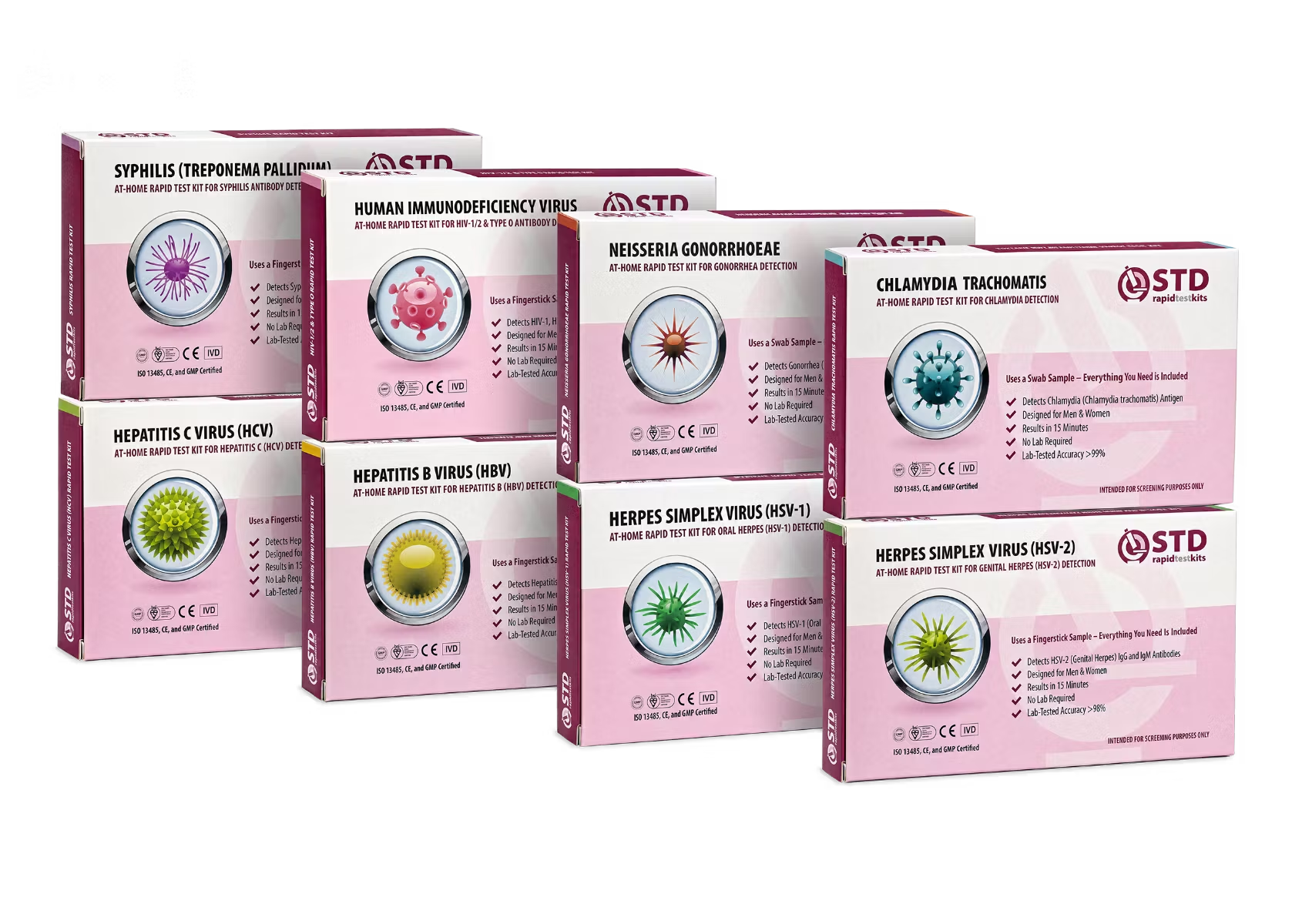
For most readers in the situation this article describes (recent exposure, persistent fatigue, no obvious other diagnosis), a multi-test panel covers more ground in one go than a single-infection test. The 8-in-1 kit below screens for the most common viral and bacterial STIs that can present with systemic symptoms. The result is a starting position, not a final verdict; if any line shows positive, the next step is a confirmatory lab test, ideally through a primary care provider or a sexual-health clinic.
At-home test packaging from reputable providers ships in plain, unbranded outer wrap. Nothing on the outside indicates what is inside. Billing statements typically list the parent company name without describing the product, which matters for readers in shared households or rural areas where privacy is part of why they chose to test at home in the first place.
Trust your baseline
The most useful instrument in this situation is your own sense of what your body usually does. If sex used to leave you cheerful and a little drowsy and now leaves you flattened the next day, that change is real even if no test catches it on the first try. The point of testing is to narrow the search so the answer you eventually find (whether infectious, hormonal, hematologic, or psychological) lines up with what is going on. Testing serves as a fact-finding step rather than a verdict.
The reasonable plan in most cases looks like this: test now if the exposure window allows, retest at six to twelve weeks if early results are negative and the fatigue continues, and see a primary care provider for a basic blood panel if STI tests stay clean past a month. None of those steps require panic. They just require paying attention to the pattern and being willing to act on it.
If you are unsure where to start, a multi-infection home panel covers the highest-yield tests in one go. The result is a beginning, and depending on what it shows, the next step is either reassurance, a confirmatory clinic visit, or a broader workup for the non-STI causes that present the same way.
1. Test now if you are inside the right exposure window for the relevant STIs (chlamydia and gonorrhea from 1 to 2 weeks; HIV, hepatitis, syphilis from 3 to 4 weeks for an early read).
2. Retest at 6 to 12 weeks if the early results are negative and the fatigue continues, since antibody seroconversion takes longer than the first window.
3. See a primary care provider for a basic blood panel (CBC, ferritin, TSH) if STI tests stay clean past a month and the tiredness has not lifted.
FAQs
- Can fatigue alone be a sign of an STD?
- It can be, especially when it persists past a day and arrives with other systemic symptoms (sore throat, low-grade fever, swollen glands, body aches) within weeks of a new exposure. Acute HIV, hepatitis B and C, and secondary syphilis can all begin this way before more recognizable signs appear.
- How long after sex would fatigue from an STD usually appear?
- Acute HIV typically shows up 2 to 4 weeks after exposure. Hepatitis B and C can produce a slow-building tiredness over 4 to 12 weeks or longer. Secondary syphilis fatigue often appears 6 weeks to several months after the initial exposure. Chlamydia and gonorrhea less commonly cause fatigue alone, though pelvic complications from either can.
- I used a condom. Could I still feel sick from an STD?
- Condoms substantially reduce risk for HIV, hepatitis B, gonorrhea, and chlamydia, though they do not fully prevent skin-to-skin transmission of HSV, syphilis, and HPV. So a condom-protected encounter does not make every STI impossible. If the symptom cluster lines up, test anyway.
- How accurate are at-home rapid STD tests when fatigue is the main symptom?
- At-home lateral-flow kits report sensitivity in the mid-to-high 90s after the proper window period has passed. Inside the window they can produce false negatives because antibodies have not built up yet. For a current acute illness with fatigue, an early test gives a partial answer and a retest at 6 to 12 weeks confirms it.
- If I test negative twice, can I stop worrying about STDs?
- Two negative tests across the appropriate windows make an STI very unlikely as the cause. At that point the more productive next step is a basic blood panel through a primary care provider, looking for anemia, thyroid issues, sleep disorders, depression, or other systemic causes of persistent tiredness.
- Is post-orgasmic illness syndrome (POIS) the same as an STD?
- No. POIS is a rare non-infectious condition where flu-like symptoms appear within minutes to hours after orgasm and last several days. It is not contagious. If POIS is suspected, a clinician with experience in sexual medicine is the right referral; STI testing rules out the more common explanations first.
- Should I tell my partner I am testing?
- It is a personal choice, and many people do test privately first. If a result comes back positive, partner notification becomes important for both their health and to interrupt onward transmission. Local health departments offer anonymous notification services if a direct conversation is not safe or wanted.
- Will at-home test packaging show what is inside?
- Reputable at-home STI test providers ship in plain, unbranded outer packaging. Nothing on the outside indicates what is inside. Billing statements typically use the parent company name without describing the product, so shared-household privacy stays intact.
How we sourced this article. We summarized current public-health and clinical guidance from the U.S. Centers for Disease Control and Prevention and the UK National Health Service, with attention to peer-reviewed clinical references on early STI presentation. Window-period figures reflect CDC testing guidance and standard at-home rapid-test labelling. This article is editorial summary, not personal medical advice; for symptoms that concern you, see a licensed clinician.
- U.S. Centers for Disease Control and Prevention. About HIV: symptoms of acute infection, including the 2 to 4 week flu-like illness window.
- U.S. Centers for Disease Control and Prevention. HIV testing guidance: antibody-test windows from 23 to 90 days and follow-up recommendations.
- U.S. Centers for Disease Control and Prevention. About hepatitis C: early-phase symptoms and testing windows.
- U.S. Centers for Disease Control and Prevention. About hepatitis B: acute and chronic infection presentation.
- U.S. Centers for Disease Control and Prevention. About syphilis: primary, secondary, and latent stages including secondary-stage systemic symptoms.
- UK National Health Service. Sexually transmitted infections (STIs): overview of common STI symptoms and testing pathways.
