
Published: October 2025 | Last updated: May 2026 | Editorial review and quality control: Martina N.
The hardest part about chlamydia is what you don't feel. Women with chlamydia often have no obvious symptoms, according to the CDC's chlamydia overview. For Black women, that quiet presentation collides with documented healthcare gaps: higher reported infection rates, lower rates of being proactively offered screening, and longer delays between exposure and diagnosis. This guide explains the subtle signs worth taking seriously, when a test will actually catch the infection, and what to do if a result comes back positive.
Key Takeaways
- Women with chlamydia often have no obvious symptoms, which is why the CDC recommends annual screening for sexually active women under 25 regardless of how they feel.
- The most reliable first-test window opens around 14 days after a possible exposure. Test sooner if symptoms or known exposure are present, then plan a confirming test at day 14.
Who this guide is for
This article is written for Black women navigating uncertainty after a possible exposure, vague pelvic symptoms that don't quite match any obvious cause, or a partner's positive result. It also takes a clear look at why chlamydia rates are higher among Black women. The answer has more to do with healthcare access and provider bias than with behavior, and that distinction matters for how you advocate for the screening you should already be offered.
Three questions, in order: what does chlamydia look and feel like in women, when does a test actually catch it after exposure, and what comes next if a result is positive. If your only concern is a vague discomfort with no known exposure, the most common causes are far less serious than chlamydia, but testing is the only way to know for certain.
How chlamydia often goes unnoticed
Chlamydia usually goes quiet. Women with chlamydia often have no obvious symptoms, per the CDC fact-sheet guidance. When symptoms do appear, they tend to be subtle and easy to attribute to something else: a tight pair of jeans, the tail end of a period, a yeast infection, mild stress.
Subtle signs reported in clinical literature include:
- Pelvic heaviness or aching after sex with no visible discharge
- Spotting between periods that mimics a hormonal shift
- Mild burning during urination that comes and goes
- Changes in cervical mucus that don't quite match yeast or bacterial vaginosis
- Dull lower-abdominal discomfort that lingers without spiking
Internal inflammation can sit in the cervix or fallopian tubes for weeks while the outside signs stay vague.
If something feels off and a clinician dismisses it, you are allowed to ask for an STI screen by name. The CDC's screening recommendations include opt-out testing in many clinical settings, meaning a screen should be offered without you having to ask. If it isn't, asking for it is appropriate and reasonable.
Why chlamydia disproportionately affects Black women
This is not a story about behavior. CDC surveillance data, available at cdc.gov/sti-statistics, consistently documents higher reported chlamydia rates among Black women than among white women. That gap reflects structural factors, not individual choices.
Drivers documented in public-health research include:
- Reduced access to consistent gynecological care
- Implicit bias during symptom evaluation, especially in emergency and urgent-care settings
- Lower rates of being proactively offered STI screening at primary-care visits
- Healthcare deserts in many predominantly Black neighborhoods
- Stigma around disclosing sexual history in clinical settings, especially for younger women
Untreated infections push reported rates higher in a feedback loop: when an infection isn't caught, partners aren't notified, treatment doesn't happen, and the same infection cycles back into the community. Individual-level testing breaks the feedback loop, which is why knowing the pattern helps you advocate for the screening that should already be on offer.
Most people who have chlamydia have no symptoms. If you do have symptoms, they may not appear until several weeks after you have sex with an infected partner.
What testing for chlamydia actually involves
Disclosure: this site sells rapid at-home STI tests, and the products linked in this article are from our own catalog. Recommendations are based on fit-for-purpose for the reader's concern, not commercial benefit.
Testing is less invasive than most people expect. Clinic NAAT testing (nucleic acid amplification test) detects the bacteria's genetic material with very high sensitivity. NAAT can be performed on a urine sample or a vaginal swab. Vaginal swabs are the preferred specimen type for women undergoing NAAT for chlamydia, per NIH StatPearls clinical reference.
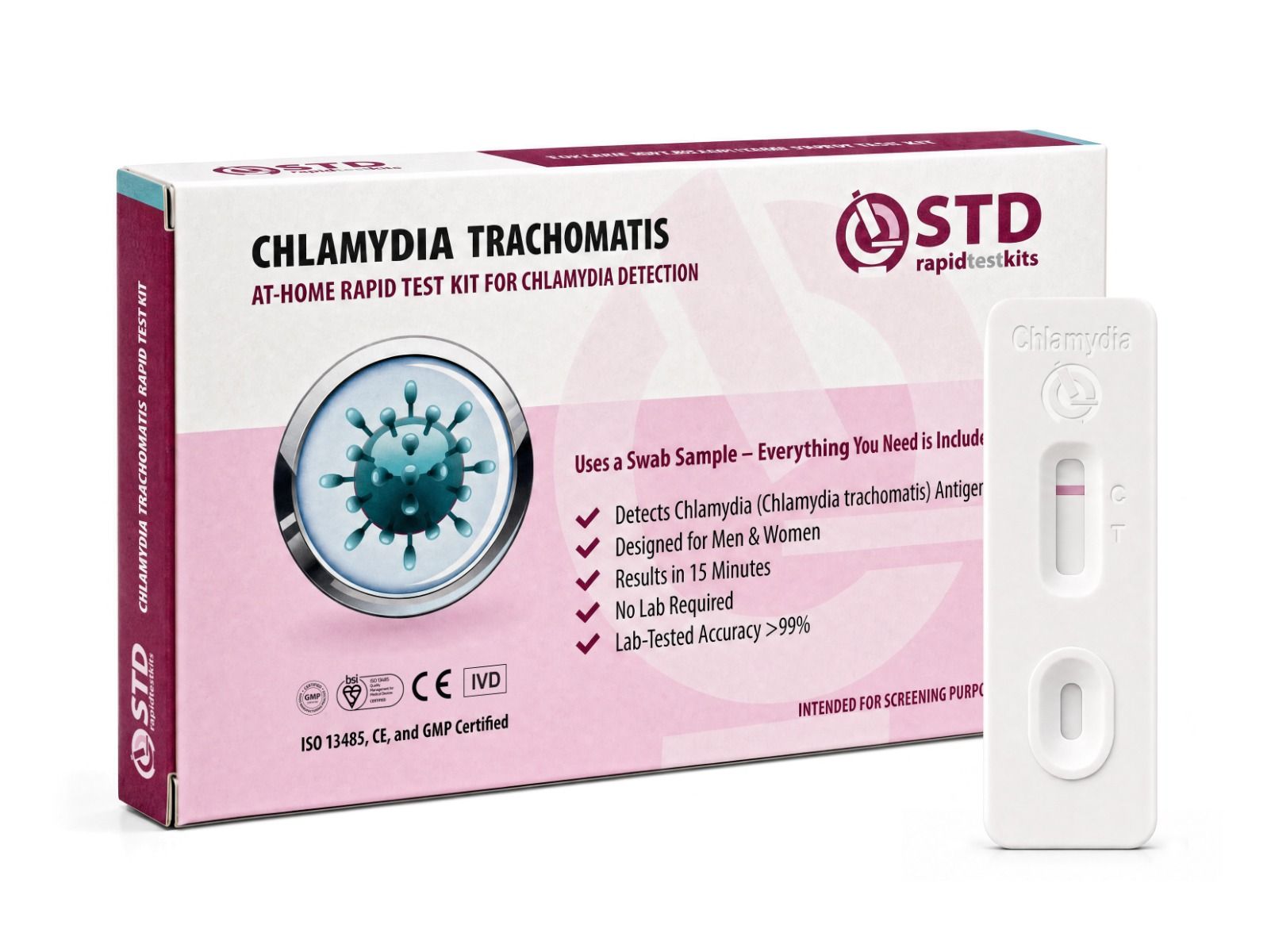
At-home rapid tests use lateral-flow chemistry on a self-collected vaginal swab. They are screening tests, not lab NAATs. A positive rapid result is a strong signal to seek treatment and confirmatory testing. A negative result taken too early in the window does not rule infection out.
| Option | Sample | Privacy | Result Time | Best Use |
|---|---|---|---|---|
| Clinic NAAT | Urine or vaginal swab | Moderate | 1 to 2 days | Symptoms or contact tracing |
| Mail-in lab kit | Urine or vaginal swab | High | 2 to 5 days | Lab-quality screening at home |
| At-home rapid test | Vaginal swab | Very high | 10 to 15 minutes | Fast screening for peace of mind |
When should you test for chlamydia?
Timing is the part most people get wrong. After a possible exposure, the earliest a test can detect infection is around 5 to 7 days, but reliability is low at that edge. Sensitivity climbs each day after that. Most clinical guidance treats day 14 as the practical first-test point.
That doesn't mean you should wait if symptoms are intense, you've had a known exposure to a positive partner, or you've experienced sexual assault. In those cases, test now and plan to retest at day 14 to confirm. A negative early test followed by a confirming day-14 test is the pattern most clinicians recommend after a high-concern exposure.
| Days Since Exposure | Test Reliability | Recommended Action |
|---|---|---|
| 0 to 5 days | Low | Wait if asymptomatic. Test immediately if symptoms or known exposure. |
| 6 to 13 days | Moderate | Testing can begin. Plan to retest at day 14. |
| 14+ days | High | Standard window for accurate first result. |
How soon after exposure can I test for chlamydia?
The earliest reliable testing window is around 5 to 7 days after a possible exposure, but sensitivity is low at that edge. Day 14 is the practical sweet spot for a first test, with most NAAT and rapid lateral-flow tests reaching their best accuracy from that point on. If you test before day 14 and get a negative result, plan to retest at or after day 14 to confirm.
Can you have chlamydia with no symptoms at all?
Yes, and it's the most common presentation. Women with chlamydia often have no obvious symptoms, per the CDC. That's why chlamydia is one of the few infections where annual screening is recommended for sexually active women under 25, even when nothing feels wrong. Internal inflammation can be silently affecting the fallopian tubes while everything outside feels normal.
For women over 25, screening is still recommended after new or multiple partners, after a partner's positive result, or before trying to conceive. Annual screening for sexually active women under 25 is the CDC-recommended standard regardless of risk factors. The NHS similarly advises testing once a year or when you have a new partner, per NHS chlamydia guidance.

What happens if chlamydia goes untreated
Untreated chlamydia doesn't disappear on its own. The bacteria can climb from the cervix into the uterus, fallopian tubes, and ovaries, causing pelvic inflammatory disease (PID). The CDC links PID to long-term fertility complications: roughly 1 in 8 women with a history of PID experience difficulty getting pregnant, according to the CDC's PID overview.
PID can also scar the fallopian tubes, raising the risk of ectopic pregnancy. Chronic pelvic pain is another long-term complication. The progression is often quiet: light cramps, low-grade fatigue, a fever that never quite spikes. Many women dismiss those signs as period-related until the damage is done.
Persistent pelvic pain, fever, abnormal bleeding, pain during sex, or unusual discharge that doesn't clear in a few days warrants a clinical visit, even if a home test was negative. PID can develop without dramatic symptoms; clinicians can diagnose and treat it promptly with the right exam.
Should you retest? Common scenarios
Retesting is not just for people who had a positive result. It is appropriate any time the timing of your first test was uncertain, you've been re-exposed, or new symptoms appeared after a clean result. CDC guidance recommends retesting roughly three months after treatment for chlamydia, regardless of symptoms, because reinfection from an untreated partner is common.
Partners who haven't been tested often don't know they're carrying the infection, which is why reinfection happens even after a clean course of antibiotics. Retesting is also smart in any of these situations:
- A new partner has entered the picture since the last test
- You're planning a pregnancy
- Symptoms have returned or evolved
- A current partner tested positive
- It's been roughly three months since you completed treatment for a confirmed infection
What if you test positive
A positive chlamydia result is treatable, usually with a short course of antibiotics. Current CDC treatment guidelines recommend doxycycline 100 mg twice daily for 7 days as first-line treatment for uncomplicated genital chlamydia. Symptoms generally improve within days, but full clearance takes the complete antibiotic course. Doxycycline clears the infection for most people. If symptoms persist after the full course, return to a clinician, since treatment failure, while uncommon, can occur and warrants a different antibiotic regimen.
Avoid sex for 7 days after starting treatment, and longer if your partner hasn't been treated yet. Partner notification matters: chlamydia spreads quietly, and an untreated partner is the most common reason a person gets reinfected within months of treatment. If a direct conversation feels unsafe, anonymous notification services through state and local health departments can do the outreach for you.
Telling a partner can be simple: "I tested positive for chlamydia. You should get tested too." That sentence is enough.
1. Start treatment promptly, typically doxycycline 100 mg twice daily for 7 days per CDC guidance. 2. Avoid sex for 7 days after the first dose, and until any partner has also completed treatment. 3. Tell recent partners so they can be tested and treated. Health-department anonymous notification services can do the outreach if direct contact feels unsafe. 4. Plan a retest about three months after treatment, regardless of symptoms.
Discreet at-home testing options
For many Black women, the clinic experience is itself a barrier: judgment, racism, long waits, lack of childcare or transportation. At-home testing exists in part to remove those friction points. You can order a test online, receive it in plain packaging, and complete the sample collection in your own space.
Two formats are available. Rapid lateral-flow tests deliver a result at home in about 15 minutes. Mail-in lab kits use the same NAAT methodology as clinic testing, with results returned in a few business days. If your priority is fast reassurance and you're past the day-14 window, a rapid test is appropriate. If you want lab-grade NAAT sensitivity and don't mind a short wait, a mail-in kit is the better choice. The main trade-off is time: about 15 minutes with a rapid test, two to five business days with a mail-in kit.
FAQs
- Can I have chlamydia with absolutely no symptoms?
- Yes. Women with chlamydia often feel nothing at all, which is exactly why the CDC backs routine annual screening for sexually active women under 25. Don't wait for a symptom that may never come.
- How soon after sex can I get a reliable test?
- Book a test for day 14 after exposure. Testing at day 5 to 7 is possible but unreliable, and a negative early result still needs confirming at day 14 to be meaningful. Test sooner if symptoms or a known exposure are present, then retest at day 14.
- What does chlamydia discharge actually look like?
- When discharge is present, it tends to be subtle: a small change in volume, a slightly different texture, or a faintly off color. Many women have chlamydia with no discharge change at all, which is part of why the infection so often goes unnoticed.
- Can chlamydia from oral sex show up in the throat?
- Yes, pharyngeal chlamydia exists, though it is less common than genital infection. We do not sell a throat-swab kit; if you suspect throat infection, see a clinic for a pharyngeal swab. Our home kit covers the genital infection that the same exposure event likely also created risk for.
- Are at-home rapid tests as accurate as clinic tests?
- Lab NAAT remains the most sensitive test available. At-home rapid lateral-flow tests are a screening tool with strong specificity and good sensitivity when used at the right time in the testing window. A positive rapid result should be followed by treatment and ideally a confirmatory NAAT.
- Do I really have to tell my partner if I test positive?
- Ethically, yes. Chlamydia spreads quietly and an untreated partner is the most common source of reinfection. Anonymous partner-notification services are available through most state and local health departments if a direct conversation feels unsafe.
- How often should I retest if I'm sexually active?
- The CDC recommends annual chlamydia screening for sexually active women under 25, and for older women with new or multiple partners. Retest about three months after any treated infection because reinfection is common, even after a successful course of antibiotics.
- What's the difference between chlamydia symptoms and a UTI?
- Both can cause burning during urination and lower-abdominal discomfort. Chlamydia is more likely to bring spotting between periods, pain during sex, or subtle changes in discharge. UTIs usually don't affect the menstrual cycle. When in doubt, ask to be tested for both, since each has a different treatment.
How we sourced this article: Our article was constructed based on current advice from the most prominent public health and medical organizations, then translated into plain language to match the questions readers actually arrive with. We synthesize CDC, NIH, NHS, and MedlinePlus guidance on chlamydia screening, testing windows, treatment, and disparities, and we cross-check at-home testing recommendations against published clinical guidelines.
- U.S. Centers for Disease Control and Prevention. About Chlamydia: clinical overview, symptom presentation, and screening recommendations.
- U.S. Centers for Disease Control and Prevention. STI Treatment Guidelines, Chlamydial Infections: first-line antibiotic regimen and post-treatment retest guidance.
- U.S. Centers for Disease Control and Prevention. About Pelvic Inflammatory Disease: long-term fertility complications associated with PID.
- U.S. Centers for Disease Control and Prevention. STI Surveillance: national reported case rates and demographic breakdowns including racial and ethnic disparities.
- NHS. Chlamydia: symptoms, testing, and annual screening recommendations.
- MedlinePlus (NIH). Chlamydia Infections: clinical overview and screening rationale.
- NIH/NCBI StatPearls. Chlamydia trachomatis: vaginal swab as preferred specimen type for NAAT testing in women.
