
Published: October 2025 | Last updated: May 2026 | Editorial review and quality control: Martina N.
A positive chlamydia test in a relationship you trust can feel like two betrayals at once: one by your partner, one by your own body. The first reaction is almost always the same question: who cheated? That is the loudest possibility, but it is rarely the only one, and on the science it is often not the most likely one either.
Chlamydia behaves differently from how most people imagine an infection. It can sit in the body without symptoms for months or even years. It is not always included in basic STI panels unless someone specifically asks for it. A diagnosis today does not mean exposure today, and a test that came back negative six months ago does not always mean someone was never infected.
Key takeaways
- A positive chlamydia test does not by itself prove infidelity. The infection often goes undetected for months or years because it is symptomless in most people and is not included in every standard STI screen.
- Both partners should complete treatment together and retest at three months, even if one partner initially tests negative. Reinfection from an untreated partner is the most common reason chlamydia keeps coming back.
Why a positive test in a monogamous relationship is not proof of cheating
The math here is more forgiving than most couples assume. Chlamydia, the bacterial infection caused by Chlamydia trachomatis, is the most commonly reported bacterial sexually transmitted infection in the United States, and most people who carry it never know they have it. The CDC's overview of chlamydia notes that most people with chlamydia have no symptoms, which is why annual screening is recommended even for people who feel completely well.
That asymptomatic window is what makes the timeline so unforgiving for relationships. If neither partner has symptoms, neither will think to test. If one partner tested in the past but their panel did not include chlamydia, they could have entered the relationship infected and never have known. If a previous partner had it and never disclosed, it could have been passed forward years before the current relationship began. None of this excuses infidelity if it actually happened. It just means that a positive result, on its own, is not evidence of recent unfaithfulness.
A positive test establishes that an infection is present and treatable. It does not establish when or from whom exposure happened. Chlamydia is curable with a short course of antibiotics, and the complications people fear most, including pelvic inflammatory disease and the fertility risks that follow it, almost always come from infections that were never diagnosed.
How chlamydia hides: the timeline most people never hear
To understand why a delayed positive can blindside a couple, it helps to look at three different time windows that often get confused in conversation. The incubation period describes how long it takes for symptoms to appear after exposure, when symptoms appear at all. The window period describes how long after exposure the infection becomes detectable on a standard test. And the asymptomatic duration describes how long someone can carry the infection with no warning signs and no test result, simply because no one looked.
These three windows do not line up neatly, and that mismatch is where the confusion lives. The CDC's screening guidance is built around this asymptomatic reality. Annual chlamydia screening is recommended for sexually active women under 25, and for older women with new or multiple partners, precisely because the infection so often presents with no warning. The same logic explains why someone can date you for a year, share what feels like a clean medical history, and still test positive at their next physical.
| Stage | Typical range | What it means in practice |
|---|---|---|
| Incubation period | 1 to 3 weeks | If symptoms appear at all, this is when. The majority of people have none. |
| Test window period | 1 to 2 weeks | Time from exposure until standard tests can reliably detect the infection. |
| Asymptomatic duration | Months to years | Untreated infection can quietly persist with no symptoms and never appear on routine bloodwork or pap testing. |
Five ways chlamydia enters a faithful relationship without recent cheating
Walking through the realistic pathways helps separate the medical question from the moral one. Each of the patterns below is more common than the assumption that someone must have cheated this month, which is the explanation most people land on first because it is the most emotionally loud, not because it is the most statistically likely.
| Pathway | How it happens |
|---|---|
| Carried in from a past partner | One person was exposed before the relationship started, never developed symptoms, and was never tested for chlamydia specifically. |
| Standard panel did not include chlamydia | An earlier 'full STI test' may have skipped chlamydia, especially in routine bloodwork-only panels that focus on HIV, syphilis, and hepatitis. |
| Only one partner was treated last time | If a past relationship ended with one person getting antibiotics and the other not, the untreated partner could carry the infection forward. |
| Test was done too early after exposure | A test taken inside the first week or two after exposure can return a negative result even when infection is present. |
| Older infidelity that has been quiet for months | If a partner had a single contact months or years ago and never developed symptoms, the infection could surface only now. |
What to do in the first week after a positive result
The 48 hours after a positive result are usually the worst, partly because most people try to solve the relationship question and the medical question at the same time. Separating them helps. The medical question has a clear answer; the relational one needs space.
The clinical sequence is straightforward and time-sensitive:
- Confirm the result if there is any doubt. Lab errors are uncommon, but a confirmatory test can be reassuring before treatment begins. If the original test was a rapid screening test rather than a lab assay, a follow-up lab test is reasonable.
- Treat both partners, not just the one who tested positive. The CDC's STI treatment guidelines recommend treating recent sexual partners of a chlamydia case, even when their own test is negative or has not been done, because false negatives early in infection are common.
- Stop sex during the treatment window. Most regimens require seven days after a single-dose treatment, or completion of a seven-day course such as doxycycline, before sex resumes. Skipping this window is the most common cause of immediate reinfection.
- Schedule the three-month retest now. Not three months from when you both feel better. Three months from the day of treatment, on the calendar, before the appointment slips down the priority list.
The relational conversation can wait until those four steps are in motion. There is no medical urgency in resolving the question of who or when before the antibiotics get started. Trying to settle the relational question first usually makes both questions harder.
Most people who have chlamydia have no symptoms. If you do have symptoms, they may not appear until several weeks after you have sex with an infected partner.
Why the three-month retest matters more than the first treatment
The single biggest gap in how couples handle chlamydia is the assumption that one round of antibiotics ends the story. It usually does not. Reinfection is common enough that the CDC's treatment guidance specifically recommends a follow-up test about three months after treatment for everyone who has been diagnosed, regardless of symptoms or how confident the couple is in their behavior since.
The retest is not catching cases where the antibiotic failed. Modern chlamydia treatment, with either azithromycin or doxycycline, has a high cure rate when taken correctly. What the retest catches is reinfection, usually from a partner who was missed, treated incompletely, or re-exposed during the abstinence window. Here is the typical timeline most clinicians follow after a confirmed diagnosis. (Note: this site sells at-home rapid test kits for chlamydia and other STIs, so the kit recommendations below are commercial; they fit the screening cadence described, but a clinic test is the right call when symptoms are present or treatment decisions hinge on the result.)
| When | What happens | Why it matters |
|---|---|---|
| Day 0 | Both partners begin antibiotic treatment, typically a single dose of azithromycin or a 7-day course of doxycycline. | Treatment is most effective when both partners take it together, not in sequence. |
| Day 7 | Sexual contact can resume after this point if the full course is complete and no symptoms have re-emerged. | Resuming sex inside this window is the most common cause of immediate reinfection. |
| Week 3 to 4 | Optional follow-up test if symptoms persist or if there is doubt about adherence. | Confirms the antibiotic worked and flags any treatment failure or new exposure. |
| Month 3 | Recommended retest for everyone treated, even with no symptoms. | Catches reinfection, which is most common in the first three to six months after treatment. |
Ping-pong reinfection: why one partner getting treated is not enough
Clinicians use the term ping-pong infection to describe what happens when partners are not treated together. One person gets antibiotics, clears the infection, and is then re-exposed by the partner who did not. The second partner may also be re-exposed if the first one is reinfected. The cycle can repeat for months and is one of the main reasons routine retesting is recommended at all, not just for couples who think they are at risk.
This is why the CDC supports a strategy called expedited partner therapy in many states, which allows a clinician to give a treated patient an antibiotic prescription to take home for a partner who has not yet been seen. The point of the strategy is exactly to prevent the ping-pong cycle by closing the time gap between when the first patient is treated and when the partner gets seen. If your clinician offers it and your partner is willing, it is usually faster than scheduling a separate appointment.
For a couple in a monogamous relationship, the practical implication is simple. Both of you take the antibiotic. Neither of you skips the dose or shortens the course. Neither of you resumes sex before the medication is fully absorbed and the recommended waiting period has passed. Both of you retest at three months.
1. Treat both partners, even if one tests negative. 2. Complete the full antibiotic course, no shortened doses. 3. Abstain from sex for seven days after the final pill in either regimen. 4. Retest at three months for both partners, on the calendar, even when nothing feels off.
Talking to your partner without turning a diagnosis into an accusation
The conversation rarely goes well when it starts with did you cheat. Even if the answer turns out to be yes, leading with the accusation locks both people into defensive positions before the medical part gets handled. A more useful structure usually goes something like this:
- State the test result first. I tested positive for chlamydia, and here is what the doctor said. Keep it factual, keep it short, leave space for their reaction.
- Cover the medical plan before the relational one. We both need to get treated this week. The doctor can prescribe yours too, or you can go to the same clinic. Putting the action items on the table first slows the panic.
- Save the timeline question for after treatment is in motion. Once both of you have the antibiotics, the urgency drops. The conversation about how this came in can take place without the pressure of an active untreated infection.
- Be honest about uncertainty. The most truthful thing one of you may be able to say is, I do not know when this came in. That is often the actual answer, and pretending to know more than you do undermines the trust you are trying to rebuild.
Couples who handle this conversation well often describe it later as forced clarity, not forced rupture. The diagnosis surfaces a topic that had been avoided. The treatment ends in a few days. The conversation, handled calmly, can change the shape of the relationship for the better rather than the worse.
If the diagnosis has destabilized the relationship in ways that conversation alone cannot repair, a couples therapist or counselor experienced with sexual health issues can help separate medical facts from relational concerns. Many therapists offer a single consultation specifically for moments like this, no long-term commitment required. The American Association for Marriage and Family Therapy and similar professional registries can help locate someone local with relevant experience.
Setting a new testing routine going forward
One outcome of a surprise positive is that couples often build a more honest testing rhythm afterward. The CDC's screening recommendations are designed for general use, but couples can choose to test more often if it provides peace of mind, particularly during the year after a recent diagnosis when reinfection rates are highest.
A reasonable cadence after an initial positive looks like this:
- Three-month retest after treatment for both partners, regardless of symptoms.
- Six-month retest after that, especially if either partner has had any new exposure or any return of symptoms.
- Annual screening from then on, even when nothing feels off, in line with general CDC and NHS guidance for sexually active adults.
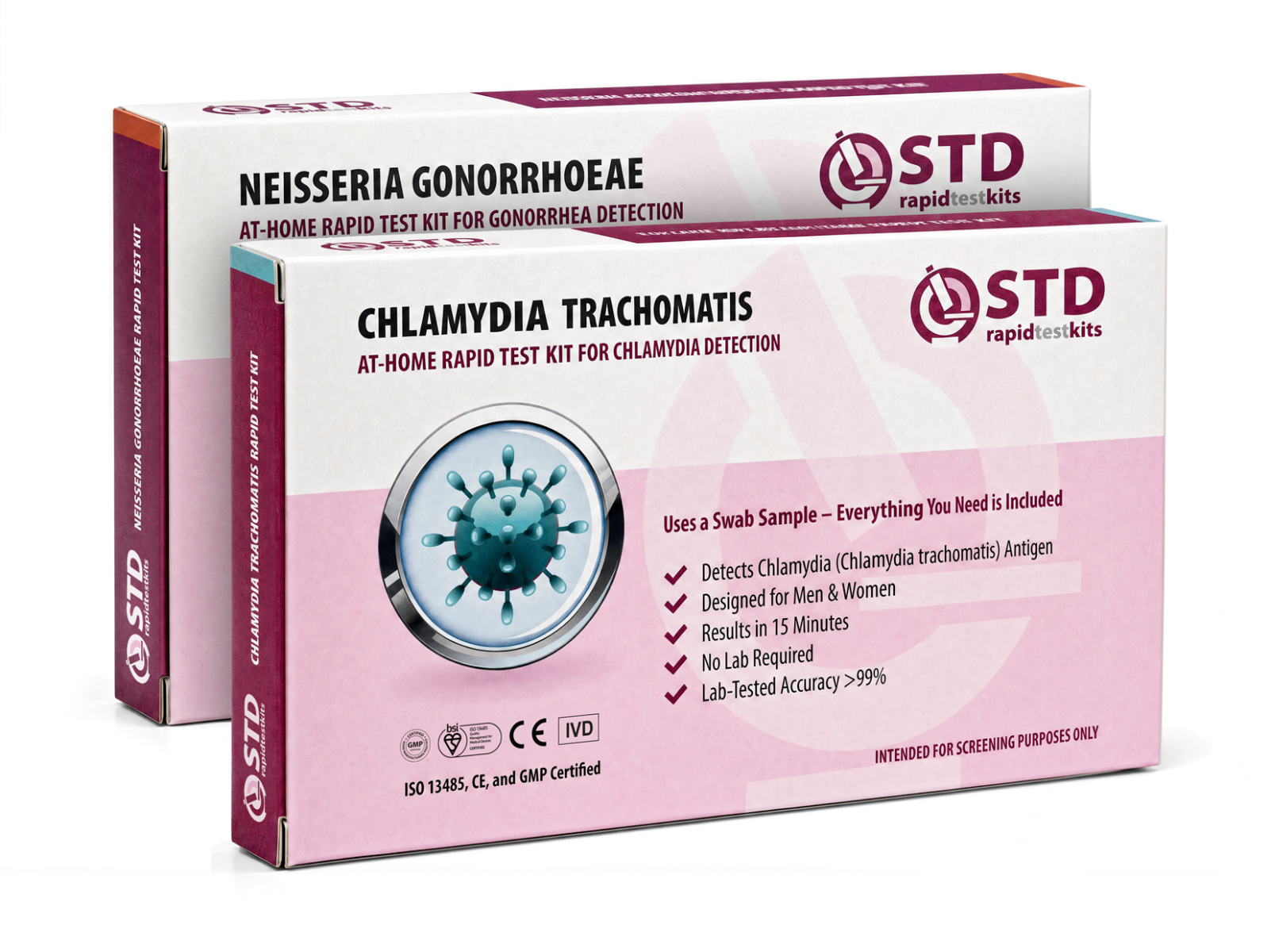
For couples who prefer privacy and want to coordinate at home rather than at a clinic, at-home rapid tests can make this routine easier to keep up with. The kits are not a replacement for clinical lab testing in every case, particularly when symptoms are present or a confirmatory result is needed for treatment decisions. But for routine screening when neither partner has symptoms, they offer a practical way to stay on top of testing without the friction of repeat clinic visits.
Common questions after a chlamydia diagnosis
- Can I really get chlamydia in a monogamous relationship without anyone cheating?
- Yes. The most common pathway is that one partner had the infection before the relationship began and never knew, because chlamydia is symptomless in the majority of people and is not always included in standard STI panels. A positive test today does not pin down when the exposure happened, only that the infection is present and treatable now.
- My partner tested negative and I tested positive. How can that be?
- Two common explanations. The first is timing: tests taken inside the first week or two after exposure can return a negative result even when the infection is present. The second is normal variability with rapid screening tests. The CDC recommends treating recent partners of a positive case regardless of their own test result, which is why both of you should usually take the antibiotics.
- Does a positive chlamydia test always come with symptoms eventually?
- No. Most people with chlamydia have no symptoms throughout the entire course of infection. That is why the CDC recommends annual screening for sexually active women under 25 and for anyone with new or multiple partners, regardless of how they feel. Feeling fine is not evidence that you do not have it.
- Can chlamydia clear up on its own without antibiotics?
- A small fraction of infections may clear without treatment, but waiting it out is not safe. Untreated chlamydia can cause pelvic inflammatory disease, increase the risk of ectopic pregnancy and infertility, and pass to a sexual partner during the asymptomatic period. Treatment is short, well-tolerated, and almost always curative when taken as prescribed.
- Do both of us need antibiotics if only one tested positive?
- Yes. The CDC's standard guidance is that recent sexual partners of a chlamydia case should be treated, even if their own test is negative or has not been done yet. False negatives early in infection are common enough that treating both partners together is the safest way to break the transmission cycle and prevent ping-pong reinfection.
- How long do we have to wait before we can have sex again?
- Seven days, and the clock starts from the final pill, not from day one of treatment. If both partners take single-dose azithromycin on the same day, you can resume after one week from that day. If one partner finishes a 7-day doxycycline course a day later than the other, wait for the later finish date and add the seven days from there. The most common reinfection story is a couple who counted from day one and resumed too early.
- Will an untreated chlamydia infection affect my fertility?
- It can, especially in people with uteruses. Untreated chlamydia can ascend into the uterus and fallopian tubes and cause pelvic inflammatory disease, which is associated with tubal scarring and reduced fertility. Treatment caught early prevents most of these complications. The fertility risk comes from infections that are never diagnosed, not from infections that are diagnosed and treated promptly.
- Should we keep testing even after we both treat and retest negative?
- Annual screening is recommended for most adults under 25 and for older adults with any new partners, regardless of recent history. Couples who want extra confidence after a previous diagnosis often choose a six-month retest in addition to the recommended three-month one, then settle into an annual cadence. Testing at predictable intervals is easier to maintain than testing only when something feels off.
A diagnosis is information, not a verdict
Chlamydia is one of the most-treated bacterial infections in modern medicine. The antibiotic course is short, the cure rate is high, and the long-term effects on fertility and reproductive health are almost entirely preventable with timely treatment. None of that erases how a positive result feels in the moment, especially in a relationship where neither partner expected it. But the science offers a kind of permission: permission to slow down, to handle the medical part first, and to leave the relational part room to breathe instead of being settled in the same panicked hour.
The infection is treatable, the timeline is recoverable, and the conversation can wait until the medical part is handled. The testing routine you set up afterward can leave the relationship more honest than it was before, not less.
Your next three steps
- Complete the antibiotic course as prescribed, both partners, no shortened doses.
- Retest both partners at three months from the day of treatment, on the calendar.
- Set an annual screening reminder so testing stays predictable rather than reactive.
This article draws on current public-health guidance from the U.S. Centers for Disease Control and Prevention, the World Health Organization, and the U.K. National Health Service. Statements about screening cadence, treatment regimens, abstinence windows, and reinfection timing reflect those organizations' published recommendations as of the article's update date. This is editorial summary intended for general information; it does not replace a conversation with a licensed clinician about your individual case.
- U.S. Centers for Disease Control and Prevention. About Chlamydia: overview, transmission, asymptomatic presentation, and complications.
- U.S. Centers for Disease Control and Prevention. STI Screening Recommendations: who should be screened, how often, and which infections.
- U.S. Centers for Disease Control and Prevention. STI Treatment Guidelines, including chlamydia treatment regimens, abstinence windows, and three-month retest recommendation.
- U.S. Centers for Disease Control and Prevention. Expedited Partner Therapy: clinical guidance for treating sexual partners of patients with chlamydia or gonorrhea.
- U.K. National Health Service. Chlamydia overview: symptoms, testing, treatment, and partner notification.
- World Health Organization. Sexually transmitted infections fact sheet, including global prevalence and treatment guidance.
