
Published: August 2025 | Editorial review and quality control: Martina N.
The phone call usually comes a day or two after delivery. Your baby is in the NICU, you have barely slept, and the pediatrician asks whether you were ever tested for syphilis during pregnancy. Or chlamydia. Or HIV. The answer in your head is yes, of course, you had prenatal care. But the result they are holding says otherwise.
Stories like that one are not rare. The U.S. recorded more than 3,800 cases of congenital syphilis in 2023, the highest annual count in more than three decades and more than ten times the 2012 case count, according to CDC STI surveillance data. A CDC review of 2022 cases concluded that roughly 88 percent were preventable with timely testing and treatment during pregnancy. Syphilis is the headline infection because it is the easiest to count, but chlamydia, gonorrhea, herpes simplex virus, hepatitis B, and HIV can all pass from a pregnant person to a baby during pregnancy, delivery, or shortly after birth.
The hard part is biology, not behavior. Most of these infections cause no symptoms in adults. A person can feel completely well, attend every prenatal visit, and still carry an infection that puts the baby at risk. That is not negligence. It is a screening system that does not test everyone for everything every time.
This article walks through what congenital and perinatal STI transmission actually involves, which infections matter most, why standard prenatal panels sometimes miss them, and what screening you can ask for, including which tests are reasonable to run at home before or between provider visits.
Key Takeaways
- Most adult STIs cause no symptoms, so a pregnant person can transmit an infection to a baby without ever feeling unwell.
- Standard U.S. prenatal panels universally screen only HIV, syphilis, hepatitis B, and hepatitis C. Chlamydia and gonorrhea are universal only for those under 25 or with stated risk factors, which leaves a real gap older or “low-risk” pregnant people often do not know about.
How a Silent Infection Passes to a Baby
Transmission to a baby happens through three routes, and each STI uses one or more of them.
The first route is across the placenta during pregnancy. Syphilis is the classic example. The bacterium that causes it (Treponema pallidum) can cross the placenta any time after about week 14 of pregnancy and infect the developing fetus directly. Syphilis in pregnancy globally led to more than 390,000 adverse birth outcomes in 2022, including stillbirth, neonatal death, prematurity, low birth weight, and congenital infection, per the World Health Organization; about 1.1 million pregnant women were infected that year. HIV can also cross the placenta, though most vertical HIV transmission today happens during labor and delivery rather than in utero. With effective antiretroviral therapy and routine perinatal management, transmission risk drops to under 1 percent, per CDC perinatal HIV data.
The second route is through the birth canal during a vaginal delivery. This is how chlamydia, gonorrhea, and herpes simplex virus most commonly reach a newborn. A baby exposed to chlamydia during birth has roughly a 30 to 50 percent chance of developing conjunctivitis (eye infection) and a 5 to 30 percent chance of developing pneumonia in the first weeks of life, the CDC reports. Gonorrhea exposure during birth can cause ophthalmia neonatorum, an aggressive eye infection that can scar the cornea and cause blindness if untreated. Erythromycin eye ointment given to every U.S. newborn at birth is the standard prophylaxis for gonococcal eye infection.
Herpes simplex virus is the most dangerous of the birth-canal-acquired infections. Neonatal herpes is rare (roughly 10 cases per 100,000 live births) but devastating when it happens, with high mortality for the disseminated form and significant rates of long-term neurologic damage in survivors. The risk is highest when a pregnant person acquires their first herpes infection in the third trimester, because they have not yet developed the antibodies that would otherwise be passed to the baby for partial protection.
The third route is at or just after birth. Hepatitis B is the main example. A pregnant person with active hepatitis B infection has a 70 to 90 percent chance of passing the virus to the baby at delivery without intervention, the CDC notes. With timely hepatitis B vaccine and immunoglobulin given within 12 hours of birth, that risk drops to under 1 percent. This is why hepatitis B screening is part of every prenatal panel, and why the first hepatitis B vaccine dose is administered in the hospital before discharge.

Which STIs Carry the Highest Transmission Risk
Not every STI poses the same risk to a baby. Here is the practical hierarchy, drawn from current CDC treatment guidance and WHO fact sheets.
Syphilis is the highest-stakes infection because the consequences of untreated maternal syphilis are severe and the fix is genuinely simple. A single dose of intramuscular benzathine penicillin G given to the pregnant person at least 30 days before delivery is curative and prevents nearly all cases of congenital syphilis. Congenital syphilis keeps climbing in the U.S. because screening, repeat screening, and follow-up are inconsistent, not because the treatment is difficult. Benzathine penicillin G is inexpensive and curative; the problem is getting people tested and treated in time.
HIV is the second highest-impact infection on this list. Without intervention, vertical HIV transmission rates run about 15 to 45 percent depending on viral load, mode of delivery, and breastfeeding status. With combination antiretroviral therapy started during pregnancy and maintained through delivery, plus appropriate management of the newborn, transmission drops below 1 percent. Universal opt-out HIV screening is recommended at the first prenatal visit, with a repeat in the third trimester for anyone in a higher-incidence setting or with new risk.
Chlamydia and gonorrhea are the most common bacterial STIs in the U.S. and the most likely to be missed during pregnancy because they are usually symptomless. Up to 70 percent of women with chlamydia have no symptoms, the CDC notes. Both infections are easy to treat with a single antibiotic course, but the screening gap matters: CDC recommends universal chlamydia and gonorrhea screening at the first prenatal visit only for pregnant people under 25 or with risk factors, with a repeat in the third trimester for those at continued risk. Anyone older than 25 who wants to be screened needs to ask.
Hepatitis B is universally screened. The intervention (vaccine plus immunoglobulin given to the newborn) is highly effective. The system is set up to catch this one.
Hepatitis C screening is also now universal during each pregnancy, per a 2021 CDC update. Vertical transmission risk is roughly 5 to 15 percent if the parent has detectable hepatitis C virus, and there is no perinatal antiviral protocol equivalent to the HIV regimen. Prenatal identification mostly enables careful newborn follow-up and early infant treatment if needed.
Herpes simplex virus is not part of universal prenatal screening because most pregnant people with HSV-2 antibodies have already had the infection long enough that protective IgG is present. Risk management focuses on assessing for active lesions at delivery and discussing suppressive antiviral therapy in the third trimester for those with known HSV.
Bring this list with you: HIV, syphilis, hepatitis B, hepatitis C, chlamydia, gonorrhea. The first four are universal in the U.S. The last two are conditional on age and risk. Ask your provider to confirm in writing which infections are on your panel rather than asking the more common (and easily misunderstood) question, “did you test me for everything?”
Why Standard Prenatal Screening Often Misses Cases
Standard U.S. prenatal screening is more conditional than most pregnant people realize. The CDC's analysis of 2022 congenital syphilis cases found 88 percent were preventable, meaning the infection could have been identified and treated in time. It was not.
One reason is the “young or high-risk only” carve-out for chlamydia and gonorrhea. CDC guidance recommends universal first-visit screening only for pregnant people under 25 or with documented risk factors. Pregnant people 25 and older who have a single partner and no listed risk factor are not routinely screened, even though chlamydia is asymptomatic in most adults. If your obstetrician follows the standard panel exactly and you fall outside the under-25-or-high-risk category, chlamydia and gonorrhea may simply not be tested.
Timing creates another gap. A test at 8 to 10 weeks of pregnancy says nothing about an infection acquired at week 22 or week 30. CDC's 2021 STI Treatment Guidelines recommend a repeat syphilis test at 28 weeks and again at delivery for those in higher-incidence areas, and a repeat HIV test in the third trimester for anyone at continued risk. In practice, many clinics test once early in pregnancy and never again unless symptoms appear. A new infection acquired mid-pregnancy can pass to the baby without ever appearing on a chart.
Application of the “high risk” label is also uneven. CDC STI surveillance data show persistent racial and socioeconomic disparities in screening, retesting, and timely treatment during pregnancy. Providers often rely on demographic shorthand rather than asking every patient about new partners, untreated symptoms, or prior diagnoses since the last test. The result: people who are routinely under-screened are also more likely to have an undiagnosed infection at delivery.
A CDC analysis of 2022 congenital syphilis cases broke down the gaps in detail. Roughly 38 percent had inadequate maternal treatment despite a timely diagnosis. About 36 percent involved no maternal testing or late testing during pregnancy. Around 11 percent had a positive test late in pregnancy without treatment. The infections were detectable; the system did not catch them in time.
If you are over 25, in a settled relationship, and assumed your prenatal panel covered everything, that assumption is reasonable. It just is not how the screening is actually configured.
What should I actually ask my OB to test for?
At your first prenatal visit, ask explicitly for HIV, syphilis, hepatitis B, and hepatitis C (universal). Add chlamydia and gonorrhea regardless of age or stated risk. Ask for a repeat syphilis test at 28 weeks, a repeat HIV test in the third trimester for any continued risk, and a repeat chlamydia and gonorrhea test for those under 25 or with new exposure. Request HSV serology only if you have never had a known herpes diagnosis and want to know your status before delivery.
What Current CDC Guidance Recommends
Here is the screening schedule current U.S. guidance supports for every pregnancy, drawn from the CDC 2021 STI Treatment Guidelines and the CDC 2021 universal hepatitis C screening update.
At the first prenatal visit, universal:
- HIV (opt-out screening)
- Syphilis (treponemal or non-treponemal serology)
- Hepatitis B surface antigen
- Hepatitis C antibody (universal in every pregnancy since the 2021 CDC update)
At the first prenatal visit, conditional on age or risk per CDC, but reasonable to request universally:
- Chlamydia (NAAT, vaginal or endocervical swab)
- Gonorrhea (NAAT, vaginal or endocervical swab)
Optional at the first prenatal visit if relevant to your situation:
- Trichomoniasis screening, especially if there are vaginal symptoms
- HSV serology if you have never had a known herpes diagnosis
In the third trimester (28 to 36 weeks):
- Repeat syphilis test for those in higher-incidence states or with new risk
- Repeat HIV for those at continued risk
- Repeat chlamydia and gonorrhea for those under 25 or at continued risk
- Group B Streptococcus rectovaginal swab at 36 to 37 weeks (not an STI, but standard)
At any new exposure during pregnancy:
Repeat the relevant test based on the infection's window period. Chlamydia and gonorrhea NAATs are reliable around two weeks after exposure. Syphilis serology becomes reliable by six weeks. HIV combination antigen-antibody tests are reliable from about three to four weeks. Hepatitis B surface antigen is detectable from about four weeks.
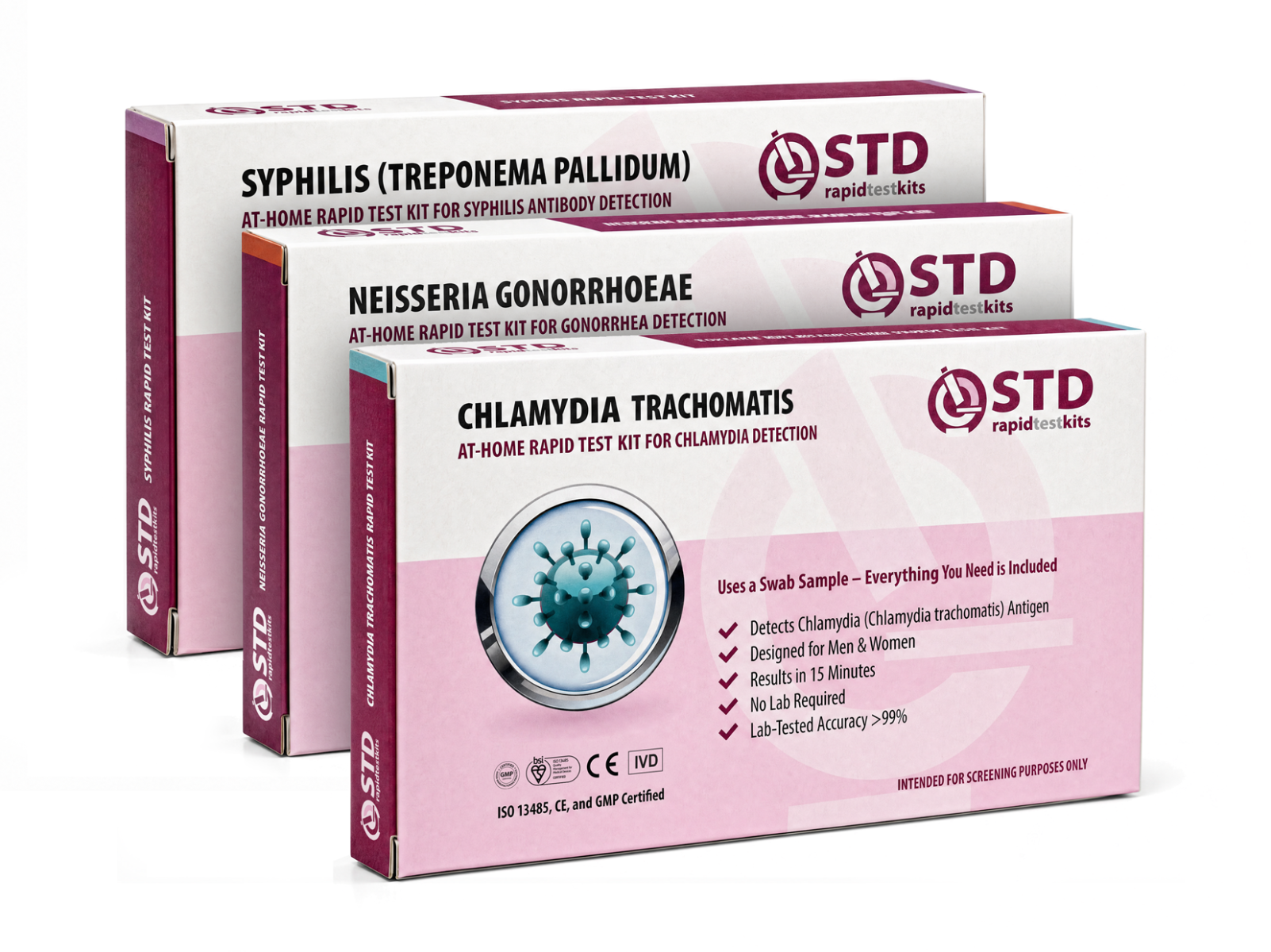
This site sells rapid at-home STI tests; the kit below is one of our products, included where it directly fits the screening gap discussed above.
If You Test Positive Mid-Pregnancy: What Treatment Looks Like
A positive result is frightening, especially during pregnancy. Almost every STI on the screening list is treatable in pregnancy, and treatment dramatically reduces or eliminates the risk to the baby.
Syphilis: a single dose of intramuscular benzathine penicillin G, repeated weekly for late-stage or unknown-duration infection. Treatment given at least 30 days before delivery is considered adequate to prevent congenital syphilis. Pregnant people with a documented penicillin allergy require desensitization, because penicillin is the only treatment shown to reliably cross the placenta and treat the fetus.
Chlamydia: a single oral dose of azithromycin (1 gram). Safe during pregnancy and curative in most cases. A test of cure is recommended three weeks after treatment.
Gonorrhea: a single intramuscular dose of ceftriaxone (500 mg, or 1 gram if weight is over 150 kg), per the 2020 CDC update. Safe in pregnancy.
HIV: combination antiretroviral therapy initiated as early as possible. The goal is undetectable viral load by delivery, which reduces vertical transmission risk to under 1 percent. Mode of delivery is informed by the viral load near delivery; the newborn receives antiretroviral prophylaxis, and infant feeding decisions are made with the care team.
Hepatitis B: no antiviral treatment during pregnancy is needed for most cases. Pregnant people with very high viral loads may be offered tenofovir in the third trimester to further reduce transmission risk. The newborn receives hepatitis B vaccine and hepatitis B immunoglobulin within 12 hours of birth.
Hepatitis C: no perinatal antiviral protocol is currently approved during pregnancy. Direct-acting antivirals are deferred to after delivery. The infant is followed and tested at appropriate ages.
Herpes simplex virus: suppressive acyclovir or valacyclovir starting at 36 weeks for those with a history of genital HSV reduces the chance of an active outbreak at delivery. If active lesions are present at the time of labor, cesarean delivery is recommended to prevent neonatal transmission. An at-home test result, positive or negative, is screening information for the conversation with your obstetric team, not a substitute for the clinic NAAT that guides treatment.
Trichomoniasis: a single oral dose of metronidazole, safe during pregnancy.

How to Ask the Right Questions, and Where to Test on Your Own
Two practical scripts make a real difference at appointments.
For your first prenatal visit: “Can you tell me which specific STIs are on the panel you are running today? I want HIV, syphilis, hepatitis B, hepatitis C, chlamydia, and gonorrhea included.”
For new exposures or partner concerns during pregnancy: “I have had a possible exposure since my last test. Can we repeat chlamydia, gonorrhea, syphilis, and HIV?”
If a provider responds with “you do not need that, you are low risk,” ask them to document the request and the response in your chart, and consider getting a second opinion. Risk-stratified screening is a clinical guideline default, not a binding rule, and a request from the patient is a legitimate reason to test.
For the gap between provider visits, an at-home rapid test is a reasonable screening tool. Lateral-flow rapid tests do not match the analytical sensitivity of laboratory NAATs (which are the laboratory gold standard for chlamydia and gonorrhea), but they are useful for fast home screening. A positive home result needs confirmation with a clinic NAAT before treatment. A negative result a few weeks after a possible exposure is reassuring but does not replace the prenatal screening schedule above.
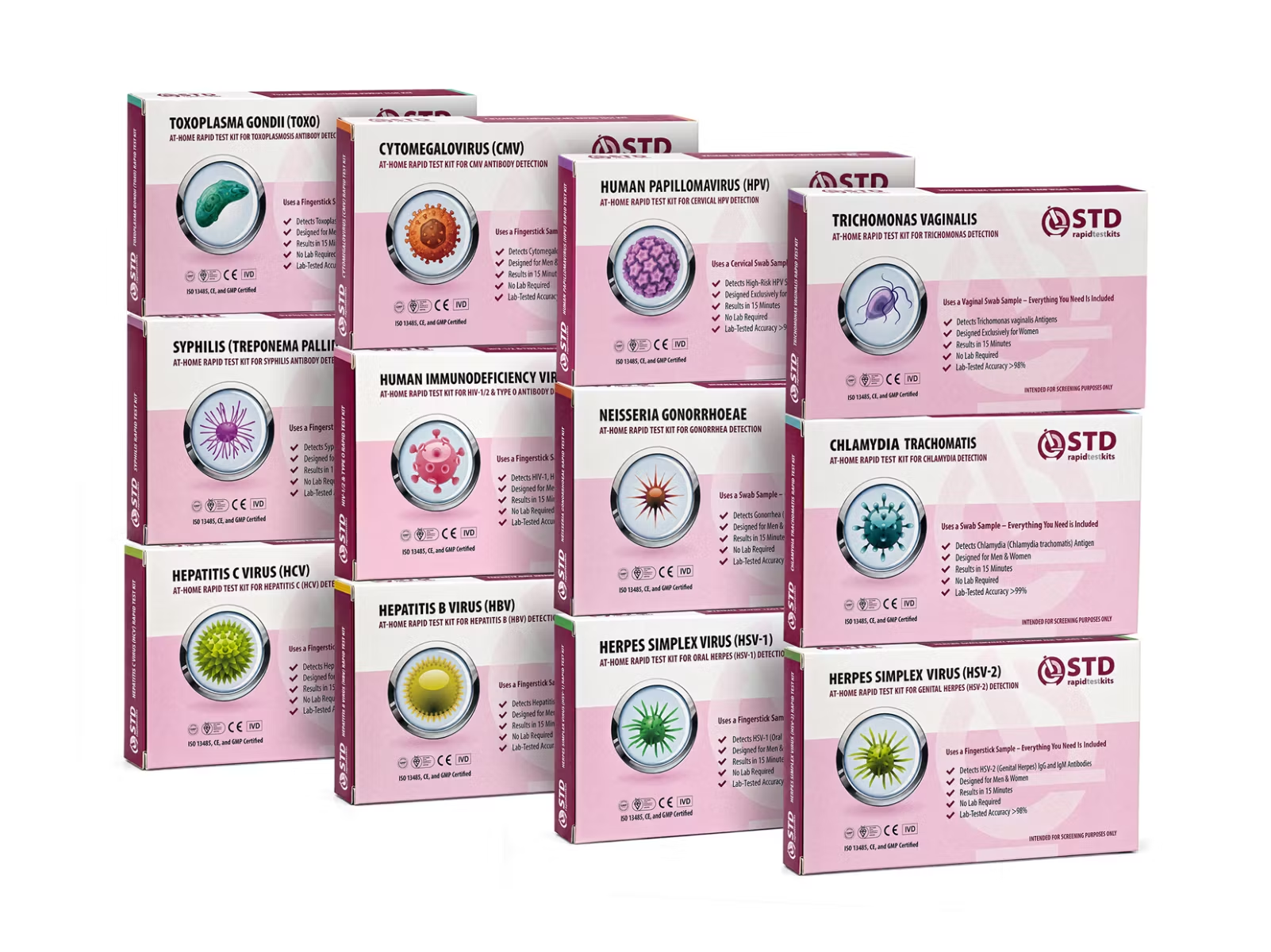
Home swab tests for chlamydia, gonorrhea, trichomoniasis, and HPV use vaginal self-swabs and are validated for female anatomy. The fingerstick blood tests for HIV, syphilis, hepatitis B, hepatitis C, and HSV antibody work for any anatomy. If you are pregnant and want a fast check on the most likely missed infections without an appointment, a chlamydia plus gonorrhea plus syphilis combo kit covers the three highest-impact infections most often dropped from a standard older-or-low-risk prenatal panel. A broader 10-in-1 panel is appropriate when you want a comprehensive baseline before a planned pregnancy or after a known exposure.
Frequently Asked Questions
- Can I really transmit an STI to my baby without any symptoms?
- Yes. Most adult STIs (chlamydia, gonorrhea, early HIV, latent syphilis) cause no symptoms in the parent. The infection is detected by a test, not by a feeling. That is why universal and repeat testing during pregnancy matters more than self-assessment.
- Are pregnant people automatically tested for every STI in the U.S.?
- If you are 25 or older with no listed risk factors, chlamydia and gonorrhea are probably not on your prenatal panel, even with full prenatal care and a thorough first visit. Both infections are usually symptomless and both can pass to the baby during delivery. Ask your provider at the first prenatal visit to add both, and ask them to confirm in writing which infections are on the panel ordered that day. The four that ARE universally screened in the U.S.: HIV, syphilis, hepatitis B, and hepatitis C.
- What happens if a baby is exposed to an STI during birth?
- It depends on the infection. Gonorrhea and chlamydia exposure most often cause newborn eye infection (conjunctivitis), and chlamydia can also cause newborn pneumonia. Herpes exposure can cause neonatal herpes, which is rare but serious. Syphilis acquired in utero can cause stillbirth, prematurity, or congenital syphilis with bone, eye, brain, or skin involvement. Most are preventable with timely maternal screening and treatment.
- Is it too late to test if I am already in my second or third trimester?
- No. CDC guidance specifically recommends repeat syphilis and HIV testing in the third trimester for many pregnancies, and any new exposure should trigger a repeat test. Treatment of syphilis with intramuscular penicillin is effective at any point as long as it is given at least 30 days before delivery.
- Can I use an at-home STI test while pregnant?
- Yes. Home rapid lateral-flow tests are usable any time and provide fast screening at home. A positive home result should always be confirmed with a clinic NAAT, and any positive result during pregnancy should be discussed with the obstetric team for treatment planning.
- How long after a possible exposure should I test?
- Two weeks is enough for chlamydia and gonorrhea. Six weeks for syphilis. Three to four weeks for HIV with a combination antigen-antibody test. During pregnancy, testing at the shorter window and repeating at the full window is reasonable; a second test costs less than a missed diagnosis weeks before delivery. Home rapid tests work on the same timing windows. A positive result at two weeks needs clinic confirmation, but a negative is already useful information.
- If I test positive during pregnancy, what happens to the baby?
- For most STIs, prompt treatment of the parent dramatically reduces or eliminates the risk to the baby. Syphilis treated at least 30 days before delivery prevents nearly all cases of congenital syphilis. HIV with combination antiretroviral therapy reduces transmission to under 1 percent. Hepatitis B exposure is managed with vaccine and immunoglobulin to the newborn within 12 hours of birth. Chlamydia and gonorrhea are cleared with single-dose antibiotics.
- Should I tell my partner if I test positive?
- Yes. Partner notification and treatment is what breaks the reinfection cycle and protects future pregnancies. Most clinics offer expedited partner therapy or anonymous partner-notification services if telling the partner directly feels too difficult.
- U.S. Centers for Disease Control and Prevention. STI Treatment Guidelines, 2021. Source for the prenatal screening schedule, treatment regimens, and repeat-screening recommendations during pregnancy.
- U.S. Centers for Disease Control and Prevention. STI Surveillance Statistics. Source for U.S. congenital syphilis case counts, the increase from 2012, and racial and socioeconomic disparities in prenatal screening and follow-up.
- U.S. Centers for Disease Control and Prevention. HIV section, including perinatal transmission guidance. Source for vertical HIV transmission rates with and without antiretroviral therapy.
- U.S. Centers for Disease Control and Prevention. Viral Hepatitis section. Source for hepatitis B perinatal transmission rates and the universal hepatitis C screening update for pregnancy.
- World Health Organization. Sexually Transmitted Infections fact sheet. Source for global syphilis-in-pregnancy adverse birth outcome counts and overall STI epidemiology.
- U.S. Centers for Disease Control and Prevention. Congenital Syphilis topic page. Source for the CDC analysis of 2022 cases identifying that 88 percent were preventable and breaking down the specific testing and treatment gaps.
