

Published: September 2025 | Last updated: April 2026 | Editorial review and quality control: Martina N.
The stretch between taking a test and seeing the result is one of the quieter forms of stress in sexual health. The swab or fingerstick takes seconds. The waiting takes days. And underneath the practical questions sits one most guides tiptoe around: what about sex right now?
Biology, timing, and judgment all factor in. Many sexually transmitted infections can spread before a test turns positive, and most produce no early symptoms at all. So feeling fine is a poor signal of whether you are contagious. This article walks through what is actually happening during the wait, where protection helps and where it falls short, and how to choose intentionally so you do not have to revisit the decision once results return.
Can you have sex while waiting for STD results?
Technically yes; medically the safest choice is to pause until results are back, especially if your test fell inside the relevant window period. If you do choose to have sex during the wait, use a condom every time, avoid contact with any sores or unusual discharge, and stop immediately if symptoms appear. Many infections, including chlamydia and gonorrhea, can spread before a test detects them.
Key Takeaways
- Most STIs are contagious before a test turns positive, so a pending result does not equal low risk.
- Pausing sex until results are back and you are outside the test's window period is the cleanest way to avoid retroactive worry.
What the window period actually means
The window period is the gap between exposure and the point at which a test can reliably detect an infection. It varies by infection and by test technology, and it is the single most important number to know when interpreting an STI result. A test taken too early can miss a real infection, and the person carrying it is often contagious during that exact gap.
Two timelines run side by side. One is how soon after exposure you become infectious to a partner. The other is how soon a test can pick up the infection. They do not line up. The CDC STI overview notes that many infections produce no early symptoms, which is why people commonly transmit them without realizing. The WHO fact sheet on STIs describes the same pattern globally: the majority of new infections come from people who feel completely well.
So during the wait you sit in one of three states: not infected, infected and detectable, or infected but in the gap before the test catches up. Your body offers no obvious clue which of those three you are in. That is why testing guidelines tell people to pause sex or use protection until the result is back.

Window periods by common infection
Different infections have different detection windows. Knowing roughly where your test falls on that timeline is what lets you read your result honestly. The values below are drawn from CDC testing guidance and WHO fact sheets for laboratory tests; rapid at-home lateral-flow tests sometimes need a slightly longer window to reach the same accuracy because they screen rather than amplify.
| Infection | Test type | Typical window period | When the result becomes most reliable |
|---|---|---|---|
| Chlamydia | NAAT (lab) or rapid swab | 1 to 2 weeks | After 14 days from exposure |
| Gonorrhea | NAAT (lab) or rapid swab | 1 to 2 weeks | After 14 days from exposure |
| Syphilis | Blood antibody | 3 to 6 weeks | Retest at 12 weeks if very early |
| HIV (4th-generation lab antigen/antibody) | Blood draw | 18 to 45 days | Retest at 90 days if first test was early |
| HIV (rapid antibody fingerstick) | Fingerstick blood | 23 to 90 days | Retest at 90 days if first test was early |
| Herpes simplex (HSV-2 antibody) | Blood antibody | 6 to 12 weeks | Retest at 16 weeks if very early |
| Hepatitis B | Blood antibody | 3 to 6 weeks | Retest at 9 weeks if very early |
| Hepatitis C | Blood antibody | 8 to 11 weeks | Retest at 6 months if very early |
What the evidence says about sex during the wait
Technically, you can have sex while waiting. Medically, the safest answer is to pause. Public-health guidance favors pausing because it removes the variable nobody can see: whether you are infected and contagious in the window before the test catches up. CDC STI guidance consistently treats waiting as the default, with protection as a fallback when waiting is not feasible.
Real life does not always pause on command. Long-term partners, established relationships, and emotional intimacy do not switch off because a test is in transit. The useful framing is harm reduction: pause if you can; if you cannot, lower the risk that remains by combining several smaller actions instead of relying on any single one.
Risk lines up roughly like this:
- No sex: no transmission risk.
- Mutual touching with no fluid exchange: minimal risk.
- Oral sex with a barrier or condom: low risk for fluid-borne infections, but does not eliminate skin-to-skin spread.
- Vaginal or anal sex with a condom every time, used correctly start to finish: moderate residual risk.
- Unprotected vaginal or anal sex: highest risk, especially if either partner has visible sores, unusual discharge, or recent symptoms.
Stop if symptoms appear, regardless of plan.
New sores, ulcers, blisters, painful urination, unusual discharge, pelvic or testicular pain, fever with rash, or sudden flu-like symptoms after a possible exposure all change the calculus. These are not signs to ride out. Pause sex, contact a clinician, and let the symptom guide the next test rather than the original one.
Where condoms help and where they fall short
Condoms and dental dams do meaningful work. Used correctly and consistently, they substantially reduce transmission of infections that spread through fluids: chlamydia, gonorrhea, HIV, hepatitis B, and syphilis transmission via genital contact. Public-health guidance, including NHS guidance on STIs, identifies barrier protection as a key prevention measure.
What they cannot do is cover every square centimeter of skin involved in sex. Herpes simplex (HSV-1 and HSV-2) and human papillomavirus (HPV) both spread through skin-to-skin contact in regions a condom does not fully cover: the base of the penis, the scrotum, the vulva, the perineum, the inner thighs. Asymptomatic shedding of HSV is well documented, so a partner with no visible sores can still transmit. The same is true for HPV, which is why condoms reduce but do not eliminate the risk of either.
The takeaway is not that condoms are useless. They are extremely useful. They are also imperfect, and the imperfection matters most during the exact window where you are uncertain whether anything is being transmitted. Treat them as one of several layers, not as a sealed barrier.
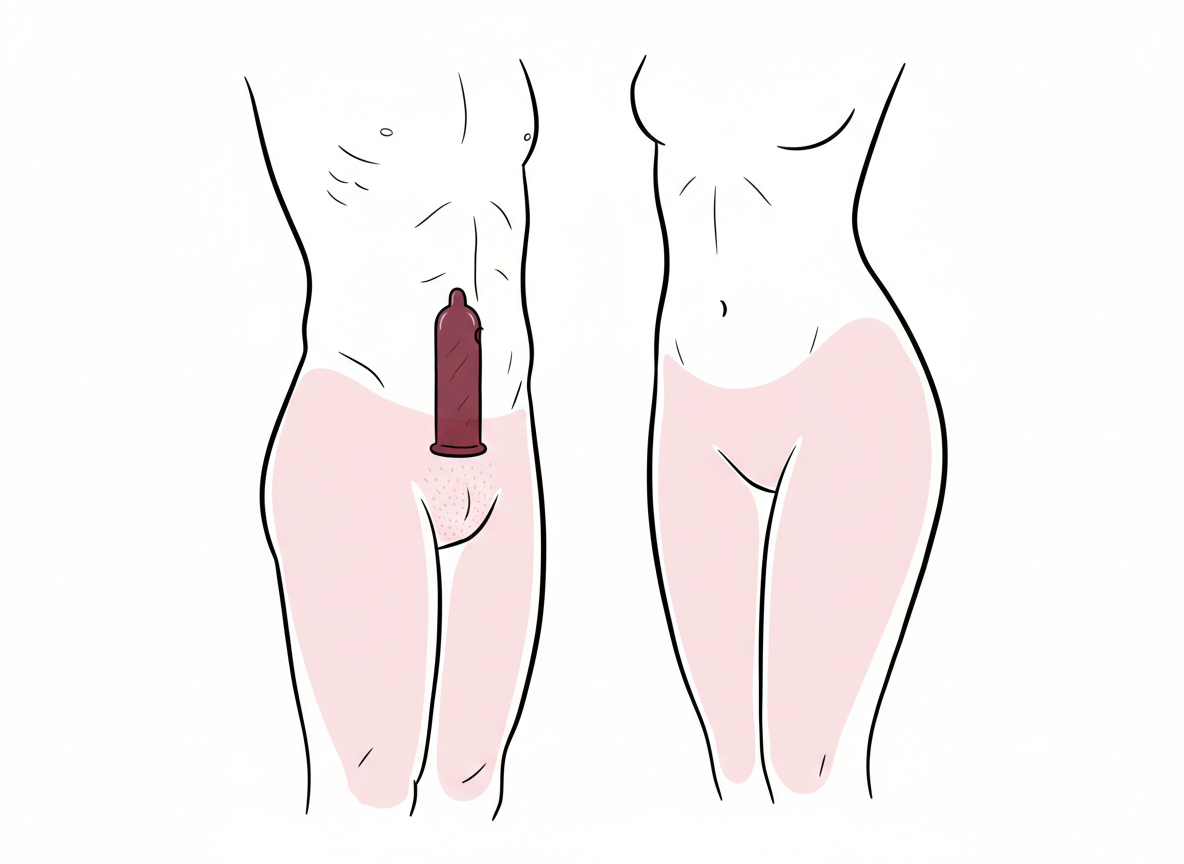
The skin areas a condom does not cover are exactly where herpes simplex and HPV most commonly transmit. That is why even consistent condom use does not bring skin-to-skin infection risk to zero. The surrounding pelvic and genital skin can shed virus during contact even when no sores are visible, which is the reason public-health guidance treats condoms as a strong layer rather than a complete shield.
How to bring it up with a partner
The conversation feels heavier than it needs to. Most partners respond better to a short factual statement than to an anxious one. The framing matters more than the content. Anxious framing reads as confession; calm framing reads as adulthood. Same information, very different room temperature.
Informed consent is the underlying principle. The other person is choosing what level of uncertainty to accept, and they cannot do that without the information you have. You are not asking them to share your stress. You are giving them the data they need to make their own decision.
A practical script: name what you tested for, name when you expect results, and propose a concrete plan for the days in between. That gives the other person something specific to respond to instead of an open-ended worry.
Anxious version: "I might have something. I don't know. I'm freaking out and I don't know what to do."
Adult version: "I tested recently and I'm waiting on results, so I'd feel better taking it slow until I know for sure."
Same information. The second one almost always lands as maturity rather than alarm.
How at-home testing changes the wait
One reason this question is so common is that traditional testing builds a queue: clinic appointment, blood draw, lab processing, results call or portal message. That queue routinely runs five to seven days, sometimes longer. The wait itself is the source of most of the uncertainty.
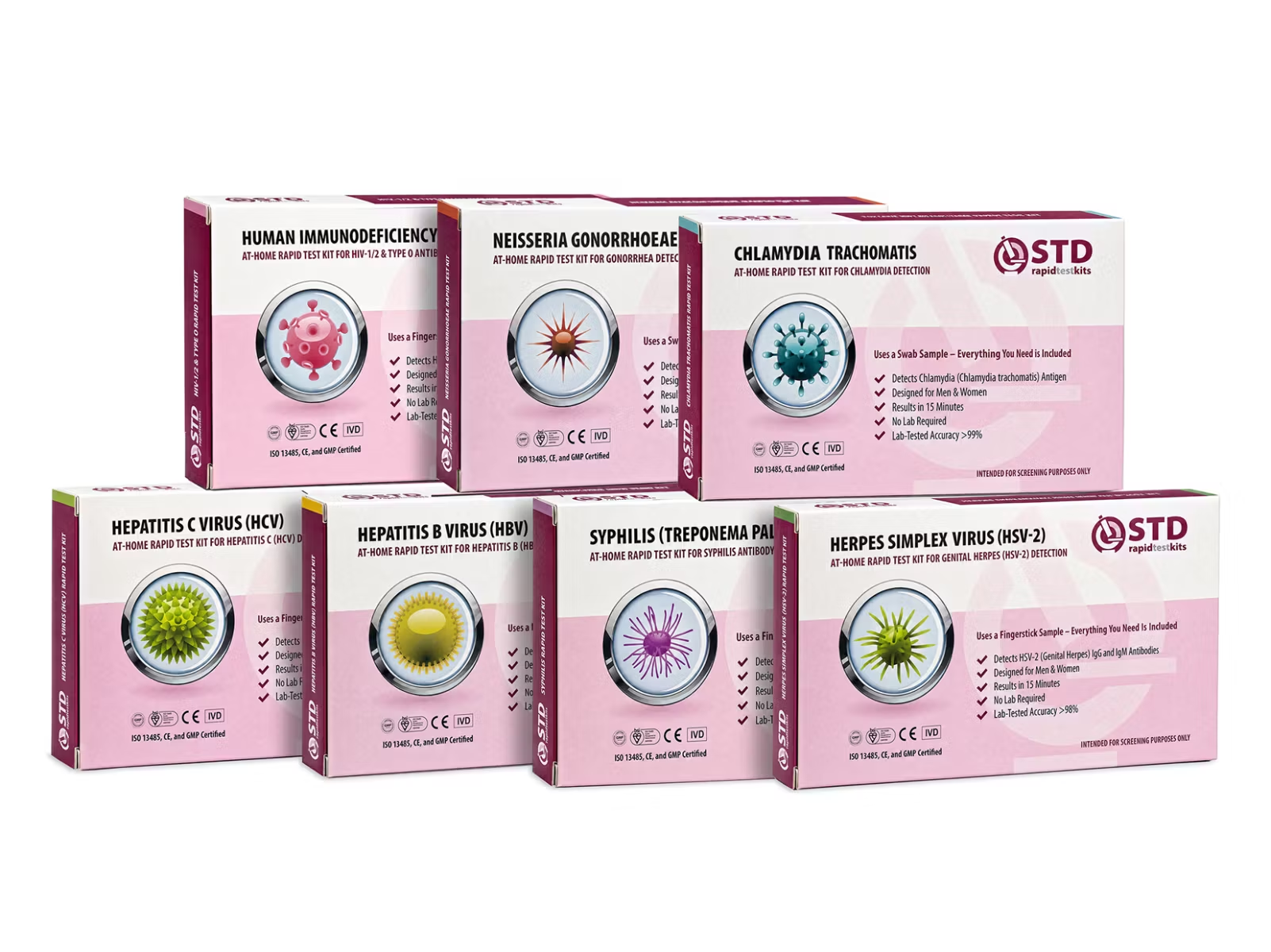
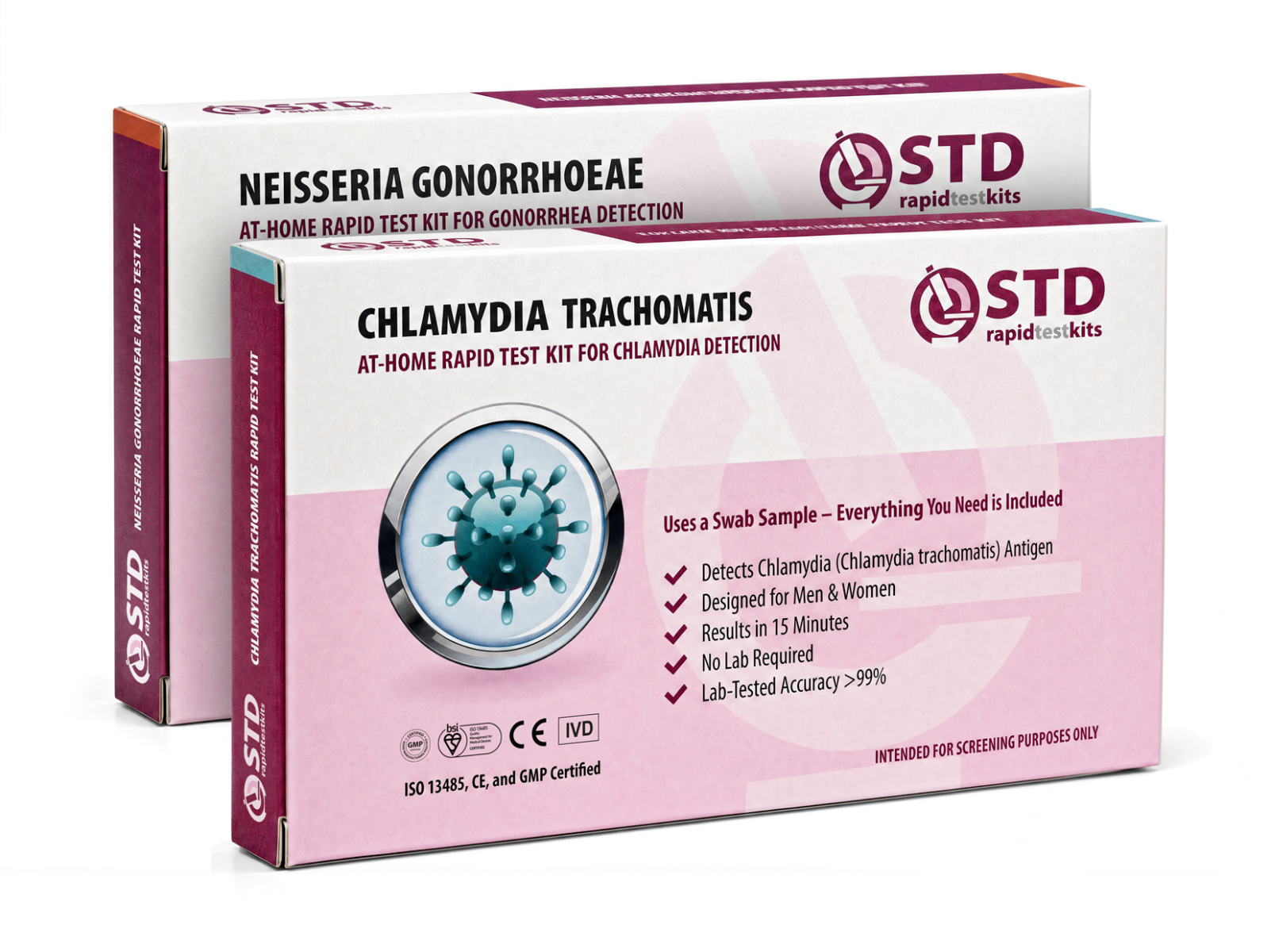
At-home rapid lateral-flow tests compress that timeline. The sample-to-result window for a rapid swab is typically about 15 minutes once the sample is collected. They do not replace lab confirmation for a positive result, and they are most accurate when used outside the relevant window period. But for the practical question of how long to sit in limbo, they remove most of it. A combination panel can screen for several infections at once, which is closer to how exposures actually happen.
When it is safer to resume sex
The medical green light usually arrives when three things line up. Your results are back and clearly negative. Your test fell outside the window period for the relevant infections, so the negative result is statistically reliable. And you have no symptoms.
If any of those three is missing, you are still in the gray zone. A negative result on a chlamydia swab taken three days after exposure does not mean much yet, because the infection may not have reached detectable levels. A negative HIV antibody test taken at four weeks does not yet rule out infection; the CDC HIV testing guidance recommends retesting at 90 days for the rapid antibody assay if the first test came early.
Treating the result as one data point inside a timeline, rather than as a final verdict, changes how you act on it. A clearly negative result on a test taken at the right time is reassuring. A negative result on a test taken too early is a reason to retest before resuming.
Three conditions for safely resuming sex
- Your results are back and clearly negative.
- Your test fell outside the window period for every infection it covered.
- You have no new symptoms (sores, discharge, painful urination, fever, or rash).
If your results come back negative
Negative is the most common outcome of an STI test. Take the relief. It is real. Then check the timing. If your test fell outside the window period for everything you tested for, the result is reliable and you can resume normal activity. If part of the test fell early (for example, an HIV rapid antibody test at four weeks instead of twelve), the recommended action is a retest at the longer window to confirm.
New exposures start a fresh window. Anyone with new partners or changing risk factors benefits from periodic testing as part of routine care, not as a reaction to fear. CDC STI guidance treats routine screening as a core part of sexual health for sexually active adults, separate from any specific exposure event.
Some STIs have no symptoms, so testing is the only way to know for sure if you have one.
If your results come back positive
A positive result is manageable. Most common STIs are treatable, and the bacterial infections (chlamydia, gonorrhea, syphilis) are curable with a defined course of antibiotics. Viral infections (HIV, HSV, HPV, hepatitis B) are not all curable, but they are treatable, and modern care has changed the long-term outlook for all of them. The CDC STI Treatment Guidelines set out the standard regimens.
Resuming sex usually has to wait until treatment is complete and any post-treatment retesting clears. For chlamydia and gonorrhea, that is typically about a week after finishing antibiotics, with a test-of-cure for some cases. For viral infections, your clinician will set a timeline based on the specific infection and your treatment.
Pausing sex during the original wait pays off here. It reduces the chain of partners that need to be notified, and it removes the worst version of the conversation: telling a partner you slept with them after testing but before getting results.
First three steps after a positive result
- Confirm the result with a clinical lab if it came from a rapid at-home test.
- Start treatment promptly under clinical guidance, following the CDC STI Treatment Guidelines for the specific infection.
- Notify any partners from the relevant exposure window so they can test and, if needed, start treatment too.
What to do during the wait that actually helps
The wait is not passive time. There is a small set of actions that lower stress, lower risk, and produce a cleaner outcome regardless of how the result lands.
- Write down your exposure date. Knowing the gap between exposure and test is what lets you read the result correctly.
- Watch for symptoms without spiraling. New sores, unusual discharge, painful urination, fever, or a rash matter. Mild itching that comes and goes probably does not.
- Avoid new partners until the result is back. Adding variables makes any future contact tracing harder for everyone.
- Plan a retest if your first test fell early. Set the date in your calendar now so you do not have to decide later.
- Keep the practical contacts handy: a clinician you can reach, a pharmacy, and the test kit's instructions for retest timing if relevant.
Put the result delivery date on your calendar. Knowing when the uncertainty ends makes the days in between easier to plan around.
FAQs
- Can I have sex while waiting for STD results if I feel completely fine?
- You can, but feeling fine is one of the weakest signals here. Most early-stage STIs are silent. Chlamydia, gonorrhea, and HIV all transmit easily from people with no symptoms at all, often before a test would turn positive. The absence of symptoms does not equal the absence of infection. The safer default is to pause, or at minimum to use a condom every time and stop if anything changes.
- If we use a condom, are we safe?
- Condoms substantially reduce the risk of fluid-borne infections like chlamydia, gonorrhea, HIV, and hepatitis B when used correctly start to finish. They do not fully cover the skin areas where herpes simplex and HPV live, so those can still transmit through skin-to-skin contact even with consistent condom use. Treat condoms as a strong protective layer rather than as an absolute barrier.
- Can I actually pass an STD before my test confirms it?
- Yes, and this surprises most people. Tests do not detect infections instantly; each one has a window period during which a real infection produces a negative or unclear result. For chlamydia and gonorrhea, you are typically contagious well before the 14-day point at which the test becomes most reliable. The same is true for HIV, syphilis, and the hepatitis viruses, with longer windows.
- Is oral sex safer than penetrative sex while I wait?
- Lower-risk for some infections, but not zero-risk. Gonorrhea and syphilis can both transmit through oral contact, and herpes can transmit either direction (oral to genital or genital to oral). Oral with a barrier reduces transmission of fluid-borne infections, but it does not eliminate skin-to-skin spread. If you are using oral sex as a compromise during the wait, treat it as a smaller risk rather than a free pass.
- Do I have to tell my partner I am waiting on STD results?
- Have to is a strong phrase. The clearer principle is informed consent: the other person is choosing what level of uncertainty to accept, and they need the information to do that. The way you say it matters more than whether you say it. A calm, factual disclosure tends to land as maturity. A nervous confession tends to land as alarm. Same information, different room temperature.
- What is the actual window period for the most common STIs?
- Roughly: chlamydia and gonorrhea are reliably detectable by 14 days after exposure. Syphilis is reliable by 6 to 12 weeks. HIV depends on test type. A 4th-generation lab antigen/antibody test is reliable by 18 to 45 days; a rapid antibody fingerstick is reliable by 23 to 90 days. Herpes (HSV-2 antibody) takes 6 to 12 weeks, occasionally longer. Hepatitis C can take 8 to 11 weeks. The table earlier in this article has the full breakdown.
- If my results come back negative, can I resume sex right away?
- Check your exposure date against the window period for each infection you tested for. If the test fell outside the window, the negative result is reliable and you can resume. If any test fell early, schedule a retest now rather than waiting for symptoms or another exposure to complicate the picture. The exposure date is what tells those two situations apart.
- What if symptoms appear while I am waiting?
- Stop sex, do not wait for the test result, and contact a clinician. New symptoms change both the diagnosis and the timeline. The original test may have been the wrong one, or it may have been taken too early. A clinical visit is faster than guessing, and most early-stage STIs are simpler to treat the sooner they are caught.
- U.S. Centers for Disease Control and Prevention. STI overview, including the role of asymptomatic infection, routine screening recommendations, and prevention guidance.
- U.S. Centers for Disease Control and Prevention. HIV testing guidance, including window periods for 4th-generation antigen/antibody tests and rapid antibody tests, and the 90-day retest recommendation.
- U.S. Centers for Disease Control and Prevention. STI Treatment Guidelines, including standard regimens and post-treatment retesting timing for chlamydia, gonorrhea, and syphilis.
- World Health Organization. Sexually transmitted infections fact sheet covering global epidemiology and the prevalence of asymptomatic transmission.
- UK National Health Service. Sexually transmitted infections overview, covering symptoms, testing, and barrier-protection guidance for fluid-borne and skin-to-skin transmission.
