
Published: December 2025 | Last updated: May 2026 | Editorial review and quality control: Martina N.
A partner gets a "clean" STD panel, swears he has no symptoms, and three months later you walk out of an annual exam holding a positive HPV result. The reflexive question is some version of: did he lie, or did the test miss something? For HPV in men, the honest answer is almost always neither. Most men who carry HPV never know they have it, because the standard male STD workup does not include an HPV test, and the virus often produces no visible signs even on close inspection.
This article walks through how silent HPV transmission actually works: which men's tests catch it (very few), how long the virus can sit dormant before showing up on a partner's Pap smear, what condoms can and cannot protect against, and the testing options available to people with a cervix when their partner has no way to test. The goal is calmer, more specific footing for whatever decision comes next.
Key Takeaways
- There is no FDA-approved HPV test for men without visible warts, so a "clean" male STD panel almost always excludes HPV entirely.
- HPV can lie dormant for months to years before causing visible changes, so a new positive Pap does not necessarily mean recent exposure or infidelity.
The Silent Spread: Why HPV Often Goes Unnoticed in Men
Unlike chlamydia or gonorrhea, which often cause discharge or pain on urination, HPV typically lives on the skin without producing pain, itching, or visible changes. Most men who carry the virus never develop warts. Most never learn they were infected unless a partner is diagnosed. According to the CDC's genital HPV fact sheet, the virus is common enough that "if you are sexually active, you can get HPV, even if you have had sex with only one person." The CDC also reports about 13 million new HPV infections in the U.S. each year.
The challenge for men specifically is structural. There is no equivalent of the Pap smear for penile or scrotal skin. A routine male sexual-health checkup screens for chlamydia and gonorrhea via urine sample, for HIV and syphilis via blood, and sometimes for herpes if symptoms warrant it. HPV is not on that list. The FDA has not approved an HPV test for use in men without visible lesions; the few HPV swab assays that exist are validated only for the cervix or for anal screening in select higher-risk populations (typically men who have sex with men who are also living with HIV).
That gap is the root of most "how did this happen" moments. The man in the story is usually telling the truth when he says he was tested. The clinic he was tested by simply does not look for HPV.
Can you get HPV from a guy with no symptoms?
Yes. HPV is the most common STI in the United States, with the CDC reporting roughly 13 million new infections each year. Any sexually active person can contract the virus, and most men who carry HPV never develop visible warts and never know they are infected. Standard male STD panels do not include an HPV test, so a "clean" panel result does not rule out HPV transmission. Condoms reduce transmission by roughly 60% to 70% with consistent use but do not eliminate it, because the virus spreads through skin-to-skin contact in areas condoms do not cover.
What Counts as a "Full STD Panel" (and What It Misses)
Even at clinics that pride themselves on comprehensive screening, a "full panel" for a man typically covers chlamydia, gonorrhea, syphilis, HIV, and the hepatitis viruses. Herpes is sometimes added via blood antibody test, though many providers skip it without symptoms because antibody tests in asymptomatic people have a meaningfully high false-positive rate. HPV is almost never on that menu for male patients, regardless of how thorough the rest of the workup looks.
The table below shows how the standard male panel maps to actual transmission risk for the most common STIs.
| STI | Included in Standard Male Panel? | Asymptomatic Spread? | Routine Test for Men? |
|---|---|---|---|
| Chlamydia | Yes | Yes | Yes (urine or swab) |
| Gonorrhea | Yes | Yes | Yes (urine or swab) |
| HIV | Yes | Yes | Yes (blood, fingerstick or lab) |
| Syphilis | Yes | Yes (latent) | Yes (blood) |
| Hepatitis B / C | Often | Yes | Yes (blood) |
| Herpes (HSV-2) | Sometimes | Yes | Blood antibody (limited accuracy without symptoms) |
| HPV | No | Yes | No (unless visible warts are present) |
Reading the Pattern in the Panel
That pattern holds across the standard infections. The ones on the male panel either present with clear symptoms or have a reliable urine or blood test that works in asymptomatic men. HPV falls outside both categories. The lateral-flow swab assays that exist for at-home HPV testing are validated for vaginal self-collection in women, which means they are not the answer for male partners either.
So when a man says he was tested, he usually means he was tested for the things providers look for in men. HPV was almost certainly not one of them. Translating "clean" that way changes the conversation from "did he lie" to "what was the panel scoped to detect."
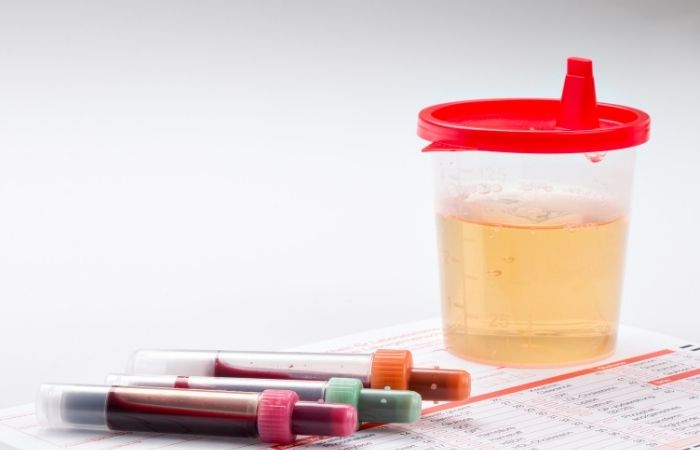
The image below shows the kind of clinical sample collection a routine male STD checkup actually involves. A urine cup for chlamydia and gonorrhea, a tube for the blood panel, and that is it. Nothing in this picture detects HPV.
Warts Are the Exception, Not the Rule
The HPV types that cause visible genital warts (types 6 and 11) are different from the types responsible for most cervical, anal, and oropharyngeal cancers (types 16 and 18). All belong to the same broad virus family, all spread through skin-to-skin contact during intimate activity, and all can be passed before, during, and sometimes after the periods when symptoms are visible on the carrier.
Visible warts develop in only a small fraction of HPV infections. The vast majority of HPV infections, including most high-risk strains, never produce a visible sign on the carrier at all. The virus can also occupy areas that even careful skin checks miss: the base of the penile shaft, the scrotum, the perineum, the foreskin in uncircumcised men, and the perianal area. None of those are reliably covered by condoms during typical use, which is one reason condom protection against HPV is partial rather than complete.
Visible warts mean current contagious HPV. Absent warts say nothing certain about HPV status, which is part of why the timing question ("when did this start?") tends to be the next thing on a reader's mind.
HPV types 6 and 11 cause roughly 90% of genital warts but are not associated with cancer. Types 16 and 18 cause about 70% of cervical cancers but rarely produce any visible sign on the carrier. Someone can carry the cancer-risk types for years with no external clue, which is why a wart-free skin check tells you nothing about whether the high-risk strains are present.
When HPV Hides: Incubation, Dormancy, and Delayed Symptoms
HPV does not follow the short-incubation pattern most people associate with STIs. Chlamydia and gonorrhea show up within days to weeks if they show up at all. HPV's clinical timeline runs in months to years. The virus enters the basal layer of skin or mucosal cells, hides from the immune system there, and may or may not eventually cause the cell changes that show up on a Pap smear or as a visible wart.
That latency window is where most relationship-blame anxiety comes from. A long-time partner gets a positive HPV result, and the assumption jumps to recent infidelity. The biological reality is more boring: either partner could have acquired HPV before the relationship started, the immune system kept it suppressed for months or years, and a routine Pap eventually caught it on cervical cells where the virus had become detectable. The next section opens up what "cleared" actually means biologically.
| HPV Type | Possible Symptoms | Typical Incubation | Transmission Risk During Latency |
|---|---|---|---|
| Types 6 & 11 (low-risk) | Genital warts (may appear weeks to months later) | ~2 weeks to 8 months | High |
| Types 16 & 18 (high-risk) | No symptoms; causes gradual cell changes | ~3 weeks to several years | High |
| Other high-risk types (31, 33, 45, 52, 58) | No symptoms; may cause cell changes | Months to years | High |
Can You Transmit HPV After "Clearing" It?
Most HPV infections become undetectable within 1 to 2 years, especially in people under 30 with healthy immune systems. The immune system suppresses the virus to the point where standard tests no longer detect it. Whether that counts as "cleared" depends on what the word is being used to mean.
Researchers continue to debate whether truly cleared HPV reactivates later or whether late detections reflect a new exposure that the immune system did not suppress. What is reasonably well-established is that the virus can remain in a latent state in basal skin cells, undetectable by current screening tests, and there is evidence in older adults of HPV reappearing during periods of immune stress (illness, immunosuppressive medication, advanced age). During those reappearances, transmission to a partner is biologically possible.
For practical purposes, a partner who tested negative a year ago is lower-risk than one who tested positive a year ago, but neither category is zero-risk. Who actually gets diagnosed when HPV shows up in a relationship is the next piece of this picture.
People on immunosuppressive medications (post-transplant, certain autoimmune treatments), people living with untreated HIV, and people over 60 with age-related immune decline are the populations where previously undetectable HPV is most likely to become detectable again. If you or a partner falls into one of these groups, this is worth flagging to your provider so screening intervals can be adjusted.
The Testing Gap Falls Hardest on Women
Because HPV is detected through cervical screening, the diagnostic burden lands disproportionately on women, transmasculine people with a cervix, and others with cervical tissue available to sample. A man with the same infection often never gets diagnosed at all unless warts appear. That asymmetry has practical consequences: the conversation about HPV in a relationship usually starts with the female partner's Pap result, even when transmission could have gone in either direction or could predate the relationship.
The financial and emotional load is uneven too. Follow-up testing after an abnormal Pap (a colposcopy, sometimes a biopsy, sometimes a LEEP or cone procedure for higher-grade changes) is invasive, anxiety-producing, and often partially out-of-pocket depending on insurance. A male partner with the same underlying infection typically has no equivalent procedure to undergo because none exists for men outside specialized contexts.
None of this is anyone's individual fault. It is what happens when the only validated screening test for a virus works only on cervical tissue. Whether to tell a partner who has no way to test himself is the disclosure question, and the next section walks through it.
If you are sexually active, you can get HPV, even if you have had sex with only one person.
Should You Tell a Partner If You Test Positive?
There is no legal requirement to disclose HPV in most jurisdictions, partly because the virus is so common and partly because most cases resolve on their own without symptoms or treatment. Disclosure is a relationship and ethics question, not a legal one.
In an ongoing relationship, telling a current partner does a few useful things. It lets him watch for any visible signs (warts, particularly), gives him the option of talking to his own provider about the HPV vaccine if he is under 45 and not already vaccinated, and pre-empts the harder version of the conversation later if symptoms eventually appear.
For casual or past partners, the calculus is different and personal. Some people contact prior partners they were intimate with within the rough 8-month-or-shorter incubation window; others do not. There is no public-health consensus that contact tracing is necessary for HPV the way it is for chlamydia or syphilis, so this is a values call rather than a clinical requirement.
If you want a sentence to start the conversation, this one does the job without sounding clinical: "My provider found HPV at a routine screening. It is extremely common and usually clears on its own; I wanted to let you know so you can decide whether to ask your own doctor about it." Keep the framing matter-of-fact. The goal is information transfer, not an apology or a confession.
Protection: What Works and What Doesn't
Condoms reduce HPV transmission but do not eliminate it. Studies of consistent condom use put risk reduction around 60% to 70%, with the residual risk coming from skin-to-skin contact in areas the condom does not cover (the base of the penis, the scrotum, the pubic skin, the inner thighs, the perineum). For a partner trying to estimate risk, condoms are meaningfully protective; they are not a forcefield.
Oral sex carries real, if lower, HPV risk. Oropharyngeal HPV (typically type 16) is implicated in a growing share of cancers of the tonsil and base of the tongue, with rates rising fastest in men under 60. Dental dams provide a barrier for oral-vulvar contact; thin barriers for oral-penile contact are less commonly used in practice. Most readers' partners will not be using dental dams or thin oral-sex barriers in any setting, which is part of why the vaccination conversation matters more than the barrier conversation for most adults.
Shared sex toys and prolonged skin-to-skin contact without full intercourse can also transmit HPV if viral particles are present. Cleaning toys between partners reduces risk; covering them with a condom and changing between users reduces it further. A provider conversation about the vaccine is the higher-leverage next step.
Published estimates from consistent-use studies cluster in the 60% to 70% range for reducing genital HPV transmission. That is meaningfully protective. Two specific limits explain why the figure is not higher: the virus lives on skin (not just in fluids), and condoms do not cover the pubic skin, the base of the penis, the scrotum, or the inner thighs. If those areas have viral particles present, skin contact during intimate activity can transmit.
The HPV Vaccine: Who Can Still Get It
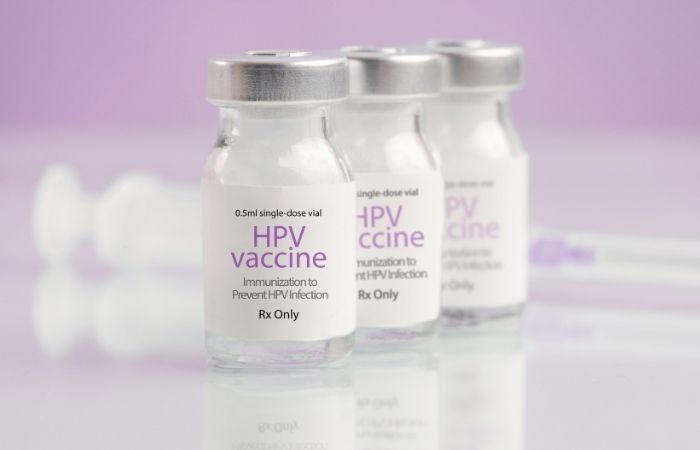
The HPV vaccine (Gardasil 9, the current U.S. formulation) protects against nine HPV types, including the two responsible for most genital warts (6 and 11) and seven oncogenic types responsible for most cervical, anal, and oropharyngeal cancers (16, 18, 31, 33, 45, 52, 58). It is routinely recommended for everyone starting at age 11 or 12, and is FDA-approved through age 45.
The vaccine does not clear an existing HPV infection, but it does protect against types you have not yet been exposed to, which is most types for most people. The CDC's HPV vaccine page states that "some adults age 27 through 45 years who are not already vaccinated may decide to get HPV vaccine after speaking with their doctor about their risk for new HPV infections and the possible benefits of vaccination for them," which is the agency's shared-clinical-decision-making framing for that age range.
If you have already tested positive for one HPV type, that does not disqualify you from the vaccine; you can still be protected against the other eight strains in the panel. Most insurance covers the vaccine through age 26 outright, and many cover it through 45 with shared decision-making documented by your provider.
How to Test When He Cannot
Because there is no validated HPV test for men without visible lesions, the testing strategy in a relationship usually depends on the partner with a cervix. Standard guidance is HPV testing (sometimes paired with a Pap, sometimes alone) every 5 years from age 30, or a Pap alone every 3 years from age 21. Many providers screen more often if there has been a prior abnormal result.
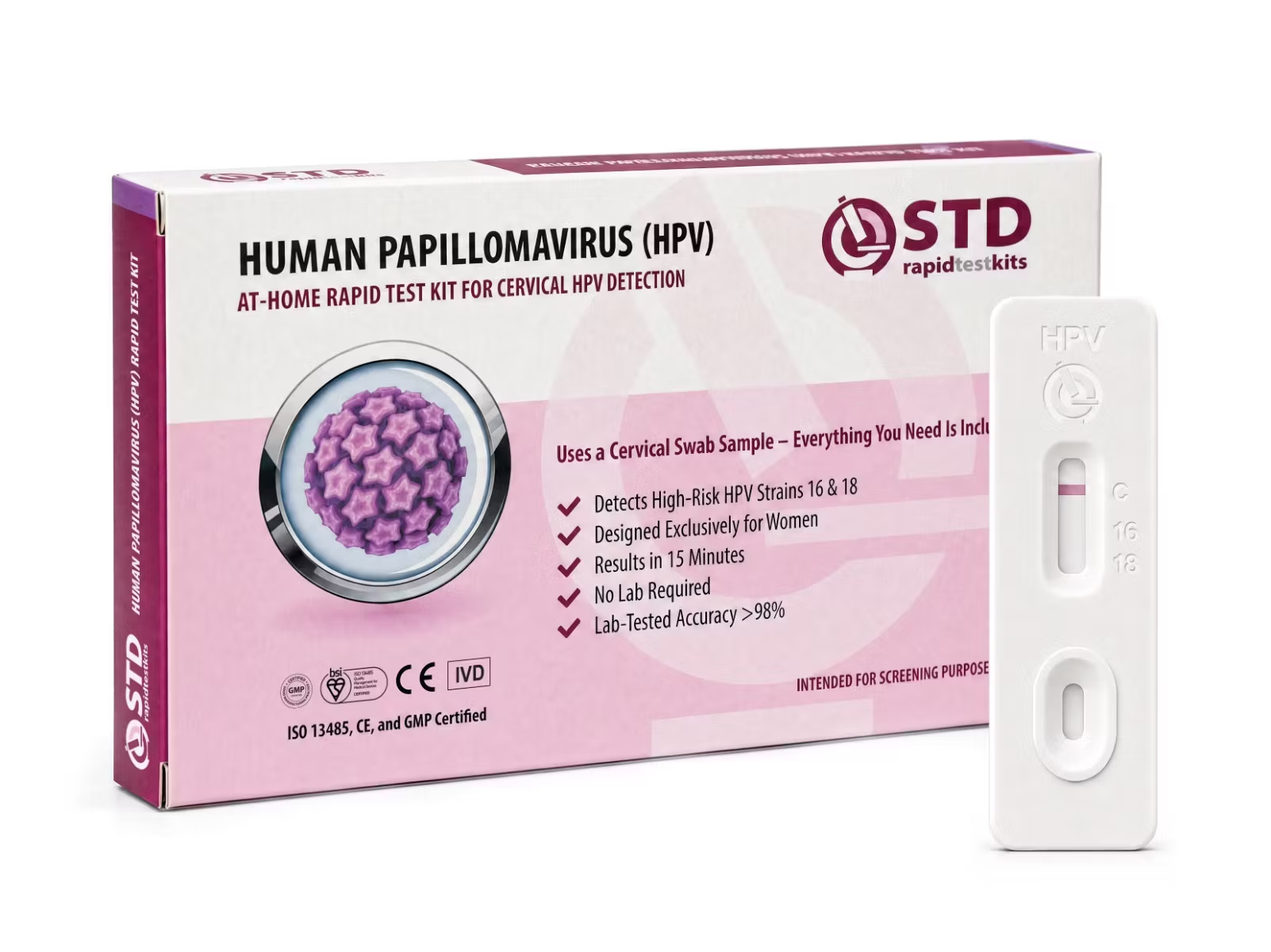
For at-home testing, lateral-flow HPV swab kits are validated for vaginal self-collection in women. They detect viral antigen rather than identifying which type is present, so a positive home result means follow-up at a clinic with HPV typing; a negative result is reassuring but not equivalent to a full lab HPV panel.
What Else to Screen For After a Mixed-Status Exposure
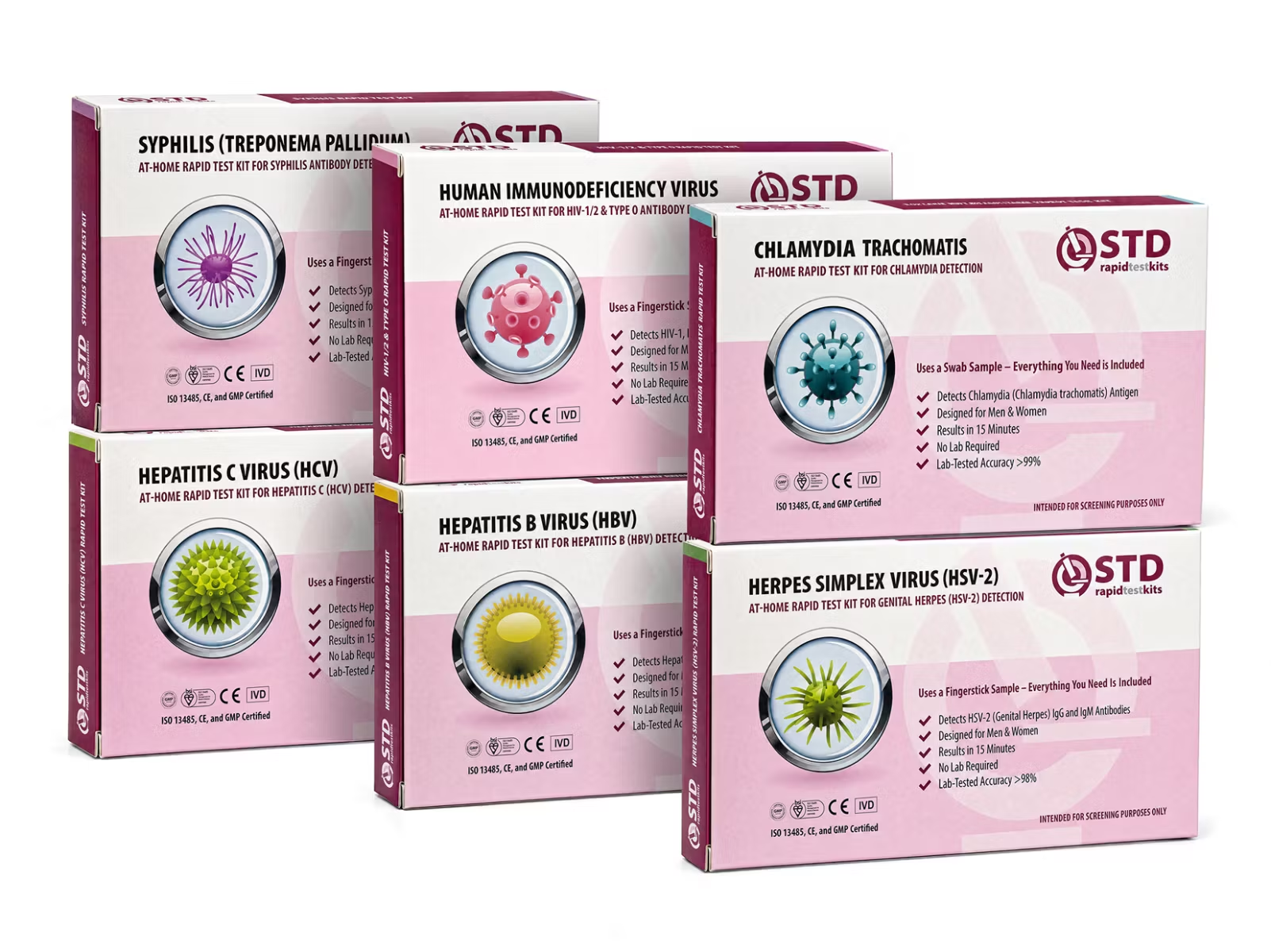
HPV is not the only infection that travels with an exposure event, and it is the only common one that has no validated home test for the male partner. The rest of the standard panel, chlamydia, gonorrhea, HIV, syphilis, and the hepatitis viruses, all have reliable home tests that work whether or not a partner has been clinically screened.
For male partners, no equivalent HPV home test exists; the most useful step is a visual check for warts and a provider conversation about vaccination. For the rest of the panel, a combination at-home kit catches what a male partner's clinic would have checked, on your own schedule and without the awkward intake conversation.
What Happens After a Positive HPV Test
A positive HPV test result is not a cancer diagnosis. It is a flag that the virus is present in the cervical tissue and that follow-up monitoring is appropriate. For most people, the immune system suppresses the virus over the next 1 to 2 years and no further treatment is needed.
If the positive result is for a high-risk type (16, 18, or another oncogenic strain), the typical next step is a colposcopy: a closer look at the cervix with a magnifier and, if any areas look abnormal, a small biopsy. The procedure takes 10 to 20 minutes in a provider's office and is uncomfortable rather than painful for most people. Most colposcopies do not result in a precancer finding.
If the biopsy does show precancerous cell changes (graded CIN 1, CIN 2, or CIN 3 depending on depth), treatment options include monitoring for the lowest grade and a LEEP procedure or cone biopsy for higher grades. The entire rationale for the screening program is catching cell changes at the CIN stage, before they progress.
For genital warts (HPV types 6 and 11), treatment options range from prescription topical creams to in-office removal (cryotherapy, electrocautery, surgical excision). Treatment removes the visible warts; the underlying virus may persist and warts can recur, but most cases resolve over time as the immune system suppresses the virus.
After a positive HPV test: what to expect
- A positive HPV test is a monitoring flag, not a cancer diagnosis. Most infections clear without treatment within 1 to 2 years.
- High-risk type positives usually trigger a colposcopy, a brief in-office exam of the cervix with a magnifier.
- If a biopsy shows precancerous changes, treatments like LEEP and cone biopsy are highly effective at preventing progression.
- Visible warts (types 6 and 11) are treated with topical prescription medications or in-office removal; recurrence is possible while the immune system suppresses the underlying virus.
Knowing Is the Next Action
The hardest part of HPV is how much of the conversation falls on women specifically. She sits through the test, absorbs the result, undergoes whatever follow-up is needed, and still has to walk a partner through information he genuinely did not have. None of that is going to be solved by a strongly-worded blog paragraph.
What can be solved is the information gap. Once you know HPV is not on the standard male panel, "he tested clean" loses its mystery and becomes a specific, useful piece of information about chlamydia and gonorrhea and HIV and syphilis. Once you know condoms cut HPV risk by roughly two-thirds rather than eliminating it, you can make a more honest call about your own exposure history. Once you know the vaccine is approved through age 45, you can ask your provider about it for yourself or pass that information along.
Order the kit when you are ready. A comprehensive at-home STI panel covers what a male partner's clinic would have checked, on your own schedule.
Three concrete next steps
- Translate "he tested clean" as "clean for chlamydia, gonorrhea, HIV, and syphilis" and treat HPV as a separate question.
- If you are under 45 and not yet vaccinated, ask your provider whether the HPV vaccine is right for you.
- Run a comprehensive home STI kit to cover the rest of the panel a male partner's clinic would have checked.
Frequently Asked Questions
- Can you really get HPV from someone who feels fine?
- Yes. Most HPV infections in men produce no symptoms, no warts, and no warning signs the person could notice. Skin-to-skin contact during intimate activity transmits the virus regardless of whether either partner has any visible sign of infection. This is the most common HPV transmission scenario rather than the exception.
- He got a full STD panel and it came back clean. How did I get HPV?
- A standard male STD panel typically covers chlamydia, gonorrhea, syphilis, HIV, and the hepatitis viruses. HPV is not on that list because there is no FDA-approved HPV test for men without visible warts. A negative panel is honest evidence that he does not have the listed infections; it tells you very little about his HPV status.
- We used condoms every time. Why did I still get HPV?
- Condoms reduce HPV transmission by roughly 60% to 70% with consistent use, which is meaningful but not complete protection. HPV lives on skin, and condoms do not cover the base of the penis, the scrotum, the pubic skin, or the inner thighs. Skin-to-skin contact in those uncovered areas can transmit HPV during intimate activity.
- How long can someone carry HPV without knowing?
- Incubation varies widely by HPV type. Genital warts typically appear within 2 to 8 months of exposure when they appear at all. High-risk oncogenic types can take from a few weeks to several years to produce detectable cell changes. Once the virus enters latency in basal skin cells, it can remain undetectable for many years.
- Does my positive HPV test mean my partner cheated?
- No, not by itself. HPV's long latency means either partner could have acquired the virus before the relationship started. A new positive test reflects when the virus was detected, not when it was acquired. A diagnosis on its own is not evidence of recent exposure or infidelity.
- Can I still get the HPV vaccine if I am over 26?
- Yes. The vaccine is FDA-approved through age 45. The CDC describes the decision for adults aged 27 through 45 as one to make after talking with your provider about your risk for new HPV infections and the possible benefits in your situation. The vaccine does not treat existing infections but does protect against types you have not yet been exposed to.
- Can HPV spread through oral sex?
- Yes. Oropharyngeal HPV, mainly type 16, is implicated in a rising number of throat and tonsil cancers, particularly in men. The transmission rate per act of oral sex is lower than for vaginal or anal contact, but the route is real and documented in the clinical literature.
- Is there any way to test a man for HPV?
- Not as a routine screening test. The FDA has not approved an HPV test for use in men without visible lesions. The few HPV swab tests that exist for men are validated only for anal screening in specific high-risk populations, typically men who have sex with men who are also living with HIV. For most men, the available signals are visual inspection for warts and, if a partner is diagnosed, a conversation with a provider about vaccination and monitoring.
How we sourced this article: We reviewed current guidance from the CDC, WHO, and the National Cancer Institute on HPV transmission, screening, and vaccination, and translated it into plain-English action items for general readers. Where the article discusses a specific number or window, the inline citation points to the public-facing fact sheet or guideline page that supports it. This article is for general education and does not replace a conversation with your own provider.
- U.S. Centers for Disease Control and Prevention. Genital HPV Infection Fact Sheet. Supports the broad statement that any sexually active person can acquire HPV, including from a single partner.
- U.S. Centers for Disease Control and Prevention. HPV Vaccines page. Supports the 13 million annual U.S. new infections figure and the 27-45 shared clinical decision-making framing for adult vaccination.
- World Health Organization. Cervical cancer fact sheet, including the role of high-risk HPV types 16 and 18 in cervical cancer etiology.
- National Cancer Institute. HPV and Cancer. Background on HPV types, oncogenic strains, and the immune-system clearance pathway.
- U.S. Centers for Disease Control and Prevention. About Sexually Transmitted Infections. Overview of STI categories, asymptomatic spread, and the role of testing.
