Published: July 2025 | Last updated: May 2026 | Editorial review and quality control: Martina N.
Oral sex gets framed as the safer alternative to vaginal or anal sex. That framing is half-right. The transmission risk is genuinely lower for some infections, especially HIV. For others, it is roughly the same as any unprotected mucosal contact. Either way, oral sex is sex, and several common sexually transmitted infections move comfortably between mouths, throats, and genitals.
What follows is a calm read of what current public-health guidance actually says, what symptoms to watch for, and what to ask a clinician so you do not leave the visit with a half-tested status. We will also cover what at-home rapid kits can and cannot do for an oral exposure, since the answer is not a clean one-liner.
Can you get an STD from oral sex?
Yes. Gonorrhea, chlamydia, syphilis, herpes (HSV-1 and HSV-2), and HPV transmit through oral-genital or oral-anal contact at meaningful rates. HIV transmission through oral sex is, per the CDC, extremely rare under typical conditions, with risk rising in the presence of bleeding gums, oral ulcers, or another active STI. Most standard STI panels do not include a throat swab unless you specifically ask for one. A single isolated oral exposure, especially with no sores or known active infection in the partner, carries meaningful but typically low absolute risk for most infections; the guide below helps calibrate which situations call for testing and which do not.
Key Takeaways
- If you have given or received oral sex and want a complete picture of your status, you usually have to specifically request a pharyngeal swab. Standard clinic panels test urine, blood, and the genitals only.
- Throat infections from gonorrhea or chlamydia often produce no symptoms at all. Asymptomatic does not mean uninfected and does not mean not contagious.
Why Oral Sex Got Tagged as “Low Risk” in the First Place
The framing comes from real biology. Oral mucosa is somewhat more resistant to several pathogens than rectal or vaginal tissue. Saliva contains enzymes and antibodies that disable some viruses on contact. The mouth also lacks the kind of microtearing that vaginal or anal penetration can produce, which removes one of the easier entry points for bloodborne infections. For HIV specifically, the per-act transmission risk during oral sex is so low that the CDC describes it as extremely rare under typical conditions.
Real biology still leaves a wide gap between rare and never. The mouth is full of mucous membranes. Bleeding gums after flossing, a healing canker sore, a cracked lip, freshly extracted teeth, recent dental work, or active oral thrush all change the calculus. Bacterial infections like gonorrhea and chlamydia colonize the pharynx without needing a wound at all. Viruses like HSV-1 and HPV transmit through skin-to-skin contact, which a tongue against a vulva or penis qualifies as.
Cultural framing accounts for the rest. Sex education frames oral as the alternative when condoms feel inconvenient. Dental dams are recommended in clinical guidelines but rarely sold next to the condom aisle. Most people who use condoms reliably for vaginal or anal sex skip protection during oral, which means oral exposure is the most common unprotected exposure in many sexual histories.
Two cultural patterns stack: oral sex is widely framed as the safe alternative, and dental dams are recommended in clinical guidelines but rarely available at the pharmacy counter. The result is that even people who use condoms reliably for vaginal or anal sex usually go without barriers for oral, leaving the mouth and throat as the most exposed mucosal site in many sexual histories.
Which STIs Actually Transmit Through Oral Contact
Six pathogens account for almost all of the clinically significant oral-route transmission. The risk per exposure varies, the symptoms vary, and the testing approaches vary, so it helps to look at them one at a time before getting to the comparison table.
Gonorrhea. The CDC notes that gonorrhea can cause infection in the genitals, rectum, and throat, and that providers may swab the throat or rectum specifically when the patient has had oral or anal sex. Pharyngeal gonorrhea is most often asymptomatic and frequently picked up only on a partner trace. The clinical concern is twofold: the throat is a known site for the development of antibiotic-resistant strains, and asymptomatic carriers spread it forward without realizing.
Chlamydia. Pharyngeal chlamydia is less efficient than gonorrhea at colonizing the throat, but the same principle applies. The CDC's chlamydia page confirms that transmission occurs via vaginal, anal, or oral sex. Throat chlamydia rarely produces symptoms, and clinicians typically only swab the throat when the patient discloses oral exposure.
Syphilis. Syphilis is the infection where oral exposure most clearly produces a visible early sign. The primary chancre, a painless ulcer, can appear on the lips, tongue, or oral mucosa. Per the CDC, syphilis transmits through direct contact with a syphilis sore during vaginal, anal, or oral sex. Because the chancre does not hurt, it is easy to mistake for a canker sore or a bite mark and let it resolve untreated, which only moves the infection into a more dangerous secondary stage.
Herpes (HSV-1 and HSV-2). HSV-1, traditionally responsible for cold sores around the mouth, is increasingly the cause of new genital herpes diagnoses in younger adults, almost entirely through oral sex. HSV-2, traditionally genital, can also infect the oral region during oral-genital contact, although it is less common. Asymptomatic viral shedding is the main reason transmission is hard to predict from visible cold sores alone.
HPV. Oral HPV is acquired through oral-genital sex, and high-risk strains drive the steady rise in oropharyngeal cancers. The CDC attributes 60 to 70 percent of US oropharyngeal cancers to HPV, with progression typically taking years after infection. Routine screening for oral HPV is not standard for asymptomatic adults, which is one reason ACIP-recommended vaccination through age 26, with shared clinical decision-making for adults aged 27 to 45, matters.
HIV. The CDC characterizes oral sex as having little to no risk for HIV under typical conditions, and notes that risk rises with oral ulcers, bleeding gums, ejaculation in the mouth, genital sores, or another active STI. The category exists more for completeness than as a primary concern, but it is not zero, especially in stacked-risk circumstances.
| Infection | Oral transmission frequency | Typical throat or oral symptoms | How clinicians test |
|---|---|---|---|
| Gonorrhea | Common via oral-genital contact | Often none; sometimes mild sore throat | Pharyngeal NAAT (nucleic acid amplification test) swab |
| Chlamydia | Possible, less efficient than gonorrhea | Almost always silent | Pharyngeal NAAT swab |
| Syphilis | Possible via direct contact with a sore | Painless ulcer on lip, tongue, or oral mucosa | Blood test plus exam of any visible lesion |
| HSV-1 | Common via oral-genital contact | Cold sores around the mouth, sometimes none | Visual exam plus PCR of an active lesion; type-specific antibody blood test |
| HSV-2 | Less common but possible | Often none; sometimes oral lesions | Same as HSV-1 |
| HPV | Common via oral-genital contact | None until late-stage cancer changes | No routine screening; biopsy if a suspicious lesion is found |
| HIV | Extremely rare under typical conditions | Acute infection: fever, sore throat, swollen nodes, rash | Fourth-generation antigen-antibody lab test, or rapid antibody test at the appropriate window |
Symptoms Are Not Always Where You Expect Them
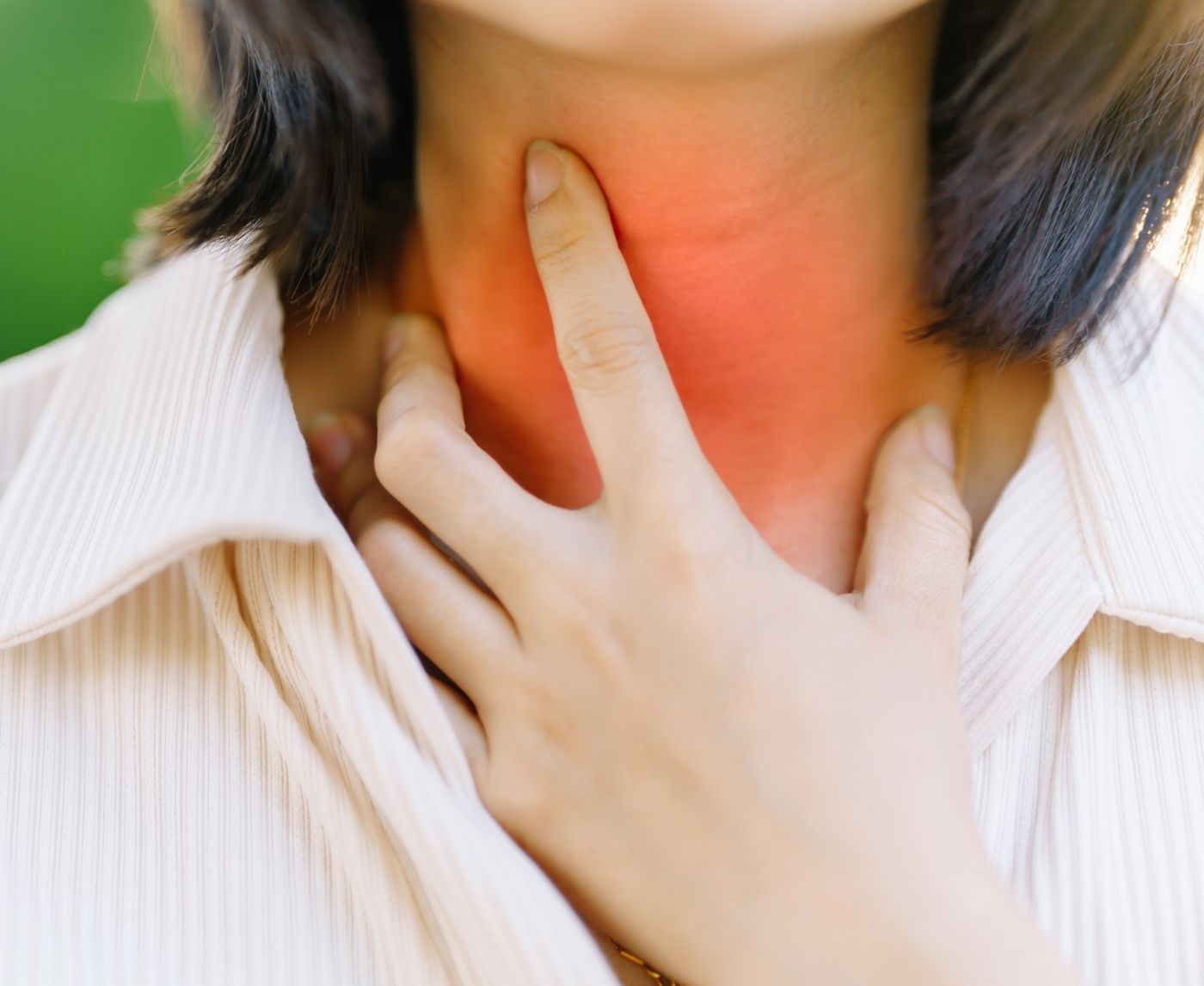
The mental picture most people carry of an STI is genital. That picture is wrong roughly half the time after an oral exposure. The infection can colonize the throat with no detectable lesion and no clear symptoms, or it can produce symptoms that look like a lingering virus to anyone not specifically asking the right question.
What an oral STI can feel like in the early stages varies. Pharyngeal gonorrhea may produce a low-grade sore throat that does not respond to throat lozenges and tests negative on a strep culture. Pharyngeal chlamydia is most often silent. Syphilis may show a single painless ulcer on the lip, tongue, or tonsil, which can resolve on its own without treatment as the infection progresses internally. HSV may produce one or several painful blisters or a tingling, burning patch on the lip or oral mucosa. Acute HIV, the only infection here that is rarely transmitted orally but worth covering, produces a flu-like cluster of fever, sore throat, swollen lymph nodes, and a maculopapular rash (a flat, spotted skin rash) a few weeks after exposure.
Most people miss the trickier presentation entirely: no sore throat, no visible lesion, no sensation at all. The CDC's gonorrhea page notes that pharyngeal infection often produces no symptoms while still being transmissible to subsequent partners. That asymptomatic period can last weeks to months, which is the public-health reason throat swabs are recommended after oral exposure even when nothing feels off.
If you had oral sex two months ago and feel completely normal, you can still test positive for pharyngeal gonorrhea or chlamydia. The most reliable way to rule out a throat infection is a pharyngeal swab from a clinic, not how you feel.
Why Your Standard STI Test Probably Skipped Your Throat
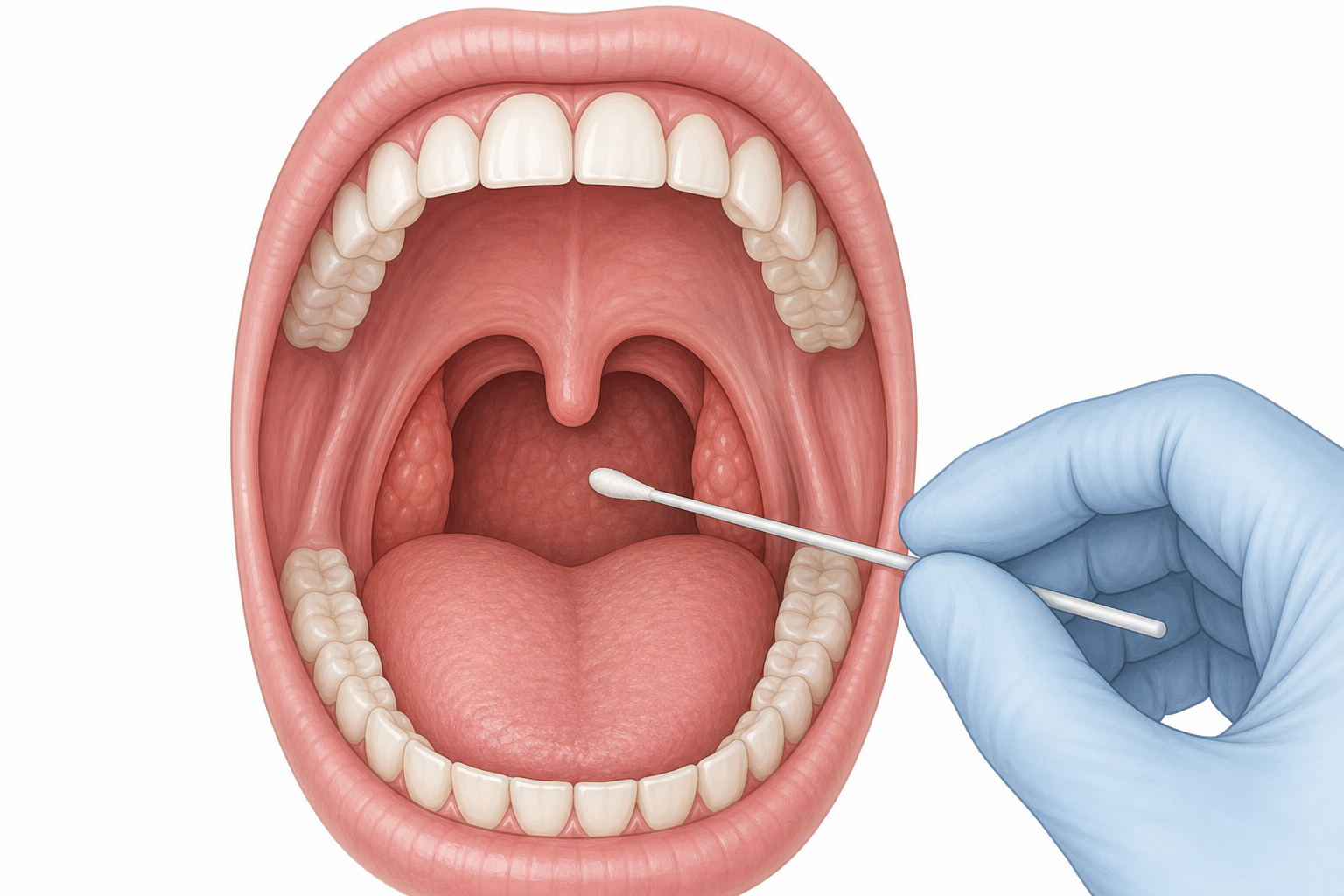
A typical clinic STI panel collects three samples: a urine specimen, a blood draw, and, if you mention vaginal symptoms, a vaginal or cervical swab. None of those three samples will detect a pharyngeal infection. Throat swabs and rectal swabs are extra-site tests that providers usually only add when the patient explicitly tells them about oral or anal exposure.
The CDC's gonorrhea page is direct on this point. It states that providers may use swabs to collect samples from the throat or rectum if the patient has had oral or anal sex. The wording matters. Many clinics treat extra-site testing as opt-in based on the sexual history the patient discloses, not as a default. If you do not mention oral exposure, the swab does not happen, and your eventual lab report can come back clean while a throat infection is still active.
The cleanest way to ask is the most direct one. A useful single sentence to a clinician is something like: I have had unprotected oral sex; please add pharyngeal swabs for gonorrhea and chlamydia along with the standard panel. That single sentence usually solves the gap. If you are testing for syphilis, HIV, or HSV, those are blood tests anyway, and the standard panel covers them so long as you are within the appropriate window period for each infection.
Cost is sometimes a sticking point. Pharyngeal NAAT swabs are usually billed as a separate test, and not every insurance plan covers extra-site testing without a documented exposure note. Asking the clinic about cost up front saves a surprise bill.
What At-Home Rapid Kits Actually Cover (and What They Do Not)
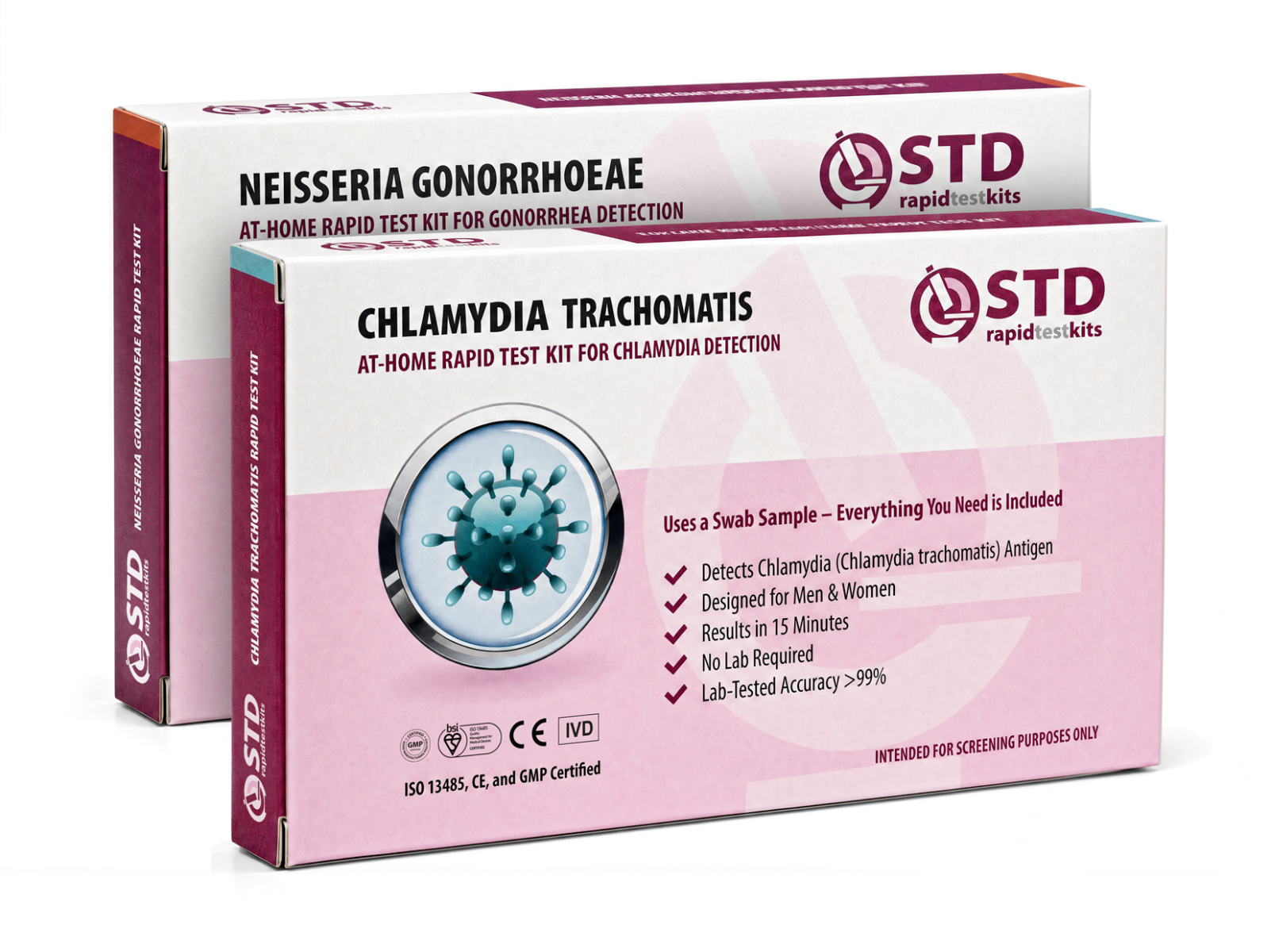
Our at-home rapid tests are lateral-flow chemistry, the same family as a home pregnancy test or a rapid antigen COVID test. They use either a self-collected vaginal or penile swab or a fingerstick blood drop. None of them are validated as a pharyngeal swab. If your specific concern is a possible throat infection from giving oral sex, the right tool is a clinic-administered pharyngeal NAAT, not an at-home rapid kit.
Where the at-home kits do fit cleanly is in the adjacent risk that an oral exposure usually creates. If a partner had a genital infection and you went down on them, the partner often wants to confirm their own status with a self-collected swab. Any blood-borne risk on the receiving side, including HIV, syphilis, and herpes, is detectable on a fingerstick blood test once you are past the relevant window period. The pharyngeal swab fills the gap that a clinic visit covers; the at-home kits fill the gap that comes after, for the genital and bloodwork picture.
Practically, that often means two steps. First, ask a clinic for the throat swab if oral exposure is the specific concern. Second, depending on what else happened during that exposure event, run the matching at-home rapid panel for the genital or bloodwork follow-up. Treating an at-home kit as a substitute for the throat swab will give you a false sense of security; treating it as a complement to the clinic visit covers the rest of the picture.
One scope note worth flagging here: our 10-in-1 combo panel is validated for vaginal self-swab only. Male readers needing a multi-infection panel should look at the 7-in-1 or 8-in-1 instead, both of which use samples that work for any-gender anatomy.
Step one: ask a clinic for a pharyngeal NAAT swab if there is any chance of a throat infection from giving oral sex. Step two: run an at-home rapid panel for the genital and bloodwork side of the same exposure, once you are past the relevant window period. The two cover different parts of the picture and are complementary, not interchangeable.
How to Lower the Risk During Oral Sex Without Killing the Mood
None of the harm-reduction options here are perfect. Each one shifts the curve of risk down, and stacking two or three lowers it more than relying on any one alone.
Barriers. A condom on a penis or a dental dam over a vulva or anus blocks most direct mucosal contact. Flavored condoms exist specifically for this use case. A dental dam can be improvised by cutting a non-lubricated condom along its length and laying it flat. Used consistently, barriers cut transmission of bacterial infections substantially, although they do not eliminate skin-to-skin transmission of HSV or HPV from areas the barrier does not cover.
Timing. Avoid oral sex when you have a cold sore, a recent tooth extraction, recent piercings of the mouth or tongue, bleeding gums, or active oral thrush. Avoid oral contact with a partner who has visible genital sores or unexplained discharge. The viral and bacterial load is highest when there is something to spread.
Vaccination. The HPV vaccine is the only intervention here that is also primary prevention against an STI-driven cancer. ACIP recommends routine vaccination through age 26 and shared clinical decision-making for adults aged 27 to 45. Hepatitis B vaccination, which the same age groups largely already have, also offsets a small but real oral-route risk.
Communication and testing. Co-testing before a new sexual relationship is the single most actionable step a couple can take, and it is increasingly normalized. A short, direct sentence works: I am current on my testing, here is what I have. Want to do it together this week before we get more involved? Most couples find that conversation easier than expected. Skipping it now leads to a much harder conversation later if a result comes back positive.
Gonorrhea is an STI that can cause infection in the genitals, rectum, and throat. You can get gonorrhea by having vaginal, anal, or oral sex without a condom with someone who has the infection.
When to Test After an Oral Exposure
Every infection has its own window period, the gap between exposure and reliable detection. Testing too early produces a false sense of security that can persist for weeks. The figures below come from the testing windows currently used by US public-health guidance and major commercial assays.
Gonorrhea and chlamydia (pharyngeal NAAT). Reliable from approximately 14 days after exposure. Earlier testing is reasonable if symptoms develop, but a clean result before day 14 should not be treated as a final clearance.
Syphilis (RPR, or Rapid Plasma Reagin, or treponemal blood test). Most laboratory tests detect syphilis 3 to 6 weeks after exposure, with a small fraction of cases requiring up to 12 weeks. If a chancre is visible, an exam and direct testing of the lesion can confirm earlier.
HIV (fourth-generation antigen-antibody lab test). Detection by approximately 18 to 45 days after exposure. Antibody-only formats, including the lateral-flow rapid tests sold for at-home use, take longer to turn reliably positive, with the CDC indicating up to 90 days for some assays. For an isolated oral exposure, the absolute risk is very low, but the test still applies if the exposure context was higher-risk.
HSV (type-specific antibody blood test). Most cases are detectable within 12 weeks of exposure, per the CDC STD Treatment Guidelines, which recommend repeat type-specific antibody testing 12 weeks after the presumed time of acquisition. PCR of an active lesion gives a faster answer if a sore is visible at the time of testing.
HPV. No standard screening test exists for asymptomatic oral HPV. Cervical screening covers the most common high-risk strains in women through routine pap and HPV co-testing schedules. For oral HPV specifically, attention to any persistent throat or oral lesion that does not heal within two to three weeks is the practical signal to ask a provider for an evaluation.
| Infection | Test type | Reliable from |
|---|---|---|
| Gonorrhea, chlamydia | Pharyngeal NAAT swab | About 14 days after exposure |
| Syphilis | RPR or treponemal blood test | 3 to 6 weeks; up to 12 weeks for a small fraction |
| HIV | Fourth-generation antigen-antibody lab test | 18 to 45 days; up to 90 days for antibody-only rapid formats |
| HSV | Type-specific antibody blood test | About 12 weeks; PCR of an active lesion if visible |
| HPV | No standard oral screening test | Evaluation only if a persistent lesion does not heal in 2 to 3 weeks |
Frequently asked questions
- Can I get an STI from giving oral sex even if my mouth feels fine?
- Yes. Pharyngeal gonorrhea and chlamydia routinely produce no symptoms at all. The CDC notes that throat infections are often picked up only on a partner trace, so a normal-feeling mouth does not rule out either infection. A pharyngeal NAAT swab from a clinic is the only way to confirm.
- Do dental dams really make a difference?
- Yes, when used correctly. A dental dam covers the vulva or anus during oral contact and blocks most direct mucosal exposure. It does not stop skin-to-skin spread of HSV or HPV from any area the dam does not cover. A non-lubricated condom cut along its length works as an improvised dam if a real one is unavailable.
- How long after oral exposure should I wait to test?
- Start with the most actionable figure: roughly 14 days for a pharyngeal swab covering gonorrhea and chlamydia. The blood-based tests run longer windows; syphilis is typically detectable within 3 to 6 weeks, HIV within about 18 to 45 days on a fourth-generation lab antigen-antibody test, and HSV antibodies within about 12 weeks. If you are unsure or symptomatic, test now and retest at the longer window for whichever infection the exposure raises concern about.
- Will a regular clinic STI panel test my throat?
- Usually not by default. A standard panel collects urine, blood, and sometimes a genital swab. The pharyngeal swab is added when you specifically tell the provider you have had oral sex and want it included. A useful sentence is: please add pharyngeal swabs for gonorrhea and chlamydia.
- Can a cold sore really cause genital herpes?
- Yes. HSV-1, the virus most often associated with cold sores, is now responsible for a significant share of new genital herpes diagnoses, almost entirely transmitted through oral sex. Asymptomatic viral shedding means transmission can happen without a visible cold sore present at the time of contact.
- If I only received oral sex, am I safer than the giver?
- Slightly, on average, but not safe. The receiver can still pick up gonorrhea, chlamydia, syphilis, HSV, or HPV through direct contact with infected oral mucosa, especially if the giver has a recent or active oral infection. The risk is lower than for the giver in some categories, and not zero in any of them.
- Is HIV transmission through oral sex actually a real concern?
- It is a real but very low-frequency risk. The CDC characterizes oral HIV transmission as extremely rare under typical conditions, with risk rising when ejaculation in the mouth coincides with bleeding gums, oral ulcers, or another active STI. For most isolated oral exposures, HIV testing is reasonable, but the absolute risk is small.
- Can I use an at-home rapid kit instead of a throat swab?
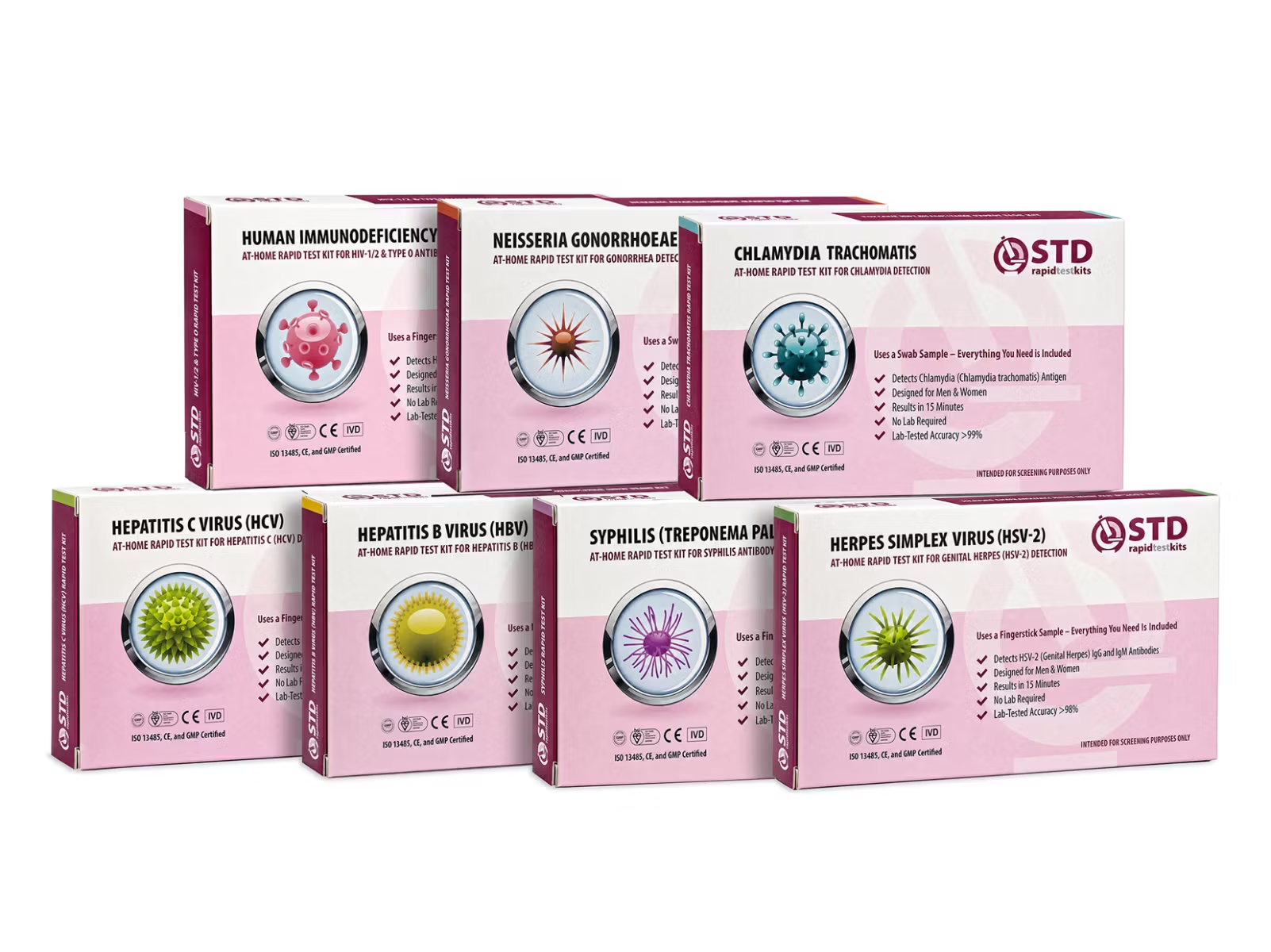
- Our at-home kits cover genital-swab infections (chlamydia, gonorrhea, trichomoniasis, HPV) and bloodwork (HIV, syphilis, hepatitis, HSV antibodies); none of them are validated for pharyngeal samples. For a possible throat infection after giving oral sex, you need a clinic-administered throat swab, not a home kit. Use the at-home panel for the genital and blood follow-up from the same exposure event.
- U.S. Centers for Disease Control and Prevention. About Gonorrhea, including pharyngeal infection, transmission via oral sex, and provider guidance on adding throat or rectal swabs based on disclosed exposure.
- U.S. Centers for Disease Control and Prevention. About Syphilis, including primary-stage chancres on the lips or in the mouth and transmission through direct contact with a syphilis sore during vaginal, anal, or oral sex.
- U.S. Centers for Disease Control and Prevention. About Chlamydia, including transmission via vaginal, anal, or oral sex.
- U.S. Centers for Disease Control and Prevention. HPV-Associated Oropharyngeal Cancer, including the 60 to 70 percent attributable share of US oropharyngeal cancers and the role of oral sex in oral HPV transmission.
- U.S. Centers for Disease Control and Prevention. How HIV is transmitted, including the classification of oral-route transmission as extremely rare under typical conditions and the risk modifiers that increase it.
- U.S. Centers for Disease Control and Prevention. HIV Testing overview, including the detection windows for fourth-generation antigen-antibody lab tests and antibody-only rapid formats.
- U.S. Centers for Disease Control and Prevention. STD Treatment Guidelines: Genital Herpes, including the recommendation to repeat type-specific antibody testing 12 weeks after the presumed time of acquisition.
- World Health Organization. Sexually transmitted infections fact sheet, including the global STI prevalence figures and the broad transmission overview that vaginal, anal, and oral contact can all transmit STIs.
