
Published: November 2025 | Last updated: May 2026 | Editorial review and quality control: Martina N.
Finding a dried stain on a hotel sheet, a towel, or even a bathroom surface can rattle anyone who travels. The first thought that often follows is unsettling: could that have just exposed me to an STI? The short answer is reassuring. Sexually transmitted pathogens are adapted to live inside the human body, and outside it they die quickly. The realistic risk from a dried semen stain on a hotel sheet, a towel, or a surface is very close to zero. Public-health agencies including the CDC and the World Health Organization have published guidance on this for years, and the consensus is consistent: STIs need fluid-to-mucous-membrane contact in warm, living conditions to pass on.
This article walks through what each common STI pathogen actually does outside the body, why hotel hygiene anxieties usually outpace the science, and the small handful of situations that are worth taking seriously. It also covers what reasonable next steps look like if your real concern is rooted in sexual exposure during the trip rather than environmental contact with a stain.
Key Takeaways
- Dried semen on hotel sheets, towels, or surfaces poses negligible STI risk: the pathogens that cause STIs die rapidly once outside the human body.
- If a real sexual exposure happened during the trip, an at-home rapid test panel can rule out common infections after the correct window period (typically 2 weeks to 3 months depending on the pathogen and test type).
The short answer: how likely is environmental STI transmission?
For practical purposes, environmental (fomite) transmission of sexually transmitted infections from a dried semen stain is so rare that public-health agencies do not list it as a meaningful route of infection. The CDC states plainly that HIV does not survive long outside the human body, and that you cannot get HIV from objects, toilet seats, or surfaces that someone with HIV has touched. The same logic, with slight variation in survival time, applies to gonorrhea, chlamydia, syphilis, and herpes.
Two exceptions deserve a more careful look. Trichomoniasis can survive a few hours on damp objects, and HPV is somewhat more environmentally stable than the bacterial or viral STIs that depend on blood, semen, or vaginal fluids. Even for these two, documented surface transmission in adults is extremely uncommon. The vast majority of new infections continue to come from direct sexual contact, not from contact with bedding, towels, or hotel furniture.
What this means in practice: if your worry is a dried stain you noticed on a sheet, a towel, or a toilet seat, the science says the risk is functionally zero. If your worry is unprotected sex you had during the trip, that is a different conversation with a clearer answer (testing, after the correct window).
Trichomoniasis can stay viable on damp objects (a wet towel, for example) for a few hours under favorable conditions. HPV is somewhat more environmentally stable than the enveloped viruses. Even so, neither is a documented surface-transmission route for adults in any meaningful public-health surveillance data. Sexual contact remains the route that actually drives new infections.
Why STI pathogens die quickly outside the body
STI pathogens are highly adapted to a narrow set of conditions: warm, moist, internal human tissue with a steady supply of nutrients. Outside those conditions they fail rapidly. Several environmental factors do the killing.
Drying. Once a fluid like semen, blood, or vaginal secretions dries, most STI pathogens become inactive within minutes. The viral envelope on HIV, for example, depends on a moist environment to remain intact, and once disrupted the virus cannot infect a new cell. The CDC notes that even if a small amount of HIV-infected fluid were exposed to the environment, the virus would not be able to reproduce and would die quickly.
Temperature. STI pathogens grow best at body temperature, roughly 37 degrees Celsius. A hotel room sitting at 20 to 22 degrees Celsius is well outside that comfort range, slowing replication and accelerating die-off.
Oxygen exposure. Bacteria like Neisseria gonorrhoeae (the cause of gonorrhea) are sensitive to oxygen and dry air; clinical labs grow them in special atmospheric conditions for a reason. On a bedsheet exposed to room air, gonorrhea bacteria do not last.
UV light and surface chemistry. Sunlight, indoor lighting, and routine detergents inactivate most STI pathogens. Hotel laundry cycles, which combine hot water, detergent, and tumble-drying, are reliably more than enough to render bedding non-infectious.
The practical upshot: by the time you encounter a dried stain in a hotel room, the pathogens that might once have been in that fluid have almost certainly already died.
| Pathogen | Survival outside the body (typical) | Realistic surface-transmission risk |
|---|---|---|
| HIV | Inactive within minutes once dried | Negligible |
| Neisseria gonorrhoeae (gonorrhea) | Minutes once dried; needs a moist, warm environment | Negligible |
| Chlamydia trachomatis | Cannot replicate outside human cells | Negligible |
| Treponema pallidum (syphilis) | Highly fragile; dies quickly on dry surfaces | Negligible |
| Herpes simplex virus (HSV) | Inactive within minutes on dry surfaces | Negligible |
| Trichomonas vaginalis | Up to a few hours on damp objects | Very low |
| HPV | More environmentally stable; needs direct genital contact for genital infection | Very low |
Pathogen by pathogen: what each one actually does outside the body
Generic reassurance is fine, but most readers want specifics. Here is what each common STI pathogen does once it is no longer inside a person.
HIV. Of all STI pathogens, HIV is among the most fragile in the environment. According to CDC HIV transmission guidance, the virus cannot live outside the body for very long; once exposed to air, the virus is unable to reproduce and dies quickly. Reports of HIV transmission via dried fluid on a household surface are not a recognized route in public-health surveillance.
Gonorrhea. Neisseria gonorrhoeae is a gram-negative diplococcus that needs warm, moist, oxygen-controlled conditions. On a dry sheet or towel, it dies within minutes. The CDC STD section describes sexual contact as essentially the only meaningful route of transmission for gonorrhea, with newborn eye infection during birth as a separate clinical scenario.
Chlamydia. Chlamydia trachomatis is an obligate intracellular bacterium: it cannot replicate at all outside of human cells. Once outside a host, the organism is functionally inert. Surface transmission is not part of how the infection spreads.
Syphilis. Treponema pallidum, the bacterium that causes syphilis, is one of the most fragile pathogens in clinical medicine. It cannot be grown in standard laboratory media and is rapidly inactivated by drying, mild heat, soap, and disinfectants. The NHS syphilis page describes transmission through direct contact with an infectious syphilis sore during sexual activity, and the CDC further notes that syphilis is not spread by contact with toilet seats, doorknobs, swimming pools, hot tubs, bathtubs, shared clothing, or eating utensils.
Herpes simplex virus (HSV-1 and HSV-2). Herpes viruses are enveloped, which makes them sensitive to drying and disinfectants. HSV inactivates within minutes on dry surfaces. Public-health resources consistently describe herpes transmission as requiring direct skin-to-skin contact with an active lesion or with skin that is shedding virus, not contact with a stain hours after the fact.
Trichomoniasis. Trichomonas vaginalis is the one common STI pathogen with a meaningful (though still small) survival time on damp objects: lab studies suggest up to a few hours under favorable conditions, such as a wet towel. Documented adult fomite transmission is still rare. The CDC describes sexual contact as the primary route.
HPV. Human papillomavirus is structurally tougher than the enveloped viruses listed above and can persist on surfaces for longer. Even so, genital HPV transmission consistently requires direct genital skin-to-skin contact; surface or stain contact is not how it spreads in adults. Vaccination (per CDC ACIP guidance, routine through age 26 and shared clinical decision-making through age 45) is the single most effective protective step.
Real-world hotel scenarios that worry travelers
Here is how the science maps onto the situations that anxious travelers most often describe.
Touching a dried stain on a sheet with your hand. Skin is an excellent barrier. STI pathogens do not enter through intact skin on a fingertip. Even if a small number of HIV virions were somehow still viable inside a dried stain (very unlikely), they would not cross your palm. Wash your hands with soap and water, change rooms if you want to, and move on.
This is also the answer to one of the most common fears in this category: the supposed risk of catching HIV from dried blood or semen on a hand or a fingernail. The CDC is explicit that HIV does not pass through casual surface contact, and the documented occupational risk of HIV from a hollow-bore needle stick is itself less than one percent. A dried stain on a sheet is many orders of magnitude further from that scenario.
Sitting on a toilet seat with a residue. Toilet seats are not a recognized route for any STI. The seat is a smooth, dry, cool surface that is hostile to STI pathogens, and the seat does not touch any mucous membrane that the pathogen would need to infect. The WHO STI fact sheet does not list toilet seats as a route of transmission for any STI.
Using a hotel towel with a stain. A clean towel from a reputable hotel has been through a hot-wash cycle that is reliably more than sufficient to inactivate STI pathogens. If the towel is visibly stained or smells off, request a fresh one. The hygiene complaint is fair; the STI risk specifically is still negligible.
Sharing a hotel bed with a partner. Sleeping next to someone in a hotel bed, with normal clothing or pajamas, does not carry STI risk in itself. STI risk in this scenario comes from sexual activity with that partner, not from the bedding.
If your worry is that you touched what looked like a dried stain with your hand, you can stop here. Intact skin is not a route of entry for any STI pathogen. Wash with soap and water, request a linen change, and consider that exposure closed. Testing is not indicated for this scenario.
The real risks travelers should worry about
There is one situation where travel genuinely raises STI risk, and it has nothing to do with stains on the bedding. The risk comes from new or unprotected sexual contact during the trip itself. Surveillance data from the CDC and the WHO consistently identify the same handful of behavior patterns as the dominant drivers of new infections: unprotected vaginal, anal, or oral sex; sex with a new partner whose status is unknown; sex without barrier protection while intoxicated; and inconsistent condom use across the duration of a relationship.
Per-act transmission risk also varies meaningfully by route. CDC HIV risk data places receptive anal sex as the highest-risk per-act exposure for HIV (roughly 138 transmissions per 10,000 exposures with an infected partner not on treatment), with vaginal sex carrying lower per-act risk and oral sex carrying very low but non-zero risk for several STIs including gonorrhea, syphilis, and herpes. None of those numbers apply to surface or stain contact, where the risk does not register at all.
Travel doesn't change biology, but it can change behavior. Unfamiliar settings, alcohol, lowered inhibitions, and a sense of distance from one's usual social context all push some people toward sexual decisions they would not normally make. If you had any of those experiences during your trip, that is the part of the picture that warrants attention.
This distinction matters because the response is different. A stain on a sheet calls for changing rooms and not much else. Unprotected sex with a new partner calls for thinking about post-exposure prophylaxis (PEP, useful only within 72 hours of possible HIV exposure) and a structured testing plan aligned with each STI's window period.
The risk discussion shifts entirely. Within 72 hours of a possible HIV exposure, a clinician can prescribe post-exposure prophylaxis (PEP). Outside that window, the right move is structured testing across the window periods for HIV, syphilis, chlamydia, gonorrhea, and hepatitis. A stain on a sheet is not the issue; a sexual contact you are unsure about is.
Practical hotel hygiene that actually matters
Hotel cleanliness is a legitimate concern even when STI transmission is not. The practical hygiene steps below are reasonable, low-effort, and worth doing on any stay; none of them target dried stains specifically, because the science does not justify that worry.
- Scan the bed and bathroom on arrival. If you see anything that looks like a stain on the sheet, pillowcase, or duvet cover, request a change. The hotel will almost always swap linens without question.
- Use the in-room hand wash and a quick wipe-down. Door handles, the remote control, the light switches, and the bathroom taps see far more bacterial traffic than the bedsheets. A small pack of alcohol wipes covers all of them.
- Bring your own towel for the gym or pool if you are unsure. Hotel pool towels usually go through commercial laundry, but if the linen quality looks low elsewhere in the property, packing your own is sensible.
- Do not share personal items with strangers. Razors and toothbrushes are routes for blood-borne pathogens (hepatitis B in particular, per CDC hepatitis guidance), and the risk there is small but not zero. Keep them yours, and the everyday hygiene that actually matters takes care of itself.
- Use barrier protection consistently if you do have sex on the trip. This is the single biggest STI-prevention lever, far more than any bedding behavior.
HIV does not survive long outside the human body (such as on surfaces), and it cannot reproduce outside a human host. It is not spread by saliva, tears, or sweat, or by sharing food, dishes, or toilets.
When testing makes sense after a hotel stay
Testing is the right move when there was a real sexual exposure during the trip, not because of a stain on the sheets. The fourth-generation HIV antigen-antibody test used in clinical settings can detect HIV in many people from about 18 to 45 days post-exposure (per CDC HIV testing guidance); for high-risk exposures, post-exposure prophylaxis (PEP) is time-sensitive and should be discussed within 72 hours of contact, not delayed for a test.
For HSV-2 specifically, antibody testing typically becomes accurate by 12 to 16 weeks, though CDC guidance notes some people may need longer; if you tested negative before 16 weeks, a repeat test at that point is reasonable. Trichomoniasis is typically detectable shortly after symptoms appear, although asymptomatic infections require active screening. A negative HIV and syphilis test at three months post-exposure is the conventional public-health threshold for ruling out infection from that exposure.
The table below summarizes when each common STI typically becomes detectable. Individual window periods vary by test technology and by the assay's specific characteristics; check the package insert for the kit or lab test you use.
| Timeframe after exposure | What to test for | Test type |
|---|---|---|
| 0 to 7 days | Most tests not yet accurate; PEP for HIV is time-sensitive (within 72 hours) | Clinician visit; fourth-generation HIV antigen-antibody test in clinic from about day 18 |
| 2 to 3 weeks | Chlamydia, gonorrhea | Lab NAAT (gold standard) or at-home rapid swab; positive home result worth confirming at a clinic |
| 4 to 12 weeks | Syphilis, HIV antibody, trichomoniasis, hepatitis B and C | Lab antibody assays or at-home rapid blood tests after the relevant window opens |
| 3 months and beyond | Definitive HIV and syphilis ruling-out; HSV-2 antibody | Standard clinic-grade testing; HSV-2 antibody often needs 12 to 16 weeks or longer |
How home rapid testing can settle the question
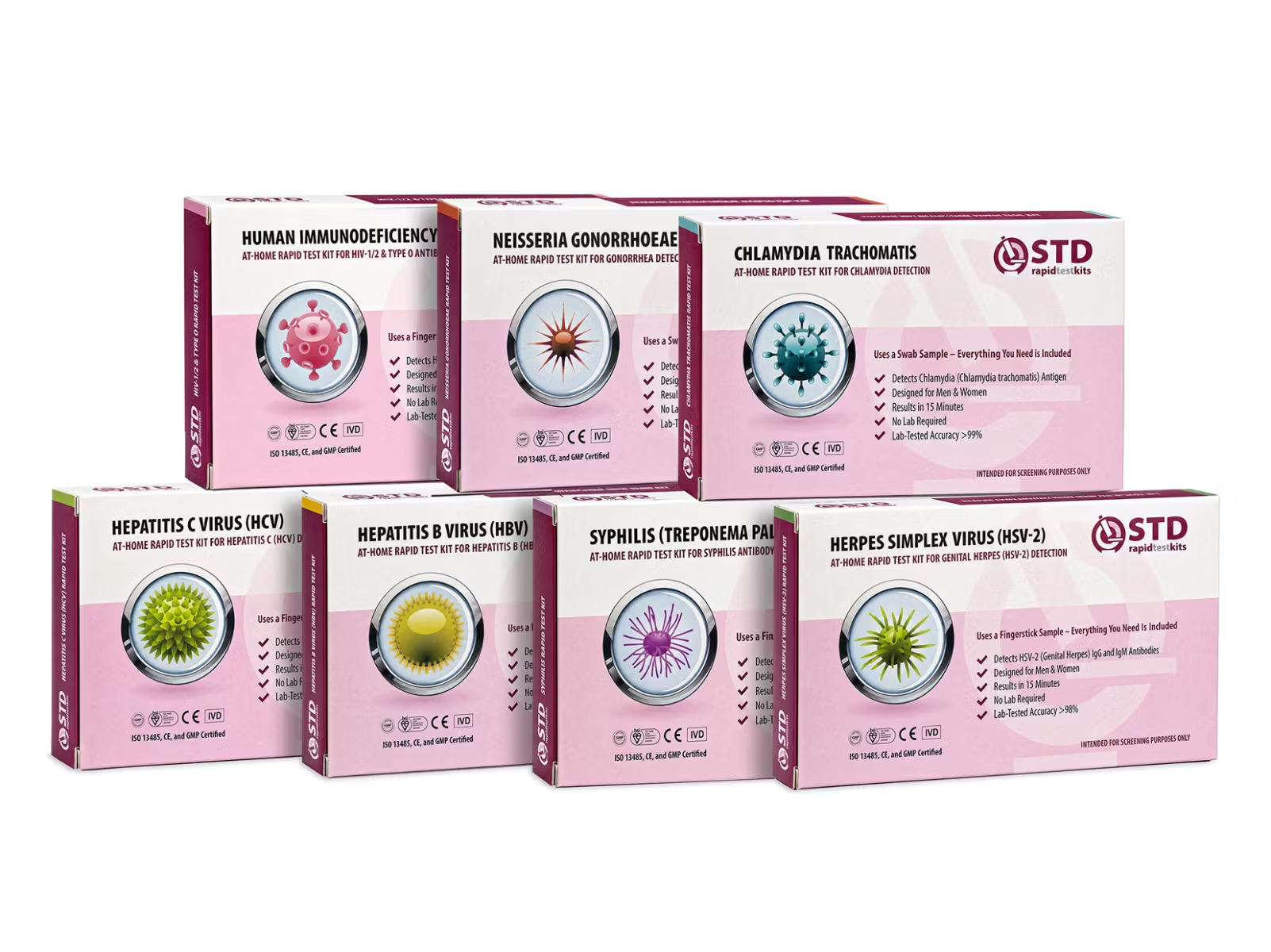
For travelers who want a private, fast way to check their status after a real exposure (not after a stain on a sheet), at-home rapid test panels are a reasonable tool. They use lateral-flow chemistry, the same technology family as rapid COVID and pregnancy tests, applied to swab or fingerstick blood samples.
A few honest framings are worth knowing.
Sample type matters. Chlamydia, gonorrhea, trichomoniasis, and HPV at-home rapid tests are swab-based. HIV, syphilis, hepatitis B, hepatitis C, and the herpes panels are fingerstick blood tests. Our kits do not use urine samples and do not include pharyngeal (throat) or rectal swabs; if the exposure was specifically oral or anal and you want testing of those sites, a clinic visit using a NAAT is the right tool for that.
Lateral-flow is screening, not lab-grade NAAT. At-home rapid tests are useful as a first look in privacy. Lab NAAT and antigen-antibody assays have higher analytical sensitivity, especially in asymptomatic infections. A positive home test is worth confirming at a clinic; a negative home test taken inside the correct window is reassuring but not absolute.
Window periods still apply. An at-home HIV antibody test taken five days after exposure cannot detect a recent infection because antibodies have not yet formed. The window-period framework above applies whether the test is done at home or in a lab.
Privacy and time savings are real benefits. For someone who simply wants to rule out the most common infections after a single risky contact, an at-home panel can do that work in 15 to 30 minutes per assay, in private, without scheduling a clinic visit.
When to see a clinician instead of testing at home
At-home testing has a clear lane, and it is not the right tool for every situation. See a clinician (urgent care, a sexual-health clinic, or your GP) when any of the following apply.
- The exposure is very recent and possibly high-risk. PEP for HIV is time-sensitive (within 72 hours, ideally as soon as possible). A clinician can also offer doxy-PEP for bacterial STI prevention in some circumstances, per CDC guidance.
- You have active symptoms. Genital ulcers, unusual discharge, painful urination, pelvic pain, new rashes, or testicular pain warrant a clinician visit, not just home testing. A clinician can examine, swab, and prescribe in one appointment.
- You are pregnant. STI testing in pregnancy is part of standard antenatal care, and a positive result has implications for the pregnancy that need clinical management.
- The exposure was specifically oral or rectal. Site-specific swabs for pharyngeal or rectal chlamydia and gonorrhea are not in our at-home kit range; the right test is a clinic-administered NAAT.
- Your home test came back positive. Confirmation testing, treatment, and partner notification are clinician-led work.
The honest framing here is that at-home testing handles screening well and handles complex clinical situations badly. The two tools complement each other.
The reassurance, one more time
If the worry that brought you to this article is a stain you saw in a hotel room, the science is on your side. STI pathogens cannot survive the conditions of a dried mark on a sheet, a towel, or a toilet seat for any length of time relevant to your hand or your skin. Public-health agencies have not documented this as a route of transmission for any common STI. Changing rooms, washing your hands, and continuing your trip are reasonable responses; testing for STIs in this scenario is not.
If the worry is something else (an unprotected sexual contact during the trip, a condom that broke, a partner whose status you do not know), that is the part of the picture that does deserve attention. The window-period framework above and the at-home panel give you a clean, private way to settle it, with a clinic visit reserved for the cases where it actually adds value.
Two decision branches, on one page
- Stain only, no sexual exposure: change rooms if you want, wash your hands, and move on. STI testing is not indicated for surface contact with a dried stain.
- Real sexual exposure on the trip: use the window-period framework above. PEP for HIV within 72 hours of contact via a clinician, then home testing at 2 to 3 weeks (chlamydia, gonorrhea), 4 to 12 weeks (syphilis, HIV antibody, hepatitis), and 3 months and beyond for a definitive HIV and syphilis ruling-out (HSV-2 antibody 12 to 16 weeks or longer).
- Symptoms, pregnancy, or a positive home result: see a clinician rather than relying on additional home tests.
Frequently asked questions
- Can I catch HIV from dried semen on hotel sheets or a towel?
- No. The CDC states that HIV does not survive long outside the human body and cannot reproduce outside a host. By the time a stain has dried, the virus is no longer infectious. There are no documented cases of HIV transmission via dried fluid on hotel bedding or towels.
- How long does gonorrhea survive outside the body on a surface?
- Neisseria gonorrhoeae is fragile in the environment and dies within minutes once a fluid dries. The bacteria need warm, moist, oxygen-controlled conditions, which are not present on a dry hotel sheet or surface. Surface transmission is not a recognized route for gonorrhea.
- Can a toilet seat give me an STI?
- No STI pathogen survives long enough on the smooth, dry, cool surface of a toilet seat to remain infectious, and the seat itself never makes contact with the mucous membranes a pathogen would need to infect. Both the WHO and CDC have confirmed for decades that toilet seats are not a transmission route for any common STI.
- What about trichomoniasis on damp towels or in a bathroom?
- Trichomonas vaginalis can survive up to a few hours on damp objects in lab conditions, which is longer than other STI pathogens. Even so, adult fomite transmission is rare. The dominant route is sexual contact. If you used a clean towel from a reputable hotel laundry, the risk is essentially zero.
- Can herpes be transmitted through a stain on bedding?
- No. Herpes simplex virus is inactivated within minutes on dry surfaces. The virus needs direct skin-to-skin contact with an active lesion or actively shedding skin to transmit. Touching a dried stain on a sheet does not provide that route.
- How clean are hotel sheets actually?
- Standard hotel laundry uses hot water, detergent, and tumble-drying, which is reliably more than enough to inactivate STI pathogens. Hygiene complaints about visibly stained or off-smelling linens are fair on aesthetic grounds, but the specific STI risk from properly laundered hotel bedding is negligible.
- Should I get tested if I touched what looked like a stain?
- Not for that reason alone. Touching a stain with your hand does not constitute a meaningful STI exposure. If you also had a real sexual exposure during the trip (unprotected sex, a condom break, sex with a partner whose status is unknown), testing aligned with the window period for each infection is the right step.
- What is the only realistic way to get an STI during a hotel stay?
- Sexual contact during the trip itself. Unprotected vaginal, anal, or oral sex with a partner whose status is unknown is by far the dominant route. The bedding, towels, surfaces, and toilet seat are not part of the transmission picture for any common STI.
- U.S. Centers for Disease Control and Prevention. HIV transmission overview, including statements that HIV does not survive long outside the human body and is not spread through surfaces, saliva, or toilet seats.
- U.S. Centers for Disease Control and Prevention. STD facts including transmission routes, screening guidance, and treatment overviews for chlamydia, gonorrhea, syphilis, trichomoniasis, and HPV.
- World Health Organization. Sexually transmitted infections fact sheet covering routes of transmission, symptom overview, and global epidemiology.
- NHS UK. Sexually transmitted infections overview, including transmission, symptoms, and testing pathways in a public-health system context.
- NHS UK. Syphilis information page, including transmission through direct contact with an infectious sore during sexual activity.
- U.S. Centers for Disease Control and Prevention. Hepatitis division information, including transmission routes for hepatitis B and C through blood-borne exposure.
- U.S. Centers for Disease Control and Prevention. Vaccines and immunization program, including ACIP guidance on HPV vaccination through age 26 and shared clinical decision-making through age 45.
