
Published: November 2025 | Last updated: May 2026 | Editorial review and quality control: Martina N.
Can men get yeast infections from sex?
Yes. A partner with an active vaginal yeast infection can pass enough Candida during unprotected sex to trigger an overgrowth on the head of the penis, especially in uncircumcised men. Symptoms start two to four days later: itching, redness, and a white film under the foreskin that usually clears in seven to fourteen days with an OTC antifungal cream.
Most guys never see this one coming. The itch shows up two or three days after sex, the head of the penis looks redder than it should, and the mind jumps straight to the worst-case scenario. Nine times out of ten, the real cause is something far more ordinary. Male genital yeast infections, clinically called candida balanitis, are common, treatable, and routinely mistaken for sexually transmitted infections by men who were never told this can happen to them.
This guide covers what triggers a male yeast infection, how partner-to-partner transmission actually works, how to tell candida apart from chlamydia, gonorrhea, or herpes, what clears it up, and when an at-home rapid STI test makes sense before you reach for an antifungal cream. The goal is to help you read what your body is signaling and give it the right backup so the itch goes away, without piling on shame about hygiene or sexual history.
Key Takeaways
- Men can develop genital yeast infections, especially after sex with a partner who has an active vaginal infection, after a course of antibiotics, or when blood sugar runs high. Itching, redness, a thick white residue, and burning when urinating are the most common signs.
- The symptoms overlap enough with chlamydia, gonorrhea, and herpes that ruling out STIs with a rapid at-home test is often the fastest way to know what you are dealing with.
When "Just Irritated" Might Be a Yeast Infection
Jordan, 32, figured it was the cheap lube. A couple of days after sex with his girlfriend, he started feeling itchy. The head of his penis looked red and a little raw. He brushed it off as friction. By the third morning, the itch had turned into a sting whenever he peed, and a faint white film was showing up in the creases of his foreskin.
What Jordan had was a male genital yeast infection. The clinical term is candida balanitis, meaning inflammation of the head of the penis caused by Candida, the same yeast behind most vaginal yeast infections. Cleveland Clinic's overview notes that candida balanitis occurs most often in uncircumcised men and in men whose partners have an active vaginal yeast infection, and estimates that roughly 1 in 30 uncircumcised men develop it at some point. The StatPearls chapter on balanitis identifies Candida albicans as the most common identifiable infectious cause of balanitis and balanoposthitis.
Most men do not realize this is a thing. We get told about STIs in school, we hear vague warnings about hygiene, and the rest is left to internet panic. Yeast does not get the same airtime, so when symptoms show up the default assumption is the worst one. Usually that guess is wrong, and the right answer is a seven to fourteen day course of an over-the-counter antifungal cream.
Most cases of male candida balanitis show some combination of: itching that does not let up, redness or a shiny look on the head of the penis, a thick white film under the foreskin or in the creases, and a burning sting when urinating. If two or three of those show up together two to four days after sex or a course of antibiotics, yeast is the leading suspect.
How Transmission Works Between Partners
Yes, sex can pass a yeast infection between partners, though the framing matters more than the headline. Candida albicans is already part of the normal flora on most people's skin and mucous membranes. It becomes a problem only when something tips the balance and the yeast overgrows. A partner with an active infection raises the local count, and unprotected genital contact can hand that overgrowth off.
The most common route is vaginal sex with a partner who has an active vaginal yeast infection. Candida from her vaginal flora transfers to the penis during intercourse, and if the receiving skin is already irritated, antibiotic-exposed, or sitting in a sugar-rich micro-environment (think uncontrolled diabetes), the fungus can take hold instead of being washed away. Oral sex can transfer Candida from oral thrush to the genitals, and anal sex can move Candida species from the lower digestive tract to the penis. The shared thread is that a partner's active infection raises the local Candida count enough to overwhelm skin that is already vulnerable.
The link is not as automatic as a bacterial STI. You can have unprotected sex with a partner who has thrush and walk away with nothing. You can also develop a yeast infection with no recent sex at all. Antibiotic use, high blood sugar, sweat under tight clothing, and immune suppression are all just as capable of triggering an overgrowth. Asymptomatic carriage matters too: a partner with no symptoms can still carry Candida at low levels, especially after recent antibiotics, so the risk drops but does not vanish.
The CDC's candidiasis overview frames genital candidiasis as an overgrowth that happens when Candida grows out of control rather than as a sexually transmitted infection, and candida balanitis follows the same classification. That is why sex is only one delivery system among several: antibiotics, sweat, and high blood sugar can each tip the balance on their own. Skin-to-skin contact, oral-genital contact, and shared sex toys can also move enough yeast to start an overgrowth in a partner whose defenses are already lowered.
Candida is not an STI in the way chlamydia or gonorrhea are. The yeast is already present on most people's skin and mucous membranes in small amounts. Sex can shift the local balance and tip an existing population into an overgrowth, though the underlying trigger is the overgrowth itself, not a brand-new pathogen arriving from outside the body.
Everyone has Candida on their skin and in parts of their body, like the mouth, throat, gut, and vagina. Candida only causes symptoms and infections if it grows out of control.
Risk Factors That Tip the Balance
Several conditions make a male yeast infection more likely after exposure. Most come down to local moisture, a weakened skin barrier, or an immune system running below full strength. The StatPearls review notes that diabetes is the single most commonly identified contributing factor behind balanitis.
| Risk Factor | Why It Matters |
|---|---|
| Unprotected sex with a partner who has an active yeast infection | Local Candida count climbs above what your skin's normal flora can keep in check |
| Uncircumcised anatomy | Moisture and warmth under the foreskin create the environment Candida prefers |
| Recent antibiotic course | Antibiotics knock back the bacteria that normally compete with yeast, leaving room for overgrowth |
| Diabetes or high blood sugar | Glucose-rich tissues feed Candida; recurrent yeast infections are sometimes the first sign of undiagnosed diabetes |
| Tight synthetic underwear, prolonged sweat | Heat plus moisture is the baseline that lets a small overgrowth become symptomatic |
| Obesity or skin folds near the groin | Trapped warmth and sweat create a yeast-friendly micro-environment between folds |
| Compromised immune system (HIV, chemotherapy, long-term steroids) | Lower immune surveillance means smaller overgrowths can flare |
What a Yeast Infection Looks Like on a Man
The visible signs usually center on the glans, the head of the penis. Expect some combination of bright pink or red patches with a glossy or shiny look, small satellite spots or pinpoint papules around the main patch, and sometimes cracked or peeling skin. A thick white residue, often compared to cottage cheese, can collect under the foreskin or in the creases. A fine white film frequently wipes off and leaves raw-looking skin underneath. Some men also get tiny pustules around the rim of the glans.
Burning when you pee is common but not universal. Sex starts to hurt because friction on inflamed skin is painful. The skin can feel tight, raw, or hot to the touch. Many men describe a faint sweet or yeasty odor, separate from the stronger fishy smell that points to a bacterial infection.
Circumcised men tend to see milder, surface-level symptoms: itching, a dry patch, mild redness on the glans. Uncircumcised men can develop more dramatic inflammation because the warm, moist space under the foreskin is exactly the environment Candida prefers. The clinical name shifts with what is involved: balanitis when the head of the penis is inflamed, balanoposthitis when the foreskin is affected too. The StatPearls balanitis chapter names uncircumcised men, men with diabetes, and immunocompromised individuals as the groups who make up the bulk of clinical cases.
One pattern needs same-day attention. If the foreskin becomes too swollen to retract, or a retracted foreskin gets stuck and cannot return to its resting position (a painful emergency called paraphimosis), get clinical care right away. These problems can restrict blood flow to the glans and should not be managed at home. The same goes for symptoms that spread beyond the glans, a fever, or red streaks traveling up the groin.
Self-Check: Signs That Lean Toward Yeast
Having one or more of these does not confirm a yeast infection. Only a clinician's exam or a lab swab can do that.
- Redness, a shiny appearance, or small papules on the glans rather than the shaft Common
- Thick white residue under the foreskin or in skin creases that wipes off and leaves raw skin behind Common
- Burning sting when urinating, especially after sex Common
- Skin that feels tight, raw, or hot to the touch, sometimes with a faint sweet or yeasty odor Less common
- Foreskin too swollen to retract, or a retracted foreskin stuck in place (urgent: stop self-treating and get same-day clinical attention) Rare
Why It Gets Mistaken for an STD
A penis rash after sex sends most guys spiraling. You search the phrase online and land in a corner of the internet that treats every symptom as an STI. Some symptoms genuinely do overlap with chlamydia, gonorrhea, and herpes. Others look much more like yeast once you know what to compare.
Malik, 27, walked into urgent care convinced he had herpes. There was a red, shiny patch on the underside of his glans that burned when he touched it. His herpes test came back negative. The provider asked about recent antibiotics, and yes, he had finished a course for a sinus infection two weeks earlier. The pieces pointed to a candida overgrowth, and a short course of antifungal cream cleared the rash in about a week.
Three differences usually decide what is happening. The first is the type of skin change. Yeast produces flat, pink, itchy patches with white residue you can wipe off. Herpes produces clusters of small fluid-filled blisters that crust over and heal into shallow round ulcers; the CDC's genital herpes page describes herpes sores as one or more blisters on or around the genitals. Chlamydia and gonorrhea often produce no visible skin lesion on the penis at all; both inflame the urethra instead. The second difference is the discharge. Yeast discharge is thick, white, and clumpy, and it sits on the surface of the glans or under the foreskin. Gonorrheal and chlamydial discharge is thinner, yellowish, sometimes greenish, and runs from the urethral opening when the penis is gently squeezed from base to tip. The third is urination. Yeast can sting during urination because urine passes over irritated skin, but it does not cause the deep, urethra-wide burning that bacterial STIs produce.
Trichomoniasis adds one more wrinkle. It is a parasitic STI that often causes no symptoms in men, or only a mild urethritis, and it is a common companion of recurrent vaginal infections in women. If your partner has had repeated yeast infections plus a positive trichomoniasis result, the back-and-forth pattern can be trichomoniasis passing one way and Candida passing the other.
Reading the difference has a concrete payoff: yeast responds to antifungals, while chlamydia and gonorrhea need antibiotics. Reaching for the wrong treatment first usually delays relief by a week or more and can make the underlying overgrowth worse.
Yeast vs Herpes vs Chlamydia or Gonorrhea
| Sign | Yeast infection | Herpes (HSV) | Chlamydia or gonorrhea |
|---|---|---|---|
| Skin appearance | Pink or red patches with white residue you can wipe off | Clusters of fluid-filled blisters that crust into shallow ulcers | Often no visible skin change |
| Discharge | Thick, white, sitting on skin or under foreskin | None typical | Thin, yellow-green, dripping from inside the urethra |
| Itch | Strong itch is typical | Tingling or burning before lesions appear | Itch is uncommon |
| Urination | Mild burning if urine touches irritated skin | Sharp pain if urine touches sores | Deep urethral burning with frequency |
| Open sores or ulcers | No | Yes | Rare |
| Onset after exposure | Two to four days, often after antibiotics or a partner's yeast infection | Two to twelve days for a first outbreak | Chlamydia one to three weeks, gonorrhea two to fourteen days |
Skin patches with wipe-off residue lean yeast; blisters or urethral discharge lean STD.
How Testing Helps Tell the Difference
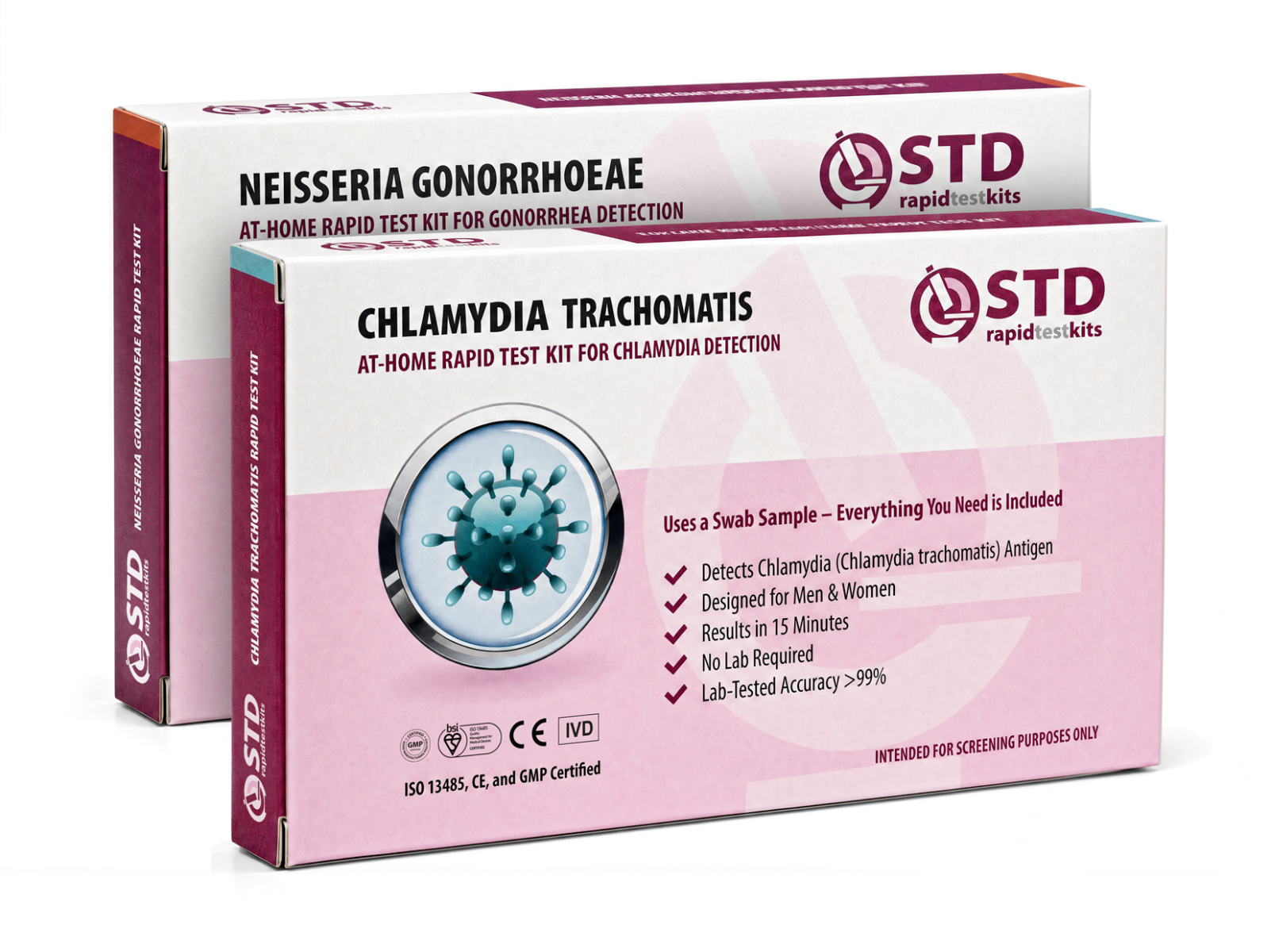
There is no widely available standalone at-home yeast test for men. Clinicians usually diagnose candida balanitis by looking at the lesion and weighing the history. What you can do at home is rule out the STIs that look similar, which narrows the field fast. An at-home STI test kit covers the bacterial and viral infections that share this picture, so you are not guessing about the part that carries real risk.
If chlamydia, gonorrhea, syphilis, herpes, and HIV all come back negative, candida moves to the top of the list. Timing matters. Rapid tests for the bacterial infections typically reach reliable accuracy within one to two weeks of exposure, while HIV and syphilis need longer windows, often four to twelve weeks for full sensitivity. If your symptoms started two or three days after sex, a rapid test at day five or seven can read falsely negative for chlamydia and gonorrhea simply because it is too early. Wait out the window, retest if needed, and trust negative results that land after the correct window has passed.
This site sells at-home STI test kits, and we recommend testing only when it genuinely helps. We choose products based on fit for your concern, not commercial benefit. If your symptoms clearly match candida and you have already cleared the STIs, an antifungal cream from any pharmacy will do the job without a kit from us.
A rapid lateral-flow test like the kits we sell screens for the most common STIs in about 15 minutes at home. It is not a laboratory NAAT, which is the molecular gold standard for chlamydia and gonorrhea. The two technologies are complementary. A positive at home is worth confirming with a lab. A negative at home, taken after the correct window, gives you enough to stop chasing an STI diagnosis and treat the yeast.
Rapid tests for the bacterial infections, chlamydia and gonorrhea, reach reliable accuracy about one to two weeks after exposure. HIV and syphilis need longer, often four to twelve weeks for full sensitivity. If you test earlier than the window, treat a negative as provisional and retest once the window has passed.
Treatment and When to See a Provider
Over-the-counter antifungal creams handle most cases. Clotrimazole (sold as Lotrimin) and miconazole (Monistat) are the two common picks, and terbinafine 1% (Lamisil AT), better known for athlete's foot and jock itch, also works against Candida. Each belongs to the same antifungal family a clinician would prescribe for candida balanitis. The usual approach is a thin layer on clean, dry skin twice a day, and NHS guidance on thrush notes that thrush usually clears within seven to fourteen days of starting treatment. Do not stop early just because the itch fades. Yeast bounces back fast if you cut the course short.
For stubborn or recurrent cases, a clinician can prescribe oral fluconazole, often a single dose or a short course depending on severity. MedlinePlus describes fluconazole as a treatment for yeast infections that may be given as a single dose. If bacterial inflammation has layered on top of the yeast, a combination cream pairing a low-potency steroid with an antifungal can calm the inflammation while the antifungal clears the fungus.
A quick word on home remedies you will see online. Plain yogurt and probiotic supplements may support gut and skin flora, but they will not clear an active infection on their own. Coconut oil shows weak antifungal activity in lab studies; topical use is unlikely to harm, though it should not replace a proven antifungal cream. Tea tree oil and garlic can irritate already-inflamed genital skin and should not be applied directly. Anything that brings on extra burning or worsening redness should be stopped at once.
See a provider if symptoms worsen after a week of OTC treatment, if you develop fever, spreading redness, swollen lymph nodes, or pus, or if your foreskin gets too tight to retract. Recurring yeast infections are also a reason to get checked for diabetes. High blood sugar feeds candida overgrowth, and a new diabetes diagnosis often shows up first as repeated genital infections.
Most male yeast infections clear with seven to fourteen days of an over-the-counter antifungal. Stop self-treating and book a visit the same week if any of the following show up: symptoms worsen or do not improve after seven days of OTC treatment, fever or red streaking up the groin, pus or open sores, swollen lymph nodes, a foreskin too swollen to retract or a retracted foreskin stuck in place, diabetes that is not well-controlled (HbA1c above 7, the blood-sugar marker your doctor checks at routine visits), immune suppression from HIV, chemotherapy, or long-term steroids, or this being your third or more episode in twelve months.
Prevention and Lowering Recurrence
Once it clears, the goal is keeping it gone. Most of prevention comes down to three habits: keep the area dry, avoid disrupting your normal skin flora, and watch the triggers you can control.
Wash with mild, unscented soap. Skip antibacterial body washes on your genitals; they strip the bacteria that compete with yeast and leave the field open for overgrowth. Pat dry rather than rub, and let the area air-dry for a moment before getting dressed. Breathable cotton underwear beats tight synthetics, especially in warm weather or after the gym. Change out of wet swimwear or sweaty workout gear as soon as you can; a two-hour ride home in damp shorts builds a near-perfect culture medium.
Antibiotics are one of the most reliable yeast triggers. If you are prescribed a course for an unrelated infection, watch for early symptoms in the days that follow. Catching the itch on day two is far easier than treating a full balanitis on day ten. If you get recurrent yeast infections during antibiotic courses, ask your provider whether a preventive dose of fluconazole during or right after the course makes sense for you.
If your partner has an active vaginal yeast infection, hold off on penetrative sex until her treatment finishes and symptoms clear, then use condoms for a couple of weeks to give both of you time to reset. Yeast can ping-pong between partners if one of you is still carrying an overgrowth. NHS guidance on thrush lists poorly controlled diabetes among the conditions that make thrush more likely and more likely to return. If you have had repeated episodes and have not had a blood-sugar check recently, raise it with your provider; an HbA1c above 7 is a common threshold for flagging poor control.
What Recurring Yeast Infections Might Really Mean
If you have treated what you thought was yeast three or more times in a year and it keeps returning, the differential changes. At that point the likely explanations look different from a one-off candida flare.
An undiagnosed STI sits at the top of the list. Recurrent balanitis in men is the textbook scenario where chlamydia, trichomoniasis, or low-grade gonorrhea gets missed. Each recurrence reads as one more yeast infection, each course of antifungal helps a little because the cream calms the local irritation, and the underlying STI never gets tested for. A single screening panel can break the cycle. Diabetes or pre-diabetes is the next layer; recurrent fungal infections of any kind are sometimes the first hint of impaired glucose tolerance. A non-infectious skin condition such as eczema, psoriasis, or lichen sclerosus can also cause patchy, itchy, scaly skin on the glans that responds partway to creams but never fully clears, and a dermatologist can usually tell from a single look. The last common cause is partner pair-cycling: if both partners are treated separately rather than in the same window, Candida ping-pongs between them indefinitely. Synchronized treatment plus condom use during the treatment window breaks that loop.
Recurrent yeast infections in men are often not only yeast. A broader STI screen, a glucose check, and a careful partner conversation each tackle a different layer of the same problem. Skipping all three and buying another tube of antifungal cream is the most common reason this drags on for years.
This site sells rapid at-home tests for the bacterial and viral STIs that hide inside this picture. We do not sell a yeast infection test; Candida is identified by a clinician's visual exam or a lab swab, not by a rapid at-home strip. The role our tests play is the rule-out: if your home rapid is negative for chlamydia, gonorrhea, syphilis, HIV, and the hepatitis viruses after the correct window period, you have narrowed the recurrent-balanitis differential to non-STI causes, and your next clinician appointment runs shorter and more focused.
What Recurrent 'Yeast' Often Turns Out to Be
- A missed STI. Chlamydia, trichomoniasis, or low-grade gonorrhea reads as 'another yeast infection' while the antifungal only calms the surface irritation.
- Diabetes or pre-diabetes. Repeated fungal infections are sometimes the first hint of impaired glucose tolerance.
- A non-infectious skin condition. Eczema, psoriasis, or lichen sclerosus can mimic yeast and respond only partway to creams.
- Partner pair-cycling. If both partners are not treated in the same window, Candida ping-pongs between them indefinitely.
Does It Mean You're Dirty? (Short Answer: No)
Candida balanitis happens because the local skin microbiome shifts out of balance, which has nothing to do with how often a man showers. The same overgrowth that causes a vaginal yeast infection after a course of antibiotics is what causes candida balanitis after a hot summer week in synthetic underwear. It happens to men who shower daily and to men who do not. It happens to people in long-term monogamous relationships and to people who are completely celibate.
The stigma is part of why guys wait too long to deal with it. The longer you ignore a yeast infection, the more uncomfortable it gets and the more likely a secondary bacterial infection piles on top. Talking to a partner about it does not have to feel like a confession. A simple message that you are dealing with a yeast infection and want to hold off on sex for a week is enough. Candida looks for a damp environment and an opening, and sometimes it finds one. Catching it early keeps the treatment short and spares you the secondary irritation that sets in on cracked, untreated skin.
The same Candida overgrowth that drives a vaginal yeast infection after a course of antibiotics is what drives candida balanitis after a warm, sweaty week. Neither has anything to do with how often anyone showers.
What to Do Right Now
Genital irritation is the kind of thing most men try to ignore until they cannot. The sooner you put a name to it, the sooner it clears up. If your symptoms match what we have described and you have already ruled out the common STIs, an antifungal cream from any pharmacy is usually enough. If you have not ruled them out, an at-home rapid test takes about 15 minutes and saves you the clinic visit. Either way, you do not have to sit with the not-knowing.
Your body sends signals when something is off balance. Read them, give the area the right backup, and most of the time the itch fades within a few days. If it does not, a clinician can take it from there.
Your Next Steps
Do you have any sores, blisters, ulcers, or discharge running from inside the urethra, or a recent higher-risk exposure?
Yes: These point away from yeast. Rule out the common STIs with a rapid at-home test after the correct window (one to two weeks for the bacterial infections, longer for HIV and syphilis) before treating anything as yeast.
Are your symptoms limited to itch, glans redness, and a white residue you can wipe off, with no high-risk exposure?
Yes: This fits the yeast pattern. Apply an over-the-counter antifungal cream (clotrimazole, miconazole, or terbinafine) twice daily for the full seven to fourteen days, even after symptoms ease.
No: If an antifungal brings no improvement after a week, if fever or spreading redness develops, or if this is your third recurrence in a year, see a provider.
Guidance only. A healthcare provider can advise based on your specific situation.
FAQs
- Can men really get yeast infections?
- Yes, and candida balanitis is one of the more common reasons primary-care providers see men with penile irritation. Most men simply do not have a name for it, so they assume it is friction, bad soap, or something they will walk off. Male yeast infections are real, very treatable, and usually clear with a basic over-the-counter antifungal cream when caught early.
- Can I get a yeast infection from my partner?
- The most predictable scenario is unprotected sex with a partner who currently has an active vaginal yeast infection, especially if your skin barrier is already compromised by recent antibiotics, sweat, friction, or diabetes. It does not mean either of you did anything wrong. Candida lives on both partners' skin in small amounts already; the partner's active infection just raises the local count enough to tip your balance.
- Can my partner give me one if she has no symptoms?
- Yes, though the risk is lower. Candida can live in the vagina without causing symptoms, and this asymptomatic carriage is common, especially after recent antibiotics or during pregnancy. If you have stacked risk factors (uncircumcised, recent antibiotics, uncontrolled diabetes), even low-level carriage can be enough to set off an overgrowth on your skin.
- What does a male yeast infection feel like?
- Itchy first, then sometimes burning. The head of the penis looks redder than usual, often a shiny red. You might notice a white residue under the foreskin or in the creases, a faint yeasty odor, or small red spots like satellite dots around a main patch. Burning during urination is common but not universal, and sex starts to hurt because friction on inflamed skin is painful.
- How long after sex do symptoms appear?
- Usually two to four days after the trigger. Yeast does not follow the exact timing of a bacterial STI like gonorrhea, which often shows symptoms within a few days, or herpes, where a first outbreak can take about two to twelve days. Yeast can also stay quiet for a week before sweat or friction tips it into a full flare.
- Should I have sex during treatment?
- Better to wait until symptoms are fully gone, usually one to two weeks. Sex during treatment can re-irritate inflamed skin and re-introduce Candida from a partner who may also be carrying it, which restarts the cycle from day one. If your partner has symptoms too, treating both of you in the same window prevents the back-and-forth.
- How do I know it is not an STD?
- Start with what you can see. Yeast tends to show flat pink patches with a white residue you can wipe off and a strong itch; sores or blisters point to herpes, and discharge running from inside the urethra points to chlamydia or gonorrhea. Because that overlap is real, the surest way to be certain is a rapid at-home STI test taken once the window period has passed. If those infections come back negative, candida becomes the leading explanation.
- Why do I keep getting yeast infections?
- Recurring yeast is a flag for an underlying trigger. The common ones are uncontrolled diabetes or pre-diabetes, repeated antibiotic courses, an uncircumcised anatomy paired with chronic moisture, a weakened immune system, a chronic skin condition like eczema or lichen sclerosus, or steady reinfection from a partner who carries Candida without symptoms. Three or more episodes in a year warrants a broader workup.
- Can a male yeast infection turn into something more serious?
- In otherwise healthy men, almost never. In men with poorly controlled diabetes, HIV, or chemotherapy-related immune suppression, Candida can occasionally spread beyond the skin (a condition called invasive candidiasis) and become a medical emergency, which is why those groups should not self-manage for long. For everyone else, the bigger risk is a secondary bacterial infection setting up on cracked, untreated skin.
- Will an at-home STI test tell me if I have yeast?
- No. The rapid kits detect chlamydia, gonorrhea, HIV, syphilis, hepatitis B and C, and herpes antibodies, but none of them picks up Candida, which a clinician confirms by exam or lab swab. Their value here is elimination: clear those infections after the correct window and you can stop chasing an STI, treat the yeast, and walk into any follow-up visit with a much shorter list to discuss.
How we sourced this article: We drew on current clinical guidance from the U.S. Centers for Disease Control and Prevention, the NHS, the Cleveland Clinic, MedlinePlus, and the peer-reviewed StatPearls chapter on balanitis. The plain-English translation is our editorial team's; a licensed medical doctor reviews each article for clinical accuracy before publication.
- U.S. Centers for Disease Control and Prevention. About Candidiasis: Candida lives normally on the body and only causes infection when it grows out of control; genital candidiasis is framed as an overgrowth condition rather than a sexually transmitted infection.
- U.S. Centers for Disease Control and Prevention. About Genital Herpes: herpes sores appear as one or more blisters on or around the genitals, used here for the herpes-versus-yeast visual differential.
- NHS. Thrush in men and women: male symptoms (redness, cottage-cheese discharge, difficulty retracting the foreskin), antifungal treatment clearing within seven to fourteen days, and poorly controlled diabetes as a recurrence trigger.
- Cleveland Clinic. Male yeast infection (candida balanitis): most common in uncircumcised men and in men whose partners have a vaginal yeast infection; roughly 1 in 30 uncircumcised men affected over a lifetime.
- Edwards SK et al. Balanitis. StatPearls (NCBI Bookshelf): Candida albicans is the most common identifiable infectious cause of balanitis and balanoposthitis; diabetes is the most commonly identified contributing factor, with uncircumcised and immunocompromised men also predominant.
- MedlinePlus (U.S. National Library of Medicine). Fluconazole: treats yeast (Candida) infections and may be given as a single dose, used here for the oral prescription option.
