
Published: November 2025 | Last updated: May 2026 | Editorial review and quality control: Martina N.
Yes, kissing can transmit the herpes simplex virus, almost always HSV-1, the strain behind cold sores. But "can" is doing a lot of work in that sentence. Whether a kiss leads to a real infection depends on a few specific things: whether the other person has an active cold sore, whether their lip skin is shedding virus invisibly, and whether your own lips have a tiny opening the virus can use to slip in.
If you are reading this because of a specific kiss replaying in your head, the realistic picture is calmer than your search history suggests. Most exposures do not lead to infection. Most adults already carry HSV-1. Even a true new infection is usually manageable. This guide pulls apart the situations that genuinely matter from the ones that don't, then explains when and how testing helps.
Key Takeaways
- Kissing can spread HSV-1, but the real risk concentrates around active cold sores. Once the sore has fully healed, the contagious window has largely closed.
- If you were exposed and develop tingling, itching, or small blisters on your lip within roughly 2 to 12 days, that is the window to watch and the moment to consider testing or a clinic visit.
What HSV-1 Is and Why Kissing Matters
When people search for "herpes," they are usually thinking about one of two viruses in the same family. HSV-1 is the strain associated with oral herpes, the recurring cold sores or fever blisters that appear on or around the lips. HSV-2 is the strain more often associated with genital herpes. Either virus can technically infect either location, but the everyday split lines up that way for most people.
According to the World Health Organization, an estimated 3.8 billion people under age 50 carry HSV-1 globally, roughly 64% of that age group. Most of those infections were picked up in childhood through ordinary close contact, not through anything dramatic.
That is the reason kissing keeps coming up in this conversation. HSV-1 lives on and around the lips. Kissing is the most efficient direct-skin route between two mouths. When someone has an active sore, the lesion itself carries a high concentration of virus, and a kiss puts that virus in direct contact with another person's lip skin and mucous membrane.
An estimated 3.8 billion people under age 50, or about 64% of that age group, carry HSV-1 globally (WHO). Most acquired the virus in childhood through ordinary family contact.
How HSV-1 Spreads Through Kissing
HSV-1 is not airborne. It does not survive long on dry surfaces and it does not float around a room waiting to catch someone. Transmission almost always requires direct skin-to-skin or mucous-membrane contact with the virus, or contact with infected fluid like the contents of a cold sore.
The highest-risk window is during a visible outbreak. Cold sores are fluid-filled blisters packed with virus particles. When that blister touches another person's lip, the virus can pass through a microscopic break in the skin or directly across the lip's mucous membrane. The receiving person's immune system may still stop the infection from establishing, but the opportunity has been created.
The table below sums up how transmission risk shifts depending on what the infected person's mouth looks like at the moment of the kiss.
| Scenario | Risk Level | Why |
|---|---|---|
| Kissing during an active, open cold sore | High | Virus concentration is highest while the blister is fluid-filled. |
| Kissing during the tingling prodrome (before a visible sore) | Moderate to high | The virus is already active at the skin surface, even without a visible lesion. |
| Kissing during the healing or crusted stage | Moderate | Some virus may persist until the skin has fully closed and new skin has formed. |
| Kissing with no visible cold sore or prodrome | Low | Possible through asymptomatic shedding, but far less common. |
So can one kiss actually give you herpes?
It can, but it usually does not. Real risk concentrates around active cold sores. If there is a visible sore on your partner's lip and you kiss it directly, the virus has a clear path. If there is no sore and no tingling prodrome, transmission is still possible through asymptomatic shedding but uncommon. After exposure, the window to watch for symptoms is roughly 2 to 12 days.
The Quiet Years: How HSV-1 Hides in Nerve Cells
One reason herpes confuses people is that the virus does not leave after the first infection. Once the initial outbreak heals, HSV-1 retreats into nearby sensory nerve cells (the trigeminal ganglion, for oral herpes) and stays there for life, usually dormant. Most of the time it does nothing at all.
Reactivation can be triggered by anything that puts the immune system under load. When the virus reactivates, it travels back down the nerve to the skin surface, which is where a cold sore forms. Some people get outbreaks every few weeks. Others get one in their twenties and never see another.
- Stress, fatigue, or poor sleep.
- Other illnesses, especially with fever.
- Sun exposure on the lips (UV light is a common trigger).
- Hormonal cycles, including menstruation.
- Dental work or trauma to the lip area.
- Immune suppression from medication or other conditions.
Timeline: What Happens in the Days After a Risky Kiss
If a kiss transmits HSV-1, you would not feel it immediately. The virus needs time to copy itself in the skin cells where it landed before the immune system notices and symptoms appear. For oral herpes, that incubation period typically runs 2 to 12 days, with most first outbreaks landing somewhere between days 4 and 7.
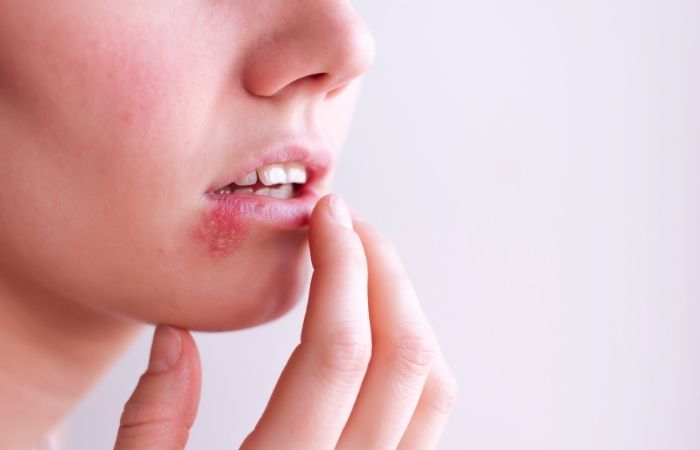
The first sign is rarely a visible blister. More often it is a strange tingling, itching, or burning patch on the lip, called the prodrome stage. Within a day or two of that prodrome, small fluid-filled blisters cluster together and become recognizable as a cold sore.
| Stage | What Happens | Approximate Timing |
|---|---|---|
| Exposure | Virus enters lip skin through contact. | Day 0 |
| Incubation | Virus replicates in skin cells; no symptoms yet. | 2 to 12 days |
| Prodrome | Tingling, itching, or burning patch on the lip. | Often day 3 to 7 |
| Blister formation | Small fluid-filled vesicles cluster together. | Within 1 to 2 days of prodrome |
| Crusting and healing | Blisters break, scab, and heal under new skin. | Roughly 7 to 10 days after blisters appear |
What If You Already Kissed Someone With a Visible Cold Sore?
This is the question that drives a lot of late-night searches. Someone notices a sore on their partner, or remembers one later, and immediately starts replaying the kiss. The first thing worth saying clearly: exposure is not the same as infection.
For transmission to happen, three things usually need to line up. The virus has to be present in detectable amounts. Your lip needs a small opening for the virus to enter, like a chapped patch, a tiny cut, a crack at the corner of the mouth, or irritated mucous membrane. And your immune system has to fail to clear the small initial infection before it establishes.
If no tingling, itching, or blisters appear within 14 days of a possible kiss exposure, the virus most likely did not take hold. The 2 to 12 day window is your most useful piece of information.
What Raises the Transmission Risk
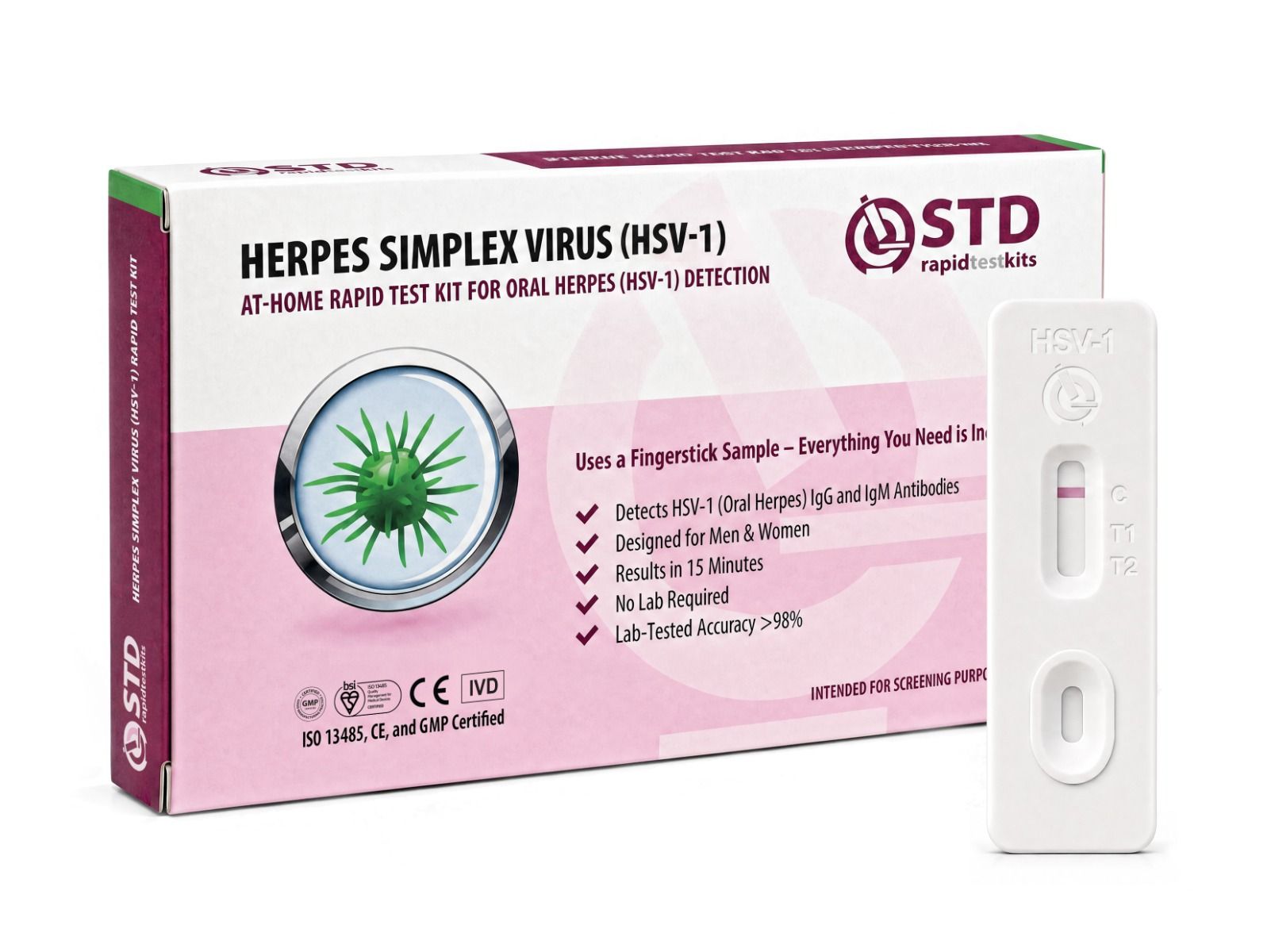
This site sells rapid at-home STI tests, including the HSV-1 antibody test described below. Certain conditions make transmission much more likely. Most involve the virus being active or the receiving skin being unable to defend itself.
- An active cold sore on the other person's lip, especially during the fluid-filled blister stage when virus concentration peaks.
- Prodrome symptoms (tingling, itching, burning on the lip) even before a visible sore appears.
- Cracked, chapped, or split lips on the receiving person, which give the virus a clear path in.
- A weakened immune system from illness, immunosuppressive medication, or chemotherapy.
- Prolonged, deep kissing rather than a brief peck, which increases exposure time and skin friction.
- Sharing items that have just touched a sore, such as lip balm, utensils, drinking straws, or cups.
Asymptomatic Shedding: The Confusing Part of HSV-1
Most transmission happens around visible cold sores, but not all of it does. The virus occasionally becomes active on the skin without producing any sore at all. This is asymptomatic shedding, and it is the reason HSV-1 keeps spreading even between people who feel perfectly healthy.
Shedding episodes are usually brief, last hours to a couple of days, and involve far lower viral concentrations than an open sore. Still, they happen often enough that, across years and many close contacts, a meaningful share of new infections come from kisses where nobody looked sick.
The practical takeaway is simple. The absence of a visible cold sore lowers transmission risk dramatically without bringing it to zero. Couples with one HSV-1 partner often handle this by avoiding kissing during outbreaks and prodrome, then resuming normal contact between episodes.
No visible sore means dramatically lower risk, though the virus can still shed for hours to a day without any symptom. That is part of why HSV-1 is so widespread even among careful people.
First Signs of a New HSV-1 Infection
A first-ever HSV-1 outbreak can feel more uncomfortable than the recurring cold sores some people are used to. The body has no antibodies yet, so the initial response is broader and the symptoms can extend beyond the lip itself.
The earliest sign is the prodrome: tingling, itching, or burning on a small patch of lip skin or just inside the mouth. Within a day or two, clusters of small fluid-filled vesicles appear. These rupture, form shallow ulcers, then crust over as the area heals, typically within about 10 days according to the NHS.
First infections sometimes come with broader symptoms, including a mild fever, swollen lymph nodes under the jaw, a sore throat, or general fatigue. These usually resolve within two to three weeks as the immune system catches up. Recurrent outbreaks later in life are generally milder and shorter than the first.
How Common HSV-1 Really Is
One of the most useful pieces of context for anyone worried about a single kiss: HSV-1 is one of the most common viruses humans carry. The WHO's global estimate of 3.8 billion people under age 50 means that, statistically, many of the people in your life already have it, including most of the people you have kissed in the past.
Most of those infections were acquired in childhood, when adults kissed children's faces, when families shared food and utensils, or when kids played in close contact. By adulthood, the virus has already been quietly circulating through normal human contact for decades.
That context changes how this should be thought about. HSV-1 sits alongside the common cold and chickenpox as a virus most people will encounter in their lifetimes. It is a common skin virus with a particular reactivation pattern, and it has been part of human life for as long as we have had recorded medicine.
| Region | Estimated adult HSV-1 prevalence | Notes |
|---|---|---|
| Global, under age 50 | ~64% | WHO estimate of 3.8 billion people. |
| Americas | ~40 to 50% | Lower in younger adults than historical generations. |
| Europe | ~60 to 70% | Often acquired in childhood through family contact. |
| Sub-Saharan Africa and South-East Asia | ~80 to 90% | Exposure tends to occur earlier in life. |
An estimated 3.8 billion people under age 50, or 64% of the global population, have herpes simplex virus type 1 infection, the main cause of oral herpes.
How to Reduce Transmission Risk in Day-to-Day Life
The simplest and most effective rule is also the most obvious: avoid direct lip contact when a cold sore is visible or in the tingling prodrome stage. The contagious period stretches from the first prodrome symptoms until the sore has fully crusted and new skin has formed over the area. Once that has happened, kissing is broadly safe again.
A few practical habits cover most of the remaining risk:
- Skip kissing during visible cold sores and during the tingling prodrome that precedes them.
- Avoid sharing utensils, drinks, straws, lip balm, or lipstick during an outbreak.
- Wash hands after touching a cold sore, and avoid touching your eyes (HSV-1 can rarely infect the eye, which is more serious).
- Let the sore fully heal under new skin before resuming direct lip contact.
- For partners with frequent recurrences, ask a clinician about daily suppressive antiviral medication, which lowers both outbreak frequency and transmission risk.
When to Test for Herpes After Kissing
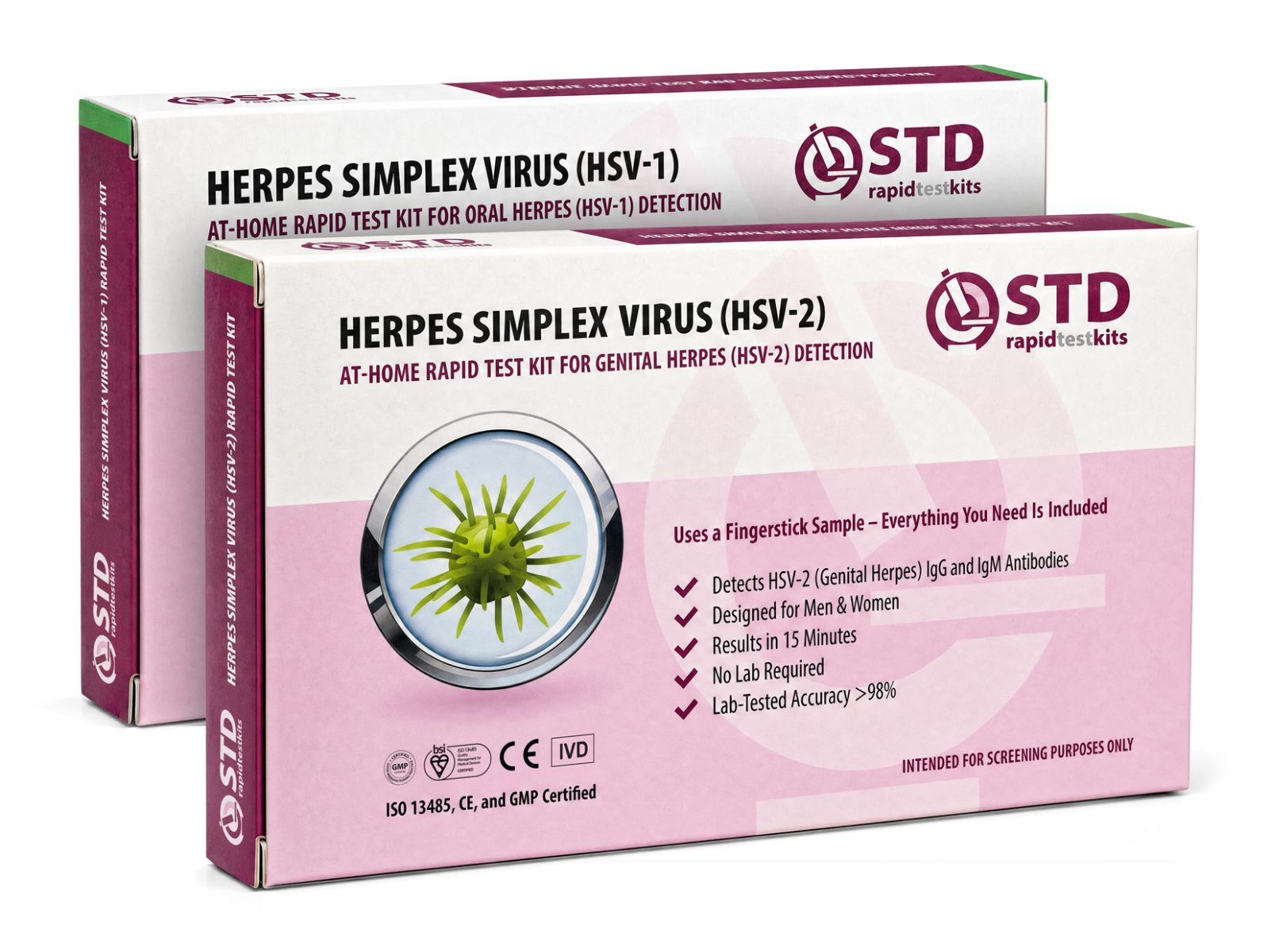
Herpes testing is different from testing for other STIs. Standard STI panels often skip HSV unless symptoms are present, and the results can be hard to interpret if you do not know what to do with them.
The most useful test for an active sore is a swab of the lesion itself, performed at a clinic, which goes to a lab for PCR analysis. This identifies the virus directly and is most accurate during an outbreak. If you have a visible sore that has been around for less than 48 hours, that swab is the gold standard.
Blood tests look for antibodies, which only appear after the immune system has had time to react. Testing too soon after a kiss can produce false negatives because your body has not yet built detectable antibodies; the CDC's herpes resources emphasise waiting several weeks to a few months before relying on a blood antibody test result.
For someone with no symptoms and no specific high-risk exposure, routine HSV antibody screening is not generally recommended. But if you have a clear high-risk exposure, repeated cold-sore-like symptoms, or strong anxiety affecting your life, a discussion with a clinician about timing makes sense.
Living Around Someone Who Gets Cold Sores
Plenty of long-term couples include one partner who gets recurrent cold sores. These relationships are common and entirely workable. The key is timing and a shared rule that during prodrome and active outbreaks, the affected person avoids direct lip contact, oral sex, and sharing items that touch the mouth.
For people with frequent outbreaks, antiviral medications prescribed by a clinician can both shorten outbreaks and reduce the frequency of recurrences. Daily suppressive dosing is sometimes used for partners trying to lower transmission risk further.
Clinicians most often prescribe acyclovir, valacyclovir, or famciclovir. These can be used episodically (taken at the first prodrome to shorten an outbreak) or as daily suppressive therapy to reduce both recurrences and transmission risk. A primary-care visit is enough to start; specialist referral is rarely needed.
Why Stigma Makes This Harder Than It Needs to Be
HSV-1 carries social weight that has very little to do with the biology of the virus. The word "herpes" still produces anxiety even for an infection most adults already have. That gap between how common the virus is and how scary it sounds is what generates so many late-night search spirals.
Cold sores are a skin manifestation of a virus most adults already carry, picked up through ordinary human contact, often in childhood. For most people who carry HSV-1, the entire lived experience of the virus is an occasional sore once or twice a year, sometimes less than that. Knowing the contagious window, from first tingle through fully healed skin, is the one piece of information that changes daily decisions about kissing someone who gets cold sores.
Kissing risk runs from the first tingle of a prodrome until the sore has fully crusted and new skin has formed over the area. Outside that window, normal affection carries very low risk.
FAQs
- Can a single kiss really give me herpes?
- It can, but it rarely turns into the inevitable infection people fear. Real risk concentrates around contact with an active cold sore. Direct lip-to-blister contact gives the virus a clear path. Without that, the odds drop sharply.
- I kissed someone with a cold sore. Should I panic?
- No. Exposure does not equal infection. The useful response is to watch your lips over the next 2 to 12 days for tingling, itching, or small blisters. If nothing appears in that window, you have most likely cleared the exposure.
- What does the first herpes cold sore feel like?
- Usually a small patch of tingling, itching, or burning skin on the lip or right at the lip border. It often comes a day or two before any visible blister. Once you have had one outbreak, the sensation is unmistakable if it ever comes back.
- Can HSV-1 spread when there is no visible cold sore?
- Yes, through asymptomatic shedding, but at a far lower rate than during a visible outbreak. The presence of a sore concentrates the virus dramatically. Asymptomatic shedding is part of why HSV-1 is so widespread, even though most people only notice the visible cases.
- If I already get cold sores, can a new partner give me a "second" infection?
- Usually not in the way people fear. Once you carry HSV-1, your immune system already recognizes that strain on contact. You cannot really catch what you already have, although co-infection with HSV-2 in a different location is biologically possible.
- Can kissing give someone genital herpes?
- Not directly. Kissing transmits HSV-1 to the lip area. Genital herpes typically comes from genital-to-genital or oral-to-genital contact. The most common bridge between the two locations is oral sex performed by someone with oral HSV-1, which can leave HSV-1 on a partner's genitals.
- How long after a kiss would symptoms show up?
- For a new HSV-1 infection, symptoms typically appear 2 to 12 days after exposure, clustering in the first week. The first clue is usually that tingling prodrome on the lip, not a fully formed blister.
- Do I need an at-home herpes test after one kiss?
- Usually not. Testing is most informative when you have specific symptoms or a known high-risk exposure with enough time elapsed for antibodies to develop, typically a few months. Testing earlier can produce false negatives. If you develop sores, a clinic swab during the active outbreak is the most accurate test.
How We Sourced This Article: Our article was constructed based on current advice from the most prominent public health and medical organizations, including the World Health Organization, the U.S. Centers for Disease Control and Prevention, the NHS, and Mayo Clinic. We then molded that science into plain English shaped around the situations people describe when they search for information about kissing, cold sores, and HSV-1 exposure. Specific numerical claims, including the global HSV-1 seroprevalence estimate and the typical 2 to 12 day incubation window, are drawn from those sources and verified at the time of publication. Guidance on waiting several weeks to a few months before relying on a blood antibody test is drawn from CDC herpes resources.
- World Health Organization. Herpes simplex virus fact sheet, including the global seroprevalence estimate of 3.8 billion people under age 50 with HSV-1.
- U.S. Centers for Disease Control and Prevention. Genital and oral herpes overview: transmission routes, symptoms, and general testing guidance, including timing considerations for blood antibody testing.
- NHS. Cold sores: symptoms, course of a first infection, healing timeline, and self-care advice.
- Mayo Clinic. Cold sore: symptoms, causes, triggers of reactivation, and antiviral treatment options.
- MedlinePlus (U.S. National Library of Medicine). Herpes simplex overview for patients, covering HSV-1 vs HSV-2 and recurrence patterns.
- DermNet. Herpes simplex: clinical features, diagnosis, and management.
