
Published: November 2025 | Last updated: May 2026 | Editorial review and quality control: Martina N.
People search this question for a lot of reasons. Some are anxious after an exposure they regret. Some are clinicians trying to give an accurate answer to a worried patient. Some are simply curious about whether the diseases we group as “sexually transmitted” can cross between species at all. The honest, public-health answer is layered. The human-specific STIs that drive most of our clinical concern (HIV, chlamydia, gonorrhea, syphilis, herpes, HPV) are largely species-specific and have not been shown to transmit from animals to people through sexual contact. But sexual contact with an animal still carries real infection risk, just not from the pathogens most people picture when they hear “STI.” The real concerns are zoonotic bacteria, viruses, and parasites that already transmit through close contact with animal body fluids, plus mechanical injury and bacterial wound infection.
This article walks through what the published medical literature actually shows, which infections are realistic worries, what at-home testing covers and what it does not, when a clinic visit beats a home kit, and the legal context that frames the whole question.
Key Takeaways
- The well-known human STIs (HIV, chlamydia, gonorrhea, syphilis, herpes, HPV) are species-specific. They have no documented transmission route from animals to people through sexual contact.
- The real infection risk from sexual contact with animals comes from zoonotic bacteria (brucella, leptospira, Coxiella burnetii) and mechanical wound infection, not from human STI pathogens. That workup belongs in a clinic, not in an at-home kit.
What “Zoonotic” Actually Means, and Why It Reframes the Question
The relevant biological concept here is zoonosis. A zoonotic disease is any infection that naturally jumps between non-human animals and humans. The U.S. Centers for Disease Control and Prevention estimates that more than six of every ten known infectious diseases in people can be spread from animals, and three of every four newly emerging infectious diseases in people come from animals (CDC One Health, About Zoonotic Diseases). Infectious-disease scientists ask a different question when assessing animal-contact exposure. The relevant test is whether the organism can cross the species barrier and establish in human tissue. The STI label comes later, if at all.
Most things classified as sexually transmitted infections in human medicine are caused by organisms that have evolved with the human host. HIV is human immunodeficiency virus. Chlamydia trachomatis serovars D through K live in human urogenital epithelium. Treponema pallidum subspecies pallidum (syphilis) is a human pathogen. Herpes simplex viruses 1 and 2 are human herpesviruses. The genital and oncogenic HPV strains are human papillomaviruses. None of these has a known animal reservoir from which human infection can be acquired through sexual contact.
What you can pick up from an animal is anything in the zoonotic catalog whose transmission route allows entry through mucous membranes, broken skin, or aerosolized droplets. Sexual contact creates several of these exposures at once: mucous membrane contact, microtrauma, sometimes blood contact, often fecal-oral contact. That is why the question matters as a public-health one, even though the answer involves a different set of pathogens than people initially expect.
A zoonotic disease is any infection that naturally passes between non-human animals and people. The category covers rabies, salmonellosis, brucellosis, Q fever, leptospirosis, psittacosis, and many others. Sexual contact is one of several exposure routes; it concentrates the usual transmission pathways (mucous-membrane contact, microtrauma, fluid exposure) into one event.
Why Most Human STIs Don’t Cross From Animals
Pathogen host range is a measurable property, not a guess. Each pathogen has evolved cellular machinery that binds specific receptors on its host. HIV-1, for example, binds the CD4 receptor and one of two co-receptors (CCR5 or CXCR4) on human T cells. Non-human great apes carry related lentiviruses (SIV in chimpanzees, gorillas, and other primates), and SIV strains have crossed into humans historically to generate HIV-1 and HIV-2 over the course of the twentieth century. But that crossing happened over generations, through repeated exposures to non-human-primate blood (most likely via bushmeat hunting), not through casual or sexual contact. There is no documented case of HIV acquisition from sexual contact with any animal species (CDC HIV).
The same pattern holds for the other major human STIs. Treponema pallidum has subspecies that affect humans (syphilis, bejel, yaws, pinta) and a related organism (T. paraluiscuniculi) that causes a syphilis-like disease in rabbits, but the rabbit organism does not infect humans. Neisseria gonorrhoeae is essentially exclusive to humans; there is no animal reservoir of clinical relevance. Chlamydia trachomatis is human-restricted. The related Chlamydia species that infect animals (C. psittaci in birds, C. felis in cats, C. abortus in sheep) cause different diseases by different routes, primarily respiratory and ocular rather than sexual, and they are not the same infections.
The species barrier here is real and well-mapped. None of this is a moral framing; it is basic infectious-disease biology. The set of human STIs you can catch from another human partner cannot be acquired from sexual contact with an animal, because the pathogens themselves cannot establish in the animal host in the first place.
“STI” is a category defined by transmission route in humans, not a property of any organism. Pathogens that meet the definition of an STI in humans simply do not meet it in animal hosts of different species. The actual cross-species infection question is about zoonotic pathogens, which is a different list.
Documented Cross-Species Cases via Sexual Contact
The published medical literature does contain isolated case reports of infection acquired through animal sexual contact. They are unusual enough to be publishable, which itself indicates rarity. Two are worth describing because they appear repeatedly in summary articles on this topic.
The Kurthia gibsonii case described a male patient who developed genital and urinary symptoms after sexual contact with a piglet. Kurthia gibsonii is a gram-positive bacterium previously identified in soil, meat, and the digestive tract of pigs. Human infection had not previously been reported in that anatomical context. The organism was isolated from the patient’s urethral swab and matched a swab of the source animal. The case demonstrated that an environmental bacterium present in an animal’s body could establish in human mucous tissue under sexual-contact conditions. It did not demonstrate that this happens commonly, and the organism does not behave like a typical human STI in the broader literature.
The Lymphogranuloma venereum (LGV) case is more complicated. LGV is caused by specific serovars (L1, L2, L3) of Chlamydia trachomatis, which is the human-restricted organism described above. A published case of a man developing LGV-pattern lesions following sexual contact with a female donkey is widely cited in summaries of zoonotic STI risk, but the case report itself is older, the microbiology has been debated, and several modern reviewers have questioned whether the lesions were truly LGV from the donkey or whether the patient acquired C. trachomatis from a separate human exposure. The case appears in the zoophilia-and-health literature largely as a curiosity, not as a confirmed zoonotic transmission pathway.
The pattern across the published literature is consistent. When transmission does occur, it tends to involve organisms already known to be zoonotic, or it produces atypical infections that do not follow normal STI clinical patterns. There is no published case series large enough to estimate per-act transmission probability for any specific pathogen.

Zoonotic Infections That Are the Real Concern
The diseases worth thinking about after any close, fluid-exposing contact with an animal are the ones already known to transmit through animal body fluids, urine, feces, milk, or close contact with mucous membranes. The CDC publishes guidance on each of these as a routine occupational and farm-exposure concern; sexual contact is simply a high-intensity version of the same exposure pathways.
Brucellosis. Caused by Brucella species (B. abortus in cattle, B. melitensis in goats and sheep, B. suis in pigs, B. canis in dogs). Brucella transmits to humans through contact with infected animal tissues, body fluids, unpasteurized dairy, and aerosolized particles in birthing or slaughter settings (CDC Brucellosis). Clinical presentation is an undulating fever, joint pain, drenching sweats, and fatigue that can persist for weeks. Diagnosis is by blood culture or serology and treatment is a multi-week combination antibiotic regimen. Brucella is one of the most-reported laboratory-acquired infections in the world, which gives some sense of how readily it transmits given mucous-membrane or wound exposure.
Leptospirosis. Caused by Leptospira species, transmitted through contact with the urine of infected animals or contaminated water. Mucous-membrane or broken-skin contact is the typical route (CDC Leptospirosis). Clinical presentation is biphasic: an initial flu-like illness with high fever, headache, muscle pain, and conjunctival redness, followed in severe cases by Weil’s disease with hepatic, renal, and pulmonary involvement. Diagnosis is by serology or PCR; treatment is doxycycline or penicillin depending on severity.
Q fever. Caused by Coxiella burnetii. Sheep, goats, and cattle are the most common reservoirs. Transmission is primarily by inhalation of contaminated aerosols generated during birthing, but direct contact with infected birth products, urine, feces, or milk also carries risk (CDC Q Fever). Clinical presentation ranges from asymptomatic seroconversion to severe pneumonia, hepatitis, or chronic endocarditis. Diagnosis is serologic; treatment is doxycycline, with longer courses for chronic disease.
Psittacosis. Caused by Chlamydia psittaci. The reservoir is birds, particularly parrots, parakeets, and poultry. Transmission is by inhalation of dried droppings or respiratory secretions (CDC Psittacosis). Clinical presentation is atypical pneumonia with fever, cough, and headache. Diagnosis is by PCR or serology; treatment is doxycycline.
Enteric pathogens. Salmonella, Campylobacter, shigatoxin-producing E. coli, and other bacterial enteric pathogens are routinely carried in the gut of livestock, poultry, reptiles, and amphibians. Sexual contact creates fecal-oral exposure conditions. Clinical presentation is gastroenteritis; some strains cause invasive disease. Treatment depends on organism and severity.
Rabies. Mammalian zoonosis transmitted by saliva entering through bite wounds or non-intact mucous membranes. Post-exposure prophylaxis (rabies immunoglobulin plus a vaccine series) is highly effective if initiated promptly; the disease is essentially uniformly fatal once symptoms appear. Bat, raccoon, fox, skunk, and unvaccinated-dog exposures all warrant urgent evaluation.
Parasitic infections including Toxoplasma, Giardia, Cryptosporidium, and various helminths are also documented animal-contact risks. None of this list is hypothetical; these are the categories a clinician would consider when taking a sexual-history follow-up on an animal-contact exposure.
Physical Injury, Bite Wounds, and Bacterial Wound Infections
Beyond pathogen transmission, the mechanical injury risk from sexual contact with animals is itself a category clinicians address. Animal genital and oral anatomy differs substantially from human anatomy. Lacerations, abrasions, fractures, perforation injuries, and bite wounds are documented complications in emergency presentations and account for a meaningful share of the medical literature on this topic.
Animal bite wounds are particularly relevant because they carry their own infection signature. Pasteurella multocida, Capnocytophaga canimorsus, and Bartonella henselae are common pathogens introduced by cat and dog bites. Anaerobic mouth flora is heavily represented in any bite from a carnivore or omnivore. Bite wounds typically warrant prophylactic antibiotics (commonly amoxicillin-clavulanate), tetanus booster evaluation, and assessment for rabies post-exposure prophylaxis based on the species and circumstances.
Open wounds in the genital area also create entry points for the zoonotic pathogens described above and for environmental bacteria present in the animal’s habitat. Skin-and-soft-tissue infections in this anatomic area can progress quickly and require clinical attention; self-treatment is not appropriate. The injury workup at an emergency department or sexual health clinic is straightforward and confidential in most jurisdictions. The clinician’s job is to treat the injury, not to comment on the circumstances.
Go to an emergency department, do not wait for a home test, if any of the following are present after the exposure: bleeding that does not stop with brief pressure, a bite wound from any species, suspected fracture or severe localised pain, fever or expanding redness around a wound, foul discharge, difficulty urinating or defecating, or any concern about bowel or bladder injury. Mammalian saliva contact also needs same-day rabies post-exposure prophylaxis evaluation.
Legal Status in Major Jurisdictions
The legal framework around bestiality varies by jurisdiction and is worth understanding because it affects what disclosure obligations a clinician may have and what options a patient has when seeking care. The summary below is general orientation, not legal advice; consult a qualified attorney for specifics in your jurisdiction.
United States. Bestiality is a criminal offense in most states under animal-cruelty statutes; the specific charge, classification (misdemeanor vs felony), and penalty vary by state. A handful of states still lack explicit prohibition, but federal animal-cruelty law (the Preventing Animal Cruelty and Torture Act, signed in 2019) addresses certain related conduct, particularly when it involves creation or distribution of recordings.
Canada. The Criminal Code criminalizes bestiality. A 2016 Supreme Court of Canada ruling narrowed the original interpretation to require penetration; Parliament subsequently amended the statute in 2019 to broaden it to “any contact, for a sexual purpose, with an animal.”
United Kingdom. Sexual penetration of an animal is criminalized under the Sexual Offences Act 2003.
Other jurisdictions. Many European countries, Australia, and New Zealand have analogous prohibitions, typically framed under animal welfare or sexual offences legislation. A growing number of jurisdictions that previously had no explicit prohibition have added one in the past decade.
Confidentiality in clinical settings generally protects medical information disclosed during care. There are exceptions for mandated reporting of child abuse, certain communicable diseases, and (in some jurisdictions) credible threats to others. A clinician’s primary obligation in a typical post-exposure presentation is to treat the patient and protect their health. Patients concerned about disclosure should ask the clinician directly what reporting obligations apply in their state or country; the answer varies. Sexual health clinics, infectious disease specialty clinics, and emergency departments are all reasonable points of entry for confidential care.
What to Do After Animal Sexual Contact
The practical answer for someone who has had this exposure and is wondering what to do next has several time-stamped layers. Use the table below as a quick reference; each row maps to the kind of decision that needs to be made on its own timeline.
| Timeframe | Action |
|---|---|
| Immediate | Emergency department if there is any bleeding that does not stop with brief pressure, deep lacerations, an animal bite, suspected fracture, severe pain, perforation, embedded foreign body, or signs of bowel or bladder injury. Injury workup is the priority before any testing question. |
| Within hours | Rabies post-exposure prophylaxis evaluation for any mammalian saliva contact. HIV post-exposure prophylaxis within 72 hours if there is concurrent human sexual exposure layered onto the timeline. Tetanus booster evaluation for any break in the skin. |
| Within the first week | If the animal can be identified and contained, a veterinarian can sometimes test it for relevant pathogens (rabies, Brucella in livestock). Local public health departments can coordinate. Rabies workup in particular becomes more complicated if the animal is not available. |
| Within weeks to months | A clinician runs serologic panels for brucellosis, leptospirosis, Q fever, and others appropriate to the species involved, based on clinical history and symptoms. These are clinical lab orders, not at-home tests. The workup belongs at a sexual health clinic, infectious disease clinic, primary care office, or emergency department. |
| In parallel | Standard human STI screening (HIV, syphilis, hepatitis B, hepatitis C, chlamydia, gonorrhea, herpes) if there has been concurrent human sexual exposure, or as a baseline check before any further exposure. At-home rapid kits cover this set with the usual window-period caveats (NHS STI overview: https://www.nhs.uk/conditions/sexually-transmitted-infections-stis/). |
Testing Strategy: What At-Home Kits Cover, and What They Don’t
Being explicit about test scope matters here, because misaligned testing wastes time without answering the underlying clinical question.
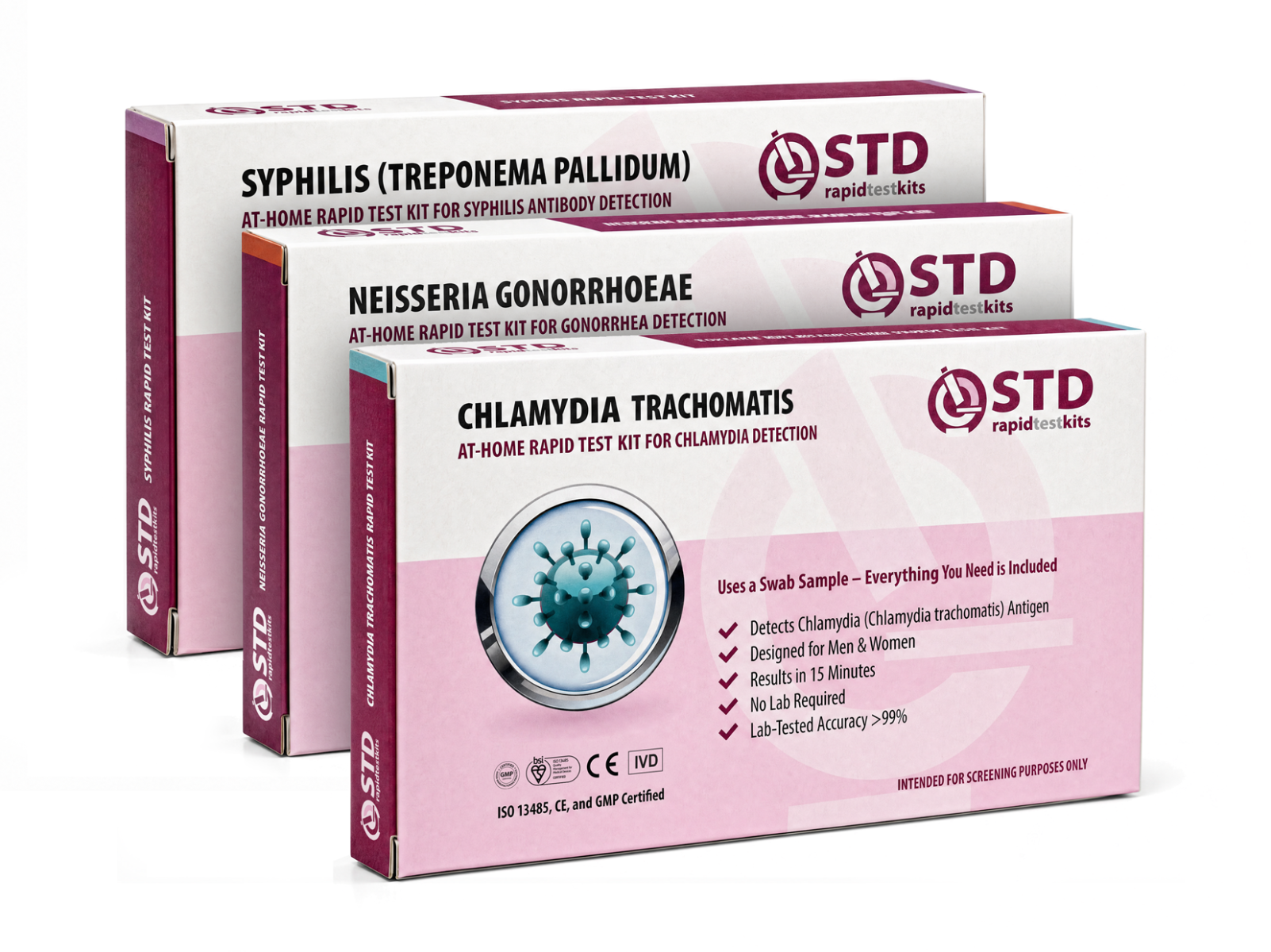
What at-home rapid tests cover. The home kit category most relevant to general STI screening uses lateral-flow chemistry to detect: HIV antibodies and p24 antigen (fourth-generation tests), syphilis antibodies (Treponema pallidum), hepatitis B surface antigen, hepatitis C antibodies, chlamydia (swab-based antigen detection), gonorrhea (swab-based antigen detection), herpes simplex virus 2 antibodies, herpes simplex virus 1 antibodies, trichomoniasis (vaginal swab), and HPV (vaginal swab). Result times are typically about 15 minutes for the lateral-flow strips. Sensitivity and specificity vary by infection and by window period; check each product’s data sheet for the specific assay numbers.
Window-period rules of thumb. Fourth-generation HIV tests detect most infections by about 45 days post-exposure. Syphilis treponemal antibody tests are generally reliable by about six weeks. Hepatitis B surface antigen is detectable about four to eight weeks after infection. Chlamydia and gonorrhea swab antigen tests are usable from about 14 days post-exposure (NHS STIs). Testing before the window has elapsed produces false negatives that need to be repeated.
What at-home rapid tests do not cover. None of the consumer lateral-flow kits on the market test for Brucella, Leptospira, Coxiella burnetii (Q fever), Chlamydia psittaci, Salmonella, Campylobacter, rabies, or other zoonotic pathogens. These workups require clinical lab orders, frequently serologic panels run by reference laboratories, and the result-interpretation belongs to a clinician who can correlate the serology with the clinical picture and exposure timeline. There is no shortcut here. The diagnostic pathway for zoonotic infections is fundamentally clinical, and saying otherwise would misrepresent what an at-home kit can do.
How to sequence the two pathways. If the question is “do I have a standard human STI,” at-home rapid testing is a reasonable first pass with the usual window-period caveats. If the question is “do I have a zoonotic infection from animal contact,” at-home rapid testing does not answer that question and the right action is a clinic visit. Many people in this situation benefit from running both pathways in parallel: a home kit clears the human-STI baseline quickly so the clinic visit can focus on the zoonotic workup.
Editorial disclosure: the kits linked below are sold by this site and cover the human-STI baseline described above; zoonotic workups are not available as home tests and need clinical lab orders.
Broader Screening: When a Combo Kit Makes Sense
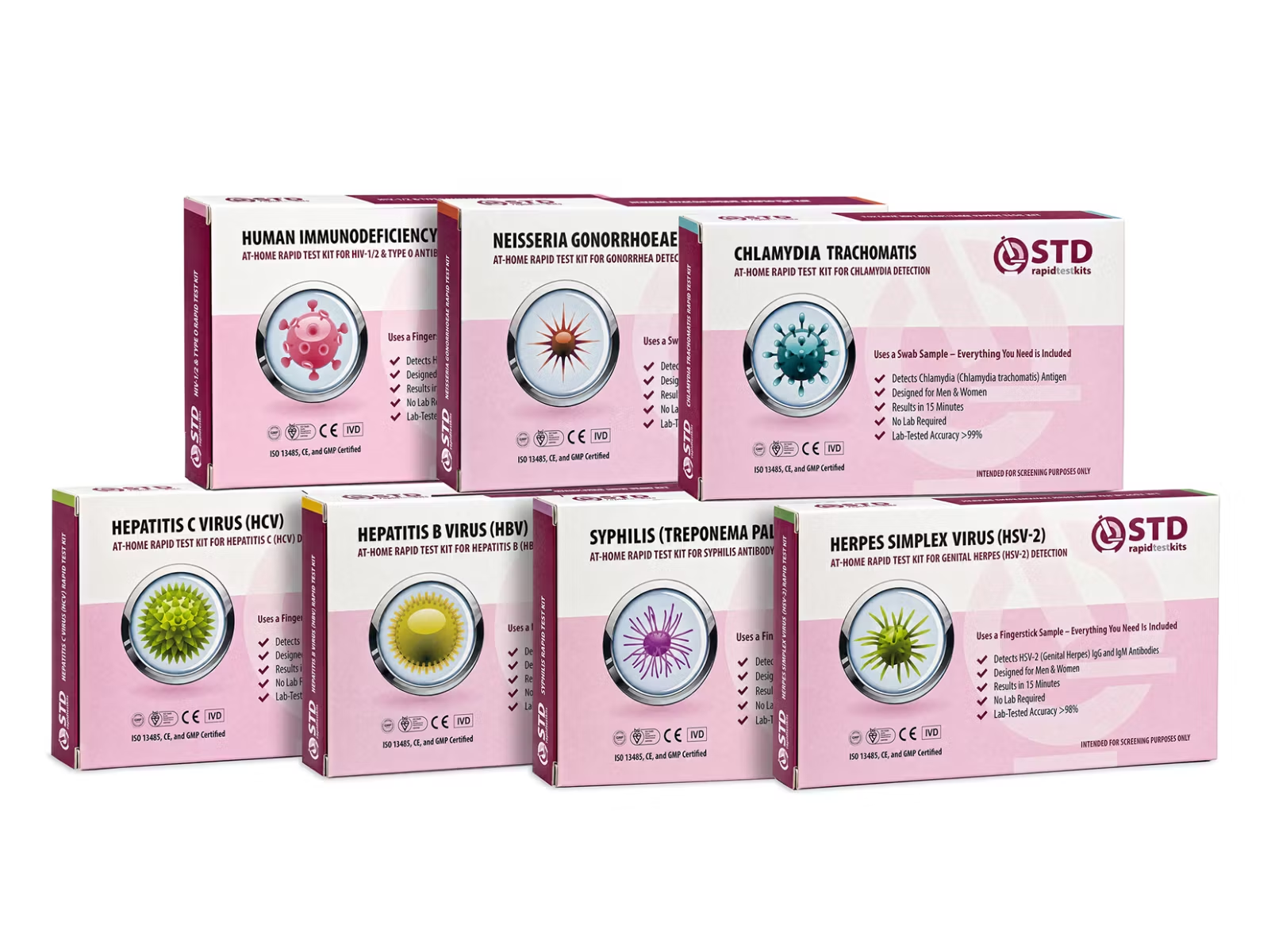
There are situations where a broader baseline check is the right move alongside (not instead of) the clinical zoonotic workup. If there has been concurrent human sexual contact in the relevant window, a multi-test rapid kit can clear up the human-STI side of the question quickly, leaving the clinical visit free to focus on the zoonotic-pathogen workup. The same logic applies if you are simply due for a baseline screen and the animal-exposure event is the reason you are paying attention to sexual health right now.
The selection question is single-test versus combo. If you have one specific concern (a recent partner with a known infection, or a specific symptom that points to one pathogen), a single-infection kit is sufficient and cheaper. If the goal is “I want to know my baseline status on the common set,” a combo kit is more efficient than running several single tests in sequence. For people with broader concern, a 6-in-1 or 7-in-1 panel covers the major bacterial and viral human STIs at once.
More than 6 out of every 10 known infectious diseases in people can be spread from animals, and 3 out of every 4 new or emerging infectious diseases in people come from animals.
Frequently Asked Questions
- Can humans catch HIV, syphilis, chlamydia, or herpes from animals?
- No documented cases. These human STIs are caused by pathogens that have evolved with the human host and do not establish in animal hosts of different species. The transmission path from animal to human, sexual or otherwise, has not been demonstrated for any of these organisms.
- What infections are actually realistic after sexual contact with an animal?
- Zoonotic bacteria: Brucella, Leptospira, Coxiella burnetii (Q fever), Chlamydia psittaci, Salmonella, Campylobacter, and others appropriate to the species involved. Rabies if there was mammalian saliva contact. Bacterial wound infection from any laceration or bite. Mechanical injury including lacerations or fractures.
- Do at-home STI kits detect zoonotic infections?
- No, and reaching for one wastes the critical first days. At-home lateral-flow kits are calibrated to human STI pathogens only. For brucellosis, Q fever, leptospirosis, or psittacosis exposure, bring the animal-contact history to a sexual health or infectious disease clinic and ask for a targeted serologic panel.
- How long should I wait before testing?
- Fourteen days for chlamydia and gonorrhea swab tests; six weeks for syphilis antibody; 45 days for a fourth-generation HIV test to catch most infections; four to eight weeks for hepatitis B surface antigen. Test negative before the window closes? Retest at the full window before ruling it out. For zoonotic pathogens, timing is pathogen-specific; let the clinician guide that workup based on the species involved.
- What should I do immediately after an exposure with bleeding or injury?
- Go to an emergency department. Bleeding that does not stop with brief pressure, deep lacerations, animal bites, severe pain, suspected fracture, or signs of bowel or bladder injury all need urgent assessment. The injury workup is the priority before any testing question.
- Is rabies a serious concern after this kind of exposure?
- If there was contact with mammalian saliva (bites, mucous-membrane exposure, broken skin), rabies post-exposure prophylaxis evaluation needs to happen within hours, not days. PEP is highly effective when started early and the disease is essentially uniformly fatal once symptoms appear. Bat, raccoon, fox, skunk, and unvaccinated-dog exposures all warrant urgent evaluation.
- Will a clinician have to report this to authorities?
- In most clinical settings, medical confidentiality protects information disclosed during care. There are jurisdiction-specific exceptions for mandated reporting (child abuse, certain communicable diseases). Reporting obligations for the sexual contact itself vary by state and country. Patients concerned about disclosure should ask the clinician directly what applies in their jurisdiction; the answer is not uniform.
- Is bestiality illegal everywhere?
- It is criminalized in most U.S. states (under animal-cruelty law), in Canada (Criminal Code), in the U.K. (Sexual Offences Act 2003), and in many European, Australian, and New Zealand jurisdictions. Specific charges, penalties, and statutory wording vary. A growing number of previously-uncovered jurisdictions have added prohibitions in the past decade. This article is not legal advice; consult a qualified attorney for jurisdiction-specific questions.
- U.S. Centers for Disease Control and Prevention. One Health: About Zoonotic Diseases. Source for the verbatim statistics that more than 6 in 10 known infectious diseases in people can be spread from animals, and 3 in 4 new or emerging infectious diseases in people come from animals.
- U.S. Centers for Disease Control and Prevention. Brucellosis information page. Source for Brucella species, transmission routes, clinical presentation, and treatment.
- U.S. Centers for Disease Control and Prevention. Leptospirosis information page. Source for Leptospira transmission via animal urine and mucous-membrane contact, and for biphasic clinical course.
- U.S. Centers for Disease Control and Prevention. Q Fever information page. Source for Coxiella burnetii reservoirs, transmission routes, and clinical spectrum from asymptomatic seroconversion to chronic endocarditis.
- U.S. Centers for Disease Control and Prevention. Psittacosis information page. Source for Chlamydia psittaci, bird reservoirs, transmission via inhalation of dried droppings or respiratory secretions, atypical pneumonia presentation, and doxycycline treatment.
- U.K. National Health Service. Sexually transmitted infections (STIs) overview. Source for general human STI testing-window guidance.
- U.S. Centers for Disease Control and Prevention. HIV information hub. Source for HIV post-exposure prophylaxis (PEP) timing and clinical pathway.
