
Published: August 2025 | Last updated: May 2026 | Editorial review and quality control: Martina N.
Can sexually transmitted infections actually cause infertility?
Yes. Untreated chlamydia and gonorrhea are the leading causes: in women they trigger pelvic inflammatory disease that scars the fallopian tubes; in men they inflame the epididymis and block sperm transport. The CDC estimates about <a href="https://www.cdc.gov/pid/about/index.html" target="_blank" rel="noopener noreferrer">1 in 8 women with a history of PID</a> later have difficulty conceiving. Most damage is silent, so annual testing is the strongest protection.
Fertility damage from a sexually transmitted infection rarely announces itself. The infection often produces no symptoms at all, while the scarring it leaves behind in the fallopian tubes, the epididymis, or cervical tissue can sit silently for years. For many people the first sign that anything is wrong arrives when they try to conceive and cannot. By that point the damage is structural, and curing the original infection no longer reverses it.
Chlamydia and gonorrhea are the two most commonly reported bacterial STIs in the United States, and they are also the two most likely to cost someone their fertility. The NIH's MedlinePlus describes pelvic inflammatory disease, the condition these infections most often trigger in women, as the most common preventable cause of infertility in the country (NIH MedlinePlus, Pelvic Inflammatory Disease). HPV, HIV, syphilis, trichomoniasis, and Mycoplasma genitalium each carry their own reproductive risk when they go undiagnosed. Almost every consequence covered here is preventable with routine testing and prompt treatment, and several are reversible when caught early.
Key Takeaways
- Chlamydia and gonorrhea cause fertility loss mainly through pelvic inflammatory disease, which scars the fallopian tubes. The CDC estimates roughly 1 in 8 women with a history of PID later have trouble getting pregnant, and the damage is often permanent once it forms.
- Most fertility-damaging STIs cause no symptoms in their early stages, so annual screening (or more often with new partners) is the only reliable way to catch them in time.
This article is published by stdrapidtestkits.com, which sells at-home STI testing kits. We recommend products based on fit-for-purpose for the reader's concern, not commercial benefit. Where the topic genuinely calls for a clinic-only test (cervical cancer screening, lab NAAT confirmation, a full fertility workup), we say so directly.
How STIs damage the female reproductive system
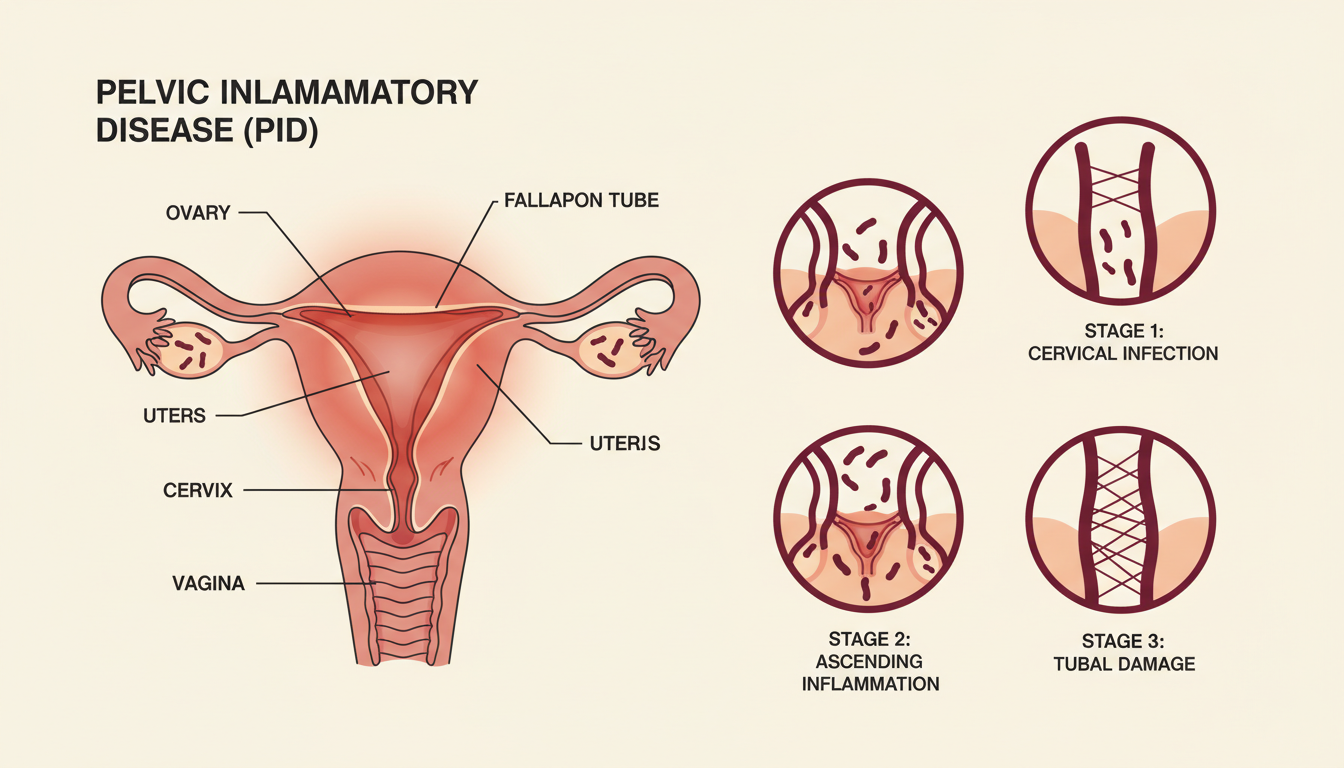
The female reproductive tract is built in a way that lets infection climb. A bacterial pathogen that takes hold in the cervix can travel upward into the uterus, the fallopian tubes, and the ovaries, where it sets off an inflammatory response. That inflammation, when it is repeated or prolonged, leaves scar tissue. Scarring inside the fallopian tubes is the single most common structural cause of female infertility tied to STIs, and clinicians call it tubal factor infertility (TFI).
Pelvic inflammatory disease (PID)
PID is the umbrella term for infection and inflammation of the upper female reproductive organs. The NIH's MedlinePlus names gonorrhea and chlamydia as its most common causes and calls it the most common preventable cause of infertility in the United States (NIH MedlinePlus, PID). The CDC adds that roughly 1 in 8 women with a history of PID later experience difficulty getting pregnant (CDC About PID). Each additional episode raises the odds of permanent tubal damage, so repeat infections matter as much as a first one.
PID is so often missed while it is happening that many women never know they had it. Some feel pelvic discomfort, abnormal bleeding, fever, or pain during sex; others feel nothing and only learn of the damage years later, during a fertility workup.
Blocked or scarred fallopian tubes
Healthy fallopian tubes do active work. Their inner surface is lined with tiny hair-like cilia that sweep the egg toward the uterus, while thin muscle layers contract gently to move it along. When inflammation scars that lining, the cilia are damaged or destroyed, the tube can narrow or close, and the egg either cannot reach the uterus or gets stuck on the way.
A partly blocked tube is its own hazard. It can still let sperm reach an egg, but then trap the fertilized embryo before it reaches the uterus, producing an ectopic pregnancy. Ectopic pregnancy is a medical emergency and one of the leading causes of pregnancy-related death in the first trimester.
Hydrosalpinx
Hydrosalpinx is a specific form of tubal damage in which the fallopian tube fills with fluid because the end nearest the ovary has scarred shut. The trapped fluid is toxic to embryos, which is why hydrosalpinx lowers the success rate of in vitro fertilization even when an embryo is placed directly into the uterus. Surgically removing the affected tube before IVF is often needed to restore reasonable odds.
Cervical changes from HPV
Persistent infection with high-risk strains of human papillomavirus is the main cause of cervical cancer, according to the WHO cervical cancer fact sheet. HPV does not cause infertility on its own. The risk comes from treatment: surgery, radiation, and chemotherapy for advanced cervical cancer can affect the uterus, cervix, or ovaries, and even a loop electrosurgical excision procedure (LEEP) on precancerous cells modestly raises the chance of preterm birth in a later pregnancy.
Timing decides the outcome here. Catching chlamydia or gonorrhea before it climbs past the cervix keeps tubal scarring from ever starting, so a routine screening schedule does far more good than waiting for symptoms.
How STIs damage the male reproductive system
Men are not spared, though the mechanisms differ. Most male infertility linked to a sexually transmitted infection comes down to one of two things: physical obstruction of the duct system that carries sperm out of the body, or inflammation that lowers sperm production and quality directly.
Epididymitis and orchitis
The epididymis is the coiled tube where sperm mature and wait before ejaculation. Bacterial infection there, most often from untreated chlamydia or gonorrhea, brings pain, swelling, and one-sided testicular tenderness. Orchitis, inflammation of the testicle itself, sometimes joins it and can lower local sperm production. The CDC's epididymitis treatment guidance lists infertility among the complications that prompt antibiotic treatment is meant to prevent (CDC epididymitis treatment guidelines). When inflammation scars the duct on both sides, the result can be obstructive azoospermia: no sperm in the ejaculate despite normal production in the testes.
Urethritis and urethral scarring
Urethritis, inflammation of the urethra, is the most common male sign of chlamydia and gonorrhea. It usually clears with antibiotics, but severe or repeated untreated infection can leave a urethral stricture, a band of scar tissue that narrows the channel and can interfere with the flow of semen during ejaculation.
Prostatitis
Bacterial prostatitis is inflammation of the prostate gland, sometimes traceable to STI exposure. Because the prostate supplies much of the fluid and nutrients that keep sperm moving, chronic prostatitis can lower semen quality even when the sperm count looks normal. It is also stubborn to clear, since antibiotics reach prostate tissue poorly.
HIV and sperm quality
HIV affects fertility along several routes. It can disrupt testosterone production and pituitary signaling, lowering sperm count and motility, and the systemic inflammation of active infection is independently tied to poorer sperm quality. Effective antiretroviral therapy that drives the viral load to undetectable protects general health and prevents sexual transmission to a partner, which greatly improves the reproductive picture for people living with HIV.
Untreated syphilis
Syphilis does not block sperm the way chlamydia can, but late-stage disease can damage the testes (gummatous orchitis is a rare complication), and chronic inflammation chips away at overall reproductive health. Its larger danger is in pregnancy: untreated syphilis is one of the most damaging conditions in obstetrics, carrying high rates of stillbirth, miscarriage, and congenital syphilis in surviving infants.
Mycoplasma genitalium, an emerging contributor to both PID in women and non-gonococcal urethritis in men, requires a lab molecular test (NAAT) and is not available in any home rapid format. If your symptoms persist after a negative chlamydia and gonorrhea screen, ask a clinician specifically about M. genitalium testing. Cervical cancer screening (a Pap smear with HPV co-test) also requires a clinic visit and is the appropriate tool for monitoring HPV-related cervical changes.
Symptoms that should prompt a test
Symptoms are a poor early-warning system for these infections, because most cases are silent. When signs do show up, though, they are worth acting on the same week. Chlamydia tends to be the quieter of the two; when it does cause symptoms in women they are often mild and easy to mistake for a urinary tract infection or a yeast issue, such as light discharge, mild burning on urination, or spotting between periods. Gonorrhea tends to move a little faster and is somewhat more likely to produce noticeable discharge, often yellow or green, along with painful urination and lower abdominal pain within days to weeks of exposure.
Both infections respond well to antibiotics when caught early. The CDC's recommended first-line treatment for chlamydia is a short course of doxycycline, with azithromycin as an alternative when doxycycline is not suitable; gonorrhea is treated with an injectable regimen a clinician selects. Treatment clears the active infection, but it cannot undo scarring that has already formed, so the earlier the catch, the lower the fertility cost. The NHS makes the same point bluntly: because most people have no symptoms, regular testing is the only reliable way to know your status (NHS chlamydia overview).
Signs of chlamydia or gonorrhea that warrant a same-week test
Most chlamydia and gonorrhea infections cause no symptoms at all, so a normal exam does not rule them out. When signs do appear, these are the ones worth acting on quickly. Only a test can confirm an infection.
- Unusual vaginal or penile discharge, sometimes yellow or green with gonorrhea Common
- Burning or pain when urinating Common
- Painful or more frequent urination in men Common
- Lower abdominal or pelvic pain Less common
- Bleeding between periods or after sex Less common
- Pain during sex Less common
- One-sided testicular pain or swelling in men Less common
- Fever or generally feeling unwell Rare
STI by STI: which infections carry the most fertility risk
Risk is not spread evenly across infections. Some scar reproductive tissue directly, some threaten a pregnancy rather than conception itself, and a few are mainly a danger to a newborn at delivery. The table below summarizes how each common STI affects reproductive health and what tools exist to prevent or treat it.
| Infection | Primary fertility risk | Reversibility with treatment |
|---|---|---|
| Chlamydia | PID and tubal scarring in women; epididymitis in men | First-line antibiotic is doxycycline; cures the infection but existing scarring is permanent |
| Gonorrhea | PID, tubal blockage, epididymitis, urethral scarring | Antibiotic treatment cures the infection; scarring is permanent; resistance is rising |
| Syphilis | Pregnancy loss, stillbirth, congenital syphilis | Curable with penicillin if caught before pregnancy complications |
| HPV | Indirect: cervical cancer treatment can affect fertility | HPV vaccine prevents most high-risk strains |
| HIV | Reduced sperm quality, hormonal disruption, transmission risk | Antiretroviral therapy substantially improves outcomes |
| Trichomoniasis | Inflammation, possible PID contribution, pregnancy complications | Single-dose antibiotic treatment is highly effective |
| Herpes (HSV) | Newborn infection if active outbreak at delivery; not a direct fertility cause | Antiviral suppression manages outbreaks; no cure for the virus |
| Mycoplasma genitalium | Emerging contributor to PID and male infertility | Antibiotic treatment effective if caught early; resistance is rising |
Why so many fertility-damaging infections are silent
Most infections that do this damage give no warning at all. The CDC's guidance on chlamydia, the most commonly reported bacterial STI in the country, notes that most people who have it have no symptoms (CDC About Chlamydia). Gonorrhea follows the same pattern, with many infections producing no signs or only mild ones easily blamed on a minor urinary problem. Public-health analysts also believe the true case totals run higher than what is reported, precisely because so many infections are never noticed or tested.
This silence is the reason screening matters even when you feel fine. By the time pelvic pain, abnormal discharge, or testicular pain appears, inflammation has often been at work long enough to start scarring; by the time a couple realizes they have spent a year trying to conceive without success, scarring is usually well established. For some bacterial STIs the window to catch the infection before structural damage begins is measured in weeks to months, not years. If you are sexually active and it has been a while, an at-home chlamydia and gonorrhea test is a low-friction way to close that gap, and the CDC's STI screening recommendations spell out how often different groups should test.
The CDC's chlamydia guidance is unusually blunt about what is at stake when the infection is left alone. Speaking of untreated chlamydia in women, the agency states:
It can cause permanent damage to a woman's reproductive system. This can make it difficult or impossible to get pregnant later.
What to do after an exposure or a new partner
The right time to test depends on the infection. Some bacterial STIs are detectable within a week or two; some viral infections need 12 weeks or more before an antibody test is reliable.
Bacterial STIs (chlamydia, gonorrhea, trichomoniasis)
For chlamydia and gonorrhea, the recommended window is roughly two weeks after exposure for a dependable result. A self-collected swab test at home or a clinic NAAT can detect the bacteria once it reaches a detectable level; testing sooner risks a false negative because the infection has not built up yet. Trichomoniasis follows a similar timeline.
Blood-based STIs (HIV, syphilis, hepatitis B, hepatitis C)
For HIV, fourth-generation antigen-antibody lab tests can detect infection roughly 18 to 45 days after exposure, while antibody-only rapid tests usually need about 23 to 90 days. The CDC HIV testing guide lays out the window for each test type. Syphilis blood tests become reliable about 3 to 6 weeks after exposure.
Home lateral-flow versus lab NAAT
At-home rapid kits use lateral-flow chemistry. They are accurate when used inside the right window and according to the instructions, and they are genuinely useful for private, fast screening. They are not the same technology as the laboratory NAAT (nucleic acid amplification test) that clinicians treat as the gold standard for chlamydia and gonorrhea. The practical rule: a positive home result is worth confirming with a lab, and a negative result taken close to the start of the window is worth repeating later. The two methods are complementary rather than interchangeable.
A note on gonorrhea positives
The WHO's STI fact sheet warns that antimicrobial resistance among STIs, gonorrhea in particular, has risen rapidly and narrowed the treatment options. In practice that means a positive gonorrhea result deserves same-week clinical evaluation so a clinician can choose an appropriate regimen rather than relying on a generic course.
Can fertility recover after STI treatment?
It depends on what has already happened to the tissue. Antibiotics cure the bacterial infection, but they cannot reverse scarring that has formed. The earlier the diagnosis, the better the outlook.
If it was caught early
Chlamydia or gonorrhea found before PID develops carries essentially no fertility cost once treated. The infection clears, the tissue heals, and natural conception is unaffected.
If PID happened but the tubes stayed open
A single mild episode of PID, treated promptly, often leaves the fallopian tubes working, though the lifetime risk of ectopic pregnancy ticks upward. Recurrent PID compounds the problem, with each further episode raising the infertility rate.
Assessing tubal damage after a late diagnosis
The standard test is a hysterosalpingogram (HSG), in which a small amount of contrast dye is passed through the cervix while X-rays show whether the tubes are open. Ultrasound and laparoscopy can add detail when needed. If conception has not happened after six months of trying (or twelve months for women under 35 with no known risk factors), a fertility consultation that includes an HSG is a reasonable next step. Anyone with a history of PID should also stay alert in early pregnancy: sharp one-sided pelvic pain, shoulder-tip pain, or unusual bleeding can signal an ectopic pregnancy and needs urgent evaluation.
If tubal damage is established
Once the tubes are blocked or hydrosalpinx has formed, natural conception becomes unlikely or impossible, and assisted reproduction takes over. Intrauterine insemination (IUI) helps in milder cases, while in vitro fertilization (IVF) bypasses the tubes entirely by retrieving eggs from the ovaries and placing an embryo in the uterus. Where hydrosalpinx is present, removing the damaged tube before IVF improves success. A reproductive endocrinologist is the right specialist to weigh these options.
Male obstructive infertility
For men with epididymal scarring causing obstructive azoospermia, microsurgical reconstruction or surgical sperm retrieval (TESE) followed by intracytoplasmic sperm injection (ICSI) can produce pregnancies. Outcomes hinge on how much of the duct is scarred and whether the testes are still making sperm.
Living with HPV or HIV
For HPV, current ACIP guidance recommends routine vaccination through age 26, with shared clinical decision-making through age 45 for adults not previously vaccinated; the vaccine prevents the high-risk strains behind most cervical cancers. For people living with HIV, modern antiretroviral therapy that reaches an undetectable viral load preserves both general health and the ability to conceive without passing the virus to a partner or child.
Fertility outlook after treatment, by scenario
| Scenario | Fertility outlook | Recommended path |
|---|---|---|
| Caught before PID develops | Essentially no fertility cost once treated | Routine screening and prompt treatment |
| Single mild PID, treated promptly | Often preserved; ectopic-pregnancy risk slightly higher | Treat fully; monitor early pregnancy closely |
| Recurrent or severe PID | Natural conception may be difficult or impossible | Fertility consultation; IUI or IVF |
| Blocked tubes or hydrosalpinx | Natural conception unlikely | IVF, often after removing a damaged tube |
| Male duct obstruction | Depends on the extent of scarring | Surgical repair or sperm retrieval with ICSI |
The earlier an infection is caught, the more fertility is preserved.
How to protect your fertility, starting today
Three habits do most of the work, and none of them is complicated.
Test on a regular schedule. Annual chlamydia and gonorrhea screening is the baseline for anyone sexually active, and the CDC specifically recommends it every year for sexually active women under 25 and for older women with new or multiple partners or other risk factors (CDC screening recommendations). Increase the frequency to every three to six months in higher-risk situations, add HIV and syphilis at least yearly, and fold in hepatitis B and C on a comprehensive panel. At-home at-home STI test kits make this easy to keep up without booking a clinic visit. Testing before you stop using condoms with a new partner is a sensible habit at any age, since neither feeling well nor a visual check is a screening method.
Treat completely, and treat partners. Finish every dose you are prescribed, even after symptoms fade; stopping early invites treatment failure and feeds antibiotic resistance, a real concern with gonorrhea. Notify partners from roughly the past 60 days so they can be tested and treated, because reinfection from an untreated partner is one of the most common reasons treatment seems to fail. Many US states allow expedited partner therapy (EPT), where a clinician prescribes for a partner without an in-person visit. Plan to retest about three months after treatment, since reinfection in that window is common and each new infection adds to the lifetime risk of PID.
Use barrier protection and vaccines. Used correctly and consistently, condoms sharply cut the transmission of bacterial STIs and meaningfully reduce viral ones. Pair them with vaccination where it exists: the HPV vaccine prevents most strains behind cervical cancer, and the hepatitis B vaccine is part of the standard immunization schedule. For anyone at higher risk of HIV, pre-exposure prophylaxis (PrEP) is highly effective when taken as prescribed; the CDC PrEP overview explains who qualifies and how to start.
Your fertility-protection checklist
- Test annually for chlamydia, gonorrhea, HIV, and syphilis; every three to six months if you have multiple or changing partners.
- Finish every prescribed dose, get partners from the past 60 days tested and treated, and retest about three months after treatment to catch reinfection.
- Use condoms consistently and stay current on the HPV and hepatitis B vaccines; ask about PrEP if your HIV risk is elevated.
What should you do next?
Do you have symptoms right now, such as unusual discharge, pelvic or lower abdominal pain, or testicular pain?
Yes: See a clinician this week. Symptoms warrant a prompt test and, if positive, treatment before the infection can ascend and scar tissue.
Have you had a new partner or unprotected sex in the past few months without a recent screen?
Yes: Screen now. An at-home chlamydia and gonorrhea swab works about two weeks after exposure; confirm any positive with a clinic NAAT and notify partners from the past 60 days.
Did a past infection or PID episode go untreated, and are you now having trouble conceiving?
Yes: Ask a reproductive endocrinologist about a hysterosalpingogram (HSG) to check whether your fallopian tubes are open.
No: Keep annual screening on the calendar, retest about three months after any treatment, and use condoms with new partners.
Guidance only. A clinician can advise based on your specific situation.
Frequently asked questions
- Can a single STI infection cause permanent infertility?
- It can, but most often does not. A single episode of chlamydia or gonorrhea, treated promptly, usually leaves fertility intact. The risk rises sharply with delayed treatment, repeated infections, and progression to pelvic inflammatory disease. The longer the infection sits untreated, the higher the chance of structural scarring.
- How long can chlamydia or gonorrhea quietly damage fertility before I notice?
- There is no fixed timeline. Damage can begin within weeks if the infection ascends to the upper reproductive tract, while in other cases the spread takes months. Most women only learn about the damage during a fertility evaluation years later, which is why annual screening is the only reliable way to catch a silent infection in time.
- If I had chlamydia years ago and got treated, am I still at risk for infertility?
- It depends on whether the infection caused PID before treatment. If it was caught and treated before pelvic symptoms developed, the risk is essentially baseline. If it caused even one mild episode of PID, your risk of tubal infertility and ectopic pregnancy is somewhat elevated. A reproductive endocrinologist can assess tubal patency directly with a hysterosalpingogram if you are having difficulty conceiving.
- Can a past infection still show up on a fertility test?
- An active infection is detected by a current swab or NAAT test. Past structural damage is detected by imaging such as a hysterosalpingogram or ultrasound, or by laparoscopy. Some labs also offer chlamydia antibody tests, which can indicate a prior exposure even after the active infection has cleared, though they do not by themselves measure tubal damage.
- Are home STI test kits accurate enough to rely on for fertility planning?
- Home rapid tests are reliable when used inside the correct window period and according to instructions. They use lateral-flow chemistry, which is different from lab NAAT (the highest-sensitivity standard). For fertility planning, the practical approach is to use home tests for routine screening and to confirm any positive home result, or any persistent symptoms despite a negative home result, with a clinic NAAT.
- Does HPV cause infertility directly?
- No. HPV itself does not cause infertility. The risk to fertility comes from cervical cancer treatment, since surgery, radiation, or chemotherapy for advanced disease can affect the uterus, cervix, or ovaries. The HPV vaccine prevents most of the high-risk strains responsible for cervical cancer; ACIP recommends routine vaccination through age 26 and shared clinical decision-making through age 45 for adults not previously vaccinated.
- Can pregnancy still happen after PID?
- Often yes, but with a higher chance of ectopic pregnancy and a longer time to conception. After mild treated PID, many women conceive naturally. After severe or recurrent PID, natural conception can become difficult or impossible, and IUI or IVF is sometimes the most reliable path forward. A reproductive specialist can evaluate tubal damage with imaging.
- Does HIV mean I can't have children?
- Not at all. Modern antiretroviral therapy that achieves an undetectable viral load preserves both fertility and the ability to conceive without transmitting the virus to a partner or to a child. This is the basis of the U=U principle (undetectable equals untransmittable). Conception planning with an HIV-experienced provider is the standard approach.
- U.S. Centers for Disease Control and Prevention. About Pelvic Inflammatory Disease (PID), including the estimate that about 1 in 8 women with a history of PID have difficulty getting pregnant and the role of untreated chlamydia and gonorrhea.
- U.S. National Library of Medicine, NIH MedlinePlus. Pelvic Inflammatory Disease, naming chlamydia and gonorrhea as the most common causes and describing PID as the most common preventable cause of infertility in the United States.
- U.S. Centers for Disease Control and Prevention. About Chlamydia, including the asymptomatic nature of most infections and reproductive-health consequences in women.
- U.S. Centers for Disease Control and Prevention. STI screening recommendations by population, frequency, and risk profile.
- U.S. Centers for Disease Control and Prevention. Types of HIV tests and window-period guidance for antibody, antigen-antibody, and nucleic acid tests.
- World Health Organization. Cervical cancer fact sheet, including the role of persistent high-risk HPV infection and the vaccine's preventive role.
- World Health Organization. Sexually Transmitted Infections (STIs) fact sheet, including rising antimicrobial resistance in gonorrhea and reduced treatment options.
- National Health Service (UK). Chlamydia overview, including the asymptomatic profile and the importance of annual testing or testing after a new partner.
