
Published: July 2025 | Last updated: May 2026 | Editorial review and quality control: Martina N.
Testicular atrophy is the medical term for testicles that have lost size, firmness, or function. Several sexually transmitted infections can trigger it when they go untreated, and the most common pathway is bacterial inflammation of the epididymis from chlamydia or gonorrhea, which spreads from the urethra into the testicle's storage tube. Advanced HIV, late-stage syphilis, and the viral infection mumps can also damage testicular tissue or hormone production.
The reassuring part for most readers: catching and treating the underlying infection early almost always prevents permanent shrinkage, and clinicians can usually reverse mild damage once the inflammation clears. This article explains which STIs put testicles at risk, what symptoms warrant testing, how at-home testing works, and what recovery typically looks like.
Can an STD really shrink your testicles?
Yes, but mostly when infections go untreated for weeks to months. Chlamydia and gonorrhea can cause epididymitis and orchitis that sometimes lead to testicular atrophy. Advanced HIV can lower testosterone and reduce testicle volume over time. Late-stage syphilis and viral mumps are rarer causes. Early testing and antibiotic treatment prevent the vast majority of permanent damage.
Key Takeaways
- Chlamydia and gonorrhea are the most common STIs that lead to testicular damage, almost always through inflammation of the epididymis.
- Most STI-related testicular changes are reversible with prompt antibiotic treatment; lasting atrophy is associated with chronic untreated infection.
How an STI Reaches Your Testicles
The testicles produce sperm. Each one connects to a tightly coiled tube called the epididymis, which stores and matures sperm before sending it through the vas deferens. When bacteria from a urethral infection travel backward through that pathway, they can colonize the epididymis and trigger inflammation, a condition called epididymitis. From there, the inflammation can extend into the testicle itself (orchitis), and chronic inflammation is what eventually leads to scarring and tissue loss.
This inflammation pathway is the dominant mechanism for STI-driven testicular damage. According to the NHS, epididymitis in sexually active men under 35 is most often caused by chlamydia or gonorrhea, while in older men it is more often caused by urinary tract bacteria. The practical takeaway: a sexually active man with new testicular pain or swelling has a high prior probability of an STI as the cause and should test for one.
HIV operates through a different mechanism. In advanced disease, HIV can suppress the function of Leydig cells (the cells inside the testes that produce testosterone), and chronic illness combined with weight loss can reduce testicular volume. This is a slow process measured in months to years, not days, and modern antiretroviral therapy prevents most of these complications when started early.
For most cases worth worrying about, the chain is: urethral infection (chlamydia or gonorrhea) reaches the epididymis, inflammation spreads to the testicle, and chronic untreated inflammation produces scarring that can shrink testicular tissue.
The STIs Most Likely to Affect Testicles
Several infections sit on this list, but two account for most cases worth worrying about.
Chlamydia
Chlamydia is the most commonly reported bacterial STI in the United States and a leading cause of epididymitis in men under 35. Many infections cause no urethral symptoms at all, which is one reason it can progress to the testicle without warning. When epididymitis develops, men typically notice gradual onset of pain in one testicle, swelling on the same side, and sometimes burning during urination or unusual penile discharge. The infection is curable with a short course of antibiotics, and treating it early prevents the scarring that drives long-term shrinkage.
Gonorrhea
Gonorrhea behaves more aggressively than chlamydia in the testicle. The infection often produces a thicker, pus-like discharge and a sharper, faster onset of pain. Untreated, gonorrhea can spread into the testicle and cause severe inflammation, abscess formation, and scarring of the sperm-carrying tubes. Antibiotic resistance is a growing concern with gonorrhea, so prescribed regimens have changed in recent years; treatment should always be supervised by a clinician using current CDC guidance.
HIV
In advanced or untreated HIV, hormone changes affect the testicles indirectly. Testosterone production can fall, libido often drops, and chronic illness can reduce overall body and testicular mass. Modern antiretroviral therapy prevents most of these complications, which is one of many reasons testing for HIV and starting treatment early matters. A reactive HIV test does not mean inevitable testicular damage; it means the medical pathway forward is well-defined and effective.
Syphilis
Untreated syphilis can progress to a tertiary stage that affects multiple organ systems. Gummatous syphilis, a late-stage manifestation described by the CDC, can involve the testicles, but this presentation is rare in countries with routine testing and access to penicillin treatment. The earlier stages of syphilis (primary chancre and secondary rash) do not directly damage testicular tissue.
Mumps (a viral infection, not strictly an STI)
The mumps virus deserves a mention because it is the classic cause of viral orchitis in adults, even though it spreads through respiratory droplets rather than sexual contact. According to the CDC, a significant proportion of postpubertal males who get mumps develop orchitis, and a subset of those experience lasting testicular atrophy in the affected testicle. Vaccination through routine MMR coverage has dramatically reduced cases, but unvaccinated travelers and outbreaks still occur.
Most cases of acute epididymitis among sexually active men aged less than 35 years are caused by Chlamydia trachomatis or Neisseria gonorrhoeae.
Symptoms That Should Prompt Testing
Testicles do not typically change in size or sensation without a reason. Persistent symptoms in or around the scrotum, especially after a recent unprotected sexual contact, warrant a clinical workup that includes STI testing. The most common warning signs include:
- Pain or aching in one testicle, sometimes radiating into the groin
- Swelling, redness, or warmth on one side of the scrotum
- A heavy or full feeling in the testicle
- Burning during urination or unusual penile discharge (clear, white, or yellow)
- Pain during or after ejaculation
- Fever, chills, or general malaise alongside scrotal symptoms
- Gradual change in size or firmness of one testicle relative to the other
Symptoms do not always arrive together. Sometimes a sharp pain comes and goes, leaving only mild firmness change behind. Other times the discomfort is subtle while the change in size is what catches your attention in the shower. Either pattern justifies a clinical workup.
If testicular pain comes on suddenly, is severe, and is paired with nausea or one testicle riding higher than the other, treat it as a medical emergency. Testicular torsion can mimic an infection but requires surgical evaluation within hours to save the testicle, as described by the <a href="https://medlineplus.gov/ency/article/000517.htm">MedlinePlus encyclopedia</a>. Go to an emergency department first; STI testing can wait.
Why STI-Related Testicle Pain Often Gets Misdiagnosed
Many men delay seeking care for genital symptoms out of embarrassment or the hope that the problem will resolve on its own. That delay is one reason mild epididymitis sometimes progresses to chronic inflammation and atrophy. Even when men do present for care, STI-driven testicular pain can be misattributed to other causes, particularly when sexual history is not discussed.
Common alternative explanations clinicians consider include:
- Muscle strain or sports-related groin injury
- A hydrocele (fluid-filled sac around the testicle)
- Varicocele (enlarged scrotal veins)
- Testicular torsion (an emergency that presents acutely)
- Inguinal hernia
- Referred pain from the lower back or abdomen
If a sexual history is not taken, or if the patient does not disclose recent sexual activity, STI testing can be skipped entirely. That is how some men walk around with chronic epididymitis or low testosterone for months before the underlying infection is identified. The fix is straightforward: be honest about sexual exposure when you see a clinician, and ask specifically about STI testing if it is not offered. (Disclosure: this site sells rapid at-home STI tests; relevant products are linked where useful.)

STIs, Testosterone, and Hormone Health
Certain infections can disrupt testicular function badly enough that hormone levels take a measurable hit. That matters beyond sexual function: testosterone influences muscle mass, bone density, mood regulation, energy levels, and red blood cell production. According to MedlinePlus, conditions that damage the testicles can produce a state called primary hypogonadism, where the testicles themselves no longer make enough testosterone.
STIs influence testosterone in a few ways:
- Advanced HIV can damage the Leydig cells responsible for testosterone production, lowering circulating testosterone over time.
- Chronic inflammation from prolonged untreated chlamydia or gonorrhea epididymitis can scar testicular tissue and reduce hormone output.
- Late-stage syphilis can cause immune-mediated testicular damage in rare cases.
- Mumps orchitis with significant atrophy can reduce testosterone production from the affected testicle.
If you have had an STI in the past, especially one that was not promptly treated, and you are noticing several of the symptoms below, ask a clinician to check both your hormone panel and your testicular volume.
- Fatigue that does not resolve with sleep
- Reduced libido or erectile difficulties
- Loss of muscle mass or noticeable strength drop
- New depression, irritability, or persistent mood changes
- Reduced facial or body hair growth
- Visible shrinking or softening of one or both testicles
The Long-Term Fertility Picture
The same STIs that cause testicular inflammation or shrinkage can also interfere with fertility. The mechanism is again mostly inflammatory: bacteria reach the epididymis, scar tissue forms, sperm transport is impaired, and sperm quality drops.
Specifically:
- Chronic epididymitis can scar the tubes that carry sperm from the testicle, sometimes blocking them entirely on one side.
- Orchitis can damage the seminiferous tubules where sperm are produced.
- Prolonged inflammation can lower sperm count and motility, even in cases where no permanent blockage forms.
- Untreated infections can reduce semen volume or quality on a temporary basis that recovers after treatment.
Most damage is not permanent if infection is treated early. Some men, however, only discover a fertility issue years later when trying to conceive. That is a strong argument for proactive testing now, regardless of whether children are part of your near-term plans. Even with only one testicle affected, an asymptomatic partner can keep reinfecting you in cycles unless both of you test and treat at the same time.
Fertility risk by infection
- Chlamydia: high risk if untreated for months; low risk after a course of antibiotics caught early.
- Gonorrhea: higher risk than chlamydia because of faster, more destructive epididymal scarring.
- HIV: risk is mostly indirect through hormone changes and is well-controlled by modern antiretroviral therapy.
- Mumps orchitis: can permanently reduce sperm output from the affected testicle in a subset of cases.
When and How to Test
Two trigger events should prompt testing: a recent unprotected sexual exposure, or new testicular symptoms (pain, swelling, change in size, discharge, burning urination, ejaculation pain). You do not need both. Either one alone is enough to justify a screening panel.
The infections most relevant to testicular health are bacterial chlamydia and gonorrhea, plus HIV and syphilis as part of any general sexual-health screen. Mumps is not part of routine STI testing because it spreads respiratorily and a clinician will diagnose it through a different workup if your history points there.
Testing approach:
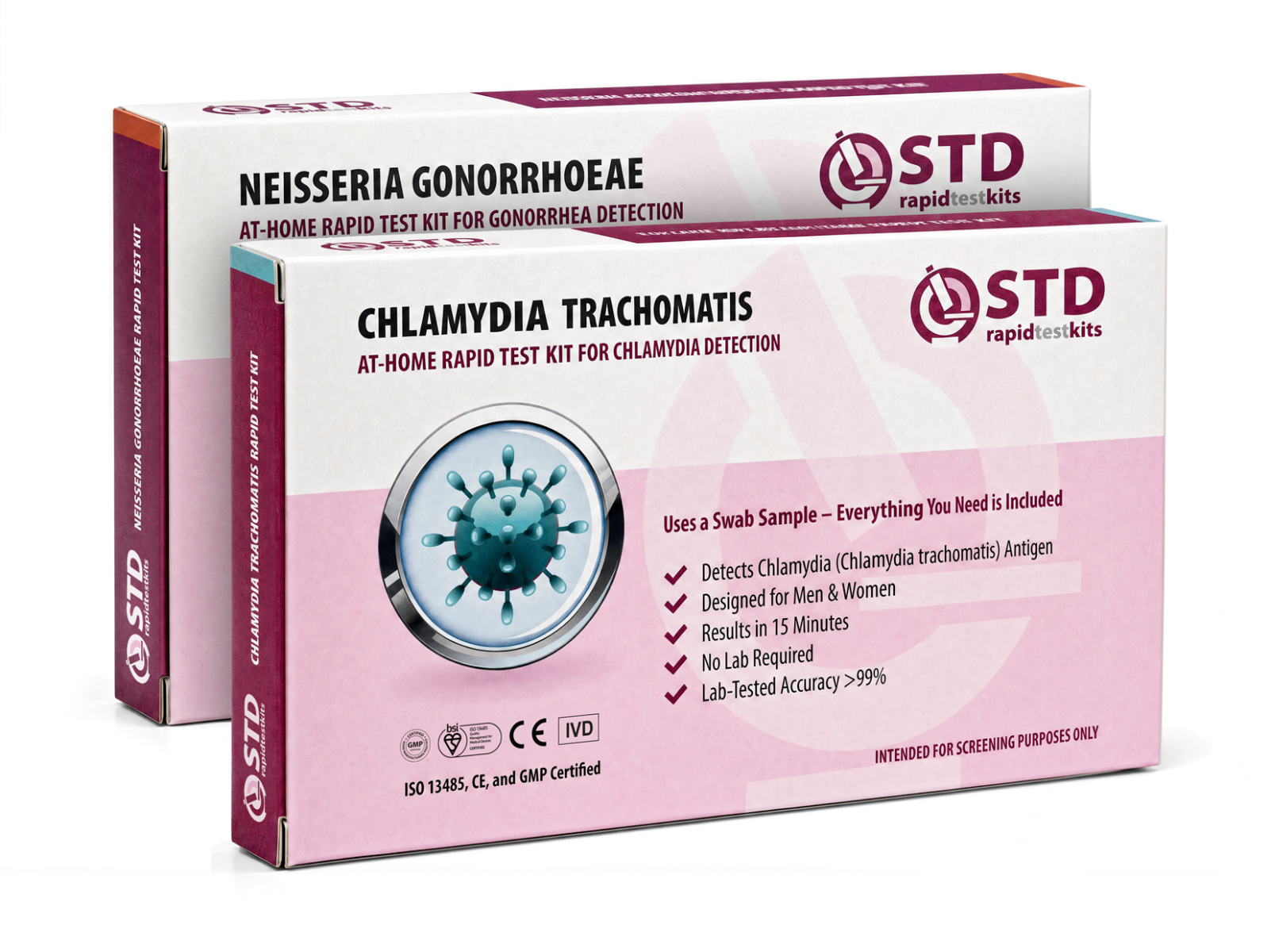
- For chlamydia and gonorrhea, our home rapid test uses a self-collected urethral swab. Lateral-flow chemistry returns a result in about 15 minutes. A positive should be confirmed with a clinician's lab NAAT before treatment, but a positive at home tells you to seek care urgently.
- For HIV and syphilis, our home tests use a fingerstick blood sample. HIV antibody tests are most reliable when used at least 23 to 90 days after possible exposure depending on the test generation. Syphilis blood tests detect antibodies that develop within several weeks of infection.
- For broader screening, multi-infection panels combine swab and fingerstick samples to cover the bacterial and bloodborne infections that matter for testicular and overall sexual health.
Lateral-flow rapid tests at home and laboratory NAAT testing are complementary, not equivalent. NAATs (nucleic acid amplification tests) used in clinical labs have higher analytical sensitivity, especially in asymptomatic infections. The at-home rapid tests are a fast screening tool with strong utility when symptoms are present or after a known exposure, and a positive result is worth confirming through a clinician.
| Infection | Sample type at home | Earliest reliable testing window |
|---|---|---|
| Chlamydia | Self-collected urethral swab | About 1 to 2 weeks after exposure |
| Gonorrhea | Self-collected urethral swab | About 1 to 2 weeks after exposure |
| HIV (antibody rapid) | Fingerstick blood | 23 to 90 days, depending on test generation |
| Syphilis | Fingerstick blood | About 3 to 6 weeks after exposure |

Talking to a Partner
If you have testicular symptoms or have tested positive for an STI, telling a partner can feel awkward, but it is a public-health and personal-health issue worth handling directly. The practical script that works for most people is short and factual.
If you have symptoms but no diagnosis yet:
"I have been noticing some symptoms I want to get checked out. I do not know what it is yet, but I think it is worth both of us testing just to be safe."
If you have tested positive:
"I tested positive for chlamydia. It can affect the testicles if it goes untreated, which is why I caught it. You may not have any symptoms, but I want to make sure you can test and treat too if needed."
The goal is honesty without blame. Sexual transmission of an asymptomatic infection is not anyone's fault, and the practical move is mutual testing and treatment. Most people respect the directness, and treated partners stop passing the infection back to you.
- Lead with your own symptoms or test result, not theirs.
- Frame testing as something you both do together, not something they need to prove.
- Skip the relationship history; focus on the next 15 minutes of action.
- Offer to share a kit or split testing logistics if cost or access is a barrier.
What Recovery Looks Like
Recovery depends on the cause and on how early it is caught.
For inflammation-driven cases (chlamydia or gonorrhea epididymitis, orchitis):
- Antibiotic treatment, prescribed and supervised by a clinician, clears the underlying infection.
- Swelling typically subsides within days to a few weeks.
- In mild cases, testicle size returns to normal as inflammation resolves.
- In severe or chronic untreated cases, some shrinkage may persist permanently because of scarring.
For hormonal cases (advanced HIV, post-mumps atrophy):
- Antiretroviral therapy for HIV often restores testosterone levels and stabilizes testicular volume.
- Testosterone replacement therapy is an option when production is permanently reduced.
- Testicle size may not return after significant atrophy, but sexual function and fertility can often be partially or fully preserved with the right treatment plan.
Across all causes, earlier intervention means better outcomes. If you have had testicular symptoms or a recent unprotected exposure, testing now gives you the information you need to start treatment before scarring sets in.

FAQs
- Can chlamydia really make my testicles shrink?
- Yes, but typically only when the infection goes untreated long enough to cause chronic epididymitis. Early antibiotic treatment almost always prevents long-term shrinkage. The bigger risk is silent chlamydia that produces no urethral symptoms while the infection slowly inflames the epididymis.
- Which STIs are most likely to damage the testicles?
- Chlamydia and gonorrhea are by far the most common because they cause epididymitis in sexually active men under 35. Advanced HIV can reduce testicular volume through hormone changes. Late-stage syphilis is a rare cause. Mumps virus, while not an STI, is the classic cause of viral orchitis.
- Can gonorrhea cause infertility?
- Yes. Untreated gonorrhea can scar the epididymis and the tubes that carry sperm, reducing sperm transport on the affected side. Treated promptly with appropriate antibiotics, the risk is low. Late or chronic infections carry the highest fertility risk.
- Why is one of my testicles smaller or softer than the other?
- Some asymmetry is normal, often with the left testicle hanging slightly lower. New, noticeable size or firmness changes are different and warrant evaluation. Causes include testicular atrophy from past inflammation, hormone imbalance, varicocele, and rarely tumors. Test for STIs and see a clinician for an exam.
- Is testicle pain after sex a sign of an STI?
- It can be, particularly if the pain is new, persistent, or paired with discharge or burning urination. Pain during or after ejaculation is associated with epididymitis and prostatitis, both of which can be triggered by chlamydia or gonorrhea. A home rapid test for chlamydia and gonorrhea returns a result in about 15 minutes and is the fastest first step.
- Will my testicles return to normal after treatment?
- In most cases yes, especially when treatment starts early. Inflammation usually subsides within days to weeks of starting antibiotics, and mild size changes resolve. Long-standing untreated infections occasionally leave permanent shrinkage from scarring.
- Can low testosterone alone make the testicles shrink?
- Yes. Testosterone production sustains testicular volume. When production drops sharply, whether from advanced HIV, certain medications, anabolic steroid use, or other causes of hypogonadism, the testicles can shrink. STI-driven hormone disruption is one mechanism among several.
- How do I test at home for the STIs that affect the testicles?
- Use a swab-based rapid test for chlamydia and gonorrhea (the two most relevant infections) and a fingerstick blood test for HIV and syphilis. Multi-infection panels bundle these together. A positive at-home result should be followed up with a clinician for confirmation and treatment.
- U.S. Centers for Disease Control and Prevention. STI Treatment Guidelines and information on chlamydia, gonorrhea, syphilis, and acute epididymitis.
- Mayo Clinic. Symptoms, causes, and complications of epididymitis, including STI-related cases in men under 35.
- U.K. National Health Service. Patient guidance on epididymitis causes, symptoms, and treatment.
- MedlinePlus, U.S. National Library of Medicine. Encyclopedia entry on testicular torsion as a surgical emergency that can mimic infection.
- U.S. Centers for Disease Control and Prevention. HIV basics, transmission, testing windows by test generation, and treatment.
- U.S. Centers for Disease Control and Prevention. Mumps virus, orchitis as a complication, and MMR vaccination guidance.
- MedlinePlus, U.S. National Library of Medicine. Overview of testicular disorders, including atrophy and hypogonadism.
