Burning After Using a Condom: Latex Sensitivity or STI?
Burning that starts within an hour of protected sex and fades in a couple of days usually points to latex sensitivity, not infection. Most sexually transmitted infections take days to weeks to surface. This guide walks through the timing clues, the symptom patterns clinicians look for, and when an at-home test makes sense.



- Immediate burning that fades within 1 to 3 days after stopping latex exposure usually points to sensitivity or friction, not an infection.
- STI symptoms typically appear days to weeks after exposure, so persistent, blistering, or delayed symptoms warrant a test even when a condom was used.
Published: October 2025 | Last updated: April 2026 | Editorial review and quality control: Martina N.
Genital burning after a condom is one of the most common late-night search queries on this site. The panic makes sense. Sexual symptoms carry weight: history, stigma, fear, all stacked on a small patch of irritated skin. The reassuring news is that immediate burning very rarely fits the timing of a sexually transmitted infection. Most STIs take days to weeks to produce symptoms when they produce any at all, per the U.S. Centers for Disease Control and Prevention. A reaction that shows up within minutes to a few hours of condom use is far more likely to be irritant contact dermatitis, friction irritation, or a true latex allergy.
This guide walks through how to read the timing, how vulvas and penises tend to react differently, what symptoms still warrant a test even after protected sex, and which at-home options make sense if you want clarity without a clinic visit.
Is burning after a condom a sign of an STI?
Usually no. Burning that starts within minutes to a few hours of condom use, with redness or itching but no blisters, sores, or unusual discharge, most often reflects latex sensitivity or friction irritation. Symptoms that resolve within 24 to 72 hours after stopping latex exposure fit a contact reaction, not an infection. Test if symptoms persist beyond 72 hours, blister, ulcerate, appear days later, or come with fever, swollen lymph nodes, or thick discharge.
Why Immediate Burning Rarely Means an Infection
Genital tissue is one of the most reactive surfaces on the body. It is thin, vascularized, full of nerve endings, and lined in part by mucosa that absorbs moisture and chemicals quickly. That sensitivity is what makes irritation feel so dramatic. It is also why the timing of symptoms is the single most useful clue when sorting a contact reaction from infection.
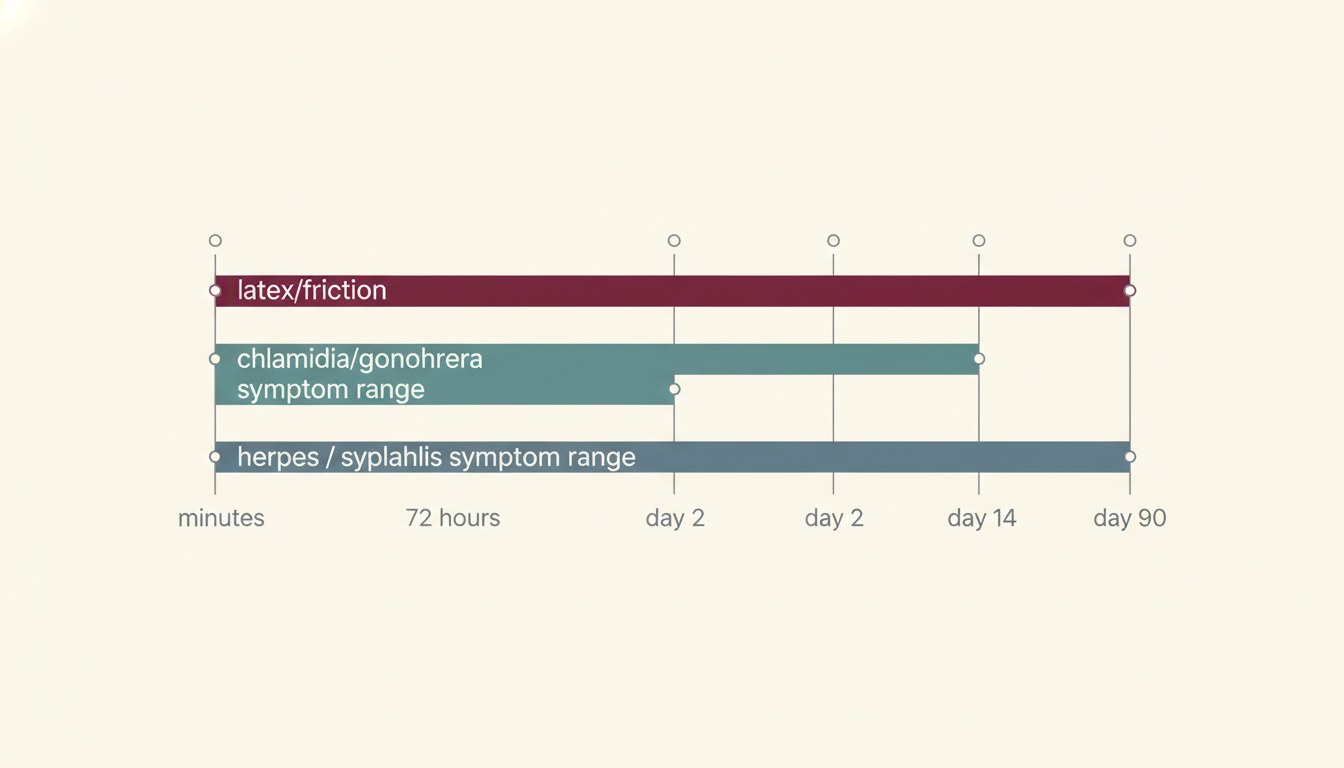
The CDC's overview of sexually transmitted infections is consistent on this point: many STIs produce no symptoms at all, and those that do typically take from a few days to several weeks after exposure to surface (CDC, Sexually Transmitted Infections overview). Chlamydia symptoms, when they occur at all, may not appear until several weeks after sex (CDC, About Chlamydia). A first herpes outbreak typically appears 6 to 8 days after exposure, with a possible window ranging from 1 to 26 days (Cleveland Clinic, Herpes Simplex Virus). Syphilis chancres can take 10 to 90 days. None of those windows overlap with the bedside-clock timing of burning that starts before you have brushed your teeth.
That timing mismatch is what makes latex sensitivity such a strong working hypothesis when symptoms appear immediately. Two distinct mechanisms can produce that pattern, and both call for different responses.
This article is published by stdrapidtestkits.com, which sells at-home STI test kits. We do not sell condoms. Recommendations below for non-latex condom materials are informational; product callouts at the end of this guide cover the testing options we do offer for the small subset of readers whose symptom pattern warrants screening.
How Anatomy Shapes the Symptom Pattern
Vulvas and penises do not experience latex the same way, and the difference is anatomical, not psychological. The vagina is lined with mucosal tissue that is thinner, more absorbent, and more easily disrupted than external skin. It also retains moisture, which prolongs contact with whatever was on the condom: lubricant, spermicide, and the latex proteins themselves. That combination tends to produce internal stinging, raw or chemical-feeling burning, and visible redness or swelling at the introitus, often with a thin watery discharge that comes from the irritation itself rather than infection.
External penile skin is keratinized and thicker. Reactions there tend to read as a surface rash: red patches, dry scaling, mild swelling along the shaft or glans, sometimes a tight feeling after the skin has been exposed for a while. Uncircumcised anatomy can hold moisture under the foreskin, which can lengthen latex contact and intensify the reaction.
Hormonal state matters too. Estrogen-thinned tissue, common around menstruation, postpartum, while breastfeeding, or during the menopausal transition, is more vulnerable to contact irritants of all kinds. Two partners using the same condom can have very different morning-after experiences for reasons that have nothing to do with cleanliness or fidelity.
| Anatomy | Most common sensation | Typical timing | Visual signs | Most often confused with |
|---|---|---|---|---|
| Vulva and vagina | Internal stinging, raw or chemical-feeling burning | Minutes to hours after sex | Redness, swelling, thin irritation-related discharge | Yeast infection, early herpes |
| Penis | External itching, surface rash, tight skin sensation | Immediately to 24 hours later | Red patches, dry scaling, mild swelling | Friction burn, contact dermatitis, early herpes |
Latex Reaction Versus Friction Versus STI: A Side-by-Side
Three things commonly produce post-condom skin symptoms: a latex reaction (irritant or allergic), mechanical friction without enough lubrication, or an infection that was already incubating from a different exposure event. They tend to look more different than they feel, especially in the first 72 hours. The table below summarizes the patterns clinicians look for.
| Feature | Latex sensitivity | Friction irritation | STI rash |
|---|---|---|---|
| Onset after sex | Minutes to a few hours | Immediately to 24 hours | 2 to 90 days, depending on infection |
| Blisters or ulcers | Rare | No | Common in herpes; single painless sore in syphilis |
| Itching | Often prominent | Mild to moderate | Varies |
| Discharge | Mild irritation-related only | None | Common in chlamydia and gonorrhea |
| Systemic signs (fever, swollen nodes) | Rare except in severe allergy | None | Possible |
| Improves on its own | Yes, within 1 to 3 days after stopping exposure | Yes, within a few days | Usually persists or progresses |
Two Different Reactions Both Called "Latex Sensitivity"
The phrase covers two distinct biological events. Most genital reactions to condoms are irritant contact dermatitis, which the NHS describes as direct damage to the outer layer of skin from contact with substances like soaps, detergents, solvents, or repeated moisture exposure (NHS, Contact Dermatitis). Applied to condom use, the same mechanism covers friction, prolonged moisture, and chemical additives like preservatives, lubricants, and spermicides. The skin is essentially saying it has had too much. Symptoms appear quickly, stay localized to where the condom touched, and resolve when the irritant is gone.
The less common but more clinically important pattern is a true latex allergy, an IgE-mediated immune response (meaning the immune system produces antibodies that trigger rapid allergic symptoms on re-exposure) to proteins in natural rubber latex. According to the Mayo Clinic, latex allergy is uncommon in the general population but meaningfully more common among healthcare workers and people with conditions like spina bifida who have had repeated latex exposure. Symptoms can include hives, swelling, intense itching, and in rare severe cases breathing difficulty or anaphylaxis. Genital exposure usually produces a localized version: dramatic redness, swelling, hives at the contact site, and intense itching.
Why the distinction matters: irritant dermatitis improves once the trigger is removed, full stop. A true allergy can intensify with each repeat exposure, occasionally crossing into systemic territory, and warrants formal evaluation by an allergist if symptoms recur or spread.
Some people with a true latex allergy also react to foods that share similar plant proteins, including bananas, avocados, kiwi, and chestnuts, per the Mayo Clinic. Itchy lips after handling those foods alongside genital symptoms after condoms is a pattern worth flagging to a clinician.
Who Develops Latex Reactions Most Often
Most people use latex condoms without any reaction at all. Several factors raise the odds of sensitivity. People with atopic conditions (eczema, asthma, hay fever) tend to have immune systems primed for over-reaction. NIOSH/CDC notes that latex sensitivity can develop after repeated occupational exposure, with healthcare workers at notably elevated risk because of frequent latex-glove contact (NIOSH/CDC, Latex Allergy Prevention). Reactions can develop after years of uneventful use; the immune system does not announce when it is about to start producing IgE antibodies against rubber proteins.
Genital tissue is also more reactive in certain hormonal states. Lower-estrogen periods (postpartum, breastfeeding, perimenopause and menopause) thin the vaginal epithelium and reduce its barrier function. Premenstrually and during menstruation, the same tissue is more swollen and vascular. The same condom on the same partner can produce different symptoms in different parts of the cycle.
One detail that surprises people: reactions to condoms are sometimes not about latex at all. Lubricant ingredients, particularly nonoxynol-9 (a spermicide), and warming or tingling additives are common irritants on their own. The CDC notes that nonoxynol-9 can cause genital epithelial irritation with frequent use and is not recommended for STI prevention (CDC, STI Treatment Guidelines). If symptoms appear with one brand and not another, the difference may live in the lubricant rather than the condom material.
When Symptoms Still Warrant an STI Test
Condoms reduce risk substantially when used correctly from start to finish, but they do not eliminate it (CDC, Condom Effectiveness). Skin-to-skin infections like herpes simplex virus and HPV can transmit from areas a condom does not cover. Syphilis chancres can appear in places that were never under the latex. Slips, breakage, late application, or inconsistent use change the math entirely.
The symptom pattern that should push toward testing rather than away from it is delayed and progressive. Painful clustered blisters appearing 6 to 8 days after sex fits a primary herpes outbreak. A single firm, painless sore appearing 10 to 90 days later fits primary syphilis. Thick or unusual discharge, painful urination, pelvic pain, swollen groin lymph nodes, or fever in the days following exposure all warrant evaluation. Anything that gets worse rather than better over 72 hours is in the same category.
Anxiety counts. If the pattern is consistent with irritation but the worry is keeping you awake, a test is reasonable. The CDC's general framing applies here: many infections are asymptomatic, especially in early stages, so even reassuring physical findings sometimes need confirmatory data (CDC, About Chlamydia).
- Clustered painful blisters appearing roughly 6 to 8 days after sex (possible primary herpes).
- A single firm, painless sore appearing 10 to 90 days after sex (possible syphilis chancre).
- Thick or unusual discharge, especially with painful urination.
- Fever, swollen groin lymph nodes, or pelvic pain in the days after exposure.
- Any symptom that is worsening rather than fading after 72 hours.
- Rash that spreads beyond the area the condom touched.
Testing Windows: Why Timing the Test Matters
Tests detect either antibodies your immune system has built against an infection or molecular signatures of the pathogen itself. Both take time to become reliably detectable. A test taken too early can return a false negative, not because the test is broken but because the body has not yet produced enough of what the test is looking for. The general windows below are drawn from CDC and NHS guidance and apply to commonly available rapid lateral-flow home tests.
| Infection | Earliest reasonable test | Most reliable window |
|---|---|---|
| Chlamydia | Around 7 days after exposure | 14 days or later |
| Gonorrhea | Around 7 days | 14 days or later |
| HIV (rapid antibody home test) | About 23 days | 45 to 90 days for high confidence |
| Syphilis (rapid antibody) | 3 to 6 weeks | 6 weeks or later |
| HSV-2 (rapid antibody) | 3 to 6 weeks | 12 weeks for highest confidence |
Lubricants and Spermicides as Hidden Triggers
If symptoms are reproducible with one condom brand but not another, the variable is rarely the latex itself. Brand-to-brand differences in lubricant chemistry are larger than most people realize. Spermicidal coatings (nonoxynol-9 in particular), warming or tingling additives, glycerin-based slick coatings, and certain preservatives can each produce a contact reaction that is nearly indistinguishable from a latex response by symptom pattern alone.
Polyurethane and polyisoprene condoms are FDA-cleared for pregnancy and STI prevention when used correctly (CDC, Condom Effectiveness) and are widely available as alternatives for people whose skin reacts to natural rubber proteins. Lambskin condoms, in contrast, prevent pregnancy but do not protect against most STIs because the membrane is permeable to viruses, so they are not an alternative for STI risk reduction.
- Switch to a fragrance-free, spermicide-free condom of the same material first.
- If symptoms continue, switch to a non-latex condom (polyurethane or polyisoprene).
- If symptoms still appear, add an unflavored, water-based or silicone-based external lubricant.
If symptoms vanish at a specific step, you have your answer. If they persist through every step, the next conversation is with a clinician rather than another product swap.
Switching Materials Without Losing Protection
The instinct after a bad reaction is sometimes to skip protection next time. That is the wrong move. The fix is not less protection; it is better-fitting protection. Polyisoprene is the closest in feel to latex among the non-latex options and contains no natural rubber proteins. Polyurethane is thinner and conducts heat well. Internal ("female") condoms, also made of nitrile or polyurethane, are another non-latex option. None of these will resolve a friction-only problem, which is why pairing the new material with a generous water-based or silicone-based lubricant matters.
For people who turn out to have a true IgE-mediated latex allergy, the avoidance list extends past condoms: medical gloves, balloons, certain dental dams, some elastic in clothing, certain rubber kitchen and household items. Telling future clinicians is important because many medical environments still default to latex gloves. Allergists can confirm an IgE-mediated allergy through skin or blood testing if the diagnosis is uncertain.
Talking to a Partner About Switching Materials
For people in newer relationships, suggesting a condom change can feel like an accusation in disguise. It does not have to be. The most useful framing is medical, brief, and matter-of-fact. Most partners hear it the way it is intended, as comfort information rather than a verdict on either person. Protection stays in place; the material changes.
"My skin reacts to latex. Can we use polyisoprene next time?"
That is a complete sentence. It does not require a backstory, an apology, or a defense. A partner who resists switching materials at all is worth having a direct conversation with about comfort and mutual care.
When to Seek Medical Care Right Away
Most condom-related skin symptoms are uncomfortable but not dangerous. A small number of presentations need same-day evaluation rather than at-home monitoring. Difficulty breathing, throat tightness, facial or tongue swelling, dizziness, or widespread hives following condom contact suggest a systemic allergic reaction and call for emergency care. The Mayo Clinic notes that severe latex allergy can progress to anaphylaxis, particularly in people with a known atopic history.
Outside of allergic emergencies, persistent painful genital ulcers, painful urination paired with discharge, fever, severe groin pain, or swollen lymph nodes warrant clinical evaluation rather than self-monitoring. The NHS recommends going to a sexual health clinic as soon as possible if symptoms of genital herpes or other STIs appear (NHS, Genital Herpes). For everything that fits the immediate-onset, self-limited pattern of latex sensitivity, observation plus a material change is reasonable first-line management.
Many people with sexually transmitted infections experience no symptoms or only mild symptoms, so testing is the only way to know for sure.
Putting It All Together: A Calm Decision Framework
Most readers landing on this page will fit the reassuring pattern: burning that started inside the first hour or two after protected sex, settled within a couple of days, and never produced blisters, ulcers, unusual discharge, or fever. That pattern almost always reflects latex sensitivity, friction, or a lubricant reaction, and the right next step is a material change rather than a panic test.
A smaller subset of readers will not fit that pattern. Symptoms that show up days later, blister, ulcerate, spread beyond the contact area, or come with systemic signs need a different response: a test timed correctly to the suspected exposure, and ideally a clinical visit if the picture is severe. Both responses are forms of taking the body seriously. Neither is overreacting.
Frequently Asked Questions
- It burned right after sex. Is that proof I caught something?
- Almost the opposite. Most sexually transmitted infections take from a few days to several weeks to produce any symptom at all per the CDC, so a burning sensation that starts within minutes to a few hours of condom use does not match the timing of an active infection. Latex sensitivity, friction, or a lubricant reaction fit that timing much better. If symptoms persist beyond 72 hours, blister, or appear days later, the picture changes and testing becomes appropriate.
- Could it be herpes and I am just in denial?
- Herpes has a recognizable pattern: a tingling or prickling sensation that comes first, then small fluid-filled blisters in clusters that break open into shallow painful ulcers. The Cleveland Clinic places typical onset of a first outbreak at 6 to 8 days after exposure, with a possible window from 1 to 26 days. Latex reactions stay as redness, itching, and mild swelling and improve once the trigger is gone. If what you are seeing is grouped blisters or progressing ulcers, do not wait to test. If it is diffuse redness fading day over day, that is a different pattern.
- Can a latex allergy develop suddenly after years of using condoms with no problem?
- Yes. Type I (IgE-mediated) latex allergies often develop after repeated exposure rather than on first contact. NIOSH/CDC notes that healthcare workers and people with frequent latex exposure are at higher risk for sensitization over time. The first reactive episode can come after years of tolerance, which is why a sudden new pattern of genital symptoms with one specific material is worth taking seriously.
- Why do I react when my partner does not?
- Skin thickness, hormonal state, atopic history, lubrication levels, and circumcision status all change how genital tissue interacts with latex and additives. The vagina absorbs more and retains contact longer than external penile skin. Hormonal cycles thin or thicken vaginal tissue at different points. Two people in the same encounter can have entirely different morning-after experiences without anything being wrong with either of them.
- If the symptoms cleared up in two days, do I still need a test?
- If the timing fit immediate onset, the pattern fit irritation, exposure was within a single, low-risk encounter with consistent condom use, and symptoms cleared on their own, testing is not strictly necessary. If any of those conditions does not hold (new partner of unknown status, condom failure, ongoing anxiety), a test at the appropriate window is reasonable. The CDC's general guidance is that asymptomatic infections are common, so testing is the only way to be sure.
- Could the lubricant or spermicide be the real problem instead of the latex?
- Often yes. Nonoxynol-9 (the most common spermicide) is a known epithelial irritant per CDC treatment guidelines. Warming, tingling, and flavored coatings can do the same thing on sensitive tissue. If symptoms appear with one brand and disappear with another, the difference may not be the latex at all. A fragrance-free, spermicide-free condom plus a separate water-based lubricant is a useful diagnostic step.
- Why does it burn when I urinate after sex?
- If the surrounding genital skin is irritated or has small surface micro-abrasions from friction, urine touching that tissue can sting. This kind of post-sex burning typically resolves within a day or two. If the burning is felt deep inside the urethra, comes with discharge, or worsens over several days, that pattern is more consistent with chlamydia, gonorrhea, or a urinary tract infection and is worth testing for.
Pick the Right Test for Your Situation
If your symptom pattern fits the reassuring side of this guide (immediate onset, fading within days, no blisters or unusual discharge), you probably do not need a test at all. For the smaller subset of readers whose pattern leans the other way, or whose anxiety wants closure regardless, the chlamydia and gonorrhea combo below is the most relevant first-line option for readers with discharge, painful urination, or pelvic discomfort that appeared days after sex. The herpes antibody and 6-in-1 multi-STI options are linked in the relevant sections above.
- U.S. Centers for Disease Control and Prevention. Sexually Transmitted Infections: overview, symptoms, and asymptomatic-case framing.
- U.S. Centers for Disease Control and Prevention. About Chlamydia: symptom timing and asymptomatic-case framing.
- Cleveland Clinic. Herpes Simplex Virus: incubation period (typical 6 to 8 days, range 1 to 26 days) and primary-outbreak presentation.
- U.S. Centers for Disease Control and Prevention. Condom Effectiveness: protection and limitations against skin-to-skin infections.
- National Health Service (UK). Contact Dermatitis: irritant-versus-allergic mechanisms and common triggers.
- NIOSH/CDC. Latex Allergy Prevention: occupational risk factors and sensitization through repeated exposure.
- U.S. Centers for Disease Control and Prevention. STI Treatment Guidelines: nonoxynol-9 and epithelial irritation.
- National Health Service (UK). Genital Herpes: symptom evolution and when to seek care.