

Published: October 2025 | Last updated: April 2026 | Editorial review and quality control: Martina N.
Most chlamydia infections in gay and bisexual men cause no symptoms at all. The infection sits quietly in the throat or rectum, transmits during the next encounter, and only gets caught when a partner calls or a routine screen flags it. Rectal and pharyngeal chlamydia in MSM are far more likely to cause no symptoms than urethral infection, and cohort screening data consistently show that the majority of extragenital cases are caught only through routine testing, not symptom awareness (CDC chlamydia overview). That asymptomatic majority is the entire reason a urine cup at a walk-in clinic can come back negative while the bacteria is still living somewhere else in the body.
This guide is for anyone who has ever Googled "burning after sex gay" at 2 a.m. and wanted a calm, specific answer. It covers the sites chlamydia actually infects in MSM, the testing window that determines whether a result means anything yet, what at-home swabs and blood tests can and cannot tell you, and how to ask a clinic for the swabs that match the sex you had. No moralizing, no scare tactics. Just what the screening literature and CDC guidance say, translated into plain English.
How long after a hookup should I test for chlamydia, and what test should I get?
The most reliable testing window is about 14 days after exposure. Earlier tests can detect chlamydia from around 5 to 7 days post-exposure, but a negative result before the two-week mark is not conclusive. Match the test to the sex you had: urethral (urine or penile swab) for insertive sex, rectal swab for receptive anal sex, throat swab for oral sex. A urine-only test misses most chlamydia in gay men because rectal and pharyngeal infections so often cause no symptoms (<a href="https://www.cdc.gov/chlamydia/about/index.html" target="_blank" rel="noopener">CDC chlamydia overview</a>).
Key Takeaways
- Most rectal and pharyngeal chlamydia infections in MSM cause no symptoms, so feeling fine is not the same as testing clear.
- Testing is most accurate around 14 days after exposure, and the swab needs to match the body site you actually exposed (urethra, rectum, or throat).
Where chlamydia hides in MSM bodies
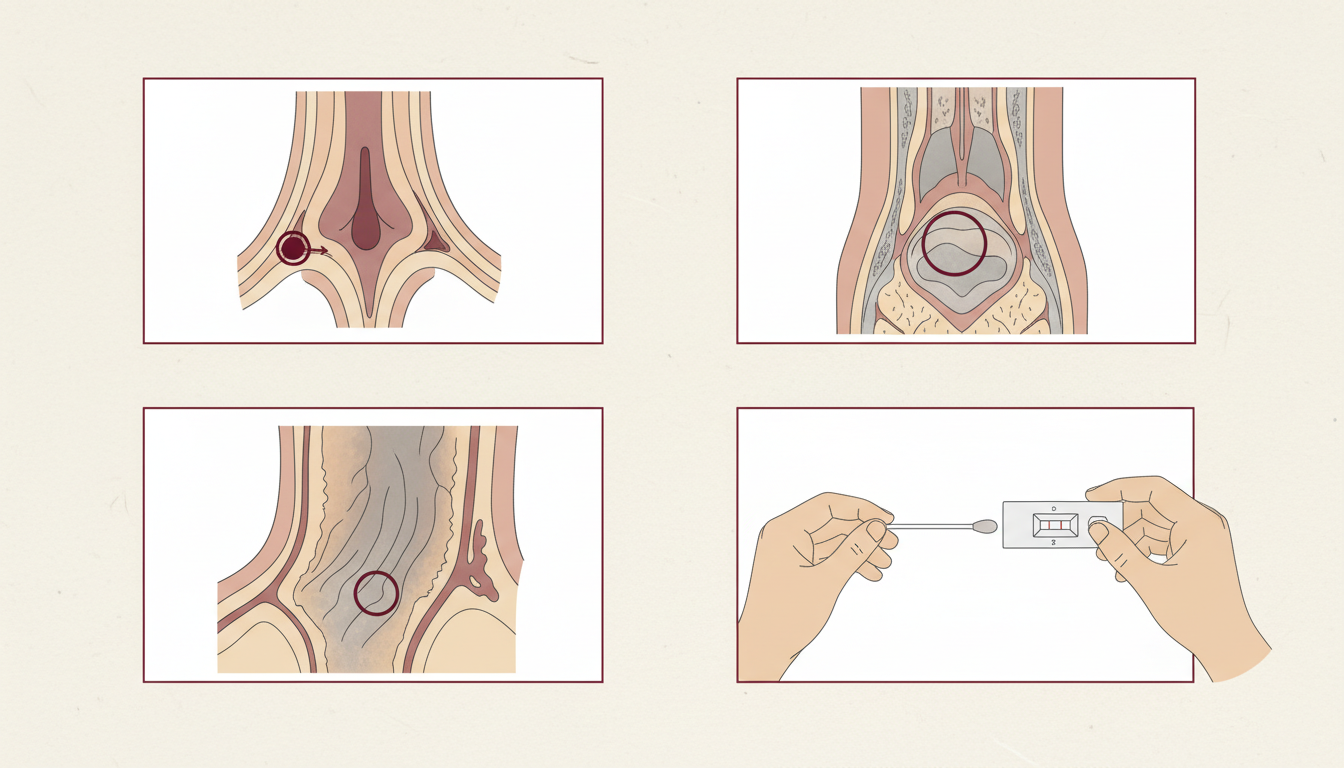
Chlamydia trachomatis is a bacterium that infects the lining of mucous membranes. In men who have sex with men, three sites matter, and each one behaves differently in terms of symptoms and testing.
The urethra. This is the tube semen and urine pass through. Urethral chlamydia is the loudest of the three sites, but even here a substantial share of infections cause no symptoms (MedlinePlus chlamydia information). When symptoms appear, they typically include burning when urinating, a clear or cloudy discharge, and a low-grade itch inside the penis. Symptoms tend to start 1 to 3 weeks after exposure but can show up later.
The rectum. This is the silent site. Rectal chlamydia is acquired through receptive anal sex, but it can also be passed through fingers, shared toys, and oral-anal contact (rimming). When it does cause symptoms, they are easy to dismiss: mild rectal itching, a sensation of fullness, mucus on toilet paper, slight bleeding after sex that gets blamed on hemorrhoids. Most of the time, there is nothing to feel.
The throat. Pharyngeal chlamydia is acquired by giving oral sex to someone with a urethral or rectal infection. It rarely produces a sore throat. The infection lives in the back of the throat and tonsillar area for weeks to months, asymptomatic, and is usually caught only through screening or partner notification.
The site-specific behavior matters because chlamydia does not migrate. A urethral infection does not travel up to the throat, and a rectal infection does not appear in urine. Each site has to be sampled where the infection actually is.
Cohort data from MSM sexual-health clinics show the same pattern over and over. Rectal and pharyngeal chlamydia infections far more often cause no symptoms at the time of diagnosis than urethral infection does, and the majority of these extragenital cases would not be caught at all without routine site-specific screening. Even at the urethra, where symptoms are most likely, a substantial share of infections still produce nothing the person notices. Symptom-watching is not a screening strategy for this infection.
How chlamydia passes during gay sex
Chlamydia spreads through direct contact between an infected mucous membrane and an exposed mucous membrane. Ejaculation is not required. The bacterium does not need much fluid, and it does not care whether the encounter felt safe.
The main exposure routes for MSM are:
- Receptive anal sex (bottoming): highest risk for rectal infection. Even partial protection or pulling out before ejaculation does not eliminate the risk.
- Insertive anal sex (topping): risk of urethral infection from the partner's rectal flora.
- Oral sex (giving or receiving): risk of pharyngeal infection (the giver) or urethral infection (the receiver). Ejaculation increases the risk but is not necessary.
- Rimming (oral-anal contact): risk of pharyngeal infection from a partner with rectal chlamydia.
- Shared sex toys: risk if toys move between bodies or sites without being cleaned and re-covered.
Screening data from MSM cohorts in Australia, the UK, and the US consistently show that the majority of rectal and pharyngeal chlamydia diagnoses in this population are caught through routine screening or partner notification, not because the infected person felt anything wrong. The bacterium is quiet at these sites; routine screening, not symptom-watching, is what catches it.
The two routes that most reliably produce silent infections detected only on screening are receptive anal sex (rectal chlamydia, almost always picked up by routine screening or partner notification rather than symptoms) and oral-anal contact, or rimming (pharyngeal chlamydia from a partner with rectal infection, or rectal chlamydia in the partner being rimmed). Insertive sex and oral sex with ejaculation are also exposure routes, but symptomatic urethral cases at least give the body some chance of waving a flag.
When to test: window periods by exposure
Testing too early gives a false sense of security. Chlamydia needs time to multiply to detectable levels at the infection site. The general rule for MSM screening is that 14 days post-exposure gives the most reliable result. Earlier tests can pick up the infection in some cases, but a negative result before that two-week mark is not conclusive and should be followed with a retest.
The table below summarizes the typical detection windows for the standard nucleic acid amplification test (NAAT), which is the laboratory gold standard used by clinics and most mail-in lab services (CDC chlamydia treatment guidance). At-home rapid lateral-flow tests follow similar windows but use a different chemistry (see the section below on at-home versus lab testing).
| Exposure | Site to test | Earliest reliable test | Most accurate window |
|---|---|---|---|
| Receptive anal sex (bottoming) | Rectum (rectal swab) | 7 days | 14 days or later |
| Insertive anal sex (topping) | Urethra (urine or penile swab) | 5 to 7 days | 14 days or later |
| Oral sex (giving) | Throat (pharyngeal swab) | 7 days | 14 days or later |
| Oral sex (receiving) | Urethra (urine or penile swab) | 5 to 7 days | 14 days or later |
| Rimming or shared toys | Rectum and/or throat | 7 to 10 days | 14 days or later |
Why a standard urine test misses most chlamydia in MSM
The default test at most general clinics, urgent-care centers, and rapid-result kiosks is a urine NAAT. That sample type detects urethral chlamydia and nothing else. If the infection is sitting in the rectum or throat, a urine test cannot reach it, no matter how sensitive the assay is.
This is the single most common reason gay men test "clean" while still carrying chlamydia. The clinic asked about urinary symptoms, took a urine sample, called it negative, and the rectal or pharyngeal infection went on transmitting. Published screening data on MSM in sexual-health clinics has repeatedly shown that adding rectal and pharyngeal swabs to routine screening uncovers a meaningful share of infections that urine alone would have missed.
The fix is straightforward: ask for site-specific swabs that match the sex you had. The phrasing that works at a clinic is direct and short. "I have had receptive anal sex and oral sex in the last few weeks, and I would like rectal and pharyngeal swabs as part of my chlamydia and gonorrhea screening." Those are the only words you need. A clinic that is confused by the request is the wrong clinic, and a referral to a sexual-health center, an LGBTQ-friendly community-health center, or a Planned Parenthood location solves the problem in one phone call.
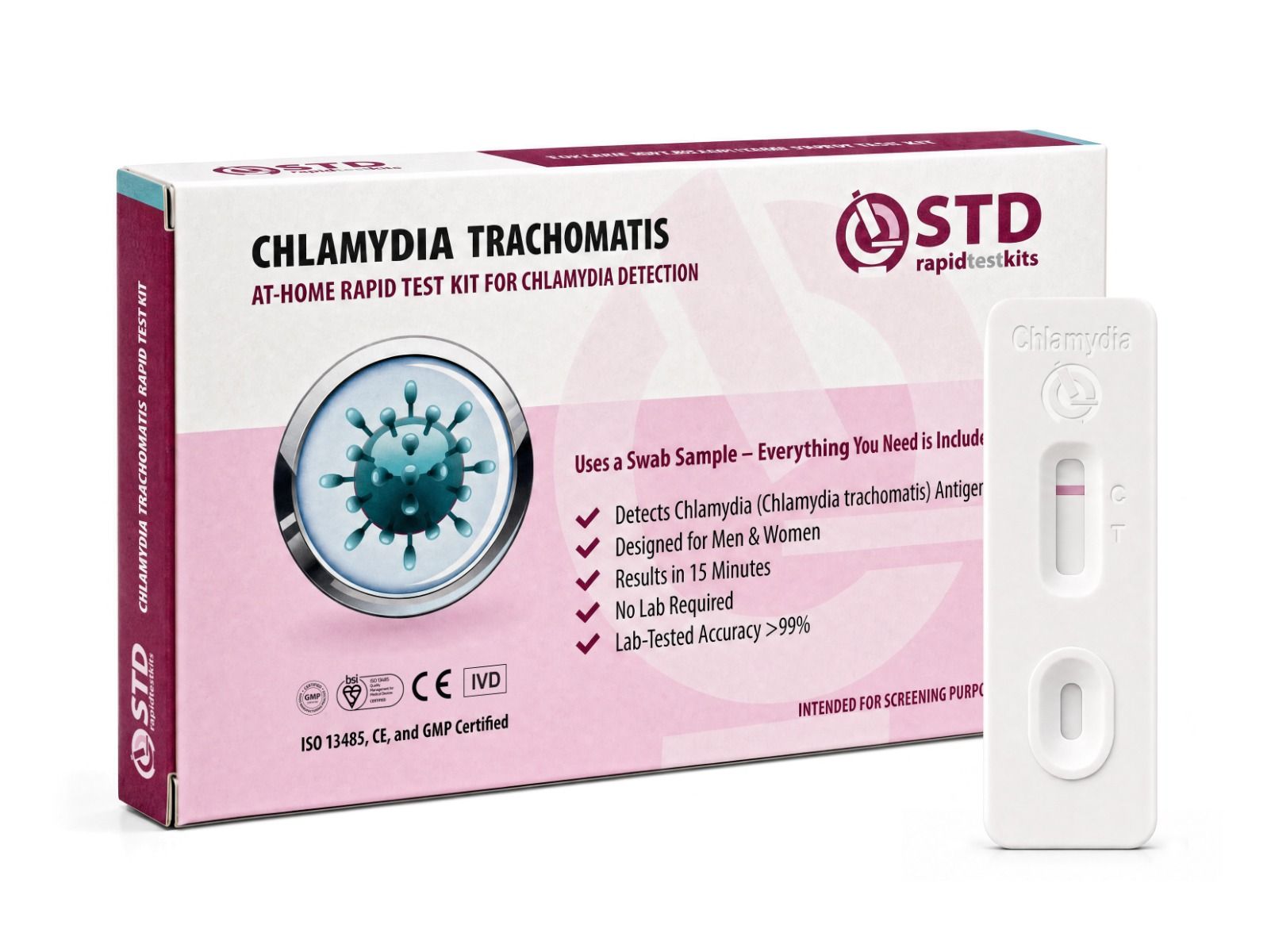
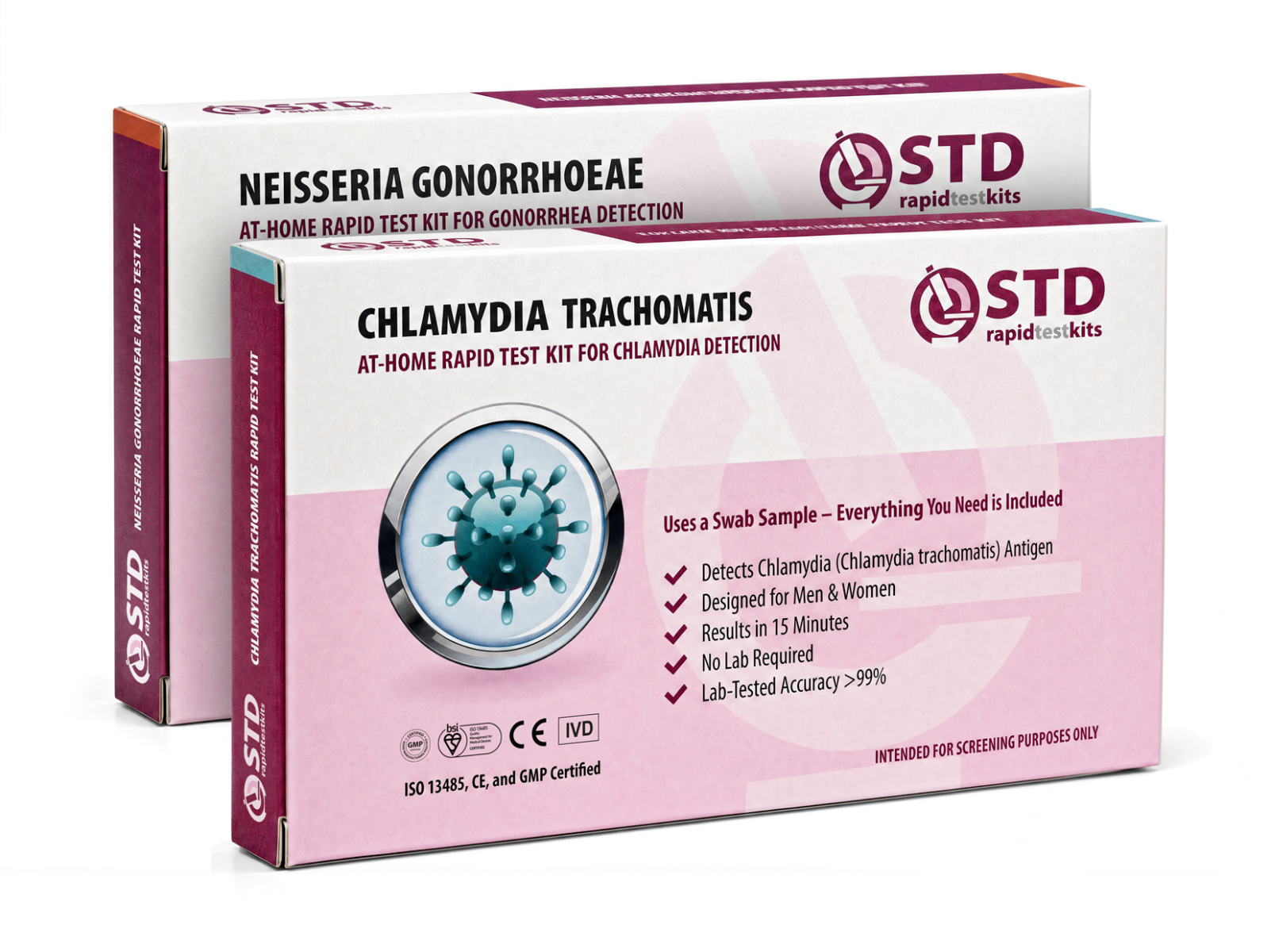
stdrapidtestkits.com sells at-home rapid lateral-flow tests for chlamydia, including a single-infection chlamydia kit and a chlamydia-plus-gonorrhea combo. Both use a self-collected genital swab (penile or vaginal). They detect urethral chlamydia from insertive sex.
Our kits are not validated for pharyngeal (throat) or rectal sampling, and we do not sell a throat-swab or rectal-swab home test. If your exposure was receptive anal sex or oral sex, the rectal or throat infection cannot be picked up by our products. For those sites, see a sexual-health clinic, community-health center, or use a mail-in lab service that explicitly offers rectal and pharyngeal NAAT swabs. Honest framing matters more than a sale.
At-home rapid test, mail-in lab, or clinic: matching the test to the situation
There is no single best testing path. The right one depends on which sites need sampling, how soon you need the result, and how much privacy or insurance friction you can tolerate. The table below compares the three common options.
| Option | Sites covered | Speed | Strengths | Best for |
|---|---|---|---|---|
| At-home rapid lateral-flow | Urethral (genital swab) | 10 to 20 minutes | Privacy, no lab wait, low cost, no insurance trail | Insertive-sex exposure, quick screening, retests after treatment |
| Mail-in lab NAAT | Urethral, rectal, throat (multi-site kits) | 3 to 5 days | Lab-grade NAAT chemistry, multi-site sampling at home | Receptive anal or oral exposure, comprehensive screening |
| Sexual-health clinic | All sites, plus other STIs | Same day to 5 days | Clinician-supervised swabs, EPT prescriptions, treatment on the spot | Active symptoms, partner notification support, full panel |
If you test negative but symptoms continue
A negative result is not the end of the road if your body is still telling you something. The two most common reasons a negative result is misleading are timing (the test was run before the bacterium reached detectable levels) and site mismatch (the test sampled a site that was not the infected one).
Standard practice in sexual-health clinics is to retest 2 to 4 weeks after a known high-risk exposure even when the first result was negative, especially if the exposure included receptive anal sex or oral sex without barriers. If symptoms persist, providers also rule out other infections that mimic chlamydia presentation, including gonorrhea, mycoplasma genitalium, herpes, and non-infectious causes such as proctitis from douching irritation or urethritis from soaps and lubes.
The basic rule of thumb: if you tested too early, retest at the 14-day mark. If you tested only urine and your exposure was anal or oral, ask for a rectal or pharyngeal swab. If both tests were negative and symptoms continue, see a clinician for a broader panel rather than assuming chlamydia is the cause.
Sexual-health clinics retest 2 to 4 weeks after a known high-risk exposure even when the first result was negative. If symptoms started, retest sooner and ask for site-specific swabs that match the kind of sex you had. A urine-only first test gives you no information about the rectum or throat, so a follow-up swab at those sites is not a redundant test, it is the first real test for that site.
Treatment, reinfection, and partner notification
Chlamydia treatment is short and effective. Current CDC STI treatment guidelines recommend doxycycline 100 mg twice daily for 7 days as the first-line regimen for chlamydia at all anatomic sites in adults, with azithromycin as an alternative in specific situations (CDC STI treatment guidelines, chlamydia). For rectal chlamydia in MSM, doxycycline is preferred because the cure rate at the rectal site is higher than with azithromycin.
Two practical points after a positive result. First, abstain from sexual contact for 7 days after starting treatment, even with protection. The bacterium can still pass during this window. Second, recent partners need to be notified so they can test and, if appropriate, be treated. Many states allow expedited partner therapy (EPT), where a clinician can prescribe treatment for a partner without seeing them in person. Anonymous partner-notification services are also available through many local health departments and online platforms.
Reinfection is common. CDC guidance recommends a retest about 3 months after treatment because a meaningful share of treated patients are reinfected by an untreated partner or a new exposure. The retest is not a sign of failure. It is the standard of care.
Sexually active men who have sex with men should be screened for chlamydia and gonorrhea at urogenital, rectal, and pharyngeal sites at least annually, and every 3 to 6 months if at increased risk.
Asking for the right swabs without the shame spiral
The single biggest reason gay men leave a clinic with an incomplete result is that no one asked, and no one volunteered. The default workflow at many primary-care clinics is a urine sample, full stop. Adding the rectal and pharyngeal swabs takes about ninety seconds and requires only a one-line request from the patient.
Useful phrasing, in order of directness. "I would like a full STI screen including rectal and pharyngeal swabs for chlamydia and gonorrhea." "My recent exposure included receptive anal sex, please run a rectal swab." "I want site-specific testing, not a urine-only screen." Any of these works. None of them require an explanation of relationship status, partner count, or why. A clinic that pushes back is the wrong clinic, and a referral to a sexual-health center or LGBTQ-friendly community clinic solves the problem in one phone call.
Testing at home with a swab-based self-collection kit changes the dynamic for some readers. Ordering arrives in plain packaging, the swab is collected in private, the result is read on a strip in 15 minutes (lateral-flow kits) or returned through a secure portal (mail-in lab kits). For readers in rural areas, on closed insurance plans, or simply tired of waiting-room awkwardness, the privacy advantage is real and worth factoring into the decision.
Sometimes, particularly at the throat, the immune system clears the bacterium without antibiotics. This is not a strategy. Untreated chlamydia at the rectum can progress to proctitis (inflammation, mucus, bleeding), and at the urethra to epididymitis (testicular pain and inflammation). Any active bacterial STI including rectal chlamydia also raises HIV acquisition risk during anal sex; cohort data suggest a two-to-five-fold increase in susceptibility when rectal or genital inflammation is present, with the receptive partner facing the highest risk. Treating chlamydia promptly removes that compounding factor and is the clearest clinical reason not to wait for self-clearance, alongside the simple fact that an untreated infection stays transmissible to every partner in the meantime.
Frequently asked questions
- Can I really have chlamydia and feel completely fine?
- Yes, and for MSM this is the rule rather than the exception. Rectal and pharyngeal infections produce no symptoms in the majority of cases, and even at the urethra a substantial share of infections are silent. Cohort screening data consistently show that most extragenital cases are caught only through routine site-specific testing, not because the person noticed anything wrong. Feeling fine is not evidence of being uninfected, it is just evidence that the bacterium is not provoking a noticeable response yet.
- How soon after a hookup should I test?
- Around 14 days post-exposure is the most reliable window. Tests can detect chlamydia from about 5 to 7 days after exposure, but a negative result before the two-week mark is not conclusive. If you want immediate peace of mind, test now and plan to retest at day 14. The second test is the one that gives a real answer.
- I had a urine test that came back negative. Am I clear?
- Only at the urethra. A urine test cannot detect chlamydia in the rectum or throat. If your exposure included receptive anal sex or oral sex, you need a rectal or pharyngeal swab to clear those sites. Many MSM diagnoses are missed exactly here, urine negative, rectal positive, infection still transmitting.
- Can I get chlamydia from oral sex or rimming?
- Yes. Pharyngeal chlamydia is acquired by giving oral sex to a partner with a urethral or rectal infection. Rimming (oral-anal contact) can pass rectal chlamydia to the giver's throat or pharyngeal chlamydia to the receiver's rectum. Both routes are well documented in MSM screening data, and both rarely produce symptoms.
- We used condoms. Do I still need to test?
- Possibly. Condoms substantially reduce risk during anal sex but do not cover oral sex, rimming, or shared toys, all of which can transmit chlamydia. If your exposure was condom-protected anal sex with no oral component, the residual risk is low. If oral sex or rimming was involved, the condom does not change the throat or rectal exposure picture.
- Does douching before sex protect me?
- No, and it can mildly increase risk. Douching disrupts the rectal lining and can create small abrasions that make bacterial entry easier. It does not clear an existing infection, and it does not prevent acquiring one. If you douche, doing so well before sex (rather than immediately before) and using barriers and regular site-specific testing matters more than the douching itself.
- What does treatment involve?
- First-line treatment per CDC guidelines is doxycycline 100 mg twice daily for 7 days, at all anatomic sites. Azithromycin is an alternative in specific situations. Abstain from sexual contact for 7 days after starting treatment. Retest about 3 months later because reinfection is common. Side effects of doxycycline are usually mild (some nausea, sun sensitivity), and the regimen is short.
- Can your at-home kits test my throat or rectum?
- No. Our chlamydia and chlamydia-plus-gonorrhea home kits use a self-collected genital swab and detect urethral infection only. They are not validated for pharyngeal or rectal sampling. For throat or rectal testing, see a sexual-health clinic or use a mail-in lab service that explicitly offers multi-site NAAT swabs.
Pulling it together
If you are sitting with anxiety after a hookup, the calm version of the answer is this. Chlamydia in MSM is mostly silent at the rectum and throat, so symptom-watching is unreliable. The most accurate test is run around 14 days after exposure, and the swab needs to match the site you exposed. A urine-only test misses the majority of MSM chlamydia because urine cannot reach the rectum or throat. Treatment is one short course of antibiotics, and retesting at three months is part of the standard pathway, not a sign anything went wrong.
If your exposure was insertive sex, an at-home genital-swab test like the kits below will give you a urethral answer in 15 minutes. If your exposure was receptive anal or oral, plan a clinic or mail-in lab visit for the site-specific swabs. The swab that matches your exposure is the one worth ordering, even if it takes a clinic visit to get.
- U.S. Centers for Disease Control and Prevention. STI Treatment Guidelines, chlamydia: first-line doxycycline regimen and screening recommendations for men who have sex with men.
- U.S. Centers for Disease Control and Prevention. Chlamydia overview, transmission, symptoms, and prevention.
- World Health Organization. Chlamydia fact sheet covering global burden, transmission routes, and screening recommendations.
- U.S. National Library of Medicine, MedlinePlus. Chlamydia infections: causes, symptoms, diagnosis, and treatment.
- UK National Health Service. Chlamydia: symptoms, transmission, testing, and treatment in the UK clinical context.
