Published: August 2025 | Last updated: May 2026 | Editorial review and quality control: Martina N.
A burning urinary infection that keeps coming back. A bump that looks like razor burn. A fishy discharge that responds to nothing. These are the symptoms most people, and most clinicians, treat as something simple. Most of the time, a UTI is a UTI and a yeast infection is a yeast infection. When the same symptoms keep coming back despite the right treatment, it is worth asking whether the real cause has been identified, because several common sexually transmitted infections produce exactly these patterns.
This article walks through the five STIs most likely to be missed or misclassified: chlamydia, gonorrhea, herpes, trichomoniasis, and HPV. For each one, we cover what gets the diagnosis confused, what the actual signs are, and when it is worth asking your provider for a specific STI test rather than another round of empiric antibiotics or antifungals.
This is informational content, not personal medical advice. If you have symptoms that concern you, speak to a licensed clinician who can examine you and run the appropriate tests.
Key Takeaways
- Most chlamydia, gonorrhea, and trichomoniasis infections cause no symptoms, which is why scheduled screening, rather than symptom-watching, is the only reliable way to catch them early.
- If two rounds of UTI or yeast-infection treatment have not fixed your symptoms, an STI panel is the next reasonable step before another round of the same treatment.
Why STI Symptoms Get Mistaken for Other Conditions
Three things stack on top of each other to make STI misdiagnosis common. First, the symptoms genuinely overlap. Burning during urination is what a urinary tract infection feels like, and it is also what chlamydia, gonorrhea, and trichomoniasis can feel like. Watery vaginal discharge fits bacterial vaginosis, and it also fits trichomoniasis. A small bump on the genitals can be folliculitis, an ingrown hair, or a herpes lesion that has not yet erupted. Pattern-matching on symptoms alone gives the wrong answer often enough that lab confirmation matters.
Second, most STIs do not cause symptoms in most people. The U.S. Centers for Disease Control and Prevention reports that around 70 percent of trichomoniasis infections cause no signs at all, and chlamydia and gonorrhea similarly produce no symptoms in many infected women (CDC about trichomoniasis). A clinician working from a symptom complaint is, by definition, only seeing a small slice of who actually has the infection.
Third, comprehensive STI panels are not standard practice. Routine office testing for a urinary or genital complaint usually covers UTI organisms and sometimes a wet mount for yeast or BV. It does not automatically include nucleic acid amplification testing (NAAT) for chlamydia or gonorrhea, and it almost never includes herpes serology or HPV typing unless the patient asks for it specifically.
- Symptom overlap. Burning urination, abnormal discharge, and small skin bumps look the same across UTIs, yeast, BV, and several STIs.
- Silent infections. The majority of chlamydia, gonorrhea, and trichomoniasis cases produce no symptoms at all.
- Incomplete office workups. Standard urinalysis and wet-mount testing rarely include the NAAT, herpes serology, or HPV typing that would catch the real cause.
Chlamydia: The Silent Infection Mistaken for a UTI
Chlamydia is the most frequently reported bacterial sexually transmitted infection in the United States. CDC provisional surveillance counted about 1.5 million reported chlamydia cases in 2024 (CDC STI surveillance, annual). It is also one of the most quietly carried. The CDC's chlamydia overview describes the infection as commonly asymptomatic, and when symptoms do appear, they look much like a routine urinary infection (CDC about chlamydia).
What gets the diagnosis confused
The early signs of chlamydia in people with vaginas overlap heavily with a UTI: stinging or burning during urination, increased frequency, lower abdominal pressure, and sometimes a thin, off-color discharge. In people with penises, urethritis (inflammation of the urethra) from chlamydia produces a clear or whitish discharge and burning that pattern-matches to a urinary infection too.
A clinician confronted with these symptoms commonly orders a urinalysis. If the urinalysis shows white blood cells (consistent with UTI), they often prescribe a course of antibiotics targeted at common urinary pathogens, which may not adequately cover chlamydia. The patient feels somewhat better for a few days, partly from the placebo of treatment and partly from the limited cross-coverage, then the symptoms return. The cycle can repeat for months.
What should prompt an STI test instead
The patterns that argue for chlamydia testing rather than another UTI script:
- Recurrent UTI symptoms with negative urine cultures.
- Symptoms that do not fully resolve on first-line UTI antibiotics.
- Lower abdominal or pelvic pain that is more positional than urinary.
- Bleeding between periods or after sex.
- A new partner within the past few months.
Why missing it matters
Untreated chlamydia in people with uteruses can ascend into the upper reproductive tract and cause pelvic inflammatory disease (PID), one of the most common preventable causes of tubal-factor infertility (CDC about chlamydia). PID often presents subtly: low-grade pelvic pain that gets attributed to dysmenorrhea, mild pain with intercourse, or what looks like a chronic UTI. By the time it is diagnosed, scarring may already be present.
The fix is straightforward when caught early. A nucleic acid amplification test on a urine sample or a self-collected vaginal swab detects chlamydia with high sensitivity, and a single course of doxycycline (or in some cases azithromycin) clears it.
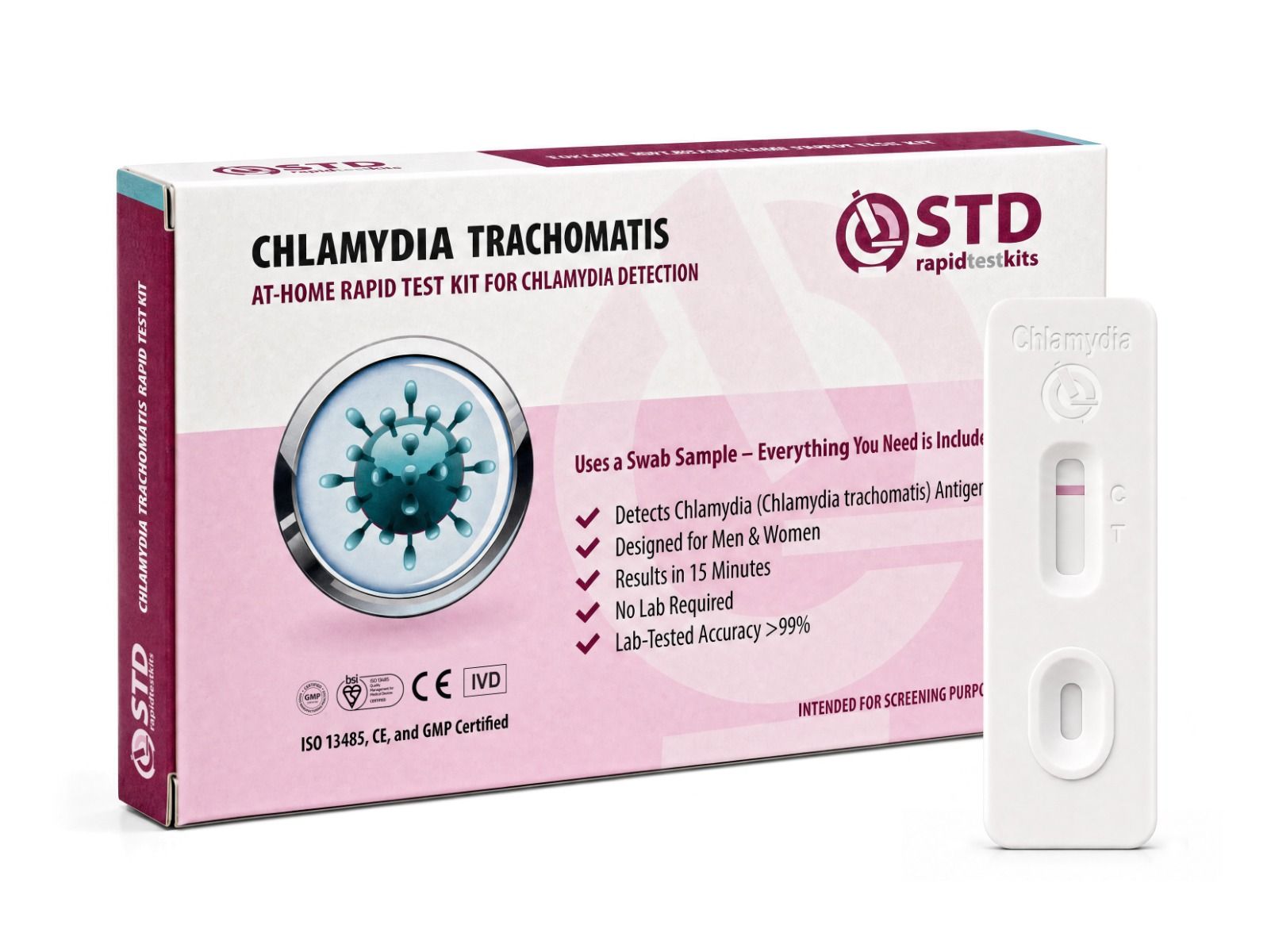
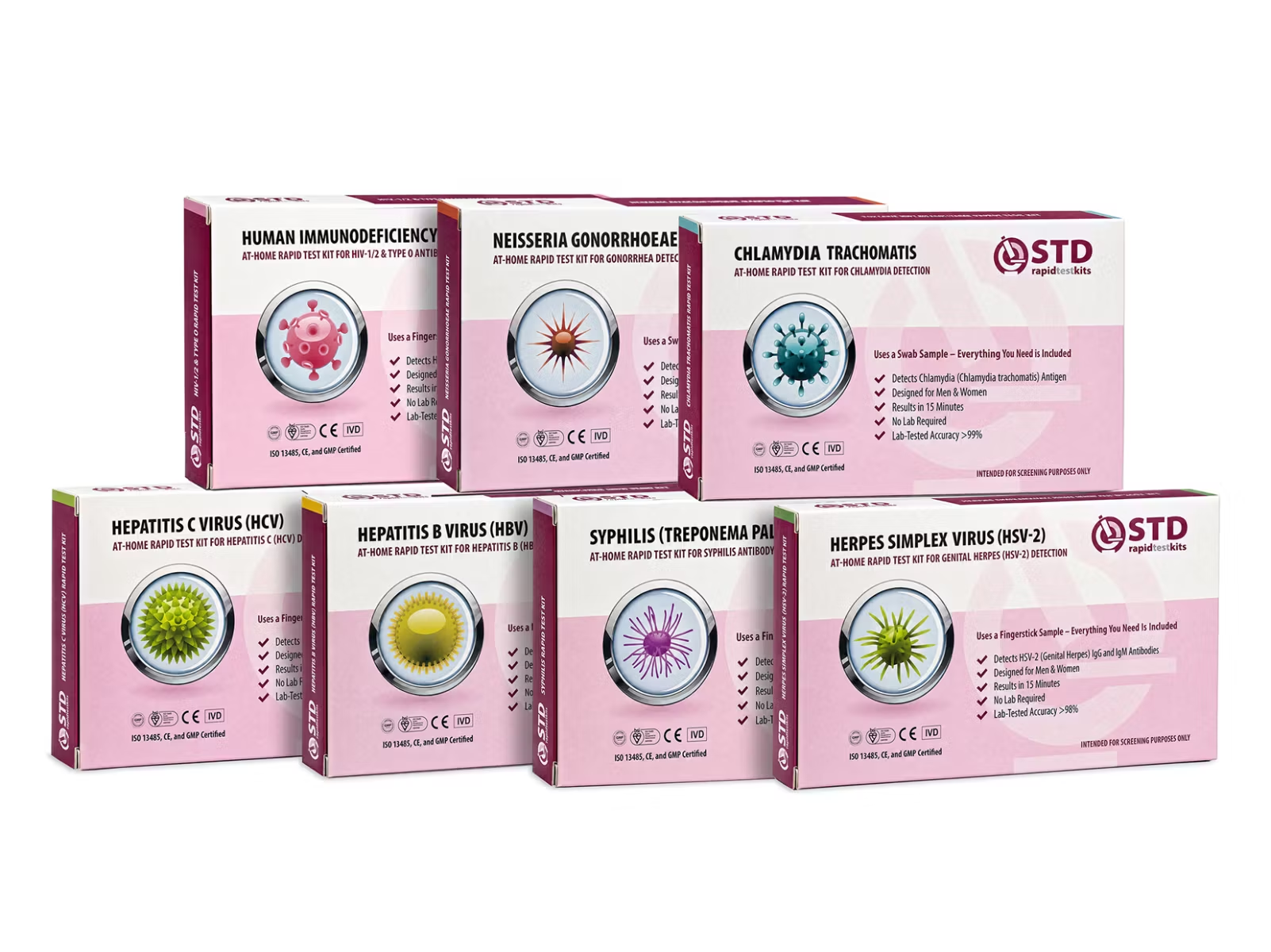
This site sells at-home rapid tests for several of the infections described in this article; the linked products below go to those test kits.
Gonorrhea: Frequently Missed When Symptoms Are Mild
Gonorrhea sits next to chlamydia in the differential and shares much of its problem profile. The CDC reports that most women with gonorrhea have no symptoms at all, and even when symptoms are present, they tend to be mild enough to be mistaken for a bladder or vaginal infection (CDC about gonorrhea). In people with penises, the discharge tends to be more visibly purulent than chlamydia, and the burning and frequency that drive an office visit still get treated as urinary first.
Why gonorrhea slips past the first encounter
Pharyngeal (throat) and rectal gonorrhea slip through the first clinical encounter most often. These sites cause minimal symptoms even at high bacterial loads, and a standard urine test will not detect them because each anatomical site needs its own swab. We do not sell pharyngeal or rectal swab tests at home; for those exposures, a clinic visit with site-specific testing is the right step.
Co-infection with chlamydia is the other common reason gonorrhea gets misclassified. Enough people with chlamydia also have gonorrhea that current CDC treatment guidelines recommend testing for both at the same time and treating empirically for both when one is positive (CDC STI treatment guidelines).
- Mucus-like or pus-like genital discharge that does not match a typical UTI.
- Sore throat following a recent oral-sex exposure.
- Rectal discomfort, mucus, or bleeding after receptive anal sex.
- Any positive chlamydia result, since co-testing for gonorrhea is standard.
Herpes: Often Mistaken for Razor Burn, Ingrown Hairs, or a Yeast Infection
Genital herpes is one of the most underdiagnosed sexually transmitted infections in the world. The World Health Organization estimates that around 520 million people aged 15 to 49 worldwide have a genital HSV-2 infection, and the great majority do not know it (WHO herpes simplex virus fact sheet). The CDC has long noted that most people with HSV-2 in the United States are unaware of their infection.
What gets confused with herpes
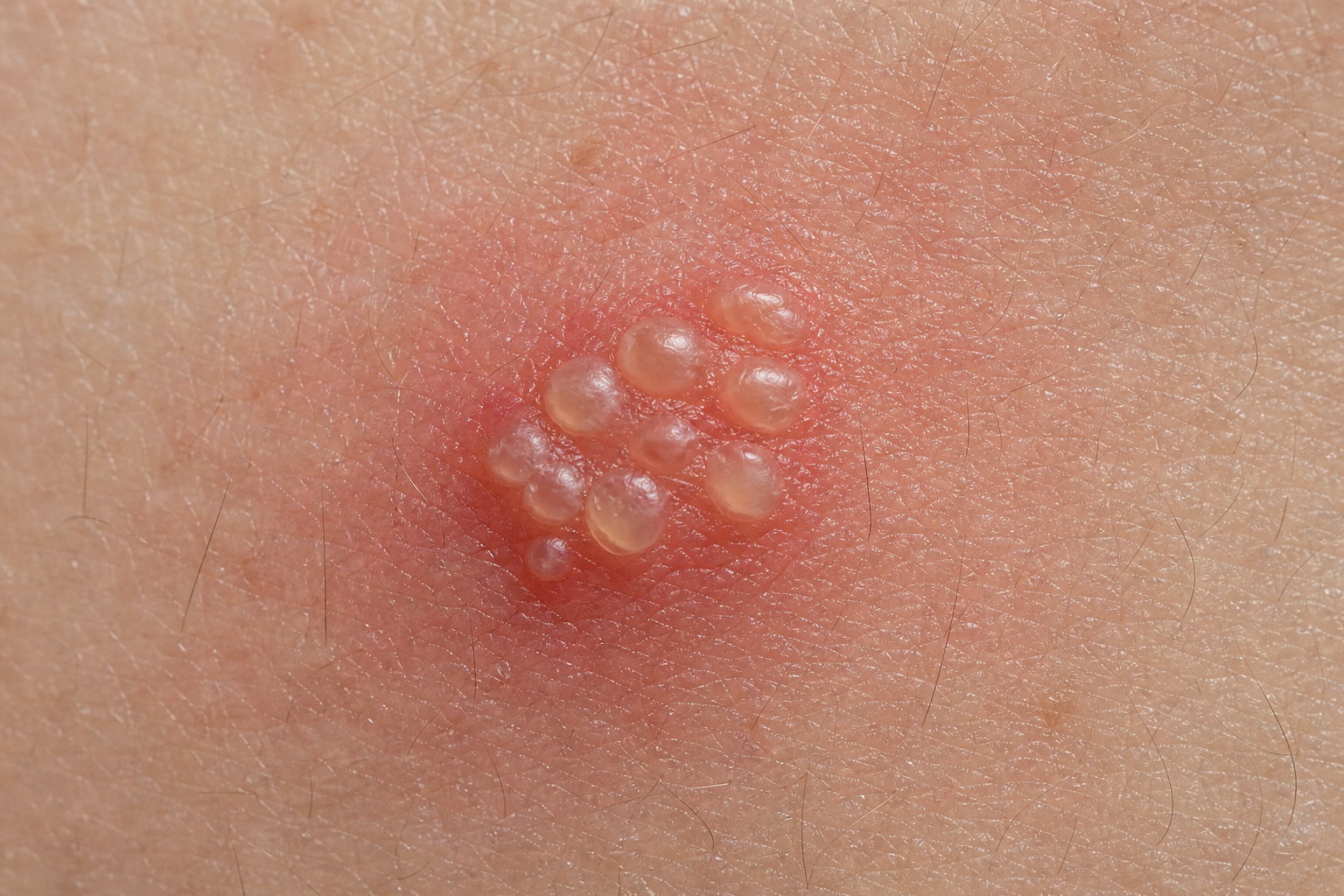
A first herpes outbreak rarely looks like the textbook image of a single clustered ulcer. It often shows up as one or two small reddish bumps, a tiny crack in the skin, or a tingling sensation that resolves before any visible lesion appears. The differential clinicians and patients commonly land on instead:
- Ingrown hairs or folliculitis after shaving or waxing.
- Razor burn or contact dermatitis.
- A yeast infection, when the dominant complaint is itching and burning rather than a visible sore.
- A urinary tract infection, when the dominant complaint is pain on urination from urine touching a small ulcer.
- A pimple, abrasion, or trauma from sex.
Because herpes outbreaks heal on their own within one to two weeks, the lesion is often gone before the patient sees a clinician, and the next outbreak gets the same misattribution.
What an actual outbreak looks like
Several features push the differential toward herpes specifically:
- The bumps cluster as small grouped vesicles or papules, rather than appearing as a single inflamed follicle.
- The lesions are painful or burning rather than just itchy.
- An early-warning tingling or shooting sensation in the area precedes the lesion.
- Outbreaks recur in roughly the same anatomical location.
- Flu-like symptoms, swollen groin lymph nodes, or systemic malaise during the first episode.
How to test for herpes
The most reliable way to diagnose an active herpes lesion is a PCR or viral culture swab of the lesion itself, taken within the first 48 to 72 hours. After the lesion heals, that option closes. The remaining option is a type-specific blood antibody test, which detects past exposure to HSV-1 or HSV-2 and cannot tell you whether a current bump is herpes or something else. The CDC's herpes testing page notes that current tests can take up to 16 weeks or more after exposure to detect infection (CDC herpes testing).
That window matters. If you are testing because of an exposure that happened last week, a negative blood test today is not informative; you would need to retest at the 16-week mark to be confident. If you are testing because you have had unexplained recurrent skin issues in the genital area for years, a current blood test will tell you about past exposure even when the bump in front of you cannot be swabbed.
Trichomoniasis: The STI That Imitates BV and Yeast Infections
Trichomoniasis is the most common curable sexually transmitted infection worldwide. The CDC estimates more than two million U.S. trichomoniasis infections, with about 70 percent of people infected having no signs or symptoms at all (CDC about trichomoniasis). That asymptomatic share is the central reason it gets missed.
What gets confused with trichomoniasis
When trich does cause symptoms in people with vaginas, the presentation overlaps strongly with bacterial vaginosis and yeast infection: a yellow-green or grey, sometimes frothy, discharge with an off odor; itching or soreness around the vulva; burning during urination. Office wet-mount microscopy can identify the protozoan if a clinician is specifically looking for it, though in busy primary care visits the wet mount is often skipped, and the symptoms are pattern-matched to the more common BV or candidiasis.
A common trajectory looks like this: a person presents with discharge, gets treated with metronidazole for presumed BV, the discharge improves briefly, then returns. Another visit, another course of antifungals or BV antibiotics, similar partial response. By the time someone runs a trichomoniasis-specific NAAT, months have passed.
Patterns that should prompt a trich test
- Recurrent BV that does not stay resolved after treatment.
- Yellow-green or frothy discharge, more specific to trich than to BV.
- Discharge accompanied by genital itching plus burning on urination.
- A new partner with similar but milder genital symptoms.
The good news is that trich is highly treatable: a single dose of metronidazole or tinidazole clears most infections (CDC STI treatment guidelines).
Our at-home trichomoniasis swab kit is validated for vaginal self-collection and is used by women. We do not sell a male-compatible trichomoniasis home test. Men with possible exposure to trich, most commonly through a partner with a confirmed infection, should see a clinic for urethral or urine NAAT testing.
HPV: The Quiet STI Found Through Screening, Not Symptoms
HPV is unusual on this list because it does not really get misdiagnosed in the symptom sense. It gets missed because most infections cause no signs at all and resolve on their own without anyone knowing they were there. The CDC notes that nearly all sexually active people will be exposed to at least one HPV type during their lifetime (CDC about HPV).
The two clinical faces of HPV
When HPV does cause something visible, it falls into two broad buckets. Low-risk types, most often types 6 and 11, cause genital warts: soft, flesh-colored or pinkish growths that can be flat, raised, or cauliflower-textured. These are sometimes mistaken for skin tags, sebaceous cysts, or pearly penile papules. The misidentification is usually benign in consequence because the warts themselves are not dangerous, though it can mean a missed opportunity for treatment and a missed conversation about transmission.
High-risk types, most importantly types 16 and 18, cause no visible signs at all. Their first visible footprint is usually an abnormal Pap smear or HPV co-test result on routine cervical cancer screening. Without screening, the infection can persist silently for years and slowly drive the cellular changes that lead to cervical cancer.
Why screening matters more than symptom-watching
The single most important thing to know about HPV is that the strategy that protects you is screening, rather than waiting for symptoms. Cervical cancer screening with a Pap test, HPV test, or co-test on the schedule recommended for your age group is what catches high-risk HPV before it becomes precancer or cancer. The U.S. Preventive Services Task Force recommends screening starting at age 21 and continuing through age 65 for most people with cervixes, with the specific test and interval depending on age (USPSTF cervical cancer screening recommendation).
A scope note on home HPV testing
A Pap smear or in-office HPV co-test remains the gold standard for cervical cancer screening. Our at-home rapid test can serve as a private indicator of high-risk HPV presence between those scheduled clinic visits. Our kit is validated for vaginal self-collection and is used by women. We do not sell a male-compatible HPV home test; HPV testing in men is generally limited to clinic-based evaluation of visible lesions.
How do you tell if a UTI, yeast infection, or skin bump is actually an STI?
The most reliable signal is failure to respond to standard treatment. If a UTI does not clear after one round of antibiotics, if a yeast infection does not resolve with antifungals, or if a bump keeps coming back in the same spot, request a specific STI panel before another empiric course. The most commonly missed are chlamydia and gonorrhea (mistaken for UTI), trichomoniasis (mistaken for BV or yeast), and herpes (mistaken for ingrown hair or razor burn). Most STI testing can be done from a urine sample, a self-collected swab, or a fingerstick blood draw.
Chlamydia often has no symptoms, but it can cause serious health problems, even without symptoms. Even when chlamydia has no symptoms, it can damage a woman's reproductive system.
How to Reduce Your Risk of an Overlooked STI
Screening on a schedule that matches your sexual activity is the most reliable way to keep STIs from going unnoticed for months. The CDC recommends annual chlamydia and gonorrhea screening for all sexually active women under 25 and for older women with risk factors (CDC STI screening recommendations). For men who have sex with men, the recommended cadence is more frequent, often every 3 to 6 months. Adults aged 13 to 64 should also get at least one HIV test in their lifetime as part of routine care.
Ask for the specific test by name
If you have symptoms that fit a UTI, BV, or yeast infection, ask whether the workup includes a NAAT for chlamydia and gonorrhea, a wet mount or NAAT for trichomoniasis, and a swab of any visible lesion. Many providers will run those tests if asked; some will not until asked. The cost of a redundant test is small compared to the cost of a missed infection.
Use home testing for screening between provider visits
At-home rapid lateral-flow testing catches infections that would otherwise go untested, especially for people who avoid clinic visits. Lab NAATs remain more analytically sensitive; confirm any positive home result before starting treatment. A negative home test is most reliable when used outside the early window period of an exposure.
Treat partner notification as part of the workup
If a screen comes back positive for chlamydia, gonorrhea, or trichomoniasis, current sexual partners need to be tested and treated as well, otherwise reinfection is the default outcome. In many U.S. states, expedited partner therapy lets a clinician send a treatment course for a partner without that partner's separate office visit; ask about it if it would help.
Frequently asked questions
- Which STI is most commonly misdiagnosed?
- Chlamydia is the single most common misdiagnosis because its symptoms in the urinary and pelvic area mirror those of a urinary tract infection, and most cases produce no symptoms at all. Herpes runs a close second among visible-symptom STIs because of how often it gets attributed to ingrown hairs or razor burn.
- Can a doctor misdiagnose herpes as something else?
- Yes, often. Herpes outbreaks in their early or healing stages do not always look like the textbook image of grouped ulcers. Without a viral PCR swab during an active outbreak, the diagnosis usually relies on the clinician's pattern recognition, which can be wrong when lesions resemble folliculitis, contact dermatitis, or a small abrasion.
- If my UTI antibiotics did not work, should I assume it is an STI?
- Antibiotic failure alone points to the need for a broader workup, though an STI is only one possible explanation. Persistent or recurrent UTI symptoms can also indicate an antibiotic-resistant organism or an underlying anatomical issue. The reasonable next step is a urine culture plus an STI NAAT for chlamydia and gonorrhea before starting another empiric round of the same antibiotic.
- Do standard STI panels include herpes?
- Often not. Many comprehensive STI panels cover chlamydia, gonorrhea, syphilis, HIV, and sometimes hepatitis. Herpes serology is usually only added when the patient asks or when a clinician sees a suggestive lesion. If you want it, ask for a type-specific HSV-1 and HSV-2 IgG antibody test by name.
- Can a negative STI test be wrong?
- Yes, when testing happens too early. Each STI has a window period: the time between infection and when the test can reliably detect it. Chlamydia and gonorrhea NAAT can detect infection within 1 to 2 weeks. HIV antigen-antibody tests are reliable by about 45 days for most people. HSV antibodies can take up to 16 weeks or more. A negative test inside the window does not rule out infection.
- How often should I get tested if I have new partners?
- The CDC recommends annual chlamydia and gonorrhea testing for sexually active women under 25 and for at-risk women over 25. For men who have sex with men, the recommended cadence is every 3 to 6 months. For everyone else, the rule of thumb is at least one screen after a new partner and at least once a year if you have multiple partners.
- Are at-home STI tests as accurate as clinic tests?
- Lab NAATs are more analytically sensitive than lateral-flow rapid tests, particularly for low-level infections. Treat home tests as a triage step that flags whether further testing is needed: they are useful for screening when the alternative is no test at all, and a positive result warrants clinic confirmation before treatment begins.
- What should I do if I think I was misdiagnosed?
- Ask for a complete STI workup that includes NAAT for chlamydia and gonorrhea, a trichomoniasis test, type-specific herpes serology if appropriate, and HIV and syphilis testing. If your provider declines, you can request a referral, go through a sexual-health clinic, or use a home testing option for the most commonly missed infections.
- U.S. Centers for Disease Control and Prevention. Annual STI surveillance, used for the 2024 reported chlamydia case count of approximately 1.5 million.
- U.S. Centers for Disease Control and Prevention. About chlamydia, used for asymptomatic-rate language and for the PID/infertility complication framing.
- U.S. Centers for Disease Control and Prevention. About gonorrhea, used for the asymptomatic-rate language in women and the differential with bladder and vaginal infection.
- U.S. Centers for Disease Control and Prevention. Herpes testing, used for the up-to-16-weeks antibody window-period guidance after exposure.
- World Health Organization. Herpes simplex virus fact sheet, used for the global HSV-2 prevalence estimate of around 520 million people aged 15 to 49.
- U.S. Centers for Disease Control and Prevention. About trichomoniasis, used for the 70 percent asymptomatic figure and the more-than-two-million U.S. infections estimate.
- U.S. Centers for Disease Control and Prevention. About HPV, used for lifetime exposure language and the high-risk vs low-risk type distinction.
- U.S. Preventive Services Task Force. Cervical cancer screening recommendation, used for the screening age range and modality.
- U.S. Centers for Disease Control and Prevention. STI treatment guidelines screening recommendations, used for annual chlamydia/gonorrhea screening cadence in women under 25.
- U.S. Centers for Disease Control and Prevention. STI treatment guidelines, used for empiric co-treatment guidance and for trichomoniasis treatment with metronidazole or tinidazole.
