
Published: October 2025 | Last updated: May 2026 | Editorial review and quality control: Martina N.
Can an STD really feel like the flu?
Yes. Acute HIV produces flu-like symptoms in most people within 2 to 4 weeks of exposure, per the CDC. Primary herpes, secondary syphilis, and acute hepatitis B or C follow the same pattern of fever, fatigue, sore throat, and swollen lymph nodes, often with no genital signs early on. Testing is the only reliable way to tell them apart.
Fever, fatigue, sore throat, body aches: when these show up a week or two after a new sexual exposure, the simplest explanation is not always the flu. Several sexually transmitted infections produce a textbook viral-illness pattern in their first phase, and during peak influenza and COVID-19 season the overlap is wide enough that the right diagnosis can be postponed by weeks or months.
This guide walks through which STIs commonly start with flu-like symptoms, how to separate them from influenza and COVID-19, when an at-home test is reliable, and which sample type detects what. Most readers will find their symptoms map onto a routine viral illness. This article exists for the smaller group whose timeline lines up with a possible exposure and who need to decide whether testing belongs on this week's to-do list.
Key Takeaways
- Flu-like symptoms after a recent sexual exposure can be the body's first response to acute HIV, primary herpes, secondary syphilis, or acute hepatitis. The pattern overlaps tightly with influenza and COVID-19, and many of these infections produce no genital symptoms in their early phase.
- Home rapid blood tests have a window period before they can detect infection: roughly 18 to 45 days for lab antigen-antibody HIV tests, 18 to 90 days for rapid HIV kits, 6 to 12 weeks for syphilis antibody tests, and up to 12 weeks for HSV-2 antibodies. Match the test to your timeline, and confirm any positive home result with a clinic test.
Without a recent sexual exposure on the timeline, the math on common viral illness wins by a wide margin. Influenza, common cold viruses, COVID-19, mononucleosis, and strep throat account for the great majority of fever-and-fatigue presentations in adults. The STI overlap below matters when both the timing and a recent possible exposure line up. In the absence of an exposure window, this article is general background reading rather than an immediate call to test.
Why your immune system reacts the same way to STIs, the flu, and COVID-19
When you catch the flu or COVID-19, your immune system shifts into a familiar gear: fever, chills, body aches, fatigue, swollen lymph nodes, and sometimes a sore throat. Cytokines released to fight a new pathogen produce that pattern whether the trigger is influenza, SARS-CoV-2, or HIV. The systemic signal is the same; only the underlying organism differs.
Acute HIV infection produces flu-like symptoms in most people within 2 to 4 weeks of exposure, an episode clinicians call acute retroviral syndrome, according to the CDC's About HIV page. These symptoms are not caused by the virus damaging tissue directly. They reflect the immune system mounting a defense, which is why the picture looks so much like a respiratory bug. The same logic applies to primary herpes, secondary syphilis, and acute hepatitis B or C.
The throat and lymph nodes add to the confusion. Both viral respiratory illness and several STIs (primary herpes, secondary syphilis, oral gonorrhea) can inflame the pharynx and swell the glands, producing the sore throat and tender neck that most people instinctively file under cold or flu.
This overlap matters for two reasons. The first is detection: people who do not connect their symptoms to a recent sexual exposure often wait the illness out, assuming a winter bug. By the time genital symptoms or routine screening flag the infection, weeks or months can pass. The second is transmission. Acute HIV involves a very high viral load before antibodies are detectable, which makes the early phase especially infectious to partners. Once HIV is treated and the viral load is suppressed to undetectable levels, the virus is not transmitted sexually, a principle the CDC summarizes as Undetectable equals Untransmittable (CDC, HIV Treatment). That protection depends on knowing you have HIV in the first place.
Most people have flu-like symptoms within 2 to 4 weeks after infection. Symptoms may last for a few days or several weeks.
The flu-like symptoms these infections share
Because the immune response is generic, the early symptoms of these infections cluster around the same short list. MedlinePlus describes the first signs of HIV as flu-like, including fever, rash, night sweats, sore throat, and swollen lymph nodes (MedlinePlus, HIV). Secondary syphilis and a first herpes episode produce much the same set.
None of these is specific to an STI, which is exactly the difficulty: your body produces the identical response to a seasonal virus. The checklist below shows what the overlap looks like.
Flu-like symptoms an acute STI can produce
Having one or more of these does not mean you have an STI. The same signals come from influenza, COVID-19, and many other viruses. A recent sexual exposure is what makes them worth testing for.
- Fever or chills Common
- Fatigue or feeling run down Common
- Sore throat Common
- Swollen lymph nodes, sometimes in more than one area of the body Common
- Muscle aches and body pain Common
- Headache Common
- Night sweats Less common
- A non-itchy rash on the trunk, or on the palms and soles Less common
- Jaundice (yellowing of the eyes or skin), a clue that points toward acute hepatitis Rare
Which STIs commonly start with flu-like symptoms
Six infections account for almost all of the flu-versus-STI confusion that reaches primary-care offices. The pattern, timing, and severity differ in ways that help with sorting.
Acute HIV (acute retroviral syndrome)
Acute, or primary, HIV infection causes flu-like symptoms in most people within 2 to 4 weeks of exposure (CDC, About HIV). The reported pattern includes fever, fatigue, sore throat, swollen lymph nodes, body aches, headache, rash, and night sweats. Both the World Health Organization and the UK's NHS describe the same early influenza-like illness, with the NHS noting it typically appears 2 to 6 weeks after infection (WHO; NHS). Symptoms can last from a few days to several weeks, then resolve on their own as the immune system reaches a steady state. A long, quiet phase follows, which is why these early symptoms are sometimes the only warning before the virus turns up on a routine test years later. A generalized rash and lymph-node swelling that outlast a typical flu are the clues clinicians most often use to push toward HIV testing.
Secondary syphilis
Primary syphilis usually appears as a single painless ulcer (a chancre) at the site of exposure, and it often goes unnoticed. Secondary syphilis follows weeks to months later, typically 6 weeks to 6 months after the chancre, and looks very different. According to the CDC syphilis overview, secondary syphilis can bring fever, swollen lymph glands, sore throat, patchy hair loss, headaches, weight loss, muscle aches, and fatigue, alongside a rash that often reaches the palms and soles. That palms-and-soles rash is the strongest single distinguishing clue; it is one of the few skin findings that should always trigger an STI workup. Without it visible at the appointment, secondary syphilis reads as a viral illness.
Primary herpes (HSV-1 or HSV-2 first episode)
A first herpes outbreak is more systemic than later flares. The CDC notes that flu-like symptoms, including fever, body aches, and swollen glands, can occur during the first outbreak (CDC, About Genital Herpes). The constitutional symptoms can precede or accompany the genital or oral lesions, so a fever and aching glands may arrive first and the blisters a day or two later. Recurrent outbreaks usually skip the systemic part and show up only as local lesions.
Acute hepatitis B
Acute hepatitis B can be silent, or it can present like a moderate flu. The CDC's hepatitis B overview lists fatigue, fever, joint pain, loss of appetite, nausea, stomach pain, dark urine, and jaundice, with symptoms that often begin around 90 days after exposure, much later than the HIV or herpes window. That long lag is part of why people miss the link back to a sexual encounter months earlier.
Acute hepatitis C
When acute hepatitis C produces symptoms at all, they appear 2 to 12 weeks after exposure, per the CDC's hepatitis C page. The picture resembles hepatitis B: fatigue, fever, nausea, stomach pain, joint pain, and sometimes jaundice. Most acute hepatitis C is asymptomatic, and the CDC notes that many people do not look or feel sick during acute infection, which is part of why the diagnosis often arrives years later on routine screening.
Disseminated gonococcal infection (uncommon)
Uncommon, but worth knowing. The CDC notes that, rarely, untreated gonorrhea can spread to the blood or joints, a condition it describes as life-threatening (CDC, About Gonorrhea). Clinically this is disseminated gonococcal infection, and it can bring fever, joint pain, tendon inflammation, and scattered skin lesions. Most people with this presentation have carried untreated genital, rectal, or pharyngeal gonorrhea for weeks or months before the systemic phase begins.
None of these STIs reliably causes the runny nose or chest congestion that marks most respiratory viruses, which is one clean line between them and the flu or COVID-19. The timing windows vary too: acute HIV and primary herpes can surface within a few weeks of exposure, while syphilis and hepatitis may hold off for months, by which point a fever feels disconnected from any sexual encounter.
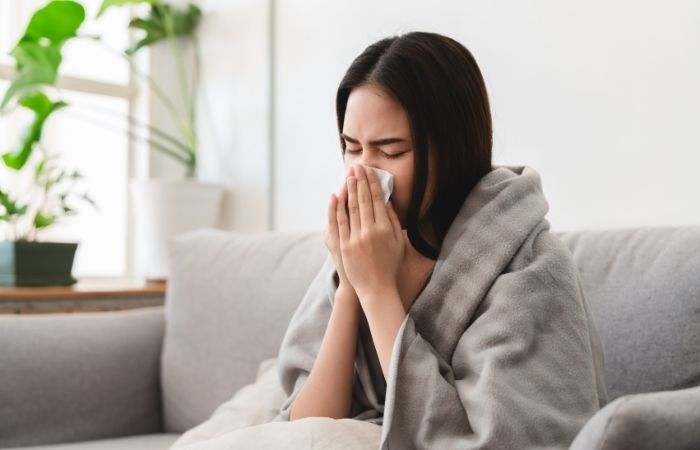
How to separate flu, COVID-19, and an early STI
No symptom checklist perfectly separates a viral upper respiratory illness from acute HIV or secondary syphilis. The symptom overlap is too tight. Useful clues exist.
Recent sexual exposure within the symptom window. A new partner, a missed condom, or any unprotected exposure within roughly the last 2 to 12 weeks is the single biggest signal that an STI deserves consideration. Without that exposure on the timeline, the math on common viral illness wins by a wide margin.
The respiratory tract. Influenza and COVID-19 both produce some combination of nasal congestion, cough, runny nose, and postnasal drip. None of the flu-mimicking STIs in this article reliably do that. A fever and body aches with no cough or congestion suggest a systemic immune response (mononucleosis, acute HIV, secondary syphilis, primary herpes) more than a respiratory virus.
Loss of taste or smell. A telltale early-COVID feature in 2020 and 2021, this has become less common with newer SARS-CoV-2 variants, but when it occurs it points firmly toward COVID-19 and away from both influenza and any of the flu-mimicking STIs.
Onset speed. Influenza typically arrives over hours, with a person fine in the morning and miserable by evening. COVID-19 tends to build gradually over days. An acute STI builds gradually too, on a longer fuse (2 weeks to 3 months after exposure for the systemic phase to begin), so the sudden-versus-gradual signal helps separate flu from COVID, less so flu from STI.
Lymph node pattern. Both viral illnesses and several STIs swell lymph nodes, but the pattern can differ. Generalized lymphadenopathy (multiple groups of nodes swelling at once: cervical, axillary, inguinal) is more typical of acute HIV and secondary syphilis. Local lymph node swelling near a herpes outbreak site or a syphilis chancre is a more common primary-infection pattern. Flu and COVID-19 lymph node swelling is usually limited to the neck and resolves with the rest of the illness.
Rash. Influenza and COVID-19 rarely produce a rash. Secondary syphilis often involves one (notably on the palms and soles). Acute HIV can produce a non-itchy macular rash on the trunk. Primary herpes produces grouped vesicles rather than a diffuse rash. A rash that pairs with fever after a possible sexual exposure should bump testing higher on the list.
Symptom duration and resolution. Influenza tends to peak in 2 to 4 days and fade within 7 to 10. COVID-19 acute illness usually resolves within 1 to 2 weeks. Acute HIV symptoms can drag on for several weeks before resolving, even as the underlying infection persists. Symptoms that pass two weeks, fade and return, or appear in unusual combinations are worth a clinical evaluation regardless of cause.
None of these clues is diagnostic on its own. They sharpen the question of whether testing is worthwhile, which is what the next sections cover.
| Sign | Influenza | COVID-19 | Acute HIV | Secondary syphilis | Primary herpes |
|---|---|---|---|---|---|
| Onset after exposure | 1 to 4 days | 2 to 14 days | 2 to 4 weeks | 6 weeks to 6 months after chancre | 2 to 12 days |
| Cough or congestion | Common | Common | Rare | Not typical | Not typical |
| Loss of taste or smell | Rare | Possible (less common with newer variants) | Not associated | Not associated | Not associated |
| Generalized lymph node swelling | Limited (cervical) | Limited (cervical) | Common, multiple groups | Common, multiple groups | Local first, then nearby groups |
| Rash | Rare | Rare | Truncal, non-itchy macular | Palms, soles, trunk | Vesicles at exposure site |
| Genital sores | No | No | No | Painless chancre may have appeared earlier | Yes (vesicles) |
| Resolution without treatment | 7 to 10 days | 1 to 2 weeks | A few weeks, then asymptomatic latent stage | Resolves into latent stage | 2 to 3 weeks, recurs |
| What detects it | Rapid flu test (nasal swab) | Rapid antigen test (nasal swab) | HIV NAT or 4th-generation antigen-antibody lab test | RPR plus treponemal antibody test | Swab PCR of active lesion, or type-specific antibody |
Why these infections slip past detection, and what that can cost
Flu-like STI symptoms slip past detection partly because they are non-specific and partly because the cultural script for fever and aches points elsewhere. Fever, fatigue, sore throat, and swollen glands fit dozens of viral and bacterial illnesses; the body uses the same toolkit regardless of the trigger. On top of that, most people who feel feverish and achy do not connect the feeling to a sexual encounter two to four weeks earlier, so the workup runs through respiratory viruses long before STI testing comes up.
For acute HIV, the detection gap is built into the biology. Viral load is high, antibodies have not yet developed, and antibody-only screening can miss the infection during the very period when a person is most infectious to partners. A meaningful share of new HIV transmissions traces back to people who do not yet know they carry the virus, which is one reason the CDC pushes testing whenever the timeline fits (CDC, HIV Testing).
The stakes are highest when a hidden infection is treated as a passing virus. Acute HIV is the highest-yield moment to start antiretroviral therapy: early treatment preserves immune function and, once viral load is suppressed to undetectable, prevents sexual transmission to partners (CDC, HIV Treatment). Untreated syphilis moves into latent stages and can affect the heart and nervous system years later. Untreated hepatitis B can become chronic and damage the liver. Catching any of these in the acute phase turns a complicated long-term problem into a manageable one.
There is also a quieter cost. Once a flu-like illness fades, the prompt to test usually fades with it. By the time the next clue appears (HIV at an advanced stage, latent syphilis, recurrent herpes, chronic hepatitis), the window for simple early treatment has closed, and working out what happened becomes harder, both clinically and emotionally.
Acute HIV carries the highest viral load of any disease stage and is one of the most infectious phases for partners. It is also the phase most likely to be written off as influenza, COVID-19, mononucleosis, or a non-specific viral illness. If flu-like symptoms appear 2 to 4 weeks after a possible HIV exposure, an early test is the right move for your own diagnosis and for partner protection: a clinic NAT can detect infection from about 10 to 33 days, and a home antigen-antibody test becomes useful from around 18 days.
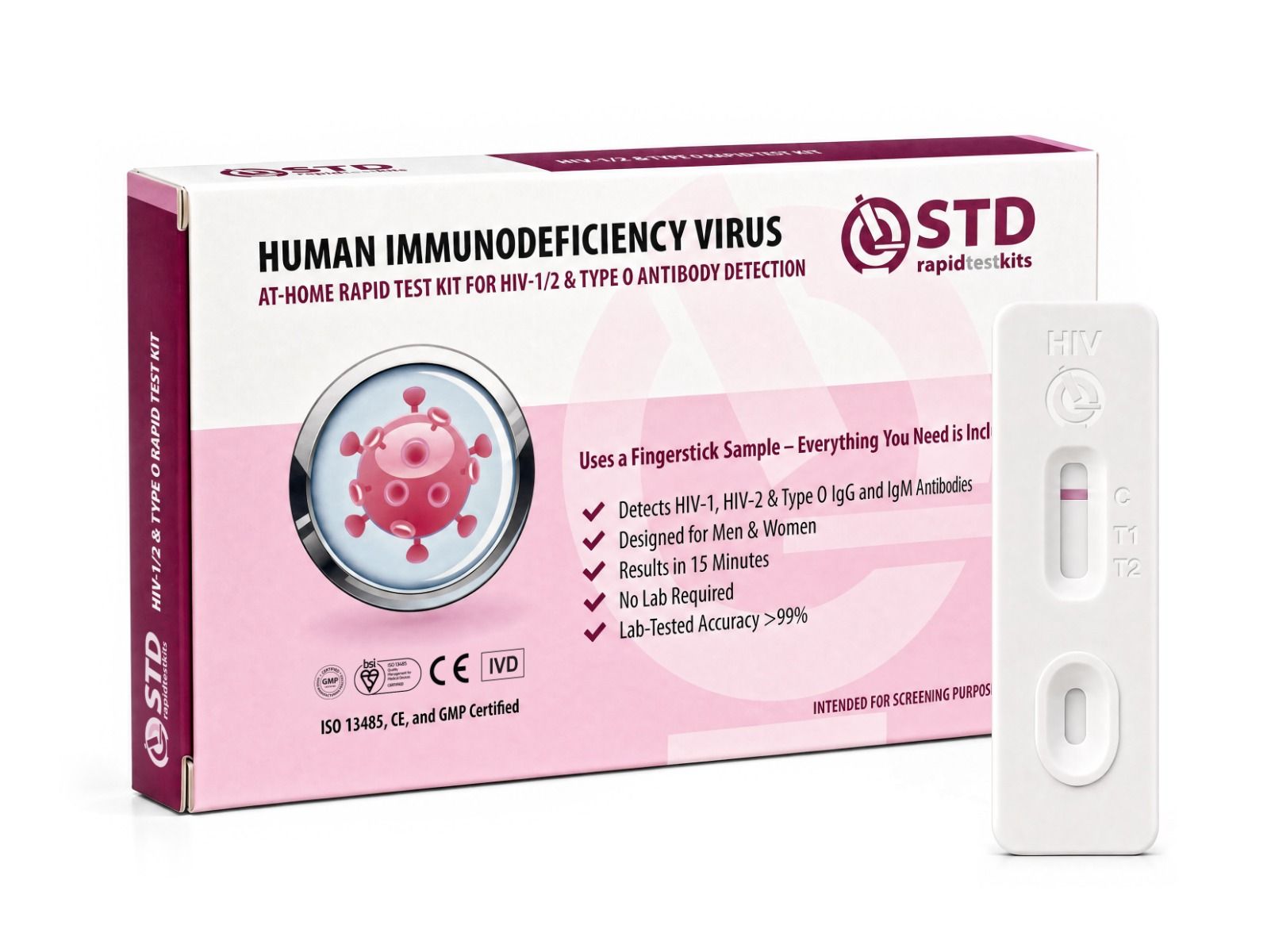
We publish this guide and also sell at-home HIV and STI rapid kits. We recommend a test here only when it fits the reader's timeline and concern, and we explain exactly what each one detects.
When home tests can actually find these infections
Home rapid tests have window periods. So do clinic tests. Testing too early produces a false negative, which feels reassuring exactly when it should not. Match the test to the timeline.
HIV. The CDC publishes window periods by test type:
- Nucleic acid tests (NAT, used in clinics for early detection): 10 to 33 days after exposure
- Antigen/antibody lab tests (fourth generation): 18 to 45 days
- Antigen/antibody rapid tests (the fingerstick technology our at-home HIV test uses): 18 to 90 days
- Antibody-only tests: 23 to 90 days
A home rapid HIV test taken at 4 weeks may catch most acute infections but will miss some. Pair an early home test with repeat testing at 6 to 12 weeks, or get a clinic NAT if flu-like symptoms appear during a possible acute window.
Syphilis. Antibody-based blood tests, including home rapid tests, usually turn positive 3 to 6 weeks after a chancre develops, roughly 6 to 12 weeks after exposure. Secondary syphilis nearly always tests positive on antibody-based testing. A negative test in the first 3 weeks after exposure does not rule infection out.
Herpes. Type-specific HSV antibody tests, including HSV-2 home tests, detect antibodies that develop 4 to 12 weeks after primary infection, sometimes longer. The CDC's STI Treatment Guidelines recommend repeating type-specific HSV-2 antibody testing 12 weeks after the presumed time of acquisition when recent exposure is suspected (CDC, STI Treatment Guidelines: Genital Herpes). Antibody tests do not diagnose an active lesion; for an active outbreak, a clinic swab PCR is the right test.
Hepatitis B. The home test detects HBsAg, the surface antigen of an active infection. HBsAg becomes detectable on average 30 days after exposure, with a range of about 6 to 60 days, per CDC MMWR serologic testing guidance. Symptoms usually appear later than the test turns positive.
Hepatitis C. The home test detects HCV antibodies, which develop 4 to 10 weeks after infection and are present in roughly 97% of people by 6 months, per CDC MMWR HCV testing recommendations. For an exposure within the last 6 months, the CDC recommends a nucleic acid test for HCV RNA rather than an antibody test, because it catches the infection earlier.
Early flu-like symptoms after a recent exposure can pre-date what most home tests can find. A negative result inside the window is not an all-clear. Repeat at the right interval, or use a clinic test that detects infection earlier. If an exposure happened within the last 72 hours and HIV is the concern, post-exposure prophylaxis (PEP) is time-critical and needs a clinic, not a home test (CDC, HIV PEP).
Sample types do not interchange
A common confusion in at-home testing is which sample type detects which infection. The blood-based tests look for antibodies (or antigens) in your bloodstream; the swab tests look for the organism itself in the genital tract. Mismatching a sample to an infection produces a useless result, and there is no way for the cassette to flag the mistake.
Quick map of what gets tested how at home:
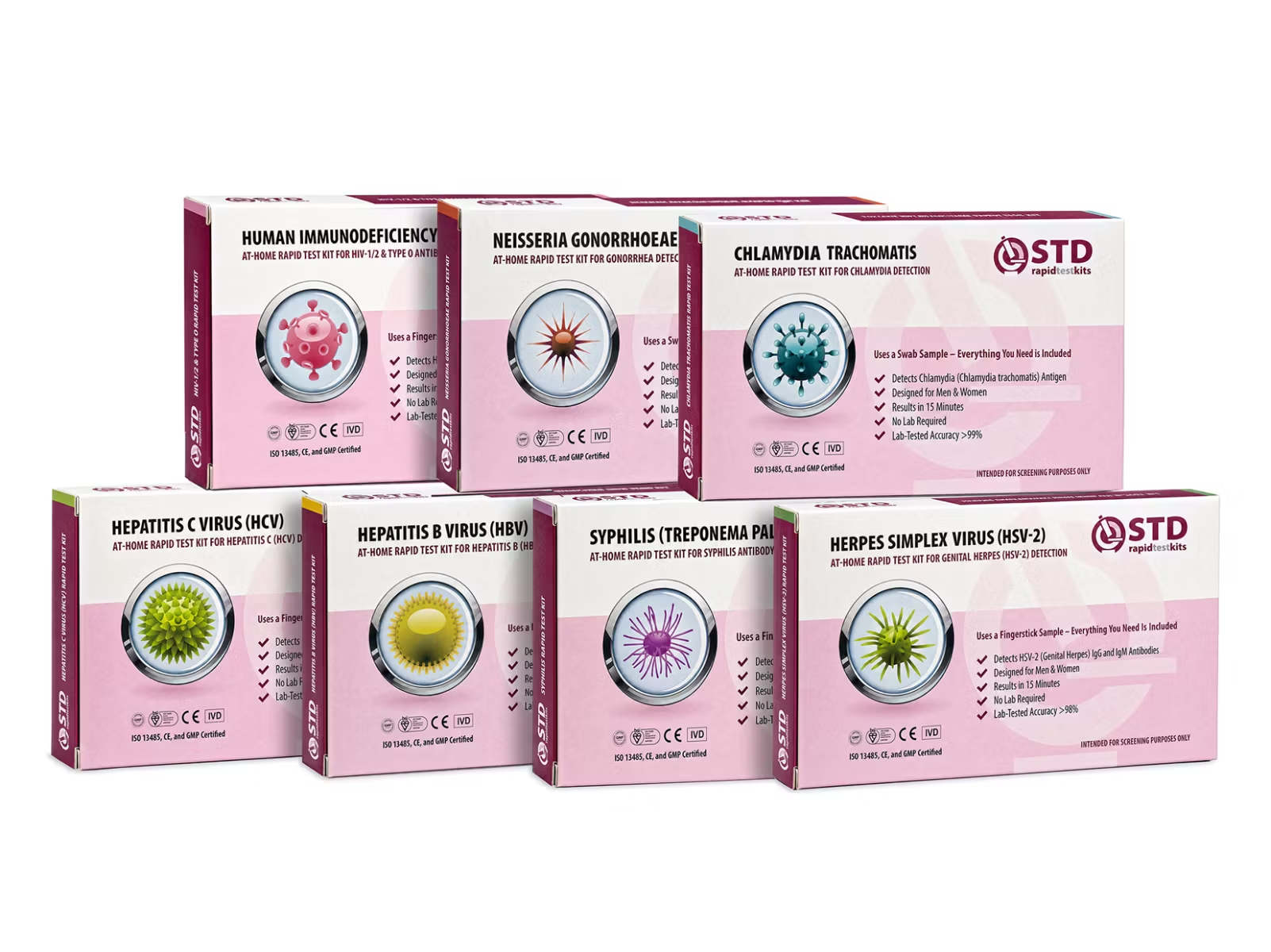
- Fingerstick blood lateral-flow test: HIV, syphilis, hepatitis B, hepatitis C, HSV-1, HSV-2.
- Self-collected genital swab: chlamydia and gonorrhea (vaginal swab for women, penile swab for men).
- Vaginal self-swab only: trichomoniasis and HPV. Our at-home trichomoniasis and HPV kits are validated for female anatomy. Men needing these tests should see a clinic.
If your concern is throat or rectal exposure (pharyngeal gonorrhea after oral sex, rectal chlamydia after receptive anal sex), an at-home kit is not the right tool. The bacteria do not reliably appear on a genital swab from a different anatomic site, and a fingerstick antibody test does not detect a localized mucosal infection. A clinic-administered swab is the correct test for that anatomic site.
The at-home rapid tests on this site are lateral-flow immunoassays, the same chemistry used in a home pregnancy test. Results appear in roughly 15 minutes on a cassette. They are accurate enough to be useful as a screening tier when used after the correct window period, but they are not a replacement for laboratory NAAT (nucleic acid amplification testing), which the CDC's STI Treatment Guidelines describe as the most sensitive and recommended method for detecting chlamydia (CDC, STI Treatment Guidelines: Chlamydia).
Blood (fingerstick): HIV, syphilis, hepatitis B, hepatitis C, HSV-1, HSV-2.
Genital swab (self-collected): chlamydia, gonorrhea.
Vaginal swab only: trichomoniasis, HPV. No male-compatible at-home version of these two.
Throat or rectal exposure: see a clinic. At-home kits do not cover those anatomic sites.
When to see a clinician instead of home-testing
Home rapid kits are good screening tools. They are not the right first stop for every situation. See a clinician (urgent care, primary care, or a sexual health clinic) directly if any of the following apply:
- The exposure was in the last 72 hours and HIV is a concern. Post-exposure prophylaxis (PEP) needs to start within 72 hours and is more effective the earlier it begins.
- The exposure was within the last 6 months and hepatitis C is a concern. The CDC recommends a NAT for HCV RNA rather than an antibody test in that window.
- You have an active genital lesion that needs sample-based testing (swab PCR for herpes, swab for chlamydia or gonorrhea, dark-field microscopy for a fresh syphilis chancre). Antibody-based home tests will not catch a current local infection in its first weeks.
- You have a fever above 39.5 °C (103 °F), severe headache with stiff neck, jaundice (yellowing of the eyes or skin), breathlessness, chest pain, confusion, or significant unexplained weight loss. These signal that home self-management is the wrong tool.
- You are pregnant or trying to conceive. Several STIs have clear pregnancy-related implications and routine clinical workup is more comprehensive than any single home kit.
- Your concern is a throat or rectal exposure that an at-home kit cannot test.
- You already have a positive home result and need confirmation, treatment, and partner counseling.
If you had a possible HIV exposure within the last 72 hours, post-exposure prophylaxis (PEP) is time-critical. See a clinic, urgent care, or emergency department today rather than ordering a home test. PEP started within 72 hours and taken for 28 days substantially reduces the chance of HIV infection. A home antibody test taken now will be falsely negative anyway, because the body has not yet produced detectable antibodies.
Lowering your risk through flu season
The same season that crowds clinics with respiratory illness is also when STI exposures hide most easily inside a fever. A few practical steps lower the risk of both at once.
- Use barrier protection. Condoms substantially reduce the risk of HIV, gonorrhea, chlamydia, and trichomoniasis transmission. Dental dams reduce oral STI transmission during oral sex.
- Vaccinate where you can. Influenza, COVID-19, hepatitis B, and HPV all appear on the CDC adult immunization schedule (CDC adult immunization schedule). Routine HPV vaccination is recommended through age 26, with shared clinical decision-making for adults aged 27 through 45.
- Screen on a schedule if you are sexually active. The CDC recommends HIV testing at least once for every adult aged 13 to 64, annual chlamydia and gonorrhea screening for sexually active women under 25 and older women with risk factors, and more frequent testing, every 3 to 6 months, for people with multiple recent partners.
- Watch the calendar on symptoms. Influenza usually fades within 7 to 10 days. A flu-like episode that drags past two weeks, fades and returns, or pairs with a rash deserves a closer look rather than more waiting.
Barriers: condoms and dental dams during the act itself.
Vaccines: influenza and COVID-19 each season; hepatitis B and HPV if not already covered.
Screening cadence: HIV at least once between ages 13 and 64; annual for sexually active women under 25; every 3 to 6 months with multiple recent partners.
Duration check: any flu-like episode that runs past two weeks warrants testing, not waiting.
What to do this week if you're worried
Most situations follow a short, practical sequence. Start by writing down two dates: the most recent higher-risk or unprotected exposure, and the day your symptoms started. The gap between them decides which test makes sense and when. The quick decision flow below covers the common branches. A confirmed diagnosis always comes from a clinic, with the home cassette as the screening step, and whatever the result, anyone who shared sexual contact during the exposure window deserves a heads-up so they can test on their own timeline.
Should you test this week?
Was the possible exposure within the last 72 hours and is HIV a concern?
Yes: Go to a clinic, urgent care, or emergency department today for PEP. It has to start within 72 hours, and a home test would read falsely negative this early.
Has it been fewer than 18 days since the exposure?
Yes: A home antigen-antibody test is still too early to trust. Get a clinic NAT (reliable from about 10 days) or wait until at least 18 to 21 days for a home test.
Is more than one infection on your mind, or were there several exposure types in one encounter?
Yes: A multi-infection home panel covers more ground in one sitting than testing one infection at a time. Confirm any positive result with a clinic test, and notify recent partners.
No: An HIV-only home test fits a single specific worry. Confirm any positive result with a clinic test before acting on it, and notify recent partners.
Guidance only. A clinician can advise based on your specific situation.
Frequently asked questions
- Can flu-like symptoms be the only sign of an STI?
- Yes, particularly in acute HIV, primary herpes, and secondary syphilis. Many cases of acute hepatitis B and C are asymptomatic, but those that do produce symptoms can resemble a moderate flu. Genital symptoms are not required for systemic STI symptoms to appear.
- How soon after a possible exposure can flu-like STI symptoms show up?
- Acute HIV symptoms typically appear within 2 to 4 weeks of exposure per the CDC. Primary herpes can begin within 2 to 12 days. Secondary syphilis usually develops 6 weeks to 6 months after the initial chancre. Hepatitis B symptoms tend to begin around 90 days after exposure; hepatitis C symptoms within 2 to 12 weeks.
- Does COVID-19 cause STI-like symptoms, or vice versa?
- COVID-19 produces flu-like symptoms (fever, fatigue, sore throat, body aches) that overlap with acute STIs, but COVID-19 is not a sexually transmitted infection. The overlap is in symptoms only, not in how the infections spread. Standard COVID testing (rapid nasal antigen) rules out COVID; STI testing (blood or genital swab) rules out STIs. Both can be done in parallel if both are on the differential.
- Can I have an STI with no genital symptoms at all?
- Yes, and often. Many chlamydia and gonorrhea infections cause no symptoms at the genital site, and HIV, syphilis, and hepatitis B can be present for years without local signs. Routine periodic screening, not symptoms, is what catches these infections early enough for straightforward treatment.
- Are there flu-like STI symptoms that should send me to a clinic immediately?
- Yes. A high fever above 39.5 °C (103 °F) that does not respond to standard care, severe headache with neck stiffness, jaundice (yellowing of skin or eyes), or any symptom appearing within 72 hours of an HIV-risk exposure all warrant clinic visits rather than home testing. Post-exposure prophylaxis for HIV needs to start within that 72-hour window.
- Can I rule out an STI with a home rapid test if I tested negative soon after symptoms started?
- Not if you tested before the window period closes. For HIV, home antigen-antibody kits are unreliable before 18 days post-exposure, while a clinic NAT reaches back to about 10 days. For hepatitis C within 6 months of exposure, the CDC recommends an HCV RNA nucleic acid test rather than an antibody kit. Repeat testing at 6 to 12 weeks gives a cleaner picture for most infections.
- If I had unprotected sex but feel completely fine, should I still test?
- Yes. Several STIs (chlamydia, gonorrhea, hepatitis C, early HIV) are commonly asymptomatic. CDC routine screening recommendations are based on exposure history and risk factors, not on symptoms. Feeling fine does not mean uninfected.
- How accurate are home rapid tests for the STIs that produce flu-like symptoms?
- Sensitivity and specificity vary by infection and kit. Check the product page or package insert for each test's stated clinical performance and the window period the manufacturer validated. Home rapid lateral-flow tests are screening tools rather than diagnostic confirmations. A positive home result needs confirmation with a clinic-based laboratory test (NAT for HIV, RPR plus treponemal antibody for syphilis, viral load PCR for hepatitis C).
- U.S. Centers for Disease Control and Prevention. About HIV: stages of infection, including the typical 2 to 4 week onset of flu-like symptoms (acute retroviral syndrome) and the note that symptoms may last a few days to several weeks.
- U.S. Centers for Disease Control and Prevention. HIV Testing: window periods by test type (NAT 10 to 33 days, antigen/antibody lab test 18 to 45 days, rapid antigen/antibody test 18 to 90 days, antibody-only test 23 to 90 days).
- U.S. Centers for Disease Control and Prevention. About Syphilis: secondary-stage symptoms (fever, swollen lymph glands, sore throat, patchy hair loss, headaches, weight loss, muscle aches, fatigue) and the rash that can appear on the palms and soles.
- U.S. Centers for Disease Control and Prevention. MMWR Recommendations and Reports. Hepatitis C testing: anti-HCV detection 4 to 10 weeks after infection, presence in roughly 97% of people by 6 months, and the NAT-for-HCV-RNA approach for recent exposures.
- World Health Organization. HIV and AIDS fact sheet: early infection can produce an influenza-like illness (fever, headache, rash, sore throat), and many people are unaware of their status until later stages.
- U.S. National Library of Medicine (NIH), MedlinePlus. HIV: the first signs of HIV infection may be flu-like symptoms that come and go within two to four weeks (acute HIV infection).
