
Published: November 2025 | Last updated: May 2026 | Editorial review and quality control: Martina N.
The moment a positive STI result lands is hard enough on its own. When the person you tell reacts with blame instead of care, you are now processing the result and defending your character at the same time. Before you scramble to do either, take a beat. The test described what is happening in your body right now. It did not describe your honesty, your loyalty, or where the infection came from, and it cannot answer those questions even if your partner insists it does.
This piece is for people sitting in that exact moment. It covers why blame so often surfaces, what a positive test can and cannot show, calm phrasing that holds a line without escalating, and the point where a partner's reaction becomes a safety issue rather than a relationship one. You do not owe anyone an apology for getting tested.
Key Takeaways
- A positive test today rarely identifies who passed an infection to whom, because many STIs can stay silent in the body for weeks, months, or years before any test turns positive.
- Your responsibility ends at disclosure. You are not responsible for how a partner reacts, and a partner's blame is not evidence of your behavior.
Why blame so often surfaces after a positive STI test
Fear runs the first reaction in most of these conversations, not logic. STIs still carry cultural baggage that ties them to dirtiness or infidelity, so a partner can hear “I tested positive” and translate it instantly into “you cheated.” That translation has no evidence behind it. It is a reflex pulled from a script that most people were never taught to question.
A few things commonly fuel the panic: shame about telling their own future partners, fear about their own health status, and a knowledge gap around how STIs actually behave. The CDC's STI overview notes that many STIs cause no symptoms or only mild symptoms, and people may carry them without knowing. That alone makes “who gave it to whom” a question the test usually cannot answer, no matter how loudly anyone asks.
Grounding yourself before responding matters here. Are you physically safe? Do you have the bandwidth for this conversation right now, or do you need to ask for space first? Those two questions come before any script.
Many people carrying an STI have no symptoms and no idea they have it, per the CDC. That is exactly why a test result on its own cannot tell either partner when transmission happened or from whom. A blame reflex usually says more about cultural scripts around STIs than it does about either person in the conversation.
What a positive test can prove, and what it cannot
The most common demand in these conversations is some version of “Then who gave it to who?” The honest answer is usually: the test cannot tell you. Different STIs have different incubation windows and different detection windows, and many people carry an infection with no symptoms for long stretches of time.
If you test positive for herpes and your partner has never tested positive, that does not mean you carried it into the relationship. The CDC notes that the majority of people living with genital herpes do not know they have it, because outbreaks are mild or absent. Either of you could have carried HSV for years before today's result. A positive does not write a transmission story.
The table below gives a sense of how incubation and detection windows overlap. The point is not the exact numbers. The point is that the overlap is large enough that pointing fingers at a specific date or person is rarely supported by what the test actually shows.
| STI | Typical incubation | When tests turn positive | Can the test name who had it first? |
|---|---|---|---|
| Chlamydia | 7–21 days | Lab NAAT detects roughly 1–2 weeks after exposure | Rarely; most cases are asymptomatic in women per the CDC's chlamydia overview at cdc.gov/chlamydia |
| Gonorrhea | 2–7 days | Lab NAAT detects roughly 1–2 weeks after exposure | Only when one partner's symptoms clearly precede the other's |
| HPV | Weeks to years | Cervical screening detects months to years later; warts appear weeks to months out | No; HPV can stay latent for years |
| HSV-2 (genital herpes) | 2–12 days for a primary outbreak | Swab or PCR during an active outbreak; blood antibody tests may take several weeks to a few months to detect seroconversion, so ask your clinician about the right test for your situation | No; most carriers are unaware they have it |
If a partner blames you the moment you disclose, what should you actually say?
Start by grounding yourself before any scripted response. Then say something short and factual: “This test result does not tell us who had it first, and many STIs can stay silent for months. I tested because I care about my health. I am willing to keep talking when things are calmer.” You are not obligated to defend your character. You are not obligated to keep talking if the conversation turns hostile.
Phrases that hold the line in the heat of the moment
When someone is spiraling, careful logic does not reach them. Having a few short sentences ready can keep the conversation from collapsing into accusation. The goal is to anchor yourself, not to win, so you do not say something you would regret while your nervous system is still hot.
Phrases that other people have found steadying include:
- “I am telling you because I care about your health and mine, not because I want to fight.”
- “I am still learning what this means. This conversation is not about whose fault it is. It is about getting the right care.”
- “I do not know when or how I got this. I know it is common, and I wanted to be honest with you.”
- “I will not be shamed for taking care of my health.”
If none of that lands, a quieter sentence works too: “I need some time before I can keep talking about this.” That pause is regulation, and stepping out of the room for ten minutes (or ending the conversation for the day) often works better than pushing through a hostile exchange while both of you are dysregulated.

How different blame reactions tend to sound
Not every accusation arrives as shouting. Sometimes it shows up as a silent disappearance, a frozen panic about their own health, or a righteous lecture about your past. Recognizing the shape of the reaction helps you choose a response that does not pour fuel on it. The grid below pairs common reactions with one possible reply you can borrow.
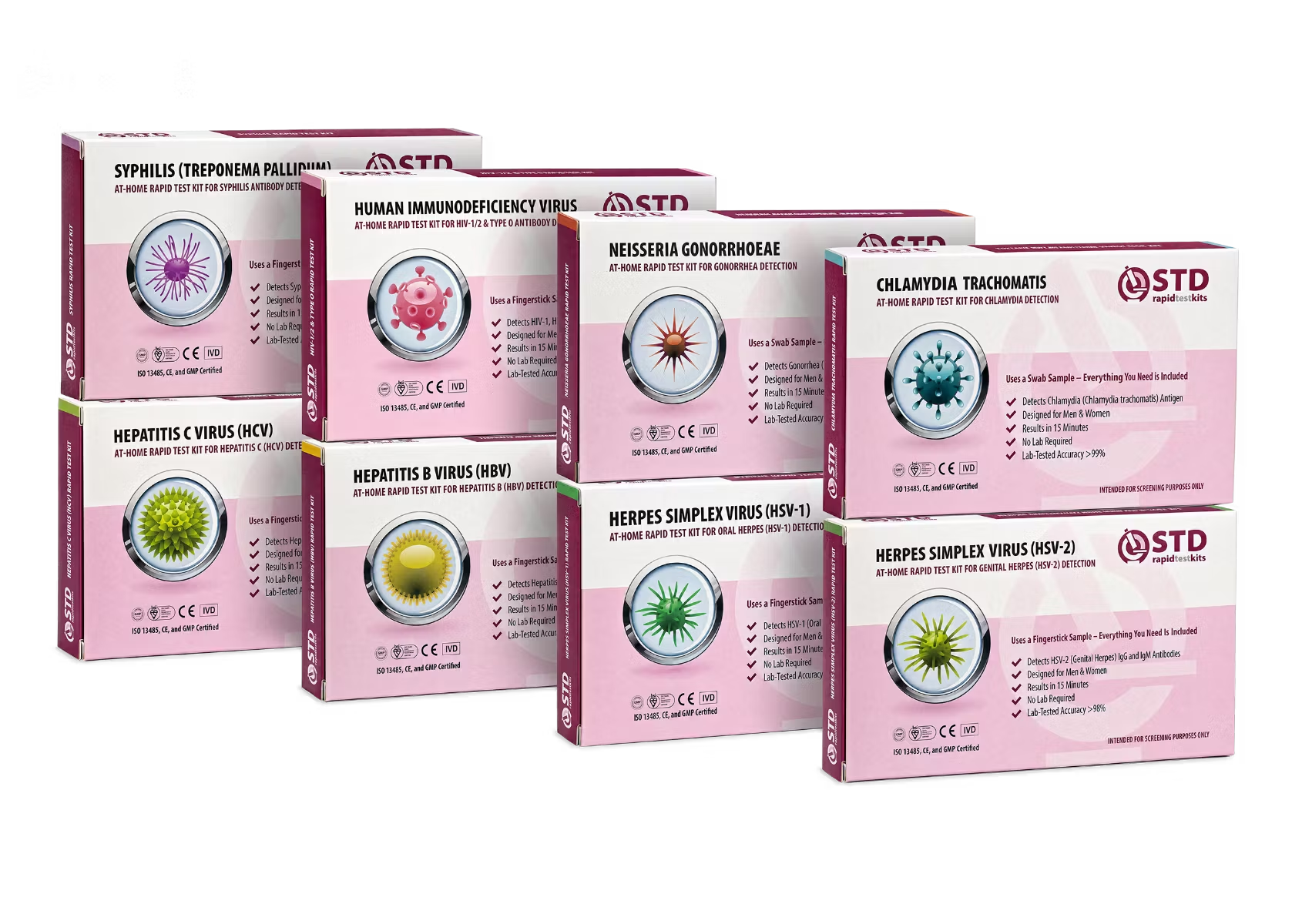
A quick disclosure before the first product mention in this article: stdrapidtestkits.com sells at-home rapid STI tests. We recommend kits based on fit for the reader's concern, not commercial benefit, and the kit below is included because retesting often comes up after a conversation like this.
| Reaction | What it might sound like | One way to respond |
|---|---|---|
| Accusatory | “You must have cheated.” / “You are lying.” | “I understand this is scary, but I will not be spoken to like this. The test does not prove what you are saying.” |
| Silent withdrawal | Disappears, stops replying, ghosts entirely | “I hope we can talk when you are ready. I tested because I care about both of our health, not to cause distance.” |
| Emotional collapse | “You ruined my life.” / Sobbing or panic | “I hear you. This is overwhelming. Most STIs are treatable or manageable. Let us take a breath and talk through next steps.” |
| Righteous rage | “I have never had anything! You brought this into my life!” | “I do not know where this came from. Many infections are silent for months. That is why testing matters, for both of us.” |
When the accusation is specifically about cheating
This one carries its own sting. The cultural script ties a positive STI result to infidelity so tightly that even partners who know better can flinch toward it. If you did not cheat, you do not have to debate that point. You can name the test's limits and let the science do some of the work.
Some partners land in those reframes within a day or two of cooling down. Others will not, because their working model is “positive equals betrayal,” and no fact dislodges that on the spot. That is not your job to fix mid-argument. Walk away from the courtroom, even if the relationship continues outside of it.
- “I did not cheat. I understand that is hard to believe right now. I tested because I wanted to be proactive about my health.”
- “If I had symptoms, I would have said something sooner. Many STIs do not show symptoms. I am not hiding anything from you.”
- “I get that this feels like betrayal. The hard reality is that either of us could have carried this without knowing.”
Whether retesting helps, and how to talk about past partners
Sometimes the conflict is not really about the result. It is about the timing. Maybe your last test was six months ago. Maybe your partner has never tested. Maybe you used condoms most of the time but not always. The timelines get blurry quickly, which is one reason a follow-up test is often part of the picture.
Current clinical practice generally recommends confirming a positive home result with a lab test where possible, and many providers recommend retesting for chlamydia or gonorrhea around three months after treatment to rule out reinfection. The CDC's STI hub and its treatment guidelines have more on this, including which infections call for repeat screening. Retesting does not mean you are guilty. It means you are being careful, and it gives both of you a clearer picture moving forward.
Talking about past partners is a different conversation. You do not owe a comprehensive sexual history spreadsheet to the person across from you. You owe honesty about anything relevant to current safety. Two phrases that protect that line:
- “I have had partners before you, yes. I cannot tell you which one this came from, or when. That is why I test.”
- “I am not looking for someone to blame. I want both of us to be safe moving forward, and to make sure anyone else who needs to know is told.”
If notifying past partners is part of what comes next, you do not have to make those calls yourself. Many sexual-health clinics and state public-health departments offer anonymous partner-notification services, where a clinician contacts past partners on your behalf without naming you. The CDC describes this framework in its <a href="https://www.cdc.gov/hivnexus/hcp/partner-services/index.html" target="_blank" rel="noopener">partner-services guidance</a>, and many clinics extend the same approach to bacterial STIs.
When blame stops being a reaction and becomes a safety issue
Some partners cross a line. Threats, manipulation, name-calling that does not stop when you ask it to stop, doxxing your test result to mutual friends, physical intimidation. None of that is acceptable. None of it is something a positive test gives anyone permission to do, and none of it is your fault for disclosing.
If a partner's reaction puts you in physical or emotional danger, your safety comes first and the relationship conversation comes much later, if at all. Practical steps to consider in this scenario:
- Step out of the immediate conversation. Leave the room or the apartment. Resume later only if it feels safe.
- Talk to a clinician or counselor at a sexual-health clinic, who can also handle anonymous partner notification on your behalf.
- Reach a domestic-violence hotline if the reaction includes threats, intimidation, or controlling behavior. In the U.S., the National Domestic Violence Hotline is 1-800-799-7233, available 24/7.
- Document what was said in writing, screenshot any threatening messages, and tell at least one trusted person what is happening.
A positive STI test is a health event. It is not a license for anyone to weaponize your vulnerability. If the reaction you are getting feels like the latter, that is information about the partner, not about you.
Many STIs have no symptoms or may only cause mild symptoms, so it is possible to have an infection and not know it.
Healing language vs harmful language
If you decide to keep the conversation going past the first reaction, the words both of you use will shape whether it leads anywhere useful. Some common blame phrasings have clean reframes that move the discussion forward instead of looping it around fault.
| Harmful phrasing | Why it hurts | Healing reframe |
|---|---|---|
| “You gave this to me.” | Assigns blame without evidence the test can support | “Let us both get tested and talk through treatment together.” |
| “You must have cheated.” | Jumps to a conclusion based on stigma, not biology | “I want to understand when this could have happened, without throwing blame.” |
| “You ruined everything.” | Uses shame as a weapon and shuts the conversation down | “This is hard. I want us to work through it together if we can.” |
| “I do not believe you.” | Dismisses honesty offered at a vulnerable moment | “I need time to process this. I appreciate you telling me.” |
Finding support that is not your partner
The number of people in this situation is much larger than it feels in the moment, per CDC surveillance data, and the World Health Organization reports more than 1 million curable STIs acquired worldwide every day. Whatever your partner is saying about how rare or shameful this is, the math says otherwise.
When you are still raw from the conversation, having someone in your corner who is not the person who just yelled at you helps. Possible sources of that backup:
- A sexual-health clinic counselor, who can both walk you through results and help with anonymous partner notification
- A therapist who specializes in sexual health or post-disclosure trauma
- A peer-support community for people living with the specific STI you tested positive for
- A friend who can listen for one hour without making the conversation about themselves
- A nurse or clinician who can explain your specific result in plain terms and answer questions about treatment
What comes after the conversation
What matters is not isolating. Shame thrives in silence. The first time you say the word “positive” out loud to someone safe, it loses a meaningful amount of its weight, and the practical next steps suddenly feel less impossible to face.
After that, the steps follow in their own order: treatment if needed, follow-up testing on the schedule your clinician recommends, and notifying anyone who needs to know. Most clinics can handle that notification anonymously through their public-health team if you do not want to make the call yourself, so you do not have to carry that piece alone either.
You are not dirty, regardless of what they say
One last reminder, because the words from a partner in panic can outlast the test itself. Testing positive for an STI does not make you reckless or unworthy of love and care. It makes you someone who decided to know your status, and that decision protects every partner you will ever have, including the one who just yelled at you.
If a partner calls you names, says you “deserve” this, or insists you must have done something wrong to end up here, that is a window into their ignorance about how STIs actually work. It is not a window into your character. You can step out of that conversation and keep walking. There is no scoreboard.
What there is, on the other side of this, is a clearer picture of who responds to a hard truth with maturity and who responds with cruelty. The relationships that survive a positive test almost always survive on the strength of the response, not the diagnosis. If yours did not survive it, that is grief worth honoring, and also a signal worth trusting.
Carry this with you
- Testing is an act of care, not a confession. A positive result describes your health, not your character.
- How a partner responds to your disclosure is information about them. It is not a verdict on you.
Frequently asked questions
- Can someone pass me an STI without knowing they have it?
- Yes, and that is one of the most important things to know in this whole conversation. Per the CDC, many STIs are asymptomatic or only cause mild symptoms, which means many people carrying them have no idea. A partner can transmit an infection in good faith for months or longer before any test catches it.
- Does testing positive mean I cheated?
- No. It means you tested. STIs do not come with timestamps, and they do not correlate cleanly with recent versus older exposures. Unless you have a documented negative test from a specific recent date and only one possible exposure since, the test cannot tell you when this happened or with whom.
- What if my partner accuses me the moment I disclose?
- Their first reaction is not your responsibility to fix. Panic and fear can come out as accusations. You can name what is happening (“I hear that this feels scary, but I will not be spoken to like this”) and pause the conversation. Some partners come back to a reasonable place within 24 to 48 hours once the panic settles.
- Should I tell future partners about my STI?
- Yes, before things become physically intimate. You do not need to lead with it on a first date, but ongoing intimate partners deserve the information so they can make their own choices about testing and protection. Many people respond with appreciation for the honesty, especially if you can also share what treatment or management looks like.
- If we both test positive, can we tell who had it first?
- Only if one partner has a lab-confirmed negative test from a date after your most recent contact, which is rare in practice. Otherwise no. The detection-window and incubation-window overlap is wide enough for most STIs that ordering the timeline from test results alone is unreliable. Focus on what comes next: treatment for both of you, follow-up testing, and any partner notification needed.
- I am scared to get retested. What if it is worse than I thought?
- That fear is normal. Not knowing does not protect you, though. Most STIs are treatable, manageable, or curable, and the ones with the worst long-term outcomes have the most to gain from early detection. A follow-up test is also useful for confirming whether the first result was accurate, especially after an at-home screen.
- What do I say to someone who I think gave me an STI?
- Keep it factual and brief: “I tested positive for X, and I wanted to let you know so you can get tested too.” You do not need to accuse, debate the timeline, or argue about fidelity. Most jurisdictions allow anonymous partner notification through public-health services if you do not want to make the call yourself.
How we sourced this article: This guide draws on current guidance from the U.S. Centers for Disease Control and Prevention and the World Health Organization for medical accuracy around STI incubation, detection windows, and partner-notification practice. Communication scripts and case scenarios are composite illustrations grounded in patterns commonly described in peer-support communities and clinical-counseling resources; no individual reader is identified. Nothing here is a substitute for personalized advice from a licensed clinician.
- U.S. Centers for Disease Control and Prevention. About STIs (root information hub on STI prevalence, asymptomatic carriage, and screening).
- U.S. Centers for Disease Control and Prevention. STI treatment guidelines, including recommendations on confirmatory testing and retesting timelines for chlamydia and gonorrhea.
- U.S. Centers for Disease Control and Prevention. Partner services framework for anonymous partner notification. The same framework is extended in practice to bacterial STIs by many sexual-health clinics.
- U.S. Centers for Disease Control and Prevention. Chlamydia information hub, including asymptomatic-carriage notes.
- World Health Organization. Fact sheet on sexually transmitted infections (STIs), including global incidence estimates.
