
Published: August 2025 | Last updated: May 2026 | Editorial review and quality control: Martina N.
Seeing a new bump, a strange rash, or a burning sensation can flip your day upside down. Maybe it appeared after a hookup. Maybe it appeared with no recent risk and you still want to rule things out. Either way, the next few hours feel chaotic: half worry, half denial, and a strong urge to either ignore it completely or panic completely.
Take a breath. Most concerning genital symptoms are not caused by a sexually transmitted infection. Yeast infections, contact dermatitis, ingrown hairs, urinary tract infections, and friction irritation send millions of people Googling every week, and the answer for most of them is reassurance, not antibiotics. The smaller group who do need testing benefit from a calm, ordered plan, not a 2 AM spiral on Reddit.
This guide walks through seven concrete steps you can take in the next 24 to 48 hours: how to protect yourself and any partners while you wait for clarity, how to test in a way that fits your privacy and budget, and how to read whatever result comes back. We will not pretend every symptom is harmless. We will also not catastrophize. The goal is to replace fear with a clear next move.
Key Takeaways
- Most genital bumps and burning are not STIs, but visual self-diagnosis is unreliable in either direction; only testing tells you for sure.
- Stop sex now, pick a test that fits your exposure window, and tell partners before you have results, not after.
Step 1: Hit Pause on Sexual Activity
From the moment you suspect a possible STI, stop having vaginal, anal, and oral sex until you have a result. This single action accomplishes three things: it prevents you from passing an infection to a partner, it stops you from re-exposing yourself to a partner who may also be carrying something, and it gives any visible symptom a chance to settle so a clinician (or your home test) can read it accurately.
Many people skip this step because the symptom seems small (a single bump, a fleeting itch, mild burning) or because they assume waiting on a result is overkill. The CDC lists abstinence among its first-line STI prevention strategies and recommends that partners get tested and share results before resuming sex (CDC STI prevention). Two or three days of waiting is a small cost compared with unknowingly passing chlamydia, gonorrhea, or herpes to someone else.
What “pause” actually covers
- No vaginal, anal, or oral sex, including with a long-term partner you trust.
- No shared sex toys, even cleaned ones, until you have a result.
- If you notice visible sores or rashes, do not share towels or razors and avoid prolonged skin-to-skin contact in that area.
- If you live with a partner, a brief, calm sentence is fair: “I noticed something and I am getting tested. I want to wait until I have results before we have sex again.”
The pause is not a relationship referendum. It is a 48-to-72-hour information-gathering window. Frame it that way to yourself and to anyone you tell.
Step 2: Step Back From the Self-Diagnosis Spiral
Search engines and symptom-checker apps are extraordinarily bad at distinguishing between conditions that look almost identical: a herpes lesion versus an ingrown hair, a yeast infection versus trichomoniasis, a urinary tract infection versus early gonorrhea. Reverse image searches of “std bump or pimple” return matched photos from completely unrelated conditions, and the algorithm cheerfully serves you the most alarming match it finds.
Visual self-diagnosis fails for a structural reason. The early visible features of many STIs (small papules, vesicles, erosions, mild discharge) overlap with non-STI conditions almost perfectly. Even clinicians do not diagnose STIs from photos alone. They rely on swab cultures, NAAT (nucleic acid amplification test) panels, antigen-antibody blood tests, and microscopy. The CDC's diagnostic guidelines for syphilis, herpes, and chlamydia all list lab confirmation as required, not optional (CDC 2021 STI Treatment Guidelines). The NHS reinforces the same point, noting that many STIs produce no symptoms at all and that testing is the only reliable way to know your status (NHS sexually transmitted infections).
Common conditions that mimic STIs
- Yeast infection (candidiasis): itching, thick white discharge, redness. Not an STI.
- Bacterial vaginosis: thin gray discharge, fishy odor. Not an STI.
- Urinary tract infection: burning when peeing, urgency. Often confused with chlamydia or gonorrhea.
- Folliculitis or ingrown hair: a single tender red bump, often where you shave. Frequently mistaken for early herpes.
- Contact dermatitis: itching and rash from a new soap, lubricant, latex condom, or laundry detergent.
- Heat rash and friction irritation: small bumps from tight clothing, sweat, or recent sex.
The point is not to convince yourself it cannot be an STI. Visual identification is unreliable in either direction, so any time spent comparing photos is better spent ordering or scheduling a test. If you take one practical action right now, close the symptom-photo tabs.

Step 3: Arrange STI Testing Within the Right Window
Once you have decided to test, the question becomes when, where, and which test. The “when” depends on the infection and the date of possible exposure. Each STI has a window period: the time between exposure and when a test can reliably detect it. Testing too early produces a falsely negative result and a false sense of security.
Approximate testing windows from authoritative sources
- Chlamydia and gonorrhea: the CDC notes that chlamydia symptoms “may not appear until several weeks after” exposure, and the 2021 STI Treatment Guidelines describe NAAT testing as the diagnostic standard for chlamydia and gonorrhea (CDC chlamydia about; CDC STI Treatment Guidelines). For practical purposes, most clinics test from about two weeks post-exposure when there is no symptom, sooner if symptoms are present.
- Syphilis (blood antibody): the CDC STI Treatment Guidelines describe serologic testing as the diagnostic mainstay, with antibody response typically detectable within a few weeks of infection; many clinics retest at three months if an initial test is negative after a known exposure (CDC STI Treatment Guidelines).
- HIV: per the CDC, 4th-generation antigen-antibody lab tests detect HIV from about 18 to 45 days post-exposure; rapid antigen/antibody tests (including most modern home fingerstick kits) from about 18 to 90 days; antibody-only tests from about 23 to 90 days; nucleic acid (NAT/NAAT) tests detect earliest at 10 to 33 days (CDC HIV testing).
- Hepatitis B and C: antibody tests become more reliable over weeks to months after exposure; for recent exposures (within six months), the CDC recommends a NAT for HCV RNA rather than antibody testing alone (CDC hepatitis C testing).
- Herpes (HSV-2 antibody): the CDC states that after exposure it can take up to 16 weeks or more for current blood antibody tests to detect infection (CDC herpes testing). Active visible lesions are best swabbed by a clinician rather than waited out for antibody seroconversion.
If you are inside the window for the test you want, you can test today and trust the result. If you are outside it, plan a date to test and set a calendar reminder. Some people choose to test once now (to rule out anything from earlier exposures) and again at the appropriate window for the most recent one.
Where to test: clinic versus at-home
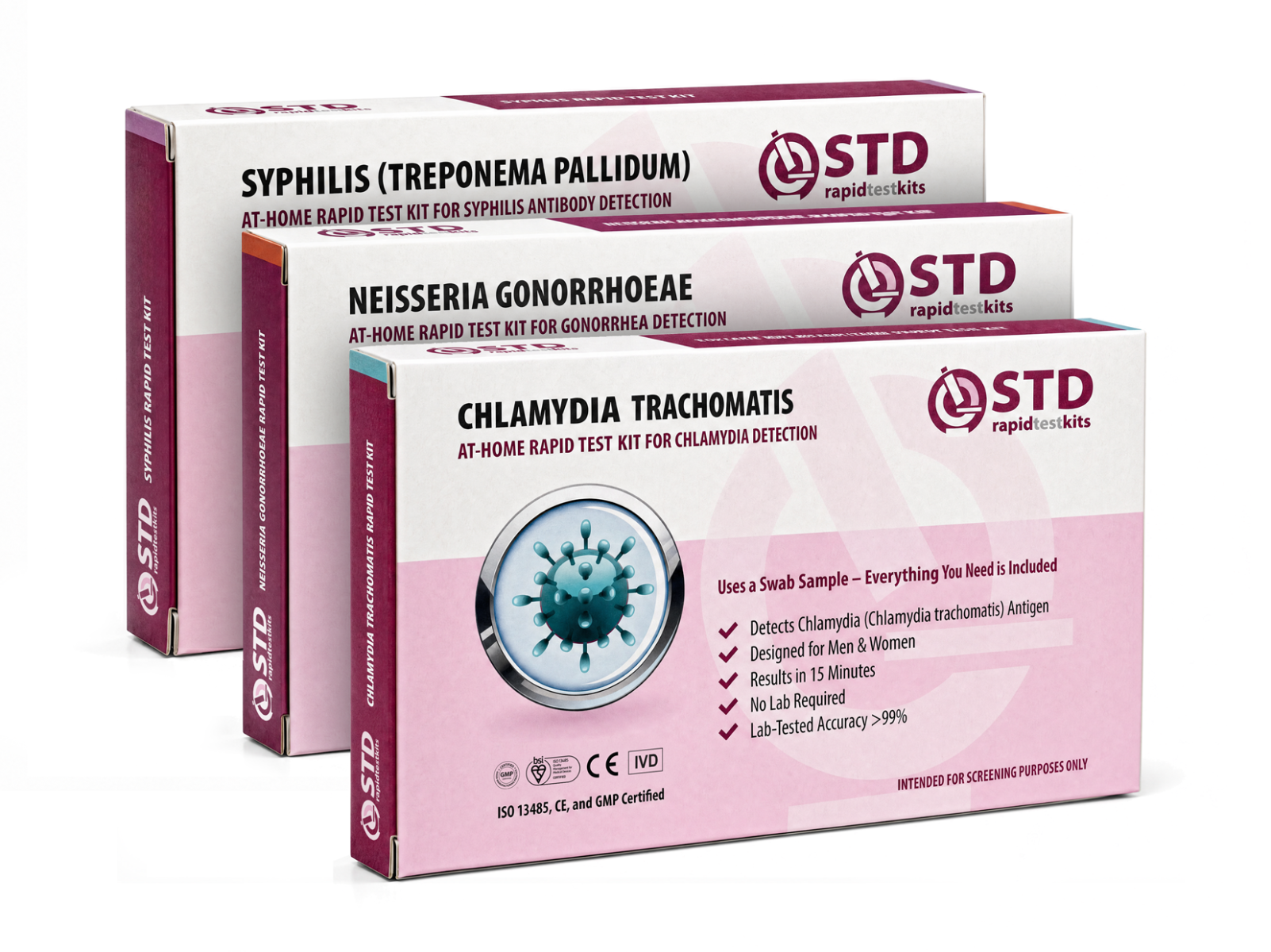
Both routes are legitimate; the right one depends on your priorities. Clinic testing is the better choice when you need same-day treatment if positive, when a clinician needs to look at a visible symptom, or when a sample type is needed that home kits do not cover (pharyngeal swabs for throat exposure, rectal swabs, or NAAT urine). At-home rapid testing is the better choice when privacy, speed, or simply avoiding a waiting room matters most. Home rapid kits are lateral-flow immunoassays: fast, private, and useful for screening, with sensitivity figures published on each kit's product page that typically sit in the mid-to-high 90s when used after the correct window. A positive result on any home rapid test should be confirmed by a clinic with a NAAT or full laboratory antibody panel before treatment.
stdrapidtestkits.com publishes this article and sells the kits referenced. Product recommendations are based on fit-for-purpose for the reader's concern, not commercial benefit. Where the right test for your situation is a sample type we do not sell (pharyngeal or rectal swab, lab-only NAAT), we say so plainly.
Step 4: Skip the Harmful “Home Remedies”
The internet is full of confidently wrong advice for sexual-health symptoms: vinegar washes for itching, toothpaste on a herpes blister, hydrogen peroxide on a sore, garlic suppositories for yeast. None of these have evidence behind them, several actively harm the tissue you are trying to protect, and a few make the underlying problem materially worse.
Specifically avoid
- Scrubbing or aggressive washing. Irritated skin gets worse with friction, not better. Lukewarm water and a mild fragrance-free soap once a day is enough.
- Popping or squeezing bumps. If the bump is herpes, popping it spreads viral particles and prolongs the outbreak. If it is folliculitis, popping it invites a secondary bacterial infection. Either way, leave it alone.
- Over-the-counter steroid creams on a suspected lesion. Topical steroids suppress the local immune response and can mask the diagnosis when you do see a clinician.
- Toothpaste, vinegar, bleach, hydrogen peroxide, essential oils. Chemical burns on already-irritated genital skin slow healing, create open wounds, and can introduce a separate skin infection.
- Antibiotics from a friend's old prescription. Wrong antibiotic, wrong dose, contributes to antibiotic resistance, and masks the lab tests you will need anyway.
The right care while you wait is gentle: lukewarm water, mild soap, loose cotton underwear, breathable cotton clothing, and patience. If pain is severe, an over-the-counter pain reliever like ibuprofen or acetaminophen is fine; targeted topical treatments should wait until you have a diagnosis.
- Wash once a day with lukewarm water and mild fragrance-free soap; pat dry.
- Wear loose, breathable cotton underwear; avoid tight synthetics until you have a result.
- For pain, an over-the-counter pain reliever like ibuprofen or acetaminophen is fine; skip topical creams until a clinician advises one.
Step 5: Track Symptoms (Without Doomscrolling)
Pay attention to your body, but write it down rather than refresh-search. A simple symptom log helps a clinician (or you, when reading your test result) understand the timeline and rule things in or out.
What to note in a symptom log
- Date and approximate time the symptom first appeared.
- Date of the exposure or activity that worried you.
- Description: location on the body, size in millimeters or coin-size, color, texture, painful or painless, itchy or not.
- Any change over the next 24 to 72 hours: bigger or smaller, more or fewer, color shift, drainage.
- Anything you tried (soap changes, antihistamines, loose clothing) and whether it helped.
- Any other symptoms anywhere in the body: fever, swollen lymph nodes, sore throat, joint pain, fatigue.
This kind of log replaces compulsive Googling with concrete information. It also makes a brief clinic visit far more productive: instead of “I think something has been wrong for a while,” you walk in with a dated record. If you order a home test, the same notes help you interpret a borderline or faint test line in context.
What a clinician most wants from your log
- Date of exposure and date the symptom first appeared.
- Size, location, color, and whether it is painful or painless.
Step 6: Talk to Your Partner Before You Have Results
This is the conversation that everyone wants to delay. The case for telling a partner before you have a confirmed result is straightforward: if you turn out to be positive, every day of delay is another day they could be passing it on themselves; if you turn out to be negative, an honest conversation about why you tested usually deepens trust rather than damages it.
Scripts that actually work
Keep the message short, factual, non-blaming, and forward-looking.
- “Hey, I noticed something that might need testing. I am getting checked. You might want to do the same so we both have peace of mind.”
- “I do not have results yet, but I want to be upfront. I would rather pause sex for a week than risk passing something to you.”
- “This is not about blame. I am telling you because I care about your health, not because I think anyone did anything wrong.”
For partners further back than the most recent one, many U.S. state and local public-health departments run partner-services programs that will, with your permission, contact previous partners anonymously on your behalf if you test positive. You provide names; the public-health team handles the conversation. Ask your local STI clinic or county health department whether this option is available in your area. The CDC's 2021 STI Treatment Guidelines also describe partner-management approaches clinicians can offer (CDC STI Treatment Guidelines).

Step 7: Move From Fear to a Plan
Once the result comes in, both outcomes are manageable and both have a clear next move.
If your test is negative
Take a breath. You are clear for the infections tested at the window you tested in. Two practical follow-ups apply. First, if your exposure was more recent than the window for the test you used, repeat the test in 2 to 4 weeks for shorter-window infections (chlamydia, gonorrhea), and at 6 weeks plus for syphilis and HIV. Second, if HIV exposure is an ongoing risk because of recent partners or partner status, talk with a clinician about pre-exposure prophylaxis (PrEP); the CDC states that when taken as prescribed, oral or injectable PrEP reduces the risk of getting HIV from sex by about 99 percent (CDC HIVNexus PrEP guidance).
If your test is positive
Most STIs are either fully curable or well-managed with medication. Chlamydia, gonorrhea, syphilis, and trichomoniasis are bacterial or parasitic and respond to a short course of antibiotics. Herpes and HIV are viral and managed long-term, with modern treatment dramatically reducing both symptoms and transmission risk. Your next move is not panic; it is a clinic visit for confirmation and a prescription. Bring your home test result with you. The CDC's STI Treatment Guidelines list the current first-line regimens for every common infection, and most clinics will treat presumptively if your test was positive and you fit the clinical picture (CDC 2021 STI Treatment Guidelines). For HIV in particular, an undetectable viral load on effective antiretroviral therapy means the virus cannot be transmitted sexually (Undetectable equals Untransmittable, the U=U principle backed by CDC and WHO).
Many sexually transmitted infections cause no symptoms at all. The only reliable way to know your status, and to protect your partners, is to be tested.
When to Skip Home STD Testing and Go Straight to a Clinic
Home rapid kits are excellent for screening, but a few situations warrant heading directly to a clinic instead of testing at home first. Pelvic inflammatory disease, for example, can develop from untreated chlamydia or gonorrhea and needs same-day evaluation (CDC pelvic inflammatory disease).
- Severe pain, fever, or pelvic or testicular pain. These can indicate pelvic inflammatory disease, epididymitis, or disseminated infection. A clinic can examine, prescribe, and rule out emergencies the same day.
- Possible HIV exposure within the last 72 hours. Post-exposure prophylaxis (PEP) reduces HIV transmission risk dramatically when started within 72 hours of exposure. PEP is prescription-only; do not wait days for a home antibody test, which would not detect a brand-new exposure anyway.
- A visible chancre, ulcer, or vesicle you want examined. A clinician can swab the lesion directly, which gives a faster and more specific answer than waiting weeks for an antibody test.
- Throat or rectal swab needed. Our home rapid kits cover genital swabs and bloodwork. They do not cover pharyngeal or rectal swab sites. If your exposure was via oral or anal sex and you want THOSE sample sites tested specifically, a clinic is the right tool; the swab type matters because chlamydia and gonorrhea live in the tissue they were exposed to.
- Pregnant or trying to become pregnant. Untreated STIs in pregnancy can cause complications for the baby. Clinic care coordinates STI testing with prenatal care.
- Sexual assault. Hospital emergency departments and Sexual Assault Nurse Examiners can collect forensic evidence, start prophylactic antibiotics, offer PEP and emergency contraception, and connect you with advocacy support.
None of this means home testing is wrong. Home testing is one tool in a kit. For routine screening or for confirmation of a worry that woke you up at 2 AM, a home rapid panel is exactly the right tool. For a medical emergency or a specific high-risk window, a clinic is faster and more complete. A common pattern is to start with a home test for screening and follow up at a clinic if the result is positive or if a non-genital sample site is involved.
| Situation | Recommended route |
|---|---|
| Severe pelvic or testicular pain, fever | Clinic, same day |
| Possible HIV exposure within 72 hours | Clinic (for PEP prescription), same day |
| Visible sore, ulcer, or chancre | Clinic (direct lesion swab) |
| Throat or rectal exposure requiring those sample sites | Clinic (we do not sell pharyngeal or rectal swabs) |
| Pregnant or planning pregnancy | Clinic (coordinated with prenatal care) |
| Sexual assault | Emergency department or Sexual Assault Nurse Examiner |
| No symptoms, screening after a new partner | Home rapid kit |
| Mild symptom, want privacy and speed | Home rapid kit; confirm at clinic if positive |
What If You Are Worried at 2 AM and Cannot Sleep?
Sexual-health anxiety is uniquely intense. STI worries carry stigma, secrecy, and self-blame that a sprained ankle never does, so the same brain that sleeps through other concerns runs panic loops about a single tiny bump. The 2 AM spiral is real, and the answer to it is rarely more research.
What helps, in rough order of effectiveness:
- Take an action you can complete tonight. Order a home test, even if it will not arrive for two days. Book a clinic appointment for tomorrow morning. Set a calendar reminder for the right testing window. Concrete action shrinks anxiety in a way that more reading does not.
- Stop searching. Close the browser tabs. Reading more does not produce more certainty; it just produces more vivid worst-case scenarios.
- Tell one person. A friend, a sibling, a therapist, a partner. The relief of saying it out loud is almost always larger than the embarrassment of saying it.
- Sleep. Decisions made at 4 AM are worse than decisions made at 9 AM. The bump will still be there in the morning, and so will the test you ordered. The sentence “I will deal with this when I have slept” is a legitimate plan, not avoidance.
If anxiety about a possible STI is a recurring pattern (every new partner, every minor symptom), that is worth raising with a clinician separately. Sexual-health anxiety responds well to short-course cognitive behavioral therapy and is recognized as a distinct issue from the underlying medical question.
You Deserve Answers, Not Assumptions
A new bump, a strange rash, or a burning sensation can feel scary, and the temptation to either ignore it or panic is real. Neither is the right move. Instead, work the seven-step plan above: pause sex, step back from self-diagnosis, test inside the right window, skip the harmful home remedies, track symptoms calmly, talk to your partner before you have results, and follow through on whatever the result tells you.
Discreet at-home rapid kits exist exactly because sitting in a clinic waiting room is not always realistic. They put screening on your timeline, and a positive result still routes you cleanly to a clinic for confirmation and a prescription.

FAQs
- How long should I wait to test after possible exposure?
- It depends on the infection. Chlamydia and gonorrhea become reliably detectable from about two weeks post-exposure for most people. Syphilis blood antibody tests are typically reliable within a few weeks, with retesting at three months for inconclusive cases. For HIV, the CDC reports detection from 10 to 33 days for NAT, 18 to 45 days for 4th-generation lab antigen/antibody tests, 18 to 90 days for rapid antigen/antibody tests (most modern home fingerstick kits), and 23 to 90 days for antibody-only tests. For HSV-2 blood antibody testing, the CDC states it can take up to 16 weeks or more after exposure for current tests to detect infection. Testing too early gives a falsely negative result, so set a calendar reminder for the correct window.
- Can I trust an at-home rapid STD test?
- Yes for first-line screening, but a positive result always needs clinic confirmation before treatment starts. Home lateral-flow kits are validated against laboratory NAAT testing, which remains the diagnostic gold standard. The performance figures for each kit are published on its product page; check sensitivity and specificity separately rather than relying on a single “accuracy” number. False positives are uncommon at the published specificity but not impossible, which is why confirmation matters.
- Is it normal to have an STI without symptoms?
- Yes. The majority of chlamydia and gonorrhea infections cause no noticeable symptoms, especially in people with vaginas. HPV is usually silent. Early HIV often presents only as a brief flu-like illness or nothing at all. This is the main reason routine screening matters even when nothing feels wrong, particularly after a new partner or after multiple partners since your last test.
- Can a urinary tract infection feel like an STI?
- Yes, very much so. Burning when peeing, urgency, and pelvic discomfort overlap heavily between UTIs, chlamydia, gonorrhea, and yeast infections. The only way to tell them apart is testing. A urine culture (for UTI) and a swab or NAAT (for STI) are different tests and a clinic can run both from the same visit.
- What if my partner has no symptoms? Should they still test?
- Yes. Most STI transmission happens between people who do not know they are infected, because most infections are silent. If you test, your sexual partners from the relevant window should test too, regardless of how they feel. This is true even in long-term monogamous relationships when one partner has a new diagnosis.
- Can I treat a suspected STI with home remedies while I wait?
- No. Vinegar, toothpaste, hydrogen peroxide, garlic, essential oils, and similar home treatments either do nothing or actively damage genital skin and prolong healing. Old antibiotics from a friend or a previous prescription are also a bad idea: wrong drug, wrong dose, builds resistance, and masks the lab tests you will need. Gentle care (mild soap, water, loose cotton clothing) is the only safe approach while you wait for results.
- If my home test is positive, do I still need to see a clinic?
- Yes. A positive at-home rapid result is a screening signal, not a final diagnosis. The clinic confirms with a lab test, prescribes the correct treatment regimen, screens for related infections, and helps with partner notification. For HIV in particular, a positive screening result must be confirmed by a clinic before any decisions about treatment or PrEP/PEP are made.
- What is the difference between sensitivity and specificity?
- Sensitivity is the test's ability to correctly identify people who DO have the infection (true positive rate). Specificity is the test's ability to correctly identify people who do NOT have the infection (true negative rate). A high-sensitivity test rarely misses a real infection; a high-specificity test rarely calls a healthy person positive. Both numbers matter, and good rapid kits report both, not a single “accuracy” figure.
- U.S. Centers for Disease Control and Prevention. STI Treatment Guidelines, 2021. Used here for diagnostic-confirmation requirements, current first-line treatment regimens for chlamydia, gonorrhea, and syphilis, and partner-management guidance.
- U.S. Centers for Disease Control and Prevention. STI prevention overview. Used here for abstinence and partner-testing as first-line STI prevention strategies.
- U.S. Centers for Disease Control and Prevention. About chlamydia. Used here for the “symptoms may not appear until several weeks” note and asymptomatic prevalence of chlamydia.
- U.S. Centers for Disease Control and Prevention. HIV testing overview. Used here for window periods of NAT, 4th-generation antigen/antibody lab tests, rapid antigen/antibody tests, and antibody-only tests.
- U.S. Centers for Disease Control and Prevention (HIVNexus). PrEP clinical guidance. Used here for the ~99 percent reduction in sexual HIV acquisition with PrEP taken as prescribed.
- U.S. Centers for Disease Control and Prevention. About pelvic inflammatory disease. Used here for the symptoms that warrant prompt clinic evaluation rather than home testing.
- U.S. Centers for Disease Control and Prevention. Hepatitis C testing. Used here for NAT for HCV RNA in recent (within six months) exposures.
- U.S. Centers for Disease Control and Prevention. Herpes testing. Used here for the “up to 16 weeks or more” HSV antibody seroconversion window.
- UK National Health Service. Sexually transmitted infections (STIs) overview. Used here for the plain-language statement that many STIs cause no symptoms and that testing is the only reliable way to know your status.
