Think It's Just a Cold? It Could Be Throat Gonorrhea
When a sore throat after oral sex is not a cold.



- Throat gonorrhea is usually silent. When symptoms do appear they mimic a viral sore throat closely enough that standard strep panels rarely catch it.
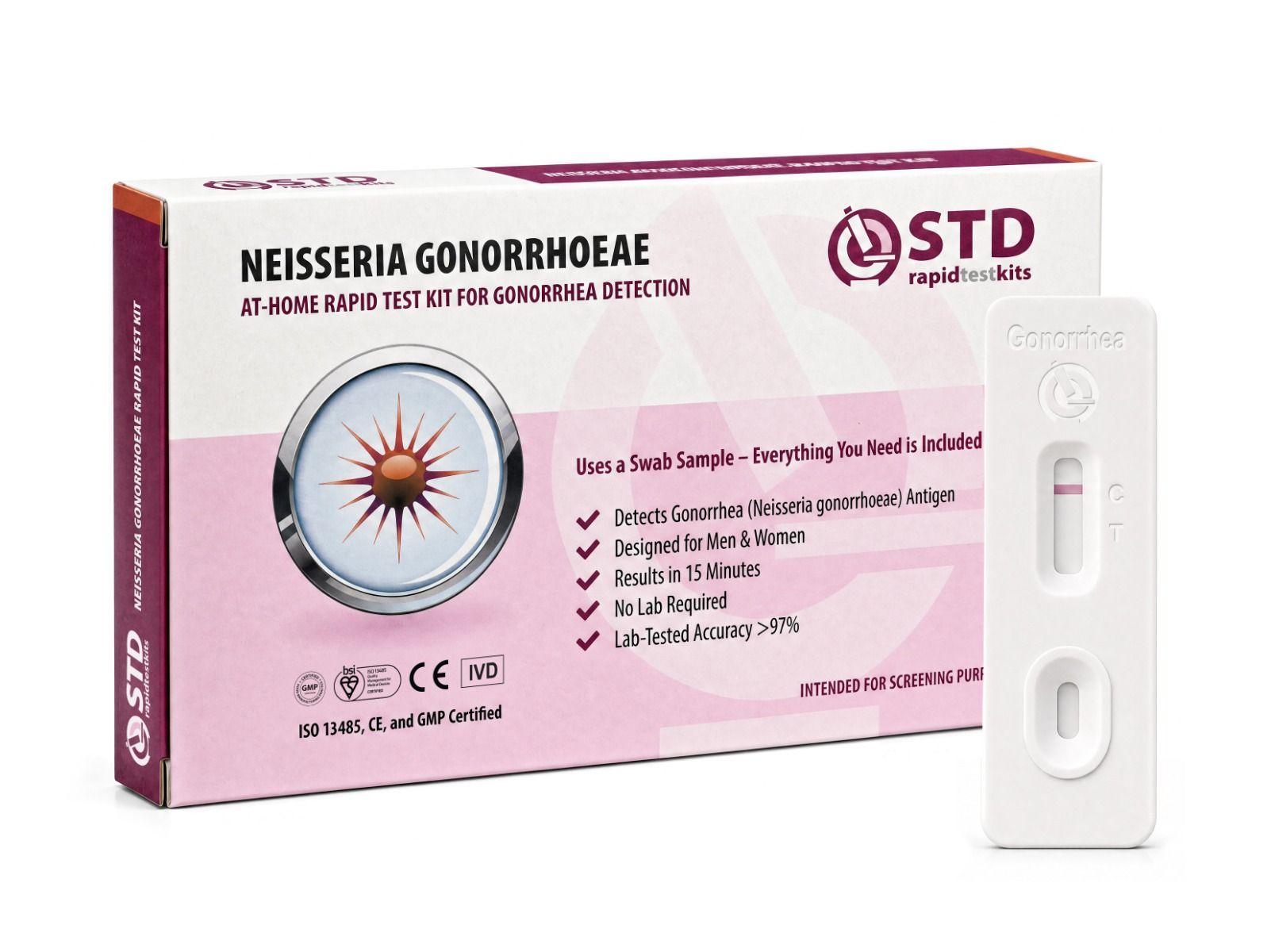
- Pharyngeal gonorrhea testing requires a clinic-administered throat swab. At-home rapid kits, including ours, use genital swab or fingerstick blood samples and cover the adjacent infection risk from the same exposure event.
Published: November 2025 | Last updated: May 2026 | Editorial review and quality control: Martina N.
Is my sore throat from an STD?
Probably not. Most sore throats are viral. The odds shift if you had unprotected oral sex in the past 1 to 14 days, the discomfort stands alone with no cough, runny nose, or fever, and lingers past a week. Then ask a clinic for a pharyngeal swab; at-home rapid kits screen genital and bloodwork risk but cannot sample the throat.
A sore throat is one of the most common reasons people miss a day of work. Most of the time it is viral, sometimes bacterial like strep, and almost always gone in a week. For a small share of cases, especially after recent oral sex with a new partner, that scratchy throat can be something a routine strep swab will never catch: gonorrhea in the throat, also called pharyngeal gonorrhea.
The infection is real, tracked closely in U.S. CDC surveillance, and most often completely silent. Studies of higher-risk groups have repeatedly found that the majority of pharyngeal cases produce no symptoms at all. When discomfort does show up, it looks so much like a viral sore throat that doctors rarely think to test for it unless the patient brings it up. The first part of closing that gap is knowing what to ask for, and where the gaps in standard testing actually are.
If you are reading this because your throat hurts and you are wondering whether the timing lines up with a recent encounter, that worry is reasonable. Most sore throats are not gonorrhea. The math shifts if you had unprotected oral contact in the last week or two, and especially if the classic cold signs (runny nose, cough, fever) are absent.
Key Takeaways
- Throat gonorrhea is usually silent. When symptoms do appear they mimic a viral sore throat closely enough that standard strep panels rarely catch it.
- Pharyngeal gonorrhea testing requires a clinic-administered throat swab. At-home rapid kits, including ours, use genital swab or fingerstick blood samples and cover the adjacent infection risk from the same exposure event.
When a Sore Throat Could Be More Than a Cold
Most sore throats are caused by ordinary viruses: rhinovirus, adenovirus, influenza, the same family of bugs that show up every winter. A smaller share are bacterial, with group A strep being the most common. Both clear with rest, fluids, and either time or a short course of antibiotics. The rapid throat swabs at urgent care look for strep specifically. They do not test for sexually transmitted bacteria unless someone explicitly asks.
Pharyngeal gonorrhea sits in a blind spot. The bacterium Neisseria gonorrhoeae can settle on the back of the throat, the tonsils, and the soft palate after oral contact with infected genital fluids. It rarely causes the classic strep picture (white pus pockets, raging fever, severely swollen lymph nodes). Instead it tends to produce mild redness, a vague scratchy feeling, sometimes mild swelling, and very often nothing at all. The CDC notes that gonorrhea often has no symptoms yet can cause infection in the genitals, rectum, and throat, picked up only when a clinician swabs as part of routine STI screening (CDC About Gonorrhea).
The clinical pattern that should raise the question of throat gonorrhea is a sore throat that lingers past the usual three to seven days, has no cold-like upper respiratory symptoms next to it (no runny nose, no cough, no real fever), and follows recent oral sex with a partner whose status is unknown. None of those features by themselves prove anything. In combination they are enough reason to ask a clinic for a pharyngeal swab.

What Throat Gonorrhea Feels Like, When It Feels Like Anything
Here is the hard part for anyone trying to self-diagnose: most pharyngeal infections produce no symptoms whatsoever. Studies of higher-risk groups have repeatedly found that the majority of throat cases stay silent, which is exactly why clinicians find them through routine screening rather than through a patient complaint (CDC About Gonorrhea). The NHS gonorrhoea overview makes the same point, noting that symptoms are often mild or absent and that an infection can be missed without testing (NHS Gonorrhoea). When the throat does react, the signs are mild and easy to write off as a passing cold or dry winter air.
The checklist below covers the range people sometimes notice. None of these confirms gonorrhea on its own, and a completely normal-feeling throat does not rule it out. Treat them as reasons to consider a swab if oral exposure is part of your recent history, not as a substitute for one.
Throat Symptoms That Can Follow Oral Exposure
Most pharyngeal infections cause no symptoms at all. Having one or more of these does not confirm gonorrhea, and their absence does not rule it out. Only a throat swab can.
- A scratchy or sore throat that does not respond to usual cold remedies Common
- Mild redness at the back of the throat with no white pus patches Common
- No symptoms at all, despite an active infection Common
- Mild discomfort or a feeling of something stuck when swallowing Less common
- Tender or slightly swollen lymph nodes in the neck Less common
- A hoarse voice Rare
How Throat Gonorrhea Differs from a Cold or Strep
Symptoms alone cannot reliably separate throat gonorrhea from common throat infections. They overlap heavily. Where they differ is in the surrounding picture: which other symptoms are present, which are absent, and what the recent exposure history looks like. For a closer look at how this mix-up plays out at the clinic, see our guide on how a lingering sore throat gets misread as strep.
The comparison below summarizes how the three conditions tend to present in practice. It is a guide for thinking, not a diagnosis. Final clarity comes from the right swab.
Throat Gonorrhea vs Common Cold vs Strep
| Symptom or Feature | Throat Gonorrhea | Common Cold | Strep Throat |
|---|---|---|---|
| Sore or scratchy throat | Common, often mild | Common, often mild | Common, often severe |
| Runny nose or cough | Rare | Very common | Uncommon |
| Fever | Uncommon | Mild if present | Common, often higher |
| White patches or pus on tonsils | Rare | Rare | Common |
| Swollen neck lymph nodes | Sometimes | Mild if present | Often, tender |
| Symptom onset after oral sex | 1 to 14+ days (throat may be at the longer end) | Unrelated to sex | Unrelated to sex |
| Resolution with strep antibiotics | No effect | No effect (viral) | Yes, within days |
Symptoms overlap heavily; the absence of cold signs plus recent oral exposure is the useful differentiator, not the throat sensation itself.
Yes, You Can Get It from Oral Sex Alone
Many people treat oral sex as the safer option, partly because pregnancy is not on the table and partly because it does not feel like "real" risk. The bacteriology disagrees. The mucous membranes inside the mouth and throat are porous, often have minor irritation from food or brushing, and offer Neisseria gonorrhoeae a workable foothold. Transmission goes both ways: an infected mouth can pass the bacteria to a partner's genitals during oral contact, and an infected genital area can pass it to a partner's throat the same way.
Giving oral sex (mouth on a partner's genitals or anus) is the higher-risk direction for picking up pharyngeal infection. Receiving oral sex from someone with throat gonorrhea is a lower-risk yet real route for picking up genital infection in return. Neither requires penetration, and neither requires the source partner to know they are infected. The CDC describes gonorrhea as transmissible through vaginal, anal, or oral sex without a condom, a multi-gender, multi-orientation concern rather than a problem concentrated in any one group (CDC About Gonorrhea). Mayo Clinic's gonorrhea overview likewise describes the infection turning up at multiple sites, the genitals, rectum, and throat, depending on the type of contact (Mayo Clinic). People who have had only oral contact with a new partner can absolutely test positive at the throat.
Kissing alone carries a much smaller risk and is not the dominant transmission route. The risk is real though low. Recent research on saliva-mediated transmission has prompted some public-health bodies to acknowledge oral-to-oral spread as plausible, particularly with deep kissing. A clinic swab still matters when the symptoms feel minimal.
Throat gonorrhea moves in both directions during oral contact. An infected mouth can pass the bacteria to a partner's genitals, and an infected genital area can pass it to a partner's throat. That mutual exposure is why partner notification matters even when only one person noticed any symptoms.
How Doctors Diagnose Throat Gonorrhea
Diagnosis requires a sample from the throat. The CDC's treatment guidance describes nucleic acid amplification testing (NAAT) on a pharyngeal swab as the appropriate way to detect Neisseria gonorrhoeae at the throat, including the post-treatment test of cure (CDC STI Treatment Guidelines: Gonococcal Infections). The clinician runs the swab along the back of the throat and the tonsillar pillars, the sample goes to a lab, and results return in one to several days depending on the lab. Our companion guide on how doctors check for oral chlamydia and gonorrhea walks through the visit step by step.
This is where most readers hit a wall. Standard urgent-care STI panels often default to urine tests or genital swabs only. They will not include the throat unless you ask. The right script for the visit is direct: "I had unprotected oral sex on this date and I am worried about throat gonorrhea or chlamydia. Please collect a pharyngeal swab for NAAT testing." A good clinic will run that without friction. A clinic that resists is the wrong clinic for this question.
Self-collected throat swabs sent to a lab are an emerging option in some markets, mostly through telehealth services or specialty STI providers. They are a separate product from the rapid lateral-flow at-home STI test kits our site sells. Our kits use either a self-collected genital swab (chlamydia, gonorrhea, trichomoniasis, HPV) or a fingerstick blood sample (HIV, syphilis, hepatitis B and C, herpes). None is validated for pharyngeal sampling. We are explicit about that here because it changes what an at-home kit can and cannot answer for you. (Editorial disclosure: we sell the at-home rapid tests linked in this article; the scope limits described here reflect what each test type is validated to do, not a sales pitch.)
For confirmed pharyngeal testing you need a clinic visit and a throat swab sent for NAAT. We do not sell that test. Our at-home rapid kits cover the adjacent infection risk from the same encounter: a self-collected genital swab for chlamydia or gonorrhea (in case the bacteria reached the genitals as well), and fingerstick blood tests for HIV, syphilis, and the hepatitis viruses commonly screened after a new partner. Use both routes if your concern includes both throat and genital exposure.
When a Negative Test Does Not Mean You're Clear
A negative throat-swab result a day or two after exposure does not reliably rule out infection. Bacterial loads need time to rise to detectable levels. NAAT is highly sensitive once enough genetic material is present in the sample, but if the swab is collected before that point or misses the colonized area, the test can still miss the infection.
The practical guidance from STI clinicians is to wait at least one week after a worrying exposure before testing the throat, and to retest at two weeks if symptoms persist or risk was substantial. The exact incubation window for pharyngeal gonorrhea is harder to pin down than it is for genital infection, which is commonly one to fourteen days. The same general window applies in practice. Throat colonization can take a few days longer to develop a reliable signal because of slower bacterial growth on mucosal surfaces.
The throat also tends to act as a quiet reservoir. Bacteria can sit on pharyngeal tissue for weeks without producing recognizable symptoms, which is part of why repeat sampling matters and why a single early negative does not warrant reassurance on its own. If your sore throat has stuck around past a week and a single test was negative, the right next step is usually a repeat swab.
| When You Tested | What That Result Means | Reasonable Next Step |
|---|---|---|
| Within 48 hours of exposure | Often too early for reliable detection | Plan a repeat test at 7 to 10 days |
| 3 to 5 days after exposure | Some detection possible; false negatives still common | Note symptoms and repeat at 7 to 14 days if anything persists |
| 7 to 14 days after exposure | Most reliable detection window for pharyngeal NAAT | Test now, act on the result |
| More than 14 days, no symptoms | Negative result reassuring; retest if any new exposure occurred | Routine screening cadence based on partner activity |
Treatment, Resistance, and Why Time Matters
Confirmed pharyngeal gonorrhea is treated with a single intramuscular dose of ceftriaxone, currently 500 mg in the U.S. for most adults under 150 kg, per the CDC's gonococcal infections treatment guidance for adolescents and adults. The antibiotic is given by injection at the clinic, and one dose is usually enough. A test of cure (a follow-up swab seven to fourteen days later) is recommended for pharyngeal infection because the throat is harder to clear than the genital tract.
The harder-to-clear part matters. Drug-resistant strains of gonorrhea are spreading worldwide, and the World Health Organization reports that antimicrobial resistance in gonorrhoea has risen rapidly in recent years and reduced treatment options (WHO STI fact sheet). Ceftriaxone is one of the last reliable single-dose options the CDC currently recommends (CDC Drug-Resistant Gonorrhea). Pharyngeal infection deserves particular attention as resistance spreads, partly because the throat is biologically harder to clear than genital sites and partly because asymptomatic carriage allows the infection to circulate before anyone seeks treatment.
The practical consequence for the reader is timing. Once a positive test comes back, treatment should not wait. Untreated pharyngeal gonorrhea can pass to a partner during oral or other sexual contact, can spread to other body sites in the same person, and is also associated with increased susceptibility to HIV infection when exposure occurs alongside an untreated STI. After the injection, abstain from all sexual activity (including oral) for seven days, and confirm that recent partners are tested and treated. Skipping that gap is the most common reason people get reinfected within weeks.
We are currently down to one last recommended and effective class of antibiotics, cephalosporins, to treat this common infection.
The Mouthwash Myth
Whether commercial antiseptic mouthwash kills oral gonorrhea is a question that recurs in social-media threads and the occasional newspaper headline. The short answer: a small amount of evidence suggests mouthwash can briefly reduce Neisseria gonorrhoeae colonization in the throat, but there is no evidence it cures established infection or prevents transmission.
The most cited study, published in the journal Sexually Transmitted Infections in 2016, randomized men with confirmed pharyngeal gonorrhea to use Listerine or saline as a one-minute rinse. Listerine reduced bacterial load on follow-up culture compared with saline, but it did not eliminate the infection in everyone studied. Subsequent follow-up trials have been less encouraging, and public-health agencies have not added mouthwash to the list of recommended preventive measures.
Mouthwash freshens breath; it does not treat infection. Rinsing after oral sex will not undo a transmission event, and it will not substitute for a clinic swab if you have a real concern. If commercial antiseptic rinse ever becomes part of an evidence-based prevention bundle in future guidance, that change will come from the CDC and major STI clinical bodies, not from a viral video. Until then, the steps that reliably reduce risk are condoms or dental dams during oral sex, knowing partners' status, and getting tested when an exposure happens.

When You Are Contagious and When You Are Not
Gonorrhea is contagious before you feel anything. The infection establishes itself, replicates, and reaches transmissible levels well before the throat starts feeling sore (if it ever does). That is why partner notification matters even when no one in the chain has obvious symptoms.
The CDC's clinical guidance on gonorrhea recommends abstaining from sexual contact for seven full days after a single ceftriaxone dose, and waiting until any treated partners have completed the same window. Reinfection from an untreated partner is the single most common reason people clear the infection and bounce back to positive within a month.
The table below tracks the rough phases. Real timelines vary by individual, by partner sexual activity, and by whether reinfection occurs.
| Phase | Contagious? | What That Means in Practice |
|---|---|---|
| Pre-symptomatic (typically 0 to 7 days post-exposure) | Yes | Bacteria can transmit to partners before any symptoms appear. |
| Symptomatic period (when symptoms are present, if at all) | Yes | Highest awareness window; refrain from oral or other sexual contact until tested. |
| Post-treatment (0 to 7 days after ceftriaxone) | Yes, possibly | Antibiotic needs time to clear bacteria from tissue. Abstain during this window. |
| Cleared (7+ days post-treatment, partners treated) | No, assuming no reinfection | Resume normal activity. Use protection with new partners. |
Telling Partners and Moving Forward
If a test comes back positive, the next call is to your recent oral-sex partners. The conversation will probably be awkward, and it is also necessary. Untreated partners are the single biggest reason cleared infections come back within weeks, and a single phone call or text can prevent the same back-and-forth in three other people's lives.
If a direct conversation feels impossible, several anonymous notification services exist (TellYourPartner.org, So They Can Know, and similar). They send a text or email naming the infection and the date of possible exposure without identifying you, and they include a link to local testing resources. Some clinics also offer expedited partner therapy in states where the law allows, which means a clinician can prescribe treatment for your partner without seeing them first.
Beyond partners, a positive test is a useful prompt to step back and look at the broader picture. When was the last full panel? Are there other infections worth screening for from the same encounter? Is the current relationship structure (monogamous, open, casual) reflected in current testing cadence? None of these questions imply anyone did anything wrong. They are the maintenance work of being sexually active, in the same way a car needs an oil change without that meaning the driver did something irresponsible.
The reflexive shame that often follows a positive STI test is loud and almost universal. It is also, in the strictest medical sense, beside the point. The more useful question after clearance is what testing cadence fits the relationship structure you are living in going forward.
Five concrete next steps, in order:
- Complete the single ceftriaxone injection at the clinic.
- Notify recent oral-sex partners. An anonymous notification service can carry the message if a direct conversation feels too hard.
- Abstain from all sexual contact, including oral, for the full seven-day window after treatment.
- Confirm that partners have been tested and treated before resuming contact.
- Return for a test of cure at seven to fourteen days, since pharyngeal infection is harder to clear than genital infection.
Do You Need a Throat Swab?
Have you had unprotected oral sex with a new or untested partner in the past 1 to 14 days?
Yes: A pharyngeal swab is worth requesting even if your throat feels fine, because most throat infections cause no symptoms. Wait at least seven days after the exposure for a reliable result.
Is a sore throat lingering past a week with no cough, runny nose, or fever?
Yes: Ask a clinic specifically for a pharyngeal gonorrhea and chlamydia NAAT swab. A standard strep test will not detect it, and a single early negative may need a repeat at two weeks.
No: If cold or flu symptoms are present, a viral cause is far more likely. Re-evaluate and consider testing if the throat does not clear within a week or a new exposure occurs.
Guidance only. A healthcare provider can advise based on your specific situation.
FAQs
- Can a sore throat really be the only sign of gonorrhea?
- Yes, and it is the rule rather than the exception. Most pharyngeal gonorrhea cases produce no symptoms at all. When discomfort does appear, it usually shows up as a mild scratchy throat without the runny nose, cough, and high fever that come with viral infection. If oral exposure is part of the recent picture, the throat is worth testing even when symptoms are subtle.
- How long after oral sex should I wait before testing the throat?
- Wait at least seven days. Earlier than that, the bacterial load is often too low for the test to detect reliably, and you risk a false negative. If symptoms persist after a negative test at one week, repeat the swab at two weeks. The detection window is similar to genital gonorrhea (one to fourteen days), but the throat tends to be a few days slower to develop a reliable signal.
- Can I get throat gonorrhea from kissing?
- The risk from kissing is much lower than from oral sex and is not the main way the infection spreads. Some research suggests deep kissing may transmit gonorrhea in a minority of cases, and a few public-health bodies now treat oral-to-oral spread as plausible. Oral sex remains the dominant route. If your concern centers on kissing alone, the odds are low, though a clinic swab settles the question when symptoms linger.
- Will a regular strep test or rapid COVID test pick this up?
- No. Strep tests look specifically for group A streptococcal antigens. COVID and flu tests look for those viruses. None of them detects Neisseria gonorrhoeae. The pharyngeal gonorrhea test is a separate NAAT swab the clinician has to order specifically. If the visit was for sore throat and only strep and COVID were ordered, gonorrhea was not ruled out.
- Can I test for throat gonorrhea with an at-home kit?
- Not with the at-home rapid kits we sell. Our kits are designed for self-collected genital swabs (chlamydia, gonorrhea, HPV, trichomoniasis) and fingerstick blood samples (HIV, syphilis, hepatitis, herpes). For confirmed pharyngeal testing you need a clinic visit and a throat swab sent for NAAT. Some telehealth services offer mail-in self-collected throat swabs as a separate option.
- How worried should I be about antibiotic resistance?
- Worried enough to take treatment seriously and complete the full ceftriaxone protocol, and not so worried it changes whether you should test. Drug-resistant strains exist and are spreading slowly. Ceftriaxone still works for the vast majority of cases. The thing that protects you and the next patient is finishing treatment, completing the abstinence window, and confirming partner treatment so reinfection does not happen.
- Does mouthwash actually help at all?
- Possibly a little, briefly, in research settings, with one specific brand and protocol. Not enough to recommend it as prevention or treatment. Use it for fresh breath. Use condoms or dental dams during oral sex if you want to genuinely reduce transmission risk, and use clinic testing if you want to know your status.
- How long until I am no longer contagious after treatment?
- Seven days post-injection is the standard sex-pause window. Bacteriologically, ceftriaxone does not flip a switch the moment the needle leaves your arm; the drug needs several days to clear residual gonococci from pharyngeal tissue, and trace amounts can remain detectable on swabs for a short period after symptoms resolve. The seven-day buffer exists to cover that tail, which is why even people who feel completely fine after the injection should hold the line on the abstinence window.
- U.S. Centers for Disease Control and Prevention. About Gonorrhea, including that infection often has no symptoms and can affect the genitals, rectum, and throat through vaginal, anal, or oral sex.
- U.S. Centers for Disease Control and Prevention. Drug-Resistant Gonorrhea, on cephalosporins being the last recommended effective antibiotic class and the spread of resistance.
- U.S. Centers for Disease Control and Prevention. STI Treatment Guidelines, Gonococcal Infections Among Adolescents and Adults, including pharyngeal NAAT diagnosis, ceftriaxone 500 mg dosing, and the 7 to 14 day test-of-cure for pharyngeal infection.
- World Health Organization. Sexually transmitted infections (STIs) fact sheet, on STIs often being asymptomatic and on the rapid rise of antimicrobial resistance in gonorrhoea.
- NHS. Gonorrhoea overview, including symptom patterns, transmission through vaginal, anal, and oral sex, and clinical testing pathways.
- Mayo Clinic. Gonorrhea symptoms and causes, including symptom presentation across infection sites such as the genitals, rectum, and throat.