
Published: October 2025 | Last updated: May 2026 | Editorial review and quality control: Martina N.
Travel changes the rules people quietly live by at home. A new city, a new bar, a new face across the table, and the careful habits of daily life can feel optional. Sex tourism, whether it shapes the entire trip or fits into a single unplanned night, sits at the center of a real and measurable risk picture for sexually transmitted infections in returning travelers. The mix is consistent: higher local prevalence in some destinations, less consistent protection, alcohol and jet lag, and a delay between exposure and any symptoms that can stretch from days to months. This guide walks through what is actually at risk, when to test, and how to handle what comes next.
Key Takeaways
- Casual sex while traveling raises STI risk in measurable ways: higher local prevalence in many destinations, less consistent condom use, and limited access to testing while you are still abroad.
- Most post-travel STIs cause no early symptoms, so testing about two weeks after the encounter for bacterial infections, and again at twelve weeks for HIV and syphilis, is the most reliable next step.
Why casual sex abroad carries higher exposure risk
Sex tourism is not limited to the obvious red-light districts. In many regions, sex with travelers is offered through informal channels: massage parlors, beach vendors who moonlight as escorts, hotel-bar introductions, and dating or hookup apps used to meet locals. Consensual adult experiences are not the issue. The issue is that the testing and treatment infrastructure in some destinations does not screen, treat, or counsel at the level a U.S. or European clinic would.
Local prevalence matters because the math of transmission is straightforward: the higher the share of partners carrying an undiagnosed infection, the higher the per-encounter risk for any given protective behavior. The CDC reports that roughly one in three travelers will have sex with a new partner while abroad, and that the excitement and anonymity of a trip can push people toward riskier behavior than they would choose at home (CDC Travelers' Health: Sexually Transmitted Infections).
Antibiotic resistance is the second piece. The CDC has observed worrisome trends of decreasing cephalosporin susceptibility in Neisseria gonorrhoeae, the bacterium that causes gonorrhea (ceftriaxone, in the cephalosporin family, is the current first-line treatment). A gonorrhea infection acquired abroad may not respond as predictably to the standard treatment a provider at home would prescribe (CDC, drug-resistant gonorrhea).
Travel itself blunts the immune response. Long-haul flights, jet lag, alcohol, dehydration, and short sleep all reduce the body's ability to manage a new infection in its earliest hours. Add the small skin tears that come with friction or a fresh shave, and the mucosa of the genital tract becomes an easier entry point.
Reduced cephalosporin susceptibility in Neisseria gonorrhoeae has been observed internationally, with notable clusters reported across the Asia-Pacific region. A clinician at home may need to adjust treatment, and a follow-up test-of-cure can be the safer call after travel-acquired gonorrhea.
Condoms reduce risk, they do not eliminate it
External (male) and internal (female) condoms remain the single most effective routine reduction in STI transmission risk for vaginal and anal sex. They are not a guarantee. The two main gaps to be honest about are the contact area and inconsistent use.
The contact-area gap is mechanical. Genital herpes (HSV-1 and HSV-2), human papillomavirus (HPV), and the syphilis chancre can transmit through skin-to-skin contact in regions a condom does not cover: the base of the shaft, the scrotum, the perineum, the vulva, the inner thigh. The CDC's herpes page notes that genital herpes can transmit from areas that do not have a visible sore, and that infected partners can pass the virus without realizing they have it (CDC, about genital herpes).
Oral sex is the other commonly underestimated route. Many travelers treat oral as the safer option, and it is lower-risk than penetrative sex, but pharyngeal gonorrhea, chlamydia, syphilis, and HSV can all transmit through unprotected oral contact. Barrier use during oral sex is consistent with general CDC STI-prevention guidance.
Real-world condom use is also imperfect. Condoms come off in water, get applied late, get reused incorrectly, or get skipped entirely during oral and manual stimulation. A vacation context with alcohol and a partner you will not see again raises the odds that one of these slips will happen at least once during the trip.
How long after exposure do STI symptoms appear?
If something is going to show up, the timing varies a lot by infection. Symptoms also overlap with normal travel side-effects (sore throat, fatigue, irritation, GI symptoms), which is why a lot of post-travel STIs get written off as travelers' diarrhea, jet lag, or a heat rash for weeks before the actual diagnosis.
The table below summarizes typical incubation windows and the symptoms post-travel STIs are most often confused with. These are general ranges drawn from CDC fact sheets; individual variation is wide, and the CDC notes that chlamydia in particular often has no symptoms, and when symptoms do appear they may not show up until several weeks after exposure (CDC, about chlamydia).
The window period (the gap between exposure and when a test can reliably detect infection) is not the same as the incubation period (the gap before any symptoms). The CDC reports that antibody-based HIV tests can usually detect HIV 23 to 90 days after exposure, while a NAT can usually detect HIV 10 to 33 days after exposure (CDC, HIV testing types and windows). For syphilis, blood tests can stay negative for the first three to six weeks after the chancre appears.
| Infection | Earliest symptom onset | Recommended test timing | Common confusion |
|---|---|---|---|
| Chlamydia | 5 to 14 days | 14 days post-exposure | UTI, dehydration, soap irritation |
| Gonorrhea | 2 to 14 days | 7 to 14 days post-exposure | Travelers' diarrhea, alcohol after-effects |
| Syphilis | 10 to 90 days (primary chancre) | 3 weeks, retest at 12 weeks | Bug bite, ingrown hair, minor rash |
| Genital herpes | 2 to 12 days (first outbreak) | Test during outbreak; antibody retest at 12 weeks | Razor irritation, heat rash, friction sore |
| HIV | 2 to 4 weeks (acute, flu-like) | NAT at 10-33 days; antibody at 23-90 days | Travel flu, jet lag, food-borne illness |
| Trichomoniasis (women) | 5 to 28 days | 1 to 4 weeks post-exposure | Yeast infection, BV, perfume reaction |
Most STIs cause no early symptoms
Asymptomatic infection is the default for the most common bacterial STIs. The CDC states plainly that chlamydia often has no symptoms, but it can cause serious health problems even without symptoms (CDC, about chlamydia). Pharyngeal gonorrhea, the kind picked up through oral sex, is asymptomatic in the majority of cases. Primary syphilis can present as a single painless ulcer that heals on its own and gets missed entirely, especially when it sits on the cervix or inside the mouth.
The practical consequence: feeling fine after a trip is not evidence that nothing was transmitted. The opposite assumption (the body would tell me) is the single biggest reason untreated STIs cause downstream damage. Untreated chlamydia and gonorrhea can scar the fallopian tubes and contribute to pelvic inflammatory disease and tubal-factor infertility. Untreated syphilis progresses through latent stages and can affect the cardiovascular and nervous systems years later. Untreated HSV stays in the body for life but is medically manageable; the practical issue is unknowingly transmitting it to a future partner.
This is the reason testing after travel is recommended even without symptoms. A 14-day check covers the most common bacterial infections; a 12-week check picks up HIV and syphilis that have not yet seroconverted (produced detectable antibodies in the blood).
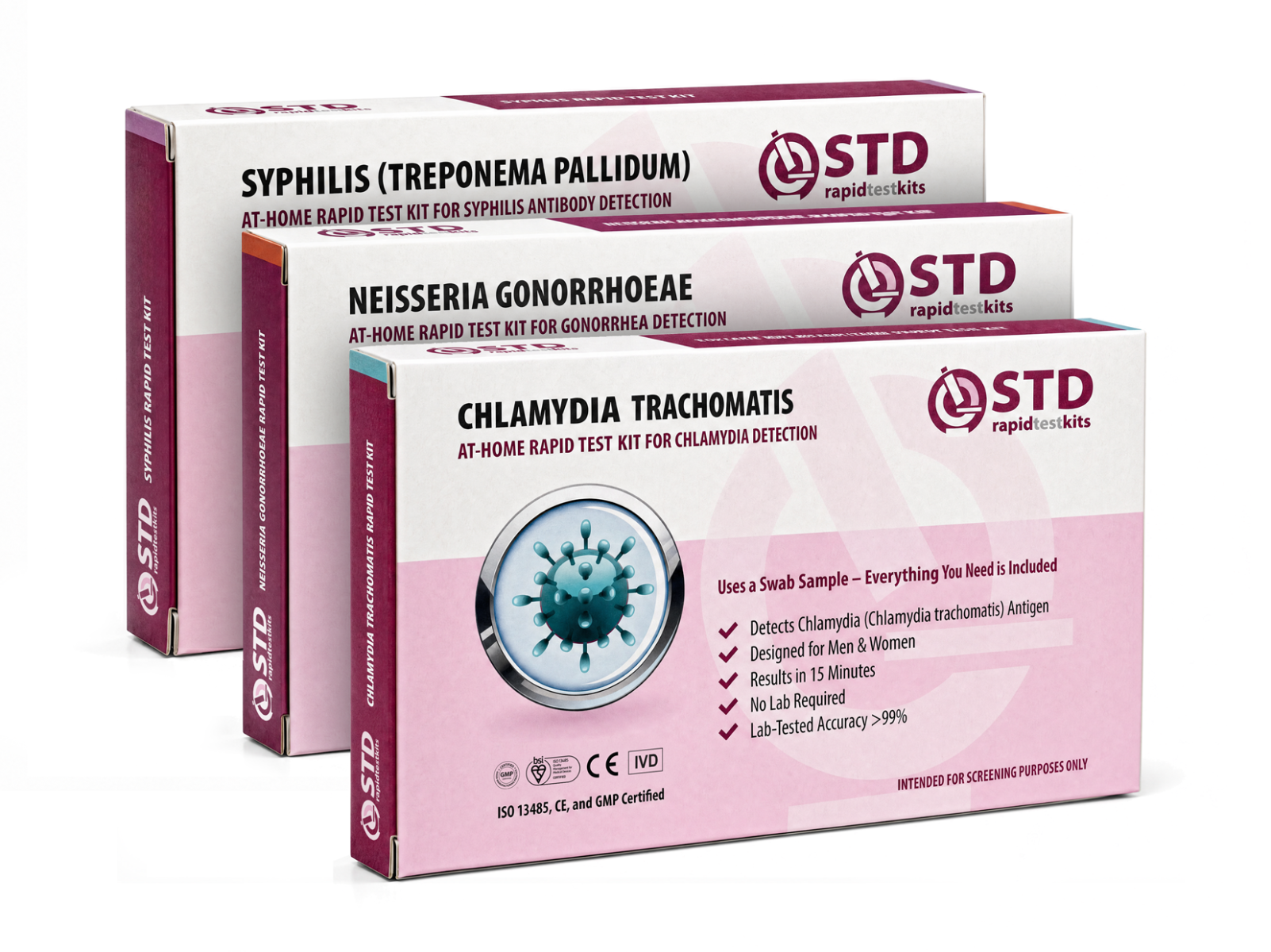
The CDC notes that chlamydia often shows no symptoms during active infection, and pharyngeal gonorrhea is largely asymptomatic. This article is published by stdrapidtestkits.com, which sells at-home rapid STI panels; the kit linked below covers the bacterial infections discussed in this section.
When to test, and when to retest, after travel
The simplest schedule that catches most post-travel infections is two checkpoints: one at about two weeks after the last exposure for bacterial STIs, and one at twelve weeks for HIV and syphilis. If symptoms appear earlier, test sooner. A positive result inside the window is real, but a negative result inside the window does not yet rule out infection.
Two-week checkpoint. By 14 days after exposure, lab NAAT testing for chlamydia, gonorrhea, and trichomoniasis (in women) is usually reliable. At-home rapid lateral-flow tests use a different chemistry than lab NAAT and are best treated as a first screen; a positive result is worth confirming with a lab NAAT when possible, and a negative result with ongoing symptoms still merits a clinic visit.
Twelve-week checkpoint. HIV antibody-based tests reach high detection by 90 days after exposure; nucleic acid tests (NAT) detect earlier, around 10 to 33 days (CDC, HIV testing methods). Syphilis treponemal blood tests are usually positive by six weeks after exposure but are routinely repeated at twelve weeks for confidence in a negative result.
If symptoms appear at any point between the two checkpoints, the schedule does not apply. Genital ulcers, persistent abnormal discharge, painful urination, unexplained pelvic pain, or a non-resolving sore throat are all worth a clinic visit, not just a home test.
If a partner you had contact with abroad later messages you about a diagnosis on their side, treat that as a reason to test now and again at the relevant window for whatever they were diagnosed with. Notifying a partner is a public-health responsibility in the other direction. Most U.S. state and local health departments offer anonymous partner-notification services for chlamydia, gonorrhea, syphilis, and HIV.
When should I get tested after sex abroad?
Test about 14 days after the last exposure for chlamydia, gonorrhea, and trichomoniasis, and again at 12 weeks for HIV and syphilis. Test sooner if symptoms appear. A negative early test does not rule out infection until the full window has passed, so the second checkpoint at 12 weeks is the one that confirms the result.
Massage, oral, and other gray-zone encounters
A common after-trip question goes like this: nothing penetrative happened, but something happened. Does it count? For STI risk purposes, the relevant question is whether there was direct contact between sexual fluids or genital, anal, or oral mucous membranes, with or without orgasm.
Sensual or so-called erotic massage that ends in oral or manual contact carries STI risk. Oral on the giver's side can transmit pharyngeal gonorrhea, chlamydia, syphilis, and herpes. Manual stimulation with shared lubricant and small abrasions on the hand can transmit HSV. Skin-to-skin genital contact without intercourse can transmit HSV, HPV, and syphilis. Shared sex toys not cleaned between partners can transmit bacterial STIs and HPV.
What is not an STI risk, in case it is on the worry list: kissing without an active mouth sore (HSV-1 transmits through kissing only when active virus is present, and most adult populations already carry it from childhood); being naked in a sauna or hot tub with strangers; sharing a hotel bathroom; sharing food or drinks. Lice and scabies can transmit through prolonged skin contact and shared bedding, which is a separate category from STIs.
If there was sexual contact in any form, even brief, run the same testing schedule as for penetrative sex.

Telling a current or future partner
Disclosure after travel is uncomfortable. Treating it as part of the normal post-trip routine, alongside laundry and unpacking, takes some of the edge off. A version that works in most relationships: "I had a couple of encounters while I was away. I am getting tested as a precaution. I would like us to use barriers until I have results." Most adult partners read this as responsible behavior, not as a confession of wrongdoing.
Two situations call for a different version. If you are in a monogamous relationship and the trip involved a breach of that agreement, the disclosure is two conversations: one about the breach itself and one about the testing. Mixing them tends to make both worse. If a test comes back positive and the diagnosis carries lifelong implications (HIV, HSV-2 in someone whose partner is HSV-negative), looping in a clinician for treatment guidance and partner-notification support is more useful than handling the conversation cold.
For partners you cannot trace (a hookup app with no name, a one-night encounter abroad), the goal shifts: you cannot inform them, but you can still treat yourself and avoid passing the infection on to someone you can reach.
Partner-notification resources
- Most U.S. state and local health departments offer anonymous partner-notification services for chlamydia, gonorrhea, syphilis, and HIV. The service contacts past partners on your behalf without revealing your name.
- Many countries outside the U.S. have similar services through national or regional sexual-health clinics; a quick search for the destination country plus "partner notification" or "contact tracing" will usually surface the right office.
- Online tools like TellYourPartner.org and inSPOT (where available) let you send anonymous notifications by text or email when a public-health service is not the right fit.
Pack smarter for the next trip
A small kit slipped into a toiletry bag covers most of the common gaps:
- External or internal condoms in enough quantity for the trip, plus extras. Buying condoms abroad is fine, but quality and sizing vary; bringing a known brand removes one variable.
- Water-based or silicone lubricant. Friction is one of the easiest ways to introduce small mucosal tears.
- A rapid at-home test kit if the trip is long enough that the testing window will pass before the flight home.
- Knowledge of one trustworthy clinic at the destination. A 60-second search before the trip beats searching with a fever in a country whose health system you do not know.
Pre-exposure prophylaxis (PrEP) for HIV is worth a separate conversation with a primary-care provider for travelers in higher-risk categories: men who have sex with men, people with multiple partners, sex workers, partners of HIV-positive people, and travelers planning multi-week trips to high-prevalence destinations. The CDC notes that PrEP reduces the chance of getting HIV but does not prevent other STIs or pregnancy, so the rest of the testing plan still applies (CDC, PrEP basics).

What this means for you, today
If a trip already happened and you are reading this with a slow background hum of worry, the path forward is uncomplicated. Note the date of the last exposure. Set a calendar reminder for two weeks after that date for a multi-test panel, and a second reminder for twelve weeks for HIV and syphilis confirmation. If symptoms appear in between, pull the schedule forward. If everything comes back negative at twelve weeks, the worry can stop.
Two calendar reminders, two checkpoints, and the question has a real answer.
About one in three travelers will have sex with a new partner while on a trip. The excitement of being in another country and meeting new people may lead travelers to engage in risky behaviors that can lead to sexually transmitted infections.
Frequently asked questions
- How likely is it to actually get an STI from one encounter abroad?
- Per-act transmission risk varies widely by infection, partner status, and protection. CDC framing: most travelers who acquire an STI do so during a single sexual encounter. The bacterial STIs (gonorrhea, chlamydia) carry meaningful per-act risk from an infected partner; HIV per-act risk is much lower for most exposures and higher when concurrent ulcerative STIs are present. One encounter is enough to transmit any of these infections, and condom use cuts the risk substantially without removing it.
- Can I get tested while I am still abroad?
- It depends on the country and your comfort level. Many European, Australian, and major Asian cities have well-run sexual-health clinics that test for the common STIs without judgment, often free or low-cost for residents and modestly priced for visitors. In some destinations, services are limited or testing is not anonymous. A rapid at-home kit packed in luggage is a workaround for trips long enough that the 14-day window will close before the return flight.
- I used a condom the whole time. Do I still need to test?
- Condoms reduce but do not eliminate STI risk. Skin-to-skin infections (HSV, HPV, syphilis chancre) can transmit from areas the condom does not cover. Oral and manual contact, if part of the encounter, fall outside the condom's protection. Condom use also fails in real-world conditions more often than people remember (slippage, late application, breakage). If the encounter mattered enough to be on your mind, testing once at the appropriate window is the cheapest way to close the question.
- Is oral sex really risky enough to worry about?
- Yes, although the risk per act is lower than for vaginal or anal sex. The CDC documents pharyngeal infection with gonorrhea, chlamydia, and syphilis from unprotected oral sex, plus HSV transmission both directions. HIV transmission through oral sex is documented but rare in the absence of cuts, sores, or recent dental work. Oral sex is a moderately reduced-risk option, not a free pass; if there was no barrier and the partner status is unknown, testing is still appropriate.
- What if I do not remember exactly what happened?
- Treat the encounter as if it were unprotected. Alcohol, jet lag, and adrenaline together can blank out specifics. The conservative approach is to assume the most-exposed scenario, run the standard testing schedule, and let the negative results provide reassurance. Assuming nothing happened because the memory is fuzzy is how STIs go undiagnosed for months.
- Does a positive STI test mean my relationship is over?
- Most STIs are treatable or manageable, and a positive result does not by itself signal a relationship-ending event. Bacterial STIs (chlamydia, gonorrhea, syphilis, trichomoniasis) clear with antibiotics. HSV and HPV are common in the general adult population and are managed, not eliminated. HIV, with current treatment, is a chronic but well-controlled condition with normal life expectancy. The harder conversation is usually about the encounter itself, which is a separate issue from the medical diagnosis.
- How accurate are at-home rapid tests after a trip?
- At-home rapid lateral-flow tests are most accurate after the recommended window has passed for the infection in question. Used inside the window (for example, an HIV antibody test before 23 days post-exposure), they are far more likely to miss a real infection. Sensitivity and specificity vary by infection and manufacturer; check the product insert or product page for the specific kit you are using rather than relying on a single industry-wide figure. A positive result is worth confirming at a clinic, especially for HIV and syphilis.
- When should I retest if my first test was negative?
- For HIV and syphilis, repeat the test at the 12-week mark after the last exposure regardless of symptoms. For chlamydia, gonorrhea, and trichomoniasis, retest if symptoms appear, if a partner is later diagnosed, or if the first test was inside the 14-day window. The CDC's general recommendation after any STI diagnosis and treatment is also to retest about three months later to detect re-infection from an untreated partner.
- U.S. Centers for Disease Control and Prevention. Travelers' Health: Sexually Transmitted Infections, including the one-in-three travelers figure and pre-travel risk-reduction guidance.
- U.S. Centers for Disease Control and Prevention. About Chlamydia: 'often has no symptoms' framing and incubation timing used in the symptom-onset and silent-infection sections.
- U.S. Centers for Disease Control and Prevention. Drug-Resistant Gonorrhea: 'worrisome trends of decreasing cephalosporin susceptibility' surveillance referenced in the antibiotic-resistance section.
- U.S. Centers for Disease Control and Prevention. About Genital Herpes: transmission from areas without visible sores referenced in the condom-coverage section.
- U.S. Centers for Disease Control and Prevention. HIV Testing: antibody (23 to 90 days), antigen/antibody, and NAT (10 to 33 days) window-period figures used in the testing schedule.
- U.S. Centers for Disease Control and Prevention. Pre-exposure prophylaxis (PrEP): 'PrEP reduces the chance of getting HIV but doesn't prevent other STIs or pregnancy.'
- World Health Organization. Sexually transmitted infections (STIs) fact sheet: global burden estimates and treatment-resistance trends.
