
Published: October 2025 | Last updated: May 2026 | Editorial review and quality control: Martina N.
Across American Indian and Alaska Native (AI/AN) communities, sexually transmitted infection rates sit consistently above the U.S. national average for nearly every reportable STI. Federal surveillance keeps confirming the disparity. Public awareness campaigns rarely name it. The result is a quiet, multi-generational gap between what the data shows and what reaches the people most affected.
This guide is for the reader navigating sexual health on tribal land, in a small town, or in any community where geographic distance, healthcare distrust, or local visibility make ordinary care hard. It walks through what the data actually says, why the numbers are what they are, the symptoms that get missed, and the testing options that work even when the nearest clinic is hours away. The aim is clarity, not alarm. Testing is not a confession. It is the same kind of routine self-knowledge that a blood-pressure check represents.
Key Takeaways
- AI/AN populations carry STI rates well above the U.S. average for chlamydia, gonorrhea, and syphilis. The CDC attributes the gap to access barriers and underfunded public-health infrastructure, not to behavior.
- At-home rapid tests close part of that access gap by removing distance, scheduling, and clinic-visibility barriers. They are screening tools, complementary to lab confirmation when a positive result needs treatment.
Why STD Rates Are Higher in Native Communities
The Centers for Disease Control and Prevention's surveillance of health disparities shows that AI/AN populations report higher rates of chlamydia, gonorrhea, and syphilis than the U.S. national average. Chlamydia rates among AI/AN populations have run roughly 3.7 times the rate among non-Hispanic white populations in recent CDC surveillance. The gap is widest for syphilis: congenital syphilis cases (transmission from a pregnant person to the baby) climbed more than 500 percent between 2014 and 2018, with disproportionate concentration in rural and tribal areas.
The CDC's STI health-equity work attributes the gap to systemic factors, not behavioral ones. Indian Health Service per-capita spending has historically been lower than per-capita spending across the rest of the federal healthcare system. Many reservations and rural Native communities sit hours from the nearest clinic that offers comprehensive sexual-health screening. Where clinics exist, staffing turnover, language barriers, and limited evening or weekend hours all shrink the window in which a working person can actually get tested. Limited Medicaid coverage in some states adds a financial layer.
What the numbers do not show is the lived edge of these gaps. Someone notices a symptom for weeks but lacks the gas money or time off to reach the nearest clinic; a patient spoken to dismissively once never returns; and in a 500-person town, the pharmacy counter is visible from the grocery aisle, which makes every purchase there a semi-public act. These are the moments where data turns into silence.
Saying it plainly: Native people are not more likely to acquire STIs because of behavior. They are more likely to lack reachable, trusted, private care.

STD Symptoms That Often Get Missed or Misread
Most STIs are quiet. The CDC's STD information library notes that the majority of chlamydia and gonorrhea infections produce no symptoms at all, especially in the early window after exposure. Pharyngeal (throat) gonorrhea is almost always asymptomatic. Trichomoniasis runs without symptoms in roughly seven of ten infected people. HIV's acute phase can pass as a flu-like episode that resolves on its own, leaving the infection to settle in unnoticed for years.
That silence is part of the problem. A reader who waits for something to feel wrong before testing is following the same script that has kept STIs moving through communities with low health-literacy investment. Genital irritation gets explained as a reaction to laundry detergent. A burning sensation while urinating gets explained as dehydration. A small painless ulcer is read as an ingrown hair, and disappears on its own (which is exactly what early-stage syphilis does, even though the infection has not gone anywhere; it has moved into the second stage). A teen with a tonsil that feels a little raw blames a cold.
The CDC's screening guidance recommends annual STI screening for sexually active people under 25, and any time partners change for anyone older.
| Infection | Symptom pattern | Why it gets missed |
|---|---|---|
| Chlamydia | Most cases asymptomatic in the early window | No prompt to seek care; spread continues unnoticed |
| Gonorrhea (genital) | Often mild discharge or burning; many silent | Symptoms read as a UTI or as dehydration |
| Gonorrhea (throat) | Almost always asymptomatic | No genital signs; throat-swab testing rarely offered outside clinics |
| Trichomoniasis | Asymptomatic in roughly 70 percent of infections | When symptoms appear, they get blamed on yeast or BV |
| Syphilis (primary) | Single painless ulcer that resolves without treatment | Read as an ingrown hair; disappearance is misread as healing |
| HIV (acute) | Flu-like 1-2 week episode that resolves | Indistinguishable from a viral cold without testing |
Why Distance, Distrust, and Privacy All Shape Testing
Imagine living four hours from the nearest clinic that offers a full STI screen. A test visit costs a day off work, a borrowed car, gas money, and an explanation to whoever owns the car about why you need it. The reachable clinic might be the regional Indian Health Service site or the closest Planned Parenthood. Both are legitimate options. Neither is around the corner. Distance is the first layer of the access problem, and it is the layer most often acknowledged in policy discussions.
Trust is the second layer, and it is harder to fund away. The history of medical care for Native people in the United States includes documented forced sterilizations of AI/AN women through the 1970s, exclusion from research that produced today's clinical evidence, and continuing reports of dismissive or stereotype-driven care. The downstream effect shows up in measurable preventive-care uptake gaps that the HHS Office of Minority Health tracks for AI/AN populations across HIV diagnosis and testing rates. A patient who has been spoken down to once will rationally avoid a return visit. That is not paranoia. It is pattern recognition shaped by community memory.
Privacy is the third layer. In a 500-person town with one clinic, the receptionist might be your cousin and the nurse practitioner might be at the same potluck on Saturday. Stigma travels at the speed of small-town gossip. People stay silent rather than risk being seen entering a sexual-health clinic, and partners avoid testing for the same reason. Solutions that ignore this layer (more clinics, more funding) only go halfway. Solutions that include private, at-home options can reach people the clinic-only model misses, even where clinics are available.
The CDC's STI health-equity work describes social conditions, including poverty, access barriers, and distrust of the healthcare system, as the forces driving higher STI rates in specific populations, not ethnicity or heritage. Source: CDC STI Health Equity, cdc.gov/sti/php/projects/health-equity.html.
The Real Cost of Delayed Testing
Untreated STIs are not just uncomfortable. They progress in specific, well-documented ways. The cost of delay shows up later, sometimes years later, and the harm is usually preventable when treatment begins early.
Untreated chlamydia or gonorrhea in people with a uterus can ascend into the upper reproductive tract and cause pelvic inflammatory disease (PID). The CDC's PID information links untreated PID to long-term tubal infertility, chronic pelvic pain, and ectopic pregnancy. Roughly one in ten people who develop PID will end up with tubal-factor infertility. People with male anatomy face epididymitis (painful inflammation of the testicular ducts) and reactive arthritis in a smaller share of cases.
Untreated syphilis can move through three stages over years, eventually reaching cardiovascular and neurological tissue. During pregnancy it crosses the placenta and can cause stillbirth, prematurity, or congenital syphilis (the constellation of bone, brain, and organ damage in newborns). Congenital syphilis cases in the U.S. have multiplied steeply since 2018, and AI/AN infants are overrepresented in that increase.
Untreated HIV progresses through years of immune-system erosion before reaching AIDS. Antiretroviral therapy started early changes that trajectory completely. Most people on consistent therapy now have a normal life expectancy and an undetectable viral load, which means they cannot transmit HIV through sex. That outcome depends on early diagnosis. Late diagnosis is the single biggest barrier to it.
| STI | Complications if untreated | Long-term risk |
|---|---|---|
| Chlamydia | PID, infertility, ectopic pregnancy, epididymitis | High in people under 25 |
| Gonorrhea | PID, infertility, joint infections, antibiotic resistance | Moderate to high |
| Syphilis | Cardiovascular and neurological damage, congenital syphilis in pregnancy | Severe past secondary stage |
| HIV | Progressive immune erosion, AIDS without therapy | Manageable with early ART, life-threatening without |
| Trichomoniasis | Increased HIV susceptibility, preterm birth in pregnancy | Moderate |
At-Home Testing as a Practical Option
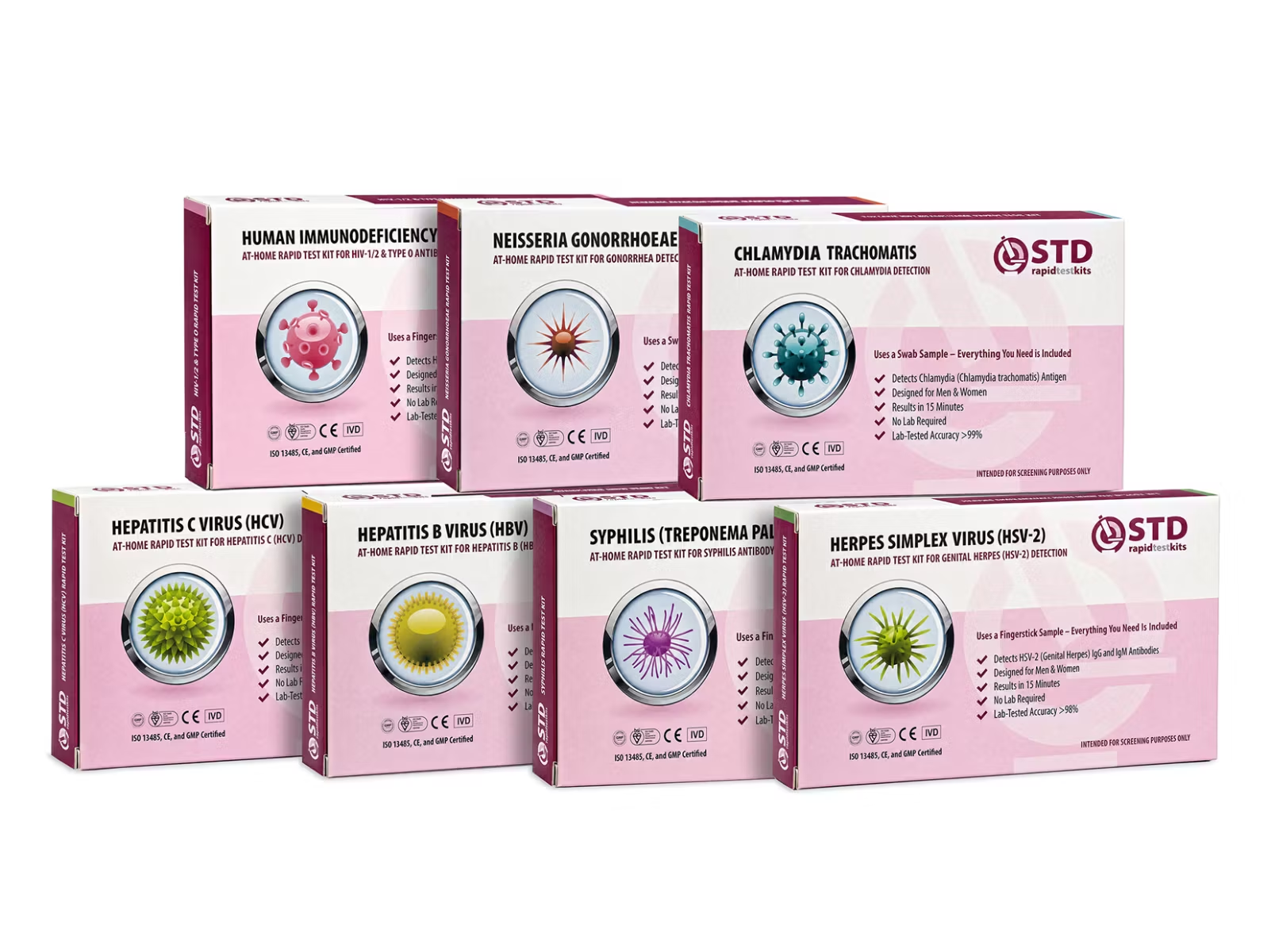
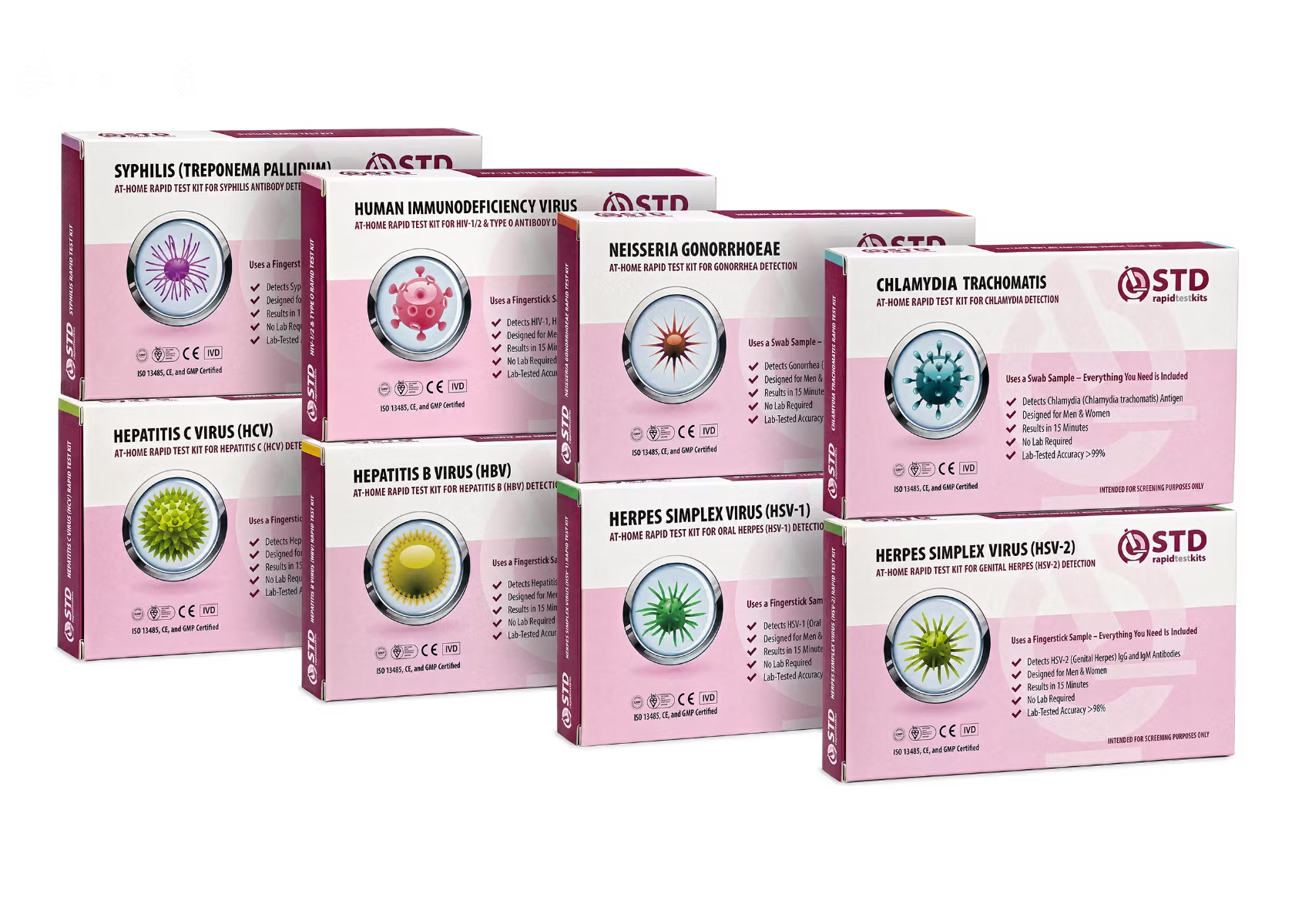
For someone who lives hours from the closest clinic, at-home testing changes the math. The kits ship in plain packaging without identifying labels. They do not require a prescription. They use the same swab or fingerstick sample collection that a clinic would use for a rapid screen, and most return a result within 15 to 20 minutes on the test cassette. Nobody at the post office sees what arrived. Nobody in town sees who walked in.
At-home rapid kits use lateral-flow immunoassay chemistry, the same chemistry used for at-home pregnancy tests. Laboratories use NAAT or PCR for STI screening, which has higher analytical sensitivity than lateral flow, especially in early infections during the window period (the time between exposure and a detectable signal). The two are complementary, not equivalent. A negative rapid result inside a possible window should be repeated or confirmed with lab testing. A positive rapid result is worth confirming clinically so treatment can be prescribed and partners notified through a documented diagnosis.
For the access problem this article describes, that complementarity is the point. The lateral-flow test answers a question the reader can ask in private, today. Lab confirmation can come second, when the answer changes the next decision.
This article is published by stdrapidtestkits.com, which sells at-home STI testing kits. Recommendations below are based on fit for the reader's situation, not commercial benefit. The limits of at-home testing are named where they exist.
Comparing Testing Methods
Three pathways exist for someone trying to figure out what to do next. Each has a different cost, speed, and privacy trade-off. None of them is universally best. The right one depends on whether the question is routine screening, post-exposure follow-up, or active symptoms that need a treatment prescription same-week.
| Testing method | Privacy | Result speed | Best for |
|---|---|---|---|
| At-home rapid test | Very high | 15 to 20 minutes | Routine screening, distance from clinics, privacy concerns |
| Mail-in lab kit | High | 2 to 5 days after lab receipt | Higher analytical sensitivity with home collection |
| Clinic-based testing | Moderate | Same day to one week | Active symptoms, complex cases, treatment prescription needed |
Telling a Partner Without Losing Your Voice
Notifying a partner after a positive STI test is the part most people dread. In a close-knit community, the dread is louder: gossip travels, the partner's family knows the same people you know, and the conversation can feel like a public event no matter how private it is. The fear is real. So is the responsibility, because silence keeps the chain of transmission moving.
Two practical paths reduce the friction. First, anonymous partner-notification services exist in many states and tribal jurisdictions. Tools like the CDC-supported tellyourpartner.org and several state-health-department text and email services let someone send a notification without their own name attached. The recipient gets accurate information about possible exposure and a recommendation to test, with no way to identify the sender. For STIs that are reportable to public health (syphilis, gonorrhea, chlamydia, HIV), the local health department can also handle disease intervention specialist notification on the patient's behalf, which removes the conversation entirely.
Second, for partners the patient does want to talk to directly, a written script helps. The script does not need to be long. A version that works: "I tested positive for [infection]. The CDC recommends you get tested too. Here is the link to do that. I am taking treatment, and I wanted you to have the same information." Practiced once, said once, the message is delivered. The other person's reaction is not the patient's to manage.
1. Anonymous notification services. tellyourpartner.org and many state-health-department tools send a text or email naming the exposure without identifying the sender.
2. Health-department disease-intervention specialist. For reportable infections (syphilis, gonorrhea, chlamydia, HIV), the local public-health office can handle the conversation on the patient's behalf.
Shame Delays Care, Knowledge Steadies It
A common pattern: someone in a long-term, low-partner-count situation finds out at a routine check that they have an asymptomatic STI. The first reaction is anger at the partner, then anger at the test, then a quieter realization that the model of "I am fine because nothing feels wrong" was never how STIs actually work. That last realization is where the shame loosens.
For people raised inside a culture that does not openly discuss sexual health, the act of testing can feel like an admission of guilt. It is not. Testing is the same kind of routine self-knowledge that a blood-pressure check or an eye exam represents. The result tells you what is happening inside your body. What you do next is informed by that, instead of guessed at. Knowledge is the basis for care, including for the people you have been intimate with.
Testing is the same kind of routine self-knowledge that a blood-pressure check or an eye exam represents. A result is information, not a judgment, and it is the basis for whatever decision comes next.
If You Test Positive: What to Do Next
A positive result is not a verdict. Most STIs are treatable. Chlamydia, gonorrhea, syphilis, and trichomoniasis are curable with antibiotics, often a single-dose or short-course regimen. Hepatitis B has highly effective antiviral suppression. HIV is managed long-term with daily antiretroviral therapy and is now compatible with a normal life expectancy when treatment starts early. Herpes is suppressible with daily antivirals that reduce both symptoms and transmission risk. The next step depends on which infection is involved.
For curable infections, the path is: confirmatory testing if not done already, prescription, treatment, retest after the recommended interval (usually three months for chlamydia and gonorrhea, longer for syphilis depending on stage), and partner notification. For chronic infections, the path is: link to ongoing care, start the long-term medication, and maintain follow-up at intervals the prescriber sets. In both cases, treatment outcomes are better the earlier it begins, and that is true in nearly every published outcome study.
Where to access care if a clinic visit is hard: the Indian Health Service system provides federally funded sexual-health care to enrolled members of federally recognized tribes, often at no cost. Telehealth platforms (Wisp, Nurx, Plushcare and others) prescribe STI treatment via video visit and can ship medications to a private address. Federally Qualified Health Centers (FQHCs) operate on sliding-scale fees and serve everyone regardless of insurance status. None of these paths requires walking into the local clinic where everyone knows everyone, and most accept Medicaid or self-pay.
Why Testing Is an Act of Protection, for Self and Community
Across many Indigenous traditions, well-being is held as a community responsibility, not an individual one. The seven-generations principle, articulated in the Haudenosaunee Great Law of Peace and echoed in many Native cultural frames, asks that decisions today consider their effect on descendants seven generations forward. STI testing fits inside that frame more cleanly than the conventional public-health framing usually allows for, because the benefit of one person testing extends past that person.
When one person tests, the chain of transmission breaks at that node. When that person notifies partners, those partners can test and break further nodes. Multiplied across a community, the effect is measurable: fewer infections passed forward, fewer congenital syphilis cases, fewer HIV diagnoses caught only at late stage. The math of that benefit is not theoretical. It is what consistent screening has already demonstrated in better-funded communities, and it is what is missing where access has been thinnest.
What one test can do
- Breaks the transmission chain at one node, immediately, for the person testing.
- Triggers partner-notification options that break further nodes without identifying the patient.
- Reduces the lag between exposure and treatment, which is the lever that prevents most long-term harm.
- Multiplies across a community into measurable reductions in congenital syphilis and late-stage HIV diagnosis.
FAQs
- Why are STIs more common in Native communities?
- The CDC attributes the disparity to access factors, not to higher behavioral risk: fewer reachable clinics, lower per-capita Indian Health Service funding, historical mistrust of medical institutions, and privacy barriers in small communities where everyone knows everyone. People want care; they often do not have a clear or safe path to it.
- If I feel fine, do I really need to test?
- Yes. Most chlamydia and gonorrhea infections produce no symptoms in the early window. Trichomoniasis runs symptomless in roughly seven of ten cases. HIV's acute phase often passes as a flu-like episode and then quiets. The CDC recommends yearly screening for sexually active people under 25, and any time partners change for anyone older. Symptoms are not a reliable trigger to test.
- Are at-home STI tests accurate?
- Yes for screening purposes when used after the recommended window period. At-home rapid kits use lateral-flow immunoassay chemistry, the same technology as at-home pregnancy tests. Sensitivity runs high in established infections; it is lower than lab NAAT in very early infections. A positive result should be confirmed clinically so treatment can be prescribed and reportable infections can be tracked. A negative result during a possible window should be repeated.
- How soon after sex can I test?
- It depends on the infection. Chlamydia and gonorrhea are detectable within one to two weeks of exposure for most people. Syphilis takes three to six weeks for antibodies to reach detectable levels. HIV antibody-only tests detect at four to twelve weeks; fourth-generation antigen-antibody tests detect earlier, at around two to four weeks. Testing too early can miss an infection. Testing once at the early end and again at the full window is the safest pattern.
- Do I have to tell my partner if I test positive?
- Ethically and in many states legally, yes. Anonymous partner-notification services let you send the message without your name attached if direct conversation is not possible. The local health department can also handle notification on your behalf for reportable STIs. Practical scripts help: "I tested positive for X. The CDC recommends you get tested. Here is the link." The other person's reaction is not yours to manage.
- Can I get an STI from oral sex?
- Yes. Gonorrhea, chlamydia, herpes, and syphilis can all transmit through oral contact. Pharyngeal gonorrhea is almost always asymptomatic and is one reason throat-swab testing matters in clinical settings. At-home kits are not optimized for throat-only screening, so a clinic visit is the right path if the exposure was specifically oral. The genital and bloodwork screens at home still cover the same person's general STI risk.
- What if there is no clinic near me?
- At-home test kits and telehealth services are designed for exactly this situation. The kit ships in plain packaging, the test is run privately, and a positive result can be followed up via telehealth (Wisp, Nurx, Plushcare are common options) for treatment without visiting a clinic. The Indian Health Service provides care to enrolled members of federally recognized tribes, and Federally Qualified Health Centers run sliding-scale fees regardless of insurance.
- Can I get reinfected after treatment?
- Yes. Treatment clears the infection; it does not provide future immunity. If a partner was not treated at the same time, or if there is a new exposure, reinfection happens often. The CDC recommends retesting roughly three months after treatment for chlamydia and gonorrhea. Treating partners alongside the patient is the standard care pathway for that reason.
How we sourced this article: We summarized current public-health guidance from the CDC, WHO, Indian Health Service, and HHS Office of Minority Health, and combined it with the experience of writing for general health audiences since 2019. We do not provide clinical diagnosis. For symptoms that concern you, see a licensed provider.
- U.S. Centers for Disease Control and Prevention. Health disparities in HIV, STDs, TB, and viral hepatitis among American Indian and Alaska Native populations.
- U.S. Centers for Disease Control and Prevention. STI health equity: social conditions and barriers to sexual health.
- U.S. Centers for Disease Control and Prevention. STD information library, including symptom and treatment overviews.
- U.S. Department of Health and Human Services, Office of Minority Health. HIV/AIDS and American Indians/Alaska Natives.
- World Health Organization. Sexually transmitted infections fact sheet.
- Indian Health Service. Federal health-services system for AI/AN populations, including sexual-health care access.
