
Published: June 2025 | Last updated: May 2026 | Editorial review and quality control: Martina N.
A February 2025 study out of Dartmouth's Geisel School of Medicine put a hard question to the front of every neonatal ward: can a herpes infection that a newborn shows no signs of still rewire the developing brain? In a carefully controlled mouse model, yes. Tiny exposures to herpes simplex virus (HSV) on the first day of life produced no acute illness in the pups. The same animals showed measurable memory and learning deficits four to five months later, while their brains looked structurally normal under the microscope.
For most pregnant people, this single study will not change the daily risk equation. Neonatal herpes is rare in absolute terms, roughly 10 cases per 100,000 births worldwide per WHO estimates, and an active maternal lesion at delivery already triggers cesarean protocols at most U.S. hospitals. What the new research does change is the seriousness given to small, undramatic exposures: the cold sore from a visiting relative, the subclinical primary infection in late pregnancy, the kiss on the forehead during an asymptomatic shedding day. This article walks through the new findings, the clinical guidance that already existed, and the testing decisions that genuinely move the odds for human babies.
Key Takeaways
- A February 2025 Dartmouth and Harvard study (PLOS Pathogens) found that even asymptomatic neonatal HSV infections in mice caused lasting memory and learning deficits, while a maternal HSV vaccine fully protected the pups.
- Neonatal herpes is rare (about 10 cases per 100,000 births globally per WHO), but knowing maternal HSV-1 and HSV-2 antibody status before or during early pregnancy is the single most useful piece of prenatal information for preventing it.
What the 2025 Dartmouth Study Found
The paper, published in PLOS Pathogens on February 7, 2025, was a collaboration between Dartmouth's Geisel School of Medicine and Harvard Medical School. Lead authors Abigail Dutton and Evelyn Turnbaugh, with corresponding authors David Leib (Microbiology and Immunology) and Katherine Nautiyal (Psychological and Brain Sciences), used a low-dose intranasal HSV-1 infection in newborn mice on postnatal day one. The dose, 100 plaque-forming units, was small enough to cause no detectable acute illness.
Four to five months later, the same mice were tested on standard cognitive tasks: novel object recognition, spatial memory location, and a modified Barnes maze. They underperformed controls on every test. At six months post-infection, the researchers still detected HSV genomes and latency-associated transcripts in central nervous system tissue, evidence that the virus had quietly persisted in the CNS long after the apparent infection was cleared.
The second arm of the experiment is the part with practical relevance. When mother mice were vaccinated before pregnancy with a replication-defective HSV-2 strain (dl5-29), their pups had undetectable viral DNA at five days post-infection and intact recognition memory at the 4-to-5-month testing point. The protective antibodies crossed the placenta and continued to pass through milk during early life. The takeaway, stripped of caveats: maternal immune status appears to be the dominant predictor of whether even a subclinical exposure leaves a lasting mark on the developing brain.
Two caveats matter. First, this is a mouse model; human transmission dynamics, immune development, and neurodevelopmental timelines are all different. Second, no licensed HSV vaccine for humans exists yet, though several candidates (including Moderna's mRNA-1608 and BioNTech's BNT163 program) are in clinical trials. The study's authors are explicit that human application waits on those trials, not on extrapolation from mice.
Clinical outcomes of neonatal HSV infections, where symptoms have been readily apparent, have been well-studied. But little has been known about the frequency of, or outcomes following, asymptomatic neonatal HSV and how it may contribute to long-term neurological damage.
What Neonatal Herpes Looks Like in the First Weeks
Clinically, neonatal HSV is divided into three patterns that vary in severity and presentation. The categorization matters because the visible signs of one type can be nearly invisible, while another mimics common newborn complaints like jaundice or fussy feeding.
SEM disease (skin, eye, mouth) is the most localized form. Vesicles or grouped blisters appear near the lips, scalp (especially at scalp-electrode sites), or eyelids. SEM is sometimes mistaken for a bug bite, eczema, or a forceps abrasion. Caught early and treated, the prognosis is good. Untreated SEM can progress to CNS or disseminated disease.
CNS disease involves the brain and spinal cord. Presentation can be subtle: a baby who is lethargic, feeds poorly, has a low-grade fever, or makes brief jittery movements that look like normal newborn startle. Seizures may be the first unambiguous sign, but they often arrive after a window of softer symptoms that get attributed to a fussy night.
Disseminated disease affects multiple organs at once, frequently the liver and lungs, and can mimic neonatal sepsis or severe jaundice. It is the deadliest pattern, and the one in which the absence of skin lesions can delay diagnosis. A meaningful share of disseminated cases never show the classic vesicular rash that clinicians associate with herpes.
Symptoms typically emerge somewhere between five and 21 days after delivery, though CNS cases can stretch toward the four-to-six-week mark. The first signs are rarely dramatic; the diagnostic challenge is that they look like a hundred other things newborns can have. For wider context on how HSV presents at different body sites, see our guide to herpes transmission.
Any cluster of small fluid-filled blisters on a newborn's skin or scalp, any seizure-like activity, persistent poor feeding paired with a low body temperature, or any concern serious enough that you are reading this paragraph: call. Most neonatal HSV cases that did well were diagnosed within 48 hours of the first symptom; most that did poorly had a multi-day delay. Parents do not need to confirm the diagnosis themselves, they only need to get the baby seen quickly enough that a clinician can.
The 'Silent Infection' Problem
The common parental assumption is that no rash means no virus, and that an infection severe enough to matter would announce itself loudly. The 2025 mouse data, combined with what was already known about HSV biology in humans, suggests both assumptions are flawed.
HSV is neurotropic by design. After initial infection it travels along nerves to sensory ganglia, where it establishes latency: a quiet, persistent state that can reactivate to shed virus even when the host feels fine. In adults this is the mechanism behind asymptomatic shedding days, which the CDC notes occur in many seropositive people regardless of whether they have ever had a visible outbreak. In a newborn, asymptomatic shedding from a maternal genital or oral surface can transmit virus during delivery or skin contact without anyone realizing exposure happened.
What the mouse study added is the consequence side of the equation. Viral traces in the brain did not just mean ongoing infection. They appeared to correlate with measurable cognitive change months later, even with structurally normal-looking brain tissue. A growing body of neurological research is also investigating whether latent HSV contributes to neurodegenerative processes later in life, though the human evidence remains associational rather than causal.
Asymptomatic viral shedding from a parent or caregiver can occur without any visible outbreak. Exposure during vaginal delivery or postnatal skin contact may therefore go entirely unrecognized at the time. The absence of an acute neonatal illness is not strong evidence the exposure was harmless, which is why any documented HSV exposure in the first six weeks warrants developmental follow-up across the first few years of life.
Testing Before and During Pregnancy
Routine HSV serology is not part of standard U.S. prenatal panels, which is a frequent surprise to first-time parents. The reason is not that the information is useless. It is that population-level Type-2 serology has tradeoffs (false positives in low-prevalence populations, anxiety from incidental findings) that the U.S. Preventive Services Task Force has historically judged to outweigh the benefit of universal screening. That guidance applies to asymptomatic adults at the population level; it does not mean an individual person cannot benefit from knowing their own status.
Where serology genuinely helps:
- Before pregnancy or in early pregnancy. Knowing your HSV-1 and HSV-2 antibody status lets your prenatal team plan around the highest-risk scenario, which is first-time acquisition in the third trimester. If you are seronegative, the conversation shifts to barrier methods and partner testing for the rest of pregnancy.
- When your partner is known to have HSV-2 and you do not know your own status: serology answers whether you have already seroconverted (lower transmission risk to baby) or are still seronegative (higher risk if you acquire HSV late in pregnancy).
- At delivery. Visible lesions or prodromal symptoms during labor trigger an automatic cesarean conversation per ACOG guidance, regardless of prior serology.
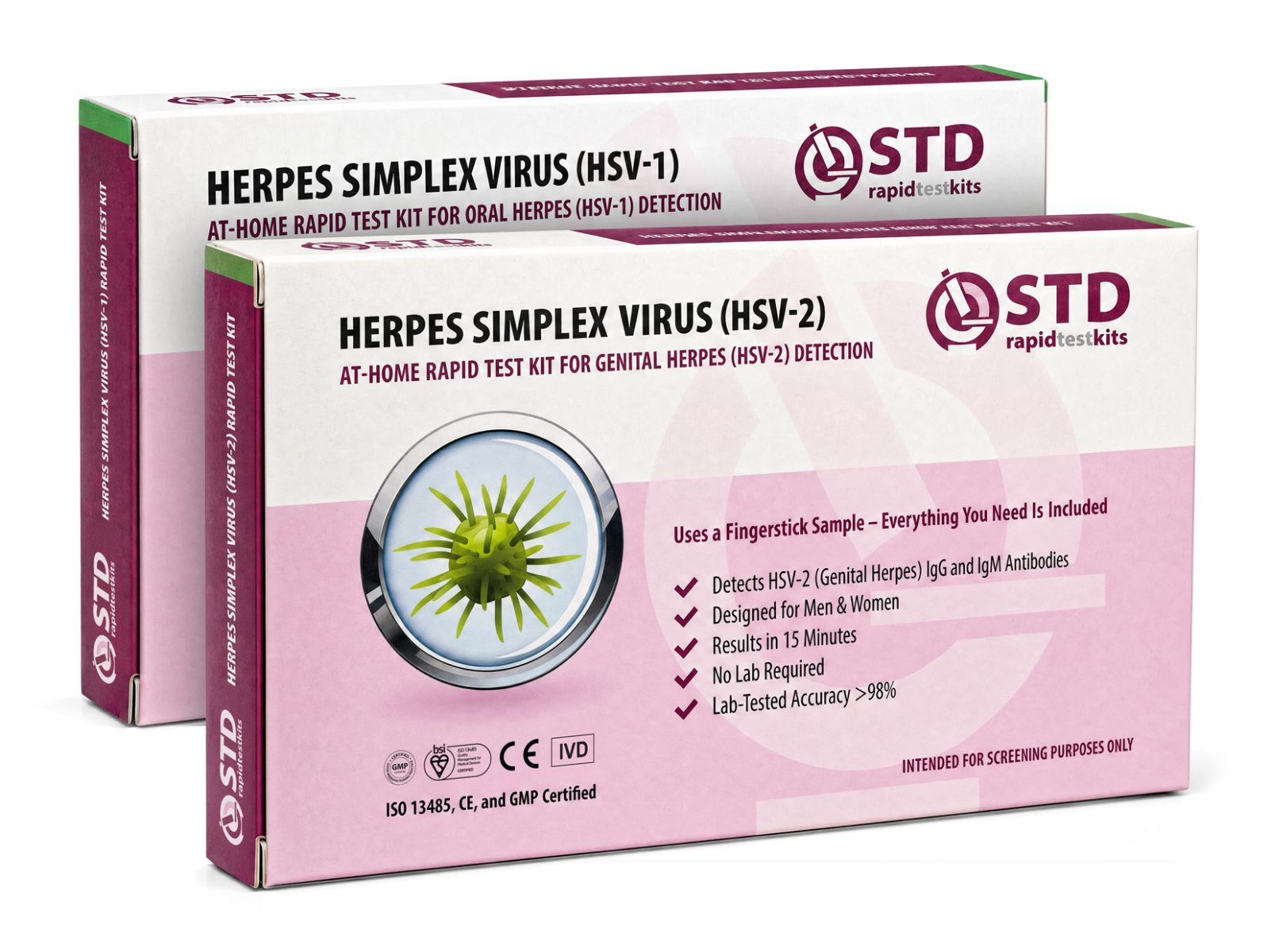
What at-home rapid tests can answer is the antibody question. They cannot diagnose an active outbreak (that needs a swab and PCR at a clinic), and they cannot be used on newborns, where the standard workup is blood and cerebrospinal-fluid PCR done in a hospital. What at-home tests can do is give an adult a fingerstick-level answer about whether antibodies to HSV-1, HSV-2, or both are present in their bloodstream, which is the relevant prenatal-planning data point.
For people in the third trimester with known genital HSV, the standard recommendation is daily suppressive acyclovir from 36 weeks until delivery to reduce the chance of an outbreak (and asymptomatic shedding) during labor.
The at-home tests linked below are sold on this site. They are rapid lateral-flow antibody screens for adults, not diagnostic instruments for newborns, and not a substitute for clinical PCR when active lesions are present at delivery.
Long-Term Consequences When HSV Reaches the Newborn Brain
The 2025 mouse paper sits inside a longer human evidence base, much of it from work by David Kimberlin and the NIAID Collaborative Antiviral Study Group. The pivotal 2011 New England Journal of Medicine trial (PubMed 21991950) randomized neonates who had completed initial IV acyclovir for HSV with CNS involvement to either six months of oral acyclovir suppression or placebo. Babies on suppression had mean Bayley mental-development scores at 12 months of 88.2, compared with 68.1 on placebo, roughly a 20-point gap on a scale where 100 is age-typical.
The longer-arc literature describes a range that is sobering even with modern treatment. Across reviews of neonatal HSV survivors with CNS involvement, a substantial fraction (estimated at 30 to 70 percent in published case series) develop some form of neurodevelopmental sequelae, including cognitive delay, language and learning difficulties, spastic motor disorders, seizures, sensory processing differences, and microcephaly. Disseminated disease carries higher mortality, around 6 percent even with prompt antivirals, and survivors face similar rates of long-term neurological impairment.
Acyclovir suppression cannot guarantee normal neurodevelopment. It remains the most rigorously studied intervention available once a diagnosis is confirmed, and the Bayley score gap in the Kimberlin trial is the cleanest demonstration of its protective effect.
What is harder to measure, and what the 2025 mouse data raises as a question for human work, is whether babies who had milder or subclinical HSV exposures, the kind that historically would not have been tested or treated, also carry an elevated risk of softer learning or memory differences later in life.
What Pregnant Parents Can Do With This Information
Most of the prevention story is upstream. Once a newborn is exposed, the clinical job is fast diagnosis and IV acyclovir; once a baby is in the post-exposure window, parents are working with their pediatrics team, not deciding alone. The places where prenatal decisions actually move the needle are narrower and worth focusing on.
Know your serostatus before or in early pregnancy. This is the highest-impact step in the data. A seronegative pregnant person who acquires HSV in the third trimester faces the highest-risk transmission scenario. A seropositive person, especially one with established HSV-2, has a much lower per-delivery transmission rate (typically cited in the obstetric literature at around 1 to 3 percent for recurrent disease) and can plan suppressive acyclovir from 36 weeks.
Test partners when possible. If you are seronegative and your partner is seropositive or status-unknown, the second and third trimesters are when consistent barrier use and avoiding new oral-genital contact matter most. New oral HSV-1 acquisition in late pregnancy has been documented to cause neonatal disease as severely as HSV-2.
Limit cold-sore contact with the newborn. The most preventable postnatal exposures are kisses on the face from adults with active or prodromal cold sores. This includes well-meaning family members. CDC guidance is to avoid contact between active oral lesions and newborns; if a primary caregiver has a cold sore, hand-washing and a surgical mask while caring for the baby substantially reduce risk during the contagious window.
Trust the prodrome. Tingling, itching, or burning at a usual cold-sore site is the most reliable advance warning. Skip kisses; start hand-washing protocols at the first hint, not after the blister appears.
Where HSV Research Goes From Here
The most consequential next step is the human vaccine question. As of early 2026, there is still no licensed HSV vaccine. Several candidates are in clinical development, and the field has had setbacks (GSK's GSK3943104 therapeutic candidate missed its phase II efficacy endpoint in September 2024 and will not advance to phase III, which is part of the noisy reality of vaccine pipelines). The current pipeline shape is summarized below.
| Candidate | Sponsor | Approach | Status (early 2026) |
|---|---|---|---|
| mRNA-1608 | Moderna | mRNA vaccine targeting HSV-2 | Phase 1/2 clinical trial |
| BNT163 | BioNTech | mRNA program targeting HSV-2 | Phase 1 clinical trial |
| 0DeltaNLS (RVx201) | Rational Vaccines | Live-attenuated replication-competent HSV-2 | Phase 1/2 clinical trial |
| GSK3943104 | GSK | Therapeutic vaccine for HSV-2 recurrences | Discontinued (missed phase II endpoint, Sept 2024) |
| dl5-29 (research only) | Dartmouth/Harvard preclinical | Replication-defective HSV-2 used in the 2025 maternal-vaccination mouse study | Preclinical, not in human trials in this exact form |
Putting the Vaccine Pipeline in Context
The 2025 mouse paper adds a specific dimension to that pipeline: maternal vaccination as a strategy for preventing neonatal disease, even in scenarios where the mother is exposed during pregnancy. The maternal-antibody mechanism it demonstrated is the same one that drives existing Tdap and RSV maternal-vaccination programs. If any of the HSV vaccine candidates clear human safety and efficacy thresholds, a prenatal-immunization use case is one likely first deployment, because the at-risk window (third-trimester primary infection) is well-defined and the protected population (newborns) is high-impact.
Until that exists, the practical playbook is the one this article has been describing: prenatal serology when it answers a real question, third-trimester suppressive acyclovir for known-positive parents, fast cesarean conversion at any active-lesion delivery, no cold-sore contact with newborns, and low-threshold workup for any HSV-suggestive symptom in the first six weeks of life.
Frequently Asked Questions
- Can a baby get herpes if the mother has no symptoms or visible sores?
- Yes. Asymptomatic viral shedding accounts for a meaningful share of neonatal HSV cases. The highest-risk situation is a first-time (primary) maternal infection in the third trimester, when the mother has not yet built protective antibodies that cross the placenta. Recurrent infection in someone who acquired HSV before pregnancy carries a much lower per-delivery transmission risk, typically cited in the obstetric literature at around 1 to 3 percent.
- How is neonatal herpes transmitted?
- Most cases come from contact with the maternal birth canal during delivery. A smaller share are intrauterine (rare) or postnatal, typically from a caregiver with an active oral HSV lesion. CDC and ACOG guidance prioritizes cesarean delivery when a parent has visible lesions or prodromal symptoms at the start of labor.
- What are the earliest signs to watch for in the first six weeks?
- The first warning is often not a rash. In the first 5 to 21 days, watch for temperature instability paired with poor feeding, or any jittery activity that does not look like a normal newborn startle. The classic clustered vesicular blisters only appear in SEM-pattern cases and can be entirely absent in CNS or disseminated disease, which is what makes early recognition difficult.
- Should pregnant people be tested for HSV antibodies?
- Routine universal serology is not part of standard U.S. prenatal panels, but individual testing is useful before pregnancy or in early pregnancy, especially if HSV status is unknown or a partner is known-positive. Knowing your antibody status lets your prenatal team plan around the highest-risk scenarios.
- If I had cold sores as a teenager, am I at risk during pregnancy?
- Established HSV-1 (the typical cold-sore strain) actually lowers the relative risk of neonatal disease compared with brand-new infection, because protective antibodies developed years before pregnancy cross the placenta. An old, long-established HSV infection is a much lower-risk situation for the baby than a brand-new primary infection acquired during late pregnancy.
- Is acyclovir safe during pregnancy?
- Yes. Acyclovir is one of the most-studied antivirals in pregnancy and is routinely prescribed for daily suppressive therapy from 36 weeks in people with known genital HSV. It reduces both visible outbreaks and asymptomatic shedding around delivery.
- Can someone with a cold sore safely hold or care for a newborn?
- Yes, with two precautions. Keep active lesions, and the prodromal tingling or burning that often precedes them, away from the baby's face, and wash hands thoroughly before any skin contact. A surgical mask during the contagious window further reduces risk, and CDC guidance specifically recommends caution during the prodromal phase rather than waiting for the visible blister.
- Is there a herpes vaccine for humans yet?
- No vaccine is currently licensed anywhere in the world. Several candidates are in clinical trials (Moderna's mRNA-1608, BioNTech's BNT163 program, Rational Vaccines' 0DeltaNLS), and the 2025 mouse data on maternal vaccination is part of the case for prioritizing prenatal use cases in those trials.
- Dutton AS, Turnbaugh EM, et al. Asymptomatic neonatal herpes simplex virus infection in mice leads to persistent CNS infection and long-term cognitive impairment. PLOS Pathogens, February 7, 2025. Primary source for the mouse model, dose, behavioral testing window, and maternal vaccine results.
- Dartmouth Geisel School of Medicine news release on the 2025 neonatal HSV mouse study, including the verbatim quote from Dr. David Leib on the asymmetry of clinical knowledge between symptomatic and asymptomatic neonatal HSV.
- Kimberlin DW, Whitley RJ, et al. Oral acyclovir suppression and neurodevelopment after neonatal herpes. New England Journal of Medicine, 2011. Source of the Bayley mental-development scores (88.2 vs 68.1) comparing six months of acyclovir suppression to placebo in CNS-involvement neonatal HSV.
- World Health Organization. Herpes simplex virus fact sheet, including the global neonatal herpes incidence estimate of approximately 10 cases per 100,000 live births and the elevated risk profile of first-time maternal infection late in pregnancy.
- U.S. Centers for Disease Control and Prevention. About Genital Herpes, including guidance on transmission during pregnancy, asymptomatic shedding, and reducing vertical transmission via antiviral suppression and cesarean delivery when lesions are present.
- ScienceDaily reporting on the February 2025 Dartmouth-Harvard PLOS Pathogens neonatal HSV study, summarizing the maternal-vaccination protective findings for a general audience.
