

Published: November 2025 | Last updated: April 2026 | Editorial review and quality control: Martina N.
Dating in your 50s, 60s, or 70s should not require giving up on protection. Yet rates of chlamydia and other sexually transmitted infections have been climbing fastest in adults over 45 for more than a decade, and most of those infections go undiagnosed because nobody at the doctor's office thinks to look. This guide walks through how chlamydia actually moves through this age group, why standard physicals miss it, what real prevention looks like outside a college dorm room, and what to do if a test comes back positive.
Can I really get chlamydia after 50?
Yes. If you are sexually active, age does not protect you. Chlamydia diagnoses among adults over 45 have risen sharply over the past decade according to <a href="https://www.cdc.gov/sti-statistics/about/" target="_blank" rel="noopener">CDC surveillance</a>, largely because condom use drops sharply after menopause and routine physicals almost never include STI screening unless you specifically ask. Prevention is straightforward: condoms with new partners, an at-home or clinic test before becoming sexually active with someone new, and a follow-up test about three months after any treatment.
Key Takeaways
- Chlamydia in adults over 45 is rising faster than in any other adult age group, but routine annual physicals rarely test for it unless you ask.
- Prevention works the same way at any age: barrier protection during new sexual encounters, plus an at-home or clinic test on a predictable schedule.
Why chlamydia cases are rising in adults over 50
The CDC's STI surveillance shows chlamydia diagnoses across all age groups, with the steepest recent rise concentrated in adults over 45. Three forces drive the pattern, and none of them have anything to do with how often older adults are dating.
The first is biological. After menopause, vaginal tissue thins and produces less natural lubrication, which makes microtears during sex more common. Microtears are small enough that you may not feel them, and they create entry points for bacteria like Chlamydia trachomatis. Postmenopausal women are therefore measurably more vulnerable to genital infections per encounter than they were in their 30s. For men, age-related changes to the prostate and urinary tract can mask symptoms, so an early infection that would have been obvious at 25 feels like ordinary aging at 60.
The second is behavioral. Condom use drops sharply once pregnancy is no longer on the table. Surveys of adults over 50 consistently show condom use rates well below those of younger adults, even with new partners. The driving belief is that condoms are a contraceptive tool. Chlamydia does not need ejaculation to spread, and it has no opinion about fertility status.
The third is medical. Standard annual physicals do not include STI testing. If your clinician draws blood at a checkup, the labs typically run a metabolic panel, lipids, thyroid, and depending on age a few cancer markers. Nothing in that bundle detects chlamydia. CDC surveillance data consistently shows that STI testing among adults over 50 remains far below recommended levels, simply because the topic rarely surfaces in older patients' visits unless they raise it themselves.
Add those factors together and you get a population that has more biological vulnerability, fewer behavioral safeguards, and a healthcare system that is not actively looking. Infections accumulate quietly when nobody is watching.
Most public-health screening targets for chlamydia focus on women under 25. Adults over 45 fall outside the default criteria, so unless you specifically request an STI panel, the test does not happen as part of a routine checkup. The gap is structural, not personal.
How chlamydia actually moves through this age group
The transmission patterns in older adults are not the ones most public-health campaigns address. The most common route involves returning to dating after a long monogamous relationship ends. After divorce, separation, or widowhood, many people return to dating with the same trust assumptions they brought to a 25-year marriage. A new partner who was also in a long marriage feels low-risk by association. Unless both of you have been tested since your last sexual relationship and the results are confirmed negative, the assumption is just that, an assumption. Chlamydia can sit in someone for months or years without producing symptoms, and a previous monogamous marriage does not retroactively clear the slate.
Close behind is condom-free reentry after menopause, where neither partner is thinking about STI risk. The conversation often runs along these lines: "we are both adults, neither of us can get pregnant, we are exclusive." Even when those statements are true today, they leave no margin for a chlamydia infection that arrived months or years ago and has been quietly persistent in one partner without symptoms.
The screening gap at the doctor's office finishes the story. Many older adults assume their annual physical includes STI testing. It does not, and most clinicians do not bring up sexual history with older patients unless prompted. An infection that a 22-year-old would catch at a routine campus visit goes unnoticed in a 62-year-old for months.
A previous long monogamous marriage does not retroactively clear anyone's STI history. Either partner could have arrived with an undiagnosed infection that has been quietly persistent. The only thing that confirms a clean baseline for a new relationship is two current negative tests.
Why symptoms get misdiagnosed in older adults
When chlamydia does produce symptoms, those symptoms are easy to attribute to other things at this age. Pelvic discomfort gets read as a flare of an old injury. Burning urination gets read as a urinary tract infection and treated with a UTI-specific antibiotic that does nothing for chlamydia. Vaginal dryness or post-coital spotting gets read as menopause progressing. Mild penile or testicular ache gets read as prostate trouble and sometimes treated as prostatitis.
Misdiagnosis gets reinforced through predictable routes at this age. A clinician who reads an older patient as low-risk often skips the STI test entirely, leaving the infection invisible to bloodwork. A UTI-specific antibiotic then masks symptoms briefly without clearing the actual infection, so the patient feels better for a week before symptoms return. By the time the pattern is recognized, weeks have passed and the infection has had time to spread and damage tissue.
Untreated chlamydia is not harmless. In women, it can travel upward and cause pelvic inflammatory disease, which produces chronic pelvic pain and, in severe cases, scarring that affects fertility even after menopause has occurred. In men, untreated infection can cause epididymitis, a painful swelling of the testicles that affects fertility and sexual function. The risk of passing the infection to partners stays high as long as it goes unrecognized.
The table below summarizes how the same underlying chlamydia infection can present differently and get misread by age and gender.
| Age and gender | Common chlamydia symptoms | Often misread as |
|---|---|---|
| 18 to 30, any gender | Burning urination, abnormal discharge, pelvic pain | Urinary tract infection |
| 50 and over, women | Mild pelvic pressure, post-coital spotting, vaginal irritation, bleeding after sex | Vaginal atrophy, menopause progression, hormonal changes |
| 50 and over, men | Mild penile discomfort, occasional discharge, testicular ache | Prostatitis, BPH, age-related urinary changes |
How to protect yourself after 50
Prevention does not change with age. Communication with new partners, barrier protection when test status is unknown, and a regular testing schedule cover most of the practical risk. What does change is the social context. Older adults rarely see themselves in public-health campaigns about STI prevention, and sexual-health conversation in midlife and later still carries more shame than it should.
Communication is the foundation. Before becoming sexually active with a new person, both of you knowing your current STI status is the single most effective protection. Framing matters. A sentence like "I get tested before any new partner, would you be open to doing the same?" lands better than an interrogation. Most adults appreciate the structure once it is offered. If a new partner refuses to test, that response is information.
Condoms fill the gap that conversation alone cannot. Lubricated condoms paired with water-based lube reduce both friction-related microtears and the chance of fluid-borne transmission. They are not romantic, and they do not need to be. Treat them as the way two people who are still getting to know each other take care of each other's bodies. Once both partners have tested clean and the relationship is genuinely exclusive, condom use becomes a choice rather than a necessity.
Testing closes the loop. A baseline test before a new partner, a repeat test about three months after any new sexual relationship begins, and another test if symptoms appear are the standard cadence. People in long-term monogamous relationships with no new exposure do not need annual STI screening. People who are dating, partnered with someone who has new partners, or unsure about a partner's history do.
Myth 1: "I cannot get pregnant, so I do not need condoms." Pregnancy and infection are separate risks. Chlamydia spreads through fluid and mucous-membrane contact, and condoms cover both.
Myth 2: "I would know if I had something." Most chlamydia cases produce no obvious symptoms at any age, and the symptoms in older adults are especially mild and easy to dismiss.
Myth 3: "My annual physical covers it." Standard annual physicals and routine bloodwork do not include STI testing unless you specifically request a panel.
When and how to get tested
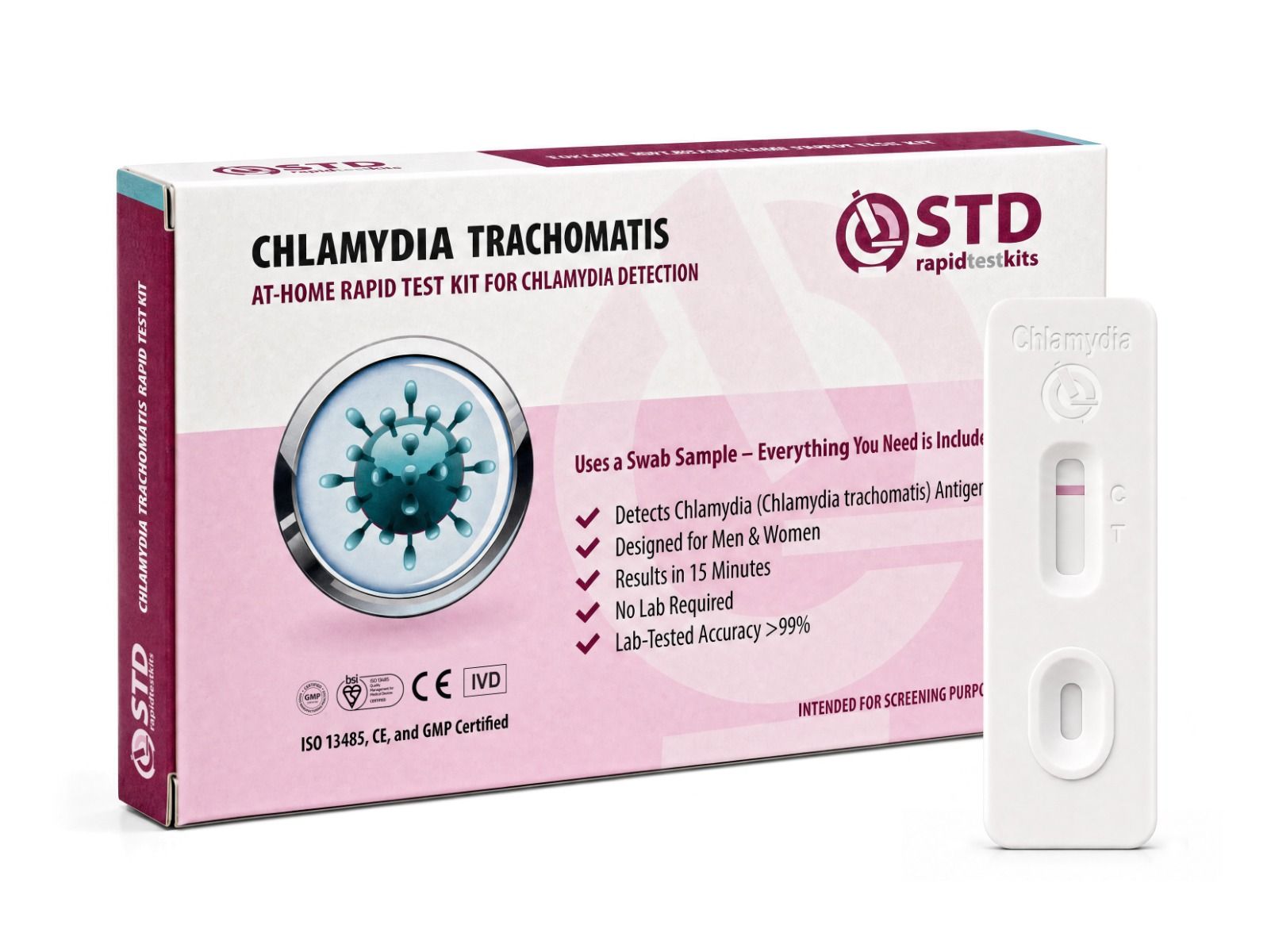
Two paths cover most situations. The clinic path uses lab-grade nucleic acid amplification testing (NAAT), which is the technical gold standard for chlamydia. The at-home path uses lateral-flow rapid tests, which screen quickly and privately at home with a self-collected swab and produce a result in about 15 minutes. We sell rapid at-home tests for chlamydia, and product links in this article go to our own catalog.
The two methods are complementary, not equivalent. Lab NAATs have higher analytical sensitivity, especially in asymptomatic infections, and a positive home result is worth confirming with a NAAT when possible. The strength of an at-home test is access. People who would not visit a clinic at all because of distance, mobility, schedule, or simple preference will use a kit at home. A test taken privately is more useful than a test never taken.
Timing matters. Chlamydia has an incubation window. A test taken within the first five to seven days of exposure can miss the infection because bacterial levels have not yet reached detectable thresholds. The reliable testing window is roughly 14 days after the exposure event, with a follow-up if symptoms appear later.
For people who want broader coverage in one go, a combination kit screens for chlamydia alongside other common infections that share the same risk profile, including gonorrhea, syphilis, HIV, and hepatitis. Combination kits are useful when an exposure event was high-risk or when this is your first STI test in years and you want a thorough baseline.
What happens if you test positive
A positive chlamydia result is one of the most treatable findings in STI medicine, and it carries no moral weight. A short antibiotic course clears most cases, and the path forward is well established.
The CDC's current STI treatment guidance for uncomplicated chlamydia is doxycycline 100 mg orally twice daily for seven days. Azithromycin remains an alternative for specific situations including pregnancy. Your prescribing clinician decides which fits your case, but the path is straightforward and the medication is inexpensive.
After a positive result, confirmatory testing with a lab NAAT rules out user error if the result came from a rapid kit. Partner notification covers anyone you have been sexually active with in the prior 60 days, and some clinics offer expedited partner therapy so the partner can be treated without a separate visit. Sex should be off the table during the seven-day antibiotic course and for an additional seven days after, to avoid passing the infection back and forth.
None of this needs to be a shame spiral. One pattern that comes up repeatedly: a woman in her mid-60s, newly dating after widowhood, tests positive after several months with a new partner. They both get treated, wait the full two weeks before resuming sex, and use the conversation as an opening for honest discussion about testing schedules going forward. That arc, from positive result to better communication, is more common than people expect.
Retesting and why it matters
A common mistake after a positive chlamydia result is to take the antibiotic, feel fine, and assume the story is over. Reinfection rates are high enough that the CDC explicitly recommends a follow-up test about three months after treatment, regardless of whether symptoms returned. Reinfection often comes from a partner who was treated late, never treated at all, or from a different new exposure.
The three-month test is the only reliable way to confirm the antibiotic worked, catch a reinfection from a partner who was treated late or never treated, and rule out complications like pelvic inflammatory disease in women or epididymitis in men developing quietly without symptoms. For older adults whose original infection may have been carried for weeks or months before diagnosis, that follow-up test is especially important because it catches lingering issues early enough to treat them.
The table below summarizes when retesting is the right move and why.
| Scenario | When to retest | Why |
|---|---|---|
| Tested within 5 days of exposure | Repeat test after 14 to 21 days | The infection may not yet be detectable at that early point |
| Treated for chlamydia | Repeat test about 3 months after treatment | CDC standard to confirm clearance and catch reinfection |
| Symptoms returned after a negative test | Retest now | May indicate a missed infection or a new exposure |
| Started a new sexual relationship | Test within 14 days, then again at 3 months | Catches early infection and confirms protection going forward |
Talking to a partner about testing without killing the mood
The conversation goes more smoothly when you frame it as something you do, not something you are asking the other person to do. "I always test before becoming sexually active with a new partner. Would you be open to doing the same?" works because it is not accusatory and it makes testing the default rather than a special demand.
If a partner refuses, that response is information about the partner. Some people are put off because the request is unfamiliar. Most people, especially in this age group, respond well once they understand it is offered as mutual care rather than suspicion. If pushback escalates into resentment or pressure to skip protection, treat that as a warning about how the relationship will handle other health and trust questions later.
For people who find the conversation easier in writing, an at-home kit ordered for both partners and used at home together can substitute for a verbal request. Unboxing two kits and doing them at the same kitchen table, then waiting 15 minutes for a result, removes the rhetorical framing entirely.
Many people with chlamydia have no symptoms or only mild symptoms.
Sex after 50 is yours to keep
The takeaway is straightforward. Chlamydia is more common in your age group than most clinical conversations acknowledge, easier to miss, and entirely treatable when caught. Prevention works the same way at 60 as it does at 25. Communication, condoms with new partners until both of you have a clean test, and a regular testing schedule cover almost the entire risk.
The shame surrounding STIs in midlife and later does more damage than the infections themselves. Patients who have been through a positive result and a course of treatment consistently describe the same pattern, that they felt unseen by the healthcare system before the diagnosis rather than reckless. The goal is to be seen by your partner, by your clinician, and by yourself as someone whose sexual health is worth maintaining at any age.
If it has been a while since you tested, or if you have a new partner and want a clean baseline, a discreet at-home kit is the lowest-friction way to get an answer. Combination kits cover chlamydia alongside other common infections that share the same risk profile, which is useful when this is your first STI test in years.

Frequently asked questions
- Can adults over 50 really get chlamydia?
- Yes. Diagnoses among adults over 45 have been rising faster than in any other adult age group for more than a decade. Age does not change how chlamydia spreads, only how willing the people around you are to consider testing as a possibility.
- How can I tell chlamydia apart from a UTI?
- You often cannot, and that is part of the problem. Chlamydia and a urinary tract infection produce overlapping symptoms including burning urination and pelvic pressure. The difference shows up after treatment. A standard UTI antibiotic clears a UTI within a few days. If symptoms linger, return, or never fully resolve, ask for an STI test specifically. UTI medications do not treat chlamydia.
- Why did my doctor not suggest STI testing?
- Standard annual physicals and routine bloodwork do not include STI screening, and most public-health screening recommendations for chlamydia focus on women under 25. Older adults fall outside the default screening criteria, so unless you specifically ask, the test does not happen. This is a system gap, not a judgment about you.
- Can you have chlamydia and feel completely fine?
- Entirely possible, and in adults over 50 it is more the rule than the exception. Symptoms in this age group are mild enough to be mistaken for hormonal changes, prostate shifts, or normal aging. That is precisely why symptom-watching is unreliable and a scheduled test is the only dependable way to know your status.
- How soon after sex can I test?
- The reliable window is about 14 days after the exposure event. A test within the first five to seven days can miss the infection entirely because bacterial levels have not yet reached detectable thresholds. If you test early and the result is negative, plan a repeat test at 14 to 21 days.
- Do I really need condoms after menopause?
- Unless both you and your partner have tested negative since your last sexual relationship and the relationship is exclusive, yes. Pregnancy is one risk; STIs are a separate risk that condoms also cover. Postmenopausal vaginal tissue is also more prone to microtears, which raises per-encounter transmission probability.
- Should I retest after I finish treatment?
- Yes. The CDC recommends a follow-up test about three months after treatment to confirm clearance and catch reinfection. Reinfection is common when a partner is treated late or not at all.
- Can men over 50 get chlamydia too?
- Yes. Men in this age group often delay testing because mild symptoms get blamed on prostate issues or general aging. Burning, occasional discharge, or testicular discomfort are reasons to test, not signs of a normal aging process.
- U.S. Centers for Disease Control and Prevention. Basic chlamydia fact sheet covering symptoms, transmission, and screening recommendations.
- U.S. Centers for Disease Control and Prevention. STI treatment guidelines for chlamydial infections including current first-line antibiotic regimen and partner-management guidance.
- U.S. Centers for Disease Control and Prevention. STI surveillance landing page with case counts and trend data across age groups.
- U.S. Centers for Disease Control and Prevention. Get Tested locator for finding clinics that test for chlamydia and other STIs.
- World Health Organization. Chlamydia fact sheet covering global incidence, transmission routes, and prevention.
- NHS. Chlamydia overview covering symptoms, transmission, testing, treatment, and complications such as pelvic inflammatory disease.
