
Published: October 2025 | Last updated: May 2026 | Editorial review and quality control: Martina N.
Kissing the neck, trailing kisses down the chest, a long makeout that strays past the mouth: none of those count as “sex” by most definitions, but all involve sustained contact with another person’s skin. That contact is mostly safe. For two infections in particular, herpes simplex virus and syphilis, it can occasionally be enough.
Most readers landing on this page need a clear answer first, so here it is. The great majority of sexually transmitted infections need mucosal contact or shared body fluids to pass between people. Kissing a partner’s neck will not give you HIV, chlamydia, gonorrhea, or hepatitis. The risk picture for herpes and syphilis is genuinely different, and that is what the rest of this article is about. The goal here is concrete information, not anxiety: when skin-to-skin contact really matters, what to look for if you are worried, and when testing becomes worth the trip.
Key Takeaways
- Most STIs require mucosal contact or shared fluids and do not transmit from kissing a partner’s neck or chest.
- Herpes simplex virus and primary-stage syphilis can transmit through skin-to-skin contact, sometimes from areas that look completely normal.
Not All STIs Use the Same Route of Transmission
Sexually transmitted infections move between people along specific biological pathways, and the pathway determines what counts as a real exposure. Lumping every STI together leads to either false alarm or false reassurance. Breaking them apart by route makes the picture clearer.
Chlamydia and gonorrhea spread when infected mucous membranes contact uninfected ones, almost always during vaginal, anal, or oral sex. They do not move through intact skin on the neck, chest, or shoulders. A person could kiss a chlamydia-positive partner’s collarbone for an hour without exposure. The same is true for trichomoniasis, which lives in vaginal and urethral mucosa.
HIV needs blood, semen, vaginal fluid, rectal fluid, or breast milk to enter the body, and it needs a mucous membrane or a fresh wound as the entry point. Saliva is not on the list, and intact skin is a strong barrier. CDC guidance on HIV transmission confirms that HIV is not transmitted by saliva, sweat, tears, closed-mouth kissing, or contact with intact skin. Hepatitis B and hepatitis C are bloodborne and follow similar logic: routine kissing or skin contact above the waist does not move them.
Two infections break this pattern. Herpes simplex virus (HSV-1 and HSV-2) can shed from skin and from oral mucosa, often without any visible sore, and it can transfer through direct skin-to-skin contact. Primary syphilis presents as a sore called a chancre, which is loaded with the bacterium Treponema pallidum; skin contact with that sore is enough to transmit it. Both infections can show up on the neck, chest, lips, or mouth depending on where the carrier’s lesion or shedding zone happens to be.
These exceptions matter because the protective intuitions people develop, “I didn’t have penetrative sex, so I’m fine” or “I used a condom, so I’m fine,” do not fully cover them. Condoms reduce transmission of herpes and syphilis without eliminating it, since latex barriers cover only the genital region and these infections frequently shed beyond it.
HIV, chlamydia, gonorrhea, trichomoniasis, hepatitis B, and hepatitis C all require either shared body fluids or direct mucous-membrane-to-mucous-membrane contact. Kissing someone’s neck, chest, or shoulders does not transmit any of these. If a recent neck kiss is your only exposure, these six can come off your worry list.
How Herpes and Syphilis Move Through Skin Contact
Herpes simplex virus has two types, HSV-1 and HSV-2. Both can live on or near the mouth and on the genitals, and either type can settle in either location. The virus replicates inside skin and mucosal cells, then sheds onto the skin surface during outbreaks and, importantly, between outbreaks. CDC’s genital herpes fact sheet states that a person can infect a sex partner even without any symptoms, and that genital herpes can be acquired from a partner who shows no visible sore or is unaware of their infection. The same shedding logic applies to oral HSV-1: a partner with a cold-sore history who currently looks clear can still pass the virus, just at lower efficiency than during a visible outbreak.
When the lips of one person make contact with skin or mucosa where another person’s HSV is active or shedding, transfer is biologically straightforward. HSV does occasionally settle on the neck or upper chest, particularly when a prior outbreak leaves residual viral activity in the area, or when a partner’s facial herpes history includes shedding beyond the lip border. The lips and genitals remain the more common sites. Risk rises further when the receiving skin has any kind of break: a small shaving nick, dry-skin cracking, recent sunburn, or friction from clothing.
Syphilis works through a different organism but follows similar contact logic. The earliest stage of syphilis presents as a chancre, a firm, usually painless ulcer that appears at the site where the bacterium first entered. The chancre is typically on the genitals or in the anal area, though extragenital chancres on the lips, tongue, nipples, fingers, or chest are documented in clinical literature. The CDC’s syphilis fact sheet notes that transmission happens through direct contact with a syphilitic sore during sexual activity; an extragenital sore on the lip or chest follows the same contact logic even outside a conventional sexual act. After the chancre heals, secondary-stage rashes on the palms, soles, or trunk can also be contagious if they are open or weeping.
HPV (human papillomavirus) deserves a brief mention. Visible genital warts are caused by certain HPV strains and can theoretically transmit through skin contact with the wart itself. Wart-to-non-wart-skin transmission outside the genital area is much rarer, and the high-risk cancer-associated HPV strains are not known to spread through casual contact like neck kissing. Molluscum contagiosum, a poxvirus that produces small pearly bumps, also passes through skin contact, including in non-sexual settings.
| Infection | Can It Spread via Neck Kissing? | How It Spreads | Notes |
|---|---|---|---|
| Herpes (HSV-1 or HSV-2) | Yes, in specific conditions | Skin-to-skin contact, including from areas without a visible sore | Neck, chin, and chest lesions or shedding zones are possible; lips and genitals are more common sites |
| Syphilis (primary stage) | Rarely | Direct contact with a syphilitic chancre | Chancres can appear on the lips, chest, or other extragenital sites and are usually painless |
| HPV (warts) | Very rare | Contact with an active wart lesion | Cancer-associated HPV strains are not spread by casual skin contact |
| HIV | No | Blood, semen, vaginal or rectal fluids, breast milk | Not transmitted by closed-mouth kissing or contact with intact skin |
| Chlamydia, gonorrhea, trichomoniasis | No | Vaginal, anal, or oral sex with mucosal contact | Require infected mucous membrane to uninfected mucous membrane |
| Hepatitis B and C | No | Blood-to-blood contact, sex involving blood | Not transmitted through routine kissing above the waist |
Why “I Didn’t See Anything There” Is Not Enough
The standard intuition is that a visible sore is a warning sign and clear skin is safe. With herpes especially, that intuition undersells the risk. Asymptomatic shedding, the release of viable virus from skin or mucosa that looks completely normal, accounts for a meaningful share of HSV transmission. Genital HSV-2 can shed on days when no sore is present, and the CDC notes that a person can transmit genital herpes without visible sores, and that infection can be acquired from a partner who has no visible signs. Oral HSV-1 shedding follows the same pattern.
A partner who has never had a visible cold sore can still carry HSV-1 and shed it occasionally from the lips or perioral skin. A partner with a prior herpes diagnosis who is currently outbreak-free still carries some risk. The per-contact transmission risk during asymptomatic shedding is low, so a single neck kiss rarely warrants immediate alarm. What it does warrant is dropping the idea that “I checked their skin and it looked fine” offers real reassurance. A clean-looking surface is a weaker signal than testing or an honest conversation about recent diagnoses.
Syphilis creates the same false-confidence problem in a different way. A primary chancre is often painless. If it lands somewhere a partner does not look at regularly, the back of the neck, between the shoulder blades, on the chest near a beard line, or on the inside of the lip, it can remain visible for weeks and heal on its own without being noticed. The person carrying it has no reason to mention it because they never saw it themselves. CDC syphilis guidance emphasizes this: the painless nature of the chancre is one of the main reasons primary syphilis goes undiagnosed.
The stronger signal is a short question, not a visual inspection: when was the partner last tested, have any new spots appeared on either of you in the past month, has anyone shared a recent diagnosis. Those answers gather more risk information than looking at someone’s skin ever will.
Three questions worth gathering before or after a close-contact encounter:
- When was the partner last tested? A recent full STI screen is more informative than how their skin looks.
- Any new or changed spots in the past month? On either of you, anywhere in a contact zone.
- Any prior herpes or syphilis diagnosis? An outbreak-free partner with a known history still carries some risk, just less.
How Your Skin’s Condition Changes the Risk
The intact stratum corneum, the outermost layer of skin, is a remarkably good barrier against most pathogens. Once it is broken, even microscopically, that barrier shifts from a strong defense to a weak one. The areas where skin tends to break are also the areas people frequently kiss: the neck, jawline, chest, inner arms, and lips themselves.
Situations that compromise the skin barrier in the kissing zone:
- Fresh shaving on the neck, chest, or face, which produces hundreds of micro-abrasions that close within hours but are open during the window when intimate contact often happens.
- Recent waxing or threading; same mechanism, slightly larger micro-tears.
- Sunburn, which damages the epidermis and increases permeability for several days.
- Eczema, psoriasis, or contact dermatitis flares, which leave skin chronically inflamed and more susceptible.
- Cold-weather chapping on the lips, the same biology of broken skin in a place that frequently makes contact during intimacy.
- Cuts, scratches, or healing acne lesions in the contact zone.
None of these guarantees an infection will transmit. They simply lower the threshold at which transmission becomes possible. For herpes, the difference between intact skin and abraded skin can be substantial; viral particles need cellular entry, and intact stratum corneum gives them very few entry points. For syphilis, direct contact with a chancre on broken receiving skin sits closer to the worst-case end of the transmission spectrum.
There is also a counterweight worth noting. Saliva contains antimicrobial enzymes (lysozyme, immunoglobulins) that reduce pathogen survival on oral mucosa, though they do not eliminate it. This is part of why HIV is not transmitted through kissing despite blood-saliva mixing being theoretically possible. The same saliva chemistry does not, however, neutralize herpes or syphilis to a meaningful degree.
| Skin Condition | Effect on Skin-Contact STI Risk | Common Scenarios |
|---|---|---|
| Normal, unbroken skin | Low background risk | Routine kissing where neither partner has visible lesions |
| Recently shaved or waxed | Slight increase from micro-abrasions | Freshly shaved neck or beard area before intimate contact |
| Sunburn, windburn, dry cracked skin | Moderate increase from impaired barrier | Kissing after a long day outdoors or in dry climates |
| Eczema, psoriasis, or dermatitis flare | Moderate increase, depending on flare severity | Active flares on the lips, neck, or chest at the time of contact |
| Visible sore, lesion, or wart | Substantially higher; the contact site of an outbreak is the highest-risk surface | Contact with an HSV vesicle, syphilis chancre, or wart |
When and How to Test After a Skin-Contact Exposure
Timing matters more than urgency when testing after a skin-contact exposure. Clinics will not run a same-day herpes blood test on someone who kissed a partner’s neck three days ago and feels fine, because the result will not be meaningful that early. Knowing what to test for and when makes the difference between a useful result and an anxious one.
For herpes, two test types apply. A swab of an active lesion (PCR or viral culture) is highly accurate during an outbreak and is the preferred approach when a visible sore is present. The window is short: lesions usually appear within 2 to 12 days after exposure if they appear at all, and the swab works best when the sore is fresh, before crusting begins. Blood antibody tests (IgG) for HSV-2 can take up to 16 weeks or longer after exposure to become reliable; HSV-1 antibody testing exists but is interpreted carefully because population seroprevalence of HSV-1 is very high. CDC herpes testing guidance explains why routine herpes screening in asymptomatic people is not recommended for the general population.
For syphilis, the standard tests are non-treponemal (RPR or VDRL) and treponemal (TP-PA, FTA-ABS) blood tests. CDC syphilis testing guidance recommends waiting at least 3 weeks after suspected exposure for the first round, with follow-up testing at 6 weeks and again at 3 months if the initial result was negative but the clinical picture stays uncertain.
For most readers worried about a non-sex skin-contact exposure, the practical plan is: watch for any new spot, rash, or lesion in the contact zone over the next two weeks; if anything appears, get it swabbed while it is fresh; if nothing appears but the worry persists, schedule blood antibody testing at the appropriate window for the exposure date.
| Infection | Time After Exposure | Best Testing Option | Notes on Accuracy |
|---|---|---|---|
| Herpes (active lesion) | 2 to 12 days, while the sore is fresh | PCR or viral culture swab | Highest accuracy when the sore has not yet crusted |
| Herpes (no symptoms, HSV-2 antibody) | Up to 16 weeks or longer | IgG blood antibody test | Earlier tests can miss seroconversion |
| Syphilis (initial screen) | 3 weeks minimum | RPR or VDRL plus treponemal confirmation | Repeat at 6 weeks and 3 months if initial result negative |
| HIV (rapid antibody) | 23 to 90 days | Fingerstick blood rapid test | Not relevant for closed-mouth kissing, included for context |
How to Bring It Up With a Healthcare Provider
A common barrier to getting tested is the awkwardness of explaining the exposure. Skin kissing feels too minor to mention. Providers hear versions of this conversation regularly, and most are trained to take it at face value without judgment.
A short, factual framing works well. Something like: “I had close skin contact with a new partner about two weeks ago and have a new spot on my neck. I would like to get it checked and rule out herpes or syphilis.” That is enough. The provider does not need a play-by-play, and offering one does not change the testing they recommend.
If the visit is purely for screening with no symptoms, the framing can be simpler: “I had a new sexual partner recently and would like to add herpes and syphilis screening to my next STI panel.” A standard STI panel often does not include HSV by default because of the IgG-interpretation issues mentioned earlier; asking for it explicitly is the only way to be sure it gets ordered. CDC’s overview of STIs includes the general screening recommendations that providers work from.
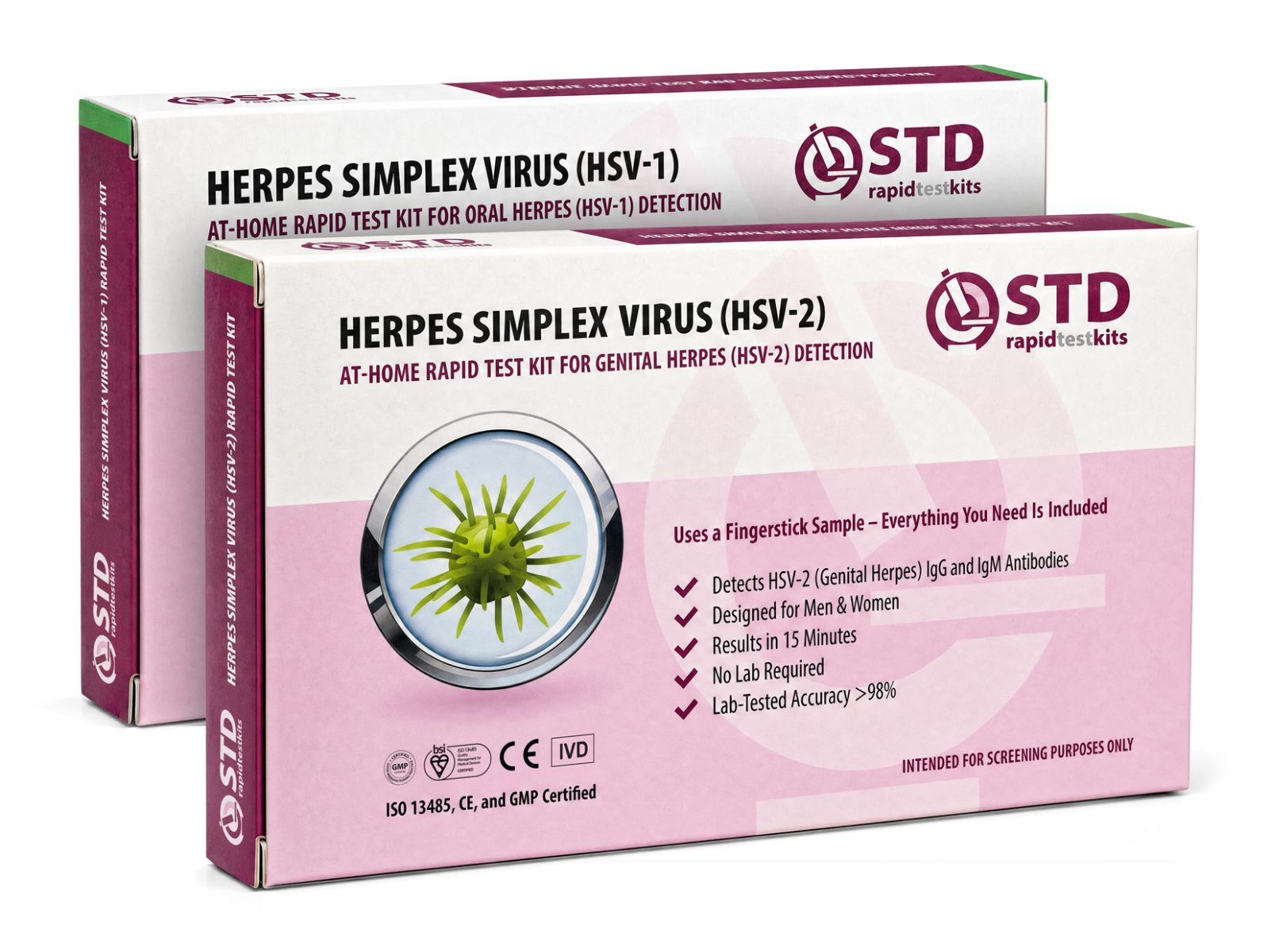
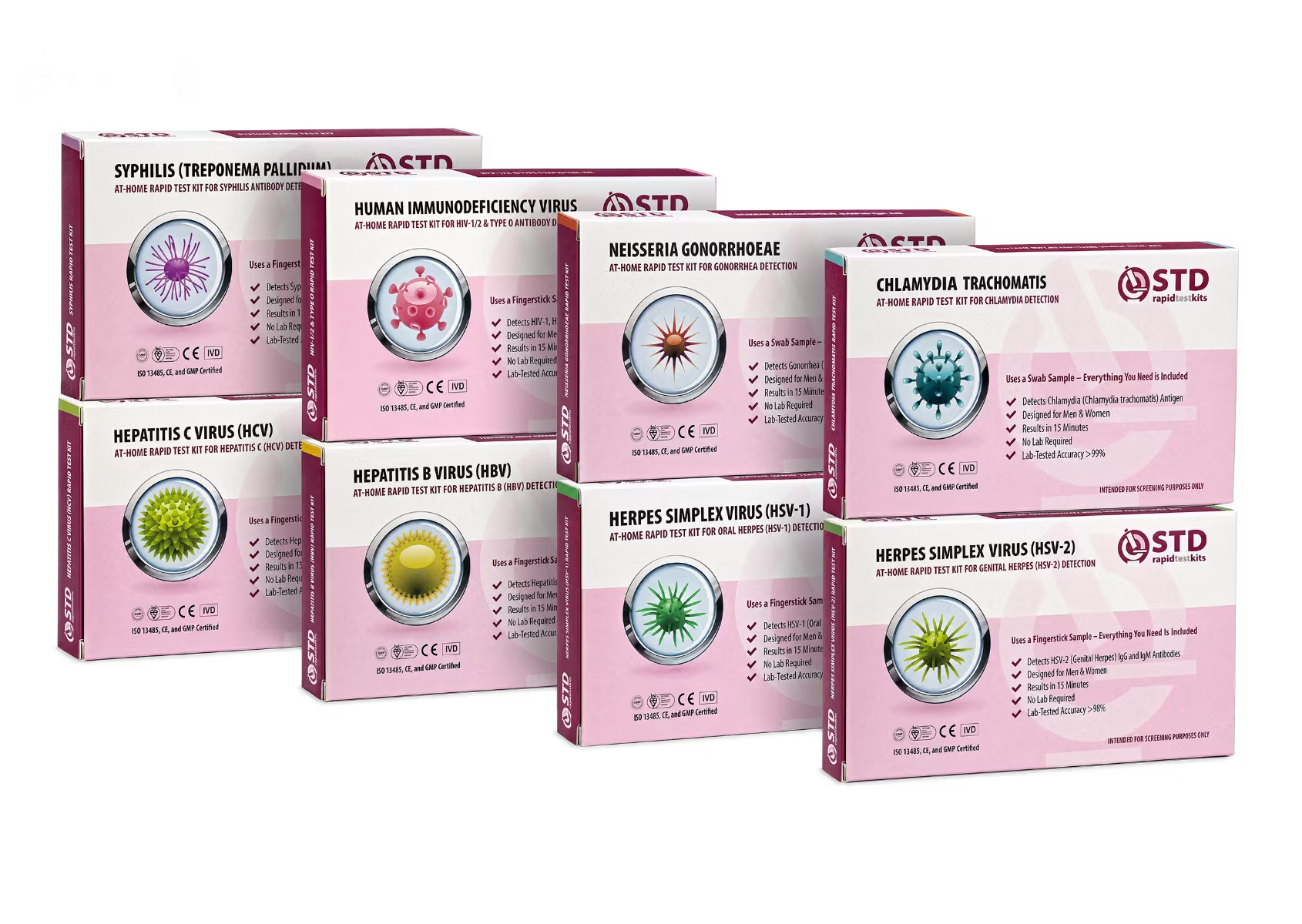
For people who would rather not have the conversation at a clinic, at-home rapid tests cover the relevant infections. Home kits use fingerstick blood samples for antibody-based infections (HIV, syphilis, HSV-1, HSV-2, hepatitis B, hepatitis C) and self-collected swabs for swab-based infections (chlamydia, gonorrhea, trichomoniasis, HPV). They sit somewhere between a clinic visit and doing nothing, with the trade-offs of privacy gained and follow-up confirmation often still needed if a result is positive.
Even if you do not have any symptoms, you can still infect your sex partners.
What These Symptoms Look Like
A new spot in a kissing zone is not automatically an STI. The differential diagnosis includes acne, ingrown hairs, contact dermatitis, viral exanthems unrelated to STIs, hickey bruises, and folliculitis. Distinguishing among them by appearance alone is hard, and many of them genuinely look alike in the first 48 hours.
Early HSV lesions on the lips or perioral skin often begin with a tingling, burning, or itching sensation a day or two before any visible change. The first visible stage is a small red bump or cluster of bumps. Within a day or two, the bumps develop into clear fluid-filled vesicles, then they break open into shallow ulcers, then they crust over and heal across 7 to 14 days. The cycle is recognizable once it completes, which is one reason providers prefer to see lesions early, while they are still fresh.
A primary syphilis chancre looks different. It is typically a single, round, firm sore with raised edges and a clean-looking base. It is usually painless. It can appear anywhere the bacterium entered the skin, including the lip, the tongue, the chin, or the chest. Without treatment it heals on its own in 3 to 6 weeks, while the underlying infection continues and often progresses to a secondary-stage rash months later.
HPV warts, when they appear in non-genital sites from skin contact (which is uncommon), present as small flesh-colored or slightly darker bumps with a slightly cauliflower texture. They take weeks to months to appear, not days. Common warts on hands and feet are caused by different HPV strains than the sexually transmitted types.
You cannot reliably diagnose any of this from appearance alone. If something new shows up in a contact zone after an exposure, the next step is a swab while it is fresh, not a Google image search.
- HSV (oral or perioral): tingling or itching first, then small red bumps, then clear fluid-filled vesicles, then shallow ulcers that crust over. Full cycle 7 to 14 days.
- Primary syphilis chancre: single round firm sore with raised edges and a clean base. Usually painless. Heals on its own in 3 to 6 weeks even though the infection continues.
- HPV warts (rare in non-genital sites): small flesh-colored or slightly darker bumps with a slightly cauliflower texture. Appear weeks to months after exposure, not days.
Practical Ways to Reduce Your Risk
Skin-contact transmission cannot be eliminated by the standard barrier methods. Condoms and dental dams do not extend to the neck or chest. The risk-reduction strategies that actually work for this transmission route are different from the genital-sex playbook.
The most effective single move is honest conversation with a new partner about recent testing and any current sores or symptoms. Specifically: “Do you have any cold sores or skin spots right now?” and “When was your last full STI screening?” Both questions sound clinical, and both feel awkward to ask, though they capture more risk information than visual inspection ever will.
The next layer is timing-aware self-care. Avoid intimate skin contact while a known cold sore is active and for at least a week after it heals. If you have shaved or waxed the neck or chest within 24 hours, your skin is briefly more permeable; either delay close contact or be aware of the trade-off. Treat skin conditions like eczema and dermatitis when they flare so the underlying barrier function returns.
Vaccination matters in one specific case: HPV. The HPV vaccine is recommended for routine use through age 26 and on a shared-decision-making basis through age 45. It does not prevent every HPV strain, though it covers the strains responsible for most warts and most HPV-associated cancers.
Routine testing closes the rest of the gap. Once a year is the CDC’s baseline screening cadence for sexually active adults under 25 and for higher-risk groups at any age. For people with frequent new partners, screening every 3 to 6 months is reasonable. MedlinePlus’s STI overview includes patient-friendly explanations of which tests are recommended and how often.
Frequently Asked Questions
- Can you actually get herpes from kissing someone’s neck?
- It is possible, though not the most common way HSV spreads. The risk goes up if the partner has an active sore or area of viral shedding on the neck or chest, and if your receiving skin has any kind of break (a shaving nick, chapped lips, sunburn). Most casual neck kissing does not result in transmission, though the risk is greater than zero.
- Which STIs can spread without sex or fluids?
- Herpes simplex virus and primary-stage syphilis are the two that genuinely transmit through direct skin-to-skin contact. HPV transmission outside genital areas is much rarer, and molluscum contagiosum can also pass through skin contact. HIV, chlamydia, gonorrhea, and hepatitis do not move this way.
- How long after a skin-contact exposure should I wait to test?
- The main fork is whether a visible sore appears. If yes, get it swabbed within the first week or so, while the lesion is fresh and PCR is most accurate. If no sore appears and you want a blood-based answer, the HSV-2 antibody window runs up to 16 weeks or longer, and the syphilis window starts at about 3 weeks with follow-up at 6 weeks and 3 months. Both can be done at home with a fingerstick kit after the appropriate window.
- What does a herpes sore on the neck or face actually look like?
- It typically starts as tingling or itching, then a small red bump or cluster of bumps, then clear fluid-filled vesicles, then shallow ulcers that crust over. The full cycle is 7 to 14 days. Early on it can resemble a pimple, ingrown hair, or razor burn, which is why a fresh swab is more reliable than a visual inspection.
- Is a painless sore something to worry about?
- Yes, a painless sore deserves attention. The primary syphilis chancre is usually painless, often single, round, and firm with raised edges. It heals on its own in 3 to 6 weeks while the infection continues. If a new painless sore appears in a contact zone after a new partner, it is worth getting a syphilis blood test even after the sore disappears.
- Can a condom prevent skin-contact STI transmission?
- Condoms reduce transmission of herpes and syphilis without eliminating it, because both infections can shed from skin beyond the area a condom covers. For neck or chest exposure, condoms offer no protection at all. Honest partner communication about current sores and recent testing is the most useful tool for this transmission route.
- What kind of test catches a skin-contact exposure?
- A PCR or viral culture swab of an active sore is the most accurate test when a lesion is present. If no lesion appears, blood antibody testing for HSV-2 and syphilis (after the appropriate window) is the standard approach. At-home rapid tests use the same antibody chemistry as clinic blood tests for these infections.
- How do I bring this up with a doctor without feeling judged?
- Use a short, factual framing: “I had close skin contact with a new partner recently and have a new spot on my [location]. I would like to rule out herpes or syphilis.” That is enough. A good provider takes this at face value. If yours does not, asking to see a different provider or using an at-home rapid test are both reasonable next steps.
- U.S. Centers for Disease Control and Prevention. Genital herpes fact sheet, transmission routes, and asymptomatic shedding.
- U.S. Centers for Disease Control and Prevention. Syphilis fact sheet, including primary chancre and transmission through direct contact with a syphilitic sore.
- U.S. Centers for Disease Control and Prevention. How HIV is transmitted, including routes that do and do not apply to saliva and closed-mouth kissing.
- U.S. Centers for Disease Control and Prevention. Sexually transmitted infections overview and general screening recommendations.
- U.S. Centers for Disease Control and Prevention. Herpes testing guidance and recommended testing windows.
- MedlinePlus, U.S. National Library of Medicine. Sexually transmitted infections, patient-facing overview of testing and screening cadence.
