Published: October 2025 | Last updated: May 2026 | Editorial review and quality control: Martina N.
It is roughly 3am in a dorm room somewhere, and a college student is staring at the ceiling running through every possible thing wrong with their body. The question forming is whether this is an STI or just anxiety, and the honest answer is more knowable than it feels right now. The hookup was three nights ago. The condom either stayed on or it did not. Somewhere between the panic and the Google search bar, your body has started serving up a parade of suspicious sensations: a weird tingle, a new bump that might always have been there, a burning that started today, or maybe yesterday, or maybe your brain just invented it. The rest of this guide walks through how to think about it without spiraling.
Key Takeaways
- Most STIs cause no symptoms at all in the early weeks, so the way you feel the morning after a hookup is rarely a reliable signal of what is or is not happening in your body.
- Tests need a window period of 1 to 12 weeks after exposure before they turn positive; testing too soon is the single most common reason students get a falsely reassuring negative.
Why Panic Usually Comes First
Most college students do not have routine STI testing on their calendar. In a culture of swipe-right hookups, party hookups, and midnight dorm visits, sex education tends to focus on pregnancy prevention. Few students are taught what early herpes actually looks like, that gonorrhea can quietly settle in the throat, or that chlamydia almost never announces itself. Prevention takes a back seat to urgency.
So most first-time STI tests happen only after something feels off: a weird itch, an unfamiliar drip, a bump that wasn't there last week, or just a sickening fear about a specific encounter. This is not because students are reckless. It is because the system rewards waiting until something goes wrong instead of empowering you to test on a schedule, the way you would for cholesterol or cavities.
CDC surveillance data, detailed in their annual STI statistics reports, consistently shows that people aged 15 to 24 account for roughly half of all new STI diagnoses each year (CDC STI Statistics). Yet many of those students will not get tested until they are already spiraling in a Reddit thread or convinced they have herpes because of a razor bump.
Anxiety does not just affect mental health. It shows up in the body as tingling, phantom itches, imagined burning, and a sudden hyper-awareness of normal urination, all of which are easy to mistake for early infection.

How STI Symptoms Actually Work, and Why They Are Easy to Miss
Most STIs do not start with flashing alarms. Many cause no symptoms at all in the first weeks, especially in young adults. Asymptomatic transmission is a well-documented biological reality, which means you can be infected and pass it to a partner without a single sign on either side.
Chlamydia is often completely silent in both vaginal and penile infections. Gonorrhea may show subtle discharge or mild burning, or absolutely nothing, particularly in the throat or rectum. Genital herpes can look like a pimple, a tiny cluster of clear blisters, or razor burn. HPV very often does not show up at all until it is found on a routine cervical screen.
Anxiety complicates everything. The more you Google, the more your brain manufactures symptoms by suggestion. You start feeling a tingle you did not notice before. You re-examine every bump and freckle. Was that there yesterday? Is that normal? This pattern has a name in clinical literature: somatic anxiety. It is real, it is uncomfortable, and it does not require an actual infection to produce vivid physical sensations. Distinguishing the two reliably means waiting until the right window has passed and then testing.
One useful filter when you are spiraling: real STI symptoms tend to appear at the site of contact and stay there. They tend to persist for days, not change every fifteen minutes. They tend to be visible to a clinician or a swab. Anxiety symptoms drift, intensify when you focus on them, and improve when you are distracted by anything else.
- Chlamydia: typically silent. Most infections cause no symptoms at all.
- Gonorrhea: mild discharge or burning at most, often absolutely nothing, especially in the throat or rectum.
- Genital herpes: frequently mistaken for a pimple, an ingrown hair, or razor burn during the first outbreak.
- HPV: rarely visible without a clinical exam or a routine cervical screen.
When Do STIs Show Up? When Can You Actually Test?
Here is the frustrating truth: even if you had unprotected sex last night and woke up panicking today, your STI test will likely show nothing yet. Your test was simply taken too early. Infections need time to incubate before they become detectable.
This delay is called the window period. It is the gap between the moment of exposure and the moment a test is reliable enough to give you a real answer. Test inside the window and you can walk away with a falsely negative result, then watch a real infection show up weeks later when the bacteria or virus has built up to detectable levels.
One quick word on the most common top fear among college students: the per-act risk of HIV transmission from a single heterosexual encounter is generally low, especially with condom use, and is meaningfully higher for receptive anal sex or for sex with an HIV-positive partner who is not on treatment. If a specific exposure was higher-risk, post-exposure prophylaxis (PEP) is available from any emergency room or urgent care within 72 hours of the exposure and is highly effective when started promptly. Routine annual HIV testing covers most other situations (CDC HIV resources).
Here is what window periods look like in practice for the most commonly tested infections (CDC STI Statistics; CDC HIV Testing):
| Infection | Earliest a test may detect | Most reliable testing window | Sample type |
|---|---|---|---|
| Chlamydia | About 5 days | 14 days after exposure | Genital swab (lab NAAT or rapid lateral-flow) |
| Gonorrhea | 2 to 6 days | 7 to 14 days after exposure | Genital swab (lab NAAT or rapid lateral-flow); throat or rectal sites need clinic-collected swabs |
| Syphilis | About 3 weeks | 6 to 12 weeks after exposure | Blood (lab antibody or rapid blood) |
| HIV (Ag/Ab combo lab test) | About 18 days | 18 to 45 days after exposure | Blood draw, 4th-generation lab assay |
| HIV (rapid antibody test) | About 23 days | Up to 90 days after exposure | Fingerstick blood (rapid lateral-flow) |
| Genital herpes (HSV-2) | 4 to 7 days if a sore is present | 12 weeks for blood antibody test | Swab of an active sore (clinic) or rapid blood antibody |
How quickly can a recent hookup actually be tested?
Most STIs need 1 to 3 weeks before a test can reliably catch them. Chlamydia and gonorrhea are typically detectable by day 7 to 14. HIV antigen-antibody lab tests usually detect infection by 18 to 45 days, while older antibody-only and rapid antibody tests can take up to 90 days. Syphilis and herpes blood tests can take 3 to 12 weeks. Testing the morning after a hookup tells you about earlier exposures, not the one you are worried about right now.
What If You Tested Negative But Something Still Feels Off?
This is one of the most common arcs in college sexual health. Someone has a scary exposure on a Saturday, books a clinic visit on Monday, gets tested on Wednesday, and walks out four days later with a clean panel. Two weeks after that, a small sore appears. A second test comes back positive for herpes. That positive result was not a failure of the first test; the infection simply had not reached detectable levels when the swab was taken.
Panic-driven testing leads to early testing, which leads to false reassurance. Then when symptoms or a true positive does show up later, it feels confusing and emotionally charged, like the test "missed" something. It did not miss anything. The infection had not yet reached detectable levels.
If you tested early and your gut still says something is off, retest at the right window. For most bacterial STIs that means around day 14. For HIV, depending on test type, somewhere between 23 days and 12 weeks. For syphilis and herpes blood tests, 6 to 12 weeks.
- Chlamydia and gonorrhea: retest by day 14 if you tested earlier, plus a 3-month re-screen after treatment.
- HIV (Ag/Ab combo lab test): reliable by 45 days post-exposure.
- HIV (rapid antibody test): up to 90 days for a reliable result.
- Syphilis and herpes blood antibody: 6 to 12 weeks after exposure.
What If You Have No Symptoms at All?
The most important sentence in this article: most STIs do not announce themselves. Some stay silent for weeks. Some stay silent for months or years. Others mimic things that have nothing to do with sex, like yeast infections, urinary tract infections, irritation from new soap, friction from sex toys, or the hormonal swings of a normal menstrual cycle.
That is why "waiting for symptoms" is risky as a strategy, and why relying on anxiety as your trigger to test creates an exhausting cycle. Anxiety strikes after every hookup, regardless of actual risk, while real infections often strike in silence.
Think of it this way: you do not wait to feel a cavity to see a dentist. You do not wait for chest pain to check your blood pressure. STI testing belongs in the same category. Routine maintenance for a sexually active adult under 25, especially with new or multiple partners, means testing every 3 to 6 months whether or not anything feels wrong.
The reality on most campuses still falls short of that. Despite CDC and ASHA guidelines recommending annual testing for sexually active young adults (ASHA testing recommendations), campus health surveys consistently find that most students do not test until a specific concern arises. Most testing still happens only after symptoms, after a partner notification, or after a fear becomes unbearable.
Sexually active and under 25 with new or multiple partners: every 3 to 6 months is a sensible baseline. More often if a partner tests positive, condoms break, or you switch into a new sexual network. A routine schedule beats reactive testing every time, both for your health and for your peace of mind.
So When Should You Actually Test?
Here is the testing decision tree in plain English.
If it has been less than 5 days since the encounter: testing now will not help much. Use this time to gather information, decide what testing route fits your situation, and plan to test around day 7 to 14 for the bacterial infections.
If it has been 7 to 14 days: this is the right window for chlamydia and gonorrhea, and for early herpes if visible lesions have appeared. If you test now, plan a follow-up later for the slower-developing infections like syphilis and HIV.
If it has been 14 to 30 days: a broader panel becomes useful. Bacterial infections are at peak detection. HIV antigen-antibody lab tests are reaching their reliable window. The longer you wait inside this window, the more accurate most results become.
If it has been 6 to 12 weeks: this is the sweet spot for a complete panel including syphilis and herpes antibody testing. Almost every infection that was real should now be detectable.
And if you are testing right now purely because the anxiety is unbearable, that is also okay. Testing for reassurance is a legitimate use of a test. Just pair it with a plan: when to retest, what specific symptoms would change your plan, and how to normalize testing every 3 to 6 months going forward so you are not riding the panic-test-relief-rinse-repeat cycle indefinitely.
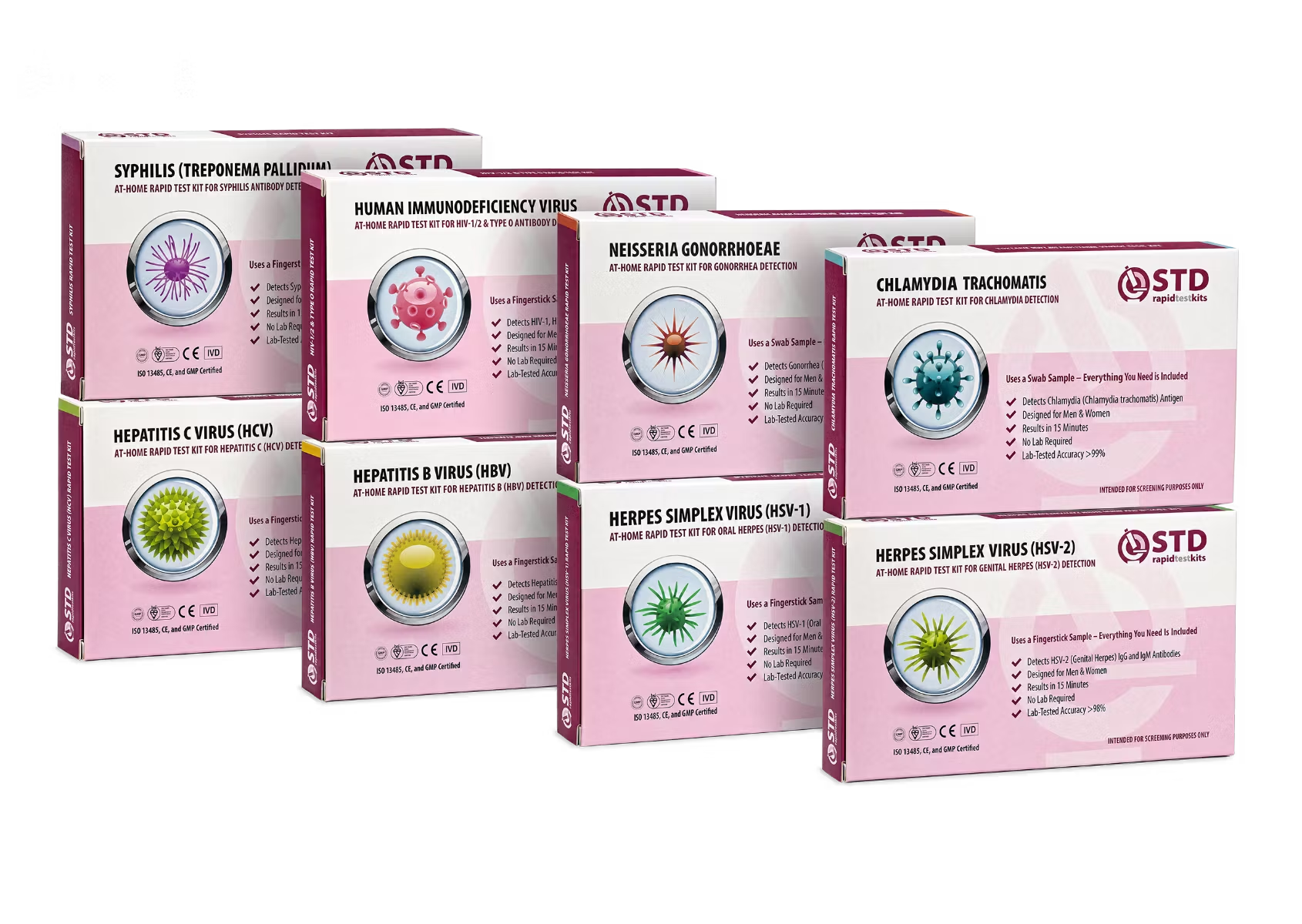
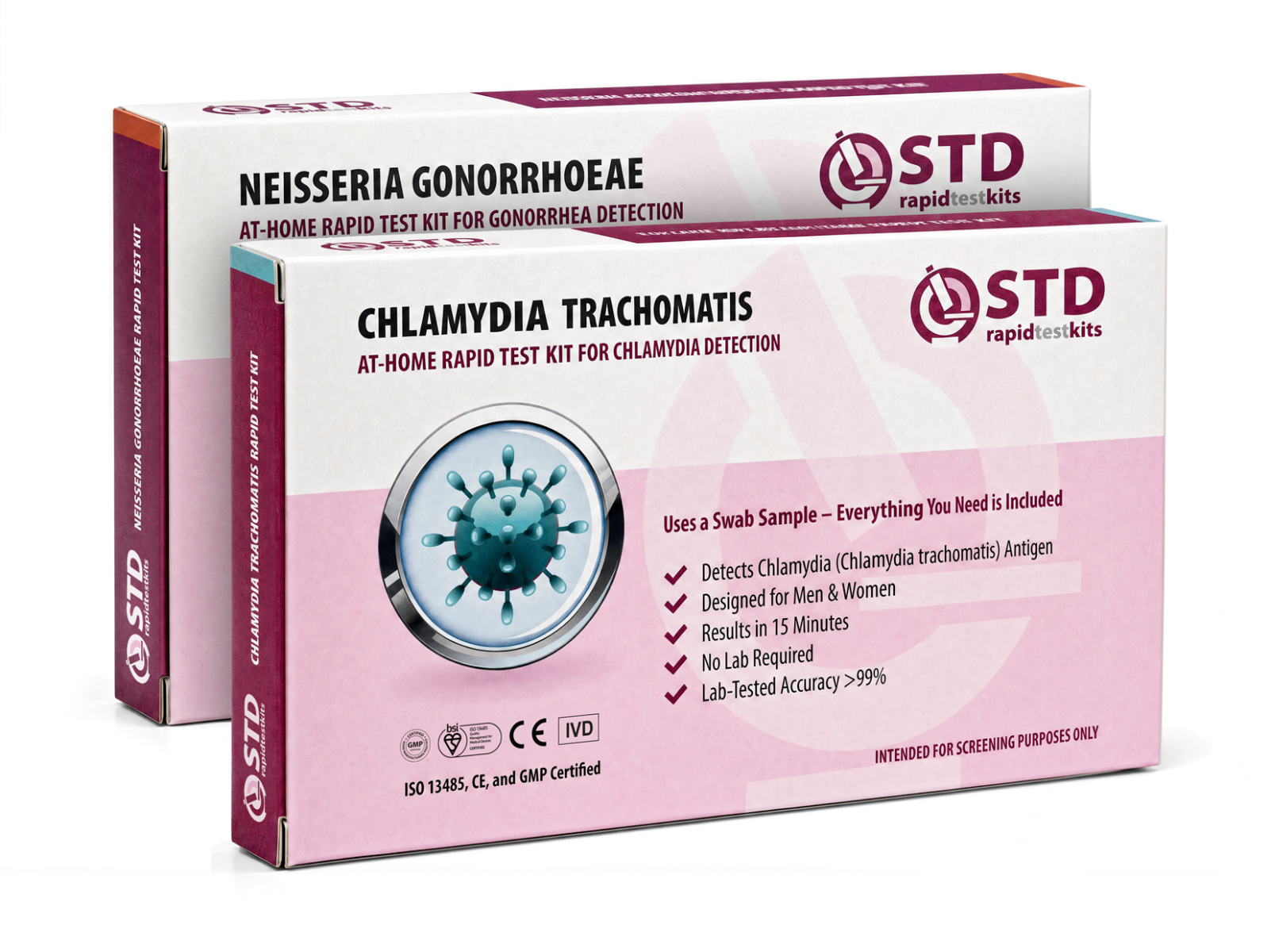
Disclosure: stdrapidtestkits.com makes some of these tests. The kit below is the gender-inclusive 8-in-1 panel that covers the bacterial and antibody infections most common in under-25s. We recommend it where it fits, not regardless.
Clinic Visit or At-Home Test? What Students Actually Choose
There is no single right answer for STI testing on a college campus. Fear, timing, privacy, insurance entanglement, and shame all push the decision in different directions. The two most common routes are the campus health clinic and a discreet at-home rapid test, and each has real trade-offs.
Many students start with the clinic, especially when it is free or low-cost on student insurance. But clinic hours do not work for everyone, some students fear being recognized in a small campus health waiting room, and others worry about results showing up on a parent's insurance statement. For exactly those reasons, at-home rapid kits have become a real option in the past few years. Throat-swab and rectal-swab testing for gonorrhea or chlamydia still needs a clinic-collected sample for reliable results, so if your exposure was oral or rectal, a clinic visit is the right move regardless of what an at-home kit can do. We do not sell pharyngeal or rectal swab kits, and a genital swab will not detect a throat or rectal infection.
| Route | Privacy | Speed | Sensitivity | Best fit |
|---|---|---|---|---|
| Campus health clinic | Moderate. Visit may appear on insurance Explanation of Benefits if you use a parent's plan, though some campuses offer confidential billing. | Same-day collection, results typically in 2 to 7 days for lab NAAT | Highest. Lab NAAT is the diagnostic gold standard, especially for asymptomatic infections. | Visible symptoms, possible exposure to a confirmed positive partner, throat or rectal exposure, anyone who wants the most sensitive test available |
| At-home rapid test kit | Very high. Discreet packaging, no waiting room, no insurance trace. | 1 to 3 days to arrive, result in roughly 15 minutes after running the test | High when used correctly and after the right window. Lateral-flow rapid tests are screening tools; positives should be confirmed with a lab NAAT. | Privacy concerns, off-campus living, anyone who avoids clinics, anyone who wants to test repeatedly without scheduling visits |
What If the Test Comes Back Positive?
This is the question every anxious student dreads. A positive result is where actual treatment starts.
For bacterial infections like chlamydia and gonorrhea, treatment is straightforward: a short course of antibiotics, no sex during the treatment window, and a re-test about three months later to make sure reinfection has not happened. For syphilis, treatment is also antibiotic-based, usually intramuscular penicillin, and is highly effective when caught early. For herpes, HIV, and HPV, there are antiviral medications and management strategies that let people live full, sexually connected lives, and HIV in particular has become a chronic manageable condition with consistent treatment.
More importantly, a positive test gives you clarity. It gives you the language to tell a partner. It gives you the ability to stop transmission. And it shifts you from being part of the silent statistic to being part of the actual solution.
If a positive result feels overwhelming, your campus health center or a clinic like Planned Parenthood can connect you with both treatment and counseling. Any shame around the result is a cultural residue rather than a measure of your character or health, and the treatment itself is usually a course of antibiotics or a clinic referral with high cure rates when started early.

Retesting, Reinfection, and Partner Care
Whether your first test was negative or positive, the follow-up matters as much as the original.
If you tested early, plan a retest. For chlamydia and gonorrhea, the CDC also recommends a test of cure or reinfection roughly 3 months after treatment, because reinfection rates in young adults are high. For HIV and syphilis, retesting at the appropriate longer window catches anything the first test was too early to see.
If you tested positive, partner testing is part of treatment. If you treat your chlamydia, your partner does not, and you keep sleeping together, you will pass it back and forth indefinitely. You can keep the conversation simple: "My doctor told me you should get checked too. We both deserve to know." Many state and local health departments offer anonymous partner notification tools if a face-to-face conversation feels impossible.
Reinfection is one of the most under-discussed parts of college STI care. A positive result followed by clean treatment followed by reinfection two months later is so common it might as well be standard. Making testing and routine partner conversations part of being sexually active, the way contraception already is, is what actually breaks that loop.
Don't Wait Until You Are Panicked
Testing does not have to be scary. It does not have to be shameful. And it definitely does not have to wait until your brain is screaming or your body is flaring up. The earlier in the right window you test, the clearer your answers, and the easier the path forward looks.
You do not need symptoms, a partner's permission, or any threshold of worry to justify testing. It is health care, full stop, and wanting clear answers without panic is reasonable.
If you are reading this mid-spiral, take a breath. Note the date of the encounter you are worried about. Look up where it falls on the window-period table above. Decide whether you are testing today, on day 14, or at 6 weeks. Pick a route that fits how you live: clinic, campus health, or a kit shipped to your dorm in plain packaging. Then put it in your calendar. The panic gets a lot smaller once it has a plan attached to it.
Three immediate next steps
- Note the date of the encounter you are worried about, so you can place it on the window-period table.
- Find that date in the window-period table above and identify which infections can reliably be tested for now versus later.
- Pick a testing route (campus clinic, urgent care, or an at-home rapid kit) and put a calendar reminder for the next test date you need.
FAQs
- Can anxiety really make you feel like you have an STI?
- Yes, and convincingly. Stress and panic activate physical sensations including tingling, phantom itches, warmth, and a sudden hyper-awareness of normal urination. None of those sensations are diagnostic. The only way to actually distinguish anxiety from infection is to wait for the right testing window and run a test.
- How soon after sex should I actually get tested?
- It depends on the infection. Chlamydia and gonorrhea become detectable around day 7 to 14. HIV antigen-antibody lab tests catch most infections by 18 to 45 days, while older antibody-only or rapid antibody tests can take up to 90 days. Syphilis and herpes antibody tests can take 6 to 12 weeks. If you are testing within a few days of a hookup, plan a retest at the right window so the result is meaningful.
- I tested negative but I still feel off. Now what?
- If your test was inside the window period, it may not have been able to detect a real infection yet. If your symptoms could plausibly be a UTI, yeast infection, irritation, or stress, those are worth ruling out separately. Either way, retest at the appropriate longer window. There is no penalty for double-checking your own health.
- Do I have to go to a clinic? I do not want anyone to know.
- No. At-home rapid kits exist exactly for this reason. They ship in discreet packaging, you collect the sample yourself, and there is no waiting room or insurance trail. For symptoms that need a physical exam, or for throat or rectal exposure, a clinic is still the right call, but for routine screening privacy is fully on the table.
- Will my parents find out if I get tested through campus health?
- Maybe, depending on the insurance setup. Explanations of Benefits sent to a parent's plan can list visit dates and clinic types. Some campus health centers offer confidential billing or sliding-scale self-pay specifically to avoid this. At-home kits bypass insurance entirely. Ask the campus health office directly how their billing privacy works before booking.
- What if my partner will not get tested?
- That is their decision, but your sexual health is yours. You can say plainly: "I got tested because I care about both of us. I would like you to do the same." If the response is deflection, guilt, or silence, that is information about the relationship as much as about the test.
- Can I get an STI from oral sex?
- Yes. Gonorrhea and chlamydia can establish in the throat, herpes can transmit in either direction between mouth and genitals, and syphilis can pass through tiny breaks in the lining of the mouth. For throat-specific testing, you need a clinic-collected pharyngeal swab; we do not sell pharyngeal kits, and a genital swab will not detect a throat infection.
- How often should I get tested while in college?
- Every 3 to 6 months is a reasonable baseline if you are sexually active, especially with new or multiple partners. More often if a partner tests positive or if you are using inconsistent protection. The goal is to make testing routine maintenance, not a panic response.
How we sourced this article: This guide was built from current CDC STI surveillance and testing guidance, the CDC's STD topic resources on asymptomatic infection patterns, and the American Sexual Health Association's testing recommendations. It is written for an under-25 college audience and is not a substitute for individualized clinical care. Talk to a campus health provider or a clinician you trust if you have specific concerns the article does not address.
- U.S. Centers for Disease Control and Prevention. STI surveillance and the burden of new infections among people aged 15 to 24.
- U.S. Centers for Disease Control and Prevention. HIV testing window periods and test-type detection times.
- U.S. Centers for Disease Control and Prevention. HIV resources, including PEP and risk-reduction guidance.
- U.S. Centers for Disease Control and Prevention. Chlamydia screening, treatment, and reinfection guidance.
- U.S. Centers for Disease Control and Prevention. STD topic resources: overview of common infections and asymptomatic patterns.
- American Sexual Health Association. Get tested: routine STI testing recommendations for sexually active young adults.
