

Published: September 2025 | Last updated: April 2026 | Editorial review and quality control: Martina N.
In a city, anonymity is the default. You walk into a clinic, fill out a form, leave with a sample collection kit, and never see the same staff member twice. In a town with one clinic, one pharmacy, and one school, that anonymity does not exist. The receptionist may be a neighbor. The lab tech may be a parent of someone you grew up with. The other person in the waiting room may be your second cousin. This article is about that gap, what it costs in real public-health terms, and the practical alternatives that exist for readers who want a real answer without putting it on display.
Why do people in small towns avoid STD testing?
Most rural and small-town readers cite three blockers: fear of being recognized at the only local clinic, religious or community judgment if a result became public, and physical distance from any testing site. None of those three reduce actual infection risk, so untreated STIs are persistently more common in places where testing is socially expensive. At-home rapid tests are not a perfect substitute for laboratory testing, although they remove the visibility and access barriers that keep most people from testing at all.
Key takeaways
- Rural and small-town areas have higher rates of undiagnosed STIs and lower rates of routine screening; the gap is driven mostly by privacy and access concerns, not by lower infection rates.
- At-home rapid lateral-flow tests give a result in about 15 minutes and ship in plain unbranded packaging. They are screening tools rather than diagnostic confirmation, and a positive home result lets you seek treatment via telehealth without a public clinic visit.
When Everyone Knows Everyone, Privacy Disappears
HIPAA protects what clinic staff write down or share in their professional capacity. It does not protect what they observe in their off-hours, what they remember at a family dinner, or what someone in the parking lot recognizes about your car. The legal layer of medical privacy is real; the cultural layer in a community where most adults know each other by face is much weaker.
For someone weighing whether to drive to the only county health clinic, the question is rarely whether the clinic itself will leak the result. The real question is whether being seen entering the building, by a single observant neighbor, is enough to start a conversation that gets back to a parent, a partner, or a workplace. In a town of a few thousand people, that probability is not low. Most readers have already done that math intuitively, which is why driving past the clinic for the third time without going in is a more common scene than any formal complaint about confidentiality.
The Public-Health Cost of Silence
When testing carries social risk, fewer people test. Fewer tests means more undiagnosed infections, longer transmission chains, and worse downstream outcomes. The CDC's national surveillance data report about 2.2 million combined chlamydia, gonorrhea, and syphilis cases in the United States for 2024, and congenital syphilis cases (mother-to-baby transmission during pregnancy) have risen for 12 consecutive years (CDC STI surveillance). Reported cases concentrate in populations where regular screening is socially or logistically out of reach, and that overlaps heavily with small-town and rural America.
Most rural undertesting comes down to logistical friction or social cost, often both:
- Logistical friction. A clinic visit may require an hour of driving each way, half a day of work missed, transportation help, or arranged childcare. For asymptomatic readers who only suspect they were exposed, that cost often exceeds the perceived benefit, even though the medical risk has not changed.
- Social cost. Even when a clinic is reachable, the prospect of being seen there can outweigh the medical reason to go. Asymptomatic exposure scenarios get postponed, then forgotten, and sometimes discovered later as a symptom in oneself or as a transmission to a partner.
The infection itself does not disappear in that pattern; the diagnosis does, along with the chance of catching the infection before it causes complications that show up months or years later.
Distance, time off work, and lack of transportation are the logistical layer. The chance of being recognized at the only reachable clinic is the social layer. They compound, which is why public-health programs have started routing rural readers toward telehealth and at-home testing as the primary entry point rather than the backup option.
Religious, Cultural, and Family Pressure
In communities shaped by conservative religious teaching about sex, an STI is often read as evidence of sin or promiscuity rather than as a common medical event. Many readers internalize that framing long before they ever encounter the clinical reality, which is that most adults will be exposed to at least one sexually transmitted infection in their lifetime.
The prevalence numbers are striking. CDC estimates that about 1 in 5 people in the United States have an STI, and many of those infections produce no symptoms at all. STIs are common, common enough that the medically interesting question is not whether you have ever been exposed but whether you currently have something treatable.
Most STIs are bacterial or viral pathogens that transmit through specific exposures. They do not select for moral character, religious outsider status, or number of partners. A single partner, with a partner of their own at any point in their history, is enough.
What Untreated Infections Actually Do
Stigma does not change what an untreated infection does inside the body. The strongest argument for testing, even quietly, is that the most common STIs are highly treatable when caught early and substantially harder to treat (or impossible to fully reverse) when missed for months or years.
- Chlamydia and gonorrhea, untreated, can ascend to the upper reproductive tract in women, causing pelvic inflammatory disease, chronic pelvic pain, ectopic pregnancy risk, and permanent fertility damage. Both also raise the risk of HIV transmission. Most chlamydia cases produce no symptoms at all, which is why CDC information on the infection emphasises routine screening for people at risk (CDC chlamydia overview).
- Syphilis, undiagnosed, progresses through stages over months and years. Late-stage syphilis affects the cardiovascular and nervous systems and is harder to treat than early infection. CDC surveillance shows congenital syphilis cases have risen sharply over the past decade, driven largely by undiagnosed maternal infection.
- HIV, undiagnosed, progresses without symptoms for years while remaining transmissible. Modern antiretroviral treatment is highly effective, and a person on stable therapy with sustained undetectable viral load does not transmit HIV sexually, provided they know to start treatment in the first place (CDC HIV testing).
- Hepatitis B and C, undiagnosed, cause chronic liver inflammation and substantial long-term liver-cancer and cirrhosis risk. Both have effective treatments now, and both are dramatically more dangerous when missed.
Early-stage chlamydia and gonorrhea are treated with a single course of antibiotics. Late-stage damage to fallopian tubes or to liver tissue cannot be reversed by treating the underlying infection later. The clinical case for screening, even on a quiet personal timeline, comes down to that one-way door.
At-Home Rapid Testing: What It Is and What It Is Not
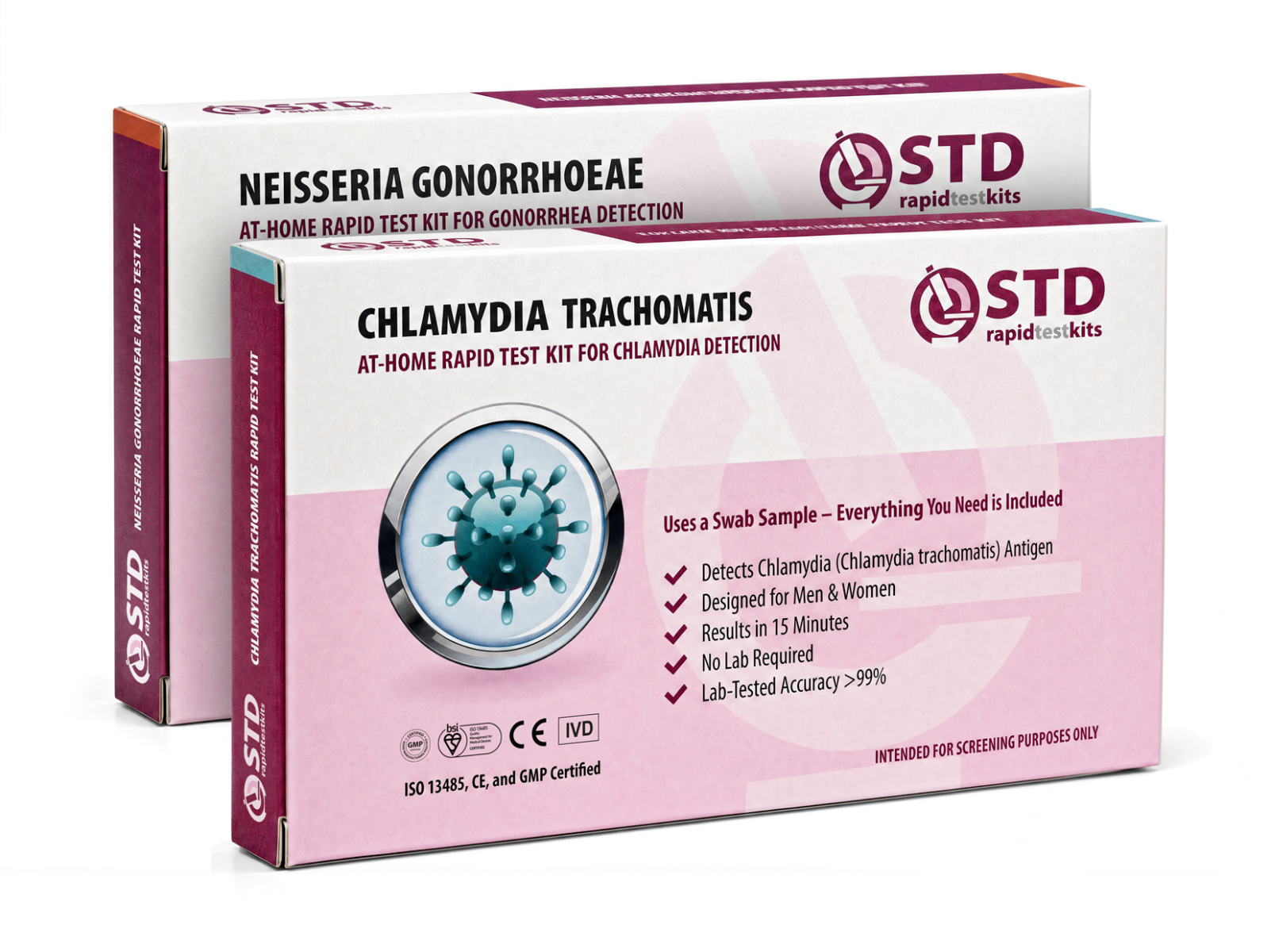
At-home rapid tests are lateral-flow immunoassays. The same chemistry as a home pregnancy test, applied to a different sample (a self-collected genital swab or a fingerstick blood drop) and a different target (an STI antigen or antibody). A control line confirms the test ran correctly; a result line indicates positive or negative.
What this technology does well:
- Returns a result in about 15 minutes, in a private space, with no staff observation.
- Ships in plain unlabeled packaging that does not announce itself to a household member or a postal worker.
- Has high specificity for the targets it detects, meaning a positive result is almost always a true positive.
- Costs less than most clinic visits in the United States after factoring in time, transport, and copays.
What it does not do:
- Does not match the analytical sensitivity of a laboratory NAAT (nucleic acid amplification test). Laboratory NAATs detect smaller amounts of pathogen and remain the diagnostic gold standard, particularly very early in infection.
- Does not replace a clinical evaluation when symptoms are present and need direct examination.
- Does not test for every STI from every exposure route. We do not sell pharyngeal (throat) or rectal swab kits; the at-home swab products are validated for genital sample collection only.
Rapid home testing is best understood as private screening. A negative result on a properly-timed home test is reassuring. A positive result is a prompt to seek confirmation and treatment, which can usually be arranged through a telehealth provider without a public clinic visit.
Comparing Your Realistic Options
Most small-town readers actually choose between four options. Laying them side by side makes the trade-offs concrete instead of abstract.
| Option | Privacy in a small town | Sensitivity | Time to result |
|---|---|---|---|
| Local public clinic | Low (staff and other patients overlap with community) | Highest (laboratory NAAT) | 1 to 3 days |
| Telehealth consult plus mailed lab kit | High (no in-person visit) | High (lab-processed) | 3 to 5 days after sample arrival |
| At-home rapid swab or fingerstick | Highest (no third party at all) | Good for screening, lower than lab NAAT | About 15 minutes |
| Doing nothing (current default) | No testing | No result | Problem persists |
How to Talk About Testing Without Inviting Shame
The hardest part of testing in a small town is often the conversation that may follow with a partner, sibling, or roommate. The framing matters more than the words:
- Frame testing as routine, not reactive. "I am due for a check" lands very differently than "I think I caught something." The first is normal adult behavior. The second invites speculation. Both can be true; one is socially safer and equally honest about what the testing event actually is.
- Lead with care, not accusation, when talking to a partner. "I want to test for both of us" is a partnership statement. "Have you been tested?" can read as cross-examination. Sequencing matters: testing yourself first, then sharing the result and asking about theirs, takes the heat out of the conversation and removes the implicit accusation.
For asymptomatic exposure where you are not sure whether anything happened, you do not owe anyone the conversation until you have a result. Testing first, talking second, is a reasonable and respectful order.
Most readers landing on a stigma article are not in active medical danger. They are weighing whether a possible exposure is worth the social cost of testing. The honest answer is that testing privately is cheap, fast, and almost always reassuring. If you have not had any unprotected exposure, no shared injection equipment, and no partner with a known infection, your statistical risk for an active untreated STI is low. A single private test is still the cleanest way to confirm that, and it costs less stress than continuing to wonder.
When a Home Test Is Not the Right Tool
Home rapid tests cover specific common infections from specific sample types. Cases where a clinic visit is still necessary:
- Active visible symptoms (sores, ulcers, persistent pain, unusual discharge, rash, scrotal or pelvic pain) need direct examination and often a swab of the lesion itself, which is not what at-home antigen and antibody tests do. A clinical exam adds information a home cassette cannot.
- Suspected throat or rectal exposure with a partner who tested positive. We do not sell pharyngeal or rectal swab kits, and the CDC recommends site-specific NAAT for those exposures, which requires a clinic visit or a specialty mail-in lab service that handles those sample types.
- Pregnancy or planning pregnancy. Routine prenatal care includes STI screening as part of standard obstetric workups. Talk to a prenatal provider rather than relying on home screening alone.
- A positive home result on any test. Treat a positive home result as a prompt to confirm and treat, ideally through a telehealth provider who can prescribe based on the result without requiring an in-person visit in your hometown.
Telehealth is the step most small-town readers skip. A home test result combined with an online consult can close the diagnose-to-treat loop without any in-person visit in your local community. Most major telehealth providers will issue prescriptions based on a documented home test result, and the prescription can be filled at any pharmacy, including national chains that operate in most rural areas.
Privacy Logistics: How the Kit Actually Arrives
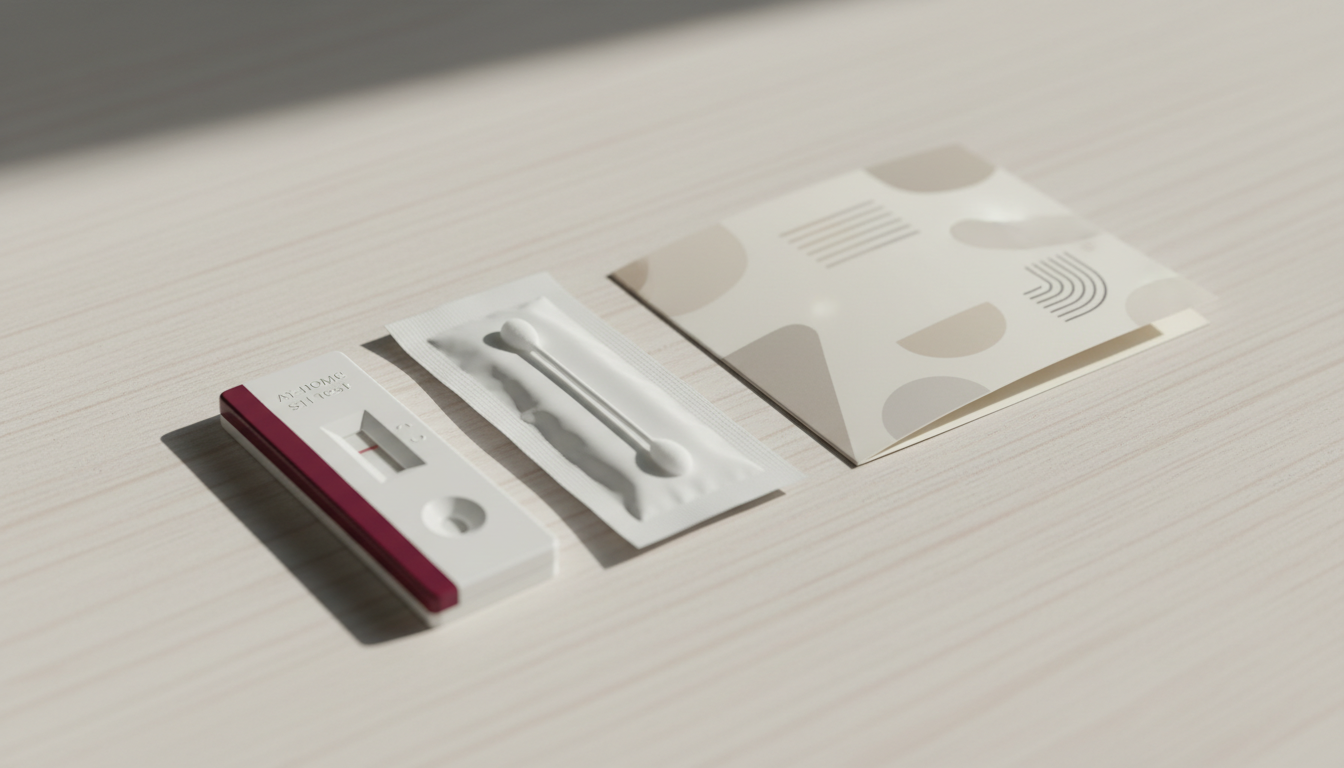
A reasonable concern: what does the package look like when it shows up at your door, and what does the order trail look like on a credit card statement? The mechanical privacy details matter, because they are exactly the points where small-town visibility tends to leak.
- Plain corrugated outer box with a generic shipping label. No clinical branding on the outside. No condition names visible to a household member or a postal worker.
- Card-statement descriptor is the parent company name, not the product name. Always check the specific provider's checkout disclosure if this matters in your situation; most discreet-shipping retailers list their billing descriptor up front.
- No insurance billing, no electronic claim, no result entered into a medical record system that follows you between providers. The result lives only on the test cassette and in whatever notes you choose to keep.
These three details (the box, the descriptor, the absence of an insurance trail) are the practical reasons an at-home order does not show up in the same places a clinic visit does.
Reputable at-home test retailers list their billing-statement descriptor on the checkout page or shipping policy. Look for that line before ordering if a card statement could be visible to a partner or family member. The same retailers usually offer email-only delivery confirmation rather than SMS, which keeps the order off a shared phone notification.
For LGBTQ+ Readers in Small or Religious Communities
Several layers compound for queer readers in conservative geographies. The same clinic that already feels exposed becomes more so if seeking sexual-health care implicitly outs you to staff or to other patients. Research consistently finds lower preventive-care utilization among LGBTQ+ adults in rural areas. The gap exists because anticipated judgment from providers, family members, and community consistently outweighs the medical reason to seek routine care.
At-home testing solves the visibility problem cleanly. The underlying community-acceptance problem is real and a kit cannot fix it; what at-home testing can do is remove one of the practical barriers that has been used as a reason to keep avoiding the question entirely. If you have been weighing the risk of a clinic visit against the medical reason to test, the home option closes that specific gap without requiring you to be out to anyone.
The home option exists exactly so you don't have to come out to a clinic in order to access routine testing. You can order, test, get a result, and (if needed) connect with an LGBTQ-affirming telehealth provider entirely online. The community-acceptance question and the medical-care question can be answered separately, on different timelines.
Breaking the Cycle Without Making It a Public Project
Testing quietly is enough. You do not have to announce it, become a community advocate, or have a hard conversation with your family in order to get useful private information about your own health. Modeling routine testing for yourself, on your own timeline, is the only thing required.
If you eventually choose to share your experience with a sibling, friend, or partner who is in the same position, that is a valuable but separate decision, and one you get to make later. Plenty of small-town readers test privately for years without ever discussing it with anyone in their hometown.
Frequently asked questions
- Are at-home STD rapid tests actually accurate?
- Lateral-flow rapid tests have high specificity, meaning a positive result is almost always a true positive. Sensitivity is good for screening but lower than laboratory NAAT. Manufacturer-reported sensitivity for major rapid STI tests is typically in the high-90s percent range when used after the correct window period for that specific infection. Treat a positive home result as a strong signal to seek confirmatory testing and treatment.
- What should I do if I test positive at home?
- Most STIs covered by home kits are highly treatable. The recommended next step is a telehealth consultation with a licensed provider; many telehealth services will prescribe treatment based on a documented home test result without requiring an in-person visit. Then notify any current partners so they can also test and treat as appropriate.
- Will the test show up on my insurance or medical record?
- Not if you order directly from a private retailer and do not file an insurance claim. The kit is paid for out of pocket, the result is not transmitted to an insurance carrier or to a clinical record system, and no provider sees it unless you choose to share it during a follow-up consultation.
- What infections can I screen for with home testing?
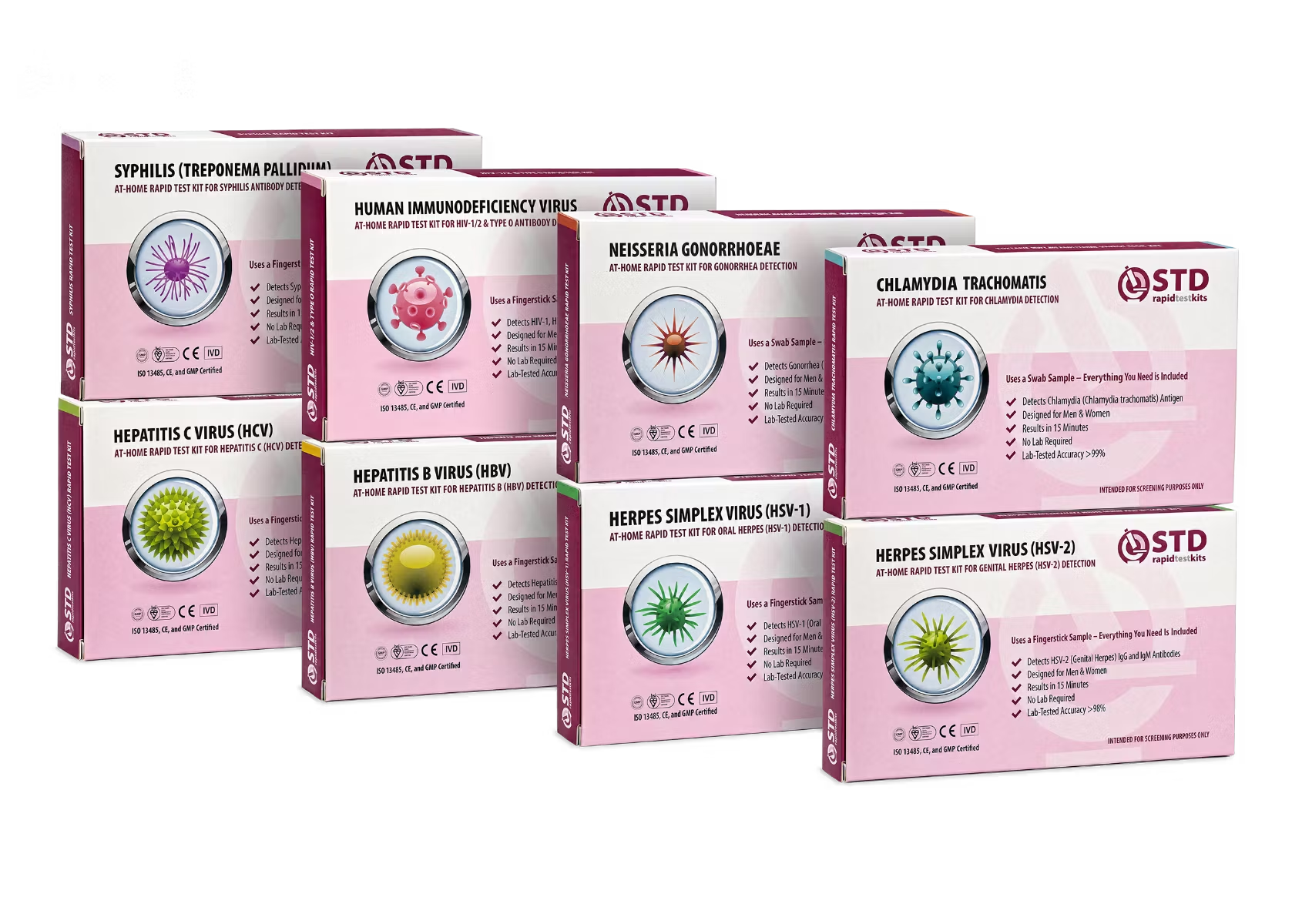
- Common at-home rapid tests cover chlamydia, gonorrhea, syphilis, HIV, hepatitis B, hepatitis C, and the herpes simplex viruses (via blood antibody testing). Combination kits screen for several at once. Note that home swab tests are validated for genital sampling; pharyngeal (throat) and rectal site testing are not part of the at-home product line.
- How long after exposure should I wait before testing?
- Window periods vary by infection. Chlamydia and gonorrhea become detectable within roughly 1 to 2 weeks of exposure. HIV antibody tests can detect infection starting around 23 days after exposure, although a result at 45 days or later is more definitive, and 90 days is the conservative benchmark for fully ruling out infection after a potential exposure. Syphilis is typically detectable within 3 to 6 weeks. Hepatitis B and C have longer windows, several weeks to a few months. Read the specific kit's instructions for its tested window.
- Will the package look obviously medical when it arrives?
- No. Plain outer box, no clinical branding, and the card-statement descriptor is the parent company name rather than a product name. Check the specific retailer's shipping disclosure page if a visible billing line on a shared statement matters in your situation.
- Can someone under 18 order a kit?
- Most retailers do not require parental consent for online kit purchases, although laws on minor consent for sexual health care vary by U.S. state. If you are under 18, check your state's confidential-care provisions; many states allow minors to access STI testing and treatment without parental notification.
- Do these kits cover throat or rectal exposure?
- No. The at-home swab products are validated for genital self-collection only. If you have specific concern about pharyngeal (throat) or rectal exposure, those sites require a different sample type and a NAAT-equivalent laboratory analysis. That is a clinic visit, or in some areas a specialty mail-in lab that supports those sample types.
Living in a small town does not obligate you to make your private health decisions visible to your community. Testing quietly, treating privately, and sharing only with partners who need to know is the same standard urban readers take for granted. The kit, the telehealth consult, and the discreet shipping exist exactly to make that possible without requiring bravery.
- U.S. Centers for Disease Control and Prevention. National STI surveillance reports including 2024 case counts (about 2.2 million combined chlamydia, gonorrhea, and syphilis cases) and the 12-year congenital syphilis trend.
- U.S. Centers for Disease Control and Prevention 2025 newsroom release on national STI data, source of the 'about 1 in 5 people in the United States have an STI' estimate cited in the article.
- U.S. Centers for Disease Control and Prevention. About Chlamydia, source for the asymptomatic-burden language about chlamydia.
- U.S. Centers for Disease Control and Prevention. HIV testing guidance and antibody-test window-period information referenced in the FAQ.
- World Health Organization. Sexually transmitted infections (STIs) fact sheet, used for global context on prevalence and asymptomatic transmission.
- UK National Health Service. Sexually transmitted infections (STIs) overview, used for plain-English background on common STIs and symptom triage.
