

Published: December 2025 | Last updated: April 2026 | Editorial review and quality control: Martina N.
Genital redness can spiral into worry within minutes. You glance down, notice an unfamiliar pink patch, and your browser history starts to look like a dermatology atlas crossed with a panic attack. Most of the time the cause is something boring: friction from sex, a different laundry detergent, sweat trapped under tight workout shorts, or a stray ingredient in a new lubricant. Sometimes the cause is an infection that needs treatment. The trick is being able to tell which kind of redness you are looking at before you either spiral or shrug.
This article walks through what dermatologists and sexual health clinicians actually look at when they assess genital inflammation. You will see the symptom patterns that lean toward simple irritation, the patterns that point at an infection, and the small handful of behaviors that mean a quiet rash has earned a real test.
Is this rash skin irritation or an STD?
Most genital rashes are irritation: contact dermatitis, friction, sweat, or shaving bumps. They calm down within a few days once the trigger is gone. STD-related rashes tend to behave differently. They evolve into blisters, ulcers, or distinct bumps. They usually appear several days to a few weeks after sexual contact, not the same evening. They do not reliably improve with hydrocortisone or moisturizer. If a rash lasts past a week, changes shape, or comes with discharge, sores, or fever, testing is the fastest way to swap guessing for an answer.
Key Takeaways
- Most genital redness is irritation, not infection. Friction, sweat, soap, and shaving cause the majority of cases clinicians see, and the inflammation usually fades within a few days once the trigger is removed.
- Three behaviors push a rash into testing territory: it lasts past a week, it evolves into blisters or distinct ulcers, or it shows up several days after new sexual contact with no obvious external trigger.
Why Genital Skin Reacts So Quickly
The skin around the vulva, penis, scrotum, and inner thighs is thinner and more permeable than skin elsewhere on the body. It sits in a warm, humid microclimate, moves constantly during walking, exercise, and sex, and absorbs whatever residue ends up on it from underwear, soap, or lube. Dermatologists describe genital tissue as reactive: it inflames at lower thresholds than the skin on your forearm and recovers quickly once the trigger is gone (DermNet on common genital skin problems).
That sensitivity is usually protective. When something irritates the tissue, the body floods the area with blood flow and immune cells to clean and repair the affected layer. You see the result as redness, warmth, and mild swelling. In most cases the trigger goes away and the redness fades within two to four days.
The trouble starts when people notice the redness, jump to the worst explanation, and skip the calmer step of asking what changed in the last 48 hours. A new laundry detergent, a different brand of condom, a longer or rougher sexual encounter, or a workout in damp synthetic shorts can each produce an inflamed patch that looks alarming for half a day and clears by midweek.
The thin keratinized and mucosal tissue of the vulva, penis, scrotum, and inner thighs is more permeable than skin on the forearm. It absorbs residue, traps moisture, and inflames at lower thresholds. The same mild trigger that produces no reaction on your arm can produce a visible patch in the groin within hours.
How Dermatitis and STD Rashes Behave Differently
Both irritation and early infection can show up as a pink patch with mild itching. The most useful difference is rarely how things look on hour one; it is how things look on day five. Contact dermatitis follows a predictable arc. It appears soon after exposure to the trigger, peaks in a day or two, and starts fading once the irritant is gone. The redness stays diffuse, often blotchy, with edges that blur into normal skin.
STD-related rashes tend to do something else. They evolve. Herpes simplex starts with tingling or burning in one specific spot, then progresses into a tight cluster of small fluid-filled blisters that break open, crust, and heal. A primary outbreak commonly lasts two to four weeks before the lesions fully resolve (NHS: genital herpes). Primary syphilis usually starts as a single painless firm-edged ulcer called a chancre, which heals on its own even without treatment while the infection continues internally (CDC: syphilis). HPV produces small flesh-colored bumps that develop slowly over weeks rather than appearing overnight.
Common Non-STD Reasons Genital Skin Turns Red
One of the most common surprises clinicians see is how often everyday inputs inflame genital skin. Someone arrives certain they have caught something, and the real cause turns out to be a new body wash or a long workout in tight shorts. The genital area sits in a perfect storm for skin reactions: warmth, moisture, friction, delicate tissue, and constant exposure to potential allergens. When the skin barrier is disrupted, the immune system reacts fast, and the resulting inflammation shows up as redness, swelling, or itching (Cleveland Clinic: contact dermatitis).
| Cause | What it usually feels like | Why it happens |
|---|---|---|
| Friction from sex | Diffuse redness, mild swelling, sensitivity | Prolonged contact and not enough lubrication wear at the skin barrier |
| Shaving or waxing irritation | Small red bumps along recently shaved skin | Hair follicles inflame after the blade or wax disrupts them |
| Sweat rash (intertrigo) | Diffuse pink with itching where skin folds meet | Moisture trapped against warm tissue irritates the barrier |
| Soap, detergent, or wipe reaction | Burning or itching, sometimes with dryness | Fragrance, dye, or surfactant chemicals strip the protective layer |
| Latex or lubricant allergy | Sudden redness or swelling within hours of exposure | Immune response to a specific ingredient (latex proteins, glycerin, flavoring) |
| Yeast infection (candidiasis) | Itching with red patches, sometimes white residue | Fungal overgrowth in warm humid tissue, common after antibiotics |
The STDs Most Often Mistaken for Plain Irritation
Not every infection looks like a textbook case. Some of the most commonly missed sexually transmitted infections start out feeling like nothing more than a slightly off patch of skin. Subtlety is part of why they get missed.
Herpes simplex. Early outbreaks often begin with vague tingling, burning, or sensitivity in a specific spot, sometimes with mild redness that looks indistinguishable from a friction reaction. The shift happens over the next 24 to 48 hours, when small fluid-filled vesicles cluster together, break open, and form shallow sores. Recurrent outbreaks tend to be milder than the first one and often appear in roughly the same location.
Primary syphilis. The first sign is a single firm painless ulcer at the site of contact. Because it does not hurt and tends to heal on its own, people frequently miss it entirely. The infection itself does not go away with the sore; it moves into a secondary stage that may include a body-wide rash on the palms, soles, or trunk weeks later.
HPV (genital warts). These appear as small flesh-colored or slightly pink soft growths that may look like skin tags or cauliflower-shaped clusters. They are usually painless, slow to develop, and easy to mistake for normal anatomy variation or a minor skin tag.
Molluscum contagiosum. Small smooth dome-shaped bumps with a tiny central dimple, often mistaken for clogged pores or razor bumps.
What unites these four infections is subtlety. None announce themselves with the kind of dramatic appearance people expect, which is why timing and behavior matter more than first-glance appearance.
For these four infections, the timing relative to sexual contact and how the rash changes over the next week matter more than how dramatic any single symptom appears on day one. Watch the arc of the rash, not the snapshot.
Timing After Exposure Says More Than Looks Do
One of the most overlooked clues is timing: when the rash showed up relative to sexual contact, not just what it looks like on day one. Skin irritation from friction, soap, or a new lube usually appears the same day or the morning after exposure. Most STDs, by contrast, have an incubation period during which the pathogen replicates before any visible sign appears.
A patch of redness the morning after sex is much more likely to be friction or product reaction than an infection: most pathogens have not had time to replicate yet. A new sore or cluster of bumps that appears five to fourteen days after a new partner is a different kind of signal. The CDC notes that many STDs produce mild or no symptoms at first, which is why the appearance of any new lesion in that window is worth taking seriously rather than waiting it out (CDC: STD information for the public).
| Infection | Typical symptom onset after exposure | Common early sign |
|---|---|---|
| Gonorrhea | 2 to 7 days | Discharge or burning during urination, sometimes asymptomatic |
| Herpes (primary outbreak) | 2 to 12 days | Tingling or burning followed by clustered blisters |
| Chlamydia | 1 to 3 weeks | Often asymptomatic, sometimes discharge or burning |
| Syphilis (chancre) | 10 to 90 days, average 21 | Single painless firm-edged ulcer at site of contact |
| HPV (visible warts) | Weeks to months | Slowly developing flesh-colored soft growths |
Where the Rash Sits Is a Clue
Location alone cannot diagnose anything, but it narrows the field. Contact dermatitis usually appears exactly where the irritant touched the skin: along the elastic line of underwear, where a condom rolled, where soap rinsed and pooled, where a fabric seam rubbed. The pattern often follows the geometry of the contact.
STD-related lesions are not constrained to that geometry. Herpes vesicles can appear in places no irritant touched, including the buttocks or upper thigh, because the virus travels along sensory nerves and emerges along the dermatome (the strip of skin supplied by a single sensory nerve root) rather than the contact area. A syphilis chancre appears at the original entry point, which may be the genitals, anus, mouth, or lip, and may be tucked somewhere not easily seen. HPV warts can show up at any contact area and tend to recur in the same locations.
| Pattern | More likely irritation | Worth testing |
|---|---|---|
| Sits exactly where a condom or fabric touched | Yes | Less likely |
| Spreads beyond the original contact area | Uncommon | More likely |
| Recurs in the same spot weeks later | Possible (saddle area, underwear seam) | Possible recurrent herpes |
| Appears with no obvious external trigger | Less common | More likely |
| Appears days after a new sexual partner | Uncommon for irritation | Worth testing |
Why “It Does Not Hurt” Is Not Reassuring
One of the most common reasons people delay testing is the assumption that a serious infection would feel serious. It often does not. Syphilis chancres are painless by definition; they are easy to miss because the body sends no alarm signal. Most early HPV warts feel like nothing. Even herpes can begin with sensitivity rather than pain, and the first noticeable change might be a faint tingling that is easy to attribute to skin friction.
Pain is a useful signal in one direction (severe pain means see someone soon) and unreliable in reverse. Heavy itching tends to lean toward irritation, yeast, or dermatitis, while many bacterial and viral STDs do not itch much at all in the early stages.
The World Health Organization notes in its sexually transmitted infections fact sheet that many STIs produce no symptoms at all, and that when symptoms do appear they can include genital sores, urethral or vaginal discharge, lower abdominal pain, painful urination, or pain during sex (<a href="https://www.who.int/news-room/fact-sheets/detail/sexually-transmitted-infections-(stis)" target="_blank" rel="noopener">WHO STI fact sheet</a>).
When Monitoring Is Reasonable, and When to Test
For most genital redness, watching it for a few days is the right move. Skin irritation from a new product, a long workout, or a single longer-than-usual sexual encounter usually starts improving within 48 to 72 hours once the trigger is removed. During that window the useful steps are simple: switch to plain water and a fragrance-free wash, wear loose breathable cotton, skip shaving the affected area, and avoid sex or further friction until the inflammation is gone.
One useful tell during that monitoring window is whether basic skin care helps. True contact dermatitis usually responds to removing the trigger and a few days of low-potency hydrocortisone or a fragrance-free moisturizer. A rash that ignores standard skin care is not behaving like dermatitis, and the next step is testing rather than reaching for a fourth product.
Testing becomes the better next step in any of these situations:
- The rash has not improved after 5 to 7 days of avoiding likely triggers.
- It has changed shape: blisters, ulcers, distinct bumps, or spreading lesions.
- It came with discharge, painful urination, or unusual bleeding.
- It came with flu-like symptoms (fever, swollen lymph nodes, body aches).
- It appeared 5 to 21 days after sex with a new partner and you cannot point to an obvious external trigger.
- You used a topical cream for a few days and saw no change at all.
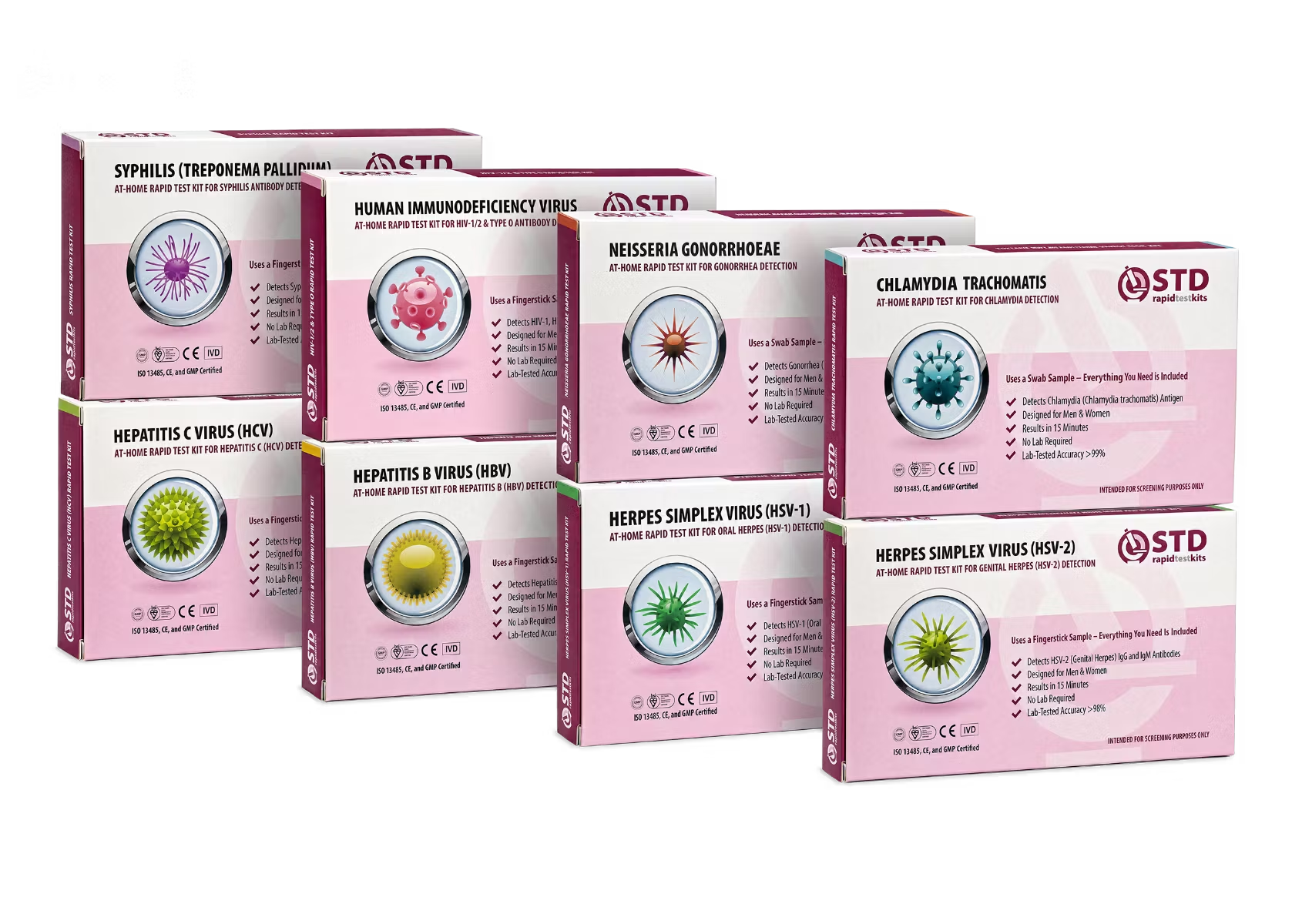
This site sells the at-home rapid tests referenced below. Our descriptions cover what each test can and cannot tell you so you can decide whether one fits your situation. The kits use lateral-flow chemistry, which is meaningfully different from a lab NAAT in analytical sensitivity; a positive at-home result is a strong signal that warrants confirmation and treatment, and a negative at-home result during a clear window period is reassuring but not equivalent to a lab panel.
If the Pattern Looks Like Herpes or Syphilis
Two infections account for most of the cases where redness gets misread. They are also the two where the answer matters most for what comes next, because both are treatable and one is curable.
Herpes simplex (HSV-1 and HSV-2): a blood antibody test confirms whether the body has produced antibodies to the virus, which usually requires 12 or more weeks after exposure to be reliable. An at-home rapid antibody test is well-suited to that confirmation question; it is less useful for diagnosing an active lesion, which is best swabbed and PCR-tested at a clinic during an outbreak.
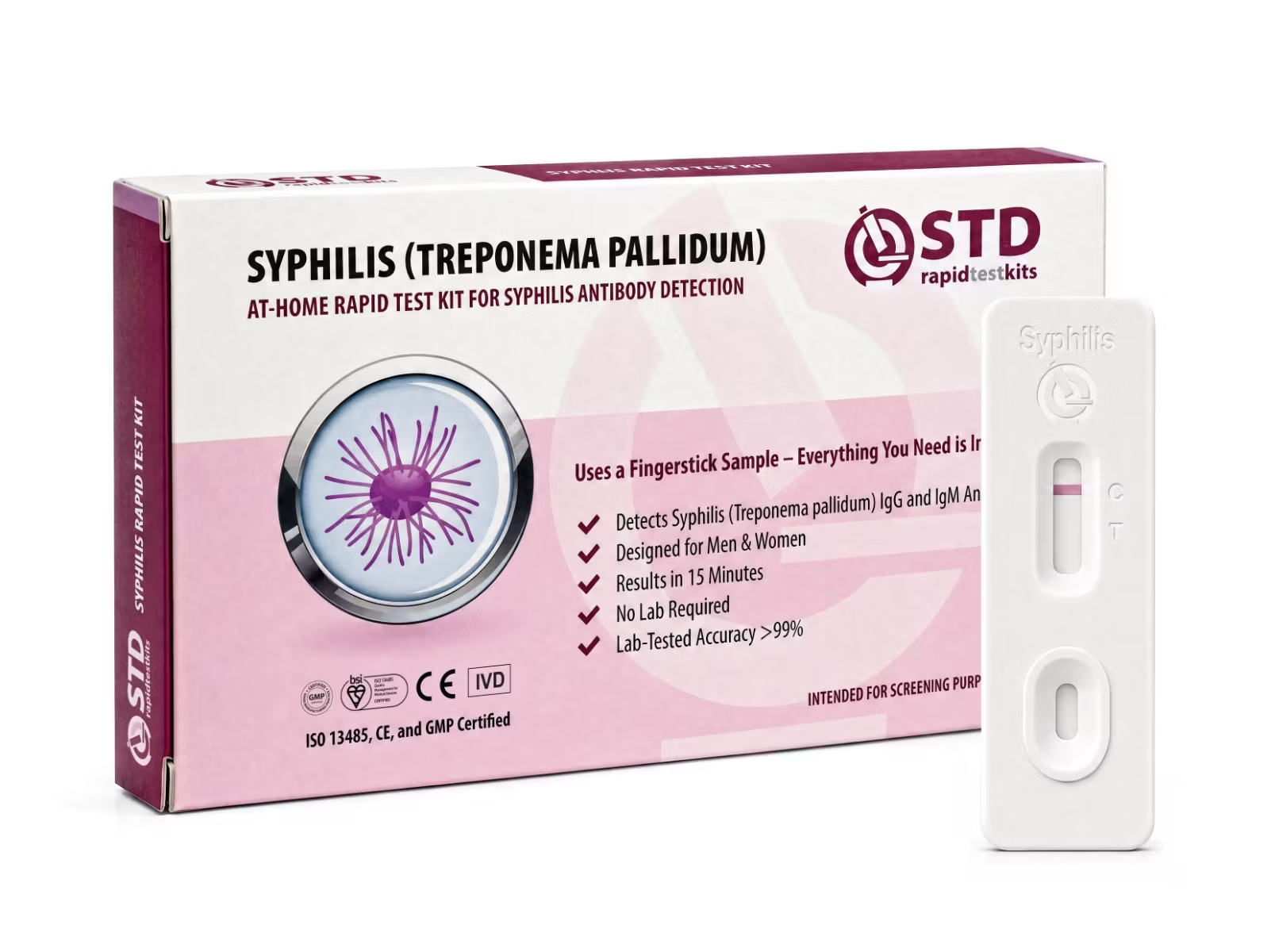
Syphilis: a fingerstick blood test detects antibodies that develop within roughly 3 to 6 weeks of exposure. A negative result during the window period is not definitive; a positive result is a strong signal to seek clinic-confirmed treatment, which is straightforward and curative when caught in the primary or secondary stage.
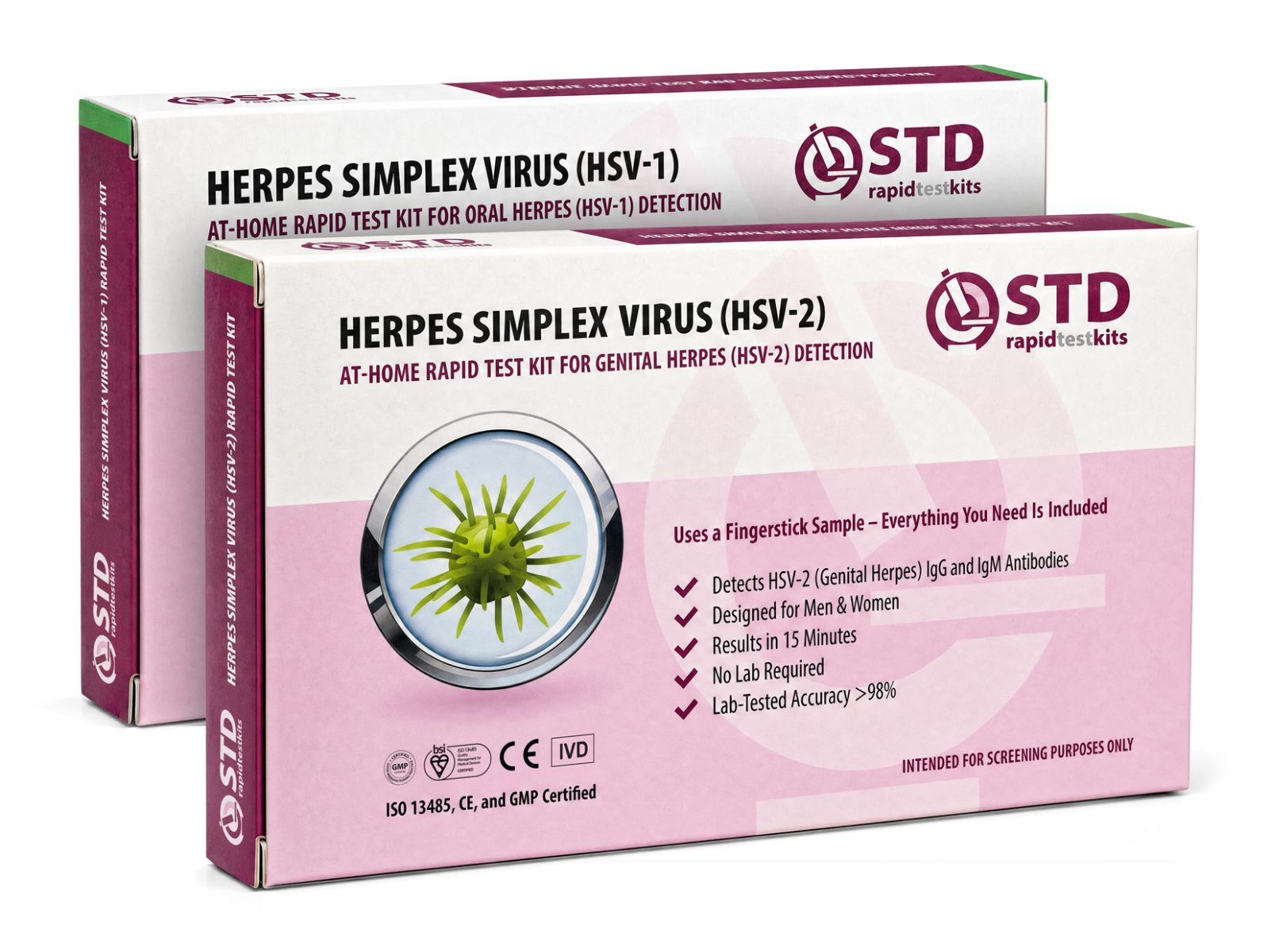
The two blood tests answer slightly different questions. The herpes antibody test confirms past seroconversion and is most reliable from twelve weeks after exposure. The syphilis blood test detects antibodies that appear earlier, often within three to six weeks, which makes it the faster post-exposure check.
Calming Irritated Skin When Infection Is Not the Cause
If the rash is dermatitis, the goal is straightforward: stop disrupting the barrier and let the tissue rebuild. Identify what changed recently. New body wash, scented wipes, flavored lubricant, a different condom, tighter underwear, or more aggressive shaving are the usual suspects.
The basic self-care steps:
- Switch back to plain water and a fragrance-free, dye-free cleanser.
- Wear loose breathable cotton underwear.
- Pat the skin dry rather than rubbing.
- Skip shaving the affected area until it heals.
- Avoid sex or further friction in the area until the redness is gone.
A short course of over-the-counter low-potency hydrocortisone (1%) for a few days can speed up resolution if itching is significant, but if it has not helped at all by day five, that is useful information rather than a reason to keep applying it. Most simple irritation resolves within four to seven days once the trigger is identified and removed. Anything beyond that, or anything that develops new features (blisters, ulcers, bumps, spreading), is worth a closer look.
You Do Not Need Certainty to Test
The hardest part of this for most people is not the test itself. It is the in-between phase where the rash could go either way and waiting feels like the only option. Testing is sometimes treated as an admission that something is wrong, which is the wrong way to frame it. A test is a tool that ends the guessing. A negative result during a valid window is reassurance you can act on. A positive result is the start of treatment, which for most curable STIs is short, effective, and standard.
You do not need to be certain something is wrong to justify the cost of a test. You only need enough doubt that staring at the rash one more night is no longer helping.
A test answers the question a rash cannot. A negative result during a valid window is reassurance you can act on. A positive result is the start of treatment. Either way, you stop waiting in ambiguity and start operating on information.
Common questions
- Can an STD really look like simple skin irritation in the early stages?
- Yes, especially in the first 24 to 48 hours. Herpes can start as a vague tingle and pink patch before any vesicle is visible. Early HPV looks like a tiny skin tag. Syphilis starts as a single ulcer that does not hurt. The clearest difference shows up over the next few days: irritation tends to fade, while infections tend to evolve.
- If a rash itches a lot, does that mean it is probably not an STD?
- Heavy itching leans toward irritation, yeast, or dermatitis. Many bacterial and viral STDs do not itch much at all in the early stages. Worth noting: pubic lice and scabies are sexually transmissible and produce intense itching, so itching alone does not exclude every infection. It is one signal among several to weigh.
- How long should I wait before treating redness as a real concern?
- About a week. Most simple irritation begins resolving within 48 to 72 hours once the trigger is removed and is largely cleared by day five to seven. A rash that lasts longer, evolves in shape, or spreads beyond the original area is a reasonable point to test rather than wait further.
- Can condoms or lube cause a rash that mimics an STD?
- Yes. Latex sensitivity and reactions to fragrances, flavorings, glycerin, or preservatives in lubricants are classic causes of contact dermatitis. The reaction usually appears within hours, follows the contact area, and fades once the irritant is gone. If you suspect this, switch to a non-latex condom and a plain water- or silicone-based lube without fragrance.
- I noticed redness the morning after sex. Is that too fast for an STD?
- Almost always, yes. Most STIs need at least 2 days for any sign to appear, and many take a week or more. Redness that shows up overnight is far more likely to be friction, a product reaction, or a small skin abrasion.
- I tried hydrocortisone for a few days and nothing changed. What now?
- Real contact dermatitis usually responds to a low-potency steroid plus removing the trigger. A rash that does not respond at all is not behaving like dermatitis, and this is the moment to test rather than try a fourth product.
- Can you have an STD without any visible symptoms at all?
- Yes, and it is common. The CDC notes that chlamydia and gonorrhea are frequently asymptomatic in both men and women, and untreated infection can persist for months. Routine screening for sexually active adults is the standard recommendation, regardless of how the skin looks.
- What is the single most useful thing to track if I am unsure?
- Change. Stable irritation usually fades. A rash that evolves, blisters, ulcerates, spreads, or recurs in the same spot is doing something simple irritation does not do. If you see change, it is the cue to swap watching for testing.
- U.S. Centers for Disease Control and Prevention. Public information on sexually transmitted diseases, including symptoms, screening recommendations, and the frequency of asymptomatic infection.
- U.S. Centers for Disease Control and Prevention. Information on syphilis stages, the painless primary chancre, and progression to secondary stage. Treatment guidelines describe an incubation period of roughly 10 to 90 days, average 21.
- UK National Health Service. Symptoms and progression of genital herpes, including primary outbreak presentation and recurrent outbreak patterns.
- World Health Organization. Fact sheet on sexually transmitted infections, including the prevalence of asymptomatic presentation across STIs and the range of symptoms when present.
- DermNet. Common genital skin problems and dermatologic differential diagnosis, including reactive skin patterns and contact dermatitis presentation.
- Cleveland Clinic. Patient education on contact dermatitis, including triggers, presentation, and resolution patterns once the irritant is removed.
