
Published: November 2025 | Last updated: May 2026 | Editorial review and quality control: Martina N.
Finding two small purple spots on the roof of your mouth, on the inside of a cheek, or under the tongue is the kind of moment that sends people straight to a search engine at 2 a.m. The results rarely calm anyone down. They list HIV, syphilis, herpes, and Kaposi sarcoma in the same paragraph as harmless bruising, with no sense of which is likely.
This guide sorts that out. Most purple spots inside the mouth are not sexually transmitted infections. They are small areas of bleeding just under the surface, usually from friction, suction, hot food, or a minor bite. When an STD does affect the mouth, it almost always brings other symptoms with it (pain, ulcers, raised growths, or a sore throat that will not clear) and almost never shows up as a single flat color change. The sections below walk through what each pattern looks like, what HIV mouth findings look like in real life, when to wait, and when to test.
Key Takeaways
- Most purple spots inside the mouth come from minor blood-vessel breaks (petechiae) in thin oral tissue, not from STDs or HIV.
- Oral STDs usually present as painful sores, persistent sore throat, or visible growths, not as flat painless purple dots that fade in a week.
What Purple Spots in the Mouth Usually Are
Almost every case of new purple spots on the soft tissue inside the mouth comes down to one mechanical event. Tiny capillaries break just under the thin mucosa lining and release a small amount of blood, which shows up as a flat purple or reddish-brown dot. The clinical term is petechiae when spots are pinpoint-sized, and purpura when they merge into larger patches.
The roof of the mouth (the hard palate, where the tissue is thinnest), the soft palate at the back, the inside of the cheeks, and the underside of the tongue are the most common places these spots appear. They are flat, painless, and do not blanch (they stay the same color when you press them, because the blood is already outside the vessel).
Here is where these spots commonly come from:
| Cause | What It Looks Like | Why It Happens |
|---|---|---|
| Minor trauma | Small purple or red dots | Biting the cheek, sharp food, vigorous brushing |
| Suction or pressure | Clustered spots on the palate | Oral sex, hard coughing, intense suction |
| Irritation | Flat discoloration | Very hot food or drinks, alcohol, smoking |
| Fragile vessels | Random small spots | Natural variation in capillary fragility, certain medications, low platelets |
Could Purple Spots Be an STD?
Some STDs do affect the mouth. The important distinction is that they usually do not show up as random flat purple dots. According to the CDC STIs overview, oral STIs typically present with structural changes (sores, ulcers, growths) or symptoms you can feel (pain, burning, persistent sore throat), not subtle color changes alone.
The table below summarizes how the four most-searched oral STDs look when they involve the mouth:
| STD | Typical Oral Presentation | Looks Like Purple Spots? |
|---|---|---|
| Oral herpes (HSV-1) | Cluster of small painful blisters that crust over, usually on or near the lips | No. Red or white blisters and crusted sores, painful |
| Oral syphilis | Single painless ulcer (chancre) at the site of contact, usually on the lip or tongue | No. Round, firm, indurated ulcer with a clean base |
| Pharyngeal gonorrhea | Often no symptoms at all, sometimes a sore, reddened throat that does not clear | No visible purple spots |
| Oral HPV | Flesh-colored or whitish wart-like growths, often slow to appear | No. Raised, not flat or purple |
What About HIV and Purple Spots?
If your mind jumped straight to HIV, let us address that directly. Early HIV infection (the acute phase, in the first two to four weeks after exposure) does not typically cause oral discoloration at all. According to HIV.gov, early HIV symptoms look more like a heavy flu:
- Fever and fatigue that feel like a serious flu
- Swollen lymph nodes in the neck, armpits, or jaw
- Sore throat, body aches, headache
- Sometimes a non-itchy rash on the trunk or face
- Occasional mouth ulcers (white or red raw sores, not flat purple dots), distinct from the petechiae pattern
- Oral thrush (creamy white patches that wipe off and leave a raw surface, not purple)
Kaposi Sarcoma and HIV Mouth Lesions
The condition people are usually thinking of when they search for purple spots and HIV in the same query is Kaposi sarcoma, a type of cancer that the National Cancer Institute describes as causing dark purple, red, or brown lesions on the skin and inside the mouth.
Several things about Kaposi sarcoma rarely appear in general search results:
- Kaposi sarcoma in the mouth is associated with advanced, untreated HIV (typically a CD4 count well below 200), not early HIV infection.
- The lesions are usually raised, persistent, and do not fade in a week. They do not appear out of nowhere overnight in someone who feels well.
- With modern antiretroviral therapy keeping HIV suppressed, Kaposi sarcoma has become much less common in people living with diagnosed and treated HIV.
- It does not present as one or two pinpoint flat dots on the palate after a normal night of oral sex.
If you are worried about a recent exposure, the question is not whether you have an unusual mouth lesion. The question is whether you have had a possible exposure and whether you have tested. HIV is most reliably confirmed with a 4th-generation antigen/antibody test at about 45 days post-exposure, or a rapid antibody test at about 90 days post-exposure.
Are purple spots in the mouth an STD or HIV?
Almost always, no. Purple spots inside the mouth are usually petechiae from minor pressure, friction, or suction (oral sex suction is a very common harmless cause) and clear within 5 to 10 days. Oral STDs typically present as painful sores, ulcers, or wart-like growths, not flat color changes. HIV-related Kaposi sarcoma can cause purple oral lesions, but only in advanced untreated HIV, and the lesions are raised and persistent rather than pinpoint dots that fade in a week.
When a Spot Is Just a Spot vs When to Test
Most purple spots do not need a doctor visit. They do, however, need a clear rule for when to stop watching and start testing or seeking care. The table below maps the four most common scenarios to the next step that matches the situation.
| Situation | What It Likely Means | Next Step |
|---|---|---|
| Small flat painless purple dots, no other symptoms | Petechiae or minor mucosal bruising | Monitor for 5 to 10 days, no testing needed |
| Spots appeared the morning after oral sex | Suction-related petechiae (same mechanism as a hickey) | Wait it out, the spots should fade within a week |
| Painful sore, blister, or open ulcer in the mouth | Possible oral herpes, syphilis chancre, or other infection | Consider an at-home STD test, see a clinician if pain is severe or lasts beyond 14 days |
| Spots that grow, multiply, become raised, or do not fade after 14 days | Outside the usual harmless pattern | Book a clinic evaluation, do not self-diagnose |
Timing Matters: Window Periods After Oral Exposure
The single biggest decision-driver for testing is not the color of the spot. It is whether you also have other symptoms or a possible exposure that has not been tested. A flat painless dot with nothing else going on is one situation. A flat painless dot plus a recent unprotected encounter you have not tested for is a different situation, and the answer there is the test, full stop.
One of the most common testing mistakes is testing too soon after a recent encounter. Every infection has a window period, the stretch of time between exposure and when a test can reliably detect the infection. Testing before the window closes can produce a false negative that feels reassuring but is not.
If your concern is tied to a recent encounter, the right move is to wait until the window for the infections you are testing for has closed, then test once. Testing daily after a recent encounter does not give you more accurate information; it just feeds the loop.
If you do test before the window closes and the result is negative, do not treat that as the final answer. Either retest at the appropriate point or treat the early test as a screen and the later test as the confirmation.
The general guidelines below come from CDC testing guidance. Exact figures vary by the specific assay and test technology; check the data sheet on the kit you choose.
| Infection | Earliest Reliable Test | Best Accuracy Window |
|---|---|---|
| Gonorrhea | About 5 to 7 days after exposure | 1 to 2 weeks after exposure |
| Chlamydia | About 7 days after exposure | 2 weeks after exposure |
| Syphilis (antibody) | About 3 to 6 weeks after exposure | 6 to 12 weeks (sometimes up to 90 days) |
| HIV (4th-gen antigen/antibody) | About 18 to 45 days after exposure | 45 days for high confidence, retest at 90 days for confirmation |
| HIV (rapid antibody) | About 23 to 90 days after exposure | 90 days for high confidence |
What Do Oral STD Symptoms Feel Like?
It helps to know not just what an oral STD looks like but how it feels. Infections in the mouth do not stay subtle for long. They almost always bring sensations along with whatever you can see in the mirror.
Flat painless purple spots do not fit the patterns of true oral STDs. They are visual without being sensory and do not interfere with eating, swallowing, or talking, which suggests a mechanical reaction in the tissue rather than an infection.
That does not make the spots irrelevant. They are telling a different story, one about pressure or fragile capillaries rather than a pathogen.
The table below covers the four most common oral STD presentations and what a person typically notices in the day-to-day, beyond just the visual.
| Symptom Type | What You Would Notice | Most Commonly Linked To |
|---|---|---|
| Painful sores or blisters | Sharp or burning pain while eating, swallowing, or talking | Oral herpes (HSV-1) |
| A single painless firm ulcer | A round, indurated sore that does not hurt but does not heal in 1 to 2 weeks | Primary oral syphilis (chancre) |
| Persistent sore throat | Feels like strep but does not clear and antibiotics for strep do not help | Pharyngeal gonorrhea or chlamydia |
| White patches that wipe off | Creamy coating on tongue, palate, or inner cheek, leaves a raw red area underneath | Oral thrush, sometimes linked to HIV-related immune changes |
| Raised wart-like growths | Small flesh-colored bumps, slow to appear, painless | Oral HPV |
How Long to Watch a Spot Before Worrying
This is the question that gets surprisingly little clear answer online. Most harmless purple spots in the mouth follow a predictable healing curve. They appear, hold their color for a few days, then fade as the small bleed under the surface reabsorbs.
Realistic expectations:
| Day | What Usually Happens |
|---|---|
| Day 1 to 2 | Spots appear, often look darkest in the first 48 hours |
| Day 3 to 5 | Color softens, edges fade from the outside in |
| Day 5 to 10 | Spots resolve completely, the tissue underneath looks normal |
| Beyond Day 14 | Outside the usual pattern, time to get it evaluated |
What Actually Deserves a Second Look
If your spots follow the healing curve above, that is a strong signal you are dealing with petechiae or minor bruising rather than an infection. If they linger past 14 days, change shape significantly, become raised, multiply, or are joined by other symptoms (fever, swollen lymph nodes, painful swallowing, fatigue), a clinician should look at them.
There is a difference between being aware of your body and being trapped in hypervigilance. The goal is to recognize which symptoms warrant follow-up.
What is notably missing from the warning-sign list below is color alone. A flat purple spot, with none of those features, is rarely the primary signal of an STD or HIV. The signal is usually in what else is happening (or not happening) in the body around it.
If the spots are isolated and nothing else is going on, monitoring is the appropriate response. If anything on the list below is present, or if you have a possible untested exposure that you have not addressed, the next step is testing. The signs worth taking seriously regardless of whether you also see purple spots:
- Pain: sharp, persistent, or worsening discomfort in the mouth or throat
- Open sores or ulcers, especially any that have not started to heal in 10 to 14 days
- Raised growths or lesions that are spreading or changing
- Systemic symptoms: fever, fatigue, swollen lymph nodes in the neck or jaw, unexplained weight loss
- Painful swallowing or a sore throat that has lasted more than two weeks
- Bleeding gums, white patches that wipe off, or recurrent oral thrush in someone not on antibiotics
The Bottom Line on Purple Spots in the Mouth
Most purple spots in the mouth are not STDs, not HIV, and not early warning signs of something hidden. They are small temporary responses to pressure, friction, or minor injury that resolve on their own within about a week. The thinness of oral tissue makes petechiae very easy to produce, especially after oral sex, hard coughing, sharp food, or vigorous brushing.
When an infection is involved, it almost never shows up as just a color change. It comes with sensation, progression, or other symptoms. Knowing the patterns (sores for herpes, painless chancre for syphilis, persistent sore throat for pharyngeal gonorrhea, wart-like growths for HPV, systemic flu-like illness for early HIV) is what lets you tell a 24-hour bruise apart from something that needs medical attention.
If you have a possible untested exposure on your mind, the answer is in a properly timed test. Wait for the window period to close, then test once and get a concrete answer.
Monitor track: flat, painless, fading within 14 days, no other symptoms, no untested exposure → watch and let it resolve.
Clinic or test track: painful, raised, growing, lasting beyond 14 days, joined by fever, swollen lymph nodes, or persistent sore throat, or following an untested possible exposure → book a clinic visit or run a properly-timed at-home test.
FAQs
- I found purple spots in my mouth and now I am worried, should I be?
- Usually not. The most common cause is tiny pressure-related bruises (petechiae) from suction, friction, hot food, or a minor bite. Oral tissue is thin, so it shows minor capillary breaks easily. Monitor for about a week, and expect flat painless spots to fade by day 5 to 10.
- Could this be HIV?
- Very unlikely from purple spots alone. Early HIV does not typically cause oral discoloration. Acute HIV looks like a heavy flu (fever, fatigue, sore throat, swollen lymph nodes), usually 2 to 4 weeks after exposure. Kaposi sarcoma can cause purple oral lesions, but only in advanced untreated HIV and the lesions are raised and persistent, not pinpoint dots that fade in a week. If you have an untested exposure, the right answer is a properly-timed HIV test, not symptom-watching.
- The spots appeared after oral sex. Is that an STD sign?
- It can feel that way, but it is most often suction-related petechiae. The roof of the mouth and inner cheeks have very thin tissue, and oral sex can apply enough negative pressure to break small capillaries (the same mechanism as a hickey on the neck). The spots are flat, painless, and clear within about a week. Persistent sores, ulcers, or a sore throat that does not clear are the patterns that suggest an oral STI.
- How do I tell a harmless spot from something serious?
- Pain is the single most useful dividing line: petechiae do not hurt. A spot that hurts, that changes shape, that has become raised, or that is still there after 10 days warrants a different response than a flat painless dot that fades. If any of those three things are true, treat it as worth investigating; if none of them are, give it the full 10-to-14-day window before worrying.
- How long should I watch a spot before getting it checked?
- 14 days is the outer limit. Expect a harmless petechial spot to be darkest at days 1 to 2, soften by days 3 to 5, and resolve completely by day 10. Anything still visible and unchanged at the two-week mark earns a clinic call regardless of color, especially if it has become raised or grown in size.
- Should I get tested even if I think the spot is harmless?
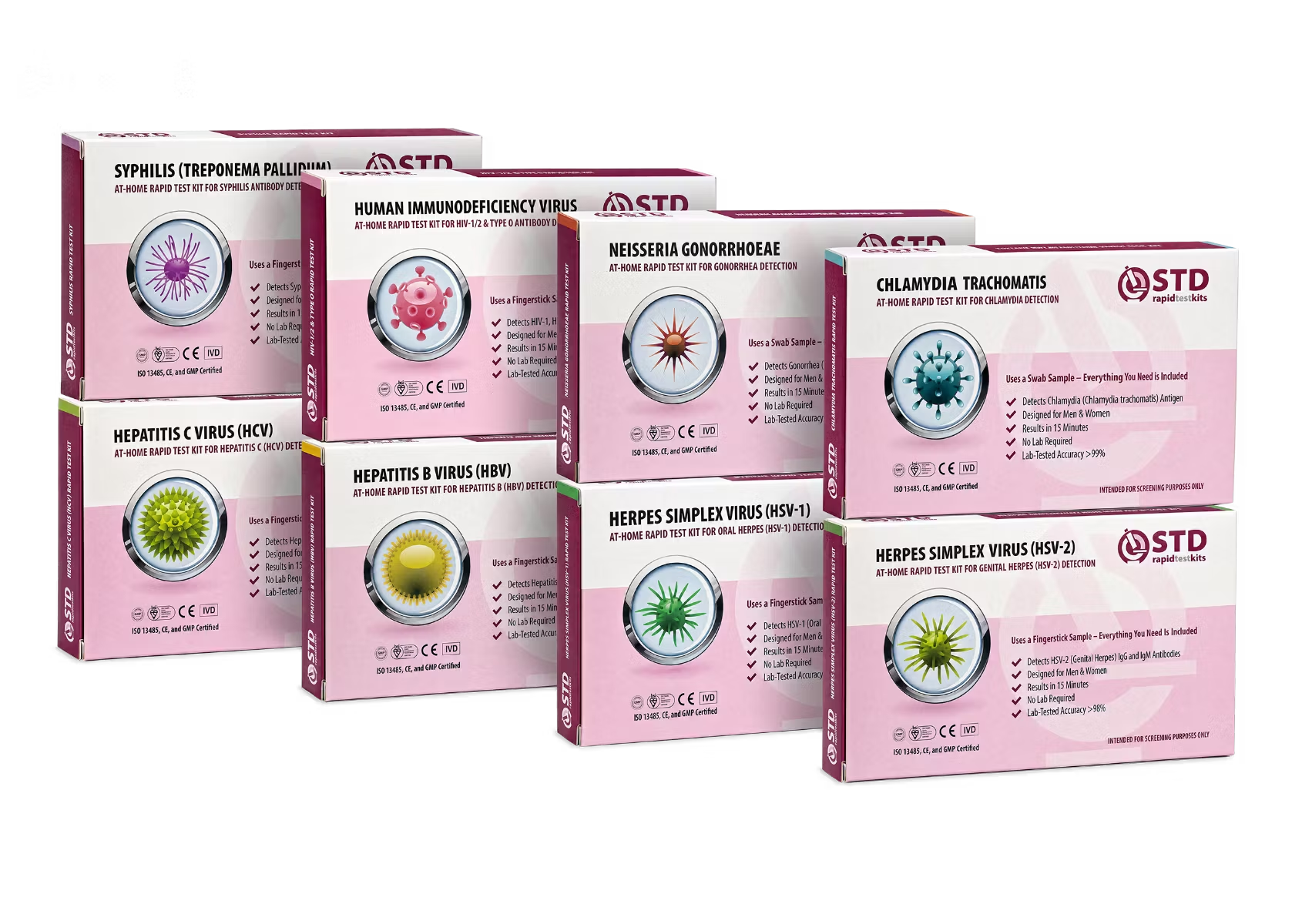
- Testing is reasonable whenever there is an untested possible exposure, even if the spot itself looks benign. The spot is rarely the deciding factor. The deciding factor is whether you have had an encounter you want a clean result on. At-home rapid tests can screen for the common infections in about 15 minutes.
- Can stress or anxiety cause mouth spots?
- Not directly, but stress can trigger behaviors that do. Jaw clenching, teeth grinding, lip biting, and unusually vigorous brushing during stressful weeks can all produce small areas of mucosal trauma and petechiae. The spot in that case is a reaction to mechanical irritation, not an infection.
- Do oral STDs always look obvious?
- Most do, but pharyngeal gonorrhea and chlamydia are notable exceptions because they often produce no visible symptoms at all and just a mild persistent sore throat. Someone who had an unprotected oral encounter and sees nothing unusual in the mirror still has an exposure worth testing for once the window period has closed.
How we sourced this article. This guide draws on current public-health guidance from the U.S. Centers for Disease Control and Prevention, HIV.gov, the World Health Organization, and the National Cancer Institute, focused on oral manifestations of STIs, HIV symptom timelines and testing windows, and the clinical context for Kaposi sarcoma. We have not introduced clinical anecdotes or first-person practice claims; the writer is a medical writer (not a clinician) summarizing published guidance, and the article is reviewed by a licensed medical doctor for clinical accuracy.
- U.S. Centers for Disease Control and Prevention. Sexually transmitted infections (STIs) overview, including pages on oral presentations of gonorrhea, chlamydia, herpes, and syphilis.
- HIV.gov. Symptoms of HIV through the acute, clinical-latency, and AIDS stages, used here for the early-HIV symptom list (including occasional mouth ulcers) and the note that purple oral lesions are not part of acute HIV presentation.
- National Cancer Institute. Kaposi sarcoma treatment (PDQ) patient version, used for the description of purple, red, or brown lesions, including oral lesions, and the association with advanced untreated HIV.
- World Health Organization. Sexually transmitted infections fact sheet: global STI burden, transmission routes, prevention, and clinical management framing.
- U.S. Centers for Disease Control and Prevention. HIV testing and window-period guidance, used for the antigen/antibody and rapid antibody window-period figures in the testing-windows table.
