
Published: July 2025 | Last updated: April 2026 | Editorial review and quality control: Martina N.
The hours after a possible HIV exposure can feel slow and very loud at the same time. A condom failed. A needle was shared. An assault happened. The replay starts before the panic subsides. In that window, one decision matters more than almost any other: whether to start post-exposure prophylaxis, the antiretroviral pill regimen better known as PEP. Started in time, it can stop HIV from establishing a permanent infection. Started late, it cannot.
This guide explains what PEP does and what it does not do. It covers the 72-hour deadline, the two pathways into care (sexual or occupational), what the pills feel like, what they cost, and the follow-up testing schedule that has to come next. PEP cannot reverse an established infection, and it does not replace condoms or PrEP. It is the one time-limited prescription that can change the outcome of a single high-risk exposure once it has happened.
Does PEP actually prevent HIV after a high-risk exposure?
Yes, when started fast and taken correctly. PEP is a 28-day course of antiretroviral pills that must begin within 72 hours of the exposure. Case-control evidence and clinical guidance from the <a href="https://www.cdc.gov/hiv/prevention/pep.html" target="_blank" rel="noopener">U.S. CDC</a> describe PEP as highly effective at preventing HIV when adherence is complete, with one frequently cited 1997 healthcare-worker study estimating roughly 80% risk reduction. PEP only protects against HIV; it does not prevent chlamydia, gonorrhea, syphilis, or other STIs, so separate testing is still needed.
Key takeaways
- PEP is HIV-only and time-limited: start within 72 hours of exposure, take all 28 days, and treat any delay as a reason to go faster, not a reason to skip it.
- PEP does not cover chlamydia, gonorrhea, syphilis, hepatitis, or herpes; comprehensive STI testing at baseline and again after the window period is a separate step that still has to happen.
What PEP is and how it works inside your body
PEP stands for post-exposure prophylaxis. It is a 28-day course of the same antiretroviral drugs used to treat established HIV infection, but here they are deployed as a short, defensive sprint. The current preferred regimen is a single daily tablet of tenofovir disoproxil fumarate plus emtricitabine, combined with a daily integrase inhibitor (most commonly dolutegravir or raltegravir). The U.S. CDC and the HIV.gov treatment library both publish the regimen schedules clinicians use; full regimen tables are housed in the Clinicalinfo.HIV.gov adult and adolescent ARV guidelines.
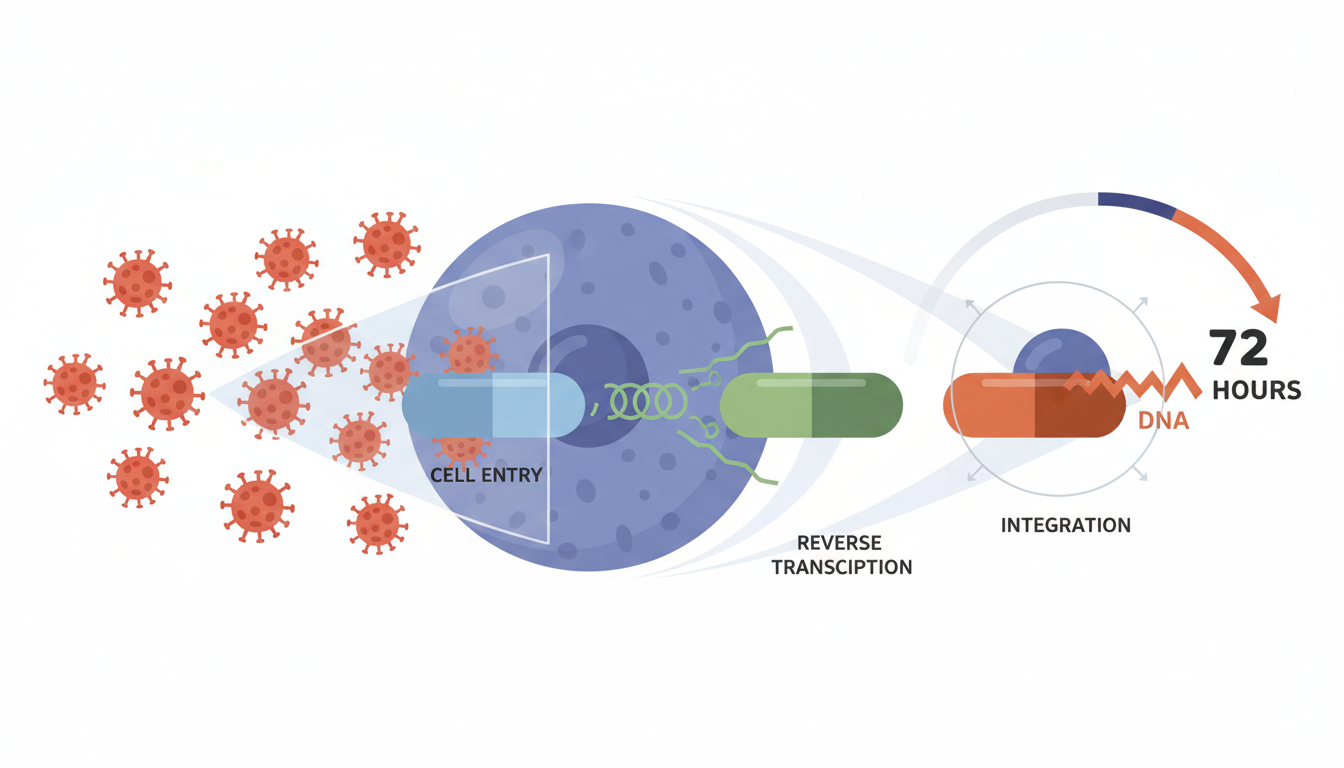
The mechanism is straightforward in concept. After mucosal or bloodstream exposure, HIV virions need a narrow window of hours to reach a target CD4 cell, fuse with it, reverse-transcribe their RNA into DNA, and integrate into the host genome. Once integration happens, infection is permanent. PEP drugs block the reverse-transcription step (tenofovir and emtricitabine) and the integration step (dolutegravir or raltegravir) at the same time. Hit those two checkpoints hard enough, fast enough, for long enough, and the virus never establishes a reservoir.
The catch is in those three words: fast enough, long enough. The pills must reach therapeutic levels before integration completes, which is why every hour of delay matters. And they must keep working for the full 28 days so that any virions still in transit are neutralized rather than just suppressed temporarily.
When PEP is appropriate, and the two pathways into care
PEP is for anyone with a recent, defined high-risk exposure to HIV, regardless of identity, gender, or sexual orientation. Public health systems split candidates into two formal categories, occupational and non-occupational, because the access pathway is different even though the medication is the same.
Non-occupational PEP (nPEP) covers exposures that happen in everyday life: a condom that broke during vaginal or anal sex, sex with a partner whose status is positive or unknown, sexual assault, or a shared needle during drug use. The CDC's non-occupational PEP guidance walks clinicians through which exposures meet the threshold and which do not.
Occupational PEP (oPEP) covers exposures during work, classically a needlestick injury for a healthcare worker, but also blood splashes to mucous membranes for first responders, lab workers, and sanitation staff. Employers are usually required to have a same-day protocol for oPEP and to cover the cost.
Receptive anal intercourse with a partner of unknown status carries the highest per-act HIV transmission risk among sexual exposures, and is one of the clearest indications for nPEP. Oral sex carries very low risk and rarely meets the threshold on its own unless there are open sores, recent dental work, or visible blood. If you are unsure whether your exposure qualifies, do not self-disqualify; the assessment belongs to a clinician with the timeline in front of them.
Exposures that usually warrant a PEP conversation
- Condom failure or no condom during vaginal or anal sex with a partner who is HIV-positive or of unknown status.
- Sexual assault, regardless of whether the assailant's status is known.
- Sharing injection equipment (needles, syringes, cookers, cottons) during drug use.
- Occupational needlestick or sharps injury, or a mucous-membrane splash with blood.
- Perinatal exposure for a newborn whose birthing parent is HIV-positive (handled by the delivery team).
The 72-hour window and where to get PEP fast
The 72-hour deadline is real and it is hard. Effectiveness drops as the hours add up. Within 2 hours is ideal. By 24 hours, the regimen is still strong. By 72 hours, you are at the outer edge of plausible benefit. After 72 hours, current guidance does not recommend PEP because the chance of the drugs reaching the virus before integration falls too low to justify the side-effect cost.
That makes the access path the most stressful part. PEP is available from emergency rooms, urgent care centers, sexual health clinics, community health centers, LGBTQ+ health organizations, some Planned Parenthood locations, and a growing number of telehealth services that can ship a starter pack overnight. Walk in. State the situation in plain language: I had a possible HIV exposure within the last 72 hours and I need PEP. Use those words. If a clinician hesitates or seems unfamiliar with the protocol, ask for the on-call infectious-disease consult, or leave and try a different facility.
Some emergency departments will dispense a 3- to 5-day starter pack on the spot and have you finish the regimen with a follow-up clinic visit. The HIV.gov service locator maps clinics that prescribe PEP, and many state health departments run dedicated PEP hotlines that can talk you through the next step in real time.
Stop reading. Go to the nearest emergency room, urgent care, or sexual health clinic and ask for PEP by name. The next hour matters more than the next paragraph. You can come back to the rest of this guide once the first dose is in your hand.
What PEP costs and how coverage usually works
The retail price of a 28-day PEP course in the United States can run into the hundreds of dollars at sticker price without coverage, with reported ranges varying widely depending on the regimen, the pharmacy, and whether generic versions of tenofovir and emtricitabine are used. Very few patients pay sticker price. Most commercial insurance plans, Medicaid in every state, and many state-funded HIV prevention programs cover PEP fully under preventive or emergency-care benefits.
If you are uninsured, ask the prescribing clinic about manufacturer patient-assistance programs (Gilead's Advancing Access program is the most commonly used for tenofovir and emtricitabine). Many state and city health departments fund free PEP for uninsured residents, and federally qualified health centers use sliding-scale fees. Privacy-sensitive billing matters too: if you are a dependent on a parent's plan and an explanation-of-benefits letter would expose the visit, ask the clinic about confidential billing options before the prescription is filed.
For occupational exposures, employer workers' compensation typically covers the full cost; ask your supervisor or occupational health office to file the incident immediately so the bill is routed correctly.
Medicaid and most commercial insurance: PEP is generally covered under preventive or emergency-care benefits in every U.S. state.
Gilead Advancing Access: manufacturer patient-assistance program that supplies tenofovir and emtricitabine to eligible uninsured patients at no cost; clinics can often submit applications same-day inside the 72-hour window.
State and city health departments: many fund free PEP for uninsured residents through their HIV prevention services; LGBTQ+ centers, federally qualified health centers, and Planned Parenthood locations can connect you to these programs.
Side effects, adherence, and finishing the 28 days
The current first-line PEP regimen is far gentler than older versions of HIV therapy, but it is not invisible. The most commonly reported side effects in the first one to two weeks are nausea, fatigue, headache, and loose stools. Less commonly, people report dizziness, vivid dreams, or trouble sleeping. Most symptoms fade by the second week as the body adjusts.
Practical things that help: take the pills with food, hydrate aggressively, ask the prescriber for an as-needed antiemetic if nausea is interfering with adherence, and set two daily phone alarms (one as the dose reminder, one as a backup). If a dose is more than a few hours late, take it as soon as you remember, then resume the regular schedule; do not double up.
Adherence is the single biggest predictor of whether PEP works. Real-world studies of PEP completion show meaningful drop-off after week two, often because side effects fade and people forget that finishing matters. Finish the 28 days even if you feel completely fine on day 15. Stopping early is the most common preventable failure mode.
The single most common reason PEP fails in the real world is early discontinuation around week two, when side effects ease and the urgency of the original exposure has faded. Therapeutic protection requires the full 28 days. If you are struggling with adherence, call the prescribing clinic before stopping; switching tablets, adding antiemetics, or simplifying the schedule is almost always possible.
PEP versus PrEP: which one fits which situation
PEP and PrEP are the two pillars of biomedical HIV prevention and they are often confused. The simplest distinction: PEP is a 28-day reactive regimen taken after a single specific exposure, while PrEP is a continuous proactive regimen taken before exposure for someone with ongoing risk. If you find yourself reaching for PEP more than once in a 6- to 12-month period, that is the signal that PrEP is the better fit.
| Feature | PEP | PrEP |
|---|---|---|
| When you take it | After a single possible exposure | Continuously, before any exposure |
| Duration | 28 days, fixed | As long as risk continues |
| Form | Daily oral pills | Daily oral pill or every-2-month injectable |
| Window to start | Within 72 hours of exposure | Days to weeks before risk period |
| Effectiveness | High when adherent and started fast | About 99% with consistent oral dosing per CDC |
| Best fit | Single emergency exposure | Ongoing risk: serodifferent partner, frequent condomless sex, injection drug use |
| Where to get it | ER, urgent care, sexual health clinic, telehealth | Primary care, sexual health clinic, telehealth |
What PEP does not prevent, and the testing that still has to happen
This is the most underdiscussed part of post-exposure care. PEP only acts on HIV. It does nothing for chlamydia, gonorrhea, syphilis, trichomoniasis, hepatitis B, hepatitis C, herpes, or HPV. A person who started PEP for an HIV exposure is, by definition, also at risk for the rest of that list, because the exposure event was the same.
That is why post-exposure care is supposed to include a baseline STI panel on the day PEP is dispensed, plus a repeat panel after the relevant window periods (roughly 2 weeks for chlamydia and gonorrhea, 6 to 12 weeks for syphilis and hepatitis C, and out to 12 weeks for HIV confirmation). The CDC's 2021 STI Treatment Guidelines spell out the recommended timing in detail. Many ERs do not run the full panel automatically, so it is worth asking specifically.
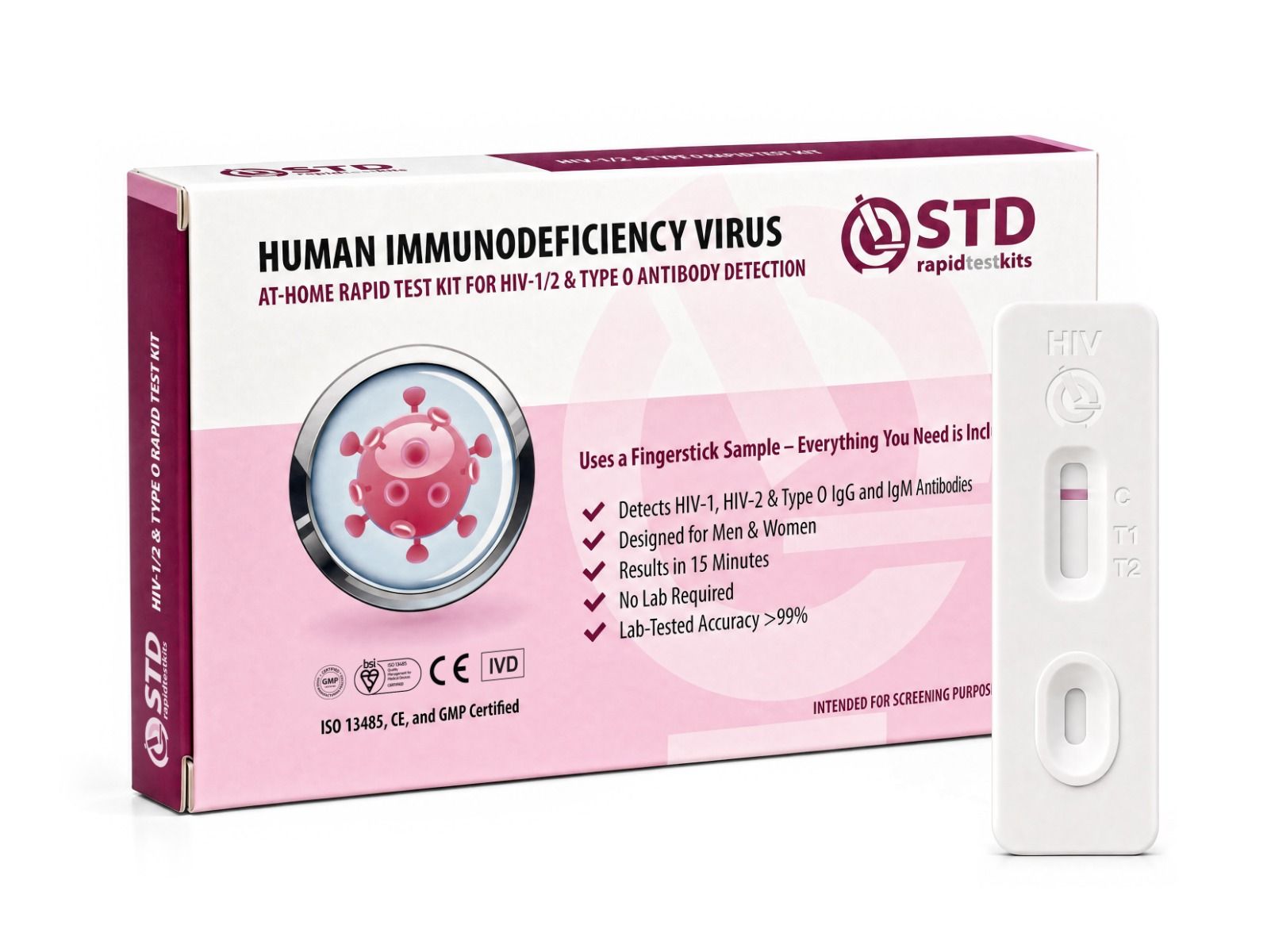
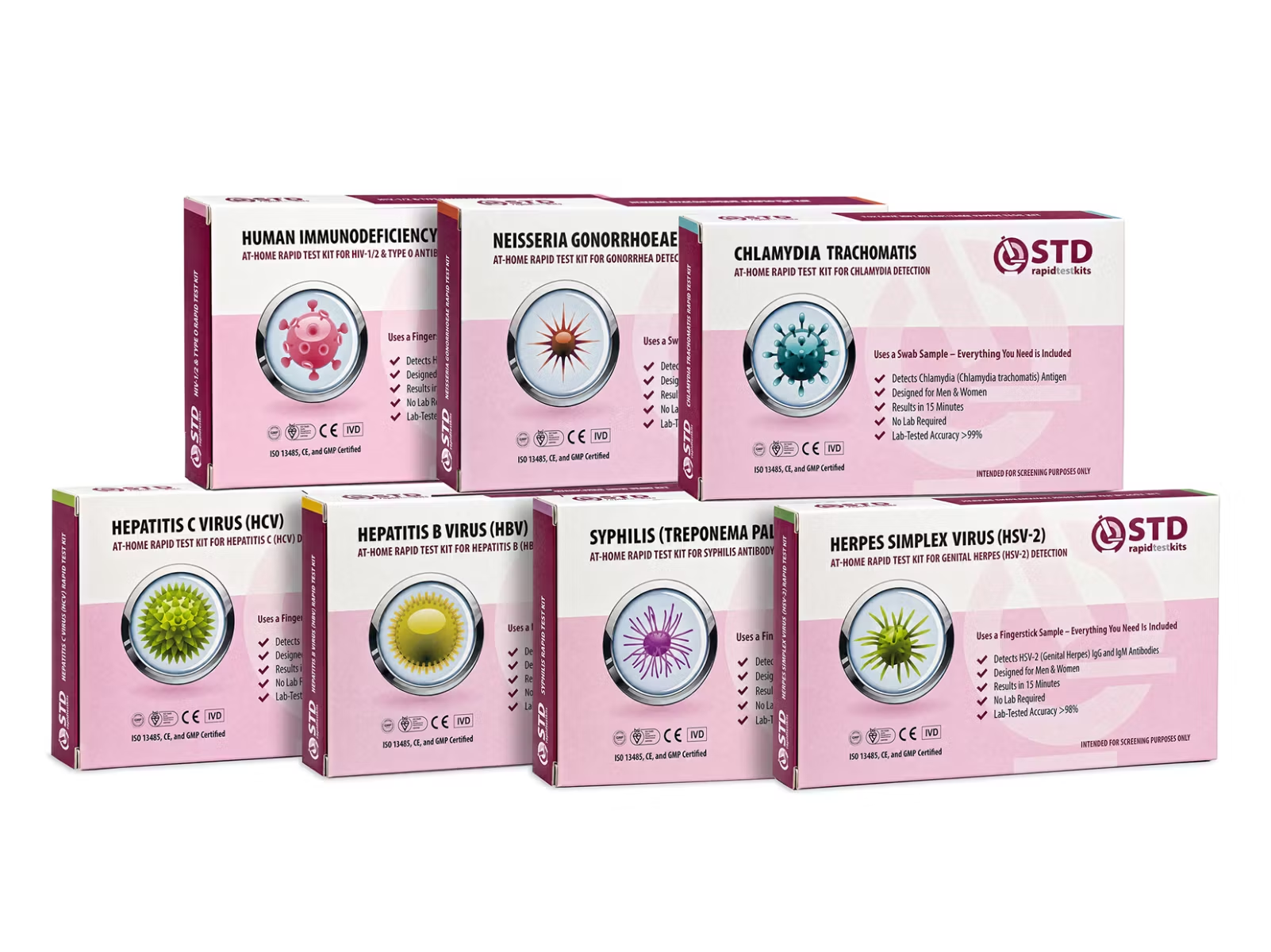
For at-home follow-up, a multi-infection rapid screening kit can cover the broad picture once enough time has passed for the lateral-flow assay to detect each infection accurately. These at-home rapid tests are screening tools, not lab-grade NAAT, so any positive result is worth confirming through a clinic. Disclosure: this article is published by stdrapidtestkits.com, which sells at-home STI testing kits; the products linked below cover several of the infections PEP does not address, and we recommend products based on fit-for-purpose for the reader's situation, not commercial benefit.
The follow-up HIV testing schedule after PEP ends
Finishing the 28-day course is not the end of the protocol. Confirming that PEP worked requires a specific follow-up testing schedule, because antibodies can take weeks to develop and a single early test is not conclusive.
The standard schedule, drawn from CDC and HIV.gov guidance, looks like this:
- Day 0 (baseline): HIV test before the first PEP dose, to rule out an existing infection that PEP would not adequately treat.
- Week 4 to 6: Repeat HIV test, ideally a fourth-generation antigen-antibody assay, to catch most acute infections that broke through PEP.
- Week 12: Final HIV test to definitively rule out seroconversion. A negative test at 12 weeks closes the case.
Many clinicians extend follow-up to 6 months for occupational exposures involving hepatitis C, or for any exposure where the source partner's HIV status is later confirmed positive with a high viral load. If you cannot get back to a clinic for the week-12 test, an at-home rapid HIV antibody test can serve as the final confirmation, with any reactive result rechecked through a lab.
When PEP is about survival, not strategy
Most public conversation about PEP frames it around lifestyle: the broken condom on a Saturday night, the casual hookup, the calculated risk. That framing leaves out the population for whom PEP matters most. Survivors of sexual assault are among the highest-priority candidates for PEP, and they are also the most likely to be missed by the system.
Emergency departments are supposed to offer PEP to every survivor presenting after a sexual assault, alongside emergency contraception, a forensic exam if the survivor consents, and a referral to a sexual assault nurse examiner (SANE). In practice, offers are uneven. Some survivors are too disoriented to ask. Some encounter providers who do not raise it. Some are met with disbelief or judgment.
If you are a survivor reading this: you are entitled to PEP. You do not need a police report, a clear memory of the event, or a named assailant to qualify. You can ask the triage nurse for a SANE, an LGBTQ+ patient advocate, or a domestic violence counselor. RAINN's national hotline (1-800-656-HOPE) can help you locate a SANE-equipped facility before you walk in, which often shortens the wait. If you are supporting someone, the most useful thing you can do is be the person who says the word PEP out loud at the front desk.
No police report required. A reported assault is not a precondition for receiving PEP, emergency contraception, or a forensic exam.
SANE referral on request. Sexual assault nurse examiners are trained for trauma-informed evaluation and PEP initiation; ask the triage nurse to page one or to transfer you to a SANE-equipped facility.
RAINN national hotline: 1-800-656-HOPE. Operators can locate the nearest SANE-equipped emergency department before you walk in, which often shortens the wait inside the 72-hour window.
You can bring an advocate. Domestic violence counselors, LGBTQ+ patient advocates, and friends are allowed to accompany you through intake.
Why PEP still does not reach everyone who needs it
Despite three decades of guidelines and clear evidence of effectiveness, PEP uptake remains uneven, and the gaps map onto familiar lines. Awareness is one barrier: surveys consistently find that most adults outside of LGBTQ+ urban networks have never heard of PEP, even though their potential need is no smaller. Provider familiarity is another: rural emergency departments and general primary care clinics may not stock starter packs or may not have a routinized protocol.
Cost is a barrier when patient-assistance programs are not surfaced quickly enough. Geography is a barrier when the nearest PEP-prescribing facility is several hours away and the 72-hour clock is already running. Stigma cuts across all of it: people who feel judged for the exposure circumstance are less likely to disclose it accurately, and a partial story produces a partial recommendation.
Communities of color, undocumented residents, transgender people, and incarcerated people face the steepest combinations of these barriers, and HIV incidence data reflects that. Closing the gap is partly a public-health system problem, but the smaller answer (the one that fits in a single conversation) is to talk about PEP plainly, the way Plan B is talked about, so that the next person who needs it knows the word before the moment arrives.
PEP must be started within 72 hours after a possible exposure to HIV, but the sooner you start PEP, the better. Every hour counts.
Frequently asked questions about PEP
- How effective is PEP if I start it on time and finish the full course?
- Effectiveness is high when two conditions hold: the first dose lands inside the 72-hour window, and every subsequent dose is taken across all 28 days. Each hour of delay and each skipped dose erodes the protection. The widely-cited 80% risk-reduction estimate originates in a 1997 case-control study of healthcare workers using earlier-generation antiretrovirals; current first-line regimens (tenofovir and emtricitabine plus dolutegravir or raltegravir) are generally expected to perform at least as well under the same adherence conditions. Drop-off in the second half of the regimen is the most common preventable failure mode, not the original exposure dose.
- Does PEP prevent any STIs other than HIV?
- No. PEP is HIV-specific. It does not prevent chlamydia, gonorrhea, syphilis, trichomoniasis, herpes, hepatitis B, hepatitis C, or HPV. Anyone starting PEP for a sexual exposure should also be screened for the other STIs at baseline and again after the appropriate window periods. Doxy-PEP is a separate, distinct intervention (doxycycline taken after exposure) that targets bacterial STIs, but that is not what HIV PEP does.
- Is PEP the same as PrEP?
- No. PEP is taken after a single possible exposure, for 28 days. PrEP is taken on an ongoing basis, before exposure, by people with continuing risk. The drugs overlap (tenofovir and emtricitabine appear in both), but the timing, schedule, and clinical indication are different. If you find yourself needing PEP repeatedly, that is the signal to talk to a provider about transitioning to PrEP.
- What happens if I miss a PEP dose?
- Take it as soon as you realize, then continue your regular schedule. Do not double up. If you miss multiple doses or stop for more than a day or two, contact the prescribing clinic; they can advise whether to resume, restart, or extend the course. Adherence is the single largest predictor of PEP success, so phone alarms, pill organizers, and accountability check-ins all genuinely help.
- Will PEP show up on my insurance or medical records?
- PEP is documented in your medical record like any other prescription, and an explanation-of-benefits letter will typically reflect a clinic visit. If privacy from a family member or partner is a concern, ask the clinic about confidential billing options, sliding-scale self-pay, or state-funded PEP programs that handle billing separately. Many sexual health clinics specifically design their billing around privacy.
- Can teenagers get PEP without parental consent?
- In most U.S. states, minors can consent to STI care (including PEP) without parental involvement under sexually transmitted infection or emergency medical care statutes. The exact age threshold varies by state. A local sexual health clinic, Planned Parenthood, or LGBTQ+ youth health center can confirm what applies in your jurisdiction and connect you with a PEP prescriber the same day.
- What if the hospital refuses to prescribe me PEP?
- Stay specific. Say: “I had a possible HIV exposure within the last 72 hours and I need post-exposure prophylaxis.” Ask for the on-call infectious-disease consult or the patient advocate. If the answer is still no, leave and try a different facility, or call your state PEP hotline or the HIV.gov service locator for the closest prescribing clinic. Refusal is rare in 2026 but not impossible, and you have the right to seek care elsewhere within the 72-hour window.
- Is PEP recommended after oral sex?
- Usually no. Per-act HIV transmission risk from oral sex is very low and PEP is rarely recommended for oral exposure alone. The picture changes if there were open sores, recent dental work, visible blood, or a high-viral-load partner. The clinician evaluating you will weigh those factors. If you are unsure, get the assessment; you cannot self-diagnose this one accurately under stress.
- U.S. Centers for Disease Control and Prevention. Post-exposure prophylaxis (PEP) basics: who it is for, the 72-hour window, the 28-day regimen, and the effectiveness summary cited inline.
- U.S. Department of Health and Human Services, HIV.gov. Public-facing PEP overview, follow-up HIV testing schedule, and the distinction between PEP and PrEP.
- U.S. Department of Health and Human Services, HIV.gov. HIV treatment overview library, providing the public-facing entry point to current antiretroviral regimen guidance referenced for PEP first-line drug selection (tenofovir, emtricitabine, plus dolutegravir or raltegravir).
- U.S. Centers for Disease Control and Prevention. 2021 Sexually Transmitted Infections Treatment Guidelines, including baseline and follow-up STI screening intervals after a possible exposure.
- U.S. Department of Health and Human Services, HIV.gov service locator. Tool for finding the nearest PEP-prescribing facility, used to support the access guidance in the timing section.
- World Health Organization. HIV/AIDS overview and global prevention guidance, including the WHO position that PEP should be available as part of comprehensive HIV prevention services.
