Over-the-Counter STD Test Kits: Do They Work and Which to Buy?
Over-the-counter STD test kits let you screen for common sexually transmitted infections at home, in roughly 15 minutes, without a clinic visit. This guide covers which infections rapid lateral-flow kits can actually detect, when in the post-exposure window they work, what they cannot do, the cost picture, and how to choose the right test for your situation.
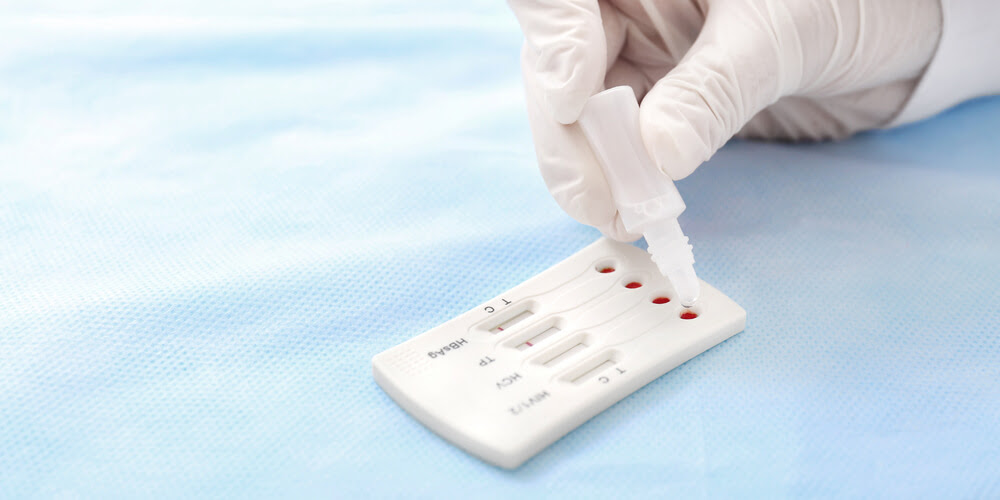



- At-home rapid STI kits use lateral-flow strips, the same chemistry as a home pregnancy test, and return a result in roughly 15 minutes without a lab visit.
- Window periods matter. An HIV antibody rapid test taken too soon after exposure can miss a real infection even if the kit reports 99% sensitivity once the window has fully closed.
Published: August 2025 | Last updated: May 2026 | Editorial review and quality control: Martina N.
Are over-the-counter STD test kits accurate enough to rely on?
Yes, with caveats. Rapid lateral-flow kits for HIV, syphilis, hepatitis B/C, herpes, chlamydia, and gonorrhea typically report 95-99% sensitivity and above 99% specificity per manufacturer data sheets when used after the correct window period. A reactive result needs clinic confirmation. A negative inside the window must be repeated.
At-home STD test kits used to be a niche category. Today they sit on the same shelf as pregnancy tests and COVID tests at the pharmacy, and most of them work the same way: a paper strip, a few drops of blood or a quick swab, a 15-minute timer, and two lines or one. The chemistry is mature, the privacy is real, and for the right person at the right point in the post-exposure window, they answer the question that brought you here.
This article is a practical buyer's guide. We sell at-home rapid STI test kits at stdrapidtestkits.com, and you will see them in this article when they fit the section. This guide also covers what these kits cannot do, which sample types we do not sell, and when a clinic visit makes more sense than a home test.
Key takeaways
- At-home rapid STI kits use lateral-flow strips, the same chemistry as a home pregnancy test, and return a result in roughly 15 minutes without a lab visit.
- Window periods matter. An HIV antibody rapid test taken too soon after exposure can miss a real infection even if the kit reports 99% sensitivity once the window has fully closed.
What "over-the-counter" actually means for STI testing
The phrase "over-the-counter STD test kit" covers two genuinely different products, and a lot of online articles blur them together. It is worth being precise.
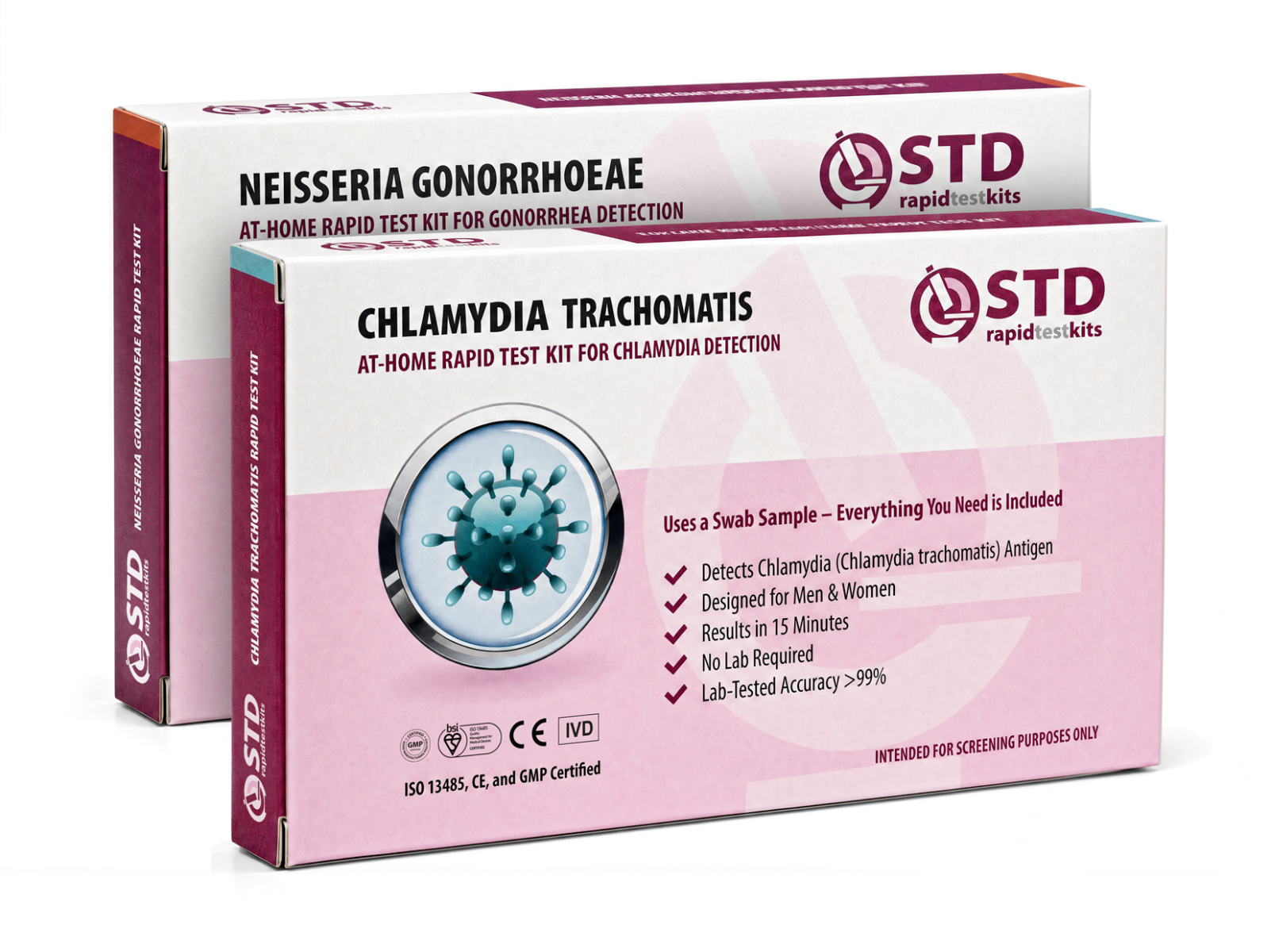
Type A: rapid lateral-flow tests you complete at home. You collect the sample (a fingerstick drop of blood, or a self-collected vaginal or penile swab, depending on the infection), apply it to a cassette, and read the result yourself in about 15 minutes. No lab is involved. The chemistry is the same family used in home pregnancy tests and rapid COVID tests. This is what we sell.
Type B: mail-in collection kits. You collect a urine, blood, or swab sample at home, drop it in a prepaid envelope, and a laboratory runs a NAAT or antibody assay and emails you a result several days later. These are accurate and useful, but they are not what "over-the-counter" usually means in everyday language. We do not sell mail-in lab kits at this site.
The distinction matters because the two product types have different strengths. Lateral-flow rapid tests trade a small amount of analytical sensitivity for speed, privacy, and the absence of a postal step. Lab NAAT panels trade speed for higher sensitivity in low-titer or asymptomatic infections. Many readers benefit from both at different times: rapid screening at home for routine peace-of-mind, and a lab-run NAAT through a clinic when a result needs to be confirmed or when symptoms persist (CDC sexually transmitted infections information).
Throughout this article, when we say "over-the-counter STD test" we mean Type A, the rapid lateral-flow kits.
Type A (rapid lateral-flow, what we sell): sample to result in about 15 minutes, no lab, no postal step, you read the cassette yourself.
Type B (mail-in lab kit, not sold here): you collect at home, mail to a lab, get results several days later. Both can be accurate; they answer at different speeds and with different chemistries.
Which STIs at-home rapid kits can screen for
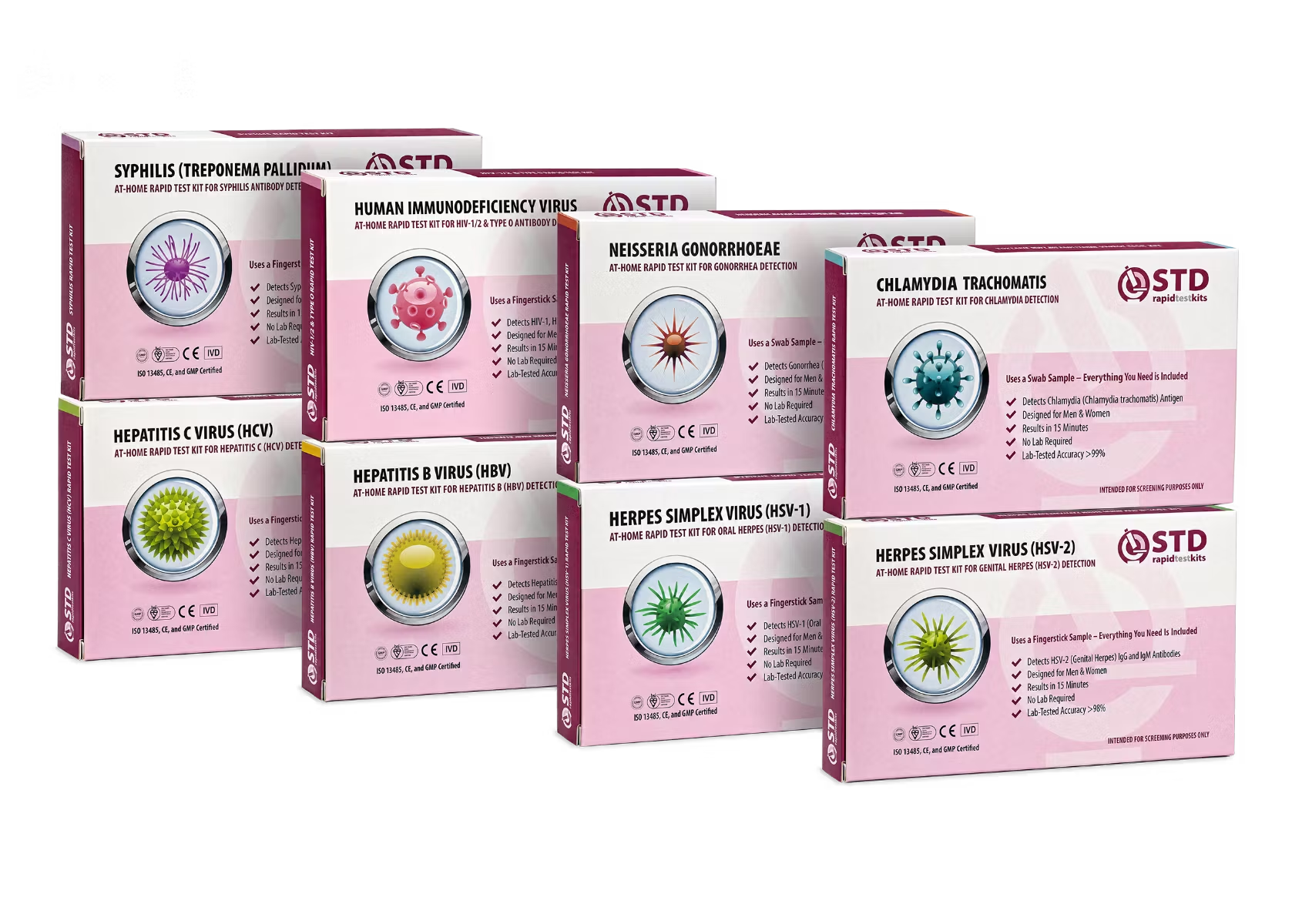
Rapid lateral-flow chemistry now exists for most of the common bacterial and viral STIs the CDC tracks. Here is the realistic catalog, organized by sample type, alongside what each test is actually looking for.
Blood-based rapid tests (fingerstick drop):
- HIV. The home rapid test detects antibodies (and in some cassettes, the p24 antigen) the immune system produces in response to HIV. Per CDC HIV testing guidance, antibody-based rapid tests typically detect infection within 23 to 90 days after exposure.
- Syphilis. The rapid test detects treponemal antibodies (the body's response to Treponema pallidum). Detection generally becomes reliable 3 to 6 weeks after exposure.
- Hepatitis B. Rapid kits typically detect HBsAg, the surface antigen that appears in blood roughly 4 to 12 weeks after exposure; check each kit's data sheet for the specific window.
- Hepatitis C. Rapid kits detect anti-HCV antibodies. Per CDC guidance, in acute HCV infection it usually takes 8 to 11 weeks before antibodies are detectable; some slow seroconverters may take longer, and a clinician can order an HCV RNA test if recent exposure is suspected and the antibody result is negative (CDC hepatitis C diagnosis and testing guidance).
- Herpes simplex virus type 1 (HSV-1) and type 2 (HSV-2). Blood antibody tests indicate the immune system has seroconverted to one or both of these viruses. They do not test individual lesions, which requires a clinic-administered swab and PCR. Antibody seroconversion takes 12 to 16 weeks for most people. Per the CDC's STI treatment guidelines, repeat type-specific antibody testing 12 weeks after presumed acquisition when initial testing is negative but recent exposure is suspected (CDC STI treatment guidelines, herpes section).
Swab-based rapid tests (self-collected genital sample):
- Chlamydia. The rapid antigen test detects Chlamydia trachomatis proteins shed at the site of infection. Suitable for both men and women using the appropriate self-swab.
- Gonorrhea. The rapid antigen test detects Neisseria gonorrhoeae proteins. Like chlamydia, suitable for both men and women.
- Trichomoniasis. Our at-home rapid trichomoniasis kit is validated for vaginal self-swab only and is therefore appropriate for women only. Male readers who think they may have trichomoniasis should see a clinic, where a urine NAAT can detect the infection in men.
- HPV. Same scope: our at-home HPV kit is a vaginal self-swab and is validated for women only. We do not currently offer a male-compatible HPV home test.
Sample type matters. Blood tests catch the body's systemic immune response to an infection (or in some cases the virus itself in blood). Swab tests catch the organism shed at the site of infection.
Our trichomoniasis and HPV rapid kits are validated for vaginal self-swab only and are appropriate for women only. We do not currently sell a male-compatible at-home test for either infection. Male readers who need testing for either should see a clinic; trichomoniasis in men can be confirmed via urine NAAT, and male HPV implications are managed clinically when relevant.
How lateral-flow rapid tests actually work
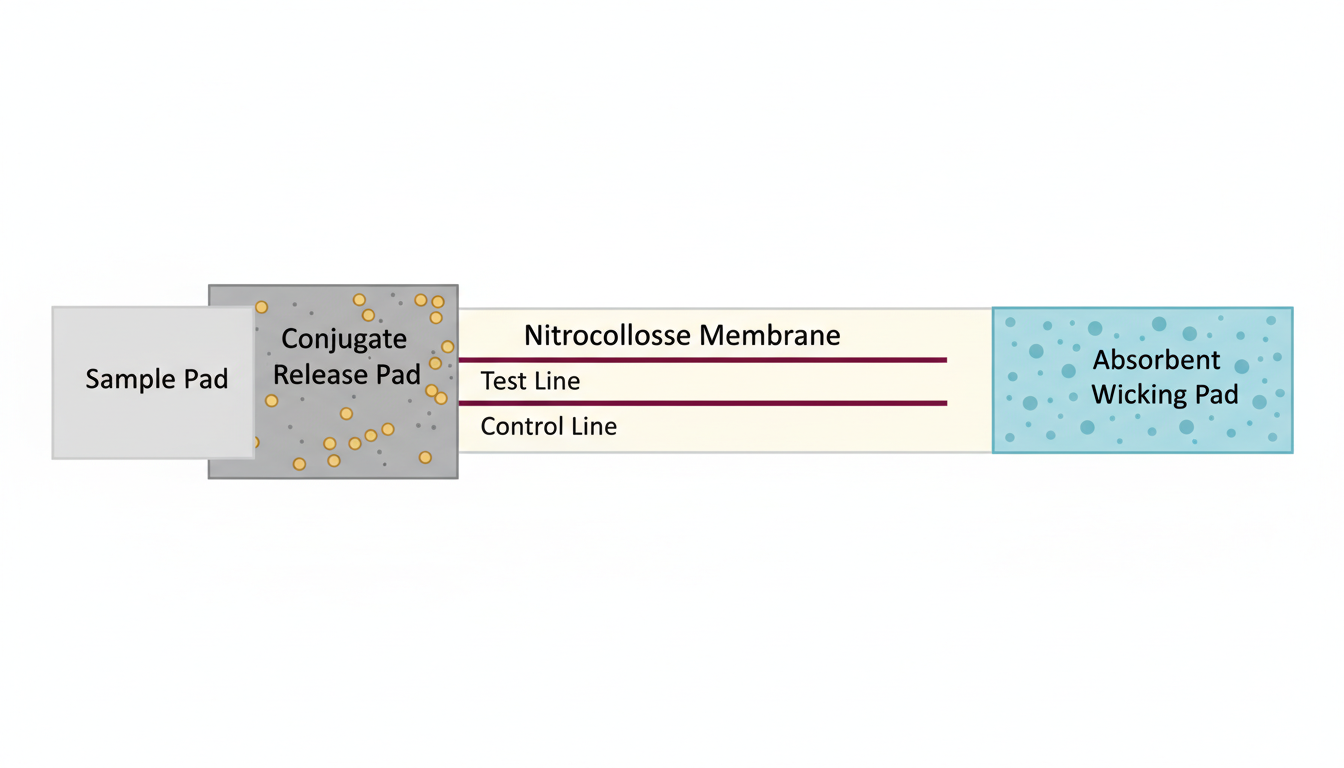
The chemistry inside the plastic cassette is simple, and understanding it makes window periods, faint lines, and invalid results much easier to interpret. A lateral-flow strip has a control line and a test line printed on a paper membrane. When you load your sample (blood plus buffer for fingerstick tests, swab dipped in buffer for swab tests), capillary action pulls the liquid across the strip from left to right.
The control line turns colored when the strip has absorbed enough sample to run properly, regardless of your status. The test line turns colored only when the strip detects the specific target the kit is looking for: HIV antibodies, HCV antibodies, chlamydia antigen, and so on. Two lines means a positive screen. One line at the control band only means a negative screen. No control line at all means the test failed and you need to repeat with a fresh cassette.
The chemistry is fast because it is not amplifying anything. The strip detects protein already present in your sample at a concentration high enough to bind to the antibody printed on the test line. That is why timing matters more for rapid tests than for laboratory nucleic-acid amplification testing (NAAT or PCR): the lab can multiply a tiny amount of pathogen DNA into a measurable signal, and a rapid test cannot. A rapid antibody test for HIV needs your immune system to have built up enough anti-HIV antibody to cross the detection threshold. A rapid swab test for chlamydia needs enough bacterial antigen on the genital surface to load the strip.
The trade-off is the home format pays for speed and privacy with a slightly higher false-negative rate near the start of an infection, where the lab NAAT would still pick up a low-copy infection. For asymptomatic screening past the window period, home rapid kits are reliable enough to act on. For exposure within the past several days, you are too early to test on either platform. That detection threshold, the minimum antigen or antibody concentration needed to bind the test line, is what creates the window-period gap where a real infection can return a negative result on even a well-performing kit.
Blood test versus swab test: which fits which infection
If you remember one rule when choosing a kit, it is this: the right sample type is determined by the biology of the infection, not by reader preference. You cannot substitute a swab for a blood test or vice versa, because the two are looking for different things.
Blood-based tests work for infections that produce a measurable systemic immune response, or that release antigen into the bloodstream. HIV, syphilis, the hepatitises, and HSV all fit this pattern. The body makes antibodies (or in HIV's case, the virus produces detectable p24 antigen), the test reads them off a fingerstick drop, and the result reflects whether the immune system has been exposed.
Swab-based tests work for infections that primarily live and shed at a local mucosal site. Chlamydia, gonorrhea, trichomoniasis, and HPV all live in genital tissues and shed measurable amounts of organism (or organism antigen) into mucus and discharge. A self-collected vaginal or penile swab gathers that material, and the rapid test reads for it.
The table below summarizes which sample type each at-home test uses, the rough window period after exposure, and a practical note on each.
| Infection | At-home sample | Approx. window period | Practical note |
|---|---|---|---|
| HIV | Fingerstick blood | 23 to 90 days (rapid antibody) | Lab antigen/antibody combo tests detect earlier; clinic preferred if exposure was within 72 hours (PEP window) |
| Syphilis | Fingerstick blood | 3 to 6 weeks | Rapid kits detect antibodies, not active disease stage; clinic confirms with VDRL/RPR |
| Hepatitis B | Fingerstick blood | 4 to 12 weeks (HBsAg) | Vaccinated individuals may produce different antibody patterns; check the kit data sheet for the specific window |
| Hepatitis C | Fingerstick blood | 8 to 11 weeks (antibody, per CDC) | A reactive antibody test needs a confirmatory clinic-run RNA test; ask a clinic about HCV RNA testing if exposure was recent |
| HSV-1 / HSV-2 | Fingerstick blood | 12 to 16 weeks (assay-dependent) | Tests systemic seroconversion, NOT individual lesions; lesions need a clinic swab + PCR |
| Chlamydia | Self-collected swab | 1 to 3 weeks (around day 14 for most kits) | Lab NAAT remains the gold standard for asymptomatic screening |
| Gonorrhea | Self-collected swab | 1 to 3 weeks (around day 14 for most kits) | Pharyngeal and rectal infection require clinic swabs; we do not sell those sample types |
| Trichomoniasis | Self-collected vaginal swab | 1 to 4 weeks | Validated for women only; men should test via clinic urine NAAT |
| HPV | Self-collected vaginal swab | Variable, often months | Validated for women only; not a substitute for cervical cytology screening |
Window periods: when after exposure does a rapid test work
The single most common mistake people make with at-home tests is testing too early. Window periods exist because every test has a minimum amount of biological material it needs in order to register positive, and that material takes time to accumulate after an exposure. A test taken inside the window can return a false negative even if the infection is real, even if the kit is 99% sensitive after the window has closed (CDC STI screening recommendations).
Here are the practical timing rules:
- For HIV with a rapid antibody fingerstick test: per CDC, most people will register positive between 23 and 90 days after exposure, with most seroconverting between 4 and 8 weeks. If you test at day 21 and get a negative, retest at day 90 to be definitive. If you tested within 72 hours of a high-risk exposure, do not wait at home: a clinic can offer post-exposure prophylaxis (PEP), which is time-sensitive.
- For syphilis: 3 to 6 weeks for a treponemal antibody test to reliably detect infection.
- For hepatitis B: HBsAg generally appears in blood 4 to 12 weeks after exposure; the exact kit-specific window is on the leaflet that ships with each product.
- For hepatitis C: in acute HCV infection it usually takes 8 to 11 weeks before antibodies are detectable, per CDC clinical guidance. Some slow seroconverters take longer; if a timely diagnosis matters and the exposure was recent, ask a clinic about HCV RNA testing, which detects the virus weeks before antibodies appear.
- For HSV-1 and HSV-2: per the CDC herpes treatment guidelines, repeat type-specific antibody testing 12 weeks after presumed acquisition when an early test is negative. Some assay inserts list seroconversion extending to 16 weeks; in that case, retest at 16 weeks if the 12-week result is also negative. If you have an active lesion right now and want to know what is causing it, a blood antibody test is not the right tool. A clinic swab plus PCR is.
- For chlamydia and gonorrhea: rapid antigen swabs typically work from 1 to 3 weeks after exposure, with most kits reliable from day 14. The lab NAAT can detect earlier and is more analytically sensitive in asymptomatic cases.
If your exposure was recent and you want an answer now, you have two good options. First, test now at home knowing that a negative result inside the window must be repeated after the window closes. Second, see a clinic if the exposure carries acute medical implications (PEP for HIV, pregnancy concerns, active symptoms).
How to actually use a rapid lateral-flow kit
The instructions in the box are the authoritative source for any specific kit. The steps below describe what most rapid lateral-flow STI tests have in common, so you know what to expect.
Step 1: read the leaflet first. Every kit has a recommended read window (typically 10 to 20 minutes). Reading the result earlier or later can change what you see. Mark the read time on a phone timer the moment you apply your sample. A result read after 30 minutes is no longer valid even if the lines look clear, because the chemistry continues to migrate after the read window closes.
Step 2: collect the sample. For blood tests, this is a fingerstick: clean the side of your fingertip with the alcohol pad, twist off the lancet cap, press it firmly against the side of your fingertip, and squeeze gently to form a hanging drop. Warm hands first by washing in warm water and shaking the hand below your heart for thirty seconds; warm fingers bleed more reliably. For swab tests, follow the leaflet's swab insertion depth and rotation count exactly (typically three to five rotations). Do not pre-clean the swab site with antiseptic wipes; residual antiseptic can interfere with the test chemistry.
Step 3: apply the sample to the cassette. Most kits use a small dropper or buffer vial: you mix the sample with a buffer fluid and then apply two or three drops to the cassette's sample well.
Step 4: wait, then read at the recommended time. A clear control line must appear, otherwise the test is invalid (run a fresh cassette). A second line at the test position is positive, even if it is faint. With most lateral-flow STI tests, any second line at the test position, however faint, counts as a positive. The intensity of the line reflects how much target antigen or antibody is in your sample, but presence is what matters. No second line is negative.
Step 5: photograph the cassette. If you ever need to discuss your result with a clinician, a photo at the recommended read time is more useful than a verbal recall.
The fingerstick is the step most readers feel uncertain about, and it is also the step that most often produces an invalid test. The side of the fingertip (not the soft pad) bleeds more easily, hurts less, and gives you the steady drop the cassette needs. Squeeze gently rather than milking aggressively, since over-squeezing dilutes the sample with tissue fluid and can produce an invalid result. The lancet is single-use; do not re-lance for the same test if the first stick produces enough blood. If a cassette returns an invalid result (no control line) twice in a row, contact customer support for a replacement before drawing any conclusion.
What rapid home tests cannot do
Rapid lateral-flow chemistry has real limits, and knowing them helps you use these tests correctly. Here is the short list of what an at-home kit will not do for you.
It will not perform a lab-grade NAAT. Laboratory nucleic-acid amplification tests (NAAT/PCR) are the gold standard for chlamydia and gonorrhea screening because they detect organism DNA rather than antigen, and DNA-based detection picks up infections that antigen-based rapid tests sometimes miss, particularly in asymptomatic people. Our at-home kits use lateral-flow chemistry, which is a complementary technology, not the same one. A reactive at-home result should be confirmed by a clinic NAAT, and a non-reactive result in a high-risk asymptomatic context should be followed up with NAAT screening as well (CDC STI screening recommendations).
It will not test pharyngeal, rectal, or urine samples. Throat-swab and rectal-swab tests for gonorrhea and chlamydia are clinic-administered, and we do not sell them at this site. If your exposure involved oral or anal contact and you want comprehensive coverage, a clinic visit with site-specific NAAT swabs is the right move. Substituting a genital swab for a throat or rectal swab is not equivalent.
It will not stage syphilis or distinguish active from past infection. The treponemal antibody test on a rapid kit will be positive in someone who has had syphilis at any point, treated or not. Distinguishing active disease from a treated past infection requires a clinic test (RPR or VDRL titer).
It will not type herpes lesions. A blood antibody test for HSV measures whether you have seroconverted to HSV-1 or HSV-2 over the past months. It does not tell you what is causing an active lesion right now. If you have an active sore and want to know what it is, see a clinician within 48 hours of the lesion appearing for a swab plus PCR.
It will not document partner notification or contact tracing. A clinic-run test creates a medical record that can support partner notification, contact tracing through your local public-health department, and treatment authorization. An at-home result is private, which is often an advantage, but it is not a clinical record.
It will not confirm a positive on its own. A reactive home result is a screen, not a diagnosis. For HIV, the CDC-recommended confirmatory step is an HIV-1/HIV-2 differentiation immunoassay, with a nucleic acid test added if the differentiation result is indeterminate. For syphilis, confirmation pairs a treponemal antibody test with a non-treponemal RPR or VDRL titer to gauge stage and treatment response. For chlamydia, gonorrhea, and trichomoniasis, confirmation is a lab NAAT. For positive hepatitis C, the workup includes an HCV RNA test and liver-function bloodwork to plan treatment; chronic HCV is now curable in most adults with an 8 to 12 week oral antiviral course. The pattern is the same in every case: confirm before treating.
Six things a home rapid kit will not do
- Replace a lab-grade NAAT for asymptomatic chlamydia or gonorrhea screening.
- Test pharyngeal (throat), rectal, or urine samples; those need a clinic.
- Stage syphilis or distinguish current infection from a treated past infection.
- Identify what is causing an active herpes lesion right now (clinic swab plus PCR does that).
- Document your result for partner notification or contact tracing through public health.
- Confirm a positive on its own; a reactive screen always needs a clinic confirmatory test.
Accuracy in plain English: sensitivity, specificity, and quality manufacturing
Manufacturers report sensitivity (the test's ability to correctly catch a true infection) of about 95 to 99 percent and specificity (the test's ability to correctly identify someone who is not infected) above 99 percent for the most common rapid STI assays, when the test is run after the appropriate window period and according to the instructions. Specific figures vary per kit; the data sheet on each product page lists the validation numbers.
A rapid test is a lateral-flow immunoassay, not a NAAT. The lab NAAT used by clinics for chlamydia, gonorrhea, and trichomoniasis amplifies pathogen DNA and remains the gold-standard analytical method. The home rapid test is a screen with high enough accuracy to act on, not a substitute for the lab method when accuracy at low pathogen load is critical. False positives are uncommon but they happen, and treating an STI without a confirmed diagnosis is not appropriate. The kit also cannot diagnose what it is not testing for: a negative HIV-and-syphilis panel does not say anything about chlamydia or hepatitis B.
The kits we sell are manufactured under ISO 13485, the international quality management standard for medical devices used by the WHO, FDA, and the European Commission as a supply-chain quality framework. ISO 13485 governs the manufacturing process; it is not a clinical-validation claim. The clinical validation that matters for accuracy is each assay's sensitivity and specificity, listed per kit on each product page. For broader context on which tests fit which exposure types, the NHS overview of sexually transmitted infections and the Mayo Clinic health-information library are useful supplementary references.
A reactive (positive) result on a rapid HIV self-test is a preliminary positive and must be confirmed by additional testing in a healthcare setting before HIV treatment begins.
- Sensitivity (about 95 to 99 percent): the test's ability to correctly catch a true infection. Higher sensitivity means fewer false negatives.
- Specificity (above 99 percent): the test's ability to correctly identify someone who is not infected. Higher specificity means fewer false positives.
- Both numbers depend on timing: a test run before the window closes performs worse on sensitivity, regardless of the kit's data-sheet figures.
How much do at-home STD test kits cost
One of the strongest arguments for over-the-counter STD testing is the price. Without insurance, a clinic STI panel can run from $80 to several hundred dollars depending on which infections are tested for and which lab the clinic uses. With insurance, copays vary, and panel coverage is inconsistent, particularly for asymptomatic people seeking routine screening.
At-home rapid kits compare as follows:
- Single-infection kits typically run between $20 and $40.
- Two-test combination kits (for example, chlamydia plus gonorrhea, or hepatitis B plus hepatitis C) usually run $40 to $70.
- Multi-infection panels covering 6 to 10 infections in one kit run from roughly $90 to $200, with the higher-coverage panels at the upper end.
Most at-home kits are not directly billed through health insurance, since they are sold as consumer products rather than physician-ordered diagnostics. However, they are often eligible for FSA or HSA reimbursement when sexual-health screening qualifies as a medical expense. Check your individual plan rules and keep the receipt.
The financial case is straightforward for routine screening. If you are sexually active and want an annual baseline check, a $90 multi-infection home kit beats a $200 to $400 unbilled clinic panel. The clinic remains the right place to go for confirmatory testing of any positive result, for symptoms, and for the sample types we do not sell (pharyngeal, rectal, urine).
| Test type | At-home rapid kit | Clinic STI panel (no insurance) |
|---|---|---|
| Single infection | $20 to $40 | $80 and up per infection |
| Two-test combo (e.g., chlamydia + gonorrhea) | $40 to $70 | Often bundled in a broader panel |
| Multi-infection panel (6 to 10 infections) | $90 to $200 | $200 to $400 or higher |
When you should skip the home test and go to a clinic
At-home testing is the right tool for routine screening, post-window check-ins, and private peace-of-mind. It is not the right tool for everything. Go to a clinic if any of the following apply:
- Your exposure was within the last 72 hours and you may have been exposed to HIV. Post-exposure prophylaxis (PEP) is a 28-day course of antiretroviral medication that significantly reduces the risk of HIV infection if started promptly. It must be started within 72 hours, ideally sooner. A home test cannot give you PEP.
- You have active acute symptoms. Pelvic pain, testicular pain or swelling, fever with discharge, painful urination, an active genital sore or rash. These warrant clinical evaluation, not a 15-minute home test.
- You think you have a throat or rectal infection. The right tool here is a clinic-administered pharyngeal or rectal swab, which we do not sell. The CDC's screening guidelines recommend site-specific NAAT for these exposures, particularly in men who have sex with men (CDC STI treatment guidelines; see also NHS guidance on getting tested).
- You have an active genital, oral, or anal lesion. A swab from the lesion plus PCR is dramatically more sensitive than a blood antibody test for catching herpes during an outbreak, and the same is true for syphilis chancres and HPV-related warts.
- You are pregnant or planning pregnancy. Antenatal STI screening uses laboratory panels and is part of routine prenatal care.
- A previous test was positive and you are checking treatment success. Test-of-cure protocols are clinic territory; for bacterial STIs (chlamydia, gonorrhea, syphilis, trichomoniasis), the standard is to re-test about three months after treatment to catch reinfection, and the workup is best run through your treating provider.
- You need partner-notification documentation. Public-health partner-notification services run through clinics, not through home tests.
Post-exposure prophylaxis (PEP) must start within 72 hours of a high-risk HIV exposure, and ideally within 24 hours. Do not wait to run a home test first; a home rapid antibody test cannot detect a new infection that early anyway. Go to a clinic, urgent-care center, or emergency room immediately and ask about PEP.
How regular at-home testing fits into a sexual-health routine
STI screening is most useful when it is built into a steady routine rather than triggered only by a scare. Public-health guidance generally recommends the following cadence (CDC screening recommendations; WHO STI fact sheet):
- Annual baseline for any sexually active adult, particularly with new or multiple partners. A multi-infection at-home panel is a reasonable way to do this. The CDC specifically recommends annual chlamydia and gonorrhea screening for all sexually active women under 25.
- After every new partner, before stopping condom use, both partners screen.
- After any unprotected exposure, paying attention to window periods. Test inside the window for early reassurance, then again after the window has closed.
- If symptoms appear, test promptly: home or clinic. Symptoms generally warrant a clinic visit, but a home test can give you a fast preliminary signal.
- Pregnancy and pre-pregnancy, through a clinic.
- For men who have sex with men, the CDC recommends at least annual screening for HIV, syphilis, chlamydia, and gonorrhea at the sites of contact (urethral, pharyngeal, rectal), and every three to six months for those with multiple or anonymous partners. The pharyngeal and rectal sites need clinic swabs, which we do not sell.
- For people taking PrEP, regular HIV and STI testing every three months is part of the protocol and is typically managed through the prescribing clinic.
- After treatment for a bacterial STI, re-test about three months later to catch reinfection from an untreated partner. This is the CDC's standard test-of-cure cadence for chlamydia, gonorrhea, and trichomoniasis.
When to test: a recommended cadence
- Annual baseline for any sexually active adult, especially with new or multiple partners.
- After every new partner, before stopping condom use; both partners screen.
- After any unprotected exposure, with attention to the relevant window period.
- Whenever symptoms appear (a clinic visit is usually the better first step here).
- Three months after treatment for any bacterial STI, to catch reinfection.
- For men who have sex with men: at least annually at urethral, pharyngeal, and rectal sites (the latter two via clinic).
Privacy and what discreet shipping actually looks like
Privacy is a real reason people choose home tests, and discreet shipping is a real, reasonable concern. Here is what to look for from any reputable retailer:
- Plain outer packaging. No medical branding or kit names visible on the shipping box.
- No contents description on the customs label or shipping manifest that identifies the package as a sexual-health test. US couriers (USPS, UPS, FedEx) handle our shipments as standard parcel mail.
- Sender name on the label is a generic shipping entity, not a clinical or pharmacy-branded name.
- Itemized receipts are sent by email rather than included in the shipping box.
Inside the box, the kit components are sealed in foil pouches, with an instruction card, a fingerstick lancet (for blood tests) or a sealed self-swab (for swab tests), a buffer vial, and the cassette. The cassette is shelf-stable for the duration of the kit's expiration date, which is printed on the foil pouch, so you can run the test on your own schedule once you receive it.
On the data side, your purchase information is held under standard e-commerce data protection. We do not transmit your test result anywhere; the cassette is yours to read and dispose of. There is no upload, no portal log, no insurer or employer notification. Compare this to a clinic, where any positive result for a reportable STI (HIV, syphilis, chlamydia, gonorrhea, hepatitis B and C in most US states) is sent to the local health department for surveillance and partner notification. The clinic pathway is the right one when you want public-health partner outreach to happen automatically; the home pathway is the right one when you want privacy and to handle disclosure yourself.
Before you order from any at-home testing retailer, look for these four signals:
- Plain outer box with no medical or kit branding visible.
- Customs label or shipping manifest does not name the package as a sexual-health test.
- Sender name on the label is a generic shipping entity rather than a clinical or pharmacy-branded name.
- Itemized receipt is emailed separately, not enclosed in the box.
Bottom line: where home tests fit, and where they don't
Rapid at-home STI test kits do exactly what they are designed to do: screen for common sexually transmitted infections in roughly 15 minutes, in private, at a price most adults can absorb without insurance. They are accurate when used correctly, after the relevant window period has closed, on the sample types they are validated for. They are not a replacement for a clinic when you have active symptoms, a recent high-risk HIV exposure, a need for pharyngeal or rectal screening, or a positive result that needs confirmation.
Used as part of a routine, alongside annual or post-exposure clinic visits when those are indicated, an at-home rapid kit is one of the most accessible and dignified sexual-health tools currently on the consumer market. Pick the one that matches your situation, read the leaflet, respect the window, and test on time.
Should I use a home kit or go to a clinic?
Do you have active acute symptoms now (genital sore or rash, fever with discharge, pelvic or testicular pain, painful urination)?
Yes: Go to a clinic for a physical exam and site-specific tests. A 15-minute home test is not the right tool for active acute symptoms.
Was there a high-risk HIV exposure in the last 72 hours?
Yes: Go directly to a clinic, urgent-care center, or ER and ask about post-exposure prophylaxis (PEP). PEP is time-sensitive; do not wait at home to test.
Did the exposure involve oral or anal contact, and you want comprehensive coverage of those sites?
Yes: Book a clinic visit for site-specific pharyngeal or rectal NAAT swabs. Those sample types are not sold for at-home use; a home genital-swab or blood test does not substitute.
Are you past the relevant window period for your concern (e.g., day 14 for chlamydia/gonorrhea, 12 weeks for HSV antibody, 90 days for an HIV antibody rapid test)?
Yes: An at-home rapid kit is fit for purpose. Pick the kit that matches your concern, run it per the leaflet, and confirm any reactive result with a clinic NAAT or laboratory antibody test before any treatment decision.
No: Test now for early reassurance if you want, but plan to retest after the relevant window closes. A negative inside the window is not definitive.
A short decision flow to match your situation to the right testing pathway.
Frequently asked questions
- How accurate are over-the-counter STD test kits?
- Accuracy depends heavily on timing. After the window closes, most kits reach 95 to 99% sensitivity (catching true positives) and above 99% specificity (correctly clearing true negatives) per manufacturer data sheets. Inside the window, the same kit can return false negatives regardless of how good the chemistry is. Confirm any reactive result with a clinic NAAT or lab antibody test before acting on it.
- Can I test for an STD the day after unprotected sex?
- Generally no, with one exception. The window period for the fastest infection in our catalog (chlamydia or gonorrhea on a swab) is about 14 days. HIV antibody rapid tests need 23 to 90 days. An HIV antibody test taken the day after exposure will not detect a new infection because antibodies have not yet developed. The exception is that within 72 hours of a high-risk HIV exposure, a clinic can prescribe post-exposure prophylaxis (PEP), which significantly reduces infection risk. PEP is time-sensitive; do not wait at home if this applies.
- Are at-home rapid tests as good as a lab NAAT or PCR test?
- Not quite. Lab nucleic-acid amplification tests (NAAT/PCR) are more analytically sensitive than rapid lateral-flow tests, especially in asymptomatic infections with low organism load. The technologies are complementary. Use a rapid home test for screening and routine post-window check-ins; use a clinic NAAT to confirm any positive result and as the gold standard for asymptomatic chlamydia and gonorrhea screening.
- Do at-home STD tests cover oral and anal exposure?
- No. Pharyngeal (throat) and rectal swab tests are clinic-administered, and we do not sell either sample type. If you had oral or anal exposure and want comprehensive screening, see a clinic for site-specific NAAT swabs. Our genital-swab and blood tests are not equivalent substitutes for pharyngeal or rectal sampling, even though some of the same infections are involved.
- Are at-home trichomoniasis and HPV tests available for men?
- Our at-home rapid trichomoniasis and HPV kits are validated for vaginal self-swab only, so they are appropriate for women only. We do not currently sell a male-compatible at-home test for either infection. Men who think they may have trichomoniasis can be tested through a clinic urine NAAT. There is no widely-validated home HPV test for men; cancer-screening implications of male HPV are typically managed clinically when relevant.
- How long should I wait after exposure before using a home test?
- It depends on the infection. Practical minimums: about 14 days for chlamydia and gonorrhea swabs (with the upper bound at 3 weeks), 3 to 6 weeks for syphilis, 4 to 12 weeks for hepatitis B HBsAg, 8 to 11 weeks for hepatitis C antibody per CDC (some slow seroconverters take longer; ask a clinic about HCV RNA testing for recent exposures), 12 to 16 weeks for HSV antibody, and 23 to 90 days for HIV antibody per CDC. If you test inside the window, repeat after the window has closed for a definitive result.
- What does a faint second line on the test mean, and what if there is no control line at all?
- On most lateral-flow STI tests, any visible second line at the test position, however faint, counts as a positive result. Faintness reflects how much target antigen or antibody is in your sample, not whether the result is real. Treat a faint line as positive and book a confirmatory clinic test. If only the control line appears, the result is negative. If no control line appears, the test is invalid and the result, positive or negative, does not count; run a fresh cassette from the same kit, and if a second one also fails contact customer support for a replacement before drawing any conclusion.
- Are at-home STD tests covered by insurance?
- Most at-home rapid kits are sold as consumer products and are not directly billed to insurance. However, they are often eligible for FSA or HSA reimbursement when sexual-health screening qualifies as a medical expense under your specific plan. Check your plan's reimbursable categories and keep the receipt. Clinic-run STI panels, by contrast, are usually billable through insurance, with the usual copay and coverage variation.
- U.S. Centers for Disease Control and Prevention. Sexually Transmitted Infections Treatment Guidelines, screening intervals and recommendations by population, including the three-month re-test cadence after treatment for bacterial STIs.
- U.S. Centers for Disease Control and Prevention. HIV testing information, including window periods for antibody and antigen/antibody tests and guidance on self-testing as a preliminary screen requiring confirmatory testing.
- U.S. Centers for Disease Control and Prevention. STI Treatment Guidelines, herpes section, including the recommendation to repeat type-specific HSV antibody testing 12 weeks after presumed acquisition when initial testing is negative.
- U.S. Centers for Disease Control and Prevention. Hepatitis C clinical diagnosis and testing guidance, including the 8-to-11-week window in acute infection before HCV antibodies are detectable and the role of HCV RNA testing when recent exposure is suspected.
- World Health Organization. Sexually transmitted infections fact sheet, including global epidemiology and screening guidance.
- National Health Service (UK). Sexually transmitted infections information, including testing options and timing guidance for the general public.
- Mayo Clinic. Health-information library overview of sexually transmitted infections, including condition descriptions, symptoms, and diagnostic approaches used as supplementary patient-facing reference.