
Published: September 2025 | Last updated: May 2026 | Editorial review and quality control: Martina N.
Chlamydia is often framed as a young person's infection. Public-health data has moved in the opposite direction for years. According to CDC STI surveillance, reported chlamydia cases in adults aged 55 and older have climbed substantially over the past decade, driven by longer sexually active years, dating after divorce or widowhood, fewer routine STI conversations at primary-care visits, and the persistent assumption that condoms exist only to prevent pregnancy.
This guide walks through why chlamydia infections get missed in adults over 50, what the symptoms can look like (and what they get confused with), how at-home rapid testing fits into a sensible screening routine, and what the math on barrier protection really looks like once pregnancy is off the table.
Key Takeaways
- Reported chlamydia cases in adults aged 55+ have risen sharply over the past decade per CDC surveillance, while routine screening at this age remains uncommon.
- Most chlamydia infections produce no symptoms, and the ones that do appear are often mistaken for UTIs, menopause changes, or prostate issues.
Why chlamydia is rising in adults over 50
Several patterns combine after 50. People live longer, stay healthier, and remain sexually active well into later decades. Online dating, divorce, and partner loss bring more people into new sexual relationships at ages that previous generations rarely encountered. Erectile-dysfunction medications have made continued sexual activity practical for many men into their 70s and 80s.
None of those shifts are problems on their own. The problem is that safer-sex behaviors and routine STI screening have not kept pace. Condom use among adults over 50 is low, partly because the only context many people learned about condoms in was pregnancy prevention. Primary-care providers rarely ask about sexual activity at annual visits with older patients, and rarely offer STI screening unless the patient brings it up first. The combination of more new partners, less protection, and less screening produces exactly the rise the CDC's annual surveillance reports are documenting.
None of this is a moral failing of any generation. It is a public-health gap. People who came of age before HIV-era safer-sex education, before at-home testing existed, and before the internet normalized sexual-health conversations are now living and dating in a context that requires updated habits.
Condom use among adults over 50 is low, and primary-care providers rarely offer STI screening at annual visits with older patients unless the patient asks. The result is more new partners and less protective scaffolding around them.
Risk factors that hit harder after 50
A handful of factors specific to the over-50 demographic combine to raise chlamydia risk per sexual contact and per year of sexual activity. None of them are catastrophic individually. Taken together, they explain why this age group is moving in the wrong direction on STI numbers.
| Factor | Why it raises chlamydia risk after 50 |
|---|---|
| Low condom use | Without pregnancy on the table, many couples skip barrier protection. Chlamydia spreads readily through unprotected vaginal, anal, or oral contact regardless of fertility status. |
| New partners after divorce or widowhood | Re-entering dating after years or decades often means encountering modern STI prevalence patterns without modern testing habits in place. |
| Genitourinary syndrome of menopause | Thinner vaginal tissue and reduced lubrication can produce micro-tears during intercourse, modestly raising transmission risk per sexual contact. |
| Missed routine screening | USPSTF chlamydia screening recommendations focus on women under 25 and during pregnancy. Older adults are rarely screened unless they request it themselves. |
| More years of sexual activity | Continued use of ED medications and improved overall health extends sexually active years without a parallel rise in safer-sex conversations. |
Why chlamydia gets missed after 50
Most chlamydia infections, at any age, produce no symptoms. Among older adults the proportion of overlooked infections gets even higher, because the symptoms that do appear are usually dismissed as something else. A burning sensation during urination at 65 reads as a urinary tract infection. Vaginal discharge after menopause reads as hormonal change or natural dryness. Lower-pelvic ache reads as arthritis, irritable bowel, or perimenopause. A pulling sensation in the testicles reads as a hernia, prostate flare-up, or pulled muscle.
Clinicians reach for the most common explanation first, which is a sound clinical habit but cuts against STI detection in a demographic where STIs are not on the differential by default. Published research in the journal Sexually Transmitted Diseases has documented that providers order fewer STI tests for older patients than for younger ones presenting with similar symptoms. Patients themselves often do not raise the topic, from a mix of embarrassment, the belief that it does not apply to them, or simply not having been asked.
The result is a familiar pattern: recurrent UTI diagnoses that respond poorly to antibiotics, repeat urgent-care visits, missed chlamydia, and the infection continuing to spread silently between partners.
Research published in the journal Sexually Transmitted Diseases has documented that providers order fewer STI tests for older patients than for younger patients presenting with similar urinary or pelvic symptoms. The under-screening is structural, not just patient-driven.
Chlamydia symptoms versus age-related causes
For both men and women over 50, chlamydia symptoms (when they appear at all) overlap heavily with conditions that get attributed to aging. The table below is not a self-diagnosis tool. It is a prompt to recognize that the same sensation can have very different causes, and that testing is the only reliable way to separate them.
| Symptom | Could be chlamydia? | Often attributed instead to |
|---|---|---|
| Burning during urination | Yes | UTI or bladder irritation |
| Vaginal or penile discharge | Sometimes | Hormonal changes, vaginal dryness, or normal lubrication |
| Pelvic or lower-abdominal pain | Yes | Arthritis, digestive issues, or menopause |
| Testicular ache or pulling sensation | Yes | Hernia, pulled muscle, or prostate inflammation |
| No symptoms at all | Very common | Assumed healthy status without testing |
Condoms still matter after menopause
The reasoning that runs "we can't get pregnant, so we don't need condoms" treats condoms as a contraceptive only. They are also a barrier against chlamydia, gonorrhea, syphilis, HIV, trichomoniasis, and several other infections that have nothing to do with reproductive timing. The NHS chlamydia page reiterates that consistent condom use during vaginal, anal, and oral sex reduces transmission risk for all of these.
Postmenopausal vaginal tissue is typically thinner and less lubricated than premenopausal tissue, a cluster of changes sometimes called genitourinary syndrome of menopause. Intercourse can produce small mucosal tears, which modestly raise the chance of acquiring an STI per sexual contact. Topical estrogen, lubricants, and longer foreplay can reduce that mechanical risk; condoms reduce the infection-transmission piece directly.
This does not make sex after menopause unusually risky in any catastrophic sense. The math on barrier protection looks the same after menopause as before. Condoms reduce, but do not eliminate, transmission of common bacterial and viral STIs. With a new partner whose status is unknown, they are doing useful work even when contraception is irrelevant.
Thinner postmenopausal vaginal tissue can produce small mucosal tears during intercourse, modestly raising STI transmission risk per contact. That mechanical factor is one of several reasons condoms remain relevant after pregnancy is no longer a factor.
What happens if chlamydia goes untreated
Chlamydia is highly treatable. The CDC's current treatment guideline recommends doxycycline 100 mg twice daily for seven days as the preferred regimen for uncomplicated genital chlamydia in non-pregnant adults; azithromycin remains an option in certain circumstances. A single course of the right antibiotic typically clears the infection.
Untreated, chlamydia can cause significant complications. In women it can ascend the reproductive tract and cause pelvic inflammatory disease, which carries a risk of chronic pelvic pain and, in women still of reproductive age, tubal damage that can affect fertility. After menopause the infertility piece is no longer the concern, but pelvic inflammatory disease itself remains painful and worth preventing. In men, untreated chlamydia can cause epididymitis, an inflammation of the duct near the testicles that produces swelling, ache, and sometimes fever, which is occasionally misdiagnosed as a hernia or prostate problem.
Both sexes face a modestly elevated risk of acquiring HIV during a sexual exposure when active chlamydia inflammation is present, because inflamed tissue disrupts the mucosal barrier and offers easier entry for the virus. The absolute per-contact elevation is small in any single encounter, but it applies to every unprotected exposure with an HIV-positive partner for as long as the chlamydia infection remains untreated. That is one more reason that treating chlamydia promptly matters beyond the bacterial infection itself, and another argument for testing sooner rather than waiting to see whether symptoms appear.
Reactive arthritis, a syndrome of joint inflammation triggered by chlamydia in a small subset of cases, can also follow an untreated infection. All of these complications are preventable with a single course of antibiotics started after a positive test.

When and how to test for chlamydia after 50
A handful of moments warrant testing regardless of age. After any new sexual partner. After unprotected sex with someone whose STI status is unknown to you. After a long-term partner discloses a positive result. Any time you have unexplained urinary or pelvic symptoms that do not resolve with a first round of standard treatment. And once as a baseline if it has been many years since you last tested, even within a long monogamous relationship.
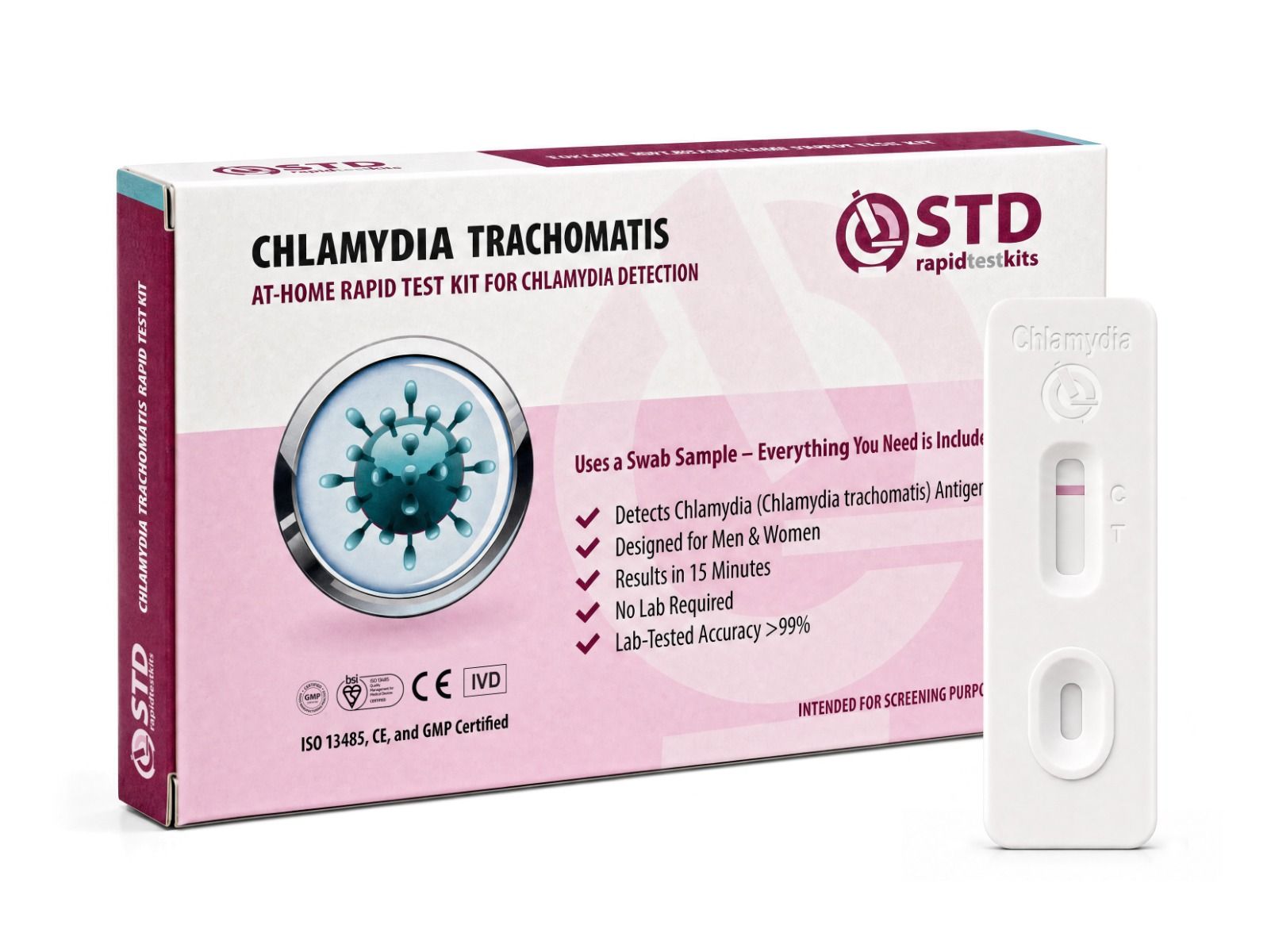
Two test types are commonly available. Laboratory testing uses nucleic acid amplification (NAAT) on a swab or urine sample, and is the analytical gold standard for chlamydia. At-home rapid kits use lateral-flow immunoassays on a self-collected vaginal or penile swab, producing a result in roughly 15 minutes at home. The two technologies are complementary, not equivalent. The laboratory NAAT has higher analytical sensitivity, especially for low-bacterial-load asymptomatic infections. The at-home rapid swab offers privacy, no waiting room, and a quick screen that is useful when a clinic visit is impractical.
A positive at-home rapid result is a strong indicator that warrants confirmation through a primary-care provider or sexual-health clinic, both to confirm analytically and to start the antibiotic course. A negative rapid result outside of an active exposure window is generally reassuring for screening purposes. The chlamydia rapid swab below covers single-infection testing. For a broader baseline that includes the other infections commonly screened together, the 8-in-1 combo further down in this article handles that.
Care, not confession
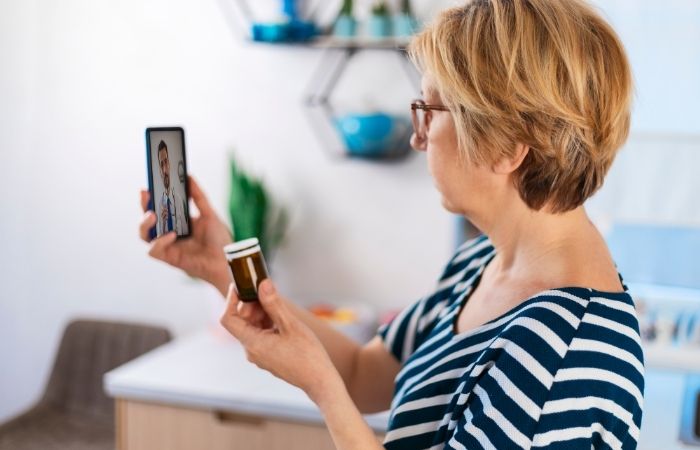
Testing is not a moral statement. It is a health-maintenance activity in the same category as a blood-pressure check or a cholesterol panel. Primary-care providers usually offer those without requiring a backstory. STI screening rarely gets the same routine treatment for older patients, which leaves many adults over 50 to take the initiative themselves.
For people who grew up before widespread sex education, before public conversation about HIV, and before at-home testing existed, the social weight of "ordering a test" can feel disproportionate to what the test actually is. The test is a diagnostic tool. The result, positive or negative, lets you decide what to do next. The act of testing does not say anything about your character, your relationship history, or your partner's honesty.
That framing matters because the alternative is what the data already shows: a generation of adults who are sexually active, under-screened, and ending up with diagnoses that could have been caught and treated months earlier.
Chlamydia often has no symptoms, but it can cause serious health problems, even without symptoms.
Myths versus facts about STIs and aging
The following beliefs come up consistently in surveys of older adults about sexual health. None of them hold up against the public-health data, but each of them affects whether someone gets tested in time.
| Common belief | Reality |
|---|---|
| Older people do not get STDs. | Reported STI cases in adults aged 55+ have climbed substantially over the past decade per CDC surveillance. |
| No symptoms means no infection. | Most chlamydia infections cause no symptoms in any age group, which is why screening is the only reliable indicator. |
| A long-term relationship is automatically safe. | Infections can persist for years undetected, or arise from past exposures decades earlier. |
| Condoms are only for pregnancy prevention. | Condoms reduce transmission of chlamydia, gonorrhea, syphilis, HIV, and trichomoniasis regardless of pregnancy risk. |
| Testing is for high-risk people only. | USPSTF and CDC support sexual-health screening for any sexually active adult who asks for it. |
When a broader STI panel makes sense
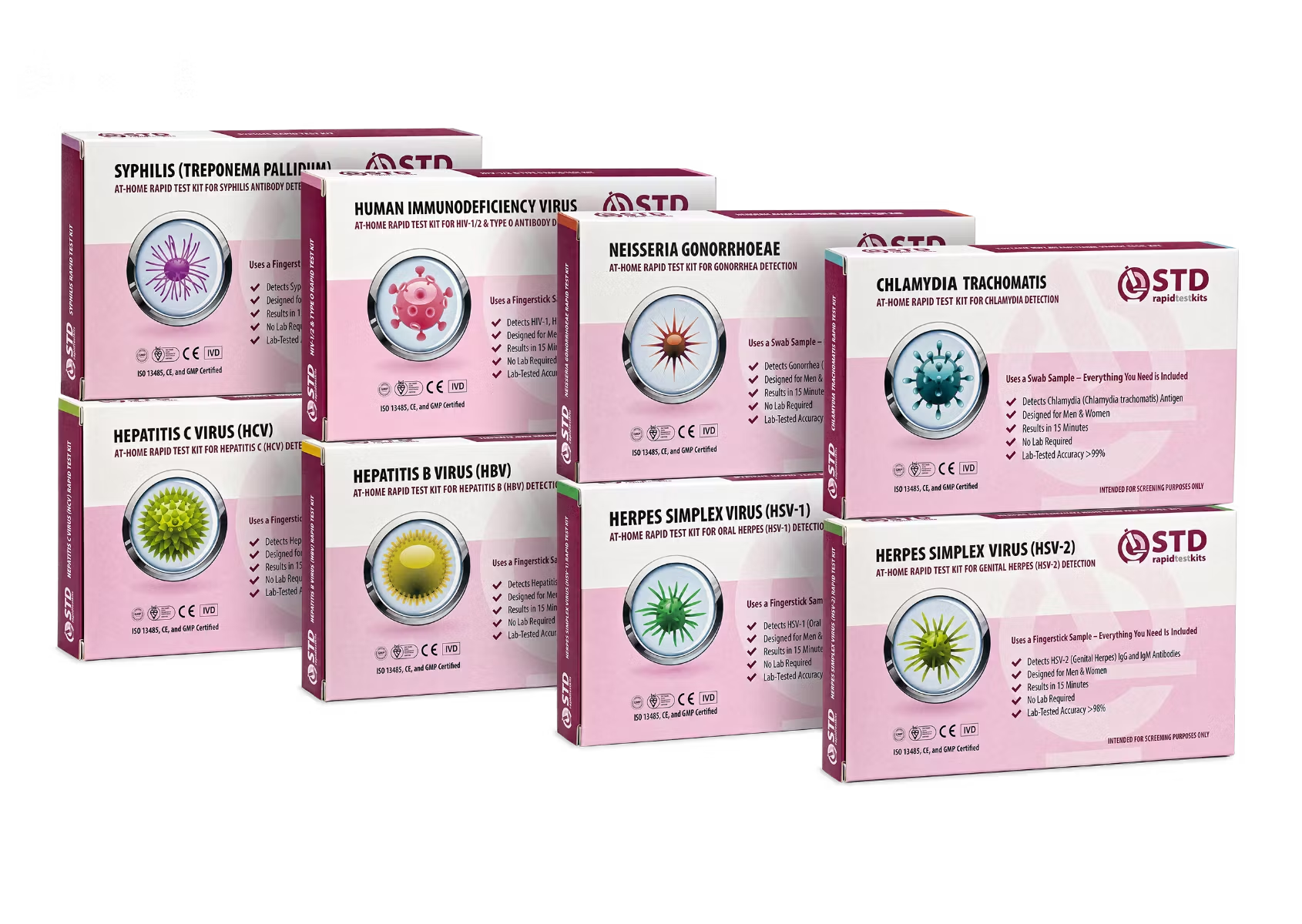
Chlamydia screening is useful when chlamydia is the specific concern. Many older adults re-entering dating want a broader look: a panel that covers chlamydia, gonorrhea, syphilis, HIV, hepatitis B, hepatitis C, herpes, and trichomoniasis in one round of testing. That broader screen is a reasonable choice when you have recently changed partners, when you and a new partner are agreeing on mutual screening before deciding on barrier-protection plans, or when you have been with the same long-term partner for many years and want a baseline after a long stretch without any testing.
The 8-in-1 combo below packages the routine adult STI screen into one kit, with a mix of self-collected swab and fingerstick blood samples. As with any at-home rapid test, treat a positive result as a strong indicator worth confirming through a clinic or laboratory NAAT for chlamydia or gonorrhea, and through repeat antibody testing through a provider for the blood-based components. Negative results outside active exposure windows are generally reassuring.
FAQs
- Can adults over 50 really get chlamydia?
- Yes. Age is not a meaningful protection against chlamydia. CDC surveillance data show sustained rises among adults 55 and older, and the underlying transmission biology is identical at every age. The main difference is that this group gets screened far less often than younger adults, so infections persist longer before they are caught.
- I have no symptoms. Should I still test?
- Yes, especially after a new partner. The majority of chlamydia infections produce no symptoms at all, which is why screening is the only reliable way to know your status. A negative result settles the question. A positive result lets you start treatment before any of the longer-term complications develop.
- Is it awkward to ask a doctor for an STI test at my age?
- It can feel awkward at first, but providers handle these requests routinely. A direct request works well: "I would like to be screened for STIs, please." You do not need to justify the request or explain your sexual history. If a provider responds in a way that makes you uncomfortable, you can switch providers or use an at-home test instead.
- Are at-home rapid tests accurate enough for screening?
- At-home rapid lateral-flow tests are useful screening tools. They are not as analytically sensitive as the laboratory NAAT tests used in clinics, but a positive rapid result is a strong indicator that warrants confirmation, and a negative rapid result outside an active exposure window is generally reassuring. Treat them as a screening step, not a final answer for complex situations.
- We have been together for years. Why test now?
- A long-term relationship does not retroactively erase infections that may have been acquired earlier. Some chlamydia infections persist for years undetected. If neither partner has been tested in a long time, a baseline screen for both of you resolves what assumption alone cannot. Many couples find it easier when both partners test together as a mutual step.
- Do I still need condoms if pregnancy is not possible?
- Condoms reduce transmission of chlamydia, gonorrhea, syphilis, HIV, trichomoniasis, and several other infections regardless of pregnancy risk. With a new partner whose status is unknown, condoms are doing useful work even when contraception is irrelevant. Postmenopausal tissue changes can also slightly raise transmission risk per sexual contact, which is one more reason barrier protection still matters.
- Can chlamydia come back after treatment?
- The infection itself clears with appropriate antibiotic treatment. The CDC recommends retesting roughly three months after treatment to check for reinfection, because reinfection from an untreated partner or a new exposure is the main reason chlamydia appears to "come back." The original infection does not relapse on its own once antibiotics have cleared it.
- Does Medicare cover STI testing?
- Medicare Part B covers chlamydia, gonorrhea, syphilis, and hepatitis B screening for certain patients judged at increased risk by their primary-care provider. Coverage details vary by plan and circumstance, so check with yours for specifics. At-home rapid kits are typically out-of-pocket but do not require a referral, prior authorization, or a clinic appointment.
- U.S. Centers for Disease Control and Prevention. Sexually Transmitted Infections Surveillance: annual national statistics on reportable STIs including chlamydia, gonorrhea, and syphilis.
- U.S. Centers for Disease Control and Prevention. STI Treatment Guidelines: chlamydial infections. First-line regimen, retesting interval, and partner-management recommendations.
- U.S. Centers for Disease Control and Prevention. About Chlamydia: plain-language overview of transmission, symptoms, complications, and testing.
- Mayo Clinic. Chlamydia trachomatis: symptoms and causes overview. Clinical summary of presentation, complications, and risk factors.
- NHS. Chlamydia. Patient-facing UK national-health-service guidance on symptoms, testing options, treatment, and condom use.
- U.S. Preventive Services Task Force. Chlamydia and Gonorrhea: Screening recommendation. Evidence basis for routine-screening recommendations and the gap in coverage for older adults.
