Mpox Symptoms and Transmission: What the Rash Looks Like and How It Spreads
Mpox is back in the news. If you have a new rash, a fever, or a recent close contact, you want to know what to look for and how worried to be. This guide covers the early signs, how the rash changes from spots to scabs, how mpox spreads, how it differs from herpes and syphilis, and what to do next. Medically reviewed by Aikaterini Maragkou, MD.
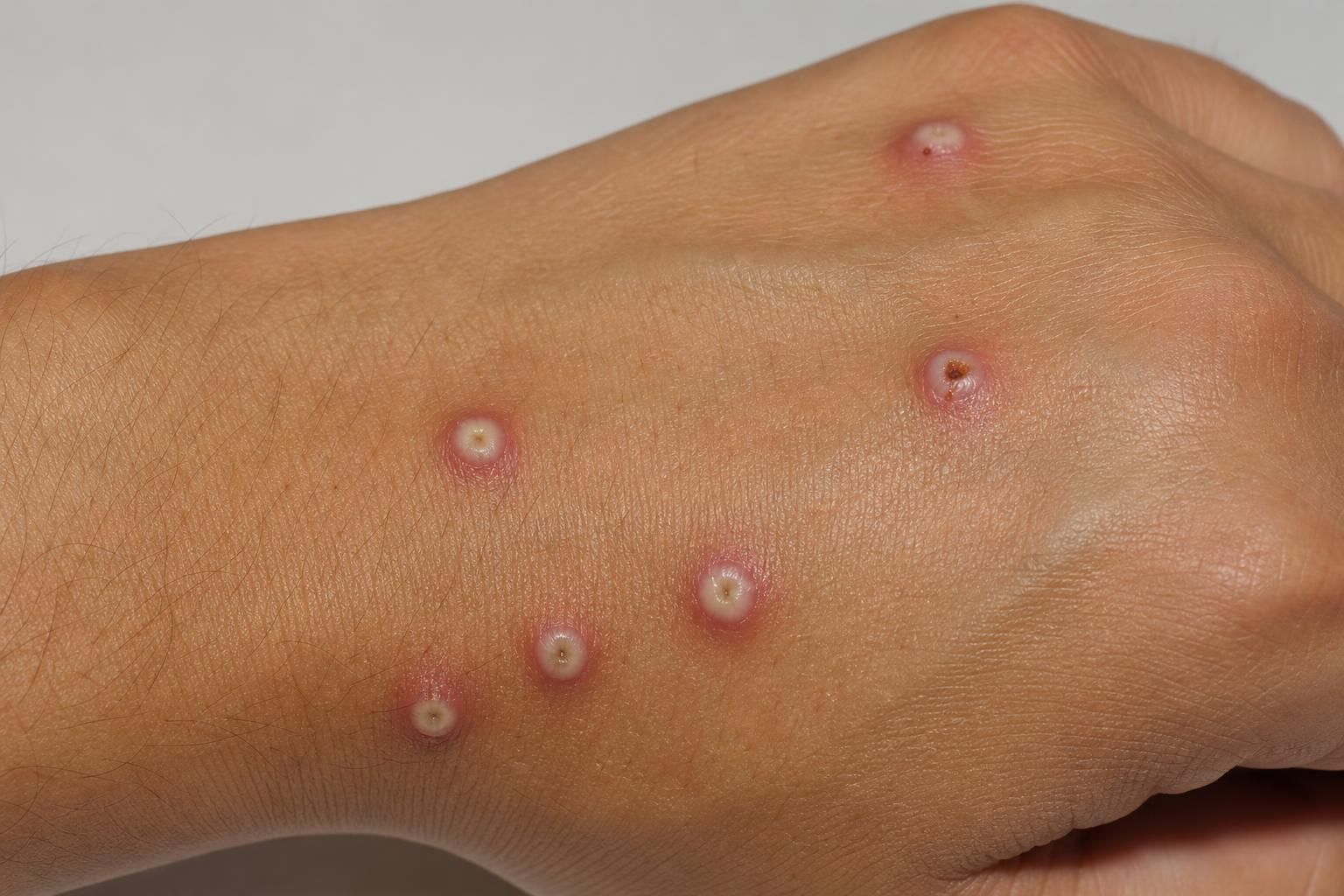



- Mpox symptoms usually appear within 21 days of exposure, and the rash goes through flat, blister, pus-filled and scab stages before the skin heals.
- It spreads mainly through close skin-to-skin and sexual contact, and a person stays contagious until the rash has fully healed and a fresh layer of skin has formed.
Published: October 2026 | Last updated: October 2026
What are the symptoms of mpox, and how does it spread?
Mpox usually starts within 3 weeks of exposure. Fever, chills, swollen lymph nodes, headache and tiredness often come first. A rash follows that moves from flat spots to blisters, pus-filled bumps and scabs over 2 to 4 weeks. It spreads mainly through close skin-to-skin contact, including sex, and through shared bedding or towels.
Medically reviewed by Aikaterini Maragkou, MD.
Mpox, which some public-health agencies still call monkeypox, is a viral infection that causes a distinctive rash and often a short flu-like illness. Most people who get it recover on their own. Some cases are very painful, though, and the infection can pass to partners, housemates and family members while the rash is healing.
Mpox cases still turn up in new places, and each new report sends people searching for symptoms. That is especially true for anyone with a new rash after a recent close contact.
For most readers, the reassuring part comes first. Most new rashes are not mpox. Heat rash, ingrown hairs, folliculitis, eczema, insect bites and herpes are all far more common. Mpox has a recognizable pattern in timing, appearance and how lesions change over days. If your rash doesn't follow that pattern and you haven't had close contact with someone who is sick, mpox is unlikely. If it does fit, the sections below explain what to do. Mpox is diagnosed in a clinic, and we cover why in the testing section.
Key Takeaways
- Mpox symptoms usually appear within 21 days of exposure, and the rash goes through flat, blister, pus-filled and scab stages before the skin heals.
- It spreads mainly through close skin-to-skin and sexual contact, and a person stays contagious until the rash has fully healed and a fresh layer of skin has formed.
What are the first symptoms of mpox?
Many people feel unwell before any rash appears. The CDC says people with mpox often, but not always, get flu-like symptoms before developing a rash 1 to 4 days later. Those early symptoms include fever, chills, swollen lymph nodes, exhaustion, muscle aches, backache and headache. Some people also get a sore throat, a stuffy nose or a cough.
Swollen lymph nodes deserve a closer look because they help tell mpox apart from chickenpox and some other rash illnesses. The swelling can show up in the neck, armpits or groin. It is often tender and may appear before the skin changes.
Not everyone follows this order. The CDC notes that someone may have all of these symptoms or only a few, and MedlinePlus notes that some people get only a rash. In many sexually acquired cases, the first sign is a single sore or a few sores near the genitals or anus, with fever coming later or not at all. The WHO fact sheet adds that some people have painful swelling inside the rectum, called proctitis, and the NHS lists anal pain or bleeding as possible symptoms. Rectal pain with no visible rash can easily be mistaken for hemorrhoids or a different STI.
Common Signs of Mpox
Having one or more of these does not confirm mpox. A clinician needs to swab a lesion to confirm the diagnosis.
- Rash or sores that look like pimples or blisters, on the genitals, anus, face, mouth, hands, feet or chest Common
- Fever, chills or feeling shivery Common
- Swollen, tender lymph nodes in the neck, armpits or groin Common
- Exhaustion, headache, muscle aches or backache Common
- Sore throat, nasal congestion or cough Less common
- Rectal pain, anal bleeding or painful bowel movements (proctitis) Less common
- Sores inside the mouth or on the eye or eyelid Rare
What does the mpox rash look like?
The rash is the most recognizable feature of mpox, and it changes in a predictable order. The NHS describes it starting as raised spots that turn into sores or small fluid-filled blisters. The blisters later form scabs that fall off. The WHO describes the first lesion as a flat sore that becomes a liquid-filled blister, which may be itchy or painful.
Clinicians look for a few features that set mpox apart from more common bumps:
- Firm, deep-set lesions. Mpox pustules feel hard and sit deep in the skin, almost like a small bead under the surface. A pimple feels soft and shallow by comparison.
- A dip in the center. Many lesions develop a small central depression, called umbilication, as they mature.
- Lesions often in the same stage. Within one area of skin, the spots usually progress together. Chickenpox, by contrast, typically shows fresh blisters next to crusted ones.
- Pain more than itch. Itching can happen, but genital and anal lesions in particular tend to hurt, sometimes a lot.
Where the rash appears depends partly on how the virus was passed on. The WHO notes that the rash often begins on the face and spreads across the body, including the palms and soles. In sexually acquired cases, lesions often stay concentrated around the genitals, anus or mouth, and there may be only a handful of them. A single sore is enough to warrant testing if the rest of the picture fits.
The figures below show the stages in order. Real cases vary with skin tone and body site, so treat these as a guide to the pattern, not a way to diagnose yourself.
How long after exposure do mpox symptoms start, and how long do they last?
Mpox has a fairly long incubation period, the quiet stretch between exposure and the first symptom. The CDC says symptoms usually start within 21 days of exposure, and that people usually feel fine during that time. The NHS gives a similar range of 5 to 21 days. The WHO notes that symptoms usually begin within a week but can start anywhere from 1 to 21 days after exposure.
If you had close contact with someone who was later diagnosed, public-health teams typically ask you to watch for symptoms for three weeks after that contact. A rash that appears five weeks later is unlikely to be from that exposure.
Once symptoms start, the illness usually runs its course over a few weeks. The WHO says symptoms typically last 2 to 4 weeks and can last longer in someone with a weakened immune system. According to the CDC, a person can spread mpox from the time symptoms start until the rash has fully healed and a fresh layer of skin has formed. For this reason, isolation guidance runs until the skin heals, not just until the fever is gone.
A Typical Mpox Timeline
- Day 0 Exposure
Close contact with an infected person, animal or contaminated item; most people feel fine at first
- Day 7 Flu-like symptoms
Fever, chills, swollen glands often start within about a week; may be absent
- Day 10 Rash appears
Often 1 to 4 days after flu-like symptoms
- Day 21 Latest usual onset
Symptoms usually start by this point
- Week 5 Skin heals
Scabs fall off, usually 2 to 4 weeks after symptoms begin; contagious until new skin forms
Timing varies. Some people never have flu-like symptoms and notice only the rash.
How is mpox transmitted?
Mpox spreads through close contact, and most of that contact involves skin. The CDC says both clades of the virus spread through close or intimate contact with a person with mpox, direct contact with an infected animal, or contact with contaminated objects.
In practice, the most common routes are:
- Direct contact with the rash or scabs. Touching the lesions of someone with mpox is the most efficient way to pick it up.
- Sex and intimate contact. The CDC lists oral, anal and vaginal sex, as well as touching the genitals or anus. Hugging, massage and kissing also count as close contact.
- Body fluids and saliva. Contact with saliva, mucus and fluids from lesions around the anus, rectum or vagina can pass the virus on.
- Shared items. Bedding, towels and clothing that haven't been washed after use by someone with mpox can carry the virus.
- Pregnancy. The virus can pass to the fetus during pregnancy or to a newborn during and after birth.
- Animals. In parts of Western and Central Africa, contact with infected wild animals remains a route.
Breathing in the virus plays a smaller role than many people assume. MedlinePlus mentions spread during prolonged face-to-face contact. The CDC also says mpox is not known to spread in settings where only respiratory spread is possible, such as offices, classrooms, markets or during travel. Sitting near someone on a plane is not the kind of exposure that drives mpox.
The CDC notes that data from 2022 suggest some people can spread mpox 1 to 4 days before they have symptoms. It also says there is no evidence that people who never develop symptoms pass the virus on.
Who Counts as a Close Contact?
- A sexual partner, including oral sex, during the time the other person had symptoms or in the few days before.
- Anyone who touched the rash, scabs or sores directly, including during hugging or massage.
- Someone who shared a bed, towels or unwashed clothing with a person who had mpox.
- A household member or caregiver with prolonged face-to-face contact during the illness.
- Brief contact in a shop, office or on public transport is not usually considered a meaningful exposure.
Is mpox a sexually transmitted infection?
Mpox is not classed as a traditional STI the way chlamydia or gonorrhea is, because it can spread through any close skin contact. In recent outbreaks, though, sex has been the main route, which is why sexual-health clinics handle most testing and vaccination. Many people with sexually acquired mpox have lesions only on or near the genitals, anus or mouth.
Because of this overlap, the same encounter that carries a risk of mpox can also carry a risk of syphilis, herpes, HIV, chlamydia or gonorrhea. Those infections can be tested for separately, and some can be tested for at home. We cover this in the testing section below.
Several beliefs about mpox are still common. They come mostly from coverage of the 2022 outbreak, and some of them keep people from getting care.
Common Misconceptions About Mpox
Myth: Only gay and bisexual men can get mpox.
Fact: Anyone can get mpox through close contact. Recent outbreaks have been concentrated in some sexual networks, but the virus does not target any group, and household spread to women and children has been documented.
Myth: You can catch mpox from someone sitting near you on a bus.
Fact: The CDC says mpox is not known to spread in settings where only respiratory spread is possible, such as offices, classrooms and travel.
Myth: Condoms fully protect against mpox.
Fact: Condoms can lower the risk of contact with genital or anal lesions, but mpox spreads through skin contact anywhere on the body, including during kissing and hugging.
Myth: Once the fever is gone, you can't pass it on.
Fact: A person stays contagious until the rash has fully healed and a fresh layer of skin has formed, which often takes weeks after the fever ends.
Mpox vs herpes vs syphilis: how to tell them apart
Genital mpox lesions can look a lot like the sores of other STIs, and the overlap is the main reason people search for pictures. Herpes and syphilis are the two infections most often confused with mpox. Clinicians can't always tell them apart by eye either, which is why lesion swabs and blood tests matter.
A few patterns help. Herpes blisters tend to be small, clustered and shallow, and often burn or tingle before they appear. A primary syphilis sore, called a chancre, is usually single, firm and painless, and many people never notice it. Mpox lesions are usually firm, deep-set and painful, can appear in more than one body area, and move through clear blister, pustule and scab stages. Fever and swollen glands before the rash point more toward mpox.
None of these patterns is reliable on its own. Two infections can also happen together, so a confirmed diagnosis of one doesn't rule out the other.
Mpox vs Genital Herpes vs Primary Syphilis
| Feature | Mpox | Genital herpes | Primary syphilis |
|---|---|---|---|
| Typical lesion | Firm, deep-set blisters or pustules, often with a central dip | Small, shallow blisters in a cluster that break into ulcers | Usually a single firm, round, clean-based sore |
| Pain | Often painful, especially in the genital or anal area | Often painful, burning or tingling | Usually painless |
| Number and spread | One to many lesions, may spread beyond the genitals | Clustered in one area | Usually one sore at the site of contact |
| Symptoms before the rash | Fever, chills, swollen glands are common | Tingling or itching; flu-like symptoms possible with a first outbreak | Usually none |
| How it is confirmed | Clinic swab of a lesion, tested by PCR | Clinic swab of a sore; blood antibody test shows past infection | Blood test; a clinician may also examine the sore |
Appearance alone can't confirm any of these. A clinician's swab or blood test settles the diagnosis.
How is mpox tested, and can you test at home?
Mpox is confirmed by testing material from the rash itself. The WHO says the preferred test is detection of viral DNA by PCR, using skin, fluid or crusts collected by vigorous swabbing of a lesion. The WHO also says testing blood is not recommended for diagnosing mpox. In practice, you need a visible lesion to get a reliable result, and a clinician or trained staff member usually takes the swab.
There is no at-home mpox test sold on this site. If you have a rash that could be mpox, see a sexual-health clinic, your primary-care provider or an urgent-care center. Call ahead so staff can arrange to see you safely, and cover the rash on the way. While you're there, ask for a full STI screen at the same visit, including swabs for chlamydia and gonorrhea and blood tests for HIV and syphilis.
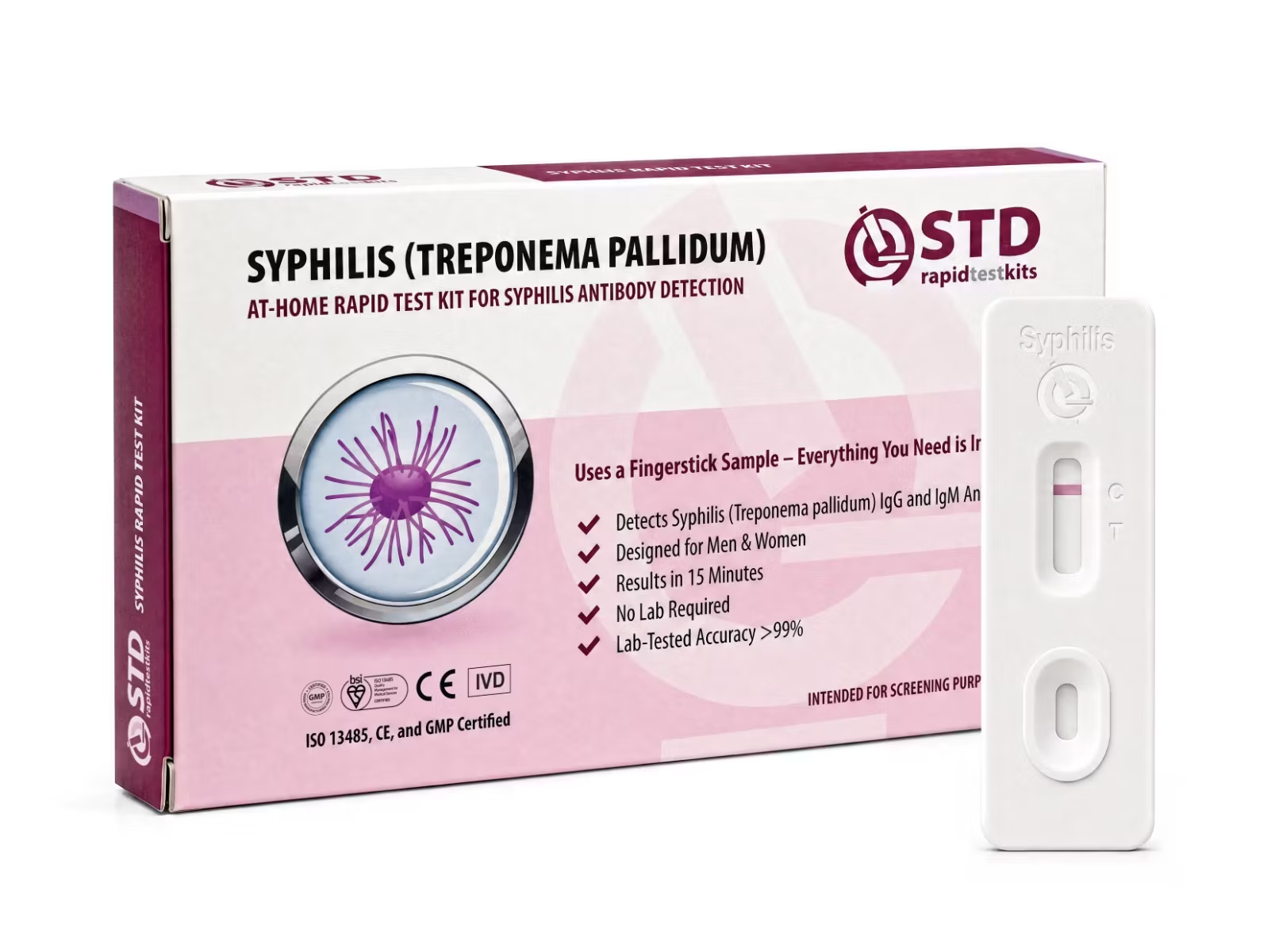
At-home testing can help with the other questions a possible mpox exposure raises. Several of those infections, including HIV and syphilis, may cause no symptoms in the early weeks. If you have no symptoms, are waiting out a window period after an exposure, or prefer privacy, our at-home STI test kits screen for them with lateral-flow chemistry, using a self-collected swab or a fingerstick blood sample. Each infection has its own window period before a test can pick it up, so check the kit instructions and retest if you tested early. A reactive result should always be confirmed by a clinician.
This article is published by stdrapidtestkits.com, which sells at-home STI testing kits. We recommend products based on fit-for-purpose for the reader's concern, not commercial benefit. None of our kits test for mpox; mpox needs a clinic swab of a lesion.
Why mpox keeps making headlines
Mpox is caused by a virus related to smallpox. The WHO describes two main clades, or genetic branches: clade I, with subclades Ia and Ib, and clade II, with subclades IIa and IIb. The global outbreak of 2022 and 2023 was driven mostly by clade IIb. More recent spread of clade Ib from Central Africa prompted renewed international concern.
The WHO Director-General has declared mpox a public health emergency of international concern twice. The first declaration came on July 23, 2022, and that emergency ended on May 11, 2023, according to the WHO mpox Emergency Committee page. The second came in August 2024, after clade Ib spread, and the Director-General ended it on September 5, 2025, as recorded in a WHO Emergency Committee statement. Neither emergency is in force today. Cases still turn up in new places, and public-health teams respond the same way each time: they isolate people with symptoms, trace close contacts and offer vaccination.
For an individual reader, the headlines change little about what to watch for. The symptoms, spread routes and testing approach described above apply to both clades, though some clade I outbreaks have caused more severe illness.
The prospective termination of the PHEIC may inadvertently signal that mpox control efforts are no longer a priority.
Is mpox dangerous? Who is at higher risk of severe illness
Most people with mpox recover fully within a few weeks with rest, pain relief and good wound care. The pain can still be severe, especially with lesions in the mouth, throat, rectum or genitals. Rectal pain can make it hard to eat, swallow or use the toilet, and some people need treatment for this alone.
Some groups face a higher risk of serious illness. The WHO notes that symptoms can last longer in people with a weakened immune system. People living with HIV whose virus is not controlled by treatment, newborns, young children and pregnant people are the groups clinicians watch most closely. Complications can include skin infections, scarring, eye involvement and, rarely, pneumonia or brain inflammation. Lesions near or in the eye need urgent care because they can threaten vision.
If you have HIV and suspect mpox, contact your HIV care team promptly. Effective HIV treatment lowers the risk of severe mpox. If you don't know your HIV status and you've had a recent sexual exposure, it's worth testing for HIV as well.
Eye pain, redness or blurred vision; a rash that spreads widely or becomes very swollen and hot; trouble swallowing, breathing or passing stool; confusion; or severe pain that over-the-counter medicine doesn't control. Pregnant people and anyone with a weakened immune system should seek care early.
How to lower your risk of mpox
The most effective step for people at higher risk is vaccination. JYNNEOS is a vaccine that can help prevent mpox and smallpox, and MedlinePlus says it is given in two doses 4 weeks apart, with both doses giving the best protection. Vaccination is usually offered to people with a recent known exposure and to people whose sexual networks have had cases. A sexual-health clinic or local health department can tell you whether you are eligible.
Other practical steps help too. Ask new partners about any recent rash or sores, and skip intimate contact if either of you has one. Don't share towels, bedding or razors with someone who is unwell. Wash your hands after touching any rash. If you're caring for someone with mpox at home, wear gloves when handling their laundry and wash it separately on a hot cycle.
If you've been diagnosed, cover the lesions, avoid sex and close contact until the skin has fully healed, and keep away from pets. Your clinic will tell you when isolation can end.
If you learn that a partner or housemate has mpox, contact a sexual-health clinic or your local health department quickly. A vaccine given soon after exposure may prevent infection or make it milder, so ask about it at the first call.
What to do if you think you have mpox
Start by covering any lesions and avoiding close contact with others, including sex, kissing and sharing a bed. Then call a sexual-health clinic, your primary-care provider or your local health department. Tell them about the rash and any recent contact before you arrive, so they can see you without exposing other patients.
Write down when your symptoms started, where the rash is and who you've been in close contact with over the past three weeks. Clinicians will ask, and it speeds up contact tracing. While you wait for results, rest, keep the lesions clean and dry, and use over-the-counter pain relief if needed. Avoid popping or scratching the lesions, which raises the risk of scarring and infection.
Use the steps below to work out how quickly to act.
Should I Get Checked for Mpox?
Do you have eye symptoms, trouble breathing or swallowing, confusion, or severe pain?
Yes: Seek urgent care now. Call ahead and mention possible mpox.
Do you have a new rash, sores or rectal pain, and close contact with someone with mpox or a new sexual partner in the past 21 days?
Yes: Cover the rash, avoid close contact, and book a clinic visit for a lesion swab soon. Ask for a full STI screen at the same visit.
Were you a close contact of someone with mpox, but you have no symptoms yet?
Yes: Contact a clinic or health department about vaccination, and watch for symptoms for 21 days after the contact.
No: Mpox is unlikely. If a rash persists or worsens, see a provider. For routine sexual-health screening, consider at-home or clinic STI testing.
Guidance only. A healthcare provider can advise based on your situation.
FAQs
- What is usually the first sign of mpox?
- For many people it's a flu-like illness with fever, chills, tiredness and swollen glands, followed by a rash 1 to 4 days later. Others notice only a sore or a few bumps near the genitals, anus or mouth, with no fever at all.
- How soon after exposure do mpox symptoms appear?
- Usually within 21 days, and often within about a week. If three weeks have passed since a close contact and you still feel well, mpox from that contact is unlikely.
- Can mpox spread through kissing?
- Yes. Saliva and lesions in or around the mouth can carry the virus, and kissing involves close face-to-face and skin contact. Avoid kissing anyone with a new rash or mouth sores.
- Can you get mpox from a toilet seat or a gym bench?
- This is very unlikely. Object-related spread mostly involves items with prolonged skin contact, such as bedding, towels and clothing used by someone with an active rash. Brief contact with shared surfaces is not a recognized driver of outbreaks.
- How long is someone with mpox contagious?
- From when symptoms start until the rash has fully healed and a fresh layer of skin has formed, which usually takes 2 to 4 weeks. Some people may pass it on 1 to 4 days before symptoms appear.
- Is there a home test for mpox?
- Not on this site. Mpox is confirmed with a PCR test on a swab taken from a lesion, usually by clinic staff. Blood tests are not recommended for diagnosis. Home kits can screen for other STIs from the same exposure, such as syphilis and HIV.
- Can you get mpox more than once?
- Reinfection appears to be uncommon but has been reported. Having had mpox doesn't replace other precautions, so ask a clinician whether vaccination is still recommended for you.
- How many doses of the mpox vaccine do you need?
- Two. JYNNEOS is given as two doses 4 weeks apart, and completing both gives the best protection. Ask a sexual-health clinic or health department about eligibility.
- U.S. Centers for Disease Control and Prevention. Signs and symptoms of mpox: symptom onset within 21 days of exposure, rash 1 to 4 days after flu-like symptoms, and the contagious period until the rash has fully healed and a fresh layer of skin has formed.
- U.S. Centers for Disease Control and Prevention. How mpox spreads: close and sexual contact including hugging, massage and kissing, contaminated objects, pregnancy, animals, respiratory-only settings, and possible spread 1 to 4 days before symptoms.
- World Health Organization. Mpox fact sheet: onset 1 to 21 days after exposure, illness lasting 2 to 4 weeks, rash distribution, proctitis, clades I and II, and PCR testing of lesion material.
- NHS. Mpox: symptoms appearing 5 to 21 days after infection, how the rash develops, anal pain or bleeding, and routes of spread.
- MedlinePlus, U.S. National Library of Medicine. Mpox: rash-only presentations, respiratory spread during prolonged face-to-face contact, and the two-dose JYNNEOS vaccine schedule.
- World Health Organization. Mpox IHR Emergency Committee: the first public health emergency of international concern, declared on 23 July 2022 and ended on 11 May 2023.
- World Health Organization. Statement on the fifth meeting of the IHR Emergency Committee on the upsurge of mpox 2024: the Director-General ended the second emergency on 5 September 2025.