

Published: October 2025 | Last updated: April 2026 | Editorial review and quality control: Martina N.
A positive syphilis result lands hard, even when the test was your idea. Maybe it came back from a clinic blood draw, maybe from an at-home rapid kit you opened in your bathroom. Either way, the next few hours feel like the most important ones, and they are not. The most important hours are the next few days, when you confirm the result, start treatment, and tell the partners who need to know.
Syphilis is one of the most treatable bacterial infections in modern medicine. A single shot of penicillin clears most early cases. The work after that is not heroic, it is administrative: book the appointment, take the dose, send a few text messages, schedule the retest. This article is a map for those steps, with the medical reasoning behind each one so the choices feel like yours instead of like instructions you are following blindly.
What should I do after a positive syphilis test?
Confirm the result with a clinic blood test if it came from a rapid kit, then get treated. Treatment is usually one intramuscular shot of long-acting penicillin (benzathine penicillin G) for early-stage syphilis. Avoid sex for at least seven days after the shot, notify any partners from the past three to twelve months (the window depends on your stage), and book follow-up RPR or VDRL blood tests at six and twelve months to confirm the infection has cleared. Many providers also add a three-month check if your initial titer was high or your stage was uncertain. If you are pregnant, treatment is urgent and should not wait for a routine appointment.
Key Takeaways
- Syphilis is highly curable with penicillin, especially when caught in the first year. Treatment is usually a single intramuscular shot for early-stage infection.
- Plan a follow-up RPR or VDRL blood test at six and twelve months. The titer number on that test is how clinicians confirm the treatment worked.
First 24 hours: what to actually do
The hours right after a positive result are full of impulse, none of them productive. Do not text every past partner before you have a confirmed result in hand. Do not search for home remedies. Do not start a course of leftover antibiotics from a previous prescription, because syphilis treatment requires a specific drug at a specific dose, and getting it wrong can mask the infection without curing it.
What helps in the first 24 hours is small and concrete. Drink some water. Look at your test report and find the test name (RPR, VDRL, FTA-ABS, TP-PA, or a rapid lateral-flow). Book a telehealth or in-person clinic appointment for the next available day. If your positive result came from an at-home rapid antibody test, the clinic visit also serves as your confirmation step, since rapid antibody tests can stay positive for life after a treated infection or, less commonly, return a false positive.
If you have visible symptoms now (a painless sore, a body rash on the palms or soles, swollen lymph nodes), the appointment becomes more urgent. Symptoms point to active infection, and earlier treatment shortens the timeline before you are no longer contagious.
If you are pregnant, do not wait for the next available appointment. Syphilis during pregnancy can pass to the fetus and cause stillbirth, neonatal death, or serious congenital harm. Contact your OB-GYN or go to a sexual health clinic the same day. The CDC recommends immediate penicillin treatment for pregnant patients at every stage of syphilis, with penicillin desensitization rather than alternative antibiotics if you have a documented allergy.
Do not self-treat with leftover antibiotics. Antibiotics from a previous prescription for chlamydia, strep throat, or a urinary tract infection are not the right drug or duration for syphilis. Treating with the wrong antibiotic can drive the infection underground without clearing it, making it harder to detect on follow-up tests. The CDC's recommended treatment is benzathine penicillin G by intramuscular injection, dosed by stage of infection, and prescribed by a clinician.
Reading your result: which test you had changes the meaning
Syphilis testing uses two families of blood tests, and reading your report well means knowing which family yours belongs to.
Treponemal tests (FTA-ABS, TP-PA, EIA, CIA, and most at-home rapid kits) detect antibodies to the syphilis bacterium itself. They turn positive shortly after infection and usually stay positive for life, even after successful treatment. So a positive treponemal test does not by itself prove you have an active infection right now, it proves your immune system has seen syphilis at some point.
Non-treponemal tests (RPR, VDRL) detect indirect markers and produce a number called a titer (for example, 1:8 or 1:64). The titer reflects how active the infection is, and is what your provider tracks before and after treatment to confirm the antibiotic worked.
Most clinics now use a two-step algorithm: a treponemal test for screening, then a non-treponemal test to confirm and to give a baseline titer. If your at-home rapid kit returned positive, the clinic visit will repeat the antibody test in a lab and add a non-treponemal test so your provider has the titer needed to monitor treatment.
| Test type | What it detects | What a positive result means |
|---|---|---|
| Rapid lateral-flow (at-home or clinic) | Antibodies to the syphilis bacterium | Probable past or current infection. Confirm with a lab non-treponemal test. |
| Treponemal lab test (FTA-ABS, TP-PA, EIA, CIA) | Antibodies specific to syphilis | Past or current infection. Usually stays positive for life. Pair with a non-treponemal test. |
| Non-treponemal (RPR, VDRL) | Indirect markers of active infection, reported as a titer | Active or recently treated infection. The titer is the number tracked over time to confirm treatment success. |
| Darkfield microscopy or PCR of a sore | The bacteria themselves in lesion fluid | Definitive active infection at the sampled site. Used when a chancre or rash is present. |
What treatment looks like (and why one shot usually works)
The first-line treatment for syphilis is benzathine penicillin G, a long-acting penicillin given as an intramuscular injection in the buttock. For primary, secondary, or early latent syphilis (the first year of infection), one 2.4 million unit shot is the full course. The drug stays in the bloodstream for weeks, slowly killing the spirochete bacteria.
Late latent syphilis (over a year since infection, or unknown duration) requires three weekly injections of the same drug. Neurosyphilis or ocular syphilis (the bacteria affecting the brain, spinal cord, or eyes) requires intravenous penicillin in a hospital for ten to fourteen days. Your provider determines the stage from your history, your symptoms, and your titer.
If you have a documented penicillin allergy, alternatives exist (doxycycline, ceftriaxone), but the CDC strongly prefers penicillin desensitization for pregnant patients and for late-stage disease, because the alternatives have weaker evidence behind them.
Within the first 24 hours of treatment, some people develop fever, chills, headache, muscle aches, and a flushed feeling. This is the Jarisch-Herxheimer reaction, an immune response to the dying bacteria, not an allergic reaction or a treatment failure. It is uncomfortable but not dangerous, and it usually passes within a day. Acetaminophen and rest are the standard supportive care.
Stages of syphilis and how treatment changes by stage
Syphilis moves through stages, but the borders between them are blurry, and many people skip noticeable symptoms entirely. Knowing the stages helps the conversation with your provider about which treatment regimen you need.
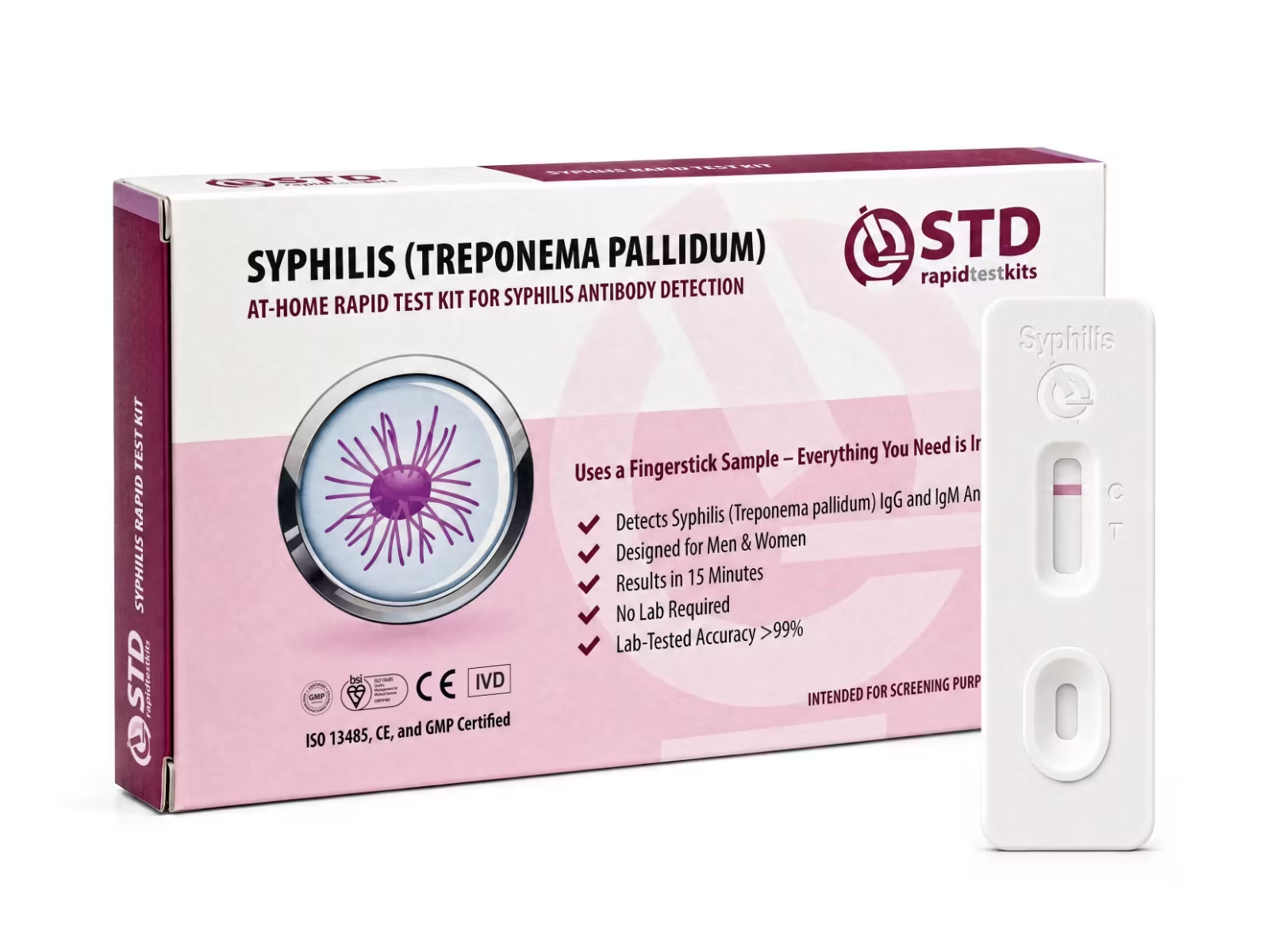
Note: stdrapidtestkits.com sells at-home rapid testing kits; the product links below this section go to products on that site. Use of the at-home kits complements clinic testing; they do not replace a clinician for treatment decisions.
| Stage | Typical timeline | Symptoms (when present) | Treatment |
|---|---|---|---|
| Primary | 10 to 90 days after exposure (about 21 days on average) | A single painless sore (chancre) at the contact site, gone within 3 to 6 weeks | Single benzathine penicillin G shot (2.4 million units) |
| Secondary | Weeks to a few months after the chancre | Body rash often on palms and soles, mucous patches, low fever, swollen lymph nodes, patchy hair loss | Single benzathine penicillin G shot |
| Early latent | Less than a year since infection, no symptoms, positive blood test | None visible | Single benzathine penicillin G shot |
| Late latent or unknown duration | More than a year since infection, no symptoms | None visible | Three weekly benzathine penicillin G shots |
| Tertiary | Years to decades after untreated infection | Heart, bone, or skin damage | Three weekly shots; specialist evaluation |
| Neurosyphilis or ocular syphilis | Can occur at any stage | Headache, vision changes, hearing loss, behavioral changes | Intravenous penicillin in hospital, 10 to 14 days |
Telling partners: when, how, and the anonymous option
The CDC recommends notifying any sexual partners from the past three months for primary syphilis, the past six months for secondary syphilis, and the past year for early latent syphilis. The window is longer for late latent disease because the timeline of exposure is harder to pin down.
The notification itself does not need to be a confession or a long conversation. A direct, low-blame text is enough: “I just tested positive for syphilis. You may want to get tested too. It is treatable, here is the link to the closest clinic.” Partners often appreciate honesty more than they appreciate detail. They are also more likely to follow through on testing when the message is short and includes a link.
If a direct conversation feels unsafe or impossible, anonymous partner notification services exist. Public health departments in most U.S. states will contact partners for you using only the information you provide, without revealing your identity. Web tools like TellYourPartner.org and DontSpreadIt.com offer anonymous text and email notifications. Your local health department can also do disease intervention outreach, which is free and confidential.
Partners who test negative may still need preventive (presumptive) treatment if they were exposed within the last 90 days, because they could be infected but still in the testing window. Your clinician can advise them on whether to treat now or retest in six weeks.
CDC partner-notification look-back windows
- Primary syphilis: notify sex partners from the past 3 months.
- Secondary syphilis: notify partners from the past 6 months.
- Early latent syphilis: notify partners from the past 12 months.
- Late latent or unknown duration: your clinician helps decide the look-back window based on your sexual history.
When can you have sex again?
Syphilis is most contagious during the primary and secondary stages, when sores or rashes contain large numbers of bacteria. The CDC's standard guidance is to avoid sexual contact until at least seven days after a single-dose treatment for early syphilis, and until any visible sores or rashes have fully healed. For multi-dose treatment of late syphilis, abstain through the full three-week course.
That seven-day mark reflects how long it takes the penicillin to render the bacteria non-infectious in the genital and oral mucosa. Some clinicians recommend extending to 10 to 14 days for extra margin, especially if symptoms were prominent or you are returning to a partner who has not yet been tested or treated.
Condoms reduce but do not eliminate transmission risk during the contagious window, because chancres and secondary rashes can occur on skin that condoms do not cover (the scrotum, the vulva, the perianal area, the mouth). Treating both partners on the same timeline removes the back-and-forth reinfection risk entirely.
When you are no longer contagious
- After a single penicillin shot for early syphilis: avoid sex for at least 7 days.
- If you still have visible sores or a rash: wait until they have fully healed.
- For late or unknown-duration syphilis (three-shot course): avoid sex through the entire treatment course.
- For neurosyphilis (intravenous treatment): your provider will tell you when it is safe to resume.
Retesting at 6 and 12 months
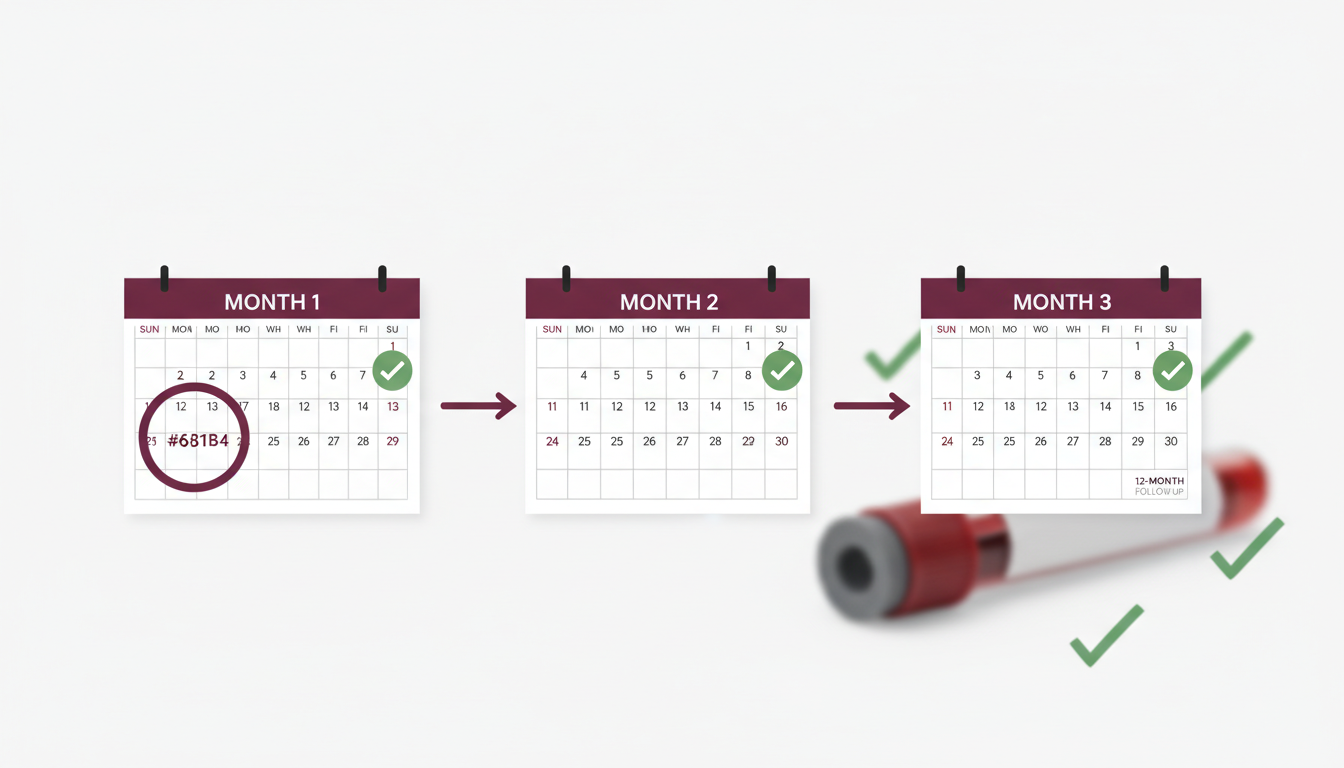
Treatment is not done when the antibiotic finishes; it is done when your follow-up titer confirms it. The CDC recommends repeat non-treponemal blood tests (RPR or VDRL) at 6 and 12 months after treatment for early syphilis, and at 6, 12, and 24 months for late latent syphilis. Many providers add a 3-month check too, especially if your initial titer was high or your stage was uncertain.
The number to watch is the titer drop. A successful treatment shows a fourfold (two-dilution) decrease, for example from 1:64 to 1:16, within 6 to 12 months for early syphilis. If the titer does not drop, or rises again, the options are reinfection, treatment failure, or, rarely, neurosyphilis that needs a different regimen. Your clinician will retest, retreat, or refer for lumbar puncture as needed.
At-home rapid antibody tests are useful for screening but cannot track treatment progress, because they detect treponemal antibodies that stay positive for life. Use a clinic-based RPR or VDRL for follow-up. The at-home option fits best when you want a fast yes/no on a new exposure between scheduled clinic visits.
Reinfection: cured does not mean immune
Syphilis does not produce lasting immunity. A treated infection clears the bacteria from your body, but your immune system does not retain the knowledge in a way that protects you against the next exposure. People who get syphilis once and are sexually active without barriers can absolutely get it again from a new (or untreated original) partner.
The CDC's surveillance data shows reinfection is a meaningful share of syphilis cases each year, especially among people in dense sexual networks or where partners did not all complete treatment. The most common reinfection scenario is a partner who tested positive but did not actually receive the full benzathine penicillin G dose, often because they were prescribed something else for an unrelated infection and assumed it covered everything.
The practical guard against reinfection is the same boring routine that catches new infections: regular screening if you have new partners, a low threshold to test after exposures, and follow-through that both you and your partner completed treatment. Confirming a partner's treatment in writing (a discharge note, a clinic receipt) is not paranoid, it is the same standard a clinic uses internally.
Confirm your partner's treatment completion in writing (a discharge note or clinic receipt). Test together at the partner's first follow-up if you stay sexually active. Stick to the 6 and 12 month retest schedule for yourself even when you feel fine, because reinfection is silent in early stages.
If your partner tests negative but you tested positive
This is one of the most-Googled and most-painful situations after a positive result, and it is rarely a simple yes/no story. Discordant partner results usually mean one of three things: window-period timing, dormant prior infection, or a transmission event that did not occur during this particular partnership.
The window for syphilis to become detectable on a blood test is roughly three to six weeks after exposure. A partner exposed last week may be genuinely infected but still test negative right now. The standard recommendation is for that partner to receive presumptive treatment (a single penicillin shot, given as if they were already positive) and to retest at six weeks. Presumptive treatment is the CDC's preferred approach for sex partners exposed within 90 days, because the math favors not waiting.
The other common explanation is timeline. Syphilis can sit silently in a person for months or years before being detected on a routine screen. Your positive result might predate this relationship entirely, even if the test feels like news today.
| Scenario | Likely explanation | What to do |
|---|---|---|
| You positive, partner negative, exposure within 90 days | Partner is in the window period, may be infected but undetectable | Partner gets presumptive treatment now, retests at 6 weeks |
| You positive, partner negative, exposure long ago | Your infection may predate the relationship, or transmission did not occur | Partner retests at 6 weeks for reassurance; no treatment needed if both tests negative |
| You positive, partner positive at lower titer | Partner infected later, or partner has been treated previously and the test is residual | Both treat, both retest titers in 6 and 12 months |
| Both negative on rapid test, one symptomatic | Symptomatic partner may be in window or test missed antibodies | Symptomatic partner sees a clinic for darkfield or PCR of any sore, plus RPR or VDRL |
Privacy, insurance, and your rights
Syphilis is a reportable disease in every U.S. state, which means your provider sends a case report to the local public health department. The case is for surveillance and for partner outreach if you opt into it; your name is never published, sold, or shared with employers, schools, or immigration. The reporting is the same kind of public health bookkeeping used for measles or tuberculosis.
If you are on a parent's or partner's insurance plan, the lab and visit may appear on the explanation-of-benefits (EOB) statement that goes to the policyholder. The EOB does not show the diagnosis, but it shows the test name (syphilis serology) and the lab. If that visibility is a problem, options include a Title X clinic that bills on a sliding scale without insurance, a community health center, or a private-pay telehealth service. Many state public health departments offer free or low-cost testing and treatment for STIs without involving insurance at all.
You are not legally required to disclose your status to a casual partner once you have completed treatment and are no longer contagious. Some states have transmission laws that apply only to specific situations and only during the contagious window; your state's department of health is the authoritative source. Ethically, telling a new partner is usually the right call when symptoms could recur or when ongoing testing matters to both of you.
Privacy-preserving testing options
- Title X clinics: sliding-scale billing, no insurance required, confidential results.
- Community health centers: low-cost STI care that does not have to be billed to a household policyholder.
- Private-pay telehealth: results sent only to you, no EOB statement to the household plan.
- State or county public health departments: free or low-cost testing and treatment for STIs, no insurance involvement.
Mental health: handling the diagnosis itself
The medical part of a syphilis diagnosis is often easier than the emotional part. Cultural baggage around STIs makes a treatable infection feel like a moral verdict, and many people report intrusive shame, sleep disruption, and relationship anxiety in the first few weeks after a positive test. None of this is unusual.
What helps is naming the gap between the disease and the meaning. The disease is a bacterial infection treated with one shot. The meaning, the shame, the worry about disclosure, the spiral of how-did-this-happen, is a separate problem that is allowed to take time. Talking to a therapist, joining an STI-positive support community (Reddit's r/STD has active threads, and many cities have in-person LGBTQ+ sexual health drop-ins), or telling one trusted friend can shorten the spiral considerably.
If anxiety, depression, or shame begin to interfere with sleep, work, or your relationships, that is a signal to bring in professional support. Some sexual health clinics offer integrated counseling, and Planned Parenthood and many community health centers can refer to therapists who work with sexual health concerns.
Syphilis can be cured with the right antibiotics from your healthcare provider. However, treatment might not undo any damage the infection has already done.
Frequently Asked Questions
- Does syphilis really go away with one shot?
- For primary, secondary, or early latent syphilis (the first year of infection), one intramuscular shot of benzathine penicillin G clears the infection in most people. The bacteria are killed within days, but the antibody titer your provider tracks may take 6 to 12 months to drop fourfold. Late latent or tertiary disease requires three weekly shots, and neurosyphilis requires intravenous penicillin in a hospital.
- Why did I test positive if I have no symptoms?
- Most syphilis infections are caught in the latent stage, when there are no visible signs at all. The chancre of primary syphilis is painless and often hidden inside the vagina, anus, or mouth, so people miss it. The rash of secondary syphilis is often mild and self-resolves. Routine screening is how the majority of cases are diagnosed, which is why the CDC recommends regular testing for sexually active people with multiple partners or other risk factors.
- Can I get syphilis again after treatment?
- Yes. Syphilis does not produce lasting immunity, so reinfection is possible from any new exposure. The most common reinfection path is a partner who never received the correct treatment dose. Confirm in writing that any partner you continue to see has completed the full benzathine penicillin G regimen, and follow your own retesting schedule at 6 and 12 months.
- My partner tested negative. Does that mean I got it from someone else?
- Not necessarily. The window period for syphilis blood tests is about three to six weeks after exposure, so a recently exposed partner can be genuinely infected but still test negative. The CDC recommends presumptive treatment for sex partners exposed within the last 90 days, plus a repeat test at 6 weeks. The result may also reflect that transmission did not occur in this partnership, or that your infection predates it.
- When is it safe to have sex again?
- Seven days is the floor after a single penicillin shot for early-stage disease. Push that out further whenever a chancre or rash is still visible at day seven, since active lesions are still infectious. The three-shot regimen for late latent syphilis means abstaining through the full three weeks. Some clinicians extend the wait to 10 or 14 days when symptoms were prominent or your partner has not been tested yet.
- Will my syphilis blood test always be positive now?
- Treponemal tests (FTA-ABS, TP-PA, most rapid kits) usually stay positive for life, even after a fully cured infection. That is normal and does not mean you are still infected. The test that tracks active disease is the non-treponemal test (RPR or VDRL), which is reported as a titer. A successful treatment shows the titer dropping fourfold within 6 to 12 months.
- Do I need to tell partners if we used condoms?
- Yes. The CDC's partner-notification look-back windows apply regardless of barrier use. Syphilis can transmit through unprotected skin at the base of the genitals, around the anus, and inside the mouth, and a condom covers only part of that surface. Notify partners from the past three, six, or twelve months depending on your stage, even if condoms were used consistently.
- I am pregnant and just tested positive. Does that change anything?
- Yes, and the urgency is higher. Syphilis can pass from a pregnant person to the fetus and cause stillbirth, neonatal death, or serious congenital harm. The CDC recommends same-day or next-day penicillin treatment for pregnant patients at every stage of syphilis. If you are penicillin-allergic, the CDC strongly prefers desensitization over alternative antibiotics during pregnancy. Contact your OB-GYN or a sexual health clinic immediately rather than waiting for a routine appointment.
- Can leftover antibiotics from another infection treat syphilis?
- No. Syphilis treatment requires a specific drug (benzathine penicillin G) given by intramuscular injection at a specific dose. Oral antibiotics like azithromycin, ciprofloxacin, or amoxicillin from a previous prescription are either inactive against syphilis or use the wrong dose and duration. Self-treating with the wrong antibiotic can also mask the infection on follow-up tests, making the next correct treatment harder to confirm.
One step at a time, then the next
The work after a positive syphilis result is short. Confirm the result, take the shot, send the messages, schedule the retest. Each piece on its own takes a phone call or a few minutes. Together they finish the situation in months, not years, and almost always without lasting consequence.
If you are still on the edge of your bed staring at the result, the move is not a master plan. The move is the next single thing: book the appointment, text the partner you have already decided to text, order the confirmation kit. The rest will follow from that.
Your next five steps
- Confirm the result with a clinic blood test if it came from a rapid kit.
- Take the penicillin shot dosed by your stage of infection.
- Notify partners from the relevant CDC look-back window.
- Avoid sex for at least seven days after a single-dose treatment.
- Schedule follow-up RPR or VDRL blood tests at six and twelve months.
- U.S. Centers for Disease Control and Prevention. Sexually Transmitted Infections Treatment Guidelines: Syphilis. Recommended dosing of benzathine penicillin G by stage, partner-notification windows, and timing of follow-up serology.
- U.S. Centers for Disease Control and Prevention. About Syphilis. Basic fact sheet on transmission, symptoms, and stages.
- U.S. Centers for Disease Control and Prevention. About Congenital Syphilis. Risks of untreated syphilis in pregnancy and the case for same-day treatment in pregnant patients.
- World Health Organization. Syphilis Fact Sheet. Global epidemiology, transmission routes, and treatment summary.
- U.K. National Health Service. Syphilis topic page. Plain-language overview of symptoms, testing, and treatment used in U.K. clinical practice.
- Mayo Clinic. Syphilis: Symptoms, Causes, Diagnosis, and Treatment.
