
Published: August 2025 | Last updated: May 2026 | Editorial review and quality control: Martina N.
An unexpected positive STD result inside a long-term monogamous relationship is one of the most disorienting moments a person can have. The reflex is immediate and ugly: someone must have stepped out. The biology of sexually transmitted infections rarely matches that script.
Many STDs can sit in the body for months, years, or in some cases decades before a test picks them up. Some clear themselves in one partner and persist in the other. A small but real fraction of test results turn out to be false positives that resolve with confirmatory testing. None of these scenarios involve infidelity. Most of them are simply how these infections behave, how immune systems behave, and how laboratory tests work.
This guide walks through what is actually going on when a long-term, monogamous couple sees a positive result. It pulls together what the CDC, WHO, NHS, and Mayo Clinic say about latency, delayed detection, false positives, and the right next steps so you can move from accusation to information.
Key Takeaways
- A positive STD test in a long-term monogamous relationship does not automatically mean infidelity. Latency, delayed detection, and the natural quirks of testing can each explain a result without a new exposure.
- Confirmatory testing is the right next step before any major conversation. A second test using a different method clarifies whether the first result was accurate.
A positive STD test does not equal a new infection
The most common mistake people make after an unexpected positive is collapsing two different timelines into one: the date the infection was acquired, and the date the test detected it. They are not the same.
STIs are usually counted from the date of detection, not the date of acquisition. The acquisition date is often unknown, and for several common infections it can predate the current relationship by years. According to the CDC's STD overview, many common STIs are asymptomatic for extended periods, which means an exposure date often cannot be pinpointed to a specific week, month, or year.
That has practical consequences. A chlamydia diagnosis in year five of a relationship may reflect an infection acquired in year zero. A syphilis blood test that comes back reactive in 2026 may reflect an exposure from 2018. A herpes diagnosis in a person who has never knowingly had a cold sore or genital outbreak may reflect a transmission event that happened in their first sexual relationship, decades earlier.
None of this absolves anyone of responsibility, and it does not rule out a recent exposure either. What it does is widen the window of possible explanations beyond the single, immediate suspicion that drives most of the panic.
Three biological realities sit underneath this:
- Many STDs are asymptomatic in the majority of cases. A person can carry chlamydia, gonorrhea, trichomoniasis, HPV, or HSV-2 without symptoms for extended periods. The CDC's overview of STDs emphasizes that lack of symptoms is the norm rather than the exception for several of these infections.
- Latency periods vary by pathogen. Some infections have weeks between acquisition and reliable detection; others have years.
- Tests have a window period. A test that came back negative six months ago does not prove a recent exposure if today's test is positive, because the exposure may have happened before the previous test could have caught it.

How long different STDs can stay quiet
Latency is not one fixed thing across all infections. Each pathogen has its own way of hiding, and the testing windows reflect that. Here is how the most common ones behave.
Chlamydia
Chlamydia is the quiet one. The CDC notes that most people with chlamydia have no symptoms, and the infection frequently goes undetected for extended periods without routine screening. A positive chlamydia test in 2026 can absolutely reflect an exposure that happened well before the current relationship started, especially if neither partner has been screened during the relationship.
Gonorrhea
Gonorrhea is more likely to produce symptoms in men, but in women it is often silent. Untreated gonorrhea can persist for months. It can also clear in one partner and remain in the other, which is one reason a partner can test negative while the other tests positive after the same exposure event.
Herpes (HSV-1 and HSV-2)
Herpes is the textbook example of latency. After the first infection, the herpes simplex virus retreats into nerve cells (sensory ganglia) and stays there for life. Reactivation can happen years or decades later, often triggered by stress, illness, or hormonal shifts. Mayo Clinic notes that many people who carry HSV either had a first outbreak so mild it was mistaken for something else (razor burn, a yeast infection, an ingrown hair) or had no recognizable first outbreak at all.
Syphilis
Syphilis has a defined latent stage that can last for years between the early symptoms (a chancre or a body rash) and the late, organ-damaging stage. The WHO syphilis fact sheet describes latent syphilis as a routine clinical category, not an exception. A reactive blood test during latent syphilis says nothing about when the exposure occurred. It says only that the body has produced antibodies to Treponema pallidum at some point.
HIV
HIV does not establish true latency the way herpes or syphilis does, yet its window period creates similar confusion about timing. CDC HIV testing guidance gives the window between exposure and reliable detection as 18 to 45 days for fourth-generation antigen/antibody lab tests, and 10 to 33 days for NAT (nucleic acid tests), which are the most sensitive option. Antibody-only rapid tests can take up to 90 days. Within that window, an exposure can occur without showing on the test, then show on a later test, with no new exposure in between.
HPV
HPV is so common that the CDC describes it as nearly universal in sexually active adults at some point in life. Most HPV infections clear on their own within a year or two, but some persist silently. A positive HPV result on a cervical screen years into a relationship is far more likely to reflect a long-standing infection than a new exposure.
| Pathogen | Detection or latency window | Why an old exposure can show up now |
|---|---|---|
| Chlamydia | Often asymptomatic; can persist undetected for extended periods without routine screening | Frequently picked up only on a first or routine screen |
| Gonorrhea | Often silent in women; persists for months untreated | Can clear in one partner and remain in the other |
| Herpes (HSV-1, HSV-2) | Lifelong latency in nerve cells | Reactivates years or decades after the first infection |
| Syphilis | Defined latent stage that can last for years | Antibodies remain detectable; the test cannot date the exposure |
| HIV | 18 to 45 days for antigen/antibody lab tests; 10 to 33 days for NAT; up to 90 days for antibody-only rapid tests | An exposure before the previous test's window may show only on a later test |
| HPV | Most clear within 1 to 2 years; some persist silently | A positive screen often reflects a long-standing infection rather than a new one |
What flips a dormant infection into a detectable one
If the infection was already there, why did it surface now? Several common triggers move an infection from below the detection threshold to showing up on a test or causing symptoms.
Immune changes. Stress, sleep deprivation, a recent illness, pregnancy, and certain medications can all shift how aggressively the immune system contains a low-grade infection. When containment relaxes, viral shedding or bacterial replication can rise enough to be detected.
Antibiotic exposure. Antibiotics taken for an unrelated infection can disrupt the vaginal or urethral microbiome. Researchers have observed an interplay between bacterial vaginosis and chlamydia persistence, where shifts in the local microbial ecology can make a previously suppressed infection more detectable. This does not mean antibiotics cause STDs. It means they can change the conditions that were keeping a low-level infection quiet.
Hormonal changes. Pregnancy, hormonal contraception changes, and menopause all alter the immune environment of the genital tract. Herpes outbreaks, in particular, can cluster around hormonal shifts.
A more sensitive test. Modern nucleic-acid amplification tests (NAATs) detect smaller amounts of pathogen than older antibody or culture tests. Someone who tested negative in 2018 with an older method might test positive in 2026 with a more sensitive method, even if nothing has changed in their actual infection burden.
A first-ever screen. Many people only get tested when they have symptoms, when a partner discloses something, or when a routine screen happens. The infection may have been present and asymptomatic for years; the test is what is new, not the infection.
- Immune changes from stress, illness, pregnancy, or medications
- Antibiotic exposure that shifts the local microbiome
- Hormonal changes around contraception, pregnancy, or menopause
- A more sensitive test method than the previous screen used
- A first-ever screen catching something present for years
False positives and how to think about them
No test is perfect. The blood-based STD tests for herpes and syphilis, in particular, have known false-positive rates that rise in low-prevalence populations. This is a counterintuitive statistical reality: when you test a population where very few people actually have the infection, even a highly specific test produces a meaningful number of false positives, because the small number of true positives is overwhelmed by the (also small but non-zero) number of false positives.
Common causes of a false positive include:
- Cross-reactivity with antibodies from other infections or autoimmune conditions
- Recent vaccination or recent unrelated illness
- Sample handling errors at the lab
- Clerical mix-ups (sample mislabeling)
- Detection thresholds set close to a borderline value
This is why every clinical guideline (CDC, WHO, NHS) emphasizes confirmatory testing for unexpected positive results, especially for blood-based herpes and syphilis tests. Mayo Clinic recommends a second test using a different method when a first herpes result is surprising or does not match the clinical picture.
For syphilis, the standard approach is a two-step protocol: a non-treponemal screening test (RPR or VDRL), confirmed by a treponemal-specific test (TP-PA, FTA-ABS, or EIA). A reactive screen alone is not a diagnosis. CDC's STI treatment guidelines explicitly require confirmation before treatment.
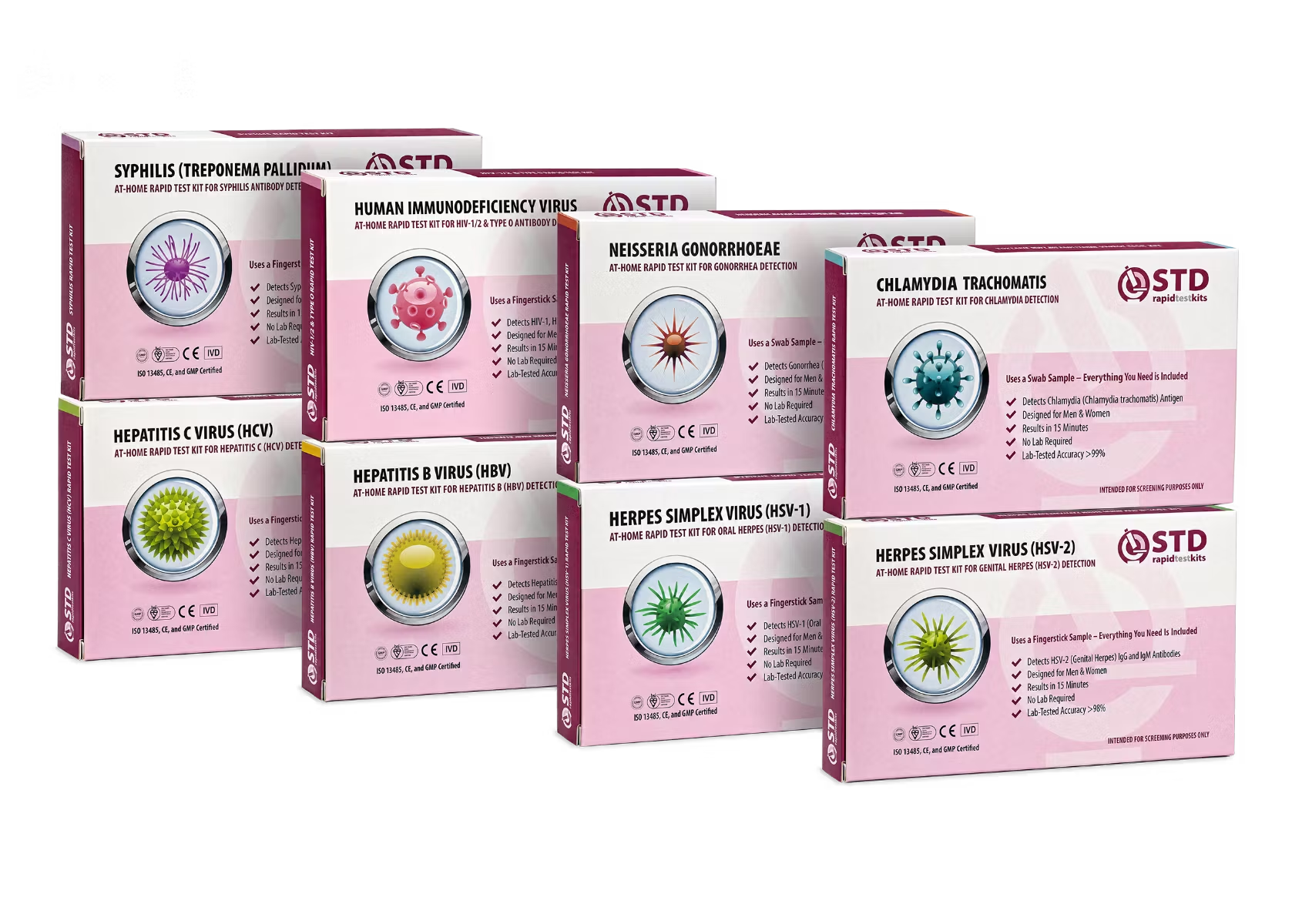
For chlamydia and gonorrhea, the home-test technology is a rapid lateral-flow immunoassay. These are useful screening tools, particularly for people who would otherwise not test at all, and any positive result calls for a clinic-administered NAAT (the laboratory gold standard) before starting antibiotics. The two technologies are complementary: home rapid screens catch cases that would otherwise go undetected, and lab NAAT confirms what the screen flags.
The single most important thing to do with an unexpected positive result is to not act on it (emotionally or medically) until it has been confirmed.
Do not act on a surprising result, emotionally or medically, until it has been confirmed by a different test method. A retest using a separate methodology resolves most false positives.
What to do when an unexpected result lands
The order of operations matters. People who get an unexpected positive often have the relationship conversation first and the medical conversation second. Reversing that order tends to lead to better outcomes for both.
Step one: confirm the result. Schedule a clinic-based confirmatory test, ideally within a week. For chlamydia and gonorrhea, that means a laboratory NAAT. For syphilis, a two-step treponemal and non-treponemal protocol. For herpes, a type-specific IgG with a Western blot if the index value is in the borderline range. For HIV, a fourth-generation antigen-antibody lab test plus a confirmatory differentiation assay. Bring the original test result with you so the clinician can see the actual values.
Step two: ask about timing, not just the result. Once a result is confirmed, ask what is known and what is unknown about when the infection was acquired. For most STDs, the honest answer is that the test alone cannot pin down a date. That single sentence often defuses an enormous amount of relationship anxiety.
Step three: have your partner tested. Concordance (both partners testing positive) is one signal. Discordance (one positive, one negative) is also informative but does not prove anything about timing or fidelity, because some infections clear naturally in one person and persist in another, and because window-period dynamics differ between bodies.
Step four: treat what is treatable. Bacterial STDs (chlamydia, gonorrhea, syphilis, trichomoniasis) are curable with antibiotics. Viral STDs (herpes, HIV, HPV, hepatitis B, hepatitis C) are managed long-term, and several have highly effective therapies that suppress transmission. Treat both partners when guidelines call for it, even if one is asymptomatic, to prevent ping-pong reinfection.
Step five: have the conversation. Once the medical picture is clear, the conversation becomes much easier, because you are talking about a known biology problem rather than an unsupported suspicion. The CDC's partner services pages walk through how to disclose, including for partners outside the current relationship who may need to be notified.
Testing as a couple, without the drama
One of the most useful relationship habits couples can build is making STD screening a routine part of healthcare, separate from any specific worry. The CDC recommends that sexually active adults who have ever had a sexual partner be screened periodically, even in long-term monogamous relationships, with the cadence depending on age, sex assigned at birth, and risk factors.
Routine joint testing removes the implicit suspicion that comes with a solo request, catches infections that would otherwise stay silent for years, and gives both partners a shared baseline to return to if something unexpected appears later.
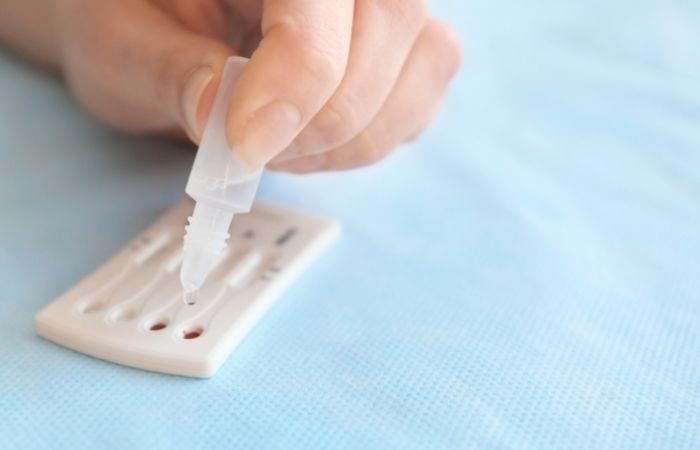
At-home rapid lateral-flow kits work best as a low-friction first screen for people who would otherwise skip testing entirely. The NHS STI overview lists home kit availability alongside clinic options. The framing matters: a home rapid kit is a screening tool, and a positive result on a home screen calls for a confirmatory clinic test before drawing any conclusions.
For couples specifically, this means picking a kit that screens for the infections that are actually relevant. A multi-test panel covering HIV, syphilis, hepatitis B, hepatitis C, chlamydia, gonorrhea, and herpes covers the realistic differential for most adults. Single-infection kits are useful when there is a specific concern (a partner's recent exposure, an unusual symptom, a window-period follow-up), while a panel kit is the more efficient baseline.
Why couples test together
- Removes the implicit suspicion that comes with a solo request to get tested
- Catches infections that would otherwise stay silent for years
- Gives both partners a shared baseline to return to if something unexpected appears later
From accusation to information
The most useful reframe a couple can make after an unexpected positive is shifting from who did this to what is this. Bodies do not keep neat calendars. Infections do not always announce themselves. Tests are excellent tools and imperfect ones at the same time. None of that is a moral failure on anyone's part. It is biology.
Couples who handle this well typically share three habits: they confirm before they accuse, they treat testing as routine medical care rather than a flag of suspicion, and they hold the relationship conversation after the medical picture is clear, not before. None of those habits require any special communication skills. They require only the willingness to wait a few days for confirmatory results before drawing conclusions.
If you are sitting with a positive result right now and you have not yet talked to your partner, the most useful thing you can do tonight is read the result document carefully, write down any questions for a clinician, and book a confirmatory test.
Many sexually transmitted diseases do not cause symptoms, and people can have them for a long time without knowing. The only way to know for sure is to be tested.
Frequently asked questions
- Can an STD really stay dormant for years?
- Yes, depending on the infection. Herpes establishes lifelong latency in nerve cells and can reactivate years or decades after the first exposure. Syphilis has a defined latent stage that can last for years between early and late symptoms. HPV often persists silently. Chlamydia can stay below the detection threshold for extended periods, particularly without regular screening. None of these timelines require a recent exposure.
- Why did I test positive but my partner tested negative?
- Several biological reasons. Some infections clear naturally in one person and persist in another. Some are below the test's detection threshold in one partner at the moment of testing but not the other. The two of you may also be at different points in your infection's window period. Discordant results are common and do not prove anything about timing or fidelity.
- How likely is a false positive on an STD test?
- It depends on the test and on prevalence in the population being tested. Blood-based herpes and syphilis tests have higher false-positive rates than swab-based tests for chlamydia and gonorrhea, particularly in low-prevalence groups. The right response to any unexpected positive is a confirmatory test using a different method before drawing conclusions or starting treatment.
- Should I treat an STD if I have no symptoms?
- Yes. Untreated bacterial STDs (chlamydia, gonorrhea, syphilis) can cause infertility, chronic pelvic pain, and increased HIV transmission risk even without symptoms. The CDC's STI treatment guidelines recommend treating confirmed asymptomatic infections to prevent long-term complications and onward transmission.
- How often should monogamous couples get tested?
- At least once when starting a relationship, then periodically based on age, sex, and other risk factors. The CDC recommends annual chlamydia and gonorrhea screening for sexually active women under 25 and for older women with risk factors. HIV screening is recommended at least once in life for everyone aged 13 to 64. Syphilis, hepatitis B, and hepatitis C screening cadence varies by individual risk.
- Can stress trigger an STD to show up?
- Stress does not cause an STD, though it can weaken the immune system enough that an infection already present in the body becomes more active or detectable. This is most clearly documented for herpes, where stress is a well-known reactivation trigger.
- Could my partner have had this infection before we met?
- Yes, and for several common infections this is more likely than a recent exposure. Chlamydia, herpes, syphilis, and HPV can all carry over from earlier sexual partners without symptoms in either of you. The relationship may not be the source of the infection at all.
- What should I do first after an unexpected positive?
- Schedule a confirmatory clinic test within a few days, before having any accusation-style conversation. The confirmatory test clarifies whether the result is real, and if it is, the clinician can usually provide context on what is known and unknown about timing, which makes the relationship conversation much easier to navigate.
- U.S. Centers for Disease Control and Prevention. STD overview, fact sheets, and surveillance data on asymptomatic infections.
- U.S. Centers for Disease Control and Prevention. HIV testing window periods and recommended test types.
- U.S. Centers for Disease Control and Prevention. Sexually Transmitted Infections Treatment Guidelines, including syphilis confirmatory testing protocols.
- World Health Organization. Syphilis fact sheet, including latent stage description.
- Mayo Clinic. Genital herpes symptoms, causes, latency, and confirmatory testing recommendations.
- NHS. Sexually Transmitted Infections (STIs) overview and home testing guidance.
