
Published: September 2025 | Last updated: May 2026 | Editorial review and quality control: Martina N.
Can a relationship survive an HSV-2 diagnosis?
Usually, yes. An HSV-2 diagnosis rarely ends a relationship. About 11.9% of U.S. adults aged 14 to 49 carry the virus, and most partners meet a calm, factual disclosure with questions rather than a goodbye. Daily antiviral therapy when appropriate, condoms, and skipping sex during outbreaks keep transmission low and intimacy intact.
Maya was three days into a silence that felt heavier than her HSV-2 diagnosis when she finally said the words out loud. She had Googled “vaginal bump after shaving” before the dermatologist’s office called back, and she had practiced what to say to her boyfriend in the bathroom mirror. When she did say it, he did not panic and he did not leave. He said, “Okay. Let’s figure this out.”
Her experience is more typical than the cultural script suggests. About 11.9% of U.S. adults aged 14 to 49 carry HSV-2, the type most often responsible for genital herpes, per CDC NCHS surveillance data, and the most common reaction to an honest disclosure lands much closer to “okay” than to “goodbye.” This guide walks through what the days before a diagnosis usually look like, how to have the disclosure conversation, what at-home and clinic testing can and cannot tell you, the transmission math couples actually use, and why a positive result inside a faithful relationship so rarely means what people fear.
Key Takeaways
- An HSV-2 diagnosis does not end most relationships. Honest disclosure, daily antiviral therapy when appropriate, and consistent condom use lower transmission risk and let intimacy continue.
- Home rapid herpes tests use a fingerstick blood sample to detect HSV antibodies, not a genital swab. Antibodies usually take about 4 to 12 weeks to develop, and the CDC notes detection can take up to 16 weeks or more for HSV-2, so timing matters when a partner tests.
Before the Call: Mistaking Every Symptom for Something Else
Most people who learn they have HSV-2 spent the days before their diagnosis searching for something else entirely: razor burn, a yeast infection, or an ingrown hair after shaving. The lesions of a first herpes outbreak can resemble several ordinary skin problems, and the prodrome (the tingling, itching, or burning that arrives a day or two before any sore) can feel like nothing at all. The U.S. Centers for Disease Control and Prevention notes that most people who carry HSV-2 either have no symptoms or have symptoms mild enough to be mistaken for another skin issue.
A first outbreak can also be more than a few local sores. The NHS genital herpes page lists small blisters that burst and leave red, open sores around the genitals, along with pain when you pee. The CDC adds that a first episode can also bring flu-like symptoms such as fever, body aches, and swollen glands, especially during the first week. Later outbreaks, when they happen, tend to be shorter and milder than the first.
Maya’s first symptom was an itch she blamed on a new laundry detergent. The stinging arrived a day later. By the time she sat in a clinic chair and watched a provider swab a small cluster of blisters for laboratory testing, she had already convinced herself it was something else. The phone call a week later split her week into a before and an after. The shock when a diagnosis lands has very little to do with the medical reality of the virus, which most people manage easily, and a great deal to do with what people absorbed growing up about who gets herpes and what it supposedly says about them.
Is It Herpes, or Something Else?
| Feature | Herpes outbreak | Ingrown hair or razor burn | Yeast infection |
|---|---|---|---|
| Appearance | A cluster of small fluid-filled blisters on a red base that break open and crust over | A single red bump, often with a trapped hair visible in the center | Redness, swelling, and thick discharge, usually with no blisters |
| Sensation | Tingling or burning a day or two before sores, then soreness or pain | Mild itch or tenderness around the one bump | Itching and irritation, sometimes burning when peeing |
| Pattern | Several sores grouped together, often returning to the same area over time | Usually one isolated bump along a shaved or waxed area | Diffuse irritation across the vulva, not discrete sores |
| Healing | Crusts and heals over one to two weeks, can recur later | Clears slowly as the hair grows out | Resolves with antifungal treatment and does not crust |
Patterns only. A clinician swab and lab test is the one reliable way to confirm herpes.
Saying It Out Loud: The Three Days Before Disclosure
For seventy-two hours after the call, Maya said nothing. She and her boyfriend were still sharing a bed and keeping their normal routines. The questions running on a loop in her head were not really about the virus. They were about him. Would he blame her? Would he assume she had cheated? Would he search “can you sue someone for giving you herpes” and never come back?
The silence grew heavier than the diagnosis. Every time she looked at him, the same thought returned: he deserved to know, and she deserved a partner who wanted to know her, including the parts she did not choose. So she wrote it out first and practiced in the mirror, then she told him. Her opening was close to the script that sexual-health counselors recommend: I found out I have HSV-2, I did not know before, I want you to be safe, and I want us to talk about what this means for us.
He did not panic and he did not leave. He said, “Okay. Let’s figure this out.” That response did not happen because the relationship was unusually strong. It happened because he had a few minutes between hearing and reacting, and Maya gave him those minutes by leading with information instead of fear. The American Sexual Health Association keeps plain-language resources on herpes and relationships for exactly this kind of conversation.

What an At-Home Herpes Test Actually Measures
One of the most common questions after a partner’s disclosure is, “Should I get tested too?” The honest answer is yes, with a caveat about timing that almost nobody hears at the moment of diagnosis. This guide is published by stdrapidtestkits.com, which sells the at-home herpes test linked below, and the recommendation here is based on what fits the reader’s situation rather than on commercial benefit. Where a clinic visit is the better tool, this article says so plainly.
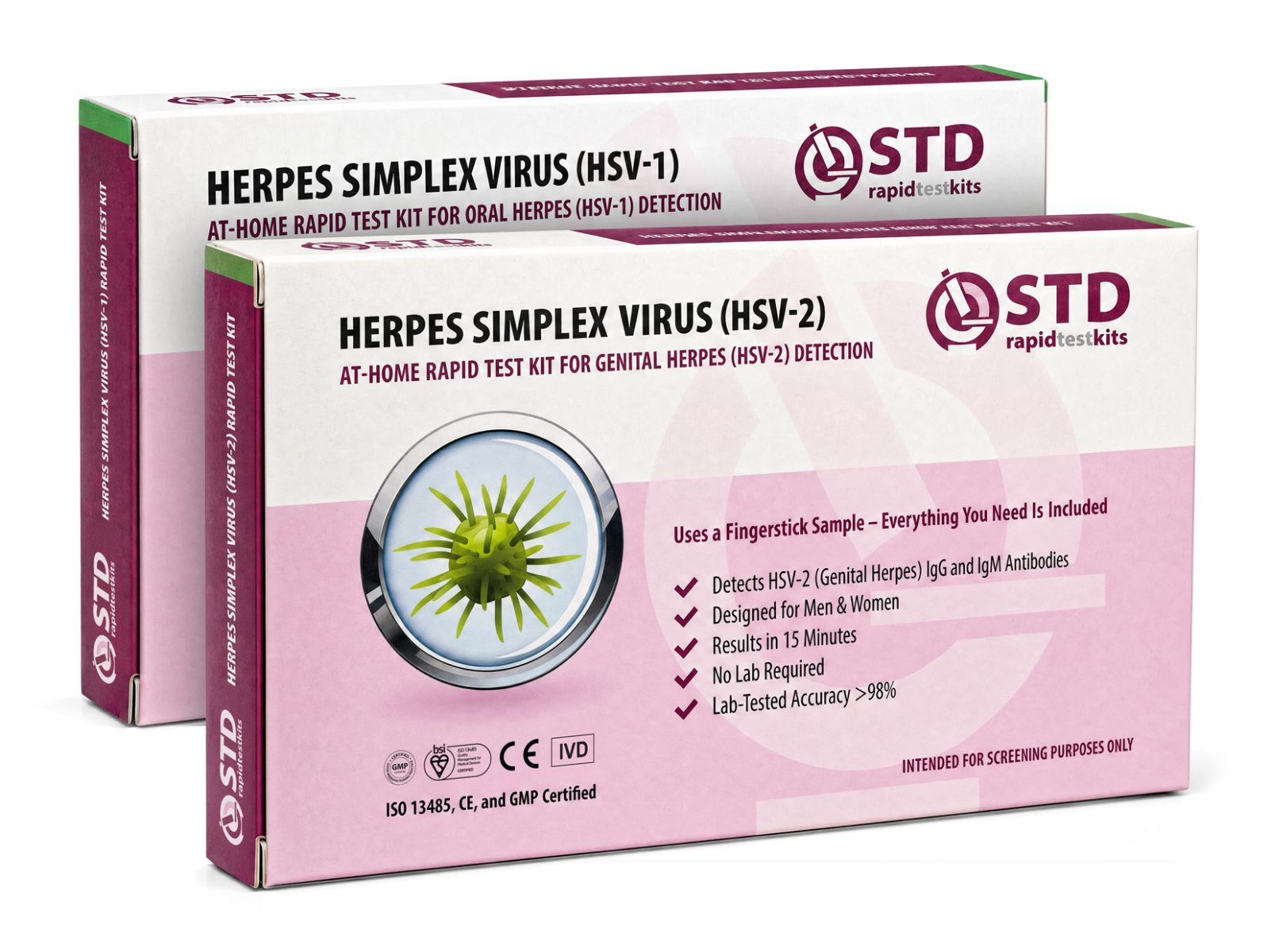
An at-home herpes antibody test does not detect the virus directly. It uses a fingerstick blood sample and lateral-flow strips to find IgG antibodies that the immune system builds against HSV-1 or HSV-2. Antibodies usually become measurable about 4 to 12 weeks after exposure, and per the CDC’s herpes testing guidance, it can take up to 16 weeks or more for current tests to reliably detect infection. A test taken three days after a partner’s diagnosis can read negative even if transmission already happened.
That is a different tool from what a clinic uses on an active sore. A clinician who can see a lesion swabs the fluid and sends it for laboratory PCR, which finds the virus itself rather than the antibody response and can usually tell HSV-1 from HSV-2. The two approaches answer different questions and work best together: PCR confirms an outbreak in front of you, while an antibody test answers the longer-term question of whether the immune system has ever met the virus. The home strip is a lateral-flow screen, so a reactive result is worth confirming with a lab.
Maya’s boyfriend ordered a home herpes panel and tested negative at four weeks, then retested at twelve weeks and was still negative. The second result was the one that mattered, because the first fell inside the window where seroconversion can still happen. Both used the same fingerstick method; the difference was timing, not the test. The CDC’s STI treatment guidelines note that HSV-2 antibody screening is not recommended for the general population, which is one reason so many couples discover the gap only after a diagnosis.
HSV-2 Antibody Seroconversion Window
- Week 0 Exposure
The virus may transmit, but there are no antibodies to detect yet
- Week 4 Earliest detection
Some people begin to seroconvert and may test positive
- Week 12 Common window
Most antibody tests have turned positive by this point
- Week 16 Outer limit
The CDC notes detection can take up to 16 weeks or more; re-test if an earlier result was negative
A negative antibody test before about twelve weeks does not rule out a recent exposure.
Why Monogamy Does Not Guarantee Immunity
The cleanest assumption a long-term couple makes about HSV-2 is also the one most likely to be wrong: that a positive result inside a faithful relationship has to mean someone strayed. It rarely does. Herpes can sit dormant in nerve tissue for months or years between flare-ups, and most people who carry HSV-2 never had a textbook outbreak that would have prompted them to test. Either partner could have acquired the virus in a previous relationship and never known. The timing of a first outbreak rarely lines up with the timeline of a current relationship.
The scale of this is global. The World Health Organization estimates that about 3.8 billion people under age 50 (around 64%) carry HSV-1, and roughly 520 million people aged 15 to 49 (about 13%) carry HSV-2. The WHO also notes that HSV-2 can be passed on even when the skin looks normal, because the virus periodically becomes active without producing visible sores. There is no signal a person can feel on a shedding day, which is why transmission so often happens between two people who both feel completely fine.
The type of virus changes how a couple reads a new diagnosis. HSV-1 is the usual cold-sore virus, but the WHO notes it can also be transmitted to the genital area through oral-to-genital contact and cause genital herpes. Genital HSV-1 tends to recur less often than genital HSV-2 and sheds less over the long term, so a genital HSV-1 result inside a faithful relationship most plausibly traces to ordinary oral sex at some point rather than to infidelity.
Prevalence is also uneven. HSV-2 is more common in women than in men, partly because vaginal tissue is more susceptible during sex with a male partner, and it rises with age as lifetime exposure accumulates. Differences across some U.S. groups track access to screening and consistent care, not behavior. None of this softens the sting of a personal diagnosis, but it does reposition it as a normal event in a normal sexual life.
What Maya learned, and what her boyfriend came to accept, was that her HSV-2 result did not actually answer who passed the virus to whom. His repeat antibody test stayed negative at twelve weeks despite ongoing intimacy. The likeliest explanation, per her clinician, was that she had carried HSV-2 from a prior partner for years without symptoms and only had her first noticeable outbreak now. There was no infidelity to find. There was a virus that had been there longer than the relationship.
Most people with genital herpes have no symptoms or have very mild symptoms. Mild symptoms may go unnoticed or be mistaken for other skin conditions like a pimple or ingrown hair.
What Sex and Intimacy Look Like After the Diagnosis
The fear that runs deepest after disclosure is usually about sex itself. Will it ever feel ordinary again, or will it turn into a clinical exercise in risk management? Maya assumed the answer was no. What surprised her was how much closer to yes it became once she and her boyfriend worked from real information rather than guesses.
Couples where one partner carries HSV-2 and the other does not (a serodiscordant couple) have a well-documented set of options. Daily suppressive antiviral therapy, usually valacyclovir or acyclovir, reduces both outbreaks and the amount of virus shed on symptom-free days; the CDC’s STI treatment guidelines note that daily valacyclovir lowers the rate of HSV-2 transmission between heterosexual partners. Consistent condom use adds protection by limiting skin-to-skin contact, though condoms do not cover every area where the virus can shed. Avoiding sex during a prodrome or a visible outbreak removes the highest-risk days. No single step is absolute, but together they push the yearly risk well below the unprotected baseline.
For couples planning a pregnancy, the risk of passing herpes to a newborn deserves a direct answer rather than avoidance. The NHS describes daily antiviral medicine from around week 32 of pregnancy to reduce the chance of an outbreak at delivery, with a cesarean offered depending on the circumstances at the time of labor. Most people with herpes have healthy pregnancies and healthy babies.
What Maya did not expect was that the conversations themselves changed something. She and her boyfriend talked about timing, about which moments felt safer, and about how to read an early prodrome. Those talks opened into subjects they had never quite reached before. Intimacy stopped being something assumed and became something they actively chose.

Disclosing to Future Partners, and the Ghosting Question
For people dating again after an HSV-2 diagnosis, the disclosure conversation can loom larger than the virus. The specific fear is that someone reacts well in the moment and then vanishes the next day, which seems to confirm the worst internalized belief: that being honest about a health condition makes a person unlovable. It does not, and the conversation has a structure that works.
Sexual-health counselors consistently find that most partners respond better than expected when disclosure is calm, factual, and well-timed. Four moves tend to defuse the listener’s biggest fears.
- Pick the right moment. Calm and private, before clothes come off. Disclosure during foreplay or after sex breeds resentment, and disclosure during an argument is worse.
- Lead with facts, not feelings. Something like: “I have HSV-2. About one in eight American adults aged 14 to 49 do, and most never knew until they were tested.” Plain numbers drain the drama.
- Be specific about prevention. Condoms, daily antivirals where appropriate, and no sex during a prodrome or outbreak. Stacked together, these lower the risk to an uninfected partner.
- Leave room for questions. Many partners need a day or two to think. Silence is not the same as rejection, and people often come back ready to continue once they have done their own reading.
Not every disclosure ends with “okay, let’s figure this out.” Some end in silence, and some end in a block. Counselors offer a reframe that is uncomfortable but useful: ghosting after a vulnerable disclosure says more about the person who left than about the person who spoke up. Someone who cannot handle one honest conversation about a common health condition is unlikely to handle a job loss, a serious illness, or any of the other hard conversations a long relationship eventually demands.
If you are the one receiving a disclosure, the most useful response is to slow down, ask questions, and read the basics on a reputable source like the NHS genital herpes page or the CDC before deciding anything.
Slow down before reacting; the first thirty seconds matter less than the next thirty minutes. Ask what type it is (HSV-1 or HSV-2), how long they have known, and whether they are on suppressive therapy. Read the CDC and NHS pages before you decide anything, because what most people picture when they hear herpes is not what the virus really is. An honest disclosure is information you can act on, and you have time to think about your response.
Ty's Story: Same Virus, a Different Way In
Ty, 26, thought his first serious relationship would be the safest place he could be. He had only ever been with one partner. When routine bloodwork came back HSV-2 positive, his first instinct was to assume he had been cheated on, and he was ready to end things before a single conversation.
What he learned over the next three months matched what Maya learned. His partner had been tested for “everything” before they started dating, but that everything had not included herpes serology, which is rarely part of a standard panel. His partner had no symptoms and had never had a recognizable outbreak. Once they understood that neither had been reckless and neither had cheated, the conversation moved from accusation to logistics. They started couples counseling, his partner began suppressive antivirals, and they opened a wider conversation about the relationship that had nothing to do with HSV at all.
His reflection a year later was simple: the diagnosis forced honesty, and honesty handled with compassion made the relationship stronger rather than breaking it. He does not recommend a herpes diagnosis as a relationship exercise.
Three Things Ty Wishes He Had Known Sooner
- Standard STI panels usually do not include herpes serology unless a patient specifically asks. A clean previous test result does not mean a partner was tested for HSV.
- Dormant carriage from a prior relationship is the likelier explanation when neither partner has had a recognizable outbreak. A positive HSV-2 result in a faithful relationship rarely signals infidelity.
- Couples counseling early, before the accusation cycle hardens, can keep a viable relationship intact. Most disclosures land better when both partners have time to read about the virus before reacting.
The First Few Months, and What an HSV Diagnosis Really Changes
The emotional arc after a herpes diagnosis tends to follow a rough shape. The first ten to fourteen days center on the physical outbreak and plain disbelief, when sleep is poor and the urge to read everything online is strong. Over the next month or so, a reframe usually sets in, often helped by one trusted conversation or a single session with a counselor familiar with sexual-health stigma. By three to six months out, most people describe herpes as an occasional logistical matter rather than an identity: a prodrome to watch for, a disclosure to plan, a daily pill if they chose suppressive therapy.
Seen clearly, an HSV-2 diagnosis changes practical things. It can change which medication someone takes, how they read early body signals, how condoms fit into their routine, and how they handle the safer-sex conversation with a new partner. It does not change a person’s worth, attractiveness, or capacity to be loved. The medical reality sits much closer to managing a common, mild skin condition with a public-relations problem than to anything that defines a life.
If you are reading this because you just got a diagnosis, or because someone you love just shared theirs, the next day does not have to produce a final answer. You are allowed to sit with it, read the CDC and WHO pages, and ask a clinician about suppressive therapy and which testing window applies to you. Many people also use the moment to look at the rest of their sexual-health picture, especially when a surprise diagnosis exposes gaps in past testing. A combined home panel can answer the questions about HIV, syphilis, hepatitis, chlamydia, and gonorrhea that a routine clinic visit may have skipped.
What to Do After a Diagnosis or Disclosure
Do you have a visible sore right now?
Yes: See a clinician for a swab and laboratory PCR, which detects the virus directly and can usually tell HSV-1 from HSV-2.
Has it been at least 12 weeks since the possible exposure?
Yes: A home antibody test can reliably check for seroconversion now; a reactive result is worth confirming with a lab.
Are you and a partner serodiscordant, meaning one of you is positive and one is not?
Yes: Ask a clinician about daily suppressive valacyclovir, and plan a calm, factual disclosure conversation using a plain-numbers opener.
No: Consider a broader home STI panel if a surprise diagnosis exposed gaps in past testing, then re-test for herpes once you are past the 12-week window.
Guidance only. A clinician can advise based on your specific situation.

FAQs
- Can someone give you herpes if they never had symptoms?
- Yes, and it happens through asymptomatic shedding, when the virus becomes briefly active in the skin without producing visible sores. A meaningful share of new HSV-2 infections happen on exactly those days, so a partner who genuinely believed they were uninfected often was not lying.
- How did I get herpes in a monogamous relationship, and does it mean someone cheated?
- Usually not. The likeliest explanation is that one partner carried the virus from a prior relationship and never knew, since HSV-2 can stay dormant for months or years and many people never have a recognizable first outbreak. A positive result inside a faithful relationship is not, on its own, evidence of infidelity.
- How soon after exposure do herpes symptoms appear?
- Most first outbreaks appear within 2 to 12 days of exposure. Some people develop their first noticeable symptoms months or years later, which is why a positive test does not prove recent transmission and a partner’s first outbreak does not necessarily date the infection to the current relationship.
- Is there a cure for genital herpes?
- No, there is no cure. Herpes is a lifelong infection, but it is very manageable. Antiviral medicines such as valacyclovir, acyclovir, and famciclovir shorten and space out outbreaks, and daily suppressive therapy also lowers the chance of passing the virus to a partner.
- Do I have to tell future partners?
- If informed consent matters to you, yes. Disclosure is about giving a partner the information they need to make their own decision before sex. Most conversations land better than people expect when the opener is calm and factual rather than apologetic. A handful of U.S. states attach criminal liability to non-disclosure of an STI; most do not, but the ethical standard holds either way.
- What if a partner ghosts me after I disclose?
- Painful as it is, ghosting after a vulnerable disclosure tells you something useful about that person’s ability to handle hard conversations in general. Learning it at week three is better than learning it at year three, and the rejection does not redefine your worth or your future relationships.
- How does a home herpes test work?
- Home rapid herpes kits use a fingerstick blood sample and lateral-flow strips to detect IgG antibodies to HSV-1 or HSV-2, with a result in about 15 minutes. Antibodies typically take 4 to 12 weeks to develop, and the CDC notes the window can stretch to 16 weeks or more for HSV-2. An active visible sore is diagnosed differently, with a clinician swab sent for laboratory PCR.
- Can I have a healthy pregnancy with herpes?
- Yes, most people with herpes have healthy pregnancies and healthy babies. The main precaution is preventing transmission to the newborn at delivery, which the NHS describes as daily antiviral medicine from around week 32 of pregnancy, with a cesarean offered depending on the circumstances at the time of labor.
- U.S. Centers for Disease Control and Prevention. About Genital Herpes. Supports asymptomatic transmission, the role of unaware carriers, first-episode symptoms including fever, body aches, and swollen glands, and the framing that most carriers have mild or no symptoms easily mistaken for a pimple or ingrown hair.
- U.S. Centers for Disease Control and Prevention, NCHS Data Brief No. 304 (2018, based on 2015-2016 NHANES survey data). Prevalence of herpes simplex virus type 1 and type 2 in persons aged 14 to 49: United States. Source for the 11.9% U.S. HSV-2 seroprevalence figure cited in the opening; remains the most recent published NCHS prevalence brief.
- U.S. Centers for Disease Control and Prevention. Herpes testing page. Supports the antibody seroconversion window, including that detection can take up to 16 weeks or more after exposure.
- U.S. Centers for Disease Control and Prevention. STI Treatment Guidelines: Genital HSV Infections. Supports suppressive antiviral therapy lowering HSV-2 transmission between partners, and that HSV-2 serologic screening is not recommended for the general population.
- World Health Organization. Herpes simplex virus fact sheet. Supports global prevalence (3.8 billion under age 50 with HSV-1; 520 million aged 15 to 49 with HSV-2), asymptomatic shedding, and that HSV-1 can be transmitted to the genital area through oral-to-genital contact.
- U.K. National Health Service. Genital herpes overview. Supports first-outbreak local symptoms including blisters, open sores, and pain when peeing, plus pregnancy management with antiviral medicine from around week 32 and a cesarean offered depending on circumstances.
