

Published: October 2025 | Last updated: April 2026 | Editorial review and quality control: Martina N.
A partner texts at 11pm. Their other partner just tested positive. Or you find out, scrolling through a group chat, that the person you slept with last weekend has an exposure history nobody mentioned. Open relationships, polyamory, and ethical non-monogamy work, but they also create overlapping exposure windows that monogamy does not. The question is not whether you will ever face a scare. It is how you will handle it when you do.
This guide walks through the actual timing of when STIs become detectable, when retesting is worth it, what counts as exposure (it is broader than people think), and how to have the partner-notification conversation without making it feel like a confession. Most exposures do not end in an infection. Most infections, when caught early, are treatable. The work is in the structure: knowing when to test, when to wait, and what to do with the result.
How soon can I test after a possible STD exposure?
It depends on the infection. Chlamydia, gonorrhea, and trichomoniasis become reliably detectable about 1 to 2 weeks after exposure. HIV with a 4th-generation antigen/antibody test takes 2 to 6 weeks; rapid antibody-only tests can take up to 3 months. Syphilis takes 3 to 6 weeks, with the CDC suggesting up to 90 days for full reliability. An early baseline test is fine, but plan a retest at the end of the relevant window.
Key Takeaways
- Most bacterial STIs (chlamydia, gonorrhea, trichomoniasis) become detectable 7 to 14 days after exposure. Viral infections like HIV and syphilis need 3 to 12 weeks for reliable detection.
- Always plan a retest at the end of the relevant window period; an early negative reflects only the moment it was taken, which matters especially in open relationships where exposure timelines overlap.
The timing trap behind most exposure scares
Even open structures with airtight agreements get caught by exposure scares. Regular testing cadences, condoms in every nightstand, careful screening of new partners; the gap can still open, because most STIs have a window period during which a person is infected, can transmit, but tests negative. People test in good faith, hand over a clean PDF, and unknowingly pass something along anyway.
Take chlamydia. The CDC notes it commonly has no symptoms, and someone tested three days after a risky encounter may genuinely test negative even though the infection is present. Two weeks later, the same person tests positive. Nothing changed about their honesty. The bacteria simply needed time to reach detectable levels.
In open setups, where partners rotate or date in parallel, these windows overlap by definition. You can do everything right and still end up at risk. From here, audit your timing and your agreements for the specific gap that produced the scare.
CDC screening guidance notes that chlamydia and gonorrhea frequently produce no symptoms, particularly in early infection. A partner can test inside the window period, receive a true negative result, and still transmit the infection days or weeks later. The structural response: time tests correctly, retest at the end of the window when the first test was early, and use a multi-infection panel when several exposures are plausible.
The window period: why timing makes or breaks your test
Every STI has a different gap between exposure and the moment a test can detect it. Test before that window closes and a true infection can read negative. Test after, and you get a reliable answer. In an open relationship, this matters more than usual because your test result also affects partners you have not slept with yet.
The ranges below come from CDC guidance for laboratory testing. Note that at-home rapid tests use lateral-flow chemistry, which is less analytically sensitive than the molecular NAATs run in a clinic, so the conservative end of each window is your friend when you are testing at home.
| Infection | Earliest plausible detection | Reliable testing window |
|---|---|---|
| Chlamydia | 7 days | 14 days or more |
| Gonorrhea | 5 to 7 days | 10 to 14 days |
| Trichomoniasis | 5 to 10 days | 2 to 3 weeks |
| Syphilis | 3 to 6 weeks | 6 to 12 weeks (up to 90 days) |
| HIV (4th-gen Ag/Ab) | 18 to 45 days | 45 days for most |
| HIV (rapid antibody) | 23 to 90 days | 12 weeks |
| Hepatitis B | 3 to 6 weeks | 6 to 9 weeks |
| Hepatitis C | 8 to 11 weeks | 12 weeks or more |
What really counts as exposure
Exposure is broader than 'a condom broke.' If a partner tested too soon after their own new contact, that is exposure. If their other partner had symptoms they brushed off as a yeast infection or razor burn, that is exposure. If oral sex happened and nobody flagged that gonorrhea, syphilis, and HSV transmit through oral contact (sometimes without visible sores), that counts. If a barrier was used for one act but not another (penetration but not oral, oral but not fingering), the unbarriered contact still counts.
The instinct after an exposure scare is to ask 'did someone cheat?' That is the wrong question. The right one is 'did any of our safety plans have a gap we did not see?' That framing leads to better adjustments. Almost every cluster of STI cases in non-monogamous networks traces back to mistimed testing or to a category of contact (oral, brief encounters, partners-of-partners) that the existing agreements did not fully cover.
Our at-home kits are rapid lateral-flow tests using genital swab samples (chlamydia, gonorrhea, trichomoniasis for women, HPV for women) and fingerstick blood markers (HIV, syphilis, hepatitis B and C, herpes antibodies). We do not sell rectal swabs, pharyngeal (throat) swabs, or urine-based panels. If your concern is throat or rectal exposure specifically, those samples need to be collected and processed in a clinic. Our genital and bloodwork kits still cover the majority of risk from the same exposure event.
How long to wait, and why 'right now' usually is not the answer
Testing immediately after a scare is a rational impulse. Your brain wants certainty. A test taken on day 2 of a 14-day window simply cannot give it. Bacterial and viral loads need time to climb to a level the test can flag. A negative result on day 2 means almost nothing.
That said, an early baseline test is not useless. It establishes what your status was around the time of exposure, which can help if a later result comes back positive and you are trying to map who passed what to whom. Use the early test as a baseline. Set a calendar reminder for the real test at the end of the window.
| Scenario | Best testing plan |
|---|---|
| A partner just told you they tested positive 1 to 3 days ago | Test now for baseline. Retest at day 14 (bacterial), day 45 (HIV 4th-gen), day 90 (syphilis confirmation). |
| Unprotected sex with someone new 5 to 7 days ago, no symptoms | Test for chlamydia and gonorrhea at day 10 to 14. Retest HIV/syphilis at the relevant window. |
| Symptoms have started (burning, discharge, sore, rash) | Test now even if exposure was recent. See a clinician within 48 hours if a sore or significant pain is present. |
| Multiple new partners in a short window, no specific scare | Run a multi-infection panel every 30 to 90 days as routine maintenance. |
| Throat or rectal exposure specifically | Home swab kits do not cover these sample types. Schedule a clinic NAAT with the appropriate site swab. |
Can you trust home testing in an open relationship?
Home tests are a useful screening tool, and knowing what kind of tool matters. Lab NAATs (the molecular tests clinics order) are the most analytically sensitive option for bacterial STIs, and the CDC treats them as the screening gold standard. Home rapid tests are lateral-flow immunoassays, a different chemistry. They work, they are useful, and they let you screen privately and quickly. A positive home result is worth confirming with a lab NAAT, and a negative home result still benefits from being timed correctly.
Where home testing earns its place in non-monogamous setups is access. People who would otherwise skip testing because of a clinic schedule, a long commute, or a partner-disclosure conversation they do not want to have actually test more often when they can do it from their own bathroom. More frequent testing, even with a less sensitive technology, beats infrequent NAAT testing for the population-level risk picture across a network of partners.
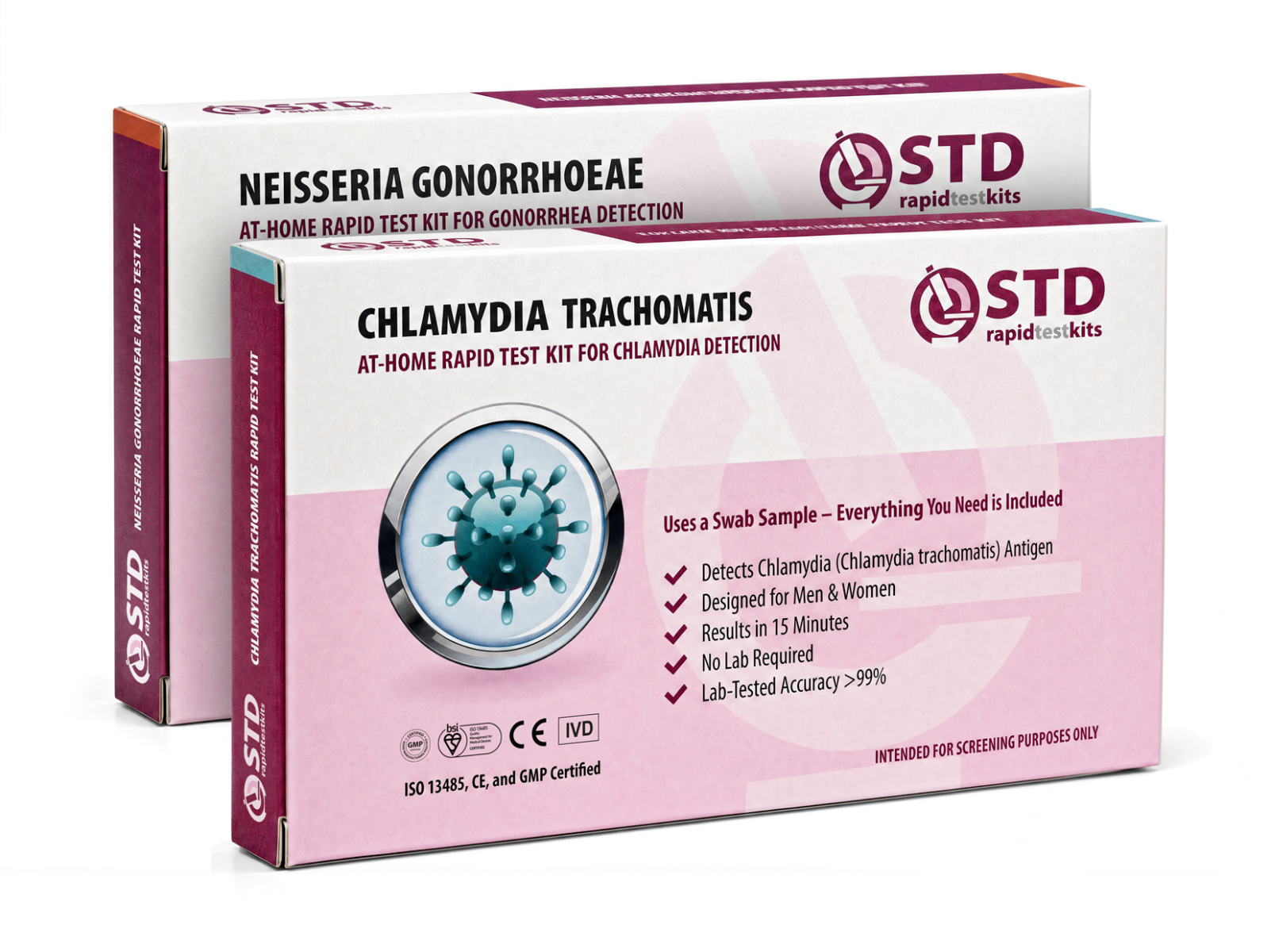
Treat home tests as your routine layer. Use a clinic NAAT for confirmation after a positive result, after a high-risk exposure, or for sample types we do not cover (throat, rectum). Disclosure: stdrapidtestkits.com sells rapid at-home lateral-flow test kits, and some product links below go to our own catalog.
When the test comes back positive
The first wave is usually shame. Then fear. Then the urge to figure out who 'gave it to you,' which is almost always less useful than it feels. Treat a positive STI result as a medical finding and move directly to treatment and notification. Most STIs are highly treatable: chlamydia, gonorrhea, trichomoniasis, and syphilis with antibiotics; herpes and HIV are managed long-term with antivirals.
HIV deserves a specific note here, because it is the fear most readers carry into this article. When viral load is suppressed to undetectable levels through consistent antiretroviral therapy, transmission risk to sexual partners drops to effectively zero. The CDC describes this finding as U=U, undetectable equals untransmittable. A positive HIV result today is a chronic, manageable condition when treatment starts early, and the prognosis is dramatically different than it was twenty years ago. Regular testing still matters because earlier diagnosis means earlier treatment.
Three things matter most after a positive result:
- Start treatment. Do not wait for confirmation if your test was a reputable home rapid and your symptoms or exposure history support the result. Telehealth services can prescribe within a day. Confirmation testing can happen alongside treatment.
- Notify partners as a health courtesy, not as an admission of fault. A useful script: 'I tested positive for X. I wanted you to know so you can get tested too. No pressure to respond to me right now.' You do not owe anyone a sexual history reconstruction. The CDC and most state health departments offer anonymous partner-notification services if a direct message feels impossible.
- Plan the retest. Most bacterial STIs need a test-of-cure or a 3-month retest after treatment to confirm the infection cleared and you were not reinfected by an untreated partner. The CDC's Expedited Partner Therapy guidance specifically addresses how to handle partners who cannot or will not see a clinician.
'Hey. Quick health update. I tested positive for [infection]. The window we were together falls inside the period when this could have been transmitted, so I wanted you to know directly. There are at-home tests and clinic options. Happy to share what I learned about timing if useful. No reply needed unless you want one.'
Short, factual, no relationship freight, no apology that implies guilt. State health departments and CDC-affiliated tools also run anonymous notification services if a direct message feels impossible.
When and why to retest, even when you are clear
Retesting is the most-skipped step and probably the highest-leverage one. A negative test taken inside the window period is provisional by definition; an early result on day 5 simply does not rule out an infection that only becomes detectable on day 10. New exposures during the gap matter too. An open structure means your timeline keeps moving, and a six-week-old result tells you nothing about contact that happened last weekend. Treatment confirmation is the other reason to retest: the CDC recommends a 3-month follow-up after chlamydia or gonorrhea antibiotics because reinfection from an untreated partner is the most common reason an infection appears to come back, not antibiotic failure.
A reasonable schedule for an open relationship after a known exposure: test now for baseline, retest at 14 days for bacterial infections, retest at 6 weeks for HIV with a 4th-generation test, and retest at 12 weeks for full coverage including syphilis. If symptoms ever appear, ignore the schedule and test immediately.
After antibiotic treatment for chlamydia or gonorrhea, the CDC recommends retesting at three months even when the original treatment course was completed correctly. Reinfection from an untreated partner is the most common reason for an apparent treatment failure, not antibiotic resistance. The CDC's Expedited Partner Therapy guidance covers how to coordinate treatment for partners who cannot or will not see a clinician.
Trust repair after a scare
An exposure scare in an open relationship lights up old fears. Am I safe with this person? Were they fully honest? Is our system actually working? It is tempting to spiral or to retreat into rules. Look forward instead: what specific gap does this scare reveal, and what concrete adjustment closes it?
One pattern shows up most often in non-monogamous networks: the existing agreement covered penetration but not oral, or it covered partners but not partners-of-partners, or the testing cadence was every 90 days when the network's actual partner-rotation rate suggested 30 days. Those are design problems in the structure, and design problems get fixed by adjusting the design.
Concrete adjustments that work after a scare: shorter testing intervals (every 30 to 60 days for actively rotating partners), broader test panels (multi-infection rather than single-target), explicit discussion of oral and other non-penetrative contact in agreements, and a rule that new partners sit through one full window-period cycle before barrier-free contact. A revised cadence and a broader panel are the two adjustments that close most gaps.
Choosing a panel that matches your exposure
If you are testing once and want broad coverage, a multi-infection panel is more efficient than running separate single-target tests. The right panel depends on your exposure history and what you are worried about:
- Recent unprotected vaginal or anal sex with a new partner: chlamydia and gonorrhea on a genital swab plus an HIV/syphilis blood test at the relevant windows.
- Several new partners in the last 90 days: a 6 to 8 infection panel covering chlamydia, gonorrhea, trichomoniasis (women), HIV, syphilis, and hepatitis.
- A partner notified you of a specific exposure: match the panel to what they tested positive for, plus the most likely co-infections (chlamydia and gonorrhea cluster together; syphilis often runs alongside HIV in surveillance data).
- Routine maintenance, no specific scare: a multi-infection panel every 30 to 90 days, calibrated to how active your network is.
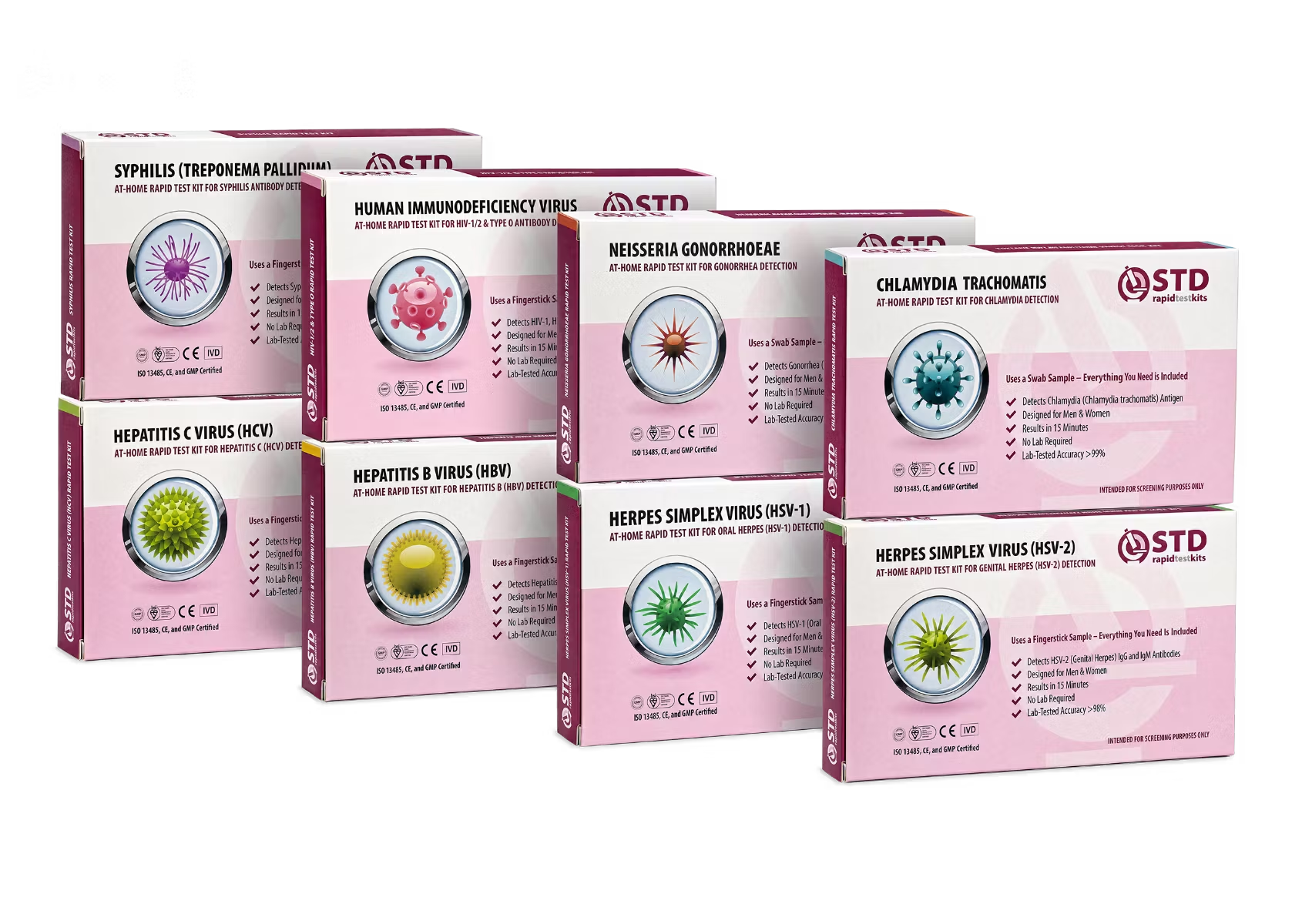
Two panels cover most of these scenarios at home: an 8-infection panel for any-gender anatomy when a single exposure could plausibly involve several infections at once, and a focused 6-infection panel when routine maintenance is the goal.
Many STDs do not cause any symptoms, especially in their early stages. Even people who feel healthy may have an infection and pass it to their partners. Testing is the only way to know for sure.
Frequently asked questions
- Can I get an STI if my partner tested negative?
- Yes, and it does not mean anyone lied. Most STIs have a window period during which someone is infected and can transmit but tests negative. A negative result taken inside that window is not a final answer. Plan for a retest at the end of the relevant window.
- How soon should I test after a risky encounter?
- The answer depends on what you were exposed to and whether symptoms have started. For bacterial infections like chlamydia and gonorrhea, test at day 10 to 14. For HIV with a 4th-generation Ag/Ab test, test at 2 to 6 weeks; rapid antibody-only tests can take up to 3 months. For syphilis, test at 3 to 6 weeks, with a final-confirmation test at 12 weeks. If symptoms have started, test immediately regardless of timing.
- We only had oral sex. That's safe, right?
- Lower risk for some infections, not zero risk. Gonorrhea, syphilis, chlamydia, herpes, and HPV all transmit through oral contact. Pharyngeal (throat) infections often have no symptoms and require a clinic-collected throat swab to detect. Our home tests do not cover throat samples; for a known oral exposure, a clinic visit is the right call.
- Can I trust at-home rapid tests?
- Yes, with the right framing. Home rapid tests are lateral-flow immunoassays, which is a different and somewhat less sensitive technology than the lab NAATs clinics use. They are accurate when used inside the right window period, and they capture infections that would otherwise go undetected because someone skipped clinic testing entirely. A positive home result is worth confirming with a lab NAAT.
- If I test positive, do I have to tell every partner?
- Ethically, yes, for any partner whose timeline overlaps with the period the infection could have been transmitted. The CDC supports anonymous partner-notification services for situations where a direct conversation is not possible. Legal disclosure rules vary by state and by infection (HIV has the strictest rules in most jurisdictions).
- I tested negative but something still feels off. What now?
- Trust your body. Rapid tests are not perfect, and some symptoms (burning, sores, atypical discharge) deserve a clinic visit even with a recent negative result. Ask specifically about a NAAT test and, if oral or anal exposure was involved, throat or rectal swabs.
- How often should we test if we are rotating partners?
- Every 30 to 90 days is a reasonable maintenance cadence for an actively non-monogamous network, with the shorter end for higher partner-turnover and the longer end for stable arrangements. Add a baseline-plus-retest cycle around any specific scare or new partner.
- Can our open relationship survive this?
- Almost always, yes, when the response is structural rather than punitive. Couples and polycules who treat an exposure as a design problem (testing cadence, panel breadth, agreement coverage of oral and partner-of-partner contact) tend to come out with stronger systems. Couples who treat it as a betrayal tend to spiral. The infection itself is rarely the actual relationship issue.
- U.S. Centers for Disease Control and Prevention. STI screening recommendations and treatment guidelines, used for window-period and treatment guidance throughout this article.
- U.S. Centers for Disease Control and Prevention. Expedited Partner Therapy clinical guidance for partner notification and treatment after a positive bacterial STI result.
- U.S. Centers for Disease Control and Prevention. HIV testing guidance and 4th-generation Ag/Ab and rapid-antibody window-period information.
- World Health Organization. Sexually transmitted infections fact sheet, used for global incidence framing and infection-by-infection summaries.
