
Published: September 2025 | Last updated: May 2026 | Editorial review and quality control: Martina N.
How can gonorrhea cause arthritis?
When gonorrhea goes untreated, the bacteria can slip into the bloodstream and settle in joint tissue. That complication is called disseminated gonococcal infection (DGI), and joint inflammation is its most common visible sign. It is uncommon, affecting an estimated 0.5% to 3% of untreated infections, and antibiotics clear most cases caught early.
Most people diagnosed with gonorrhea, or worried they might have it, focus on the obvious genital symptoms: discharge, burning, pain when urinating. Joint pain is not on that list. But for a small share of people who do not get treated quickly, the bacterium responsible for gonorrhea (Neisseria gonorrhoeae) can leave the original infection site, travel through the bloodstream, and settle in joint tissue. The medical name for that whole-body spread is disseminated gonococcal infection (DGI), and its most common visible feature is gonococcal arthritis: painful, swollen, sometimes destructive infection of one or more joints.
The deceiving part is that DGI often does not start with anything sexual at all. A young adult walks into urgent care with a swollen ankle, attributes it to a sports injury, and never mentions a recent partner. By the next day a wrist is also painful. By the day after, a low-grade fever and a few small spots on the hands have joined in. The good news is that gonococcal arthritis is uncommon, highly treatable when caught early, and entirely preventable when the original infection is found and cured. This article walks through how the bacteria actually reach a joint, what gonococcal arthritis looks and feels like, what untreated joint infection can do over time, and how clinicians diagnose and treat it today.
Key Takeaways
- Roughly 0.5% to 3% of untreated gonorrhea infections disseminate through the bloodstream to other tissues, and joint infection is the most common visible consequence.
- Catching gonorrhea early, before it disseminates, prevents joint damage entirely. A short course of the right antibiotic clears most uncomplicated cases.
How Neisseria gonorrhoeae moves from the genital tract into the bloodstream
Gonorrhea is a bacterial infection caused by Neisseria gonorrhoeae, a paired spherical organism (a diplococcus) that prefers to live on warm, moist mucous membranes. In sexually active adults, that usually means the cervix, urethra, rectum, or throat. Most infections stay local. A person feels burning when they urinate, notices unusual discharge, or develops pelvic pain over the following days, and a clinician treats the infection with antibiotics before it goes anywhere else.
Asymptomatic infection is the problem. The U.S. Centers for Disease Control and Prevention reports that gonorrhea often causes no symptoms, and most women with gonorrhea have no symptoms at all (CDC: about gonorrhea). Pharyngeal and rectal infections are particularly stealthy because the affected tissue produces little visible inflammation. A silent infection has time. Time gives the bacterium opportunities to cross from a mucous membrane into the bloodstream, where it causes a condition called bacteremia.
Once N. gonorrhoeae is circulating in the blood, it can lodge anywhere the body offers hospitable tissue: joint capsules, skin, tendon sheaths, and occasionally the heart valves or the membranes surrounding the brain. The bacterium carries surface proteins that help it stick to synovial cells (the cells lining the inside of a joint cavity) and resist clearance by the immune system. The result is what clinicians call disseminated gonococcal infection, or DGI.
Estimates of how often DGI happens vary. Public health and infectious disease references place the risk at roughly 0.5% to 3% of untreated gonorrhea cases; the CDC's STI Treatment Guidelines describe these disseminated presentations in their Gonococcal Infections section (CDC: STI Treatment Guidelines). That percentage is small, but the absolute number is not. The CDC's most recent provisional surveillance counted 543,409 reported gonorrhea cases in the United States in 2024, the third straight year of decline (CDC: STI annual surveillance). Even a fraction of a percent of that total still works out to thousands of disseminated infections nationwide each year.

Localized gonorrhea versus disseminated infection
Almost all gonorrhea stays where it started: at the mucous membranes of the cervix, urethra, rectum, or throat. That local infection causes the symptoms most people associate with the disease, or no symptoms at all, and it clears with standard antibiotics. Disseminated gonococcal infection is the uncommon detour, when the same bacterium reaches the bloodstream and the illness turns systemic. The two can look like entirely different conditions, which is exactly why DGI is so often missed. The table below lays them side by side.
Localized Gonorrhea vs Disseminated Gonococcal Infection
| Feature | Localized gonorrhea | Disseminated gonococcal infection (DGI) |
|---|---|---|
| Primary site | Genitals, throat, or rectum | Bloodstream, joints, and skin |
| Common symptoms | Burning urination, discharge, pelvic pain, or none at all | Migratory joint pain, low-grade fever, small painless skin spots, tendon inflammation |
| Typical onset | Often within days of exposure | Days to weeks after an untreated infection |
| Severity | Often mild or silent | Systemic illness that can progress to septic arthritis |
| Usual treatment | A single ceftriaxone injection in most outpatient cases | Often hospital admission with intravenous antibiotics |
Localized gonorrhea and disseminated gonococcal infection can present as two very different illnesses.
Who is most likely to develop gonococcal arthritis
Some readers carry noticeably higher risk than others, and the difference comes down to two factors: how easily the bacterium reaches the bloodstream, and how well the body clears it once it does.
Women are diagnosed with DGI more often than men. The reasons are partly anatomical and partly immunological. Cervical and pharyngeal infections in women are more likely to be asymptomatic than urethral infections in men, so they go untreated for longer. Pregnancy and menstruation both alter cervical mucus and local immune signaling in ways that may make bacteremia easier. Pregnant women in the U.S. are screened for gonorrhea at antenatal visits precisely because the consequences of untreated infection extend to the joint complications discussed here and to the newborn (NHS: gonorrhoea complications).
People with reduced immune function are also at higher risk. That category includes individuals with complement system deficiencies (a specific arm of the immune system that handles bacteria with capsules), HIV-positive people not on effective antiretroviral therapy, and patients on long-term immunosuppressive medication. The complement deficiency category is rare but well documented in the infectious disease literature: people who keep getting unexplained Neisseria infections, including meningococcal disease and DGI, often turn out to have an inherited complement defect.
The third risk factor is simply exposure. Any person who acquires gonorrhea but does not get treated for it can develop DGI. Multiple sexual partners and irregular condom use increase the chance of acquiring gonorrhea in the first place, which in turn increases the cumulative chance of dissemination if any one infection is missed. None of those risk factors are necessary, though. Untreated gonorrhea, given enough time, can disseminate regardless of the number of partners or the specific exposure event. The more useful question is whether you have been exposed, and whether you have tested at the right window, rather than whether you fit a risk profile.
- Women, especially during pregnancy or menstruation. Cervical and pharyngeal infections in women are more often asymptomatic, so they go untreated longer.
- People with reduced immune function, including complement system deficiencies, untreated HIV, and patients on long-term immunosuppressive medication.
- Anyone with an untreated gonorrhea infection. Exposure plus delayed treatment is the single most common path to dissemination.
What gonococcal arthritis feels and looks like
Gonococcal arthritis shows up in two overlapping clinical pictures, and one person can move through both. Clinicians call them the arthritis-dermatitis syndrome and the purulent arthritis syndrome.
The arthritis-dermatitis syndrome usually comes first. It is recognized by a classic three-part pattern: migratory joint pain, low-grade fever, and small painless skin lesions. None of those three signs means much on its own. The combination is what shifts clinical suspicion toward infection. Tendon sheaths often become inflamed at the same time, a finding called tenosynovitis, most noticeable along the back of the hand, the wrist, or the ankle.
The skin lesions are easy to dismiss. They are usually only a few millimeters across, fewer than a dozen in total, and rarely painful. Some carry a tiny pustule in the center, and some look like fragile blisters that crust over within a day or two. People routinely mistake them for eczema, a bug bite, or a stress flare, and almost no one connects them to a recent sexual exposure.
The purulent, or pus-producing, picture comes next, sometimes alongside the first and sometimes a few days later. Here the infection narrows to one or two joints. A single joint becomes swollen, hot, red, and intensely painful to move, with fluid that can be felt as a soft bulge inside the capsule. The knee is the most common single joint, followed by the wrist and ankle. The whole-body symptoms often ease as the infection localizes, which can fool people into delaying care just when the joint is most at risk.
A new, intensely painful, swollen, hot joint, especially alongside a fever, is treated as septic arthritis until proven otherwise, because a bacterial joint can lose cartilage within days. Anyone with that combination and any chance of a recent gonorrhea exposure should go to urgent care or an emergency department the same day rather than waiting for a routine appointment.
Signs that point to disseminated gonococcal infection
Having one of these means little by itself. Migratory joint pain, fever, and small painless skin spots appearing together within a few weeks of a possible exposure is the pattern that warrants prompt medical evaluation.
- Migratory joint pain that moves between the wrists, ankles, knees, and small joints of the hands and feet over a few days Common
- Tenosynovitis: inflamed tendon sheaths, often along the back of the hand, wrist, or ankle, where moving the tendon hurts more than the joint itself Common
- Small painless red or pus-filled skin spots on the hands, feet, arms, or legs, usually fewer than a dozen in total Common
- Low-grade fever, often 100 to 102 degrees Fahrenheit, with chills and a general unwell feeling Common
- A single hot, swollen, intensely painful joint, most often the knee, that is hard to move Less common
- Fatigue and body aches accompanying the fever during the bloodstream phase Less common
The two-stage progression in detail
The two clinical pictures described above are often discussed as two consecutive biological stages, because they reflect what the bacterium is doing inside the body.
The first stage is the bacteremic stage. N. gonorrhoeae is actively circulating in the blood. The immune system is mounting a generalized response, which is why fevers, chills, body aches, and the scattered skin lesions all happen at once. Blood cultures drawn during this stage are sometimes positive for N. gonorrhoeae, although the yield is not as high as for some other bacterial bloodstream infections, because the organism is fragile and grows slowly on standard culture media.
The second stage is the localized septic arthritis stage. The bacterium has settled into one or two specific joints and is replicating there. Fluid in the joint becomes thick and cloudy as white blood cells flood in. Cultures of joint fluid have a much better chance of growing the organism than blood cultures at this stage, which is one reason joint aspiration (drawing fluid out of the joint with a needle) is part of the standard diagnostic workup.
The transition between stages can take anywhere from two days to two weeks (per CDC STI Treatment Guidelines). Some people present in stage one and move into stage two over the course of their hospital admission. Others present in stage two without remembering any of the systemic symptoms from stage one, because they attributed those to a flu or to overwork.
Recognizing the two stages matters because antibiotic strategy changes slightly between them. Early bacteremic disease usually responds to a shorter course of intravenous antibiotics followed by an oral switch. Localized purulent joint infection often needs longer intravenous therapy plus, in some cases, physical drainage of the joint to remove infected fluid.

What untreated gonococcal arthritis does over time
Most cases that get diagnosed and treated within the first week resolve completely. The joint returns to normal and there is no permanent damage. The picture changes when the infection is missed, or when a person waits to seek care, or when a different diagnosis is treated first while the gonococcal infection continues.
The first tissue to suffer is cartilage. The cells in an infected joint release enzymes that break down the smooth cartilage surface lining the joint. Cartilage does not regenerate. Once a meaningful amount of it is gone, the joint cannot move smoothly again. The clinical consequence is post-infectious arthritis: ongoing pain, stiffness, and reduced range of motion in the affected joint, even after the bacterial infection itself has been cured.
The second thing at risk is the joint capsule and its supporting ligaments. Prolonged inflammation can stretch and weaken these structures. In severe cases the joint becomes mechanically unstable, and surgical reconstruction is sometimes needed.
The third concern is rare but devastating: gonococcal endocarditis, where the bacterium attaches to a heart valve from the bloodstream. This is an uncommon complication of DGI, but when it occurs it is life-threatening and requires weeks of intravenous antibiotic therapy. Gonococcal meningitis (infection of the membranes around the brain) is even rarer but follows the same biology.
Joint damage from infection accumulates with every day the infection is active, which is why most clinicians start intravenous antibiotics on clinical suspicion rather than waiting for culture confirmation. Speed of diagnosis and speed of starting effective antibiotics are the two biggest predictors of full recovery.
Disseminated gonococcal infection can manifest as petechial or pustular acral skin lesions, asymmetric polyarthralgia, tenosynovitis, or oligoarticular septic arthritis.
How clinicians actually diagnose gonococcal arthritis
When someone arrives at urgent care or an emergency room with a hot, swollen joint and a fever, clinicians move through a familiar checklist. They evaluate for trauma, autoimmune disease, gout, viral arthritis, and bacterial infection. If there is enough fluid in the joint, they aspirate it with a needle and send the sample to the laboratory for cell count, crystal analysis, Gram stain, and culture. Blood tests and blood cultures usually follow.
Patient history matters more than most readers expect. A sexually active adult presenting with a swollen joint, fever, and skin lesions raises suspicion immediately, but the conversation about recent sexual exposure is what speeds things up. Some patients are reluctant to share that history with a clinician they have just met, which can delay the diagnosis by a day or two. Clinicians cannot test for something they have not been asked to consider, and a one-sentence disclosure about a recent partner can shorten the diagnostic path considerably.
The CDC's STI Treatment Guidelines recommend nucleic acid amplification tests (NAATs) on urogenital, rectal, and pharyngeal samples in any patient with suspected DGI (CDC: STI Treatment Guidelines, see the Gonococcal Infections section). NAATs are the laboratory gold standard for detecting gonorrhea (MedlinePlus: gonorrhea diagnosis). Specimens from the throat or rectum are easy to miss if not specifically requested. Joint fluid analysis often combines Gram stain, culture, and polymerase chain reaction (PCR) testing. Joint fluid does not always grow N. gonorrhoeae directly, partly because the bacteria are fragile and partly because the body has often started clearing them by the time the joint becomes symptomatic. A negative joint culture does not rule DGI out on its own.
Imaging is sometimes added. X-ray is usually unhelpful in the first few days. Magnetic resonance imaging (MRI) can show the extent of soft tissue and cartilage involvement when the diagnosis is uncertain or when joint damage is suspected.
| Diagnostic stream | What it finds |
|---|---|
| Patient history and sexual health interview | Identifies likely exposure sites and risk factors; guides which sample sites the clinician orders tests for |
| Joint aspiration (drawing fluid out with a needle) | Confirms bacterial joint infection through high white-cell count; Gram stain, culture, and PCR can identify N. gonorrhoeae in the fluid |
| NAAT at original infection sites (urethra, cervix, rectum, pharynx) | Lab gold standard for detecting active gonorrhea at the original mucous-membrane site; specimens from throat or rectum require specific request |
| Blood cultures, two sets drawn before antibiotics | Captures N. gonorrhoeae during the bacteremic stage; a positive culture confirms the systemic nature of the infection |
Testing windows and what at-home tests can and cannot do
Gonorrhea testing has a window period. The most sensitive laboratory tests, nucleic acid amplification tests (NAATs), can typically detect the infection from about five to seven days after exposure, with reliability climbing through the second week (per CDC STI Treatment Guidelines). Testing too soon after exposure risks a falsely reassuring negative. Testing at the wrong site can miss it entirely, since pharyngeal and rectal infections need swabs of those specific sites rather than a urine sample or a genital swab.
At-home rapid lateral-flow kits, such as an at-home gonorrhea test, work on the same swab-based sample logic as clinic tests, with the trade-off that lateral-flow chemistry is less analytically sensitive than laboratory NAAT. A reactive at-home result is worth confirming with a clinical laboratory NAAT before treatment begins, and a negative result is most reliable when collected during the appropriate window. The two technologies are complementary rather than interchangeable: rapid kits serve the privacy-and-speed use case, while lab NAAT delivers the maximum analytical sensitivity for confirmation.
One point matters for this topic in particular: a rapid lateral-flow home kit is not a tool for diagnosing gonococcal arthritis itself. It screens for an active gonorrhea infection at the swabbed site, which is how you catch the problem before it can reach a joint. Anyone already showing signs of joint infection needs same-day clinic or emergency department evaluation, not a home swab. The table below summarizes how timing and symptoms intersect with testing decisions.
| Time after exposure | Possible symptoms | Testing guidance |
|---|---|---|
| 0 to 5 days | Often none; anxiety common | Usually too early for reliable detection; wait if you can |
| 7 to 14 days | Burning urination, discharge, mild pelvic pain, or still none | Optimal window for most NAAT and rapid lateral-flow tests |
| 2 to 4 weeks (untreated) | Possible migratory joint pain, low-grade fever, or small skin lesions in rare cases | Test promptly; seek clinical evaluation if systemic symptoms are present |
| After treatment | Symptoms usually improve within days | Retest at about 3 months to rule out reinfection |
Treatment: antibiotics, sometimes joint drainage
Gonococcal arthritis is curable. Treatment has two parts: clearing the bacterium from the body, and limiting damage to the joint.
The antibiotic strategy follows the current CDC STI Treatment Guidelines (CDC: STI Treatment Guidelines, Gonococcal Infections section). The recommended starting regimen for disseminated gonococcal infection is intravenous ceftriaxone, usually 1 gram every 24 hours, continued for at least 24 to 48 hours after clinical improvement is documented. Once the patient is afebrile and the joint symptoms are stabilizing, treatment is switched to an oral cephalosporin (such as cefixime) to complete a total course of about 7 days. Severe cases involving endocarditis or meningitis require longer intravenous courses.
Coverage for chlamydia is added when chlamydia infection has not been ruled out, because the two often co-occur. Final antibiotic selection always depends on the susceptibility pattern reported by the laboratory, particularly given rising concern about antibiotic-resistant gonorrhea worldwide (WHO: sexually transmitted infections).
The second part of treatment is mechanical. In the purulent arthritis stage, the joint may need repeated needle aspiration to remove infected fluid. Larger joints like the knee tolerate this well. A small share of cases need arthroscopic washout in an operating room, especially when the infection has been present for several days before treatment began. Physical therapy is added once the active infection is controlled, to restore range of motion before scar tissue forms.
Most people respond rapidly. Fever drops within 24 to 48 hours of starting the right antibiotic. Joint swelling improves over the following week. Full functional recovery, when treatment starts early, is the rule rather than the exception.
One detail worth knowing: sexual partners from the past 60 days should also be tested and treated, even if they have no symptoms. Treating one half of a couple while leaving the other untreated invites reinfection. Some public health departments offer expedited partner therapy, where a partner can sometimes be treated without a separate clinic visit. A retest about three months after treatment is recommended for most people, since reinfection from an untreated partner is more common than treatment failure.
- Start: Intravenous ceftriaxone 1 g every 24 hours, continued for at least 24 to 48 hours after clinical improvement.
- Step down: Switch to an oral cephalosporin (such as cefixime) once the patient is afebrile and joint symptoms are stabilizing.
- Total course: About 7 days for uncomplicated DGI; longer for endocarditis or meningitis.
- Also cover chlamydia when co-infection has not been ruled out.
- Partner treatment: Sexual partners from the past 60 days should be tested and treated.
When joint pain points to infection and when it does not
Not every swollen joint is gonorrhea. Most are not. Sports injuries, autoimmune flares, gout, viral arthritis, and simple overuse are far more common explanations for joint pain. But the pattern that should raise the question of infection looks distinctly different from the pattern of a mechanical injury.
A sprain usually has a clear injury behind it and stays in one joint that hurts most with movement. Septic arthritis arrives with no obvious trauma, often with fever, and the joint feels hot to the touch. If the pain is migratory or there are small skin lesions, the picture tilts firmly toward infection. When in doubt, doctors aspirate fluid from the joint and run laboratory tests to settle it. The table below summarizes the differences clinicians watch for when sorting out what might be infection-related from what is almost certainly not.
| Symptom pattern | More likely mechanical injury | More concerning for infection |
|---|---|---|
| Onset | Gradual, after activity or a clear injury | Sudden swelling with no clear cause |
| Fever | Absent | Low-grade or higher fever present |
| Skin findings | None | Small painless red or purple spots on hands, feet, or trunk |
| Joint distribution | Single overused joint, stays in one place | Migratory pain affecting multiple joints over a few days |
| Recent sexual exposure | Not relevant | New or unprotected partner within the last few weeks |
Prevention: catching gonorrhea before it disseminates
Every case of gonococcal arthritis begins as an ordinary gonorrhea infection that no one caught in time. Preventing it means working on two fronts at once: lowering the chance of acquiring gonorrhea, and finding any infection quickly when it does happen.
On the first front, condoms used during vaginal, anal, and oral sex reliably reduce transmission, though not to zero. Honest conversations about STI status with new partners feel awkward, yet they change behavior on both sides. Reducing the number of overlapping partners lowers cumulative exposure.
On the second front, regular testing is the single most useful tool. The CDC recommends annual gonorrhea and chlamydia screening for all sexually active women under 25, and for older women with risk factors such as a new partner, multiple partners, or a partner with an STI (CDC: about gonorrhea). It also advises at least annual screening for men who have sex with men, more often (every 3 to 6 months) for those with higher exposure, and screening for pregnant women at the first antenatal visit, repeated in the third trimester for those at continuing risk.
Anyone who suspects a recent exposure, in any category, can shorten the gap between infection and diagnosis by testing sooner. Rapid lateral-flow home kits use a self-collected swab and give a screening result in roughly 15 minutes. Confirm any reactive home result with a clinical laboratory NAAT before treatment begins. Testing within days of a suspected exposure, rather than waiting for symptoms that may never come, is what keeps a local infection from ever reaching the bloodstream.
Disclosure: stdrapidtestkits.com publishes this article and sells at-home rapid lateral-flow STI test kits; the product below is one of them. We recommend kits based on fit for the reader's concern, not commercial benefit.
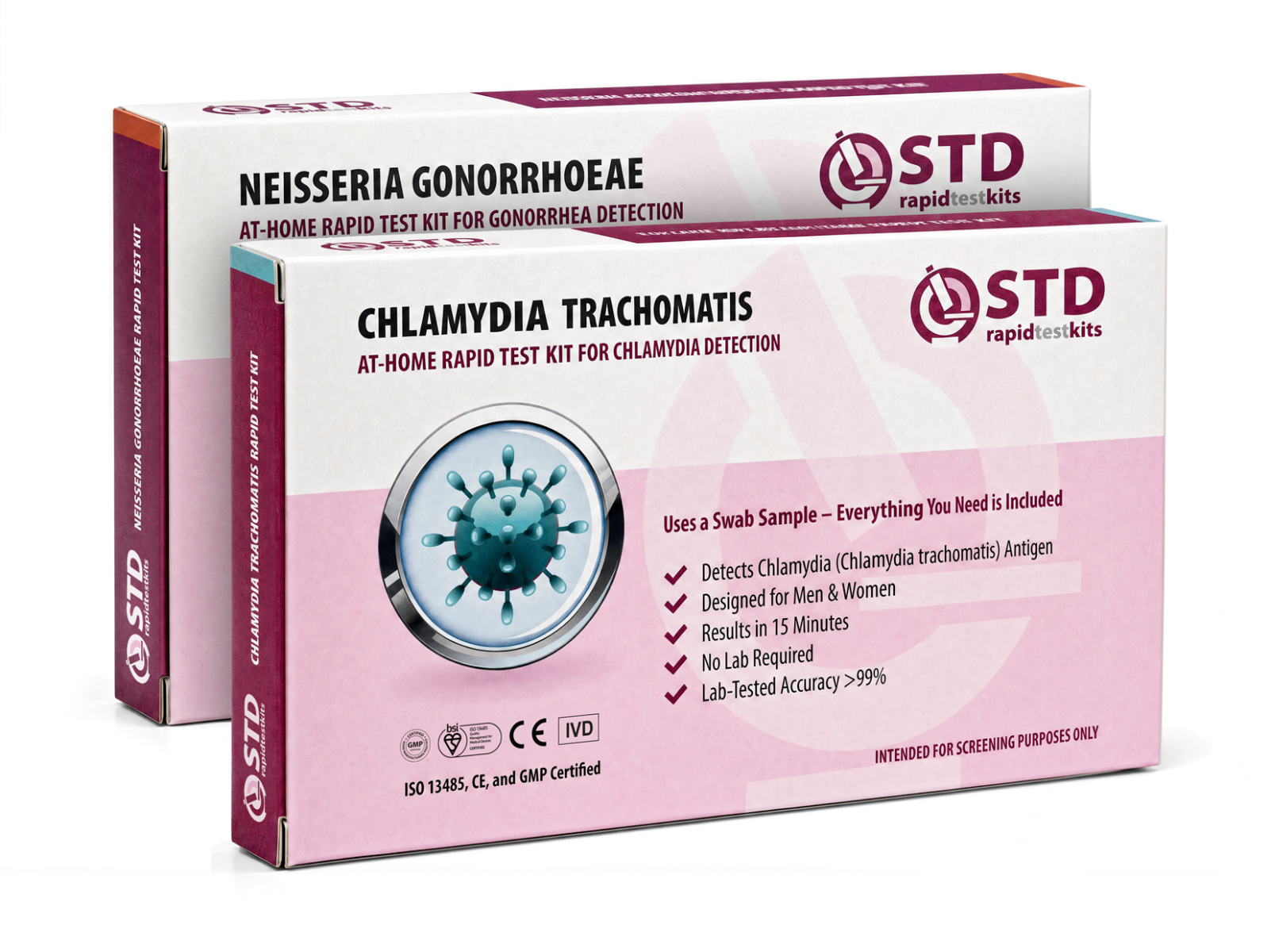
What to do next
Your next move depends on whether you already have symptoms or are mainly worried about a recent exposure. Work through the short guide that follows, and when anything is unclear, a clinician can point you to the right test.
Should I test, or see a clinician today?
Do you already have a hot, swollen, painful joint, a fever, or small painless skin spots?
Yes: Go to urgent care or an emergency department the same day. A home swab cannot diagnose or treat a joint infection, and a bacterial joint can lose cartilage within days. Mention any sexual activity in the past month so the clinician orders the right tests.
Have you had a possible gonorrhea exposure in the past two weeks but feel well?
Yes: Test now with a swab-based gonorrhea kit or a clinic NAAT, then confirm any reactive result with a laboratory NAAT before treatment. Notify partners from the past 60 days so they can test too.
No: If it has been longer than that, or you have ongoing risk, test at your next routine screening and still let recent partners know so they can be checked.
Guidance only. A healthcare provider can advise based on your specific situation.
Frequently asked questions
- What is gonococcal arthritis?
- Gonococcal arthritis develops when gonorrhea bacteria leave the original genital, rectal, or throat infection site, enter the bloodstream, and colonize a joint. The clinical label for that whole-body spread is disseminated gonococcal infection (DGI), and joint involvement is its most visible feature. Affected joints become painful, swollen, and warm; without treatment, lasting cartilage damage can follow.
- How fast does gonorrhea spread to the bloodstream?
- It does not usually happen overnight. Dissemination typically develops days to weeks after the original infection becomes established, and almost always in infections that have gone untreated. The reliable testing window opens at about five to seven days after exposure, so testing within the first two weeks can catch most infections before they have any chance to disseminate.
- Could I have gonorrhea with no burning or discharge?
- Yes, and that is common. Most women with gonorrhea have no symptoms at all, and throat and rectal infections are even more likely to be silent. A quiet infection is exactly what gives gonorrhea time to go untreated and, in a small share of cases, disseminate. That is why testing after a possible exposure matters even when nothing feels wrong.
- How common is gonococcal arthritis?
- Rare enough that most people with gonorrhea never experience joint involvement. But because gonorrhea is common (more than 543,000 cases reported in the U.S. in 2024 alone), even a small dissemination rate adds up to thousands of joint infections a year. The 0.5% to 3% figure that gets cited comes from infectious disease references rather than a single definitive trial, so treat it as a range, not a precise number.
- Is DGI life-threatening?
- Serious complications are uncommon, and most people recover fully with prompt antibiotics. Rarely, bloodstream gonorrhea can reach a heart valve (endocarditis) or the membranes around the brain (meningitis), and both need urgent hospital care. The risk drops sharply once effective antibiotics start, which is why the dangerous word is untreated rather than DGI itself.
- How do doctors tell septic arthritis apart from a sprain?
- Fever is the clearest dividing line. A true sprain does not cause a fever; bacterial joint infection almost always does by the time a joint becomes visibly swollen. The second clue is mechanism. A sprain follows a remembered injury or activity, while an infected joint flares up out of nowhere. If symptoms include moving pain across multiple joints, or a scattering of small painless spots on the hands or feet, that combination shifts suspicion further toward infection. A clinic can settle the question quickly by drawing fluid out of the joint and running it for cell count, Gram stain, and culture.
- Will gonococcal arthritis go away on its own?
- No. Without antibiotic treatment, the joint infection progresses and causes cartilage damage that does not reverse. Untreated cases also continue to seed the bloodstream, raising the risk of rare but serious complications such as endocarditis or meningitis. With prompt antibiotic treatment, however, most people recover joint function fully.
- Can a home rapid test diagnose gonococcal arthritis?
- No. A home rapid swab screens for current gonorrhea at the swabbed site, which is useful screening information. It cannot aspirate joint fluid, run a Gram stain, deliver intravenous antibiotics, or drain an infected joint. Once joint symptoms have appeared, diagnosis requires clinical evaluation including joint fluid analysis, NAAT testing at the original infection sites, blood cultures, and antibiotic decisions that only a clinician can make.
- Do I have to tell my partner if I test positive?
- Yes, and it does not have to be dramatic. A short message that says, "I tested positive for gonorrhea, you should get checked too," is enough. Some public health departments offer expedited partner therapy, where a partner can sometimes be treated without a separate clinic visit. Untreated partners are the most common reason for reinfection, which is why the conversation matters even when it feels awkward.
- U.S. Centers for Disease Control and Prevention. About gonorrhea, used here for transmission, asymptomatic infection rates, screening recommendations, and complications of untreated infection.
- U.S. Centers for Disease Control and Prevention. STI Treatment Guidelines, used here for recommended antibiotic regimens for disseminated gonococcal infection and the clinical description of DGI presentations (see the Gonococcal Infections Among Adolescents and Adults section).
- U.S. Centers for Disease Control and Prevention. STI annual surveillance, used here for the 543,409 reported U.S. gonorrhea cases in 2024 (provisional) and the third consecutive annual decline.
- U.K. National Health Service. Gonorrhoea overview, used here as a patient-facing reference for symptoms, pregnancy and newborn risks, and complications of untreated infection.
- World Health Organization. Sexually transmitted infections fact sheet, used here for the global burden of gonorrhea and rising antimicrobial resistance in N. gonorrhoeae.
- MedlinePlus (U.S. National Library of Medicine). Gonorrhea reference page, used here as a patient-facing reference for laboratory diagnosis and treatment basics.
