
Published: July 2025 | Last updated: May 2026 | Editorial review and quality control: Martina N.
The short answer is almost never. Chlamydia trachomatis is a fragile bacterium that only multiplies inside the cells lining warm, moist mucosal surfaces, so casual contact, shared bathrooms, swimming pools, and most everyday situations do not transmit it. A small number of narrow routes genuinely matter, and the rest are urban-legend territory. This guide walks through what counts as ‘sexually active’ in a clinical sense, the rare non-sexual transmission paths that have been documented, the everyday situations that have not, and how to decide whether an at-home test is worth doing for your specific situation.
Key Takeaways
- Chlamydia spreads almost exclusively through sexual contact involving the genitals, anus, throat, or eye area; it does not survive long enough on dry surfaces like toilet seats, towels, or pool decks to infect anyone.
- The two documented non-sexual routes are vertical transmission from a pregnant parent to the baby during birth, and rare eye infections from fresh transfer of genital fluids to the eye via contaminated fingers or shared products.
Can You Get Chlamydia Without Being Sexually Active?
In the vast majority of cases, no. The CDC's chlamydia information describes the infection as transmitted through vaginal, anal, or oral sex with an infected partner. Surveys of confirmed cases find a sexual exposure history in nearly everyone diagnosed. The exceptions are narrow enough that they can be listed in a paragraph.
Two narrow exceptions exist. A baby can acquire chlamydia from a pregnant parent during vaginal delivery. A person can develop chlamydial conjunctivitis if infected genital fluid is transferred to the eye, typically from contaminated fingers or, very rarely, from a shared washcloth or eye-makeup product used immediately after a person with an active urogenital infection. That is essentially the complete list of non-sexual transmission paths supported by clinical evidence.
Everything else readers worry about, including toilet seats, hot tubs, swimming pools, sharing a glass, sharing a meal, sitting on chairs, sharing a bed without sexual contact, hugging, or social kissing, does not transmit chlamydia in any meaningful clinical sense. The bacterium simply cannot stay alive long enough on those surfaces, or at the temperatures involved, to reach a new person's mucosal tissue and establish infection.
Documented and supported by clinical evidence: vertical transmission during vaginal birth; autoinoculation from infected genital fluids to the eye; rare adult eye infections from shared eye-makeup or washcloths used within minutes of contact with an infected person's genital fluids.
Not supported by clinical evidence: toilet seats, hot tubs, swimming pools, shared cutlery or drinks, hugging, social kissing, shared laundry, gym equipment, or any other casual contact scenario.
What ‘Sexually Active' Actually Means in a Clinical Context
Part of the confusion about non-sexual transmission comes from how narrowly the word ‘sex' gets defined in casual conversation. Many people who say they have never been sexually active are using the term to mean penile-vaginal penetrative intercourse only. Clinicians use a much broader definition, and the difference matters when you are trying to assess your own risk.
In clinical practice and in public-health guidance, sexual activity that can transmit chlamydia includes any genital-to-genital contact (with or without penetration), any genital-to-anal contact, any genital-to-mouth contact, transfer of genital fluids from one person's body to another's mucosa using fingers or sex toys, and oral-anal contact. Penetration is not required. Ejaculation is not required. A condom dramatically reduces but does not fully eliminate risk, because the bacterium can live on skin not covered by latex.
So a person who has had genital touching, oral-genital contact, dry humping with shared fluids, or mutual masturbation with shared fingers can transmit or acquire chlamydia even if they would not describe themselves as having had ‘sex.' If any of those situations applies and you are worried, it is reasonable to test, regardless of how you would label your sexual history out loud.
What counts as transmission-capable contact
- Genital-to-genital contact, with or without penetration
- Genital-to-anal contact (giving or receiving)
- Oral-genital and oral-anal contact
- Transfer of genital fluids by fingers, hands, or shared sex toys
- Any of the above without a condom, or with a condom that slips, breaks, or does not cover all contact skin
The Genuine Non-Sexual Transmission Routes
Stripping out the redefined-sex situations described above, what remains is a very short list of truly non-sexual transmission paths. Each one is documented in peer-reviewed literature and referenced on CDC chlamydia pages, but the conditions required for each route are specific and uncommon.
Vertical transmission at birth is the best-documented non-sexual path. If a pregnant person has untreated chlamydia at the time of vaginal delivery, the newborn can pick up the bacterium as it passes through the birth canal. This is why prenatal chlamydia screening is part of routine first-trimester care in the United States and the United Kingdom.
Autoinoculation to the eye is the second documented path. A person with a urogenital chlamydia infection can transfer the bacterium to their own eye via hands that touched infected fluids and then touched the eye. The result is chlamydial conjunctivitis, which is treatable with antibiotics but can be persistent if it is mistaken for ordinary bacterial pink-eye.
Direct fluid contact in a non-sexual context is the third route, and it is genuinely rare. Case reports exist of chlamydial eye infections in adults who shared washcloths, makeup applicators, or eye drops with a person who had a recent urogenital infection. These cases are scattered and require a specific chain of events: infected fluid, transfer within minutes, contact with mucosal tissue.
If you have never had any form of sexual contact, and you were not treated as a newborn for chlamydial conjunctivitis or pneumonia, the practical probability that you have a current chlamydia infection is essentially zero. Testing is reasonable purely for reassurance, but you do not have a medical reason to assume you are infected.
Mother-to-Baby Transmission During Birth
Of all the non-sexual routes, vertical transmission is the one that actually accounts for a meaningful number of cases globally. The CDC's chlamydia guidance recommends routine prenatal chlamydia screening at the first prenatal visit precisely because untreated infection at delivery can pass to the newborn during passage through the birth canal.
Two newborn conditions are associated with maternal chlamydia. Neonatal conjunctivitis, also called ophthalmia neonatorum, typically appears within the first month of life as red, swollen eyes with discharge. Chlamydial pneumonia is the second, usually presenting between four and twelve weeks of age with a staccato cough, congestion, and sometimes a low-grade fever. Both are treatable with appropriate antibiotics but require prompt diagnosis to avoid complications.
From the adult perspective, the implication is straightforward. A person who was born vaginally to a parent with untreated chlamydia may have been treated for conjunctivitis or pneumonia in infancy. Some of those infants were never formally diagnosed at the time, but chlamydial infection in newborns does not lie dormant into adulthood. If it was not treated, it would have resolved on its own or caused obvious symptoms decades earlier.
Neonatal conjunctivitis (ophthalmia neonatorum). Onset within the first month of life. Red, swollen eyelids with mucopurulent discharge. Untreated, it can damage the cornea.
Chlamydial pneumonia. Onset typically between 4 and 12 weeks. Hallmark is a staccato cough, often with congestion and only a low-grade or absent fever. Diagnosis needs a specific test; standard infant pneumonia panels can miss it.
Eye Infections from Contaminated Fingers or Shared Products
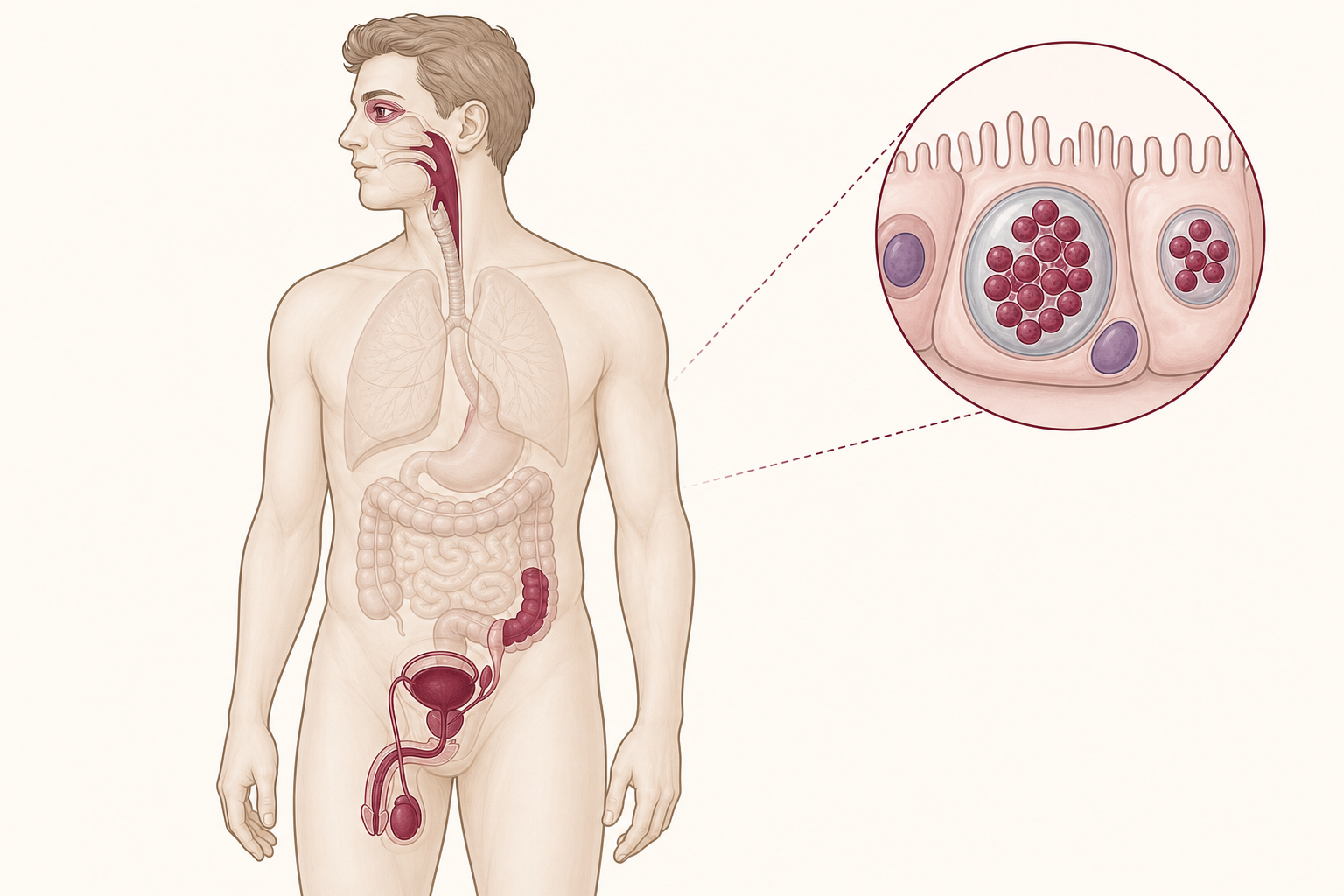
Adult chlamydial conjunctivitis is rare but real. The pattern is almost always autoinoculation: a person with an existing urogenital chlamydia infection touches genital fluids, then rubs their eye, and the bacterium establishes infection on the conjunctival surface. The NHS chlamydia page covers transmission via vaginal fluid and semen and notes that chlamydia can affect the eyes if these fluids contact them.
The symptoms look like a stubborn case of pink-eye that does not respond to standard over-the-counter eye drops. Expect redness, swelling, watery or mucopurulent discharge, and a foreign-body sensation in one or both eyes. The infection usually responds within a couple of weeks to oral or topical antibiotics prescribed specifically for chlamydia, but standard bacterial-conjunctivitis treatment will miss it.
Person-to-person transmission to the eye without sexual contact is unusual. Documented cases involve shared eye-makeup applicators used immediately after a person with active urogenital infection, shared washcloths used to clean the genital area and then the face, or, in older literature, contaminated swimming pool water. The pool-water route is now considered largely unsupported by modern epidemiology. The common thread in genuine cases is fresh, wet transfer of infected genital fluid directly onto eye tissue. Dry surfaces and indirect contact do not transmit.
If you have persistent unilateral or bilateral pink-eye that does not improve within a week of standard treatment, ask a clinician about a chlamydia eye swab. The lab needs to know to test specifically for it; routine bacterial cultures will not pick it up.
Shared Sex Toys: Still Sexual Activity by Definition
People sometimes ask whether sharing a vibrator or other sex toy counts as ‘being sexually active.' Clinically, yes. Any transfer of genital fluids between people, even when mediated by an object, counts as a transmission opportunity. Public-health guidance treats shared, unwashed sex toys the same way it treats unprotected genital contact: as a route by which bacteria in genital fluid can reach a new person's mucosal tissue.
The mechanism is direct. A toy used vaginally or anally by an infected person picks up bacteria-laden fluid. If the toy is then used by a second person without being washed or fitted with a fresh condom, the fluid transfers to their mucosal tissue and can establish infection. The per-act risk is roughly comparable to unprotected genital contact, depending on the toy's surface and the time between uses.
If a reader is otherwise non-sexually active but has shared a sex toy with someone whose chlamydia status they did not know, that situation is a legitimate testing scenario, regardless of how they describe their sexual history elsewhere.
Use a fresh condom per user. Roll a new condom onto the toy each time a different person uses it. Swap condoms, not toys.
Wash thoroughly between users. Soap and warm water work for most non-porous toys. Some materials tolerate boiling or the top rack of a dishwasher; others do not. Follow the manufacturer's care instructions before applying heat.
Toilets, Towels, and Hot Tubs: Why These Myths Refuse to Die
The most persistent question readers ask is whether chlamydia can be picked up from a toilet seat. Public-health authorities have answered this so consistently that it is worth quoting plainly: it cannot. CDC chlamydia information confirms that transmission requires sexual contact, and toilet seats do not provide the warm mucosal environment chlamydia needs to survive and infect a new person.
The biology underlying the myth-debunking is straightforward. Chlamydia trachomatis is an obligate intracellular parasite. It must enter living host cells to replicate. Outside those cells, exposed to air on a hard surface, the elementary body (the infectious form) progressively loses viability within hours. Adding the further requirement that the bacterium reach a person's mucosal surface (not their skin) within that survival window, the probability of toilet-seat transmission rounds to zero.
The same logic dismisses hot tub, swimming pool, and shared-towel transmission. Chlorinated water inactivates the bacterium quickly. A towel that touched infected genital fluid would have to be used on another person's mucosa within minutes, while still wet, with enough surviving bacterial load. No clinically documented case of chlamydia transmission via these routes exists in the modern literature.
The myth persists partly because chlamydia is so common (the World Health Organization documents chlamydia among the most prevalent curable bacterial STIs worldwide), and people understandably look for ways they could have been infected without remembering a sexual exposure.
The toilet-seat-chlamydia warning was a staple of mid-century health-class folklore and still surfaces in pop culture. It was never accurate. Health authorities now teach explicitly that chlamydia and other STIs do not transmit via toilet seats, swimming pools, or shared bathing facilities. If you grew up believing this, you can let it go.
Why Chlamydia Cannot Survive Casual Contact
Understanding why the everyday-contact myths fall apart helps put the whole picture in context. Chlamydia trachomatis has a peculiar life cycle that depends absolutely on the interior of living human cells.
Chlamydia trachomatis cycles between two structural forms throughout its life. The elementary body is the small, dense, infectious particle that travels between hosts. The reticulate body is the larger, replicating form that lives inside a host cell. Outside the host cell, the elementary body cannot multiply. It can survive for some hours on a moist surface but progressively loses its ability to infect new cells. On dry surfaces, infectivity drops more quickly still.
The other constraint is that the bacterium must reach a mucosal cell to establish infection. Intact skin is not vulnerable, because the surface keratin layer is not the right substrate. Mucosa, meaning the moist tissue lining the cervix, urethra, rectum, throat, and conjunctiva, is. Even if a few viable elementary bodies sat on a doorknob for fifteen minutes, they would still need to reach a mucosal surface to do anything biologically meaningful. Hand-to-skin contact accomplishes nothing.
This biology is why the documented non-sexual transmission routes share a common feature: they all involve fresh, wet transfer of infected fluid directly onto mucosal tissue. Childbirth, autoinoculation to the eye, and shared sex toys all satisfy that constraint.
The two forms of Chlamydia trachomatis
- Elementary body: small, dense, metabolically inactive, infectious form that travels between hosts and survives briefly outside cells.
- Reticulate body: larger, metabolically active, replicating form that lives only inside a host cell and cannot exist on surfaces.
- Outside a host cell, viability declines within hours on moist surfaces and faster on dry surfaces.
- Intact skin is not vulnerable; only mucosal tissue (cervix, urethra, rectum, throat, conjunctiva) supports infection.
Symptoms to Watch For
Most chlamydia infections produce no symptoms at all. The CDC reports that the majority of infected people are asymptomatic, which is part of why annual screening is recommended for sexually active people under 25, and for older people with risk factors. The absence of symptoms cannot be used as evidence that someone is uninfected.
When symptoms do appear, they vary by anatomy and infection site. Untreated infection in people with a cervix can progress to pelvic inflammatory disease (PID), which scars the fallopian tubes and is a leading preventable cause of ectopic pregnancy and tubal-factor infertility. The CDC describes PID as a cause of long-term complications including infertility, ectopic pregnancy, and chronic pelvic pain, which is why catching and treating chlamydia early matters even when symptoms are mild.
If symptoms began without any sexual contact you can identify, the most likely explanations are not chlamydia. Recurrent urinary tract infection, bacterial vaginosis, yeast infection, irritation from soap or hygiene products, or other non-STI conditions cause overlapping symptoms more often than chlamydia does in a truly sexually inactive person. A test gives a definitive answer, and you do not need a sexual history to ask for one.
| Infection site | Typical symptoms (when present) |
|---|---|
| Cervix / vagina | Unusual discharge, bleeding between periods or after sex, painful periods, pelvic or lower-abdominal pain, burning with urination |
| Penis / urethra | Clear or cloudy urethral discharge, burning with urination, tenderness or pain in one or both testicles |
| Rectum | Rectal pain, mucopurulent discharge, bleeding (usually after receptive anal contact) |
| Throat (pharynx) | Usually silent; sometimes a sore throat that does not behave like a typical viral pharyngitis |
| Eye (conjunctiva) | Redness, swelling, watery or mucopurulent discharge, foreign-body sensation, often unilateral |
When Testing Makes Sense and Which Test to Use
Three scenarios make testing genuinely useful. First, if you have had any form of sexual contact, even contact you would not call ‘sex,' and you are uncertain about your or a partner's status. Second, if you have symptoms that overlap with chlamydia, regardless of stated history. Third, if you simply want reassurance and a definitive result before moving on.
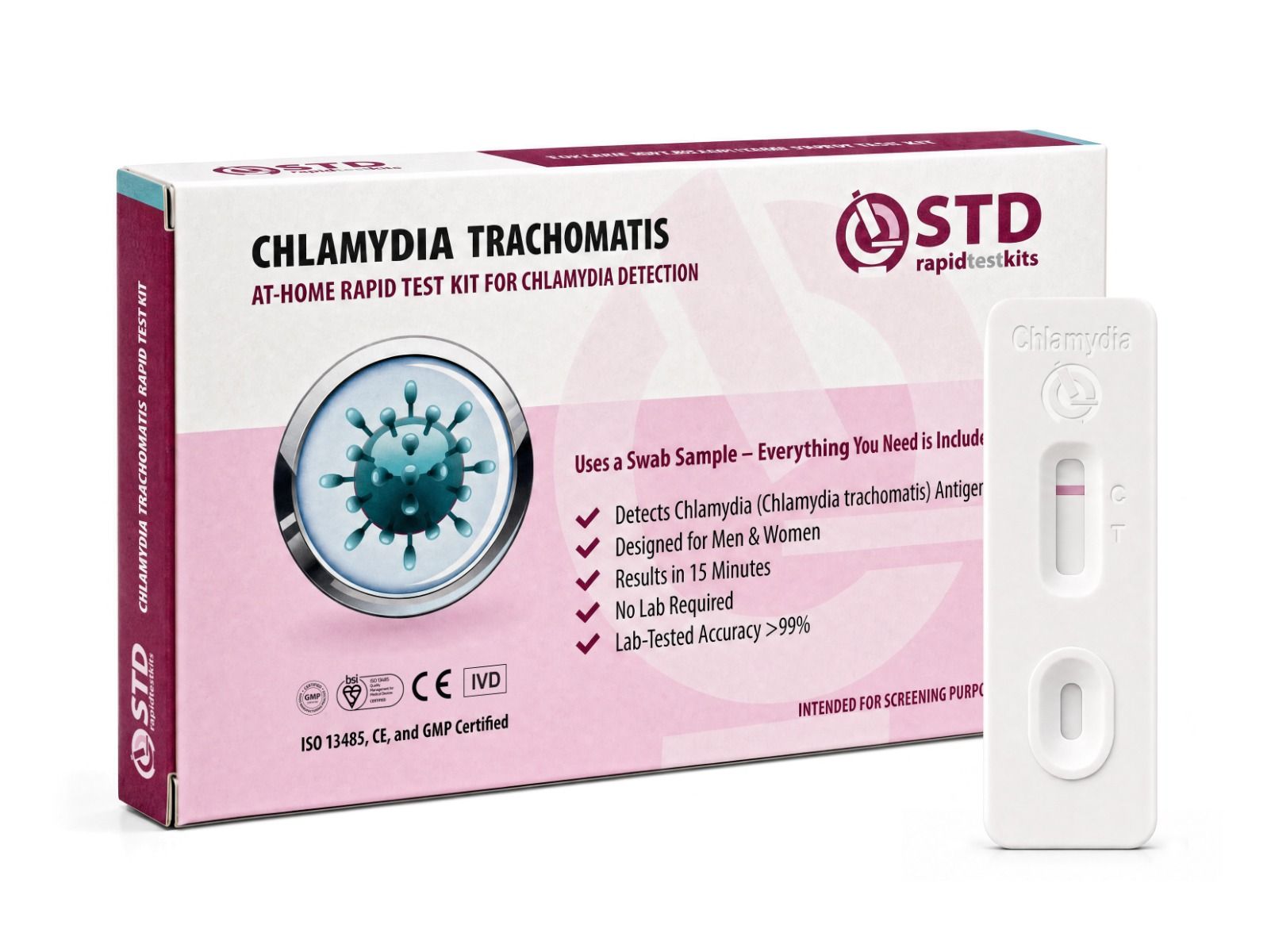
For a urogenital infection, two approaches exist for at-home use. A self-collected vaginal or penile swab is processed on a rapid lateral-flow cassette, returning a result within minutes. Laboratory NAAT (nucleic acid amplification testing) is the analytical reference standard for chlamydia and is what a clinician would order from a lab; at-home lateral-flow tests use a different chemistry on the same sample type and are convenient screening tools that give a quick answer with reasonable accuracy. The two approaches are complementary, not equivalent.
Timing matters. The window period for chlamydia between exposure and a reliable test result is generally about two weeks, though some guidance extends to three weeks for higher confidence. Testing the day after a worrying contact is likely to give a false-negative result. Wait at least 14 days, then test.
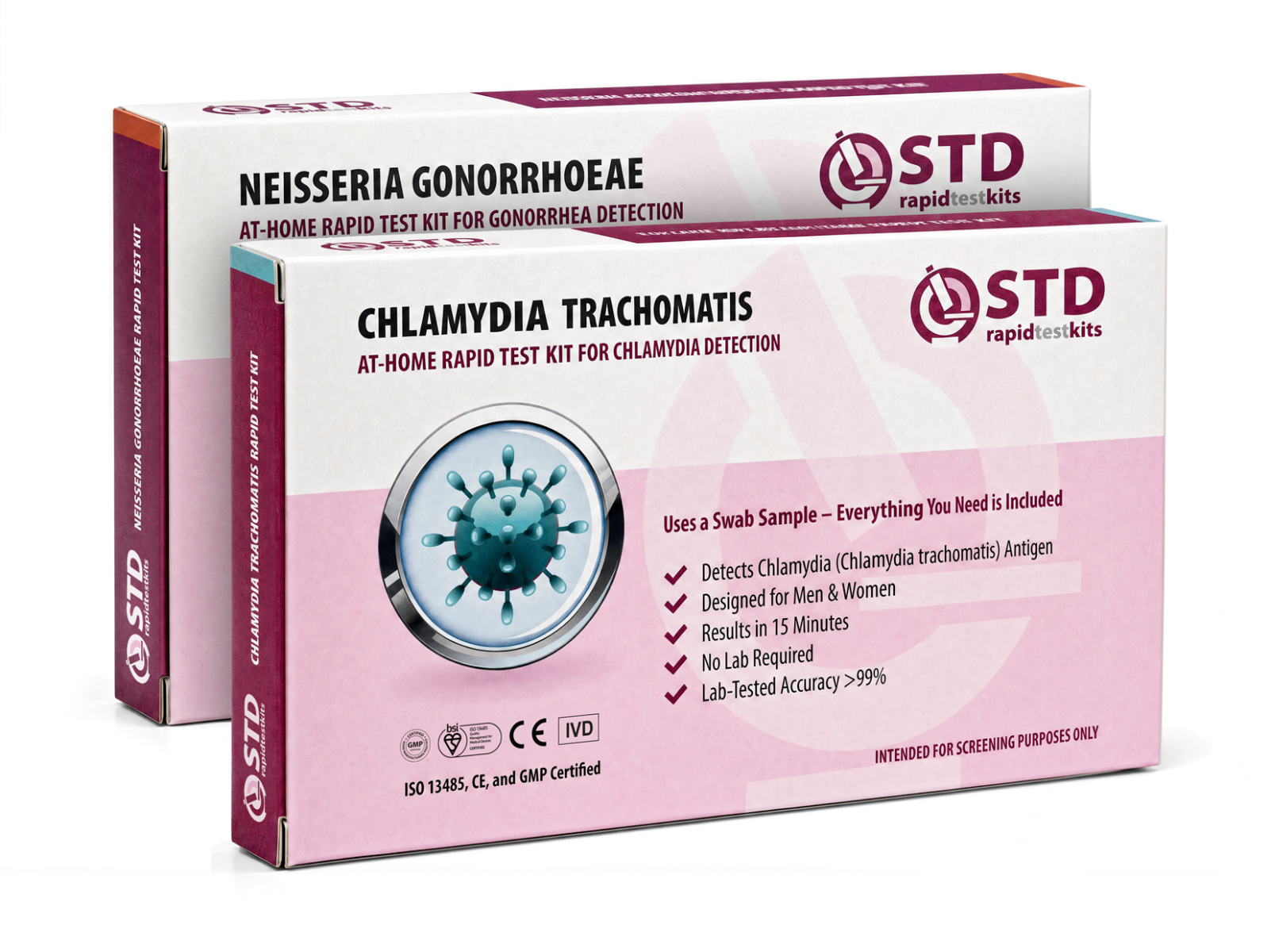
For someone who is otherwise not sexually active but worried after a single specific contact, a single-infection chlamydia test is usually the appropriate scope. For broader screening alongside other risk, a chlamydia and gonorrhea combination kit is often the better fit, because the two infections share transmission patterns and frequently co-occur. (This article is published by stdrapidtestkits.com, which sells at-home rapid testing kits. We recommend products based on fit for the reader's concern, not commercial benefit.)
Treatment, Reinfection, and Telling Partners
Chlamydia treatment is short and effective. Standard first-line therapy is a one-week course of doxycycline; azithromycin as a single dose is an alternative for some patients, but doxycycline is now the preferred regimen for non-pregnant adults per current CDC treatment guidelines. Most people clear the infection within a few days of starting antibiotics, though the full course must be completed.
Two follow-up rules matter. Sexual contact should be avoided for at least seven days after completing the antibiotic course, both to give the body time to clear the infection and to avoid re-exposing partners. And reinfection is common, so a follow-up test about three months after treatment is recommended to confirm clearance and catch any new acquisition.
Partner notification is the awkward but essential other half of treatment. Sexual partners from the previous 60 days (or the most recent partner if the last contact was more than 60 days ago) should be informed so they can test and treat. Many jurisdictions offer anonymous partner-notification services through the public-health department if a direct conversation feels too difficult. Untreated partners are the most common source of post-treatment reinfection.
For people whose exposure history is narrow and well-defined, partner notification is usually a single conversation. Self-test kits make it easier to take the first step privately and then decide how to handle follow-up.
Chlamydia often has no symptoms, but it can cause serious health problems, even without symptoms. It can cause permanent damage to a woman's reproductive system.
Frequently Asked Questions
- Can a virgin have chlamydia?
- Yes, but only through a narrow route. A baby born vaginally to a parent with untreated chlamydia can acquire the infection at birth and develop neonatal conjunctivitis or chlamydial pneumonia in the first weeks of life. These infections are typically diagnosed and treated in infancy. An adult who has truly never had any sexual contact would not still carry a chlamydia infection acquired at birth, because such infections either resolve or cause obvious symptoms in early childhood.
- Can chlamydia spread through kissing?
- Standard social kissing does not transmit chlamydia. Deep kissing with someone who has a pharyngeal chlamydia infection has been raised as a theoretical possibility in the literature, but documented transmission via kissing alone is essentially absent. The bacterium does not establish infection through casual oral contact, and saliva is not a typical transmission vehicle.
- Can you get chlamydia from a toilet seat, towel, or swimming pool?
- No. Chlamydia trachomatis cannot survive long on dry surfaces, fabric, or in chlorinated water. The bacterium needs to reach a warm mucosal surface from a fresh, wet source within hours. No clinically documented case of toilet-seat, towel, or pool transmission of chlamydia exists in the modern medical literature.
- Can fingering or mutual masturbation transmit chlamydia?
- Yes, if infected genital fluid is transferred between people. Fingers that contact infected fluid and then touch another person's mucosal tissue (genital, anal, or eye) can transfer bacteria. Washing hands between partners and avoiding eye contact during sexual activity reduces this risk substantially.
- How long should I wait after a possible exposure before testing?
- For chlamydia, a window of about 14 days between exposure and testing is the practical minimum. Some guidance extends to 21 days for highest confidence. Testing earlier than two weeks gives unreliable results because the bacterial load may not yet be detectable. If symptoms appear sooner, that is itself a reason to test, while accepting that a very early negative may need to be repeated.
- Can I get chlamydia in the eye without any sexual activity?
- Direct transfer of someone else's infected genital fluid to your eye, via shared washcloths or eye-makeup applicators used within minutes, has been documented but is rare. Most adult chlamydial conjunctivitis is autoinoculation in someone who already has a urogenital infection. Without any path for infected fluid to reach your eye, the risk is essentially zero.
- Is the rapid at-home test the same as a lab NAAT?
- No. Lateral-flow strips and lab NAATs use different chemistry. A rapid test returns a result in minutes at home using an immunoassay strip; a lab NAAT offers higher analytical sensitivity because it amplifies the bacterial DNA. Use the rapid test for initial screening at home; if it comes back positive, a clinician-ordered NAAT confirms the result and rules out a false positive.
- If I test positive but I have not been sexually active, what should I do next?
- First, repeat the test with a fresh kit or, ideally, ask a clinician for a lab NAAT confirmation. False positives are uncommon but possible with any rapid test. If a confirmatory test agrees, sit down with a clinician to think through possible transmission scenarios you may not have counted as ‘sex,' including non-penetrative contact, shared sex toys, or rare non-sexual routes. Whatever the source, treatment is straightforward and the same in every case.
- U.S. Centers for Disease Control and Prevention. About Chlamydia. Plain-language overview covering transmission, asymptomatic infection, signs and symptoms, screening recommendations, and complications including PID and infertility.
- U.S. Centers for Disease Control and Prevention. Sexually Transmitted Infections Treatment Guidelines: Chlamydial Infections. First-line doxycycline regimen for non-pregnant adolescents and adults with uncomplicated chlamydia.
- World Health Organization. Fact sheet on sexually transmitted infections including chlamydia global incidence, transmission, and prevention.
- UK National Health Service. Chlamydia condition page covering transmission, symptoms, testing, and treatment in plain English.
- U.S. National Library of Medicine, MedlinePlus. Chlamydia Infections. Reference page covering symptoms in women and men, causes, complications including PID and infertility, and diagnosis.
- U.S. Centers for Disease Control and Prevention. Sexually Transmitted Infections Surveillance, Annual Report. Most recent national chlamydia case counts and trends in the United States.
