
Published: November 2025 | Last updated: April 2026 | Editorial review and quality control: Martina N.
HIV looks different in 2026 than it did in 1995. Antiretroviral therapy can now make the virus undetectable, and undetectable means untransmittable. Pre-exposure prophylaxis (PrEP) has lowered new infections in people who use it. And testing, once a clinical event surrounded by paperwork and waiting rooms, can now happen privately at home with a fingerstick or oral swab.
What hasn't changed is the importance of knowing your status. The U.S. Centers for Disease Control and Prevention estimates roughly 13 percent of people living with HIV in the United States are unaware they carry it, and undiagnosed infections account for a disproportionate share of new transmissions (CDC HIV basics). This guide walks through what at-home HIV testing does, when each test type is reliable, and how to act on the result you get.
How accurate are at-home HIV tests, and when should I take one?
FDA-cleared at-home rapid HIV tests typically report 92 to 99 percent sensitivity and greater than 99 percent specificity once the window period has passed. For oral fluid antibody tests that window is 23 to 90 days after exposure; for fingerstick blood antibody tests it is 18 to 90 days. If a possible exposure was significant and happened in the last 72 hours, contact a clinician about post-exposure prophylaxis (PEP) before relying on test timing. Otherwise, plan a baseline test now and a confirmatory retest 6 to 12 weeks after exposure for a result you can fully trust.
Key Takeaways
- Timing decides accuracy. Most at-home antibody HIV tests are most reliable 45 to 90 days after exposure, so a negative result before that window closes warrants a retest.
- If a significant exposure happened in the last 72 hours, talk to a clinician about post-exposure prophylaxis before testing alone, PEP loses most of its protective effect after the 72-hour mark.
How HIV moves now, and why testing strategy has to keep up
Two things have changed in the past decade. The first is that prevention works. CDC surveillance shows new HIV diagnoses fell roughly 12 percent between 2018 and 2022 in the United States, with the steepest declines among people aged 13 to 24 (CDC HIV basics). PrEP, expanded harm-reduction programs, and earlier antiretroviral treatment all contributed to that drop.
The second is that HIV no longer fits its 1980s image. People living with HIV who maintain undetectable viral loads on antiretroviral therapy have life expectancies comparable to people without HIV, and they cannot sexually transmit the virus to partners (CDC HIV basics). Knowing your status is no longer about a worst-case diagnosis. It opens access to treatment that protects both individual health and partner safety.
What hasn't dropped is the share of infections among people who don't see themselves as at risk. The World Health Organization estimates that about 87 percent of people living with HIV worldwide knew their status in 2024, leaving roughly 5.3 million people with undiagnosed HIV globally (WHO HIV fact sheet). The same gap shows up inside the United States. Black and Latino communities continue to carry a disproportionate share of new HIV diagnoses, and rural counties face longer travel distances to clinics that offer confidential testing, which is one reason the U.S. National HIV/AIDS Strategy explicitly lists self-testing among its priority interventions for closing access gaps (HIV.gov).
That gap is what at-home testing is built to close. A test that ships in plain packaging, runs on a bathroom counter, and costs less than an unsubsidized clinic visit removes specific obstacles that keep people from testing: cost, time off work, geography, fear of being seen, fear of having the conversation. None of those obstacles are abstract. Surveillance data shows that the people most likely to delay testing are also the people most likely to acquire and pass on undiagnosed infections, which is why federal HIV strategy treats expanded self-testing as a near-term priority rather than a nice-to-have (HIV.gov).
What actually counts as an HIV test
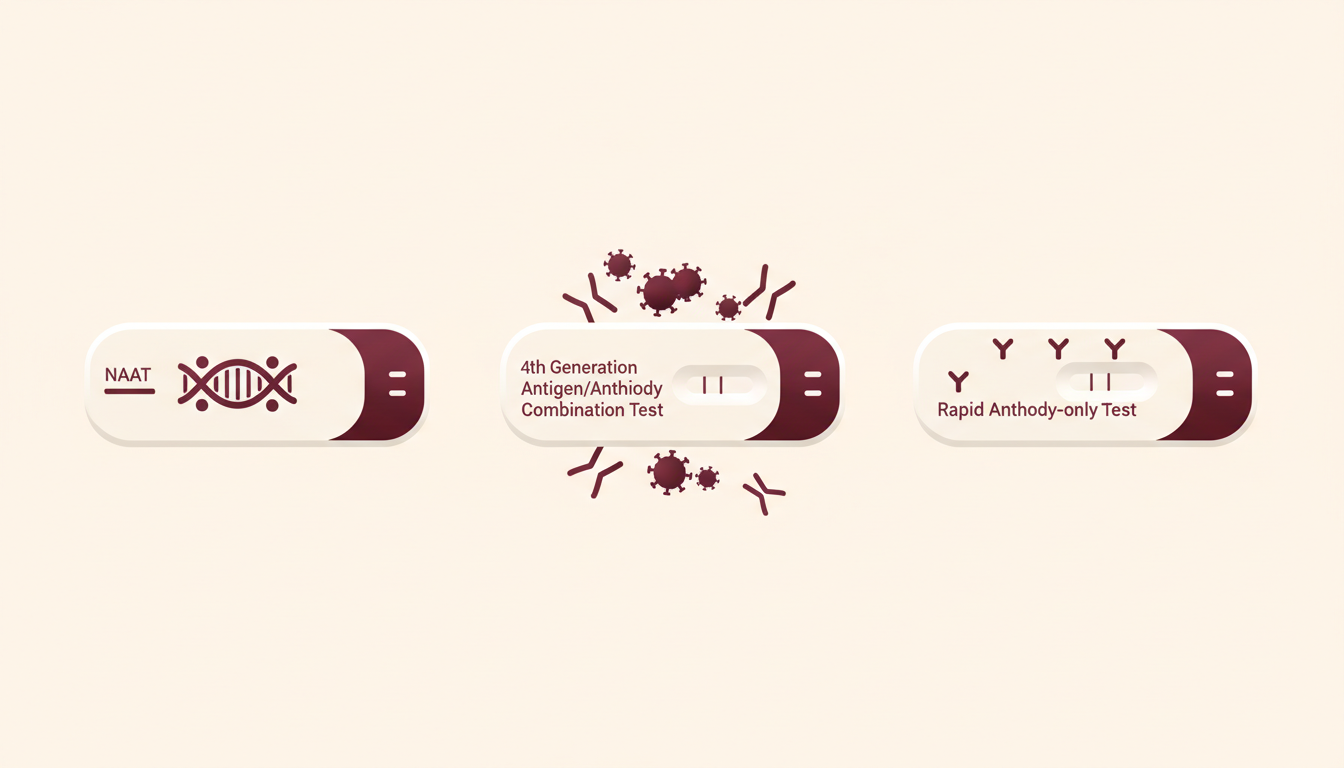
Three test technologies dominate clinical and at-home use. Each one looks for something different in your blood or oral fluid, and that difference shapes when each one is reliable.
Fourth-generation antigen/antibody combination test (lab-based). This is the standard at most clinics and labs. It detects two things: p24 antigens, which are pieces of the virus itself, and antibodies your immune system makes after infection. Antigens become detectable around 18 days after exposure, antibodies follow within 23 to 45 days, and the combined test catches infections earlier than antibody-only tests can (CDC HIV testing basics).
HIV nucleic acid test (NAAT, sometimes called RNA test). A NAAT looks for the virus's genetic material directly. It can detect infection as early as 10 to 33 days after exposure, faster than any antibody-based test. Clinicians typically order NAATs for people with very recent suspected exposure, symptoms of acute HIV infection, or for newborns. NAATs require a lab, cost more than other test types, and aren't a default screening tool.
Antibody-only rapid test (most at-home and point-of-care kits). These run on lateral-flow chemistry, the same kind of strip used in pregnancy tests, and produce a result in 15 to 20 minutes from a fingerstick blood drop or oral fluid sample. They detect antibodies your immune system makes in response to HIV infection, so they need more time after exposure than NAAT or fourth-generation combo tests.
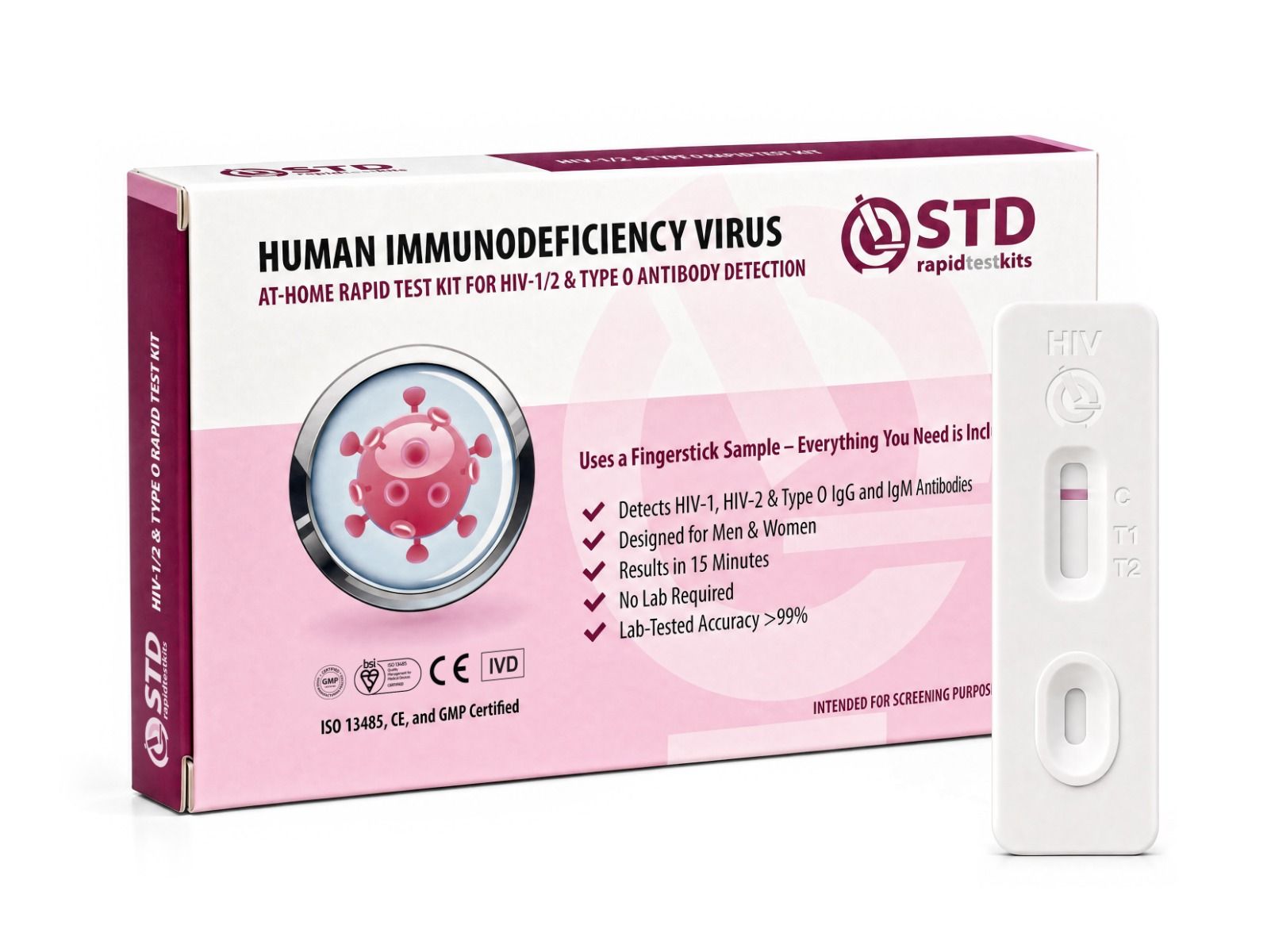
Our home kit is a fingerstick blood antibody test. It is a rapid lateral-flow immunoassay, not a NAAT or PCR test. Labs use NAAT and PCR for higher analytical sensitivity in early infection; the two technologies are complementary, not equivalent. A reactive result on any home test is a signal to confirm with lab testing, not a final diagnosis. The home kit's strength is fast, private screening when you're past the antibody window. Its weakness is the early window itself, where you'll need a NAAT or a clinic combo test for a reliable answer.
Window periods, the most misunderstood part of HIV testing
The window period is the gap between exposure and when a test can reliably detect infection. Test before the window closes, and a negative result might give false reassurance. Test after, and a negative result is meaningful.
Window periods are tied to test technology, not to brand or manufacturer. The CDC publishes the following ranges as guidance for both clinicians and self-testers (CDC HIV testing basics):
| Test Type | Sample | Earliest Detection | Peak Reliability |
|---|---|---|---|
| NAAT (HIV RNA) | Blood (lab) | 10 to 33 days | 14 to 28 days |
| 4th-Generation Ag/Ab Combo | Blood (lab) | 18 to 45 days | 28 to 90 days |
| At-Home Rapid (Fingerstick Blood) | Capillary blood | 18 to 90 days | 45 to 90 days |
| At-Home Rapid (Oral Fluid) | Oral swab | 23 to 90 days | 90 days |
| Mail-In Lab Kit (Dried Blood Spot) | Blood (lab-processed) | 18 to 45 days | 28 to 90 days |
Rapid versus lab: choosing what fits your situation
The choice between a rapid at-home test, a mail-in lab kit, and a clinic visit isn't really a question of which one is the best test in the abstract. It depends on three practical things: how soon you need an answer, what the exposure looked like, and what you'll do with the result.
Each option has tradeoffs in privacy, speed, sensitivity, and cost. The right pick changes depending on whether you're checking after a recent encounter, screening as part of a regular routine, confirming a previous result, or testing because of symptoms. Here is how the three approaches compare in plain terms:
| Method | Privacy | Speed | Accuracy (Post-Window) | Best Fit When... |
|---|---|---|---|---|
| At-Home Rapid Test | Very high, plain packaging | 15 to 20 minutes | 92 to 99% sensitivity, >99% specificity | You need a fast private screen and you're past the antibody window |
| Mail-In Lab Kit | High, lab handles sample | 2 to 5 days plus shipping | Lab-grade, comparable to clinic combo test | You want lab-grade accuracy without a clinic visit |
| Clinic-Based Lab Test | Moderate, claim trail in some cases | Same-day to several days | Highest available, includes confirmatory pathway | You have symptoms, need PEP/PrEP guidance, or need confirmatory testing |
When to test after a possible exposure
The 72-hour mark is the most important number to remember. Post-exposure prophylaxis (PEP) is a 28-day course of antiretroviral medication that can prevent HIV from establishing infection if started within 72 hours of significant exposure. After that window, PEP loses most of its protective effect (CDC PEP guidance).
Significant exposure, in clinical language, means condomless vaginal or anal sex with a partner whose status is unknown or positive and not on treatment, sharing injection equipment, sexual assault, occupational needlestick, or a similar event with an established transmission route. If something in that list happened in the last 72 hours, contact a clinician, urgent care clinic, or emergency department now. Don't wait for a test result to make that call. The result of a test taken within 72 hours of exposure will not change the urgency of the PEP decision, because no test can detect infection that early in any reliable way.
If the 72-hour PEP window has passed, testing is your tool. The right time to test depends on how recent the exposure was:
- Less than 10 days post-exposure: a lab NAAT is the only test reliable in this window. Antibody tests, including all at-home rapid kits, are likely to return false-negative results in this period. Use the time to plan: schedule a clinic NAAT if you need an early answer, otherwise mark your calendar for a later antibody test.
- 2 to 4 weeks post-exposure: fourth-generation lab combo tests start catching most infections. At-home antibody tests are still less sensitive in this range. A negative at-home rapid here is reasonable but not conclusive on its own.
- 6 to 12 weeks post-exposure: at-home rapid antibody tests reach peak reliability. A negative result with no further exposures since is a strong signal you weren't infected.
- Beyond 12 weeks: all standard test types are highly accurate. A negative test is essentially conclusive for that single exposure event.
Post-exposure prophylaxis (PEP) is most effective when started as soon as possible after exposure, and loses most of its protective effect after 72 hours. If you may have been exposed to HIV through condomless sex with a partner whose status is unknown or positive, sharing injection equipment, sexual assault, or a needlestick injury, contact a clinician, urgent care, or emergency department right now. Don't wait for a test result. No HIV test can rule out infection inside the 72-hour PEP window, and waiting for one closes the prevention door.
Why one negative test isn't always the final word
If you tested early in the window period, a negative result tells you what was true at that moment, not what's true today. The same applies if you've had any new exposures between tests, or if you're on PrEP and want to confirm continued protection.
HIV tests work by detecting either the virus itself (NAAT, p24 antigen) or your immune system's response to it (antibodies). Both take time to reach detectable levels in the body. That delay is why a negative result at 10 days isn't a final answer; it's a checkpoint that needs follow-up. The CDC recommends a planned retest in several common situations, each with a slightly different timeline but the same underlying principle: a single test is a snapshot, and HIV testing works best when it matches your actual exposure pattern.
When to plan a retest
- After a single recent exposure: initial test at 2 to 4 weeks, retest at 6 to 12 weeks for confirmation.
- Ongoing risk (multiple partners, partner with unknown status, injection-drug use): test every 3 to 6 months as part of routine sexual health screening.
- After diagnosis or treatment for another STI: retest for HIV, since some STIs can increase transmission susceptibility and may have shared exposure pathways.
- Started PrEP or completed PEP: test at start, 1 month, 3 months, then quarterly per CDC PrEP guidance.
What at-home testing protects, and what it doesn't
Home testing privacy is real, and the specifics matter. Packaging arrives without diagnostic labels. Your name doesn't enter a clinic intake system. Your insurance carrier doesn't see a billing code, which can matter on a family plan or shared employer plan where claims are visible to others. For people in unsupportive households, partnerships, or workplaces, those details remove genuine barriers, not theoretical ones.
What home testing doesn't replace is the clinical safety net. A reactive home result still needs lab confirmation, and treatment requires a prescription. Most public-health departments and many telehealth services offer free, confidential follow-up for people who get a positive home result, and several non-profits help with linkage to care regardless of insurance status (HIV.gov care services). Most people who test reactive at home end up in clinical care within weeks of the home result, and those weeks of self-paced processing are themselves part of the value of testing privately first.
What home testing keeps private (and what it doesn't)
- Stays private: shipping packaging, your name on a clinic intake form, insurance billing codes visible on a shared plan, and an in-person waiting-room interaction.
- Still needs clinical follow-up: a reactive home result requires lab confirmation before any diagnosis, and treatment requires a prescription from a clinician.
- Reporting: at-home self-test results are not reported to public-health departments, but a clinical lab confirmation typically is, the same as any other diagnosed STI.
What happens if the result is positive
A reactive at-home rapid result needs lab confirmation before any treatment decision. Even kits with sensitivity and specificity above 99 percent can produce false positives, especially in groups with low prevalence. The next step after a reactive home result is a fourth-generation combo test or NAAT through a clinic, urgent care, or community health organization. Take a photo of the cassette before disposing of it so you have a record to show a clinician.
If the lab test confirms HIV infection, antiretroviral therapy started promptly can reduce viral load to undetectable levels within months. People living with HIV who maintain an undetectable viral load on treatment have life expectancies comparable to people without HIV (CDC living with HIV). The CDC's evidence review concluded that an undetectable viral load eliminates sexual transmission risk; the message is often abbreviated as U=U, undetectable equals untransmittable. That's not marketing; it's the conclusion of multiple large studies of serodifferent couples followed for years.
Linkage to care is as important as the diagnosis itself. Many U.S. states run free linkage-to-care programs through public-health departments. Ryan White HIV/AIDS Program clinics provide care regardless of insurance or income (HRSA Ryan White program). Telehealth options now include same-day prescription review for newly diagnosed patients in many regions, which can shorten the gap between confirmation and the first dose of treatment.
When antiretroviral therapy is taken as prescribed and a person's HIV viral load becomes and remains undetectable, the chance of sexually transmitting HIV to an HIV-negative partner is effectively zero.
Picking the test that fits your situation
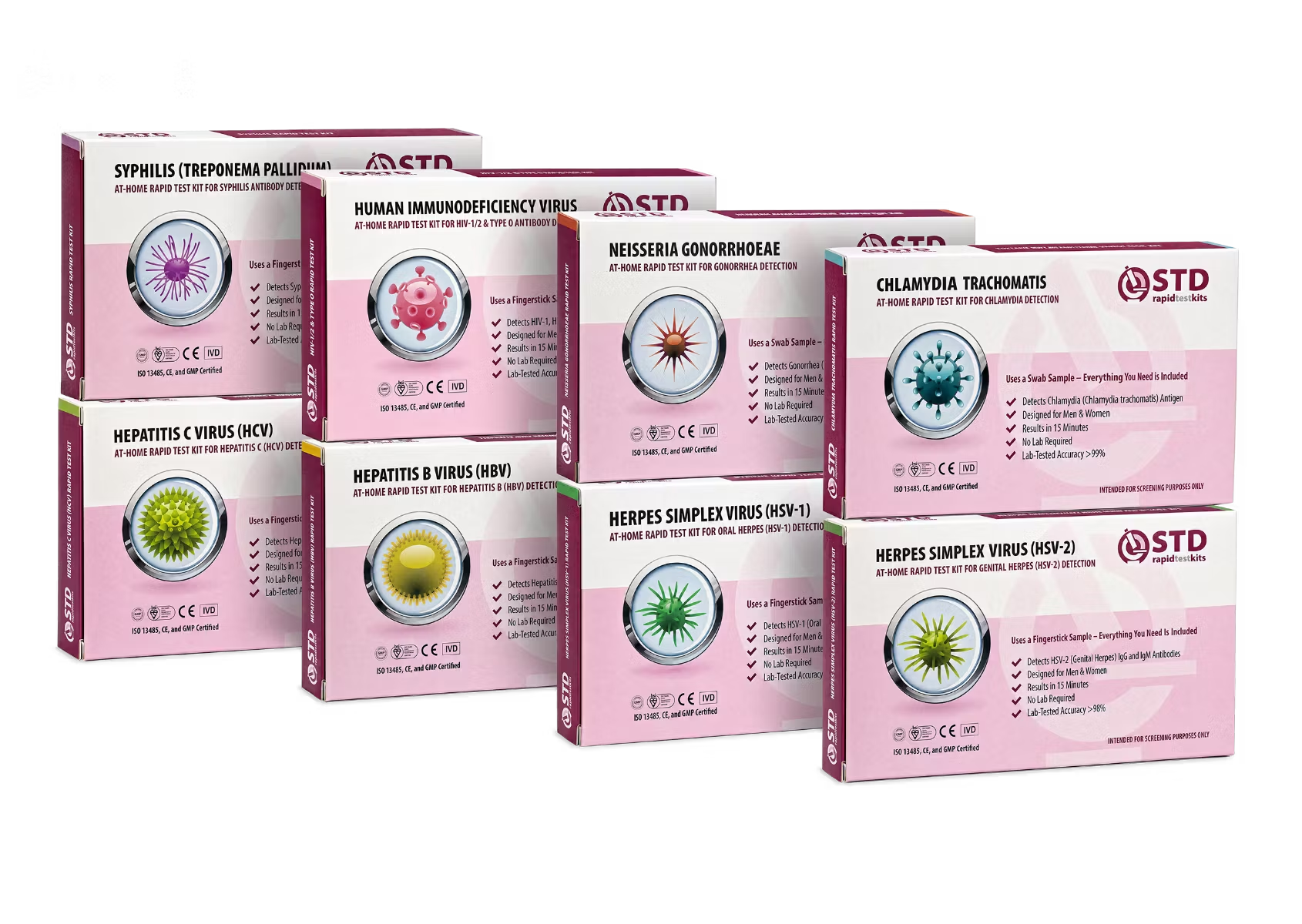
If your concern is HIV alone and you're past the 6-week mark from any exposure, a fingerstick blood antibody test gives a result in 15 minutes with no clinic visit. If you've had multiple kinds of exposure, want broader screening as part of a routine check, or aren't sure which infections to look for, a combination kit covers HIV alongside other common STIs in one shipment. Whatever you choose, plan a retest at 12 weeks for any single exposure event you're testing around, and remember that PEP is the right tool when exposure is recent and significant. Testing fits inside a prevention plan; it isn't the whole plan.
Frequently asked questions
- How soon after sex should I take an HIV test?
- A fingerstick blood rapid test can detect infection as early as 18 days after exposure, but it is less reliable before the 6-week mark. For a genuinely conclusive negative, plan to test at 6 to 12 weeks. If exposure was significant and recent, the 72-hour PEP window takes priority over any test timing, contact a clinician right away rather than waiting on a self-test result.
- Does oral sex carry meaningful HIV risk?
- The risk from oral sex is low compared with vaginal or anal sex, but it isn't zero. Cuts in the mouth, gum disease, recent dental work, and concurrent STIs can raise the risk. If you're uncertain about a recent oral encounter, a baseline test plus a 12-week retest is a reasonable approach, especially if there were any visible cuts or sores involved on either side.
- Are at-home HIV tests reliable enough to trust?
- Yes, when used at the right time. The most common reason for a missed positive is testing too soon after exposure, not test failure. Blood-based fingerstick tests are slightly more sensitive than oral fluid tests in early infection, and any reactive result should be confirmed with a lab-based test before any treatment decision.
- What does it mean if the test line is very faint?
- Any visible test line, even a faint one, is interpreted as reactive. A faint line may reflect early infection, low antibody concentration, or normal test variation. Treat it as a reactive result and confirm with a lab-based test. Photograph the cassette before disposing of it so you have a record to show a clinician at confirmation.
- Should I keep testing while on PrEP or after PEP?
- Yes. CDC and the FDA recommend HIV testing every three months for people on PrEP, plus testing at PrEP start and stop (<a href="https://www.cdc.gov/hiv/" target="_blank" rel="noopener">CDC PrEP guidance</a>). After PEP, follow-up testing typically happens at 4 to 6 weeks and 12 weeks post-exposure to confirm the medication prevented infection. Your prescriber will set a specific schedule based on your situation.
- Will testing at home stay completely private?
- In most cases, yes. Packaging arrives without diagnostic labels, no clinic visit gets logged in your insurance records, and the result stays with you unless you share it. The exceptions worth knowing: once you connect a confirmed positive result to clinical care, that care appears in your medical records like any other diagnosis, and most U.S. states require positive HIV tests reported by clinical labs to public-health departments for surveillance. Self-tests aren't reported.
- Antibodies versus antigens, what's the practical difference?
- Antigens are pieces of the virus itself, detectable about 18 days after exposure. Antibodies are your immune system's response to the virus, which takes 23 to 90 days to reach detectable levels. Fourth-generation lab tests look for both, which is why they catch infections earlier than antibody-only tests. Most at-home kits use antibody-only chemistry, which is why timing matters more for at-home tests than for lab combo tests.
- Do I have to tell partners if I test positive?
- Many U.S. states have partner-notification laws, and disclosure to current sexual partners before sex is required in some jurisdictions. Beyond legal requirements, partner notification is a public-health priority because it allows partners to test, start treatment if needed, or use PEP. Health departments offer anonymous partner-notification services that can contact partners without revealing your name. A clinician or HIV navigator can walk through both the legal landscape and the support options where you live.
- U.S. Centers for Disease Control and Prevention. HIV testing basics, window periods by test technology, PEP and PrEP clinical guidance, and U=U evidence review.
- U.S. Centers for Disease Control and Prevention. HIV basics covering surveillance trends, undiagnosed-infection estimates, and treatment-as-prevention evidence.
- World Health Organization. HIV fact sheet covering global epidemiology, undiagnosed-infection estimates, and prevention guidance.
- HIV.gov. U.S. federal portal for HIV testing, prevention, treatment, and care services, including links to state public-health resources and self-testing programs.
- Health Resources and Services Administration (HRSA). Ryan White HIV/AIDS Program, linkage-to-care services for people living with HIV regardless of insurance or income.
- U.S. Centers for Disease Control and Prevention. Sexually transmitted infections overview, screening recommendations, and concurrent-infection guidance relevant to HIV testing.
